Disclosure: Some links in this post are affiliate links. As an Amazon Associate I earn from qualifying purchases, at no extra cost to you. Learn more
Specs are compiled from manufacturer listings and verified buyer reviews and can change over time — please confirm the key details on the product page before buying.
Replacing trailer deck boards is a weekend job you only want to do once — and the screws are usually what decides whether it goes that way. The wrong fastener strips its head halfway through a cross member, snaps at the thread, or backs out a season later. The right one cuts threads into the steel cross member, sits flush with the board, and stays put under a loaded trailer. The five picks below are the ones that hold up in that real-world test.
This guide is built by comparing the manufacturers’ published specifications and the patterns across verified customer reviews, so you get each pick’s real strengths and trade-offs instead of marketing spin.
You do not need to be a fabricator to get this right, but you do need the right diameter, drive type, and pilot-hole size for your trailer frame. Here is what separates a screw that lasts from one that fails on the last board: the best screws for trailer decking.
Top Picks


How To Choose The Best Screws for Trailer Decking
Trailer deck screws are not ordinary wood screws. They have to pass through a board and then bite into a steel cross member underneath, which is a completely different job from driving into a joist. Get the diameter, the tip type, and the pilot hole right and the job runs fast. Get one of those wrong and you are drilling out broken shanks.
Match the screw diameter to your frame and load
The two common sizes are 1/4-20 and 5/16-18. The 1/4-20 screw is the lighter of the two, and the 5/16-18 is the beefier option for heavier boards and heavier loads. If your cross members are thin angle iron and your deck is light, a 1/4-20 is plenty. If you are fastening 2×8 pressure-treated boards to a heavy-duty frame, go to 5/16-18 for the extra holding strength.
Know the difference between thread-cutting and self-drilling
A Type F thread-cutting screw has a blunt, tapered point with cutting edges that carve threads into a pre-drilled hole. A self-drilling screw has an actual drill tip that bores its own hole. Thread-cutting screws typically need a pilot hole through the wood and into the metal. That extra step is what stops the screw from twisting off, so it is not wasted time.
Pilot hole size is not a suggestion
The pilot hole has to match the screw body, not the head. A 1/4-20 screw commonly wants a 7/32 pilot hole, while several 5/16-18 screws call for 9/32. Drill it undersized or oversized and the screw either will not start or it strips the threads it just cut. Use a bit that matches your screw’s stated size, and check it against the screw shank before you commit to the whole deck.
Star drive beats hex and Phillips for this job
A Torx (star-shaped) drive socket grips the bit across six lobes instead of four or two. That means less cam-out — the bit slipping and chewing the head — when you are driving a hardened screw into steel. It also lets you push higher torque through the screw without stripping it. Pair it with the correct T30 or T40 bit and an impact driver and the boards go down fast.
Side-by-Side Comparison
| Model | Best For | Size | Drive | Finish | Amazon |
|---|---|---|---|---|---|
| BCP Fasteners 1/4-20 x 2-1/2″ Flat Head★ Best Overall | Best overall for most trailer decks | 1/4-20 x 2-1/2″ | T30 Torx | Black Phosphate | Amazon |
| Bopowo 5/16-18 x 2-1/2″ Thread FormingBest Kit Value | Fast installs with bit included | 5/16-18 x 2-1/2″ | T40 Torx | Black Phosphate Coated | Amazon |
| Dorman 370-225 Trailer Floor Screws | Proven replacement on utility trailers | 1/4″-20 x 2-1/2″ | T30 Torx | Black Oxide | Amazon |
| FMhotu 5/16-18 x 2-1/2″ Self Drilling | High-volume deck builds | 5/16-18 x 2-1/2″ | T30 Torx | Phosphate | Amazon |
| Hales Yeah 5/16-18 x 2-1/2″ T40 Torx | Heavy loads and hardwoods | 5/16-18 x 2-1/2″ | T40 Torx | Oil Phosphate | Amazon |
Detailed Reviews
1. BCP Fasteners 1/4-20 x 2-1/2″ Flat Head Trailer Deck Screws, 100 Pack
Our pick — 4.5+★ from 500+ verified ratings; the strongest balance of quality and price.
One hundred black Type F screws that cut their own threads and sit flush every time.
For a standard utility or flatbed trailer running 1/4-20 hardware, this 100-pack is the pick that covers the most jobs with the fewest surprises. The 1/4-20 x 2-1/2″ size is the everyday trailer deck dimension, and the flat head drops flush with the board so nothing snags a strap or a pallet. The phosphate-coated black finish gives you corrosion resistance on exposed decks without the price jumping into premium territory.
What wins people over is the Type F thread-cutting tip, which carves threads into a pre-drilled hole instead of spinning. It has a blunt tapered point with multiple cutting edges that carves threads into an existing pilot hole, so the screw bites hard instead of spinning. Owners driving into 2″x2″ (3/16″) angle iron report the screws holding without snapping or losing thread — the kind of result that turns a one-off repair into a repeat order. The T30 star drive keeps the bit locked in under torque, which is where a cheap hex-head screw would start chewing itself up.
Here is the thing to plan around: this is not a self-drilling screw. You need a pilot hole — owners commonly run 1/4″ or 9/32 pilot bits depending on their frame — and the tip will not bore through steel on its own. Budget that extra drilling step into the job. Do that and the 100-count box covers a full deck with spares left for the next repair. It holds 4.5+ stars across 500+ ratings, and 100 screws for the price of a single repair is hard to argue with.
Where it earns its keep
- 100 screws per box — enough for a full deck plus spares
- Flat head sits flush, so cargo slides without snagging
- Thread-cutting tip carves a secure bite into steel cross members
- T30 Torx drive resists cam-out under an impact driver
Plan around this
- Not self-drilling — needs a pilot hole through wood and metal
- Pilot bit size varies with your frame thickness, so test first
Best match: The standard utility or flatbed deck running 1/4-20 hardware where you want a full box and a screw that holds flush.
Think twice: If you are fastening heavy 2×8 boards to a thick frame, the 5/16-18 picks below give you more holding strength.
2. (100pcs) 5/16-18 x 2-1/2″ Flat Head Thread Forming & Cutting Screws Trailer Deck Screws, Black Phosphate
Beefier 5/16-18 screws with the matching T40 bit and 9/32 drill bit in the box.
If you want the setup handed to you on day one, this kit pairs 100 carbon steel 5/16-18 x 2-1/2″ screws with a T40 star drive bit and a 9/32″ (7.2mm) drill bit. That bit matches the pre-drill size the screws want, so you are not hunting for hardware before you start. Going up to 5/16-18 from 1/4-20 gets you a heavier shank — the 1/4-20 BCP above is the lighter everyday option, while this one is built for boards that take more load.
The 5/16″ screws perform well on a trailer deck over 3/16″ stringers — the flat heads give a clean, level finish and the Torx drive makes quick work of the install. The Class 8.8 grade rating and 70,000 psi maximum shear strength tell you the steel is meant for real structural holding, not furniture work. For a professional-looking floor where every head sits flush, the countersunk flathead design does exactly what it says.
The catch is the included drill bit. The screws themselves hold up well, but the drill bit has a reputation for dulling fast — several owners replaced it with a hardware-store bit after it struggled through thin metal. Treat the supplied bit as a starter and buy a spare 9/32″ bit from a reputable brand before you start. The screws are the value here; the bit is the freebie. Do that and this kit is a smart buy for a 5/16 frame.
What buyers come back for
- 100 5/16-18 screws plus a matching T40 bit and 9/32″ drill bit
- 70,000 psi maximum shear strength for structural holding
- Countersunk flat head sits flush and level with the board
The honest trade-off
- Included drill bit is the weak link — plan on a spare
- Quality feedback is mixed, with a few reports of breakage over a long run
Reach for this if: You are building a 5/16 deck and want the screws and bits in one box so you can start the same day.
Skip the starter bit: Keep a separate 9/32″ drill bit on hand so a dull freebie does not stall the job.
3. Dorman 370-225 Trailer Floor Screws-Torx-1/4-20 in. x 2-1/2 in., 50 Pack

The 50-count box that has been pulling trailers apart and back together for years.
When you need exactly the right screw and you are not looking to experiment, Dorman’s 370-225 is the known quantity. The 1/4-20 x 2-1/2″ star-head screws are made from quality steel with a black oxide coating for corrosion resistance, and they are meant to go in without stripped threads. The 50-pack is a box for a repair or a touch-up rather than a full new build — the 1/4-20 BCP above gives you 100 for roughly the same job, so pick this one when 50 is all you need.
What the Dorman brings is a proven track record on utility trailer floors, with owners reporting snug threads and no breakage. Owners replacing deck boards describe the screws driving straight through 1/8″ mild steel after a 7/32 pilot hole, with every bolt threading snug and nothing breaking. Functionality is what wins people over — it does the job it was bought to do, with quality close behind. The T30 star drive keeps the head intact under load, and the flush head lets the deck boards sit flat.
The honest note is that these are not forgiving of a sloppy pilot hole. They have no self-drilling tip, so you have to pre-drill a 7/32″ hole with the correct bit and drive them with a T30 star bit. They also want a drill with real torque — a cordless drill or a small ratchet can struggle. Its 4.5+ stars across 400+ ratings reflect a part that works when you drill the 7/32″ pilot hole it calls for. Bring the right bit and a heavy-duty drill and it will not let you down.
The core argument: A known, quality steel screw with black oxide corrosion resistance that holds fast once it is in. Compatibility with a standard 7/32″ pilot hole means you are not guessing at the drill size.
The fine print: It is a 50-count box and it demands the exact bit and a strong drill. If you want more screws for the same money, the BCP 100-pack is the better volume play.
Built for: The repair job where you want a proven replacement and 50 is the right count.
Hold off if: You are decking a whole trailer and need a full box — this one will leave you short.
4. 5/16-18 x 2-1/2 100Pcs Flat Head Thread Cutting Self Drilling Deck Screws
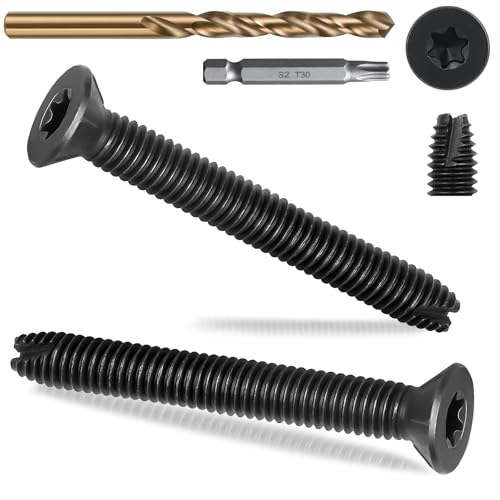
Hardened steel, reinforcing ribs, and a 100-count box built for a full flatbed deck.
The FMhotu screws are aimed at the person decking a whole trailer in one sitting. You get 100 5/16-18 x 2-1/2″ screws in hardened steel with a black phosphate coating, a T30 Torx drive, and reinforcing ribs that add torsional strength and help stop bit slippage. The flat countersunk head sits flush with the surface, and the box includes a drill bit for the pre-drill. For a flatbed build where you need volume and consistency, it is a strong starting point.
The thread-cutting Type 7 design is the star here. It resists torque, shear, and tension, which is what you want under heavy loads. On a real flatbed deck over 1/8″ and 3/16″ supports, the screws drove in with zero strip-outs, and the included bits performed better than expected — one owner pushed the drill bit through roughly 80 holes in a steel frame and kept it sharp by oiling after each one. That kind of endurance matters when you are on the last row of boards.
The mixed feedback is on the bit size. Some buyers report the included Torx bit is the wrong size for the screws, so check the fit before you start a run and swap in a proper T30 if it does not seat. Also treat this as a thread-cutting screw that wants a pilot hole, not a free-drilling miracle. Do that and a 100-count box handles a full deck with leftovers. A 4.5+ star rating across 170+ ratings backs the value of 100 hardened screws plus a drill bit in one box.
Why it holds up
- 100 hardened-steel 5/16-18 screws for a full deck
- Reinforcing ribs add torsional strength and grip
- Type 7 thread-cutting design resists torque and shear
- Drill bit included in the box
Check before you commit
- Included Torx bit can be the wrong size — verify the fit
- Still needs a pilot hole, so plan the drill step
The right tool for: A whole flatbed or utility deck where you want 100 hardened screws and reinforcing ribs in one order.
Do this first: Test the included Torx bit on one screw; if it wobbles, grab a proper T30 before the run.
5. Hales Yeah 5/16-18 x 2-1/2 in Trailer Deck Screws, T40 Torx (100 Pack)

A case-hardened 5/16 screw with a minimum surface hardness built for hardwoods and heavy loads.
For hardwood decking like apitong, or a trailer that hauls heavy equipment, this is the pick that treats the fastener as structural hardware. The 5/16-18 x 2-1/2″ screws are case-hardened carbon steel per SAE J933, with a minimum surface hardness of HRC 45 and a minimum torsional strength of 306 lb-in. That is a real spec sheet, and it is the reason these hold up where a lighter 1/4-20 screw would start to give.
The Type F thread-cutting tip is the key feature — it cuts threads into steel cross members through a 9/32″ pilot hole and skips a separate tapping step. An oil phosphate coating lubricates on contact, which cuts drive effort and extends bit life when you are running a lot of floorboard screws. The flush flathead sits at or below the deck surface so straps, tarps, and pallet runners slide without catching. The six-lobe T40 Torx drive transfers high torque with less cam-out than a hex or Phillips head, and the fully threaded shank gives consistent clamping force through the board and into the frame.
What wins people over is quality — buyers single it out most, with functionality close behind — and the case-hardened steel backs it up. The screws actually cut threads and do not break off when paired with the 9/32 pilot bit. The one thing to respect is the drill size: this is not a self-drilling screw, so the pilot hole has to be correct or the screw will not start cleanly. Get the 9/32″ bit right and this is the most spec-forward screw in the group. At 4.5+ stars it is among the most trusted picks here, and the SAE J933 case-hardened steel is why.
Where the steel shows: Case-hardened carbon steel to SAE J933, HRC 45 minimum surface hardness, and 306 lb-in minimum torsional strength — a screw built for hardwoods and heavy loads, with a flush head that does not snag cargo.
The one requirement: A 9/32″ pilot hole is mandatory; without it these Type F screws will not start cleanly. That is a drill step you have to plan for, not a flaw.
For the heavy hauler: Hardwood decks, livestock trailers, and gooseneck builds where a 5/16 screw and real torsional strength matter.
Not for quick fixes: If you want to skip the pilot hole entirely, choose a different approach — this one needs the 9/32″ bit every time.
Know the Specs
Thread-Cutting (Type F) vs. Self-Drilling
Type F thread-cutting screws have a blunt tapered point with cutting edges that carve threads into an existing hole. They want a pilot hole through the wood and into the metal. Self-drilling screws have a drill tip that bores its own hole as it goes. For trailer decking, Type F cuts a more controlled thread into a steel cross member — but only after you pre-drill. Skipping the pilot hole on a Type F screw is the fastest way to break one.
1/4-20 vs. 5/16-18 Diameter
The 1/4-20 screw has a quarter-inch shank and is the lighter everyday trailer deck size. The 5/16-18 has a larger shank and more holding strength, which suits heavier boards and heavier loads. Both use thread counts (20 or 18 threads per inch) that grip consistently through wood and into a steel frame. Match the diameter to your frame and what you are hauling, not to what happens to be in the drawer.
Common Questions
Will 1/4-20 trailer deck screws fit my utility trailer frame?
Do I need to pre-drill a pilot hole for Type F trailer deck screws?
What size pilot hole does the Dorman 370-225 need?
Is 1/4-20 or 5/16-18 better for fastening trailer decking?
What Torx bit do these trailer deck screws need?
Can I use these deck screws in pressure-treated wood?
Will the flat head really sit flush with the deck board?
How many trailer deck screws do I need for a full deck?
Are these screws self-tapping or self-drilling?
What drill do I need to drive trailer deck screws into steel?
The Bottom Line
For most trailer deck jobs, the screws for trailer decking winner is the BCP Fasteners 1/4-20 x 2-1/2″ Flat Head 100 Pack because it pairs the everyday 1/4-20 size with a thread-cutting Type F tip and a T30 star drive that holds flush under an impact driver. If you are building a 5/16 deck and want the bits in the box, grab the Bopowo 5/16-18 kit. And for hardwood decking under heavy loads, the Hales Yeah 5/16-18 is the one to reach for, with case-hardened steel to SAE J933 and a 306 lb-in minimum torsional strength behind it.
How we choose
We do not accept paid placement. Every pick is matched to a real buyer and a real use-case; we do not hands-on test units.
Sources
Specifications: manufacturer listings and product documentation. Review insights: verified customer reviews, as of October 2026. Pricing: not shown on this page (it changes often); check the current price via the retailer link.
As an Amazon Associate, Aappliancez earns from qualifying purchases. This does not affect which products we feature.