Disclosure: Some links in this post are affiliate links. As an Amazon Associate I earn from qualifying purchases, at no extra cost to you. Learn more
Specs are compiled from manufacturer listings and verified buyer reviews and can change over time — please confirm the key details on the product page before buying.
Your tap water can carry tiny plastic fragments you cannot see, taste, or smell — and only some pitchers actually stop them. The picks below are the ones that name microplastics in their own filtration claims, and the guide explains in plain words what each one catches, what it misses, and who each pitcher truly fits.
This guide is built by comparing the manufacturers’ published specifications and the patterns across verified customer reviews, so you get each pick’s real strengths and trade-offs instead of marketing spin.
Start with the filtering facts, because a pitcher that catches lead but lets plastic through is no help to you. Below you will find the best water filter pitcher for microplastics, sorted by how each one fits a real kitchen.
Top Picks


How To Choose The Best Water Filter Pitcher For Microplastics
Microplastics are fragments of plastic so small you cannot see them in a glass. A pitcher catches them only if the filter inside has holes small enough to block them, so the first thing to check on any label is the pore size in microns. A filter rated at 0.2 microns (a micron is one thousandth of a millimeter) has openings smaller than most plastic fragments, which is why that number is the one that really answers your question.
Check the pore size, not the stage count
A five-stage filter sounds impressive, but the stages tell you nothing about the size of the holes. Look for a stated micron rating or an explicit line saying the filter reduces microplastics. If a label lists lead and chlorine but never mentions plastic, it is telling you where its priorities sit.
Match filter life to your daily pouring
Filter life is measured in gallons, and it tells you how much water you get before a swap is due. A long-life filter means fewer changes and less forgetting whether it is current. Short-life filters cost more over a year and demand more attention, so read the gallon figure before you fall for the design.
Pick a size that suits your counter and your fridge
A large dispenser saves refills but takes real space. A slim pitcher slides onto a fridge shelf but needs topping up more often. Measure your shelf and think about how many people drink from it each day — that combination, not the picture on the box, decides whether a pitcher feels convenient or clumsy.
Side-by-Side Comparison
| Model | Best For | Capacity | Stated Filtration Claims | Filter Life | Amazon |
|---|---|---|---|---|---|
| Brita UltraMax Elite★ Best Overall | Big households and offices | 216 fl oz (27 cups) | Chlorine taste and odor, copper, mercury, cadmium | 120 gallons | Amazon |
| LifeStraw Home 10-CupBest for Bacteria | Bacteria and parasite worries | 2.4 liters | Bacteria, parasites, microplastics, lead, mercury, PFAS, chlorine | 264 gallons membrane | Amazon |
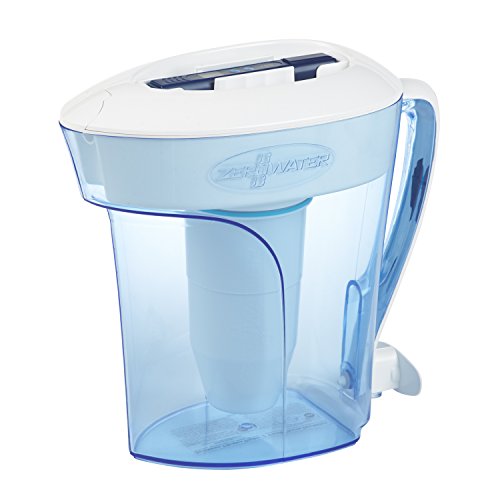
| ZeroWater 10-CupWater Clarity Pick | Very hard tap water | 80 fl oz (10 cups) | PFOA/PFOS, lead, chromium, mercury; TDS meter included | Not stated | Amazon |
| LifeStraw Home Glass 7-Cup | Less plastic contact | 1.68 liters | Bacteria, parasites, microplastics, lead, mercury, PFAS | 264 gallons membrane | Amazon |
| GLACIER FRESH Purela | Glass at a lower tier | 10 cups | 99% chlorine, 96% PFOA and PFOS, coliform, microplastics | 40 gal carbon / 264 gal membrane | Amazon |
| LARQ Pitcher 8-Cup | Mineral retention | 1.9 liters | Lead, PFAS, chlorine, mercury, cadmium, copper, HAA5 | 60 gallons | Amazon |
| Aquagear 10-Cup | Wide contaminant list | 80 fl oz (10 cups) | Lead, chlorine, microplastics, PFOA, PFOS | 120 gallons | Amazon |
| Alkanatur Alkaline | Alkaline water fans | 2.5 liters | PFAS, fluoride, chlorine, heavy metals, microplastics, nitrates | 105 gallons | Amazon |
| PIURIFY Compact Electric | Speed | 50 fl oz | >99% lead, PFAS, microplastics, E coli, chlorine | 130 gallons | Amazon |
| Clearly Filtered 10-Cup | Longest contaminant list | 80 fl oz (10 cups) | 386+ contaminants including fluoride, PFAS, arsenic, microplastics | 100 gallons | Amazon |
| KOZNOVA Hydrogen Pitcher | Hydrogen water curiosity | 3.6 liters | Lead, microplastics, PFAS, chlorine, fluoride | Not stated | Amazon |
Detailed Reviews
1. Brita UltraMax Elite Large Water Dispenser
Our pick — 4.5+★ from 300+ verified ratings; the strongest balance of quality and price.
The countertop tank that ends the constant refilling for a whole household
Here is the pitcher that wins on sheer practicality. Its 27-cup tank means a family or a small office pours all day without constantly topping up, and the spigot lets you fill a glass or a bottle one-handed. That is the whole appeal: fewer refills and filtered water on tap at counter height.
The filter runs for 120 gallons (about six months of normal use) before it needs a change, and a small sticker lets you jot down when you last swapped it. That paper sticker is easy to overlook but genuinely useful, because forgetting the change date is what quietly ruins filtered water. The BPA-free body and flip-top lid keep refilling quick.
What earns the top spot
- 27-cup tank (216 fluid ounces) means far fewer refills for a busy household.
- 120-gallon filter life keeps changes to roughly twice a year.
- Countertop spigot pours cleanly into bottles and glasses without lifting the tank.
Where it asks something of you
- The filter’s stated jobs are chlorine taste and odor plus copper, mercury, and cadmium — microplastics are not named on the box.
- At 3 pounds empty, it is a heavy unit to lift when you want to wash it out.
Pick this if: you want a counter station that keeps a family or an office topped up with filtered water all day.
Look elsewhere if: trapping microplastics is your main goal, since that removal is not stated for this filter.
2. LifeStraw Home 10-Cup Pitcher
A two-filter setup that goes after bacteria and parasites, not just taste
This is the pitcher to weigh first if you are worried about more than plastic. It uses two filters stacked together — a membrane microfilter that catches bacteria, parasites, and microplastics, plus an activated carbon and ion-exchange filter that handles lead, mercury, and PFAS. Stacking a membrane microfilter with a carbon filter is unusual for a pitcher, and it is why this model earns a place here.
The membrane is the long-lasting piece: 264 gallons, roughly a year. The carbon filter lasts 2 months or 40 gallons, whichever comes first, so you will be swapping that one far more often. The 2.4-liter body is BPA-free plastic and made in the United States, and the whole thing is simple to set up.
The catch is speed and care. Filtering through a membrane takes time, so expect to wait a bit longer than a basic pitcher. Owners who love it tend to love the taste and design; the more frustrated notes tend to center on the plastic build and the pace of filtering.
The draw: a rare combination of bacteria, parasite, and microplastic removal in one everyday pitcher, with a full year of membrane life.
The honest catch: the design feels more plastic than premium, and slow filtering is a real part of living with it.
Reach for this if: you want microplastic filtering plus bacteria and parasite protection without going to glass.
Think twice if: you pour in a hurry and dislike waiting for each batch to finish.
3. ZeroWater 10-Cup Pitcher
The one that hands you a meter and shows exactly what is left in your glass
ZeroWater’s trick is proof. The box includes a TDS meter, which measures total dissolved solids — the metals, minerals, and salts floating in your water — so you can check your tap and your filtered water back to back. That little tool turns filtration into a number you can watch, and it is the most useful thing in the kit.
The 5-stage ion-exchange filter is IAPMO certified to reduce PFOA/PFOS, lead, chromium, and mercury, and everything is BPA-free. The 10-cup body holds 80 fluid ounces and fits a fridge shelf. On notoriously hard water it is the clear favorite, pulling a 500ppm reading down to just a few.
What you give up is minerals. Because the filter strips nearly everything, the water is best for drinking and ice, not for cooking where you might want those minerals back. The pour and refill design also takes patience — filling means removing the lid, and the reservoir is small enough to need several trips to the tap.
Why it earns the nod
- The included TDS meter lets you confirm purity with your own eyes.
- IAPMO-certified reduction of PFOA/PFOS, lead, chromium, and mercury.
- Turns harsh hard water into clean, tasteless water.
The trade-off you accept
- Strips out beneficial minerals too, so it is a drinking-water pitcher rather than a cooking one.
- The lid comes fully off to refill and the small reservoir can mean several top-ups.
Best for: homes with hard or heavily mineralized water where taste and clarity matter most.
skip it if: you want a pitcher you can refill one-handed without removing a lid.
4. LifeStraw Home Glass 7-Cup Pitcher

The plastic-free version of a proven filter, for people who hate drinking from plastic
If the whole idea of microplastics worries you, drinking water stored against plastic can feel like the wrong direction. This pitcher answers that with hand-blown borosilicate glass and a silicone base that keeps it from sliding. It carries the same two-filter system as its plastic sibling: a membrane that handles bacteria, parasites, and microplastics, and a carbon filter for lead, mercury, and PFAS.
The glass body weighs 0.7 kg, so it feels solid in the hand and stays put on a counter. At 1.68 liters it suits one or two people better than a big family. The membrane still runs 264 gallons, and the carbon filter changes every 2 months or 40 gallons.
Two things to know before you buy. Assembly and filter removal have frustrated people — the larger filter can be stiff to pull out for cleaning. And filling through the lid flap is slower than simply pouring from the tap. Neither is a defect so much as the cost of the glass-and-membrane design.
What owners defend: the taste and the look. The water comes out clean and crisp, and the glass keeps a premium feel on the counter.
What to plan around: slower fill and filter changes that ask for patience and a firm hand.
Choose this: if you want microplastic and bacteria filtering in a glass body rather than plastic.
Consider the plastic version instead: if a stiff filter and slow fills would frustrate you.
5. GLACIER FRESH 10-Cup Purela Glass Pitcher
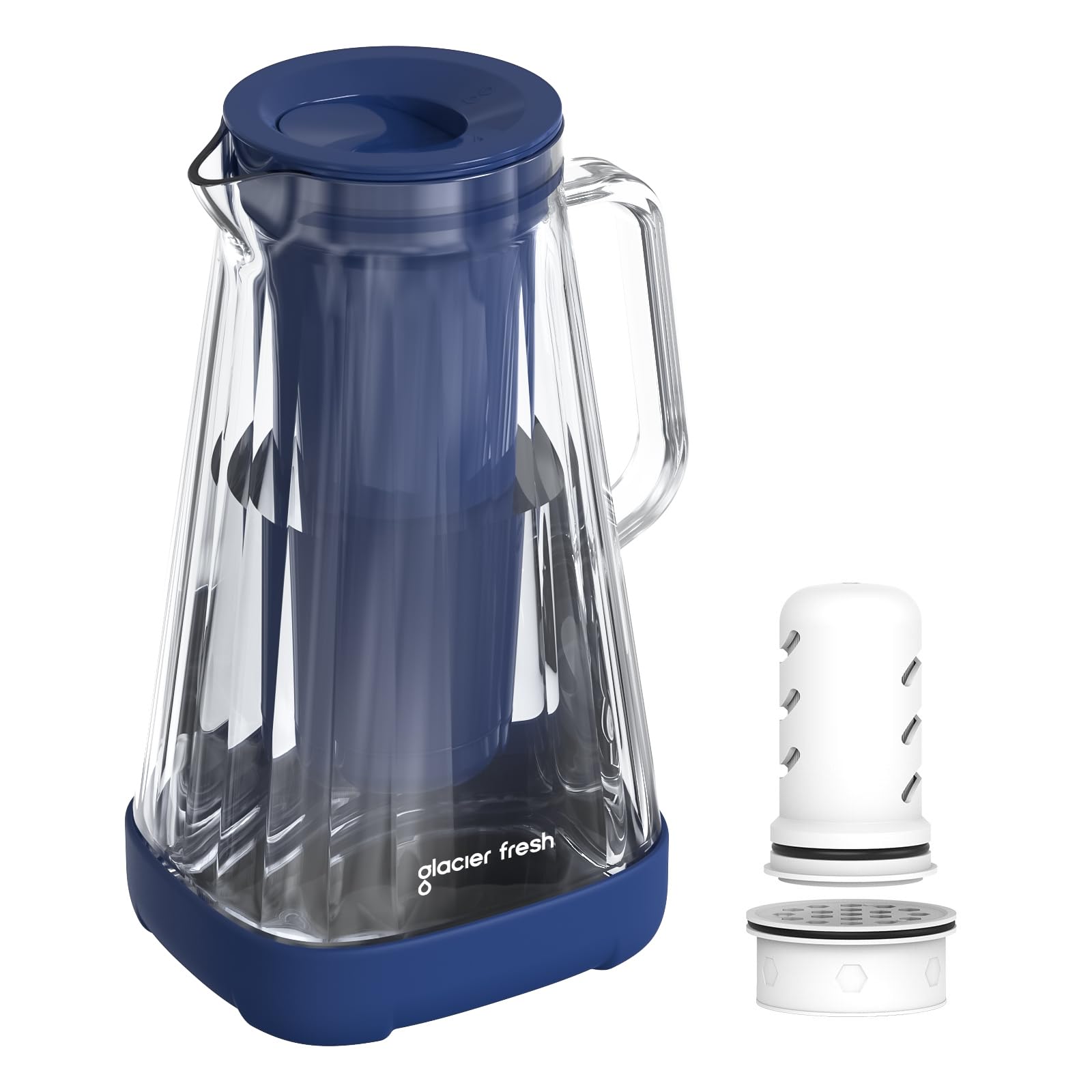
A glass pitcher that names its pore size in microns and backs it with lab tests
Most pitchers keep their pore size a secret. This one states it outright: filter openings of 0.2 microns, built from an ultrafiltration membrane plus activated carbon fiber cotton. That figure is the most direct microplastic answer on this list, since 0.2-micron openings are small enough to trap the fragments. The company says it reduces 99% of chlorine, 96% of PFOA and PFOS, and coliform, and that independent lab tests improved smell and taste.
Two filters come in the box, which softens the cost of getting started. The carbon filter is a 40-gallon or 2-month piece; the membrane microfilter stretches to 264 gallons or 6 to 12 months. Both are NSF-certified and the pitcher itself is borosilicate glass, so there is no plastic jug between you and your water.
At 3.3 pounds it is noticeably heavier than the Brita dispenser at 3 pounds, and that glass weight is the price of the material. Some buyers also find the filtering pace slow, and others feel the glass is thinner in the hand than they expected. Filter quality is the part buyers tend to defend, and that is why it earns a place.
The case for it
- 0.2-micron pores are a concrete, stated answer to microplastic filtering.
- Borosilicate glass body with a dust-blocking spout lid.
- Two filters included, and a long 264-gallon membrane.
The fine print
- Filtering is slow and the glass needs careful handling.
- The carbon filter needs changing every 2 months or 40 gallons.
Lands best with: buyers who want glass plus a specific micron figure they can point to.
May frustrate: anyone who pours many glasses in a row and dislikes waiting for each one.
6. LARQ Water Filter Pitcher 8-Cup
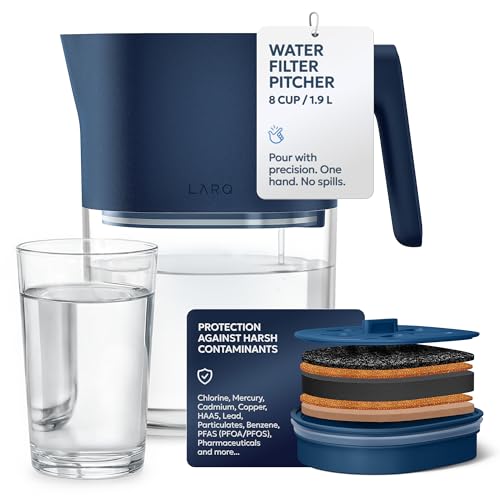
It takes out the bad stuff while leaving the minerals that make water taste good
The pitch here is balance. LARQ’s Nano Zero filter is NSF/ANSI 42, 53, and 401 tested and works on lead, PFAS, chlorine, mercury, cadmium, copper, HAA5, and pharmaceuticals — all while keeping the minerals that make water taste right. If you have tried a zero-TDS filter and found the water flat, this is the model built to fix that complaint.
At 1.9 liters it fits a fridge door without a fight, and the lid stays put when you pour. The filter runs 60 gallons, about 3 months, and the dishwasher-safe parts make cleaning easy. It is non-electric, so there is no charging and no battery to think about.
Two things to know. The first two or three fills should be flushed to clear harmless carbon dust, and the first minute or so of filtering is slow. A few buyers have also found the lid’s front door awkward when filling from the tap. Filter performance feedback is mixed, which is fair to flag for a pitcher with a smaller review base.
Where it shines: mineral retention plus a compact fridge footprint, with no electricity required.
Where to be patient: the initial flush and the slow start on each new filter.
A solid fit for: anyone who hates the flat taste of stripped water and wants minerals kept in.
Less ideal for: a big family, since the 8-cup body runs out quickly.
7. Aquagear 10-Cup Water Filter Pitcher
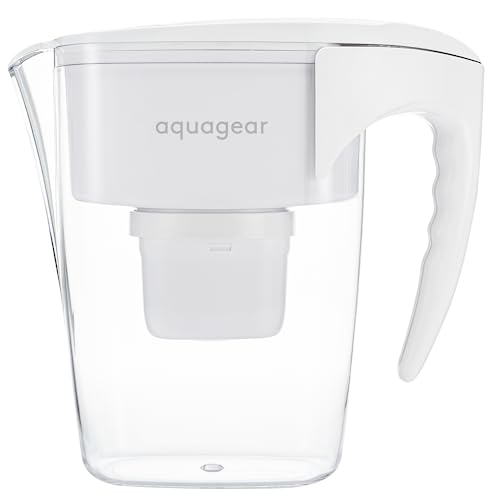
Third-party tested, made in the USA, and the filter keeps minerals instead of stripping them
Aquagear puts its testing where its mouth is. The pitcher is third-party tested to filter lead, chlorine, microplastics, PFOA, and PFOS, and the filter media is made in the USA in an ISO 9000 facility. The company says it removes 20X more contaminants than a traditional pitcher — a maker’s claim, so weigh it as such — but the independent testing is the part that matters for microplastics.
The filter lasts 120 gallons, three times the life of most standard filters, which means fewer swaps and less remembering. It keeps calcium and magnesium in the water instead of stripping everything, which is a real difference from a zero-TDS filter. A prepaid recycling label comes with it, so used filters do not end up in the trash.
The trade-off is speed. This is a slow filter, and a full pitcher can take a while to fill — owners are split on whether that is acceptable. The body is also plastic, so if plastic contact is your worry, glass may be a better direction. But what it lacks in speed it makes up for in what it leaves behind in the water.
Reasons it stands out
- 120-gallon filter life with third-party-tested contaminant reduction.
- Keeps beneficial calcium and magnesium in the water.
- Filter recycling program with a prepaid label.
What to weigh up
- Slow flow means a full pitcher takes patience.
- Plastic body rather than glass if plastic contact is your concern.
Worth it for: buyers who want a tested, wide-spectrum filter that still keeps minerals in.
Falls short for: anyone who needs a fast pour and will not tolerate a slow filter.
8. Alkanatur Alkaline Water Filter Pitcher
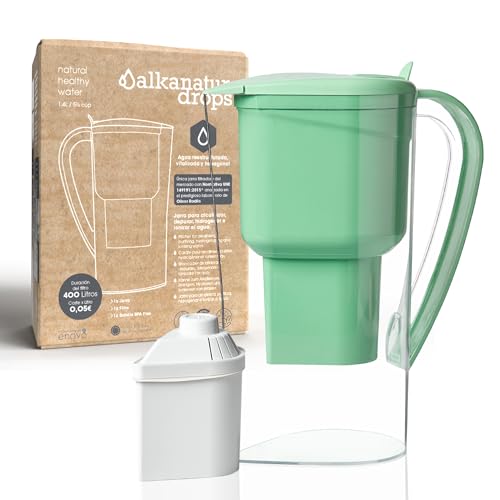
An alkaline pitcher that raises pH and adds magnesium without adding sodium
This pitcher does more than clean your water: it pushes it toward alkaline, at pH 8.5 to 9.5 (pH is the scale that tells you how acidic or alkaline water is). Along the way it removes PFAS (man-made chemicals that linger in water), fluoride, chlorine, heavy metals, microplastics, and nitrates. The company says it is independently tested and certified, and it adds up to 18mg per liter of magnesium (a mineral some people want in their water). It is made in Spain and comes with a BPA-free water bottle (BPA is a plastic chemical many buyers avoid).
The standout design choice is that it does not use an ion-exchange resin. Most alkaline pitchers soften water by swapping minerals for sodium; Alkanatur instead uses a bioceramic filter, so it adds magnesium without sodium. The filter runs 105 gallons, about 3-4 months, and the 2.5-liter capacity fits most fridge doors.
The catch is that alkaline water is a taste preference, not a necessity. Some buyers find the change takes getting used to, and value feedback is mixed. The filter also needs a slow 4-minute-per-liter pace, and the box alone will not convince you — the taste will.
Best for: buyers who want alkaline water with magnesium and no added sodium.
Not the one for you if: you simply want clean water and do not care about pH.
Suits you if: alkaline water with magnesium is the goal and you want it sodium-free.
Choose something else: if pH is not a concern and you want the fastest, simplest pitcher.
9. PIURIFY Compact Electric Water Filter Pitcher

The electric pitcher that filters in about two minutes flat instead of waiting on gravity
Gravity pitchers make you wait. This one uses a small electric pump to push water through its ultrafiltration and carbon stages in about 2 minutes, which is roughly twice as fast as a standard gravity pitcher. The four-stage system includes a pre-filter, sediment filter, ultrafiltration, and carbon, and the company says it removes more than 99% of lead, PFAS, microplastics, mercury, E coli, copper, and chlorine.
It runs on a rechargeable battery with a 30-day stated life per charge, so it is not tethered to a wall outlet. The 50-ounce body holds enough for a few glasses, and one filter lasts 6 months or 130 gallons. A smart filter alert keeps you from running past that point.
The catch is battery dependence and reliability. Owner feedback is mixed on how long the unit holds up, so plan on treating it with care and keeping the charging routine going. If a dead battery mid-batch would annoy you, a gravity pitcher is safer. If speed is what you want, this delivers.
Why it suits busy kitchens
- Filters in about 2 minutes via the electric ultrafiltration system.
- 130-gallon filter life plus a smart filter alert.
- Cordless, rechargeable design that fits a counter or a fridge.
The honest warning
- Reliability feedback is mixed, so treat it gently.
- Battery needs charging to keep the pump running.
Made for: impatient kitchens where a two-minute batch beats a slow drip every time.
Look past it if: you want a no-battery, nothing-to-charge pitcher that simply sits there and works.
10. Clearly Filtered 10-Cup Pitcher
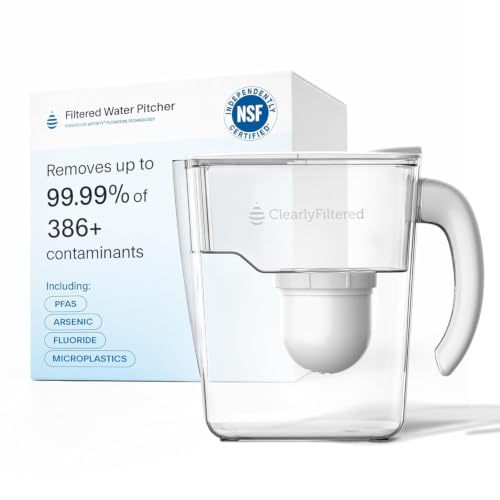
The most ambitious contaminant list here, including fluoride and 386+ others
If your worry is broader than microplastics alone, this is the pitcher that tries to do everything. The company says it targets 386+ contaminants at up to 99.99% removal, including fluoride, lead, PFAS/PFOA, arsenic, microplastics, chlorine, and perchlorate. Its Affinity Filtration Technology uses ionic binding to catch contaminants while keeping the minerals your body wants. It is NSF certified and independently tested by EPA-accredited labs, with removal rates published openly.
The 80-fluid-ounce body holds about 10 cups, which suits a family without constant refills, and the 100-gallon filter lasts roughly 4 months. Medical-grade Tritan plastic keeps the body BPA-free, BPS-free, and non-leaching, and an easy hinge lid makes refilling quick. It strikes a real balance between capacity and clean materials.
Two honest limits. Plastic is still plastic — if you want none, look to the glass options. And filtering speed is mixed: some find it steady, others report it slowing to hours over time. A rigid lid means you cannot scrub everywhere under it, which is worth knowing if you clean thoroughly.
The headline: the widest stated contaminant list of any pitcher here, with transparent third-party removal rates.
The reality check: it costs more to run, and it is still a plastic pitcher, with cleaning nooks worth a look.
Ideal for: buyers who want fluoride and a broad contaminant list covered in one pitcher.
Not for you if: glass or zero plastic is a hard requirement.
11. KOZNOVA Hydrogen Water Filter Pitcher

A cordless pitcher that adds hydrogen gas to filtered water, batteries and all
This is the odd one out, and that is the point. Alongside its filtration, it uses SPE/PEM electrodes (a membrane system that separates the hydrogen gas from unwanted byproducts) to produce up to 1300 PPB of molecular hydrogen. The 3.6-liter jug filters out lead, chlorine, fluoride, microplastics, PFAS, and odors. A 9000mAh battery lets you run it anywhere without a cord.
The filtration is conventional multi-stage carbon, and the hydrogen feature is the headline. The company pitches it as a cordless generator you can put in the fridge or on a desk, with a minimal look. The big battery is the reason it can claim to be portable, and the 3.6-liter body holds enough for a family.
The trade-off is durability and battery life. Buyers report the unit can stop charging over time — the recurring note is a unit that simply stops taking a charge after months of use. Battery life for the hydrogen function (water infused with hydrogen gas) is a real concern too. If you want hydrogen water and can accept that maintenance risk, this fills that niche. If you want reliable microplastic filtering, a gravity pitcher (one that filters by letting water drip down through the filter) is a safer bet.
For the curious: a 3.6-liter hydrogen generator with a big 9000mAh battery and a stated 1300 PPB output.
The risk to weigh: a documented pattern of units that stop charging and a battery that runs down fast for the hydrogen function.
Reach for it if: hydrogen water is the feature you want and you accept the battery risk.
Pick something sturdier: if reliable, long-term microplastic filtering is the real goal.
Know the Specs
Pore size in microns
A micron is one thousandth of a millimeter — a unit so small it takes a microscope to see what it measures. A filter rated at 0.2 microns has openings small enough to block most microplastic fragments. That is why the GLACIER FRESH’s stated 0.2-micron pores are a more direct answer to your question than any stage count. When a label leaves pore size off, that silence itself tells you something.
Filter life in gallons
Gallons tell you how much water a filter handles before a swap. A 120-gallon filter, like the Aquagear or the Brita, means changes measured in months rather than weeks. A 40-gallon carbon filter, like the one inside the LifeStraw and GLACIER FRESH pitchers, needs far more frequent changes. Read the gallon figure first; it decides your real yearly effort and cost.
Capacity in cups and liters
Capacity decides how often you refill. A 27-cup dispenser serves a family or an office all day; a 7-cup glass pitcher suits one or two people. Liters and fluid ounces describe the same thing — the 2.4-liter LifeStraw holds roughly 10 cups, and the 1.68-liter glass version holds about 7. Match this to your household, not the picture on the box.
TDS and mineral retention
TDS stands for total dissolved solids — the metals, minerals, and salts in your water. A zero-TDS filter strips nearly all of them, so you get very pure water but a flatter taste. Filters like the LARQ and Aquagear are built to keep calcium and magnesium in while removing contaminants. Neither approach is wrong; it depends on if you want pure water or mineral-tasting water.
Common Questions
Does a water filter pitcher actually remove microplastics?
Is a glass pitcher better than plastic for avoiding microplastics?
How often does a microplastic filter pitcher need a new filter?
Will filtering remove the good minerals from my water too?
Do I need an electric pitcher, or is gravity enough?
Can a pitcher filter out PFAS as well as microplastics?
Why does my pitcher filter so slowly, and is that normal?
What does the TDS meter included with the ZeroWater pitcher tell me?
Should I flush a new filter before drinking the water?
Is an alkaline pitcher worth it for microplastic removal?
The Bottom Line
For most households, the water filter pitcher for microplastics worth starting with is the Brita UltraMax Elite. It wins on the everyday job: a 27-cup tank ready to pour, and a 120-gallon filter that lasts about six months. It is also the easiest pitcher here to live with if convenience comes first. If microplastics are your hard requirement, step up to the LifeStraw Home 10-Cup, whose two-filter system names bacteria, parasites, and microplastics on the label. And for a glass body with a stated 0.2-micron pore size (a micron is one millionth of a meter, so the holes are tiny), the GLACIER FRESH Purela is the pick that gives you the number to point at.
How we choose
We do not accept paid placement. Every pick is matched to a real buyer and a real use-case; we do not hands-on test units.
Sources
Specifications: manufacturer listings and product documentation. Review insights: verified customer reviews, as of October 2026. Pricing: not shown on this page (it changes often); check the current price via the retailer link.
As an Amazon Associate, Aappliancez earns from qualifying purchases. This does not affect which products we feature.