Disclosure: Some links in this post are affiliate links. As an Amazon Associate I earn from qualifying purchases, at no extra cost to you. Learn more
Specs are compiled from manufacturer listings and verified buyer reviews and can change over time — please confirm the key details on the product page before buying.
One knife should handle the onion, the chicken breast, and the pile of carrots without you reaching for a second blade. That is what an all-purpose kitchen knife is for, and the four picks here each do that job differently. The short answer: the WÜSTHOF Classic 8 Inch Chef’s Knife is the one to buy if you want a single knife for the next twenty years, while the imarku 8 Inch is the smarter first buy if you are still learning what feels right in your hand.
This guide is built by comparing the manufacturers’ published specifications and the patterns across verified customer reviews, so you get each pick’s real strengths and trade-offs instead of marketing spin.
A chef’s knife earns its place by balance and handle comfort after ten minutes of chopping, not by how it looks on the shelf. This guide compares blade steel, handle shape, and weight across four picks so you can choose once and stop shopping.
Top Picks
How To Choose The Best All Purpose Kitchen Knife
Most people buy a knife set and end up using one blade for everything anyway. Skip the block and put your money into a single 8-inch chef’s knife with a full tang and a handle that fits your grip. Here is what separates a knife that stays sharp and comfortable from one that ends up at the back of a drawer.
Blade length: why 8 inches is the default
An 8-inch blade (about 20 cm of cutting edge) covers the full length of a large onion in one draw and still fits on a normal cutting board. A shorter blade forces you into a sawing motion, which crushes soft food instead of slicing it. Taller cooks and anyone prepping big batches often prefer moving up to a 10-inch blade, which is exactly the upgrade path one vegan cook described after living with the 8-inch WÜSTHOF. If your counter space is tight and you mostly do small jobs, a compact blade is fine — but it will not replace a chef’s knife.
Steel hardness and what it means at the board
Blade hardness is measured on the Rockwell C scale (HRC), which is simply a number for how resistant the steel is to rolling over at the edge. Harder steel holds a sharp edge longer but is more brittle; softer steel is easier to sharpen but dulls faster. The imarku sits at 56-58 HRC, while the WÜSTHOF is tempered to 58-degree HRC. Both land in the range that suits home cooking. Anything far harder tends to chip if you hit a bone or a board edge.
Handle and balance decide whether you keep using it
A full tang means the steel runs the whole length of the handle, which gives the knife its balance and stops the blade from working loose over years of use. The WÜSTHOF uses a full tang with triple-riveted composite handles; the imarku uses Pakkawood. Neither is automatically better — what matters is where the weight sits. A knife balanced toward the handle feels lighter in the hand for long prep sessions, while a front-heavy blade does more of the cutting work for you. Try to hold a knife before committing if you can.
Edge retention, honing, and the maintenance you will actually do
No knife stays sharp forever, and the gap between a good knife and a great one is how long it holds up between touch-ups. The WÜSTHOF’s Precision Edge Technology is claimed by the maker to yield a blade that is 20% sharper with twice the edge retention than previous models. Whatever knife you buy, a fine honing rod realigns the edge between sharpenings and takes seconds. Hand washing and drying immediately is the single habit that protects both the steel and the handle.
Side-by-Side Comparison
| Model | Best For | Blade Length | Weight | Construction | Amazon |
|---|---|---|---|---|---|
| WÜSTHOF Classic 8 Inch Chef’s Knife★ Best Overall | Buying once and keeping it for decades | 8 inches | 3.84 ounces | Forged, full tang | Amazon |
| WÜSTHOF Culinar Bird’s Beak Peeling Knife | Peeling and trimming small produce | 2-3/4 inches | 0.08 kg | Forged, full tang | Amazon |
| Henckels Sharpening Steel | Keeping an edge between sharpenings | — | 6.4 ounces | Stainless steel, full tang feel | Amazon |
| imarku Japanese Chef Knife 8 Inch | A first serious chef’s knife on a budget | 8 inches | 6.56 ounces | Forged, high-carbon stainless | Amazon |
Detailed Reviews
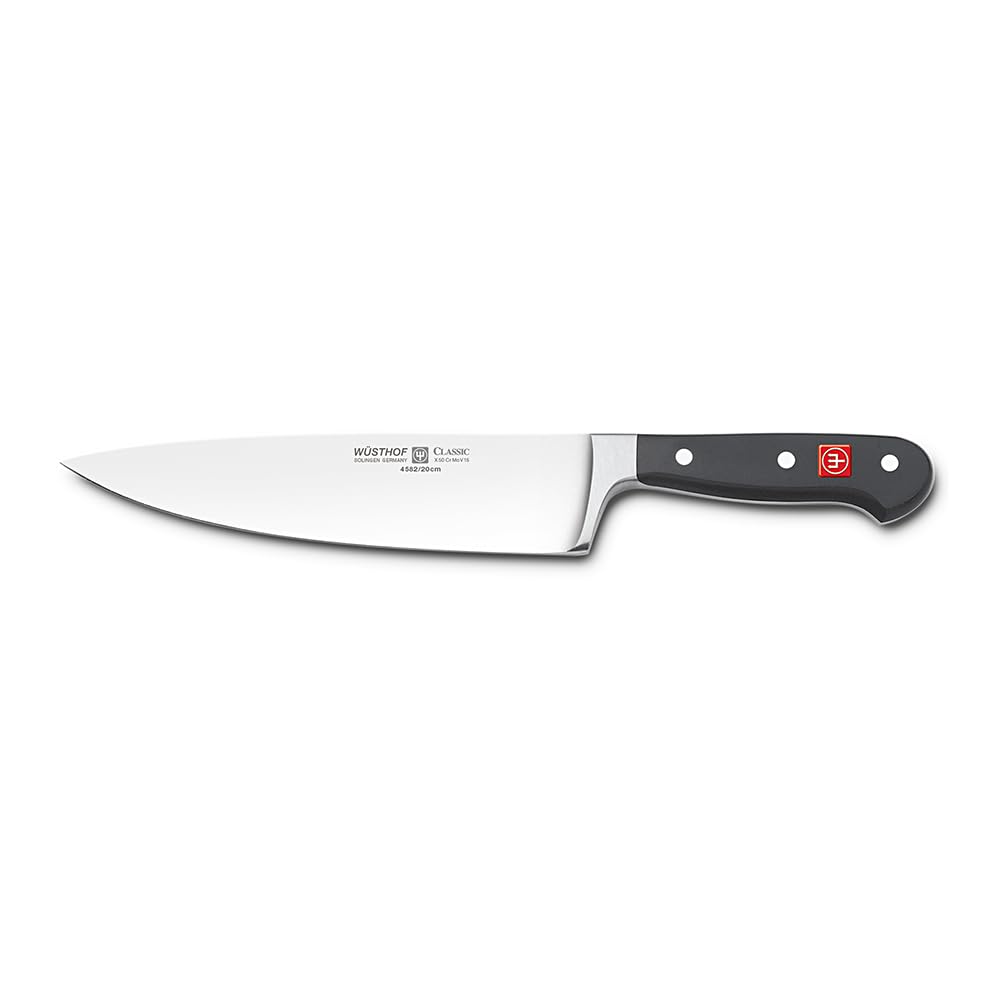
1. WÜSTHOF Classic 8 Inch Chef’s Knife
Our pick — 4.5+★ from 2,500+ verified ratings; the strongest balance of quality and price.
A forged German 8-inch chef’s knife with a full tang and 58-degree HRC steel, built to be the only blade you reach for.
If you only ever buy one knife, this is the shape and heft to buy. A single block of high carbon stainless steel is forged into an 8-inch blade and tempered to 58-degree HRC, then paired with a full tang and triple-riveted composite handle. That construction is what keeps the blade locked straight in the handle instead of wobbling after a few years — the exact problem that sends cheap knives to the bin. It chops, minces, slices, and dices, and the maker lists it as the essential blade for preparing any meal.
Weight is where this one separates itself, and the numbers are stark. At 3.84 ounces it is dramatically lighter than the imarku at 6.56 ounces — yet the review pages describe “perfect weight and balance,” with the added mass helping control through meat and big raw vegetables. It also carries a longer overall footprint at 14 inches against the imarku’s 13 inches, which gives you more handle to work with behind the bolster. The full bolster and finger guard sit between your hand and the blade, so your grip is protected on fast chopping.
The honest catch is upkeep. Hand wash it, dry it, and hone it — this knife does not belong in a dishwasher, and the maker’s traditional Solingen construction expects care. Some buyers also note that even the best knife dulls eventually, so budget for a honing rod alongside it. Still, it is the gold standard in this group, and the crowd agrees: 4.5+ stars across 2,700+ ratings, with several praising how sharp it arrives straight from the start. One long-time home cook, sizing it for a 5’7″ frame, put it plainly: the 8-inch “suits 5’7″ user,” and the handle comfort is why they picked WÜSTHOF over Henckels.
What It Gets Right
- Forged from a single block of steel and tempered to 58-degree HRC for edge holding
- Full tang with triple-riveted handle resists loosening over years
- At 3.84 ounces it is lighter than the imarku’s 6.56 ounces while feeling more controlled
- Full bolster and finger guard protect your grip on fast prep
- Maker’s Precision Edge Technology is claimed to deliver a blade 20% sharper with twice the edge retention than previous models
Where It Asks More
- Hand wash only — the dishwasher will damage the handle and edge
- Premium-tier spend for a single blade
- Needs regular honing to keep that factory edge
The long-haul pick: buy this if you want one chef’s knife that stays in your kitchen for a decade or longer and you are happy to hand wash and hone it.
Look elsewhere if: you want a knife you can toss in the dishwasher without thinking — the imarku below is the easier daily companion.
2. WÜSTHOF Culinar Bird’s Beak Peeling Knife

A 2-3/4-inch curved bird’s-beak blade for peeling shallots, apples, and mushroom stems without lifting your knuckles off the board.
This is not the knife you reach for to break down a chicken — it is the one you grab for the small jobs a chef’s knife handles clumsily. The 2-3/4-inch bird’s-beak blade curves inward, so the tip stays in contact with the surface while you peel and trim small fruits and vegetables. That shape is the whole point: it lets you rotate a shallot or mushroom under the blade without your knuckles lifting off the board.
Construction matches the WÜSTHOF family here. The blade is precision-forged from high-carbon, stain-resistant steel, and the tang extends the full length of the handle for balance. The handle itself is 18/10 stainless steel rather than the composite on the Classic above, which gives it a colder, glassier feel against your palm and a look that suits a displayed knife block. At 0.08 kg it sits light in the fingers for long peeling sessions.
You should know what you are getting: this is a specialist, not a replacement for the 8-inch chef’s knife. It also asks for hand washing, and it carries a lifetime warranty against manufacturer’s defects. The review base is tiny — a 4.5+ rating on a handful of ratings — so treat the score as a signal rather than a verdict. It earns its spot by doing one narrow job better than a big blade ever will.
Best used for: peeling apples and potatoes, trimming mushroom stems, and seeding small produce where a full chef’s knife feels like swinging a bat.
The trade-off: a 2-3/4-inch blade is no substitute for a large chef’s knife on meat or squash, and the stainless handle is slicker than composite when wet.
Add-on tool: grab this if you already own a chef’s knife and the peeling step is your least favorite part of dinner.
Not your first knife: if you are outfitting a kitchen from scratch, start with an 8-inch blade and come back for this one.
3. Henckels Sharpening Steel

A 6.4-ounce fine-grit honing rod that realigns a rolled edge between sharpenings and keeps an 8-inch chef’s knife cutting for months.
A honing rod is not a knife, but it is the reason the knife above keeps working. This steel realigns a rolled edge between professional sharpenings, and the fine grit is matched to regular maintenance rather than heavy reshaping. Hone every other use and a chef’s knife holds its bite for months instead of weeks. The rod is built for chef knives, BBQ tools, and everyday kitchen cutlery, so it covers the whole drawer.
The details that matter: a 6.4-ounce stainless steel rod, a smooth polypropylene handle for a secure grip, and a lifetime guarantee against manufacturer’s defects. The full-length shank runs through the handle in the same full-tang spirit as a good knife, and the flared hilt acts as a hand guard. That flare is the safety feature that stops your hand sliding toward the rod while you draw the blade down it.
One practical note — the listing photos show a wood-and-metal handle, but a buyer reported receiving an all-black plastic version instead, so set your expectation there. It also wants care in use: hit the angle consistently and do not overdo it. Keep the rod matched to your knives — a longer steel is the better match for blades up to 12 inches, and this one suits 8-9 inch knives well. For a few dollars it may be the highest-leverage purchase in this entire guide.
Why it earns a spot: the Henckels steel costs a fraction of any knife here and directly extends how long that knife performs, with a 4.5+ rating and 2,700+ ratings behind it.
Set the expectation: handle finish may differ from the photos, and this maintains an edge — it does not restore a badly chipped blade.
Buy it with your knife: if you are ordering a chef’s knife, this rod belongs in the same cart.
Skip it only if: you already share a honing steel with a knife set — check whether it is fine grit and undamaged first.
4. imarku Japanese Chef Knife 8 Inch

A budget 8-inch gyutou with 0.6-0.75 carbon steel at 56-58 HRC and a Pakkawood handle, priced well below the WÜSTHOF.
The carbon content is the headline. This blade carries 0.6-0.75 carbon against roughly 0.3% in comparable knives, which is why it rates at 56-58 HRC — hard enough to hold an edge through meat and stubborn vegetables. An 8-inch length plus a 13-inch overall footprint gives it a familiar chef’s profile. It is a gyutou pattern, meaning it is built as a multipurpose blade: it cuts, dices, slices, chops, and takes meat off bones. Chrome at 16-18% keeps the finish glossy and resists tarnishing.
In the hand, this is the heavier of the two 8-inch knives here at 6.56 ounces versus the WÜSTHOF’s 3.84 ounces. That mass is balanced into a Pakkawood handle, which the maker says reduces fatigue and finger numbness during long prep. The trade-off is real, though: the weight gives you cutting authority but tires a smaller wrist over a long session, and the carbon-hard steel deserves careful handling around bones. Durability is the aspect reviewers weigh most carefully — while quality and sharpness are the two biggest positives, some question long-term toughness.
The catch worth flagging before you buy: despite the “Japanese” framing, the box on at least one unit revealed a China origin, which is worth knowing if country of manufacture matters to you. The maker also notes a branding transition, so the logo on yours may differ from the photos. Still, for a first serious blade it is hard to argue with a 4.5+ rating across 10,000+ ratings. A home cook described the fit well: “Very good on the hands… came extremely sharp and gave precise cuts.”
The Case For It
- 0.6-0.75 carbon content and 56-58 HRC make it notably hard for the tier
- Multi-purpose gyutou profile handles chopping, slicing, and de-boning
- Pakkawood handle with weight balanced back toward your palm
- 16-18% chrome resists tarnish and keeps the finish glossy
- Available at a budget-tier price point with a lifetime warranty
Worth Knowing
- At 6.56 ounces it is heavier than the WÜSTHOF’s 3.84 ounces — noticeable over long prep
- Origin is China on units seen so far, despite the Japanese branding
- A few report the logo may differ due to a brand transition
- No dishwasher durability claims and hand care is still wise
Strong first chef’s knife: buy this if you want an 8-inch forged blade with real hardness without the premium-tier spend.
Think twice if: you have small hands or fatigue easily — the heft is the feature and the cost at the same time.
Know the Specs
Blade Length and the Chef’s Knife Reason
An 8-inch blade is the default because it lets you slice a whole onion with one long draw instead of a sawing motion. The WÜSTHOF and imarku both run 8 inches. A short bird’s-beak knife like the WÜSTHOF Culinar at 2-3/4 inches is for peeling and trimming, not chopping — it is a companion tool, not a replacement.
HRC: The Hardness Number That Predicts Edge Life
HRC, or Rockwell C hardness, tells you how well a blade resists rolling at the edge. The imarku runs 56-58; the WÜSTHOF is tempered to 58-degree HRC. In this range you get good edge retention without the brittleness of very hard steel, which suits the bones-included reality of home cooking.
Weight and Balance: Why Ounces Matter
At 3.84 ounces the WÜSTHOF is light enough for long prep but heavy enough not to feel flimsy. The imarku at 6.56 ounces trades that lightness for cutting mass. Neither is wrong — heavier knives push through dense food; lighter knives give more feedback. Try both if you can.
Honing vs. Sharpening: A Crucial Difference
A honing rod like the Henckels realigns a rolled edge between sharpenings. Sharpening actually removes steel to create a new edge. Hone every other use for maintenance; sharpen only when honing no longer restores the bite. The Henckels fine-grit rod suits 8-9 inch knives nicely and is best matched to 12-inch blades with a longer rod.
Common Questions
Is an 8-inch chef’s knife the right size for most home cooks?
What does full tang mean on a kitchen knife?
Can I put a forged chef’s knife in the dishwasher?
Is a honing steel the same as a knife sharpener?
What HRC should a home chef’s knife be?
Is the imarku knife actually made in Japan?
Do I need a bird’s beak peeling knife if I have a chef’s knife?
How long does a forged chef’s knife stay sharp?
What is the difference between a forged and a stamped knife?
The Bottom Line
For most kitchens, the all purpose kitchen knife winner is the WÜSTHOF Classic 8 Inch Chef’s Knife because its forged, full-tang build and 58-degree HRC steel make it a buy-once blade that stays balanced and sharp for years. If your budget points toward a first serious knife, the imarku 8 Inch delivers an 8-inch forged blade with 56-58 HRC steel and real cutting authority for a fraction of the spend. And to keep whichever you pick in top shape, the Henckels Sharpening Steel is the small addition that protects the big investment — and the WÜSTHOF Culinar Bird’s Beak rounds out the drawer for the jobs a chef’s knife fumbles. Buy the one knife you will actually reach for, then hand wash it and hone it every other use.
How we choose
We do not accept paid placement. Every pick is matched to a real buyer and a real use-case; we do not hands-on test units.
Sources
Specifications: manufacturer listings and product documentation. Review insights: verified customer reviews, as of October 2026. Pricing: not shown on this page (it changes often); check the current price via the retailer link.
As an Amazon Associate, Aappliancez earns from qualifying purchases. This does not affect which products we feature.