Disclosure: Some links in this post are affiliate links. As an Amazon Associate I earn from qualifying purchases, at no extra cost to you. Learn more
Specs are compiled from manufacturer listings and verified buyer reviews and can change over time — please confirm the key details on the product page before buying.
Stink bugs do not bite and they do not carry disease, but a dozen of them buzzing against a bedroom lamp is enough to ruin a week. The fix is not one spray but a product matched to how the bugs are getting in. If you want the short answer: a water-based concentrate you mix yourself and paint along the foundation is the strongest choice for a whole-house barrier, while sticky stakes and ready-to-use bottles handle the smaller jobs.
This guide is built by comparing the manufacturers’ published specifications and the patterns across verified customer reviews, so you get each pick’s real strengths and trade-offs instead of marketing spin.
Below you will find five working options split by job: a mix-and-spray barrier for the outside of the house, a sticky stake for potted plants and garden rows, and ready-to-use sprays for indoor touch-ups. Each entry explains what it actually kills, how long it keeps working, and where it falls short, so you can match the product to the entry point and stop the bugs at the source.
Top Picks

How To Choose The Best Stink Bug Killer
Stink bugs come in from outside, so the product that stops them usually lives outside too. A spray you mix and paint along the foundation creates a treated band the bugs must walk across to reach your windows and doors. A can you point at one bug on a curtain solves a different problem. Decide which problem you have first, then pick the format.
Residual versus quick knock-down
A residual spray leaves a treated surface that keeps killing for weeks or months, which is what stops a fall invasion from turning into a spring one. A knock-down spray kills the bug you hit and leaves nothing behind, so the next one walks straight past. Look for the word “residual” on the label and a listed window of effectiveness — one of the picks here lists control of ants, roaches, and spiders indoors for up to 12 months on nonporous surfaces.
Concentrate or ready-to-use
A concentrate is a small bottle you dilute in water and load into your own sprayer. It costs less per treated area and lets you cover a whole foundation, but you need a sprayer and you need to follow the mix instructions. A ready-to-use bottle is pre-mixed and needs no equipment — easier, faster, and fine for a single window frame or a porch corner.
Odor, staining, and where you can spray
Many modern formulas are labeled odorless or non-staining, but that does not mean every surface is fair game. Check the label for where the maker allows application — foundation, windows, doors, mattresses, clothing, and tents all appear across these products, but each product lists its own surfaces. Test a hidden patch on siding or fabric first if you are unsure.
When a trap makes more sense than a spray
Sticky traps do not kill a colony and they will not seal a window. What they do well is catch what is already moving around your plants or a room, so you can see how bad the problem is. For a stink bug issue that traces back to a garden bed or a potted plant, a trap is a diagnostic tool, not the cure.
Side-by-Side Comparison
| Model | Best For | Form | Volume / Count | Stated Residual | Amazon |
|---|---|---|---|---|---|
| Bugg Products Insecticide Concentrate★ Best Overall | Whole-house foundation barrier | Concentrate | 16 fl oz | Remains effective for months | Amazon |
| Maxguard Yellow Stake Sticky TrapsBest for Plants | Potted plants and garden rows | Sticky stake | 30 Count | Up to 6 months per trap | Amazon |
| JT Eaton Water-Based Spray, Gallon | Treating clothing, tents, and gear | Ready-to-use spray | 128 fl oz | Lasts through multiple washings | Amazon |
| Mighty Mint Peppermint Oil Spray | Repelling around doors and baseboards | Ready-to-use spray | 16 oz | — | Amazon |
| Ortho Home Defense MAX (2 Pack) | Indoor perimeter touch-ups | Ready-to-use spray | 24 fl oz each | Up to 12 months on nonporous surfaces | Amazon |
Detailed Reviews
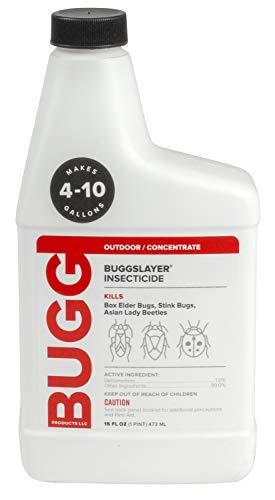
1. Bugg Products Insecticide Concentrate 16 oz
Our pick — 4.5+★ from 950+ verified ratings; the strongest balance of quality and price.
A small bottle of concentrate that turns your foundation into a treated wall the bugs have to cross.
The core spec here is the active ingredient: deltamethrin, a synthetic insecticide that kills on contact rather than driving bugs away. That distinction matters. The label states plainly that it has no repellent effect — a stink bug must walk across a treated surface to die, so the job is coverage, not fogging the air. Mixed with water as directed and sprayed along the foundation, windows, and doors, it forms a barrier around the house that the label says will not wash away in the rain and stays effective for months.
That residual behavior is what owners talk about most. The recurring story is a fall application along the exterior and a spring without the usual indoor invasion — the sort of result that makes a one-time job feel like a season-long fix. One buyer put it plainly: “Works great on box elder and stink bugs. I treated my exterior in the fall of 2025 and had no bugs inside the house in the spring (which was typical before treating).” Effectiveness is the thing buyers rave about, and the follow-on benefit — far fewer bugs getting in at all — is the second. Because it’s water-based, it is listed as odorless and non-staining, so it goes on siding and frames without leaving a visible mark the way oil-based sprays can.
Here is the part the listing page does not shout about: one 16-ounce bottle is a small amount of concentrate, and diluting it means you need your own pump or backpack sprayer plus a little patience with the mix ratio. That combination is exactly where the grumbling lands. A few owners find it pricey for the bottle size, and results thin out on poorly draining ground where the treated band gets diluted by standing water. On a well-drained, sun-exposed wall it holds up, including through rain and warm days with only a light residue on glass. If you are covering a large house, plan to buy more than one bottle.
What earns the top spot
- Deltamethrin formula kills on contact and is labeled as a months-long residual, not a one-hit spray
- Water-based, odorless, and non-staining — safe to run along siding, window frames, and doors
- One fall treatment is reported to carry through to spring with almost nothing getting inside
- Far more coverage per dollar than a shelf of ready-to-use cans once you dilute it
The honest catch
- You supply the sprayer and do the mixing — nothing here is ready to point and shoot
- 16 fluid ounces of concentrate does not stretch far on a big exterior
- No repellent action, so untreated gaps stay open no matter how much you spray
Worth the setup: You are fighting stink bugs at the source — the exterior — and you already own or will buy a pump sprayer.
Think twice: You want to spray one bug on a curtain today; a ready-to-use can is faster for that.
2. Maxguard (30 Pack) Yellow Stake Sticky Insect Traps
Thirty yellow stakes, no chemicals, and a bug count you can actually see drop.
If you would rather not spray anything near your orchids or your herb pots, this is the format that fits. You get 30 stakes in the box — a unit count that dwarfs the single bottle of concentrate — and each one is a plastic tab coated on both sides with industrial-grade adhesive described as three times the thickness of standard traps. The yellow color is the lure; flying insects head for it, land, and stay. No pesticide, no mixing, no sprayer. Peel the backing, push the pointed end into the soil like a plant tag, or thread the included twist tie through the top hole and hang it from a branch.
Each trap is listed as staying effective for up to 6 months and the glue holds through rain and shine, so a single box covers a whole season across a garden bed. In plantings where small flies keep reappearing, the yellow tabs fill in minutes and give you a fast read on how many adults are actually moving around. That visible count is the point. It tells you whether you have a nuisance or a real infestation.
Where this format genuinely has limits is scale. A sticky stake catches what flies into it — it does not kill the larvae in the soil, so the breeding cycle keeps running underneath. You will see that trade-off in the advice that comes out of long-term indoor growers: pair the traps with a larvicide rather than relying on them alone. The stakes also arrive rather large for small indoor pots, and the workaround people use is a pair of household scissors — “Effective bug catcher but a bit large for indoor potted plants. But I cut mine lengthwise with household scissors to be less obtrusive in my orchids.” Sticky is the one thing opinions split on, with some owners finding the surface aggressive and others finding it weaker than expected. Shorter stakes or a trim solve the size question in a hurry.
Why it earns a slot: Thirty pesticide-free traps for the same money as a few cans, a 6-month working life, and the only pick here that shows you exactly what is flying around your plants.
The fair warning: Traps monitor and reduce adults — they do not clear a soil-borne breeding cycle, so treat this as one part of a plant-pest plan, not the whole plan.
Reach for it if: Stink bugs and small flies are turning up around potted plants or garden rows and you want zero chemicals near them.
Look elsewhere if: The bugs are getting into the house through a window — a stake in a pot will not seal that gap.
3. JT Eaton Bed Bug Tick & Mosquito Killer Gallon
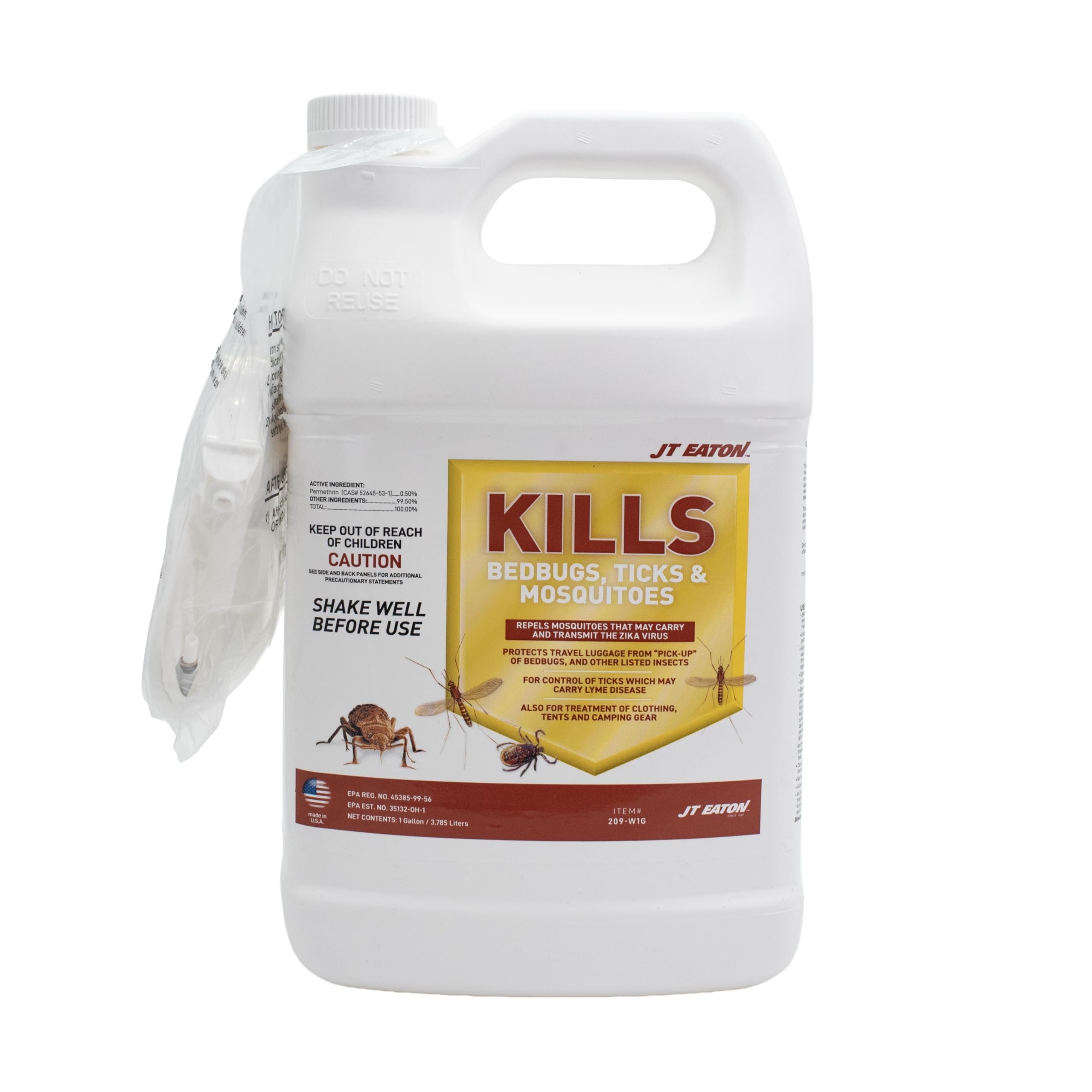
A full gallon that treats clothing, tents, and camping gear — and survives the wash cycle.
Start with the number that separates this from every other bottle in the list: 128 fluid ounces. The concentrate holds 16 fluid ounces and the peppermint spray holds 16 ounces, so the JT Eaton jug is eight times the volume of either. It arrives with sprayer attachments included, which means no separate equipment purchase. The formula is water-based and labeled for mattresses, tents, clothing, and camping gear, and the maker has been in pest control since 1932.
What people actually do with it is treat the clothes they wear outdoors, then wash them and treat again. The label’s promise — and the thing owners repeat — is that it holds through multiple washings. Ticks and mosquitoes that cross treated fabric are stopped, not simply turned away. That makes it the pick for anyone whose real problem is ticks and mosquitoes on clothing after a day in the brush. One hunting-clothes user who switched from a better-known brand of permethrin spray reported: “Used instead of Sawyers for ticks. A lot cheaper – been using on hunting clothes for almost a year …. Just as good as sawyers.”
The honest tension is the smell. Some owners describe it as odorless; others say the scent is still pretty strong out of the jug. Plan to treat clothing outdoors or in a garage and let it dry fully before wearing, which the label directions call for anyway. Two other limits worth knowing: it is labeled for dogs but not cats, and it does not do the job on fleas. Effectiveness is what this product is known for, with value running a close second — a gallon that lasts a season’s worth of treatments is a different economics than buying small cans repeatedly. A 1-year limited warranty backs it up.
The standout spec: A 128-fluid-ounce jug with sprayer hardware in the box, labeled to survive multiple washings on clothing, tents, and camping gear.
Where it gets awkward: The scent reads mixed — some call it odorless, others find it strong — and it is a fabric and gear treatment, not a window-frame barrier for stink bugs marching indoors.
Best matched to: Hunters, hikers, and anyone who wants their clothing and gear treated against ticks and mosquitoes for weeks at a time.
Not the answer for: An active stink bug invasion around your doors and windows; that calls for the concentrate and a sprayer.
4. Mighty Mint Peppermint Oil Insect Repellent Spray, 16 oz

The peppermint bottle you reach for when you want the bugs gone without chemical fumes in the room.
This one is built around a single idea: extra-concentrated peppermint oil in a 16-ounce bottle, pre-mixed and ready to spray. No sprayer, no mixing, no gloves. The listing markets it as safe around dogs, cats, and children when applied as directed, and free of synthetic fragrances and common allergens — which matters if someone in the house reacts to scented products. You point it at baseboards, entryways, door frames, and patios, and the surfaces are listed as non-staining, so it does not leave a ring on painted trim.
The smell is the most-discussed feature, and it cuts both ways. Some describe it as a crisp, clean peppermint aroma that lingers without overwhelming; others find that repeated spraying builds an aroma that is genuinely a lot. Either way, it fades rather than settling in — an honest limitation for a product whose whole method is scent. Owners treating kitchens and bedrooms report fast results on ants and roaches, and one bedroom user who had been finding spiders on the comforter nightly reported none since starting a weekly pass around the bed. Flies are another recurring target. As one owner summed it up: “This stuff works. I wanted some thing that was natural and would not affect my dog if he sniffed it or licked it. It doesn’t last for more than four hours, but I’m OK with that being that it is natural.”
That four-hour window is the crucial thing to understand before you buy. Peppermint oil is a repellent, not a residual killer: it makes a surface unpleasant to cross and then fades. If you want a barrier that keeps working for months, this is the wrong tool. If you want to clear the immediate area around a door or a bed without odorless-but-synthetic chemistry, it fits. Effectiveness and value both split in the feedback, with a share of buyers finding it did not solve their problem and a larger share swearing by it for ants, roaches, and spiders.
What makes it different
- Plant-based peppermint oil with no synthetic fragrance — the pick when chemical sprays are off the table
- Ready to spray straight from the 16-ounce bottle, no mixing or equipment
- Listed as non-staining on baseboards, entryways, and patios
- Pleasant scent that makes indoor touch-ups around doors and beds easy to live with
The limit you should know
- Repels rather than kills, and a treated surface stops working in a matter of hours
- Needs repeat application — a weekly pass, not a once-a-season job
- Peppermint oil at volume is a strong smell; over-spraying gets overwhelming fast
Make it your pick if: You want a natural, pet-conscious repellent for the area you actually sit in and are happy to respray regularly.
Pass it over if: You are trying to end an invasion at the exterior wall — a scent barrier fades long before that job is done.
5. Ortho Home Defense MAX Insect Killer Spray 2 Pack

Two 24-ounce cans that live in the garage and get used around windows, doors, and screens all year.
The label numbers here are the reason it makes the cut. Ortho lists control of ants, roaches, and spiders indoors for up to 12 months on nonporous surfaces — the longest stated window of any pick in this list — and names stinkbugs directly among the insects it kills. You get two 24-fluid-ounce cans, which means one for the basement and one for the garage. It is called out as odor-free and non-staining, so a pass along a white windowsill or a screen door does not leave anything behind for guests to notice.
What it does very well is the kind of perimeter spraying people genuinely do: around the bottom of doorways, along window frames, across screens, and inside the trash cupboard. Owners who have kept a bottle in each part of the house for years are the ones who describe it warmly, and effectiveness is what the feedback praises. A single application under ant-prone areas has been reported to hold for close to a month before a reapplication was needed.
Two caveats are worth flagging. The first is that it is not universal — clothes moths have been reported to carry on regardless, and a slower kill on roaches than a fast-acting competitor was noted by at least one household that switched brands. The second is that the value question splits: a two-pack of cans feels like a good deal to some and a poor one to others, which is really a comment on how much area you plan to cover. For spot and perimeter work, a pair of cans goes a long way. For a full exterior wall, the concentrate is the more economical route. Effectiveness is the top thing owners call out here, with the odor-free formula second.
The one-line case: The only pick listing up to 12 months of indoor control on nonporous surfaces, sold as a two-pack of 24-ounce odor-free, non-staining cans.
One check before buying: It kills the named bugs and that includes stinkbugs, but it is not labeled for every pest — clothes moths have walked away from it.
Grab this if: You want a ready-to-use, odor-free can at each door and window for spot work through the season, with no mixing involved.
Keep looking if: You are sealing a large exterior — a pair of cans will run out well before the wall is covered.
Know the Specs
Residual vs. Repellent
A residual product leaves a treated layer that keeps killing for a stated period after it dries — one pick here lists control for up to 12 months indoors on nonporous surfaces, and another is labeled as remaining effective for months outdoors. A repellent does the opposite: it makes a surface unpleasant so bugs turn away, and once the scent fades the protection is gone. For stink bugs heading toward your house, residual wins. For the area you sit in right now, a repellent can be the gentler option.
Concentrate vs. Ready-to-Use
A concentrate is a small bottle you mix with water and load into your own sprayer. It costs less per treated area but requires equipment and mixing discipline. A ready-to-use bottle is pre-mixed, which trades lower cost per area for zero setup. If your problem is a whole foundation, the concentrate math wins over time. If it is one door frame, grab the pre-mixed can.
Stated Coverage and Size
Volume tells you how far a bottle stretches. A 16-fluid-ounce concentrate dilutes into far more spray than 16 ounces of ready-to-use liquid, while a 128-fluid-ounce jug is a bulk treatment you go through over a season. Match the number on the label to the size of the job: small bottle for a small exterior, gallon for a stack of clothing or gear, trap pack for an entire garden bed.
Odor, Staining, and Surface Rules
Labels use terms like odorless, odor-free, and non-staining, but each product lists its own approved surfaces. Foundation, windows, and doors are outdoor territory; mattresses, clothing, and tents are fabric; baseboards and entryways are indoor touch-up zones. Always read where the maker allows application, and test a hidden patch on unfamiliar siding or fabric before you commit.
Common Questions
What actually kills stink bugs rather than just chasing them off?
Will a peppermint spray keep stink bugs out of my house?
Do sticky traps set in my garden stop stink bugs getting inside?
Can I spray the JT Eaton gallon directly on clothing and tents?
How long does an indoor spray like Ortho Home Defense MAX keep working?
Why does my concentrate spray stop working after rain?
Do I need a sprayer to use the Bugg Products concentrate?
Are these products safe around pets?
Should I spray for stink bugs in fall or spring?
Will the Maxguard sticky stakes work in a rainy garden?
The Bottom Line
For most households dealing with stink bugs at the door and window line, the Bugg Products Insecticide Concentrate is the pick that solves the actual problem — one mixed batch along the foundation creates a treated band the bugs have to cross, and the label’s months-long residual means you are not out there respraying every weekend. If your bugs are clustering on plants instead of walls, the Maxguard sticky stakes cover a whole garden pesticide-free and show you exactly what is flying. And when you want a natural spray for the room you are sitting in, the Mighty Mint peppermint bottle is the one to reach for — just go in knowing it works in hours, not months.
If there is one buying nudge worth taking, it is this: start with the exterior. A foundation barrier outlasts any indoor can, and the stakes cover the garden while it works.
How we choose
We do not accept paid placement. Every pick is matched to a real buyer and a real use-case; we do not hands-on test units.
Sources
Specifications: manufacturer listings and product documentation. Review insights: verified customer reviews, as of October 2026. Pricing: not shown on this page (it changes often); check the current price via the retailer link.
As an Amazon Associate, Aappliancez earns from qualifying purchases. This does not affect which products we feature.