Disclosure: Some links in this post are affiliate links. As an Amazon Associate I earn from qualifying purchases, at no extra cost to you. Learn more
Specs are compiled from manufacturer listings and verified buyer reviews and can change over time — please confirm the key details on the product page before buying.
Your pen keeps reappearing on the back of the page, and the notebook is the culprit, not the pen. The fix is simple: pick paper rated against bleed-through and a coil binding that holds up to a full semester in a backpack. Below are five spiral notebooks I would hand to a student, a teacher, or anyone who thinks better on paper. Each one suits a different job: heavy note-taking, color-coding, portability, or a single big subject binder.
This guide is built by comparing the manufacturers’ published specifications and the patterns across verified customer reviews, so you get each pick’s real strengths and trade-offs instead of marketing spin.
A spiral notebook stands or falls on two things: how the paper handles ink, and how the wire holds up after months of flipping. This breakdown of the best spiral notebooks covers both, so you can buy one pack and stop replacing thin notebooks mid-semester.
Top Picks


How To Choose The Best Spiral Notebooks
Paper weight, not the cover, is what most notebook buyers end up regretting. Thin paper turns a gel pen into a mess on the reverse side, and neat handwriting cannot save it. Start with the paper, then work outward to size, binding, and how many subjects you actually carry.
Check the paper before anything else
Paper weight is the single most useful clue, usually listed in gsm (grams per square meter — a rough measure of how thick and dense the sheet is). A higher number generally means less show-through. Look for wording about bleed-through or feathering too. “No bleeding and feathering” is a real promise a maker puts on the listing, and it tells you the paper was built for wetter inks like gel and fountain pens.
Match the ruled line to your handwriting
College ruled means tighter lines, so you fit more words per page — a good match for most adult handwriting. Wide ruled gives more room per line and helps younger students or anyone writing large. Write small and fill pages fast? College ruled keeps your notebook thinner for the same amount of notes.
Decide between one subject and five
A 1-subject notebook is light and cheap to replace. A 5-subject book with dividers keeps every class or project in one place, which cuts down on forgotten notebooks. Juggling several courses or work streams? The divider version usually wins on organization. Want to color-code by class and carry only what you need that day? A multipack of 1-subject books is the smarter grab.
Look at the binding and the tear-out edge
Spiral wire is the whole point of this category, so check that it is described as sturdy or coil-lock — that resists snagging on backpack fabric. Hand in assignments? Perforated pages let you tear a sheet out cleanly. Then 3-hole punching lets that sheet go straight into a ring binder without re-punching.
Side-by-Side Comparison
| Model | Best For | Page Count | Paper Size | Binding | Amazon |
|---|---|---|---|---|---|
| KOKUYO Spiral Notebooks, 3 Pack★ Best Overall | Bleed-free everyday notes | 480 pages | 10.5″ x 8″ | Spiral-bound | Amazon |
| Yansanido Top Bound Spiral Notebook, 4 PackCompact Pick | Portable top-flip notes | 160 pages | A5 (8.3″ x 5.9″) | Top-bound spiral | Amazon |
| MOWEE 5 Subject Notebook | All-in-one class organization | 200 pages | 8.5″ x 11″ | Twin spiral rings | Amazon |
| SUNEE Spiral Notebooks, 6 Pack | Color-coding on a budget | 70 sheets each | 8″ x 10-1/2″ | Coil lock spiral | Amazon |
| Yoment 5 Subject Notebook | Big projects and journaling | 240 pages | 8.5″ x 11″ | Double spiral wire | Amazon |
Detailed Reviews
1. KOKUYO Spiral Notebooks 3 Pack
Our pick — 4.5+★ from 1,000+ verified ratings; the strongest balance of quality and price.
The 3-pack whose imported Campus paper keeps a fountain pen from bleeding through to the back of the sheet.
This takes the top slot because its paper lets you use both sides of every page. KOKUYO uses Japan imported original Campus paper, and the listing promises no bleeding and feathering (ink spreading into fuzzy edges) for most writing instruments. In plain terms, a wet gel or fountain pen lays down a line without soaking through to the back of the sheet.
You get a 3-pack in Pink, Sky Blue, and Green, and each book runs 80 college ruled sheets. The pack totals 480 pages, the deepest paper reserve here — three times the 160 pages in the Yansanido set. So you are not cycling through a fresh notebook every few weeks. Sizes are 10.5″ x 8″, roomy enough for math problems and margin notes without the bulk of a full letter pad.
Pages tear out cleanly along the perforation (a scored line you rip along), and every sheet is 3-hole punched — three holes punched so it clips into a ring binder. A finished assignment goes straight into a binder with no extra work. The cardboard cover carries a name-and-title space. The acid-free paper is described as pH neutral, meaning it resists yellowing over long storage. Owners lean on these across high school AP classes, grad school, and everything between. As one buyer puts it: “initially purchased these for my son in 6th grade, but I ended up jacking one of them because i liked it so much.”
Where It Delivers
- Japan imported Campus paper built to stop bleed-through and feathering
- 480 pages across three books — the biggest paper reserve on this list
- Perforated sheets plus 3-hole punching for instant binder filing
- Acid-free, pH neutral paper that resists yellowing in long-term storage
What To Weigh
- Three books only — no five-subject divider option in this pack
- Cardboard cover is not described as waterproof or wipe-clean
Built for: anyone who writes with gel or fountain pens and refuses to lose the back of a page.
Think twice: if you need every class in one divided book, this pack is one-subject-per-book only.
2. Yansanido Top Bound Spiral Notebook A5
Four pocket-sized flip-tops for anyone taking notes with no table in sight.
If you take notes standing up, this is the one that fits the job. It measures 8.3″ long by 5.9″ wide in A5 format (a small international paper size), against the 11.3″ length of the MOWEE 5-subject book. That footprint slips into a jacket pocket rather than a backpack. The thick plastic hardcover means you can hold it in one hand and scribble standing up — exactly how people take notes in church pews, at piano lessons, or on a hospital chair.
Each book holds 80 sheets (160 pages) of 7mm college ruled beige paper at 80 gsm (grams per square meter — a measure of paper density), and you can write on both sides without ink crossing over. The top-bound, up-turning wire keeps the binding out of the way of your writing hand and lets you flip pages fast. That flipping motion does split opinion, though. Four colorways — wine red, black, dark green, beige — let you run one book per topic without labels.
The recurring gripe is the plastic cover and bleed on the boldest inks. One marker user summed it up honestly: “Thick papers. Sharpie does bleed too much. If covers weren’t plastic it would be 5 star. Still love these.” The plastic hardcover wipes clean after a coffee spill, which is the trade-off for the marker bleed. Treat it as a pen-and-pencil notebook, not a permanent-marker one.
What wins people over: the paper holds up far better than the price suggests, and the 7mm ruled lines plus compact A5 body make it the most portable book in this guide.
Real limit to know: the plastic hardcover is stiff rather than soft-feel, and heavy marker inks can push through.
Reach for this if: you take notes on the move and want a top-bound flip that fits in a small bag.
Look elsewhere if: you write mostly with broad permanent markers or need letter-size pages.
3. Spiral Notebook 5 Subject

Five subjects, five movable pockets, and a ruler that detaches when you need it.
This earns its spot by keeping five subjects in one book. It splits 200 pages across 5 sections with movable pocket dividers, and each divider carries its own multicolored tab and index label. A quick thumb-flip gets you to the right subject. The dividers pull out and reinsert, so you can reshuffle when one class finishes early.
At 11.3″ long by 9.8″ wide it holds a full sheet of paper inside a cover. The extra hardware is the story: a detachable 11″ ruler clips to the binding, a velcro pocket holds loose handouts, and a calendar sheet sits in each divider pocket. Pages are perforated college ruled and 3-hole punched, ready to tear into a binder. The thick PP hardcover (polypropylene — a stiff plastic) is described as durable and water-resistant for the year ahead.
Durability splits opinion, and it is worth knowing before you buy. Most owners find it tough and long-lasting — a work user reports it “still looks brand new despite rough handling” — but the wire binding is the part to watch over many months of daily use. For notes you file and revisit, it holds together. For one hard semester, the heavier 240-page Yoment is the sturdier build. One quirk: you cannot add refill paper, since the 20-plus holes do not match standard refills.
The organization payoff: five pocket dividers, replacement tabs, a removable ruler, and a built-in calendar turn this from a notebook into a portable filing system.
The honest catch: it is a fixed 200-page book — once you fill a section you can move dividers around but cannot add paper to that subject.
Best fit: the multi-class student or multiproject worker who wants one book and zero loose paper.
Skip it for: one-subject note-takers who want a light, plain book.
4. SUNEE Spiral Notebooks 6 Pack
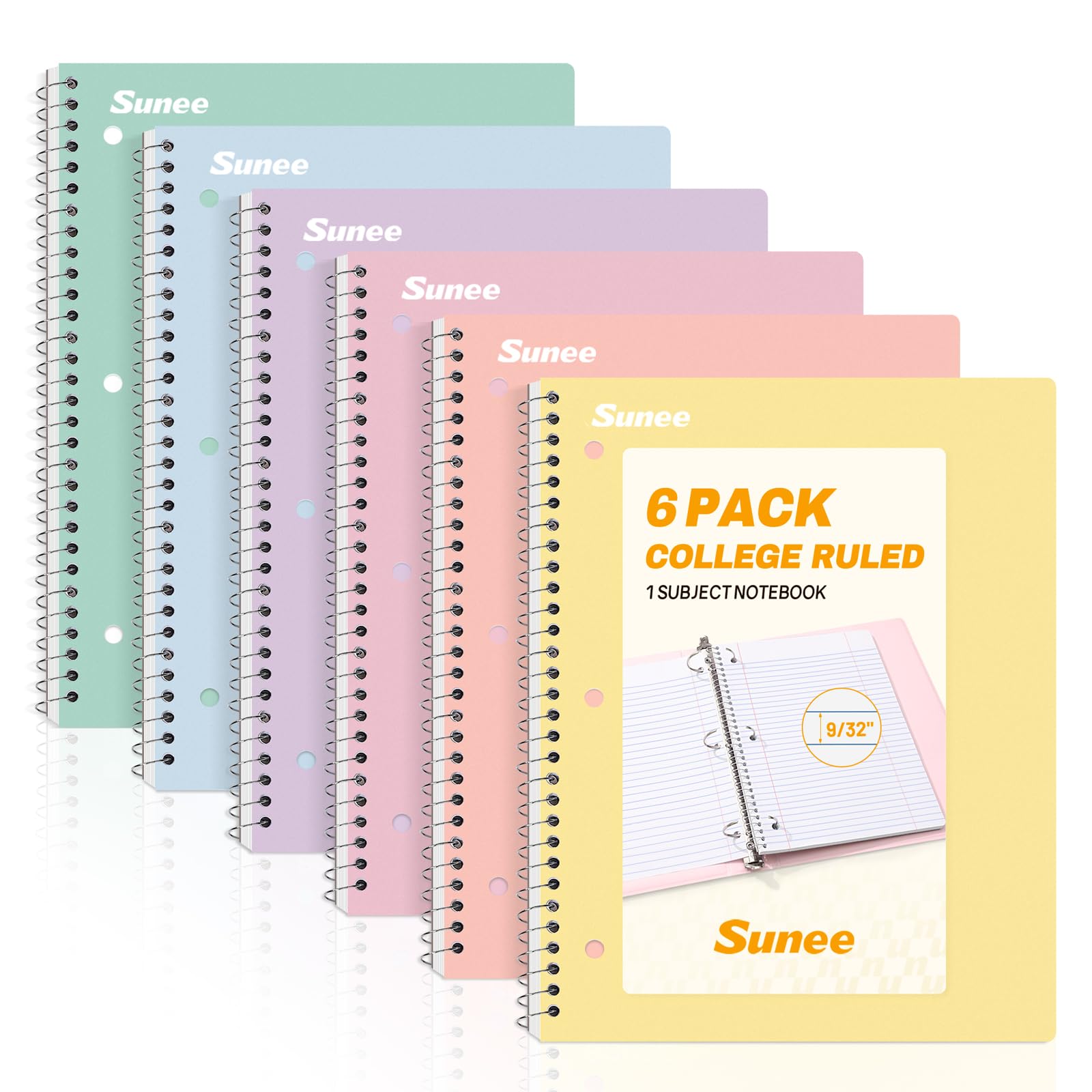
Six pastel books for the student who color-codes everything by subject.
Color variety is why this pack makes the list: six 1-subject notebooks in soft Pink, Purple, Peach, Yellow, Blue, and Green. That is one color per class or one per child — the light organizing most people actually need. No dividers, no label tape; just grab the blue book for biology. Each book runs 8″ x 10-1/2″ with 70 college ruled, double-sided sheets and a red margin line.
The coated cover is described as waterproof, and the coil lock spiral (a wire binding that locks in place so it resists snagging) is built to resist backpack fabric and car seats. Pages are micro-perforated (a fine scored line for a tidier tear), so a sheet tears free as a clean 10-1/2″ x 7-1/2″. The books are 3-hole punched for binder transfer. For loose-note clutter, the six pack plus a binder is a genuinely tidy system.
Paper thickness is the real trade-off, and it is honest to say so. The sheets run thin, so pencil and standard ballpoint are happy while heavy gel or marker may show through. Want the deepest bleed resistance on this list? The KOKUYO paper is a step up. The SUNEE shines on value and color rather than heavyweight sheets. Owners who write mostly in pencil, or who want a color-coded stack to hand around, rate it highly.
Why It Works
- Six pastel colors for fast visual sorting by class or family member
- Waterproof coated covers and a coil lock spiral built for backpacks
- Micro-perforated, 3-hole punched pages that file straight into a binder
Where It Gives Ground
- Thin paper — gel and marker users may see show-through
- 70 sheets per book, so you will rotate books more often
Pick this for: a color-coded system for a student or a whole household on a budget.
Not for: fountain-pen writers who need heavyweight bleed-free sheets.
5. Yoment 5 Subject Notebook 8.5 x 11

The heavy-paper, 240-page workhorse for multi-project note-takers who fill books fast.
Paper volume is where this one separates itself. It packs 240 pages into a single book, compared with the 200 pages in the MOWEE 5-subject — 40 extra pages for a long semester. The paper is described as a heavier stock than normal lined paper, built to prevent ink bleeding and ghosting (faint ink showing from the other side). Owners describe it as smooth enough to write in for hours.
The 8.5 x 11 size gives you the largest writing surface in this guide, sized for projects, recipe collections, and detailed journals rather than quick lists. Five colored plastic dividers split it into sections, and a hollow cut-out on the tabbed cover lets you label each subject. The waterproof plastic hardcover is wear-resistant and wipe-clean, which helps when the book rides in a bag with a water bottle.
Binding is strong double spiral wire, described as not bending or falling off for a long time, so pages turn flat and stay put. What you cannot do is add or remove paper. The honest limitation: it is a fixed 240-page book, so pages stay in their sections. If you reorganize by subject often, that is the one thing to weigh.
What stands out: the biggest page count in this guide plus heavier paper and double spiral wire, aimed at daily heavy writing.
Keep in mind: fixed pages and no refill option — you use it as one big book, not a modular system.
Go for it if: you want one durable, high-page-count book for daily journals or multi-subject notes.
Hold off if: you switch subjects often and want a book you can reconfigure over time.
Know the Specs
Paper weight and bleed-through
Paper weight, often listed in gsm (grams per square meter — a rough gauge of sheet density), tells you how well the page holds wet ink. Denser paper resists gel and fountain pen ink, keeping the reverse side of the page usable. If a listing promises “no bleeding and feathering,” it was built for wetter pens. Thin paper is fine for pencil and ballpoint but shows through with heavier inks.
Ruling type and line spacing
College ruled means tighter line spacing — around 7mm in the Yansanido book — while wide ruled gives more room per line. Tight ruling fits more words per page and suits adult handwriting; wide ruling helps young students and large handwriting. Tighter 7mm ruling fits more words per page, so a college ruled book lasts longer than a wide ruled one of the same sheet count.
Perforation and 3-hole punching
Perforated pages tear out along a scored line, and micro-perforation (a finer scored line) leaves a cleaner edge. 3-hole punching means each sheet drops into a ring binder without re-punching. Together they let you write a page, tear it out, and clip it into a binder without re-punching. Hand in assignments or keep notes for review? Prioritize both.
Binding and page turning
Spiral wire keeps pages flat and lets you flip fast. “Coil lock” resists snagging, and “double spiral wire” adds durability. A top-bound book turns upward, keeping the wire away from your writing hand — handy for one-handed note-taking — though some find that flip motion awkward. Coil-lock or double spiral wire is what keeps pages attached through a semester of backpack carry.
Common Questions
What is the difference between college ruled and wide ruled?
Will a gel pen bleed through these spiral notebooks?
Can I tear out a page without ripping it?
Do these notebooks fit in a standard 3-ring binder?
Is a 5-subject notebook better than separate 1-subject books?
What is the difference between the MOWEE and Yoment 5-subject notebooks?
Can I add or remove pages in a spiral notebook?
Which spiral notebook is best for left-handed writers?
How long does a spiral notebook last?
Are these notebooks acid-free for long-term storage?
The Bottom Line
The spiral notebooks winner for most people is the KOKUYO Spiral Notebooks 3 Pack, because its imported Campus paper stops gel and fountain pen ink from bleeding through — so you get both sides of every page. If keeping multiple classes in one book matters more than paper depth, grab the MOWEE 5 Subject Notebook with its movable pocket dividers. For daily heavy writing that fills a book fast, the Yoment 5 Subject Notebook with its 240 pages is the one to reach for. One honest nudge: if you want a single notebook for a whole semester, the higher page count of the Yoment or KOKUYO books saves you from rotating through thinner 1-subject pads mid-term.
How we choose
We do not accept paid placement. Every pick is matched to a real buyer and a real use-case; we do not hands-on test units.
Sources
Specifications: manufacturer listings and product documentation. Review insights: verified customer reviews, as of October 2026. Pricing: not shown on this page (it changes often); check the current price via the retailer link.
As an Amazon Associate, Aappliancez earns from qualifying purchases. This does not affect which products we feature.