Disclosure: Some links in this post are affiliate links. As an Amazon Associate I earn from qualifying purchases, at no extra cost to you. Learn more
Specs are compiled from manufacturer listings and verified buyer reviews and can change over time — please confirm the key details on the product page before buying.
You want something so small it vanishes behind your earlobe — and still picks out your granddaughter’s voice across a noisy kitchen table. That is the real job here, and size alone will not do it. The picks below range from a completely-in-canal bud that sits out of sight to a slightly larger receiver-in-canal set with Bluetooth. Each one is chosen because it does a specific thing well, not because it looks good in a photo.
This guide is built by comparing the manufacturers’ published specifications and the patterns across verified customer reviews, so you get each pick’s real strengths and trade-offs instead of marketing spin.
The trick is matching the shell depth to your ear canal shape and your hearing loss level. Below you will find out which size trades away power, which one streams phone calls, and where a tiny body still hides a surprisingly loud speaker. These are the options worth your money if a smallest hearing aid is what you are after.
Top Picks

How To Choose The Best Smallest Hearing Aid
Small size is the headline you came for, but it decides three other things for you at the same time. A shorter shell means less room for the battery, less room for buttons, and a tighter fit inside your ear canal. Which of those three you can live with is the whole buying decision.
Fit Type: CIC, RIC, or ITE
A completely-in-canal (CIC) aid sits deep in the ear and is the least visible option. A receiver-in-canal (RIC) aid hangs a thin wire into the canal from a small body behind the ear — still discreet, and usually roomier for controls. An in-the-ear (ITE) shell fills more of the bowl of your ear, so it hides less but is easier to handle with fingers that are not as nimble as they used to be.
Battery Hours vs Shell Size
Every millimeter you shave off the shell costs battery room. A deep CIC design tends to run shorter per charge, while a slightly larger RIC body can push well past a full day. Look at the hour figure for hearing mode specifically, not just the total with the charging case folded in — those are two different numbers.
Self-Fitting and the In-App Hearing Test
Self-fitting means you tune the aid yourself through a phone app instead of a clinic appointment. The app plays tones, builds a hearing profile for each ear separately, and sets the gain to match. It works well for mild to moderate loss. If your loss is severe, check the manufacturer’s stated range before you buy — a tiny aid built for mild loss will run out of volume.
Water and Dust Ratings You Can Trust
An IPX8 rating means the aid survives being submerged, and IP68 adds dust protection on top of water resistance. A lower IPX5 rating covers splashes only. If you sweat heavily or live somewhere humid, that rating matters more than a fraction of an inch of shell size.
Side-by-Side Comparison
| Model | Best For | Fit Style | Battery Per Charge | Bluetooth | Amazon |
|---|---|---|---|---|---|
| Yeasound RIC800★ Best Overall | Most buyers | RIC (receiver-in-canal) | 23 hrs hearing / 12 hrs streaming | Yes, iOS 14+ and Android 10+ | Amazon |
| Jabra Enhance Select 700Clinic-Grade Pick | Clinic-grade tuning with support | RIE (receiver-in-ear) | — | Yes, LE Audio and Auracast | Amazon |
| Eargo SEMost Discreet | Hiding completely in the canal | CIC (completely-in-canal) | 16 hrs, case holds 5 cycles | No | Amazon |
| Lexie B3 | Speech clarity in noise | RIC-style | 32 hrs, case adds 3 charges | Yes, iOS and Android | Amazon |
| iBstone WN-Edge-b1 | Tight budgets, quiet circuits | In-ear | — | No | Amazon |
| NVBOTY M2219 | Long runtime per charge | In-ear | 25 hrs, 100 hrs with case | No | Amazon |
| Cearvol Wave | Touchscreen case control | ITE (in-the-ear) | ~10 hrs indoor / ~6 hrs restaurant | Yes, Bluetooth 5.3 dual-device | Amazon |
| Vivtone Xpure | Budget Bluetooth calls | RIC | 24 hrs hearing / 3 hrs streaming | Yes, iOS 12 and Android 11+ | Amazon |
| Audien Ion Pro 2 | Simple two-button control | RIC (halo design) | 16 hrs, 48 hrs with case | Yes, iPhone 11+ and Android 13+ | Amazon |
| AuraLink | Active lifestyles, dust and sweat | RIC | — | Yes, Bluetooth 5.4 | Amazon |
| Sennheiser All-Day Clear | Brand-name audio quality | RIC | Up to 24 hrs | Yes, iOS and Android | Amazon |
Detailed Reviews
1. Yeasound RIC800 Hearing Aids
Our pick — 4.0+★ from 80+ verified ratings; the strongest balance of quality and price.
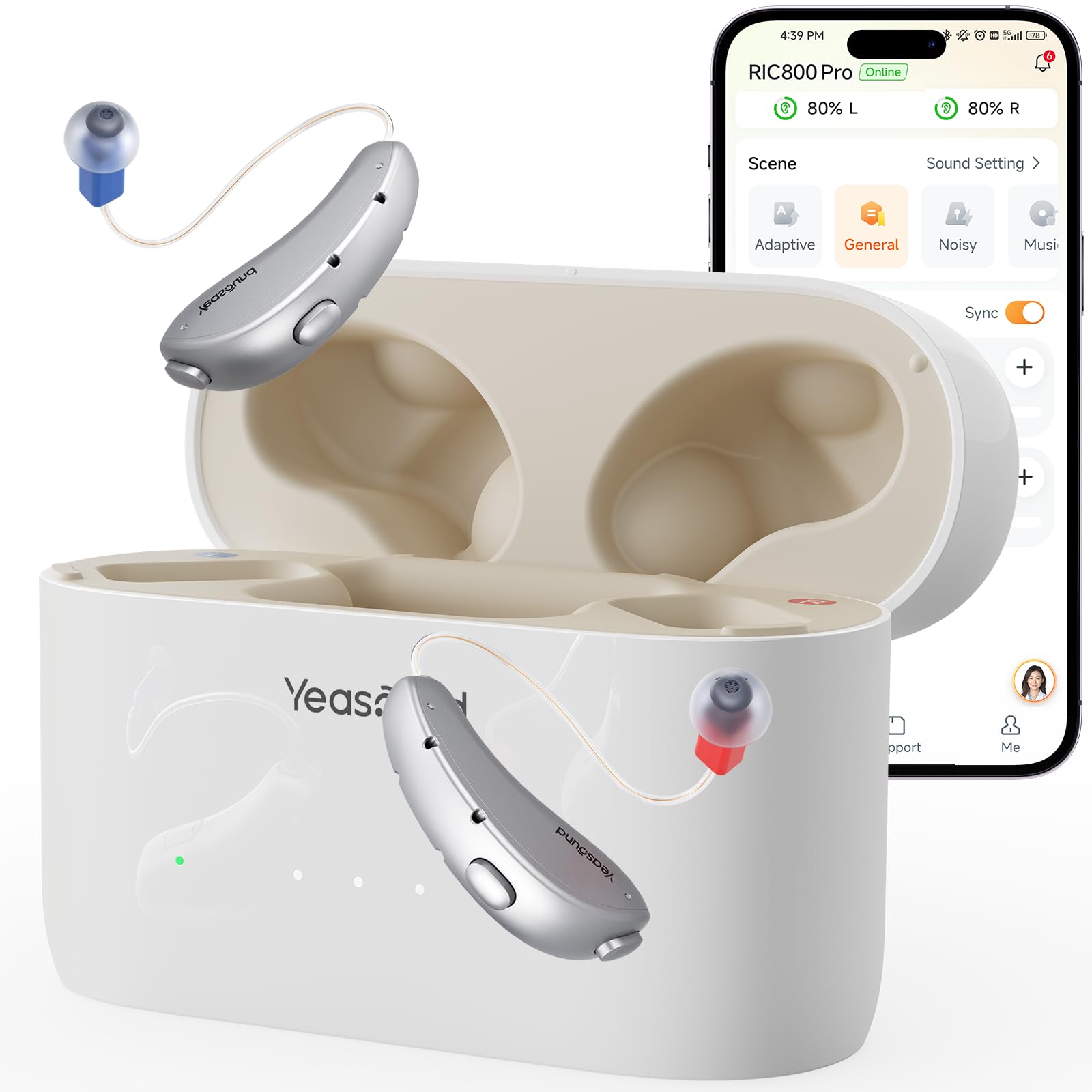
A 0.088-ounce shell that still fits Bluetooth calls, five listening modes, and a 23-hour day.
The number that sets this pick apart is 0.088 ounces. That is the weight of one earpiece, and it is why the RIC800 disappears behind your ear instead of pressing on it all day. At 1.23 inches long it is short enough to tuck away without a visible bump. At that weight you forget it is behind your ear by mid-morning, which is what most first-time buyers want.
Battery life is where the Yeasound pulls ahead of the crowd. It runs up to 23 hours in hearing mode or 12 hours in streaming mode — against 16 hours in hearing mode for the Eargo SE. The portable charging case adds three full charges, which stretches usage to four or five days between wall outlets. Wireless charging means no contact pins to clean or bend, a small detail that removes one of the more common failure points on tiny aids.
Audio processing is fast at 5.3ms, so speech and TV audio stay in sync rather than trailing behind the picture. You get five noise-reduction profiles — Adaptive, General, Noisy, Music, and Outdoors — and an AI layer that picks a setting for you when you would rather not fiddle. Bluetooth pairs with iOS 14+ and Android 10+, and each earpiece works independently. What wins people over most is that it genuinely helps: the noise cancellation and feedback control are what this model is known for, and the feedback squeal that ruins cheaper aids is largely absent. As one buyer put it after a few weeks: “clear sound,no feed back just clear sound.”
The honest catch is that this is a mild-to-moderate tool, and it will not carry severe loss. A few owners also found the wire sits at an odd angle on first insertion, so expect a short adjustment period. Also worth knowing: pair it through the iPhone Hearing Devices menu rather than the standard Bluetooth list, or it may not show up at all.
What earns its place
- 0.088 oz and 1.23 inches — small enough to vanish behind the ear
- 23 hours hearing mode, 12 hours streaming, plus three case charges
- IPX8 waterproof shell survives a real soaking
- 5.3ms processing keeps speech and TV audio in step
- Bluetooth calls and music on iOS 14+ and Android 10+
Where it asks patience
- Built for mild to moderate loss, not severe
- The receiver wire can feel awkward until you learn the angle
- Streaming volume is loud by default and needs trimming in the app
Go for it if: you want the smallest body that still does Bluetooth calls and a full day of hearing without a mid-afternoon top-up.
Think twice if: your loss is closer to severe than mild — this shell is tuned for the moderate range.
2. Jabra Enhance Select 700
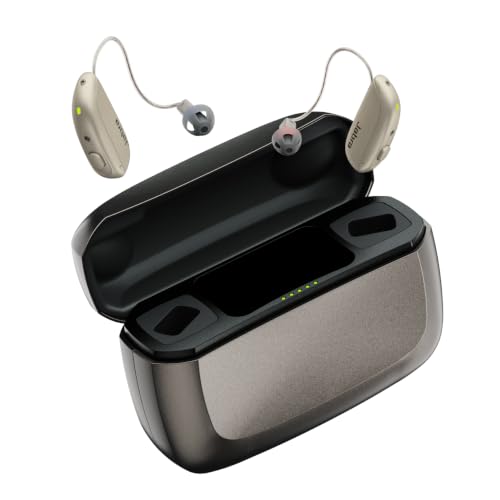
Bundled audiology support and a 2.12-gram shell that Jabra calls its smallest rechargeable RIE yet.
Jabra sells this as the smallest rechargeable receiver-in-ear design it makes, and the spec sheet backs the claim at 2.12 grams per aid. That is light enough to sit behind the ear without a pressure point through a long day. The clever part is that a licensed audiologist is part of the package, so you get remote programming help rather than a self-guided app alone. Few rivals at this weight bundle remote audiologist programming with the hardware.
Sound is the clear strength. It uses SoundScape with Auto Focus, which reshapes the listening scene in real time as you move from a quiet room to a busy restaurant. Bluetooth LE Audio and Auracast are both on board, and Tapcontrol lets you answer calls by double-tapping your ear on either iOS or Android. For a 72-year-old first-time user quoted in the reviews, that combination won out over clinic aids quoted at several thousand dollars, chosen for comfort, price, rechargeable battery, and online audiology.
The trade-offs are real and worth stating plainly. Reliability reads mixed in the review consensus, with some units failing after 30 days, and the app leans on an internet login — it becomes useless without mobile or WiFi coverage even when Bluetooth is connected. Music streaming is not this aid’s strong suit; speech in noise and quiet conversation are. If you are looking mainly for a music-first streamer, this is not the one.
The angle that matters: clinic-tier tuning with remote support, wrapped in a 2.12g shell.
What to weigh: mixed reliability reports and an app that needs a live connection to log in.
Reach for this if: you want a discreet RIE aid with real audiology backup and you mostly need speech clarity, calls, and TV.
Look elsewhere if: you expect music streaming to rival dedicated earbuds, or you need the app to work without a signal.
3. EARGO Eargo SE
A one-gram, completely-in-canal bud that all but vanishes inside the ear canal.
If invisibility is the whole reason you are shopping, the Eargo SE is the one to look at first. It sits completely in the canal at 1 gram per aid, and the shell is small enough that people around you will not spot it. You tune it through Sound Match in the Eargo app, which builds a profile for each ear separately — no clinic visit needed to get fitted. Three sizes of Trumpet eartips come in the box so you can find a secure seat.
Battery runs 16 hours on a single charge, and the charging case holds up to five full cycles, so a weekend away is manageable without carrying a wall plug. There is no Bluetooth here, which is the trade-off for the deep fit. No phone calls, no music streaming. What you get instead is a cleaner, quieter device that does one job well. Comfort and near-invisibility are the two things that keep coming back in owner feedback, and it holds its seat during sports without a wind or hat rustle.
Sound quality is the honest caveat. Some owners find it clear and natural; others describe a tinny edge, and the app only lets you adjust volume broadly rather than tone by tone. If you have sound preferences you want to dial in finely, the trade-off here is real. The charger is also finicky about seating — a couple of failed overnight charges have been reported when the bud was not sitting flat. Set it down deliberately and it behaves.
The deep-fit argument: at 1 gram in a CIC shell, it is the least visible aid on this list.
The trade: no Bluetooth at all, and a charging cradle that needs careful placement.
Pick this when: you want people to not notice you are wearing an aid, and you can live without phone streaming.
Choose another shape if: your priority is music, calls, or fine-grained tone control — the RIC picks above cover those.
4. Lexie B3 Powered by Bose
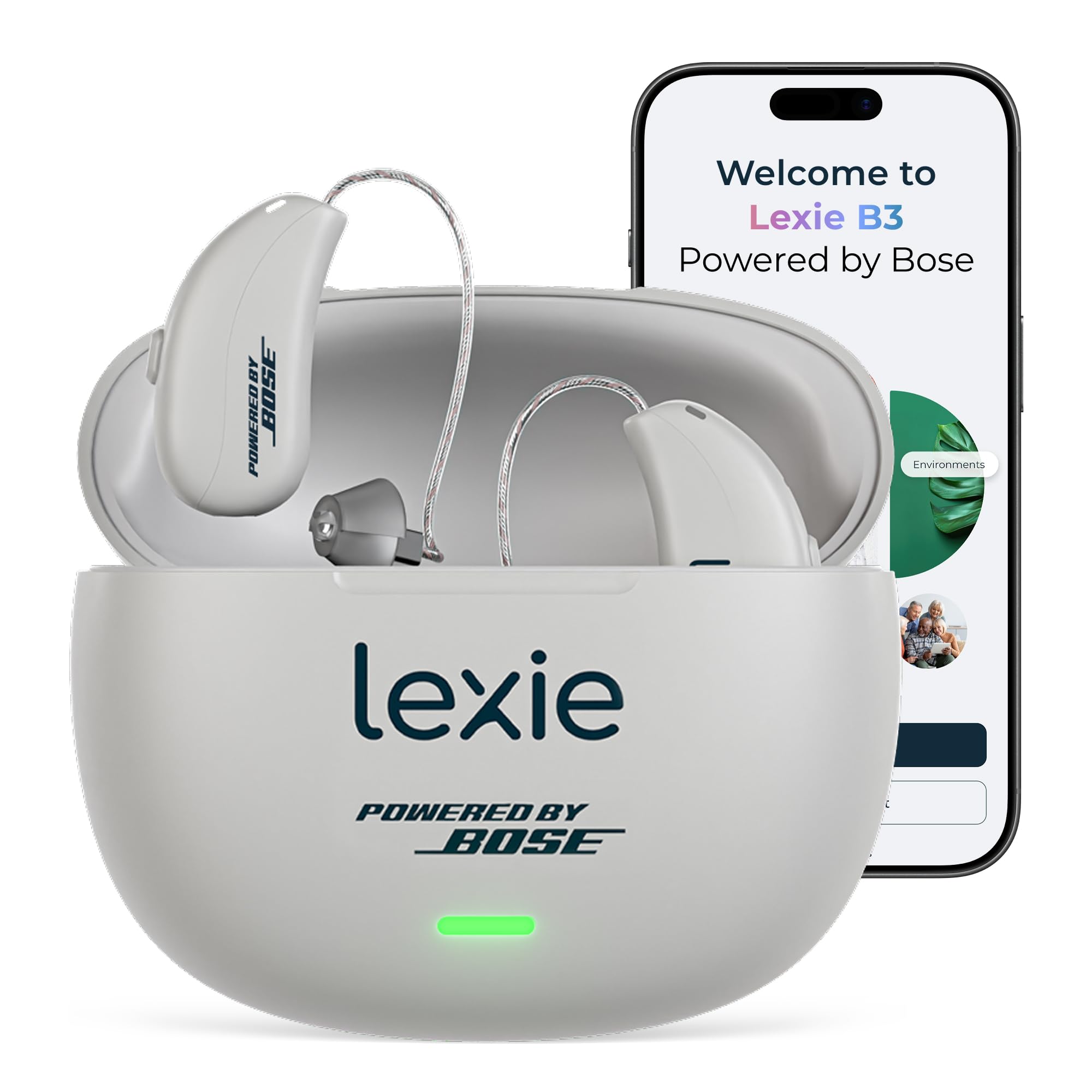
Bose-tuned sound and 128 total hours of power, if you can dodge the Bluetooth bugs.
The runtime figure is the standout here. Lexie quotes up to 128 hours of power across the larger rechargeable battery and case, with up to 32 hours on a single charge and three extra charges in the portable case. That is a genuinely big number for aids this small, and it means a long trip without hunting for an outlet. The audio side is handled with Bose technology and Automatic Sound Focus, which steers the dual microphones toward the speech in front of you and dulls the room around it.
Customization is generous. You get six listening programs — four Environment modes plus two streaming modes — and separate left and right ear adjustment with Bass, Mid, and Treble sliders. Transparency mode has four levels so you can hear the world without pausing audio. On a laptop or phone, the call and streaming profile is adjustable on its own, which matters if your phone and your TV fight over the same stream.
Now the honest part. Bluetooth reliability is the biggest point of friction in owner feedback, particularly on iPhone models, with dropped connections and calls where audio did not come through. Some buyers fixed it by toggling certain phone settings, but not everyone gets there. The bigger open question is company support: Lexie has signaled that US operations are winding down, so warranty and app commitments beyond that window are unclear. Two separate issues to weigh before you commit.
Why it earns a slot
- Up to 32 hours per charge and 128 hours total with the case
- Bose audio processing with direction-aware sound focus
- Six programs plus independent left/right tone control
- Transparency mode with four levels
Where it stumbles
- Bluetooth dropping, especially on iPhone
- Company support uncertain going forward
- No easy fix if a single earpiece fails mid-trip
Best for: buyers who want Bose-tuned clarity and the longest runtime on this list, and who can work through a phone pairing hiccup.
Not for: someone who needs a long-term support promise in writing before spending.
5. iBstone WN-Edge-b1 Rechargeable OTC
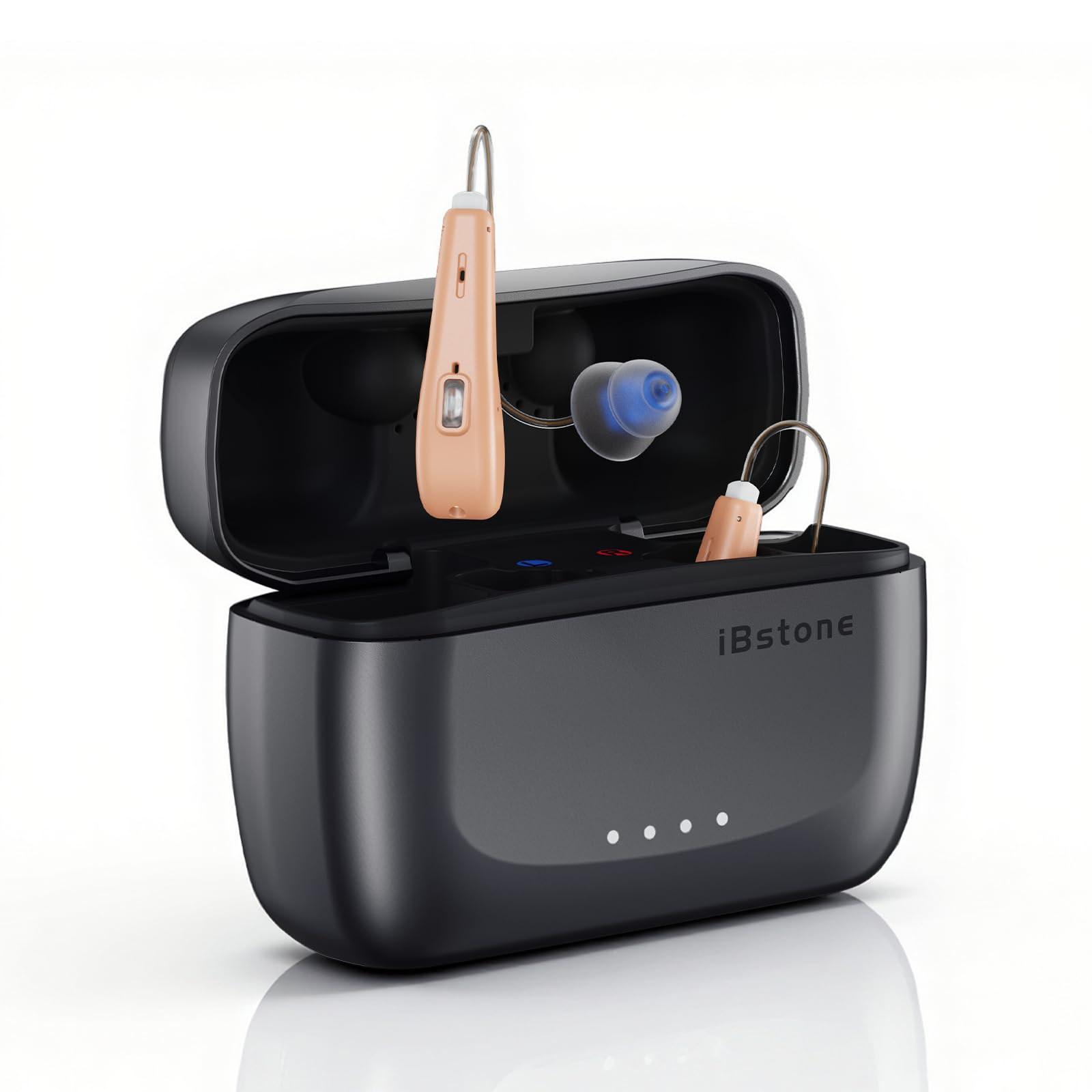
The one to try if your last cheap pair whistled and hissed and you gave up on the whole idea.
The complaint that ends most affordable hearing aid experiments is the background hiss. The WN-Edge-b1 is tuned for the opposite: a quiet circuit. Its own reviews describe it as very quiet, with clear voice pickup, and it offers 11 volume levels so you can sit on the lowest setting rather than pushing against noise. It also carries adaptive noise cancellation, which trims the room’s rumble instead of just amplifying everything around you.
This is a no-frills pick. It is in-ear, beige, runs on push buttons, has no phone app, and no Bluetooth. That is a fair trade at the entry level — less to charge, less to update, less to break. One buyer put it directly: “The hearing aids work as well or better than my 1,700.00 hearing aids that are worn out and don’t charge anymore after 4 years of wear.” Another described it as just as clear and more comfortable than an existing pair.
The catch worth flagging up front: do not count on this one for water. The product had been promoted to some buyers with a swimming claim, and one owner reported the left aid shorted the moment it got wet and would not charge again. If your day involves a pool, treat it as a dry-weather device. A separate report notes the clear wire sheath separating from the earpiece over time, though a repair kit arrived from support and resolved it.
The quiet-circuit pitch: 11 volume levels and adaptive noise cancellation make it the low-hiss choice at the budget end.
Honest scope: no app, no Bluetooth, and no swimming — treat it as a hearing-only tool.
Worth it for: buyers stepping up from a whistling drugstore amp who want a calm, clear circuit without paying for streaming they do not need.
Pass on it if: you swim, play water sports, or want phone calls piped in.
6. NVBOTY M2219 Rechargeable Hearing Aid
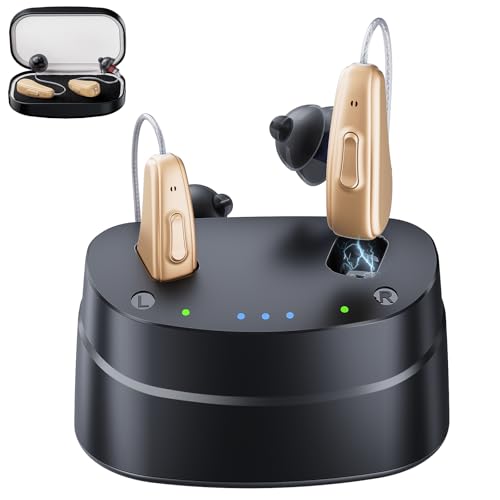
A 25-hour single charge stretched to 100 hours with the case, at a 43dB gain ceiling.
Runtime is the reason to look here. The M2219 quotes 25 hours of listening on a full charge and up to 100 hours total with the charging case, plus a three-hour quick charge when you are in a hurry. For someone who forgets to plug things in, that is a useful safety margin. The compact charging case slides into a pocket and the whole set is small enough to keep on a bedside table without drama.
Gain tops out at 43dB ±5dB, which is enough to lift moderate loss in a quiet room. It offers five volume levels with a smart memory that returns you to your last setting at power-up, so you are not starting from zero every morning. Three ear tip sizes are included, and active noise cancellation is listed to tame feedback. The physical design is in-ear and light, which helps for long sessions with someone who does not want a device on their ear all day.
The honest limit is loud rooms. The reviews point to the volume ladder climbing steeply, and to the noise cancellation not filtering background as cleanly as the listing implies. One early owner gave up within an hour because the top levels felt too loud and the crowd noise came through anyway.
What you buy it for: 25 hours on one charge and 100 hours with the case.
The real caveat: 43dB gain will not cover heavy background noise the way a dedicated noise-reduction circuit can.
Suits you if: long days away from a charger matter more than app control, and your hardest listening environments are home and TV.
Skip the fit if: crowded restaurants are your daily setting — the gain tops out sooner here than on the RIC picks.
7. Cearvol Wave OTC Hearing Aids
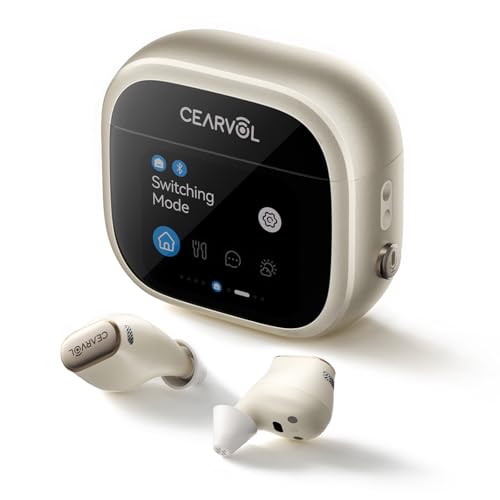
A touchscreen charging case that runs your volume, modes, and calls without reaching for your phone.
Where most aids route every setting through an app, the Wave puts the controls on the case itself. A small display on top lets you adjust left and right ear volume independently, take calls, and switch noise reduction on the spot. For someone who does not want to wrestle with a phone every time the room changes, that is a genuinely different way to run a hearing aid — and it works even when your phone is in the other room.
Under the case lid is Bluetooth 5.3 with dual-device pairing, so a laptop and a phone can both connect and you can hop between a video meeting and an incoming call. There is a direct AUX-in transmitter cable for hooking into a TV or gym machine for lag-free wireless audio. The guts include NeuroFlow AI 2.0, which lists 3ms latency and 20dB noise reduction, plus advanced feedback cancellation and an own-voice reduction circuit to cut the echo of your own speech.
Battery is where this pick needs a caveat, and it is a real one: run time is mode-dependent. You get about 10 hours in standard Indoor or Conversation mode, but only about 6 hours in Restaurant or Outdoor mode, where noise reduction is turned up. It also carries an IPX5 splash rating, not full submersion. If you need it for a full restaurant shift or an all-day outing in noisy settings, plan the charge. The list price places it in the mid tier, and its fit — in-ear with single and double-layer tips in S to XL — is one of the more adjustable on this list.
Why this one is different
- Touchscreen case controls volume and modes without an app
- Bluetooth 5.3 dual-device with AUX-in for TV and gym gear
- Case doubles as a remote mic up to 10m away
- Tips in S, M, L, and XL plus double-layer options
What to plan around
- Only ~6 hours in Restaurant mode versus ~10 hours indoors
- IPX5 splash rating, not a submersion rating
- The case screen picks up fingerprints
The right fit: anyone who wants on-case control and TV/gym audio routing without a phone screen between them and their hearing aid.
The wrong fit: someone who needs a fixed long runtime in loud rooms every day — the mode-dependent battery will not match a 23-hour aid.
8. Vivtone Xpure Bluetooth Hearing Aids

Streaming calls and music from a receiver-in-canal body, on a fast 2.5-hour charge.
The Vivtone Xpure is the lowest-priced way to get Bluetooth streaming in a receiver-in-canal shape on this list. Both the aids and the case refill in 2.5 hours, which then powers up to 24 hours of hearing use or 3 hours of straight Bluetooth streaming. The recycled case also delivers a week of standby power. That is a quick-and-ready combination for someone who wants hands-free calls without stepping up to a premium price.
The RIC design is the piece that does the work here — it moves the sound into the canal and away from the shell, which trims distortion and feedback compared with a simple in-ear amp. You tune volume and frequency through the companion app or the onboard buttons, and multiple preset modes cover quiet chats, restaurants, and outdoor settings. Real-human phone support is included, which matters if tech setup is the sticking point. This model pairs with iOS 12 and Android 11.0 or newer devices.
What to expect honestly: sound quality responses here are mixed. Some owners find them excellent for calls and TV, while others describe the tone as tinny with a white-noise floor. Battery reports are also mixed, and they perform best for mild to moderate loss rather than severe. On the plus side, when a mic did fail on one unit, support sent a replacement after troubleshooting. If you want a streaming aid on a tighter budget and mild loss, this is a defensible buy.
The value read: 24 hours of hearing use and Bluetooth calls for buyers who do not want a clinic-tier spend.
The honest note: tone is hit-or-miss and it is not built for severe loss.
Buy it if: you want Bluetooth calls and preset modes at the entry of the Bluetooth tier and your loss sits in the mild-to-moderate band.
Look up-tier if: crisp music tone and a consistently long streaming day are non-negotiable.
9. Audien Ion Pro 2
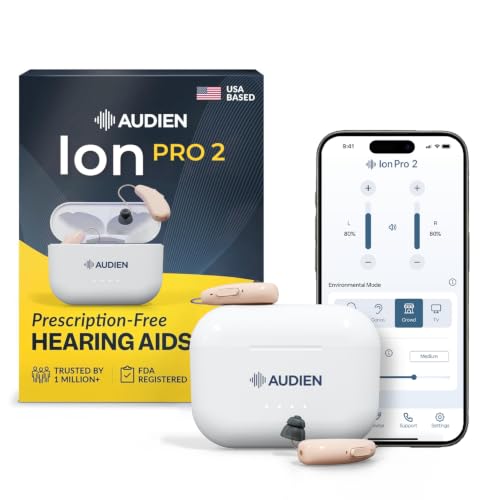
Two buttons, three modes, and a UV-cleaning case for buyers who hate menus.
Not everyone wants to navigate an app every time the volume shifts. The Ion Pro 2 gives you a dual-button interface — one press to change modes, another to trim volume — and keeps everything at your fingertip instead of behind a login screen. It has 3 hearing modes and 6 custom hearing profiles to dial the sound in. The shell is a halo-style receiver-in-canal design, and Audien states it is built for adults with mild to moderate loss who need more power than an in-canal model can reach.
Battery runs up to 16 hours on a single charge, with up to 7 or more hours while streaming, and the charging case extends total power to 48 hours. The case also includes UV sanitizing while it charges, which saves you the separate cleaning routine. Compatibility runs to iPhone 11 or newer on iOS 13+ and select Android devices on Android 13+, including Samsung Galaxy S20 or newer. It is FDA-registered as an OTC hearing aid, so no prescription or clinic visit is required.
The honest scope note: this is a mild-to-moderate device, and a small slice of owners found the conversation clarity short of their expectations in noisy settings. A couple of those buyers report needing periodic resets through the charging case when the aids behave oddly. That does not make it a bad aid — it fits a particular ear and a particular loss profile well — but it is not the option for someone chasing peak clarity in a crowded room.
The operation argument: two buttons, 3 modes, 6 profiles — nothing buried in an app.
The scope note: up to 16 hours per charge and 48 hours with the case, tuned for mild-to-moderate loss.
The pick for: the buyer who wants a hearing aid that behaves like a small appliance — press the button, hear better, put it back in a self-cleaning case.
Not the pick for: severe loss or the toughest noisy rooms, where more power is the point.
10. iBstone AuraLink
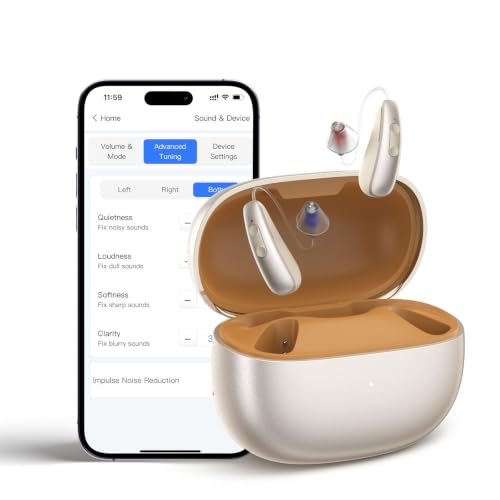
IP68 dust and water defense with Bluetooth 5.4 — built for sweat, rain, and drops.
The AuraLink is aimed at buyers who plan to move, sweat, and get caught in weather. The IP68 rating covers dust and water to a degree few aids on this list match. iBstone also states the aid is drop-tested and SGS-certified, and it ships with a UV-sanitizing charging case. For someone who wants to wear it on a run or on the golf course, that durability story is the reason to pick it.
Sound and connectivity are current generation. Bluetooth 5.4 provides faster pairing and better stability than older standards, with phone call and music streaming on both iOS and Android. The AuraFit app runs a hearing check, builds a precise fitting profile per ear, and adds tinnitus masking if you need it. The RIC body is lightweight and sits behind the ear with multiple dome shapes and sizes to choose from, so a secure fit that does not fatigue you is achievable.
One caveat worth knowing: the app’s suitability range is stated for mild to moderate hearing loss (25-85 dB HL). If your loss is outside that, or if noise-customization is what you need most, this is a middle-of-the-road choice — some owners found it sharp in tone, and the customization in noisy rooms did not hit the level they wanted. The UV case is a welcome touch that others on this list only add at the top tiers.
The active-life case: IP68 plus Bluetooth 5.4 plus a UV-sanitizing case.
What to size: best in a mild-to-moderate range; not the peak performer in heavy background noise.
Built for: the buyer who wants to run, cycle, or golf with an aid and not worry about rain or sweat ending the day.
Not built for: severe loss or buyers who need the clearest possible voice separation in the noisiest rooms.
11. Sennheiser All-Day Clear

A name-brand RIC built around a 24-hour rechargeable day and a discreet fit.
Sennheiser’s entry into OTC aids leans on what the brand is known for: tuning. The All-Day Clear uses a receiver-in-canal shape for a discreet fit, and the on-board processing adjusts to the room around you. FDA-cleared and self-fitting, it is tuned through the app in three steps without an audiologist visit. The rechargeable battery is quoted at up to 24 hours of continuous use, which is a generous ceiling for a body this small.
Comfort is the other reason it earns a slot. Sennheiser calls it a proven and modern take on the classic RIC design, and owner feedback tends to agree that it wears easily all day. The app walks you through a three-step tuning process, and Bluetooth supports hands-free calls, podcasts, and audiobooks on iOS or Android. A 30-day trial window is included, which takes the risk out of an OTC purchase that you cannot try in a clinic.
The honest caveat is durability of service after the sale. A couple of owners have reported one aid failing after about a year — just past the 12-month warranty — with the specific complaint that single-unit purchase and repair were not offered. The 30-day trial is worth using seriously, so you can find out whether the fit and tone work for you while return is still simple. The eartip supply has also been slow to restock at times, so order spares early if you like the fit.
Why it earns a place
- Up to 24 hours of continuous use per charge
- Self-fitting app setup in three steps
- FDA-cleared OTC with a 30-day trial
- Discreet RIC shell and an all-day comfort fit
What to weigh
- Single-unit repair after the 12-month warranty can be hard to arrange
- Ear tip restock has lagged at times
- Not the peak performer in very noisy rooms against Bose or Jabra options
Makes sense for: anyone who trusts the Sennheiser tuning name and wants a small, discreet RIC with a full-day charge.
Worth a pause if: you want a firm long-term repair promise — the 30-day trial is your safety net, so use it.
Know the Specs
Fit Style: CIC, RIC, and ITE
A CIC (completely-in-canal) shell sits deepest and hides best, which is why it carries the smallest battery and often skips Bluetooth. A RIC (receiver-in-canal) body sits behind the ear with a thin wire to the canal — still discreet, and roomy enough for buttons, app tuning, and streaming. An ITE (in-the-ear) shell fills more of the bowl of your ear, which means a bigger battery and bigger controls at the cost of visibility. Match the style to what you actually need to control: if you just want to hear better quietly, a CIC is fine; if you want phone calls and modes, plan for a RIC.
Battery Hours and Case Capacity
Two numbers matter: the hours per single charge and the extra charges in the case. The Yeasound RIC800 quotes up to 23 hours in hearing mode or 12 hours in streaming mode, and the case adds three more full charges. The Eargo SE runs 16 hours on a charge, with the case holding up to five cycles. The Lexie B3 quotes up to 32 hours per charge and 128 hours total. Always separate “hours in hearing mode” from “hours in streaming mode” — streaming drains a small battery faster than plain amplification does.
Water and Dust: IPX5, IPX8, and IP68
An IPX rating tells you how much water the aid survives. IPX5 is a splash-only rating. IPX8 means it can be submerged. IP68 covers both dust and water. The Yeasound RIC800 lists IPX8, the Cearvol Wave lists IPX5, and the AuraLink lists IP68. If you sweat heavily, play outdoor sports, or live somewhere humid, the higher rating genuinely changes how you wear the aid day to day.
Hearing Loss Level: Mild, Moderate, and Severe
Most of thesepicks are built for mild to moderate loss, which is the range most OTC aids target. The Audien Ion Pro 2 states it is for adults with mild to moderate loss. The AuraLink lists a 25-85 dB HL range. The Vivtone Xpure is best for mild to moderate loss and underpowered for severe. If your loss is severe, a tiny in-canal shell will run out of volume and you should look at a receiver-in-canal model with more gain headroom, or speak to a hearing professional first.
Common Questions
Will a completely-in-canal aid like the Eargo SE work if I have a very narrow ear canal?
Does a smaller hearing aid mean a weaker battery?
Can I stream phone calls through a hearing aid that sits fully in my canal?
Is a self-fitting hearing aid as accurate as a clinic fitting?
What is the difference between a hearing aid and a cheap personal sound amplifier?
How long should a rechargeable hearing aid last before the battery wears down?
Can I wear a small hearing aid while exercising or in the rain?
Do these tiny hearing aids work with an iPhone and an Android phone at the same time?
Will a hearing aid that fits in my canal make my own voice sound hollow?
Which model is the easiest to set up for someone who is not comfortable with technology?
The Bottom Line
For most people shopping for a smallest hearing aid, the Yeasound RIC800 is the pick. It packs 23 hours of hearing-mode battery, Bluetooth streaming on iOS and Android, five noise-reduction modes, and IPX8 water resistance into a shell that weighs just 0.088 of an ounce. That is rare: going small here did not mean going without Bluetooth or a full-day battery. If you want pure invisibility and can live without Bluetooth, the Eargo SE is the one to reach for — a one-gram completley-in-canal aid that sits out of sight. And for a discreet receiver-in-canal option with real audiology support behind it, the Jabra Enhance Select 700 is worth the step up.
How we choose
We do not accept paid placement. Every pick is matched to a real buyer and a real use-case; we do not hands-on test units.
Sources
Specifications: manufacturer listings and product documentation. Review insights: verified customer reviews, as of October 2026. Pricing: not shown on this page (it changes often); check the current price via the retailer link.
As an Amazon Associate, Aappliancez earns from qualifying purchases. This does not affect which products we feature.