Disclosure: Some links in this post are affiliate links. As an Amazon Associate I earn from qualifying purchases, at no extra cost to you. Learn more
Specs are compiled from manufacturer listings and verified buyer reviews and can change over time — please confirm the key details on the product page before buying.
You need a shoe that lets your foot feel the floor and pivot without dragging, and the ones that get this wrong turn a slow form into a fight with your own soles. Most tai chi classes happen on smooth wood or mats, so an ordinary running shoe with a thick, grippy tread works against you — it grabs the floor when your waist wants to rotate. What usually decides a good pair is a thin, flat sole, a flexible upper that lets your toes spread, and a fit snug enough that your heel does not lift on a weight shift. Below you will find the pairs that get those three things right, sorted from the all-round favorite down to the budget-friendly choices.
This guide is built by comparing the manufacturers’ published specifications and the patterns across verified customer reviews, so you get each pick’s real strengths and trade-offs instead of marketing spin.
A flat sole keeps you connected to the ground, a split toe sharpens your balance, and sizing from your measured foot length stops your heel lifting mid-form. This walkthrough of the shoes to wear for tai chi covers exactly those points so you can pick with confidence before class.
Top Picks


How To Choose The Best Shoes to Wear for Tai Chi
The wrong shoe shows up fast: a thick heel tips you forward and a stiff tread fights your first pivot. A thick heel tips you forward out of your stance, a stiff tread refuses to let your foot turn, and a roomy toe box lets your foot slide sideways on a single-leg balance. Match the sole to your studio floor and the toe shape to how your foot moves, and the rest follows.
Sole thickness and flatness decide your root
A tai chi shoe should sit you close to the ground, because the practice is built on feeling the floor through your foot. A thin, flat sole lets you feel where your weight sits, so a slow shift from one leg to the other stays stable instead of wobbly. A padded running sole lifts you off the floor and hides that feedback. Look for words like “flat,” “thin,” and “flexible” in the listing, not “cushioned” or “supportive.”
Tread and pivot — grip is not always your friend
Rooting wants grip and pivoting wants a clean release, so a deep lug tread that holds a mat can fight a turn on the ball of your foot. A high-traction rubber sole keeps you planted on a mat but can fight you when a form asks you to pivot on the ball of your foot. Some studios solve this by requiring cotton soles only, so check your class rules before you buy a rubber-soled pair. If your class allows rubber, a smooth, flexible tread tends to pivot more freely than a deep lug pattern.
Open toe or split toe
A split-toe design separates your big toe from the rest, which lets your toes spread and grip the floor — that is what the Japanese tabi shape does. It sharpens balance and ground feel, but it needs a break-in period and a matching split-toe sock. A closed canvas flat is easier to slip on and works fine if you just want a light, flat practice shoe.
Size from your foot length, not the label
Chinese and EU sizing on martial arts shoes does not line up neatly with US sizing, and the listings themselves warn that wide feet may need to go up. Measure your foot length in inches and match it against the brand’s own chart. If a listing only gives EU numbers, convert carefully and expect a snug fit; several of these shoes are meant to feel close to the foot.
Side-by-Side Comparison
| Model | Best For | Upper Material | Sole | Toe Shape | Amazon |
|---|---|---|---|---|---|
| Marugo Tabi Jikatabi MATSURI JOG 6★ Best Overall | Split-toe balance and outdoor training | Canvas cloth | Flexible sole | Split toe (tabi) | Amazon |
| Kung Fu Parkour Shoes (T.O.P ONE)Most Versatile | All-round practice and parkour grip | Canvas | High-grip rubber | Closed toe | Amazon |
| TOP ONE Original Kung Fu Shoes | Wide feet and daily wear | Cotton canvas | Rubber | Closed toe | Amazon |
| JiuQing Tai Chi Shoes | Barefoot-style training with cushioning | — | Soft bottom | Closed toe | Amazon |
| Leather Tai Chi Shoes (SNLMY) | Heel-to-toe rolling and zip-on fit | Leather | Rubber | Closed toe | Amazon |
| Embroidered Tai Chi Kung Fu Flats | Style and light indoor wear | Cotton-linen blend | Natural rubber | Closed toe | Amazon |
| Lightweight Breathable Martial Arts Shoes | Budget beginner pair | PU leather + Oxford | Oxford rubber | Closed toe | Amazon |
Detailed Reviews
1. Marugo Tabi boots MATSURI JOG 6
Our pick — 4.0+★ from 500+ verified ratings; the strongest balance of quality and price.
The split-toe tabi that lets your big toe work on its own.
Marugo has been making tabi since 1919, and this outdoor Jikatabi is the pair that gives you the most direct connection to the floor of anything here. The big toe is separated from the other four, which lets you grip a surface with your toes while you walk and gives you finer control over your posture and movement. If your practice is about balance and rooting, that split toe is the whole reason to pick it — the crowd favorite at 4.0+ stars across 500+ ratings.
The uppers feel like your foot is wrapped in a single layer of cloth, and the flexible sole lets your toes move freely. What wins people over is the build: the quality of the construction is the thing most praised, with comfort right behind it, and owners with wide feet single out the roomy fit. One long-form pair is described as lasting 2+ years of heavy daily gardening and rock work, with soles showing minimal wear — the cloth fades and softens, but the shoe holds. A buyer with a woman’s size 9 who ordered a 9.5 found the fit right with a little extra room for socks.
The honest catch is that the tabi shape has trade-offs. The sole is thin with minimal support, and the insoles are non-removable, so you would place any orthotic on top rather than under. Sizing runs mixed — some find them true to size, others say they run larger — and the split toe wants a matching tabi sock and a 24-hour break-in to feel right. Canvas soaks up water, so keep these for dry ground unless you treat them. The toe clasp earns the most grumbles, so treat the fastener gently.
What makes this the top pick
- Split toe separates your big toe so you can grip the floor and fine-tune your stance.
- Flexible sole and cloth-like upper give the closest floor feel in this list.
- Built to last — one pair went 2+ years of heavy daily outdoor work with minimal sole wear.
- Accommodates wide feet, and the side-tab closure is quicker than laces once you learn it.
The honest trade-offs
- Thin sole with minimal support; insoles are non-removable, so orthotics sit on top.
- Canvas soaks water and wants tabi socks plus a break-in period.
Made for: a practitioner who wants maximum ground feel, a split toe, and a shoe that handles an outdoor session as well as a studio.
Think twice if: you need arch support under the foot or you train in the rain — the thin sole and canvas upper both ask for care.
2. Kung Fu Martial Arts Parkour Shoes, Rubber Sole Sneakers
The class all-rounder that also grips a mat solidly.
This T.O.P ONE sneaker pairs a high-grip rubber sole with a breathable canvas upper, and the build quality is what carries it — the quality of the shoe is the clear standout, with comfort next in line and the value close behind. Owners use it for far more than tai chi: one mentions it works well for parkour, indoor soccer, and tai chi, and a fencing practitioner found size 11 US a perfect fit. That range is why it lands near the top here even though it uses a closed toe rather than a split.
The flat, thin, rigid sole is the part serious practitioners latch onto. One buyer who has worn a pair since October 2019 reports no abnormal wear, describing it as lightweight, tight, and flexible, and compares its durability to far pricier barefoot trainers. Longevity shows up again in the summary data, with pairs reported lasting up to 13 months of regular training, and traction earning its own praise for holding on all surfaces. Compared with the Marugo tabi above, you get more grip and more support around the foot, but you lose the split-toe ground feel.
Here is the follow-up question every buyer asks: what size do I order? The fit is the one weak spot. Multiple owners say to go up at least one full size — sometimes 1.5 — and a Wing Chun and tai chi practitioner found size 11 too tight and size 12 still snug at the toes. There are no half sizes, so if you sit between two numbers, take the larger one. The upside is that once sized right, owners describe excellent mat grip with no sliding and a shoe that stays low-impact on the mat.
Sizing is the whole game: order at least one full size up from your everyday shoe, and accept that there are no half sizes to fine-tune the fit.
Why it earns its spot: a flat rigid sole, breathable canvas, and grip that holds on a mat make it the do-everything pick for a tai chi student who also trains other styles.
Right for you if: you want one shoe for tai chi, parkour, and general training, and you are happy to size up.
Look past it if: a precise half-size fit matters to you, or you specifically want split-toe ground feel.
3. TOP ONE Kung Fu Shoes
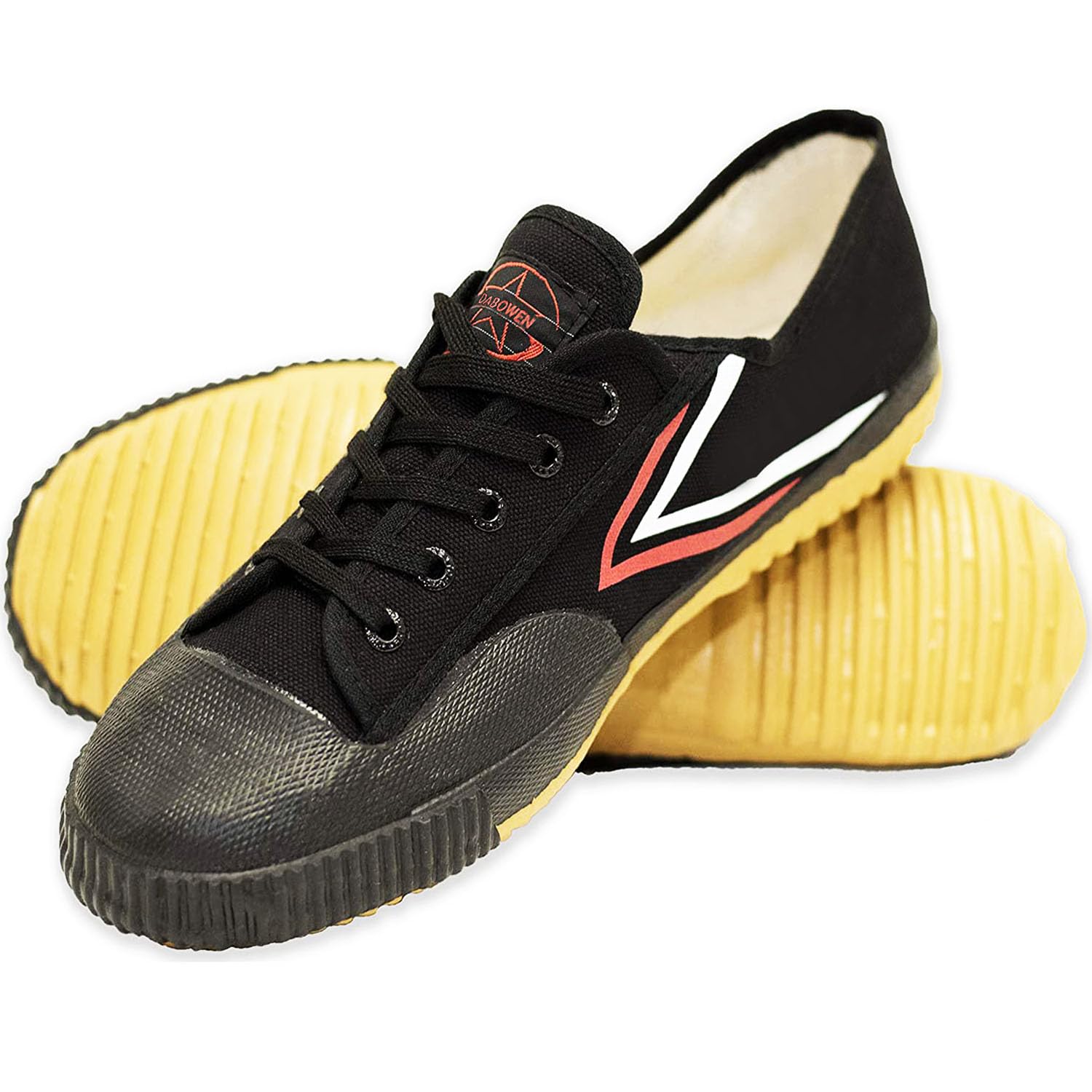
A roomy toe box for anyone whose feet get pinched.
If regular tai chi shoes squeeze your toes, this is the pair to look at. The cotton canvas upper and flexible rubber sole leave room for your toes to spread naturally, and a wide-footed owner who was introduced to them by a tai chi teacher now wears them every day, calling them the first shoes that do not pinch or rub. That same person keeps several pairs, some larger for winter socks — a practical sign the shape really is generous.
The look and the range are where this shoe earns its keep. The appearance is the most-praised trait, with versatility right behind it, and a long-time kung fu and tai chi practitioner who previously wore Feiyue calls these the best of that style found over the years. The sole stays snug without slipping once the shoe is on, and owners pack them easily for travel or a gym bag. Against the Marugo split toe, you trade that toe separation for a closed, roomier fit and easier all-day wear.
The catch is sizing on the small side. The fit is the mixed part of the picture — several owners note the shoe runs slightly smaller than expected, and one who normally wears an EU46 found even the largest 14M still too short. Another says the brand runs a half size smaller and narrower than other brands, with no give in the material. Order up if you are at the top of a size, and if you are between sizes, go with the larger number.
Why wide-footed practitioners like it
- Roomy toe box that lets toes spread — a genuine fit fix for wide feet.
- Cotton canvas upper breathes and stays comfortable for daily wear.
- Flexible rubber sole keeps things light while the shoe stays snug without slipping.
- Appearance is its most-praised trait, so it works for practice and everyday wear.
Where the sizing bites
- Runs slightly small and narrow versus other brands — order up.
- No half sizes; larger-footed buyers may run out of room at the top of the range.
Pick this one: if your feet are wide and closed-toe shoes usually pinch, and you want a light canvas flat for class and daily wear.
Skip past it: if you are at the very top of the size range — the largest sizes can still come up short.
4. JiuQing Tai Chi Shoes

A soft, barefoot-style sole built for Qi Gong and slow forms.
JiuQing markets this as a professional training shoe with better grip, cushioning, and shock absorption, and the soft bottom keeps you low and connected to the floor. It lands well for tai chi and Qi Gong — owners describe it as comfortable and stable for practice, and one who wears it for heavy-bag kicks says it is holding up well. It also comes with a 30-day free return service, which softens the sizing risk on an unfamiliar brand.
The standout practical detail is the published foot-length chart. Rather than guess at a conversion, you match your measured foot length in inches to the size — 9.84 inches maps to a 7.0 US Men, for example — and the listing asks you to measure manually. That is exactly the right approach for a Chinese-made martial arts shoe, and it beats guessing at a women’s-to-men’s conversion. The look earns its compliments too, and red is a popular choice.
The one caution is high traction on a spinning floor. One owner found the grippy sole grabs the floor and fights spin movements for taekwondo and tai chi, though the same shoe worked as a house slipper with a cushion insert. Weight and styling, that person liked; the tongue is short and can slip under the laces. If your class pivots a lot on the ball of the foot, that grip may work against you — for rooted, slow forms it is fine.
Sizing done right: measure your foot in inches and match the chart — no guessing at EU-to-US conversions. That alone saves a return.
Fit the practice to the floor: the traction is great for stability, but owners who do heavy pivoting found the sole grabs the floor. Check how much your class turns.
Reach for it: for Qi Gong and slow tai chi forms where you want a soft, low sole and a clear foot-length sizing chart.
Consider another pick: if your class pivots hard on the ball of the foot, where the high-traction sole may resist the turn.
5. Leather Tai Chi Shoes – Martial Arts & Kung Fu Boxing Shoes

The zip-on leather shoe built for heel-to-toe rolls.
This is the pair for someone who wants a glove-like leather upper and a smooth heel-to-toe roll rather than a barefoot flat. The design detail that earns praise is the sole rising slightly at the heel, which supports the heel-to-toe movement you do over and over in a long form. Owners describe it as stable on wood floors with no sliding, and a man who ordered his size calls the fit true and says he would buy them again.
Comfort is the reason to reach for leather here — the soft upper hugs the foot, the sole stays thin and flexible for positive floor feel, and the cushioning level is listed as moderate. The trade-off of any rubber-soled class shoe applies, so confirm your studio allows rubber. Against the Marugo split toe, you sacrifice the toe separation but gain a padded-in-feel upper and a heel that guides your roll.
Sizing is where this one divides opinion. Some measured their foot, ordered up from their usual size, and got a perfect fit; others found the size chart off, with one who needed a US 9 getting a 42 that was too big and a woman who ordered an EU42 finding it far too wide for her narrow foot. A few also take issue with how leather-like the upper feels, and the sole is a bright yellow that some find garish versus the photos. Treat the sizing chart as a starting point and measure your foot first.
The case for the leather upper
- Soft leather hugs the foot and the thin flexible sole keeps positive floor feel.
- Sole rises slightly at the heel to support heel-to-toe rolls.
- Stable, glove-like fit that does not slide on wood floors.
- Zip closure makes them quick to put on for class.
What to watch
- The size chart is inconsistent — measure your foot and expect to adjust.
- Some find the upper does not feel like real leather, and the sole runs bright yellow.
Best suited to: the practitioner who wants a leather-feel upper and a heel that rolls smoothly through a long form.
Hesitate if: you have a narrow foot or need a precise size — the chart is loose and the shoe runs wide.
6. Embroidered Tai Chi Kung Fu Shoes
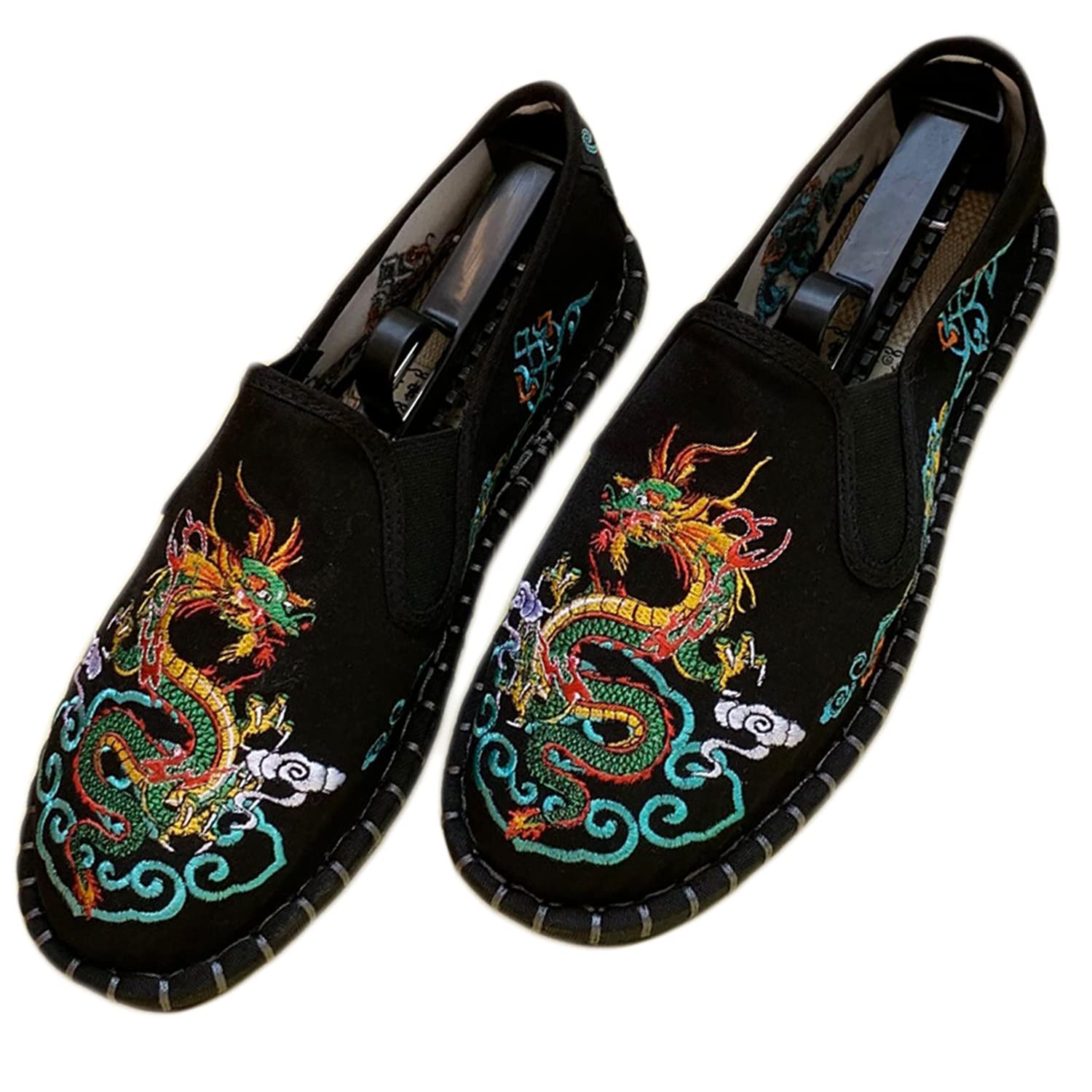
The embroidered flat that doubles as a slipper.
Made from a breathable cotton-linen blend with natural rubber anti-slip tread and a soft cotton lining, this Tinymori flat is the prettiest option on the list — and appearance is the trait it does best, with owners describing it as moccasin-like, well-made, and charming. People buy it as a house slipper as often as a practice shoe, and it does both jobs gracefully. For style and light indoor wear, that is the pitch.
The sole handles smooth wet wood floors with good grip and minimal slip risk, so it is stable for gentle forms. But there is one real compatibility check: because it has a rubber sole, at least one buyer found it was not allowed in their tai chi class, which required cotton soles. If your studio is strict about that, this shoe — and several others here — will not pass the door. Confirm the class rule before you order.
On fit, the shoe is snug. It is comfortable for a woman who typically wears an 8 wide, but only with very thin socks, and it runs wide and slightly large for others — plan to size down or expect roominess. If you order and it is not right, the maker is known for smooth service, issuing a full refund on a return and letting the buyer keep the item. Reach for it if you want something beautiful for home practice; look elsewhere if your class requires a plain cotton sole.
The studio-rule caution: rubber soles are not permitted in every class, so check the rule before you fall for the embroidery. A plainer cotton-soled shoe may be the safer route.
Sizing and wear: treat it as a snug fit — thin socks help — and enjoy it as a beautiful, moccasin-soft flat for gentle home practice.
Choose this for: a beautiful embroidered flat for home practice and daily wear, with soft cotton lining and natural rubber tread.
Pick otherwise if: your class bans rubber soles, or you want a precise, true-size fit.
7. Training Shoes

A featherweight starter pair that won’t break a budget.
This VGEBY shoe is the lightest, simplest way to get started: PU leather over oxford soles, a soft breathable build, and no laces to fiddle with — just pull them on. The maker lists a generous size run from 28 up to 45 for adults and kids, so it covers a household. For a first pair or a backup, that simplicity is the whole appeal, and owners who got the fit right describe it as fitting like a glove and being very flexible.
The traction earns its keep on a smooth floor — one owner who wears a US size 7 found size 40 fit great with lots of traction, and another wearing a 9.5 to 10 was happy with a 42. The shoe is light enough to pack and soft enough for the practice exercises the listing names. It is the budget option here, so set expectations accordingly: it is a starter shoe, not a dedicated split-toe or leather flat.
Two honest notes. First, sizing runs snug — the maker itself suggests going up a size or two if your feet are wide, and owners confirm the shoe fits close to the foot. Second, this is a lightly-reviewed newcomer, so there is less owner history to lean on than the class all-rounder above. If you are just trying tai chi and want a simple, cheap first shoe, it does the job; if you train seriously and want long-term durability, spend up.
A true starter pick: cheap, laces-free, and light, with a wide size run for a household. It gets you onto the floor without a big outlay.
Set the bar low: sizing runs snug and there is little owner history yet, so treat it as a begin-here shoe, not a long-haul one.
Go for it: if you are new to tai chi or kung fu, want a light slip-on pair, and want the leanest entry cost.
Spend up instead: if you train regularly and want durability and a proven fit — the T.O.P ONE sneaker has far more owner history.
Know the Specs
Sole Material
Most tai chi shoes use rubber for grip, but a plain cotton sole is required by some studios because it lets the foot pivot and slide with less resistance. Rubber gives better traction on a smooth mat or wet wood, but a high-grip tread can fight a fast pivot. Check your class rule first, then pick the material that matches the floor you actually practice on.
Split Toe vs Closed Toe
A split-toe (tabi) design separates the big toe from the rest, letting toes spread and grip the floor for finer balance and ground feel. The trade-off is a break-in period and the need for a matching split-toe sock. A closed canvas flat slips on faster and suits general practice, but your toes get less direct contact with the floor.
Upper Material
Canvas and cotton-linen uppers breathe well and stay soft, which suits long practice sessions in a warm room. Leather and PU leather hug the foot more closely and feel glove-like, but may need more care. Whatever the upper, a snug-but-not-tight fit matters, because a loose shoe lets your foot slide on a weight shift.
Sizing by Foot Length
Chinese and EU sizing on martial arts shoes does not map cleanly to US sizing, and the listings often warn that wide feet should go up. The most reliable method is to measure your foot length in inches and match it to the brand’s own chart. If only EU numbers are given, convert carefully and expect a close fit — these shoes are meant to feel snug.
Common Questions
Will a rubber-soled tai chi shoe be allowed in my class?
Should I size up in tai chi shoes?
Is a split-toe tabi shoe better for tai chi than a closed toe?
Can I wear tai chi shoes outside or as everyday shoes?
How long do tai chi shoes usually last?
Do I need special socks with split-toe tabi shoes?
Are tai chi shoes suitable for kung fu, parkour, or the gym too?
Can I put my own orthotic insoles in a tai chi shoe?
What is the difference between a leather and a canvas tai chi shoe?
Do tai chi shoes run true to size compared with my regular sneakers?
The Bottom Line
For most people, the best shoes to wear for tai chi is the Marugo Tabi Jikatabi MATSURI JOG 6, because the split toe and flexible sole give you the closest, most controllable connection to the floor — and the build quality is why it is the crowd favorite at 4.0+ stars across 500+ ratings. If you want one shoe for tai chi plus parkour or the gym, the Kung Fu Parkour Shoes carry far more owner history and a flat, rigid sole that serious practitioners trust, though you should order a size up. And if your feet are wide and closed-toe shoes always pinch, the roomy TOP ONE Original Kung Fu Shoes are the pair to reach for.
Two things to do before you buy: measure your foot in inches rather than guessing at a US conversion, and confirm your class allows the sole material you are choosing. Get those two right and any pick on this list will work on the floor.
How we choose
We do not accept paid placement. Every pick is matched to a real buyer and a real use-case; we do not hands-on test units.
Sources
Specifications: manufacturer listings and product documentation. Review insights: verified customer reviews, as of October 2026. Pricing: not shown on this page (it changes often); check the current price via the retailer link.
As an Amazon Associate, Aappliancez earns from qualifying purchases. This does not affect which products we feature.