Disclosure: Some links in this post are affiliate links. As an Amazon Associate I earn from qualifying purchases, at no extra cost to you. Learn more
Specs are compiled from manufacturer listings and verified buyer reviews and can change over time — please confirm the key details on the product page before buying.
You do not have to give up your dress shoes to save your feet. The fix is usually a thin insert that slides into a lace-up or loafer without crowding your toes or forcing you into a bigger size. The picks below range from a leather comfort pad for flats to a 3/4-length orthotic that fits Oxfords, and each one solves a different problem. What matters most is matching the insert’s thickness to the shoe, not chasing the biggest cushion.
This guide is built by comparing the manufacturers’ published specifications and the patterns across verified customer reviews, so you get each pick’s real strengths and trade-offs instead of marketing spin.
Dress shoes give you very little volume to work with, so a thin insert is usually the difference between a shoe you can wear all day and one that stays in the closet. This breakdown covers exactly that trade-off. I’ll walk you through the shoe inserts for dress shoes that fit inside slim formal footwear without wrecking the silhouette or squeezing your toes.
Top Picks

How To Choose The Best Shoe Inserts for Dress Shoes
Formal shoes are built tight on purpose, and the wrong insert turns a comfortable pair into something you want off by lunch. The goal is a pad thin enough to slide under your foot without lifting your heel out of the shoe or pressing your toes against the leather. The trick is finding that thinness without giving up the support you came for.
Thickness first, cushioning second
Check the listed thickness before anything else. A 3/4-length insert that only covers the back of your foot is easier to fit than a full-length model, because it never jammed under the toes. In a shoe with a snug toe box, even a few extra millimeters will change how the whole shoe feels.
Where the support actually sits
Some inserts are built around the heel and arch, while others target the ball of your foot. A leather pad that adds no real arch support helps with sliding and sweat but will not do much for a fallen arch. Read the description for what the pad is designed to support, then match it to what bothers you.
Material and moisture
Leather and perforated materials let sweat escape, which keeps a closed dress shoe from turning into a swamp by the afternoon. Synthetic foams cushion more but trap heat. If you wear the same pair through a long workday, a breathable top layer matters as much as the padding underneath.
Side-by-Side Comparison
| Model | Best For | Length | Top Layer | Listed Weight | Amazon |
|---|---|---|---|---|---|
| Spenco Rx Thinsole 3/4 Length★ Best Overall | Serious arch support in low-profile shoes | 3/4 length | Low-friction cover | 3.68 ounces | Amazon |
| Protalus T100 Thin SeriesTop Performer | Long shifts and all-day alignment | Full length | Moisture-wicking top | 4.8 ounces | Amazon |
| HANDARTE Leather Sockless Insoles | Sweaty feet and slip-on dress shoes | Full length | Perforated goatskin | 1.76 ounces | Amazon |
| pedag Comfort Leather 3/4 Inserts | Slim flats, sandals, and ball-of-foot pressure | 3/4 length | 100% leather | 1.23 ounces | Amazon |
| Plantar Arch Support Shoes Inserts | Budget arch support for casual shoes | Full length | — | 4.66 ounces | Amazon |
Detailed Reviews
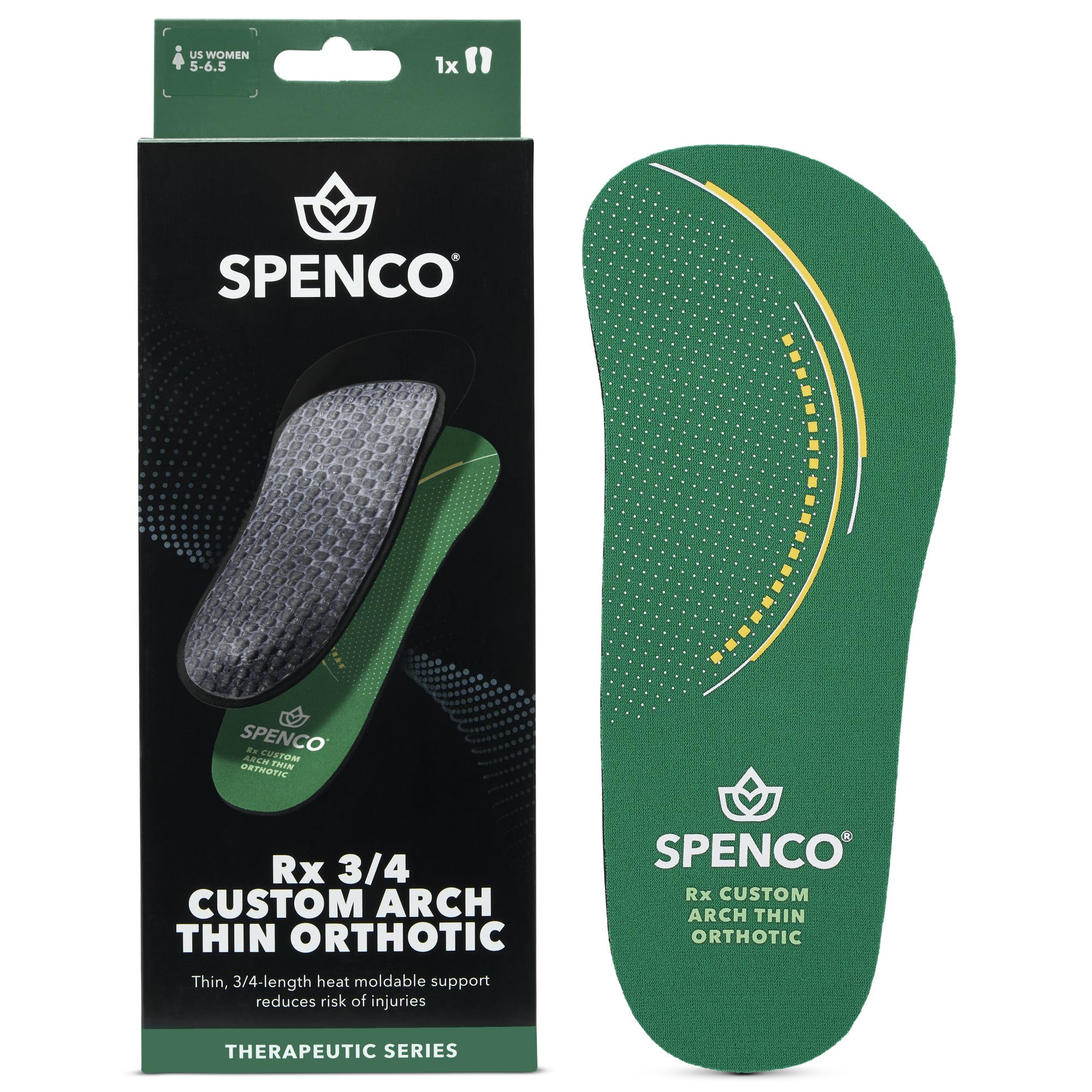
1. Spenco Rx Thinsole 3/4 Length Shoe Insoles
Our pick — 4.5+★ from 750+ verified ratings; the strongest balance of quality and price.
Real support that stops halfway down your foot — exactly what a tight Oxford can swallow.
The Spenco Thinsole earns the top spot because it solves the hardest problem in this category: giving a foot with an aching arch genuine support without filling up the shoe. It runs at 3/4 length, so it covers your heel and arch but stops short of your toes — that leaves the roomiest part of a dress shoe untouched. The cushioning is built around a material called Spencore, which is meant to soak up impact through long stretches of standing and walking. A low-friction top cover then reduces the rubbing between your foot and the insole that makes some dress shoes feel like a punishment by mid-afternoon.
The part that carries this pick is the customizable heel and arch plate. That is a stiff piece you can shape to match your own foot, so the support follows your arch instead of pressing in the wrong place. Owners describe them easing stubborn heel and arch pain and holding up to daily wear. One buyer has worn the same design since 2004 and notices the difference on days without them. Spenco also lists the insert as APMA accepted — a nod from the podiatric medical association — and backs it with 35-plus years of company history behind the design.
The catch is fit, and it is the most-discussed subject here. Several buyers find the insert too wide for slim shoes, and a handful note that it is simply too thick to stay comfortable in a close-fitting pair. This is a 3/4 insert for shoes that have real depth, so a razor-slim slip-on will want something flatter. Sizing runs Women’s 9-10.5 and Men’s 8-9.5 at 3.68 ounces, and it can usually drop into your shoe once the factory insole comes out.
What earns it first place
- Customizable heel and arch plate molds to your own foot shape
- 3/4 length keeps the toe box free in close-fitting footwear
- Low-friction top cover cuts rubbing under the foot
- APMA accepted and backed by a long track record from Spenco
Where it asks for room
- The wide footprint frustrates buyers with especially slim shoes
- Can feel thick in a shoe with minimal internal depth
- Support is concentrated at the back, not under the toes
Best for: anyone with arch or heel discomfort who wears structured lace-ups, loafers, or boots and can spare the depth.
Think twice if: your dress shoes are cut razor-close — the width is the one thing buyers push back on.
2. Protalus T100 Thin Series Patented Stress Relief Inserts
A full-length insert that thinks about your knees and hips, not just your heels.
What separates the Protalus T100 from the Spenco above is what it is designed to fix. The Spenco targets the arch outright, while the Protalus works on alignment: it supports the subtalar joint, which sits under the ankle bone, to limit the ankle rolling too far inward or outward. Fewer rolls means less stress passed up to your ankles, knees, and hips. The company calls its mechanism the Tri-Planar support system, and it works by using counter forces to line the ankle up with the heel. Protalus also claims a 31% improvement in ankle alignment over generic stock inserts — a manufacturer figure, not an independent test.
In practice, this is a full-length pad that fits running shoes, dress shoes, Oxfords, and casual styles like Vans and Sperry models. The combination of materials is built for impact reduction and moisture wicking. The quality is what keeps owners coming back: they describe the build as a step above cheaper drugstore pads, and durability shows up again and again, with one pair reportedly outlasting two to three sets of the typical alternative. One worker walking 8 to 9 miles a day on concrete across 10-hour shifts reported no foot pain, hot spots, or achy knees.
Honest note on the downside: this is the priciest pick on the list, and price is the subject buyers push back on. A few also feel the current version does not deliver the relief older versions did. It also runs heavier than a trim leather pad at 4.8 ounces, so it suits a shoe with some volume. Size this by the listed Women’s 6.5.
Why it stands out: alignment from ankle to heel is a different job from arch support, and the Tri-Planar design is the only pick here built around it.
What to know: the 31% alignment figure is Protalus’s own claim, and the price is at the top of the range — the relief is real for many, but the cost is the thing to weigh.
Reach for this one if: you stand or walk on hard floors for long shifts and want the cushioning to follow through to your knees.
Look elsewhere if: you are fitting a very slim shoe and need the flattest pad available, or you want the lowest-cost option.
3. HANDARTE Leather Sockless Shoe Insoles
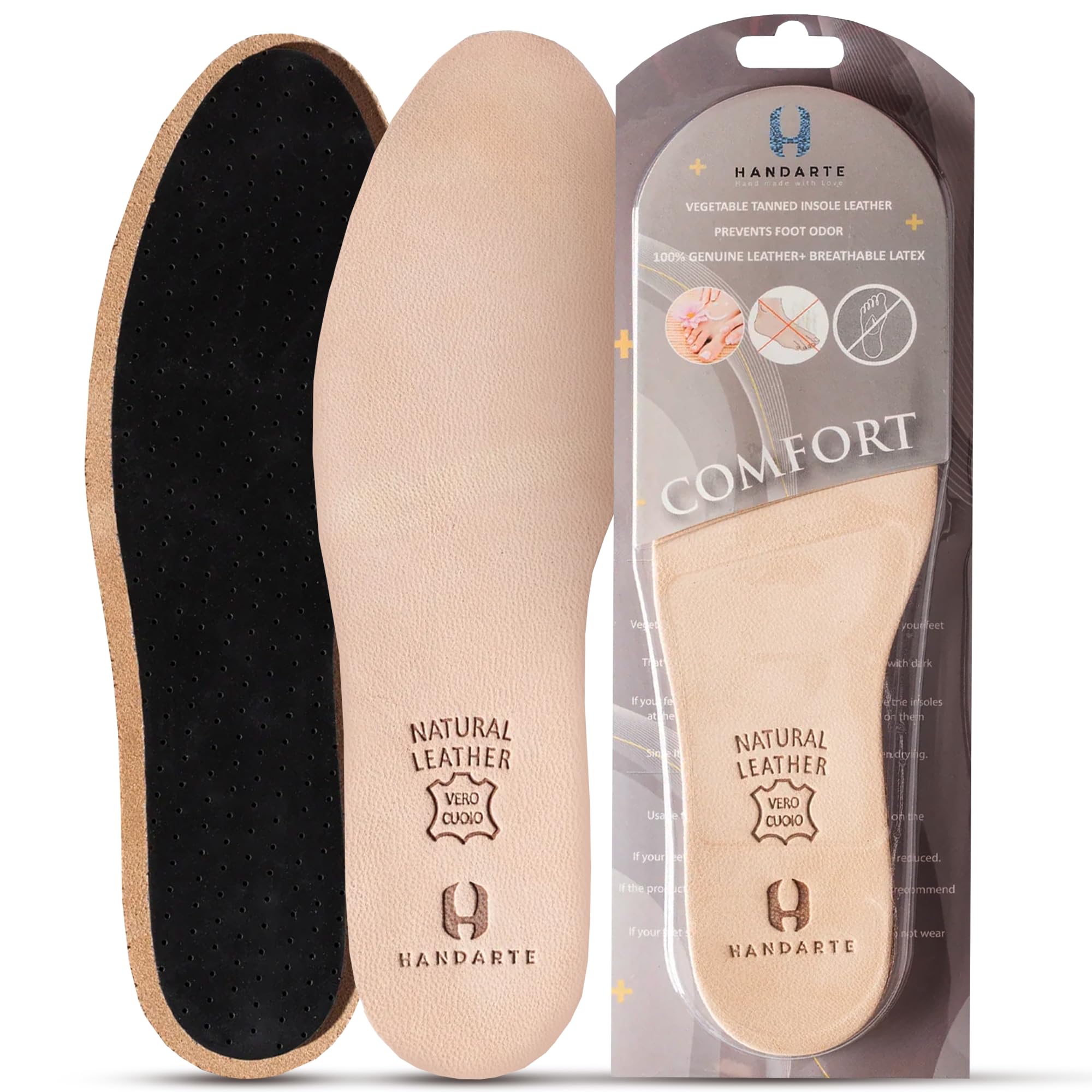
The thinnest pad here for feet that sweat through a closed leather shoe by noon.
If your issue is heat and moisture rather than arch pain, the Handarte is the pick to start with. It is built from 100% full-grain vegetable-tanned goatskin, perforated so air moves and sweat gets pulled off your foot instead of pooling under it. A layer of activated carbon hangs on to odor, and an anti-slip backing keeps the pad from creeping forward inside a slip-on. At 1.76 ounces it barely registers in the shoe, and the thin profile slots into loafers, flat-front dress shoes, and cowboy boots without tightening the fit.
Fit is the strongest signal in the feedback on this one — buyers repeatedly note the pad settles into place and stays there instead of bunching up under the toes. The leather surface is the second highlight: it feels like real hide, dries fast, and resists the plastic feel that synthetic insoles develop. Several buyers describe wearing theirs in size 6.5 cowboy boots and size 10 dress shoes with no trimming needed. That exact-shoe match is the thing to look for when you order.
There is one thing to note before you buy: this is a cushioning pad, not an orthotic. The toe area is cut narrow, and buyers with a wide, squared-off forefoot find it too tight in front. If that is you, order the largest size and trim the length down so the width works. The thinness that makes it so easy to fit is also why it will not shore up a fallen arch.
Where it wins
- Perforated goatskin moves sweat off the foot
- Activated carbon layer helps neutralize odor
- Ultra-thin 1.76-ounce build fits slim shoes without crowding
- Anti-slip backing keeps the pad planted in the shoe
Where it holds back
- Narrow toe box frustrates buyers with wide forefeet
- No arch support — it is a comfort pad first
- Durability is a fair question, with some noting it too early to judge
The right match: sockless wearers and anyone whose main complaint is damp, hot, smelly feet inside leather dress shoes.
Not the one for: a foot that needs arch correction — pick the Spenco or the Protalus instead.
4. pedag Comfort Leather 3/4 Inserts

Built for the ball of your foot, so ballet flats and strappy sandals stop burning.
The pedagogy here is specific: this 3/4 insert is shaped around the ball of your foot, with extra support at the heel. It covers the metatarsal arch — the pad just behind your toes — which is exactly where thin dress shoes and flats concentrate pressure. A real leather top layer is smooth against the skin, and a water-based adhesive on the bottom keeps the insert stuck to your shoe’s insole through sweat and constant on-and-off. At 1.23 ounces it is the lightest pick here, and it slips into flats, slip-ons, and strappy sandals without showing.
What wins people over is how well it works at that very specific job. It is handmade in Germany from natural materials and sized to fit US Women’s 6 through Men’s 13 (EU 36-46), with a note to size up if you sit half a size above the top number. Buyers with ball-of-foot pressure from narrow dress shoes on long walks report the pad softens it enough to get through the day. The pad is shaped to keep nerve pressure off the toes, and its adhesive holds it in place when you move it between shoes.
The fit is the thing to test carefully before committing, because the feedback here is genuinely split. Some buyers find the pad narrower than their shoe and want it slightly wider; others find the thickness too much for certain styles. It carries no meaningful arch support, so a foot that rolls or needs structural correction will not get it here. It also needs a little care — the leather absorbs moisture, so let it dry out between wears.
The honest read: this is a targeted pad, not an all-rounder — it does its best work under the ball of the foot and the heel, and nowhere else.
The one caveat: the adhesive is light, so open-heeled shoes and sandals may need a dab of extra glue to hold the pad steady.
Choose it for: flats, peep-toes, and slim sandals where ball-of-foot pressure is the daily annoyance.
Give it a pass for: a foot that needs arch support — this pad is shaped for forefoot relief and heel cushioning only.
5. Plantar Arch Support Shoes Inserts

An arch-support insert at the entry level — but sized for casual shoes, not dress pairs.
The Plantar Arch Support insert sits at the bottom of the range, and its 5 x 2 x 1 inch footprint tells the story before you put it in a shoe. That is a compact pad meant to slide under the arch of a wider, roomier shoe. Compare it with the pedag above, which measures 9 x 3.5 x 0.5 inches — the pedag is far longer and flatter, and the extra length is what lets it tuck into a slim flat without lifting your heel. The Plantar pad is also much heavier at 4.66 ounces versus the pedag’s 1.23 ounces, which is roughly 3.8 times the weight in the same corner of your shoe.
That weight and bulk are why this one is best treated as an entry-level arch option for trainers, work boots, and casual shoes. In a structured shoe with some depth, the pad fits inside and delivers the arch contact it promises. The honest limit is that buyers who tried it in a close-fitting pair found the support landed right on the sore spot when walking, and the fix did not work for them even after several tries. It is a good reminder that arch support has to match your foot shape, not just your shoe size.
Where this pick makes sense is as a low-cost way to test whether arch support helps your foot at all before spending more on a refined insert. It is built for plantar arch support by name and listed as unisex, with a model number of OKA-09-L. If it does not suit your foot, the Spenco’s customizable plate or the Protalus alignment design are the more serious alternatives to move up to.
Worth it for: a budget-conscious first try at arch support in roomy casual shoes or work boots.
Hold off if: you need it for a slim dress shoe — at 5 x 2 x 1 inches and 4.66 ounces, it is the bulkiest pad here.
Know the Specs
Length: 3/4 versus full length
A 3/4 insert runs from your heel to just past your arch and stops before your toes. That keeps the toe box free, which is why it fits tight dress shoes more easily. A full-length insert covers the whole footbed and gives more cushioning, but it needs a shoe with enough internal depth to hold it without squeezing your toes. The Protalus and Handarte are full length; the Spenco and pedag are 3/4.
Top layer material
Leather and perforated materials let moisture escape, which matters when your feet sit in a closed leather shoe for hours. The Handarte uses perforated goatskin, the pedag uses 100% leather, and the Spenco uses a low-friction cover designed to reduce rubbing. Gel and foam layers cushion more but trap heat. If sweat is your main complaint, a breathable leather top does more for you than extra padding.
Weight and listed dimensions
Lighter pads are easier to fit and less likely to change how the shoe feels underfoot. The pedag registers 1.23 ounces, the Handarte 1.76 ounces, and the Spenco 3.68 ounces — a big spread for something you will barely see. The listed dimensions tell you the shape: a longer, flatter pad like the pedag’s 9 x 3.5 x 0.5 inches suits a slim flat, while a shorter, blockier pad like the Plantar’s 5 x 2 x 1 inches wants a roomy shoe.
Arch support depth
Some inserts are shaped to press into your arch for structural support, like the Spenco’s customizable plate. Others, like the pedag and Handarte, add little to no arch support and focus on cushioning or pressure relief instead. Match this to what bothers you: a fallen arch wants a shaped support, while ball-of-foot pain wants a pad like the pedag that sits under the metatarsal area.
Common Questions
Will a 3/4-length insert fit inside a slim Oxford dress shoe?
Do these inserts replace the factory insole in my dress shoes?
What is the difference between arch support and metatarsal support inserts?
Will leather inserts make my feet sweat more or less?
How do I size an insert for a dress shoe?
Why do the pedag inserts sometimes need extra glue?
Where should a dress shoe insert end near my toes?
Do I need arch support if my dress shoes feel fine?
Can the same insert go between different pairs of shoes?
Will these thin inserts last through daily wear?
The Bottom Line
For most people buying shoe inserts for dress shoes, the Spenco Rx Thinsole is the pick to start with. Its 3/4 length keeps your toe box clear, its customizable heel and arch plate adapts to your own foot, and the low-friction cover cuts the rubbing that makes a formal shoe hard to wear all day. It has the strongest combination of real support and proven staying power in this group. If your problem is your knees and posture through long shifts, the Protalus T100’s alignment design goes further up the body. And if sweat and odor are the daily annoyance, the Handarte’s perforated goatskin handles that better than anything else here.
How we choose
We do not accept paid placement. Every pick is matched to a real buyer and a real use-case; we do not hands-on test units.
Sources
Specifications: manufacturer listings and product documentation. Review insights: verified customer reviews, as of October 2026. Pricing: not shown on this page (it changes often); check the current price via the retailer link.
As an Amazon Associate, Aappliancez earns from qualifying purchases. This does not affect which products we feature.