Disclosure: Some links in this post are affiliate links. As an Amazon Associate I earn from qualifying purchases, at no extra cost to you. Learn more
Specs are compiled from manufacturer listings and verified buyer reviews and can change over time — please confirm the key details on the product page before buying.
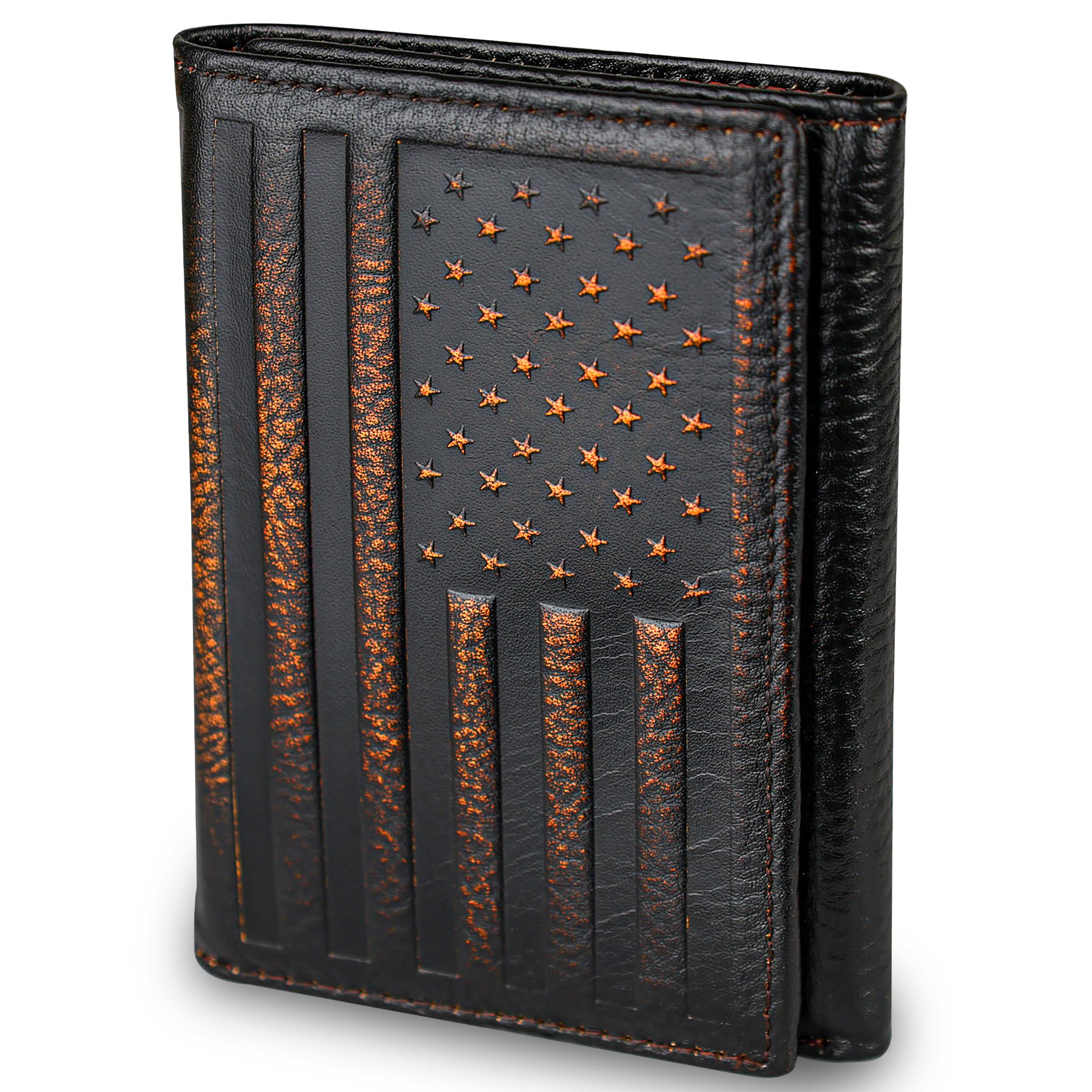
If you want the short answer, the DK86 USA Flag Trifold is the wallet most people should buy — full grain leather, a working RFID shield, and 8 card slots in a frame that weighs 0.15lb (70g). The rest of this list exists because a leather bifold man and a pop-up metal case man want opposite things from their pocket. Below, every pick is sorted by which of those two you actually are.
This guide is built by comparing the manufacturers’ published specifications and the patterns across verified customer reviews, so you get each pick’s real strengths and trade-offs instead of marketing spin.
What surprises first-time buyers is how thin these wallets run — a 12-card model can still vanish into a front pocket. What separates a keeper from a return is not the leather, it is whether the blocking layer covers your card slots or only part of them. That single detail is the whole game with any rfid wallet.
Top Picks

How To Choose The Best RFID Wallet
An RFID wallet is a wallet with a thin shielding layer built into it — usually a metal composite or a foil-like mesh — that stops the short-range radio signal a contactless card uses to talk to a reader. A scanner held near your back pocket gets nothing back if the shield sits between it and the chip. Everything else you read about wallets — leather grade, patina, stitching — matters, but it comes second to whether that shield sits where your cards actually live.
Where the shield is, not whether there is one
Nearly every wallet on this list says “RFID blocking,” but not all of them shield every slot. A wallet with an aluminum card chamber protects the cards in that chamber; the leather card slots on the outside may have no visible shielding mesh at all. That is fine if you keep your credit cards in the protected chamber and put business cards or receipts in the outer pockets. It is a problem if you assume every pocket is walled off. Read the listing for the words “RFID-blocking layer” versus “RFID-blocking chamber” — they describe two different levels of coverage.
Slot count versus comfortable slot count
Card slot numbers are honest but optimistic. A wallet listed with 12 slots will physically accept 12 cards on day one, but good leather is stiff at first, so the first few weeks feel tight. This softens as the leather breaks in. The practical read: buy a wallet with one or two slots more than you carry today, and leave the rest empty as breathing room. If you carry 9 or more cards plus cash, a leather trifold with a wide bill area is usually the safer shape than a slim metal case.
Pop-up cases and how you get cards out
A pop-up wallet keeps a stack of cards in an aluminum chamber and fans them out with a button press or a lever. It is genuinely faster than digging through a leather slot, and for anyone with stiff hands or arthritis the button does the work instead of your fingers. The trade-off is thickness: the aluminum body adds bulk. A pop-up that holds 10–14 cards still fits a front pocket, but it will not disappear the way a plain leather bifold does. Ask yourself which you use more — pulling one card out at a counter, or folding the whole wallet away and forgetting it.
The pocket you carry it in changes everything
Back-pocket carriers put pressure on a wallet all day, and a stiff aluminum case there can feel like sitting on a small brick. Front-pocket carriers want a flat, wide profile that does not print through trousers. Leather trifolds tend to suit back pockets; slim metal cases and magnetic money-clip designs tend to suit front pockets. Decide this before you shop, because it narrows the list faster than any leather grade will.
Side-by-Side Comparison
Read across the rows to see how each wallet trades card capacity against thickness and form. Every value comes from the maker’s own listing.
| Model | Best For | Card Capacity | Form / Closure | Weight | Amazon |
|---|---|---|---|---|---|
| DK86 USA Flag Trifold★ Best Overall | Everyday leather carry | 8 card slots | Tri-fold | 0.15lb (70g) | Amazon |
| Zitahli Top Grain Leather BifoldMost Card Space | Heavy card carriers | 12 card slots | Bi-fold | 8 ounces | Amazon |
| SERMAN BRANDS Trifold | Tri-fold loyalists | 11 card slots | Tri-fold | 0.13 kg | Amazon |
| furid Genuine Leather Smart Wallet | Metal-case conversion | 12+ cards | Bi-fold / Magnetic | 137 g | Amazon |
| GAOCHALE Pop Up Card Holder | Front-pocket minimalists | 10–14 cards | Tri-fold / Magnetic | 100 g | Amazon |
| QLD RFID Smart Pop Up | Badge and transit cards | Up to 11 cards | Tri-fold / Magnetic | 100 g | Amazon |
| BULLIANT Slim Leather Money Clip | Gift-boxed upgrader | Up to 10 cards | Slim / Magnetic | 0.15 kg | Amazon |
Detailed Reviews
1. DK86 USA Flag Trifold Wallet
Our pick — 4.5+★ from 950+ verified ratings; the strongest balance of quality and price.
A full grain leather trifold that survives the man who destroys wallets
Start with what this wallet is: a hand-burnished full grain leather tri-fold carrying 8 card slots — 6 card slides plus 2 storage/receipt pockets — along with a single bill compartment and an ID window with a thumbhole cut-out so your license slides out without a fight. It weighs 0.15lb (70g), light enough that you will not notice it sitting there. Full grain means the top layer of the hide, the strongest part, which is why the leather feels thick and develops a patina instead of flaking away.
The security side is a metal composite engineered to block 13.56 MHz and higher RFID signals — that is the radio band contactless cards use, so a scanner pressed near your pocket gets nothing back. Durability is what this wallet is really known for. Reviewers who burned through previous wallets in months report this trifold still going. As buyers put it, it has “outlasted all of them.”
Two honest notes. The leather starts stiff, so getting cards back out takes some thumb work in the first weeks — the recurring gripe is that cards go in easily and come out with effort. And a couple of slots sit tight until the hide relaxes. Neither is a defect; it is what a thick full grain wallet does before it molds to your carry.
What makes it the pick
- Full grain leather with hand-burnished edges, so no two look alike and the surface wears into a patina
- RFID shielding built on a metal composite that blocks 13.56 MHz and higher signals
- 8 card slots plus an ID window with a thumbhole for one-push license removal
- 0.15lb (70g) — light enough to forget in a front pocket
Where it asks patience
- Card removal is stiff while the leather breaks in
- No money clip or pop-up mechanism — you dig, you do not press a button
Buy this if: you carry 6 to 8 cards, like the feel of real leather, and want a wallet that outlives the one it replaces.
Think twice if: you want one-touch card ejection — a pop-up case below does that better.
2. Zitahli Top Grain Leather Bifold
For the person whose card collection will not fit anywhere else
Twelve card slots, two quick-access ID windows, and one bill compartment — this bifold is built for people who carry too much plastic and refuse to leave any of it home. Against the SERMAN BRANDS trifold below, it holds one more slot: 12 versus 11. That extra slot matters when your ninth card is the one that keeps getting left behind. The construction is genuine leather in either a smooth Nappa finish or a vintage Crazy Horse grain, and the whole thing measures 4.8 inches by 3.7 inches by 0.9 inches, which keeps it in front-pocket territory.
The security layer is a proprietary metal composite that blocks 13.56 MHz and higher RFID signals, so the contactless chip in your bank card stays quiet when a reader passes by. What wins people over here is the look. Reviewers describe a wallet that reads smarter than its price tier, and the pull strap for the debit card keeps your most-used card within thumb reach. The compact size is the other repeat compliment — as one buyer summed it up, it is not much thicker than the stack of cards they carry.
The genuine caveat is bulk once it is full. Wear after short use also shows up in a review or two. Treat 12 slots as the ceiling, not the daily target, and this wallet behaves.
Value read: a lifetime free replacement guarantee sits behind this one, which is a real answer to the durability worry — if it fails, the maker replaces it.
The fit question: this is the wallet for the person who genuinely needs 12 slots, and the wrong wallet for someone who wants a flat profile with three cards and cash.
The right call for: heavy card carriers who want leather, two ID windows, and a guaranteed replacement if the stitching ever gives.
Not the one for: minimalists — this bifold rewards capacity, not flatness.
3. SERMAN BRANDS Trifold Wallet for Men

The tri-fold the tri-fold faithful keep hunting for
Tri-folds are getting rare, and this one earns its place with 11 card slots, a clear ID window, hidden pockets, and dual thumb cutouts so your two most-used cards come out with a push rather than a pry. It holds up to 12 cards plus cash while measuring 4.5 inches by 3.3 inches when closed — a closed size that slips into either pocket. The leather is premium black full grain that darkens into a patina with carry, and the stitching is reinforced, which is what you are really paying for in a wallet that has to last years.
What stands out compared with the DK86 above is the cash handling. There is a dedicated cash divider that keeps bills separated and flat, plus an extra-long receipt pocket that tri-fold users specifically love — the kind of detail you only miss once you have lived without it. Buyers describe a wallet that looks and feels premium, holds a stacked deck of cards without ballooning, and keeps them easy to pull. One buyer who had burned through a “full grain” wallet in about a month noted this one “has held up for months now with no wear to it.”
The one consistent snag: the card slots start extremely tight, and a few buyers found them stiff for the break-in period. It also runs marginally wider than most tri-folds, which a buyer or two had to adjust to. Both fade with use. The 12-month warranty against manufacturer defects covers you if something real goes wrong.
Build verdict: full grain leather, reinforced stitching, a bill divider, and a 12-month defect warranty make this the most carefully assembled leather pick on the list.
Stiff for a while: expect to work the slots open over the first few weeks — that stiffness is the price of thick leather that holds its shape.
Reach for this if: you insist on a tri-fold, want a cash divider, and value stitching that holds up over years of folding.
Look elsewhere if: you need cards to slide out loose on day one — start with the QLD pop-up instead.
4. furid Genuine Leather Smart Wallet
Leather on the outside, aerospace aluminum doing the work inside
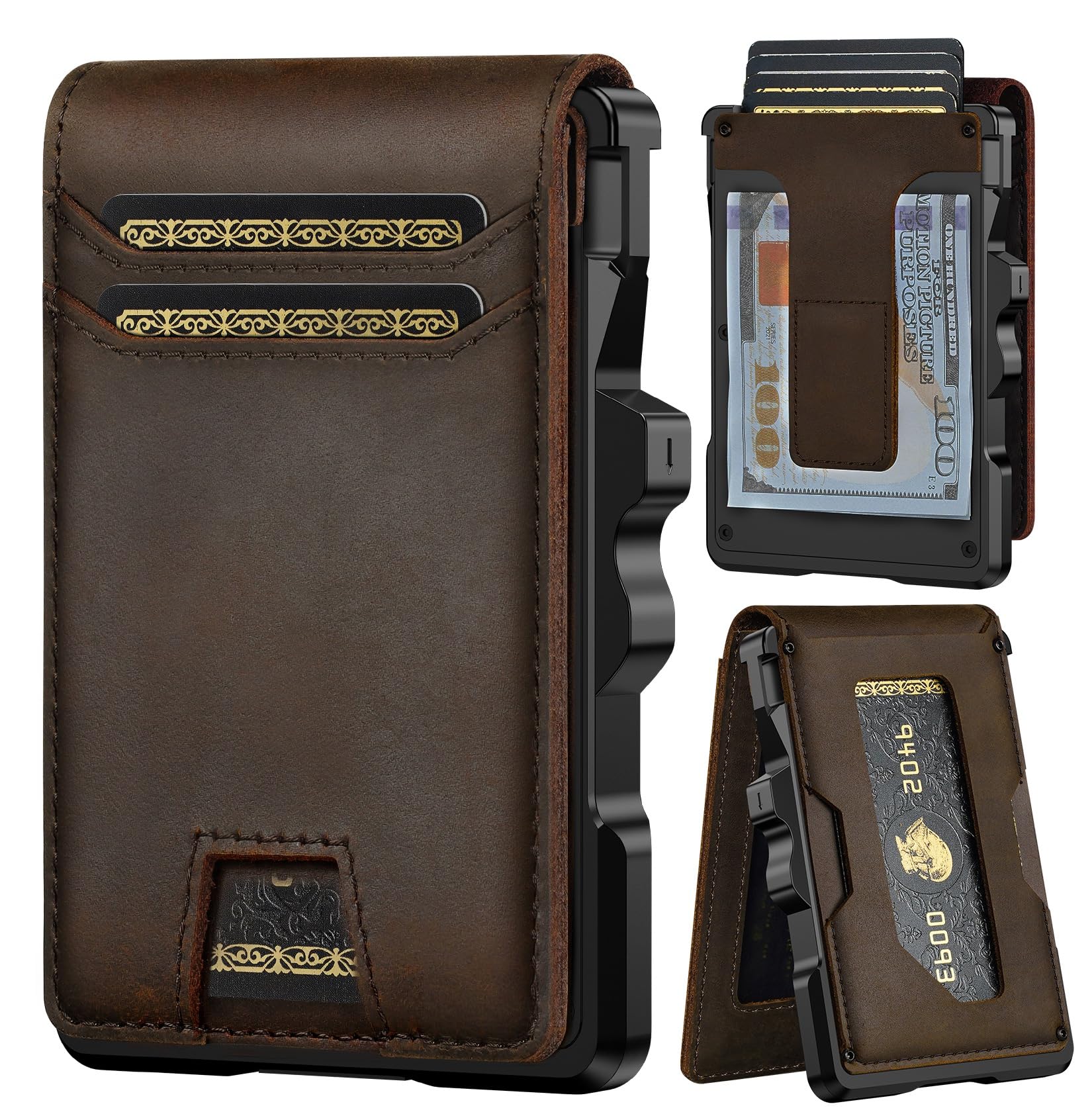
This is the pick for someone who wants pop-up speed but cannot give up the feel of real leather. A 7075 aerospace aluminum body holds the shape so the wallet does not warp or sag, and a side button fans the cards out so you can pick one with a single hand. Genuine full grain leather wraps it, and the leather cover adds 4–6 more card slots plus an ID window. Total capacity runs 12+ cards and 15+ bills, with the aluminum chamber taking 4–6 and a hidden magnetic money clip keeping cash put.
Against the BULLIANT further down, the structure here is the differentiator: the aerospace aluminum keeps the frame rigid where a leather-only pop-up softens. Card capacity is the second strongest thing about it — the wallet holds a full set with room left over, which is what owners bring up again and again. The magnetic clip also solves a small annoyance: no metal clip grinding against the inside of your pocket.
The honest weight note: at 137 g it is heavier and bulkier than a plain leather bifold, and buyers switching from one do feel that. Coverage is uneven by design — the pop-up chamber is shielded, but the outer leather slots do not have the same blocking layer, so keep credit cards in the chamber and business cards in the flaps. That is the main thing to understand before buying.
Why it converts leather people
- 7075 aerospace aluminum frame resists warping and keeps its shape
- Press the side button and the stepped slot fans cards for one-handed picks
- 12+ cards and 15+ bills in total, with a hidden magnetic money clip
- RFID-blocking layer over the card chamber, backed by a lifetime warranty
Know before you switch
- At 137 g it is noticeably heavier and thicker than a leather bifold
- Outer leather slots are not under the same shield as the pop-up chamber
Fits the buyer who: wants pop-up access and a money clip but refuses to carry plastic-looking metal.
The trade-off to accept: extra weight and bulk in exchange for that fan-out button — plain leather stays thinner.
5. GAOCHALE Pop Up Card Holder
A 100 g smart wallet that lives quietly in a front pocket
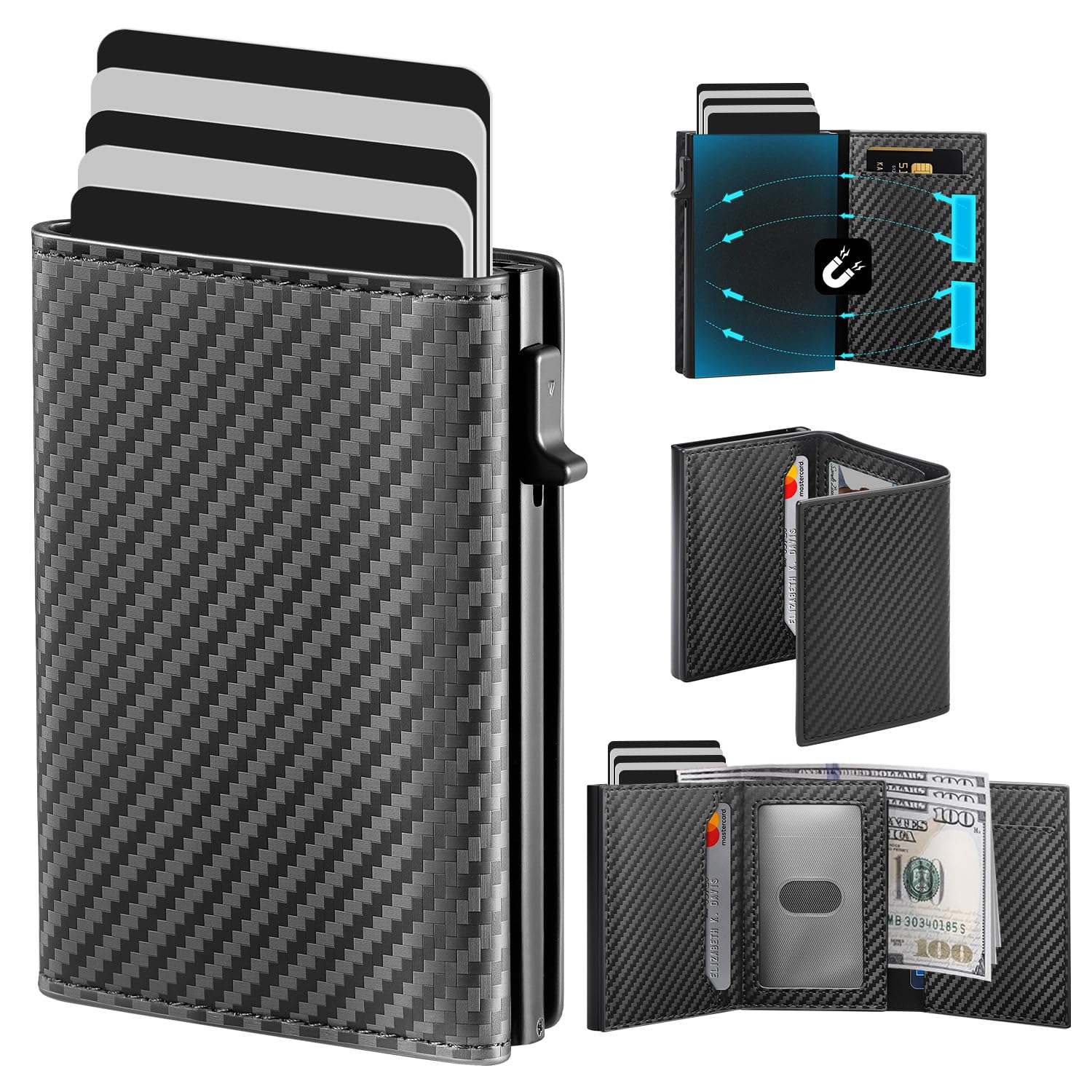
At 100 g and 3.93 inches by 2.76 inches by 0.65 inches, this is one of the slimmer pop-up wallets here, and it carries 10–14 cards with an ID window and a separate cash slot for 10–15 bills. The button reveals your go-to cards at your fingertips, and the full grain leather outer absorbs your natural oils over time, softening into a personal patina. For travel, it is the wallet you swap in to stop sitting on a brick in a back pocket all day.
What is worth knowing is how well it takes a beating. Buyers report it surviving a 17-foot fall off a roof with the pop-up mechanism still working. The pop-up mechanism stays smooth, and people who carry it daily come back to say the movement has held up over a year of use. The carbon fiber-look face is the other thing people point to — a modern look without the all-metal case.
The main trade-off is capacity versus expectation. It does not swallow every card, and the closure and thickness draw some mixed feedback once stuffed. Size the carry to essentials and it stays flat and clean. Its bill pocket is the other spot to watch — fine for a few folded notes, not a fat stack.
Durability read: the mechanism holding up over a year of daily carrying is the thing to weigh here, more than the leather.
Capacity caution: treat 10–14 cards as the absolute ceiling; this wallet stays flat because it does not overstuff, not because it can.
Best for: front-pocket carriers who want pop-up speed in a light leather shell and travel with just the essentials.
Skip if: you carry a fat stack of bills or every loyalty card in your drawer.
6. QLD RFID Smart Pop Up Wallet
Built around a badge slot you can swipe without pulling the card
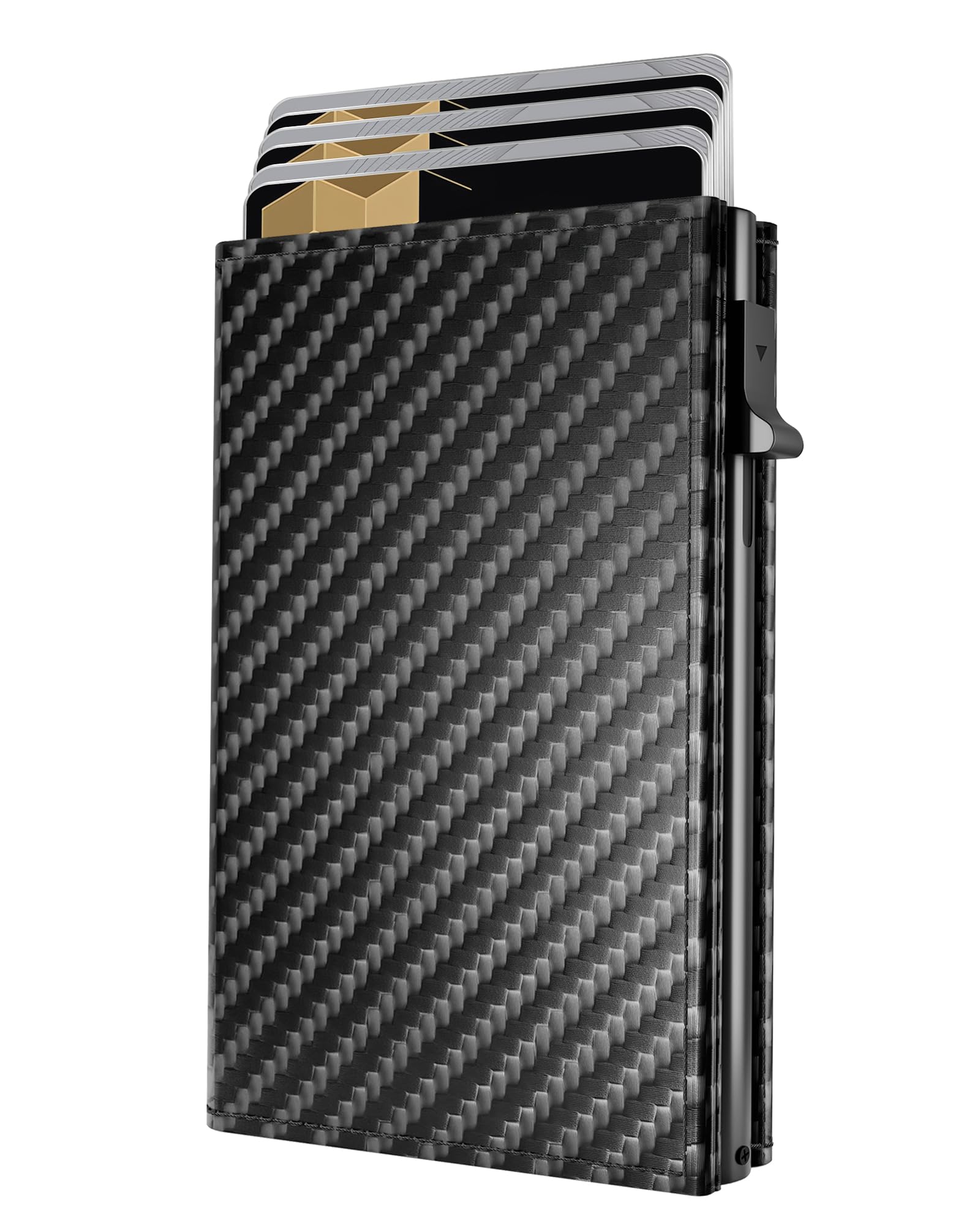
The feature that separates this wallet is the dedicated ID slot made for swiping a work badge or transit card without removing it. The rest of it is a slim wallet that holds up to 11 cards, a cash slot for up to 15 bills, and a lever-based pop-up mechanism where a gentle button press fans your cards while a smart lever stops them tumbling out. A metal shell blocks 13.56 MHz and higher RFID signals, and the build pairs cowhide leather with aircraft-grade aluminum, weighing 100 g.
Slimness is what buyers keep returning to. It fits a front pocket, a back pocket, or a side pocket, and it takes the bulk out of a pocket that used to sag. The card slot uses a pull-down quick access motion that is easy on the fingers, and several owners mention buying a second one for a family member. For commuters who tap a travel card or badge dozens of times a day, the swipe-without-removal slot is the whole reason to own it.
The honest limit is shielding coverage. The aluminum compartment blocks reliably, but the leather card slots do not carry the same visible shielding mesh, so treat the outer slots as storage and not as protected card space. The aluminum body will also scratch and dent with hard contact over the years — cosmetic, not structural. Neither issue is a defect; both are the result of a hybrid frame.
The commuter advantage: a badge slot you swipe in place saves the repeated in-and-out motion that thins a leather slot over years.
The one thing to know: cards in the aluminum chamber are shielded — cards in the outer leather slots are not, so park your bank card in the protected side.
The one to grab if: you swipe a badge or transit card constantly and want a slim shell with a lever that keeps cards from spilling.
Pass on it if: you want every slot shielded — a leather-only trifold covers your cards more evenly.
7. BULLIANT Slim Leather Money Clip
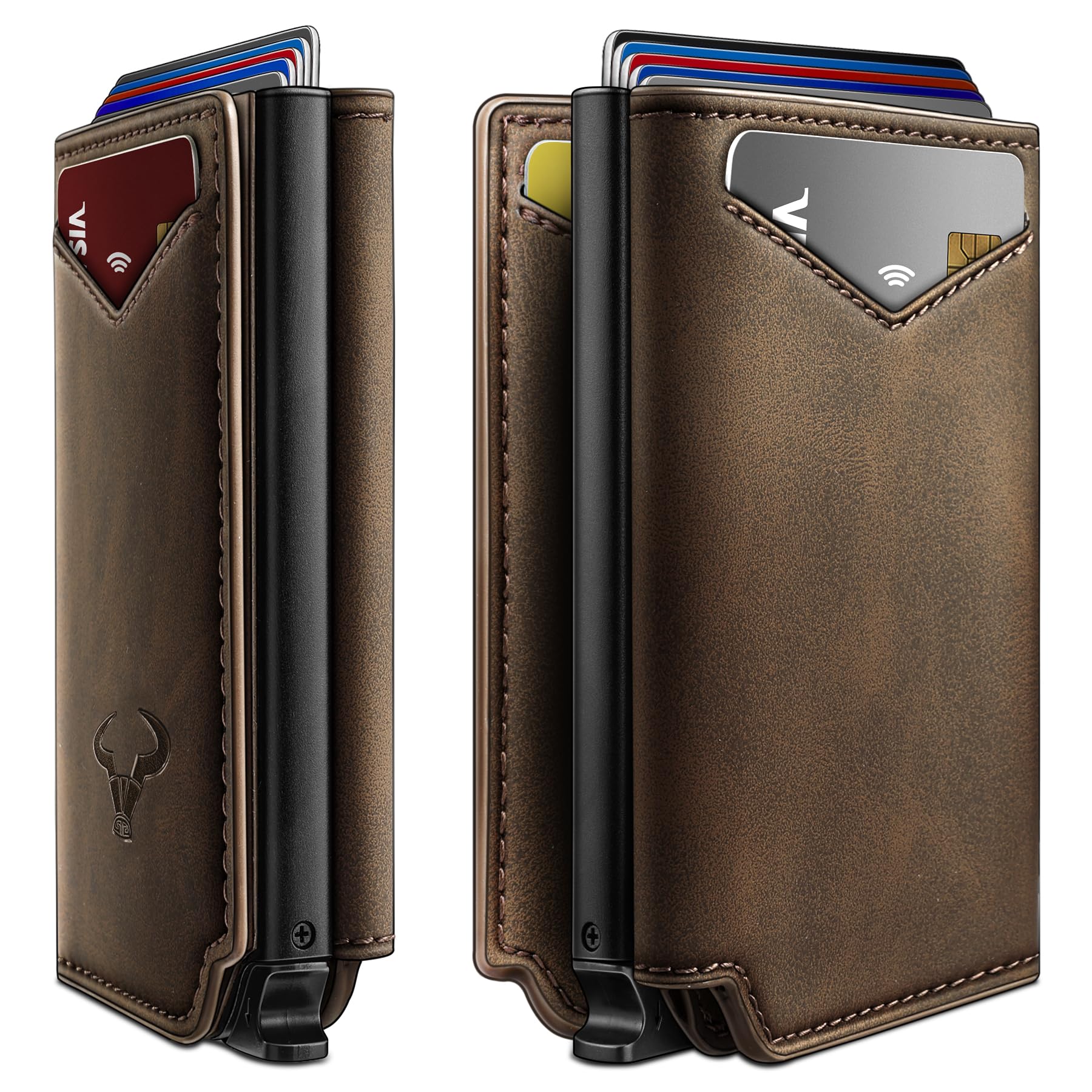
Gift-boxed leather that upgrades a back-pocket carry without shocking it
Up to 10 cards, an ID window, and a bill compartment live inside this leather wallet, and the exterior card slot keeps your go-to card at hand while a flip page holds bills flat. The pop-up structure releases cards with a button press, and the magnetic flip cover snaps into alignment with the card slots so it never loosens over time. RFID-blocking technology across the card area protects your card data, and the whole thing arrives gift-boxed — the kind of present that reads as thought-through without being loud.
For anyone upgrading a back-pocket wallet, the capacity is what sells it. Customers note squeezing a serious deck of cards plus an ID and cash inside, and the cards stay put even when the wallet is full. The leather look and the magnetic close are the two things that separate it from a plain bifold — the flip cover aligns itself, so there is no struggle to close it with one hand.
The trade-off to plan for is thickness. A wallet that swallows 10 cards gets noticeably thicker than an old thin bifold, especially in a back pocket, and one or two people found the outer slots tight at first. Wanting it slimmer with a heavy load is a common note. If you sit on your wallet all day, this one wants breaking in.
Where it wins
- Up to 10 cards plus an ID window and bill compartment in a leather shell
- Magnetic flip cover aligns itself to the slots and holds the close
- Pop-up card structure for one-press access
- RFID protection and gift-boxed packaging for a clean handoff
Where it feels heavier
- Gets thick with a full load, which can feel bulky in a back pocket
- Outer card slots start tight and need some break-in
Made for: the friendly upgrade — leather look, magnetic close, and gift boxing in one package.
Stay with a bifold if: you hate any thickness in a back pocket; this one carries more and feels it.
Know the Specs
RFID Blocking
An RFID-blocking layer is a thin sheet of metal composite or mesh that stops the short-range radio signal a contactless card uses — typically 13.56 MHz and higher, the band bank cards and IDs operate on. Blocked correctly, a scanner held near your pocket gets no card data. Where the layer sits is the thing to check: a wallet may shield its aluminum card chamber but not the outer leather slots, so park your bank card in the protected chamber and put receipts and business cards in the flaps.
Card Capacity and Slot Count
Card capacity is the maximum the wallet will accept, not the number it carries comfortably. A wallet with 12 slots takes 12 cards on day one but gets tight as leather stiffens or the aluminum chamber fills. The practical rule: buy one or two slots above what you carry today, and let the rest stay empty. A leather trifold with a wide bill area suits a heavy card load better than a pop-up case, which becomes thick and less stable once pushed to its limit.
Common Questions
How do I know an RFID wallet actually blocks scans?
Will a pop-up wallet hold my thick or old cards?
Is a leather RFID wallet or an aluminum pop-up case more secure?
Can a pop-up wallet fit in a front pocket?
How long does a full grain leather wallet last?
Do RFID wallets wear out the blocking layer over time?
Should I carry my wallet in a front or back pocket?
Can I keep my transit or work badge in an RFID wallet?
Is a pop-up wallet harder to use with stiff hands?
What is the difference between top grain and full grain leather?
The Bottom Line
For most people, the strongest rfid wallet buy on this list is the DK86 USA Flag Trifold, because full grain leather that outlasts the wallet it replaces, 8 card slots, and a metal-composite shield at 0.15lb (70g) is the balance most buyers want. If card capacity is your priority, the Zitahli holds 12 slots against the SERMAN’s 11. And if you swipe a badge all day or want pop-up speed in a front pocket, the QLD Smart Pop Up earns its spot with an in-place ID slot.
How we choose
We do not accept paid placement. Every pick is matched to a real buyer and a real use-case; we do not hands-on test units.
Sources
Specifications: manufacturer listings and product documentation. Review insights: verified customer reviews, as of October 2026. Pricing: not shown on this page (it changes often); check the current price via the retailer link.
As an Amazon Associate, Aappliancez earns from qualifying purchases. This does not affect which products we feature.