Disclosure: Some links in this post are affiliate links. As an Amazon Associate I earn from qualifying purchases, at no extra cost to you. Learn more
Specs are compiled from manufacturer listings and verified buyer reviews and can change over time — please confirm the key details on the product page before buying.
You want a machine that cuts the ditch bank and the steep back slope without you pushing, slipping, or risking a rolled ankle — and the picks below split cleanly into two camps. Cordless remote-control mowers let you stand back with a joystick and drive the deck into places a walk-behind cannot go. Wire-free robot mowers drive themselves on a schedule, but they map your yard and work alone, which suits flatter, tidier ground better than a rutted hillside. Which one is worth buying depends entirely on how rough and how steep your grass actually is, and that is the first thing this guide sorts out.
This guide is built by comparing the manufacturers’ published specifications and the patterns across verified customer reviews, so you get each pick’s real strengths and trade-offs instead of marketing spin.
Tracks, wheels, and slope ratings are where most shoppers get lost, so we break down what each number actually means on your ground before you commit. Every pick listed here earns its place in a practical remote control track mower shortlist for steep, awkward, or oversized lawns.
Top Picks
How To Choose The Best Remote Control Track Mower
The single biggest mistake buyers make here is assuming every “remote control mower” works the same way. It does not. A joystick-driven crawler and a self-driving robot mower are different tools for different yards. Decide which job you actually have before you read a single spec.
Slope rating is the number that decides everything
A slope rating is simply how steep a hill the machine can climb without losing grip, written as a percentage or in degrees. On the Mowrator S1 that figure is 37° (75%), while the ZIPmow all-wheel-drive mower lists 30° and the iBaeggs unit claims up to 45° under dry, low-speed conditions. If your bank is steeper than the rating, the mower will slide, not climb — so match that figure to your worst slope first, and read every other spec second.
Tracks versus wheels versus robot drive
Rubber tracks spread the machine’s weight over a wide footprint, which is why the AIWEIYA crawler can hold a line on soft pasture and waterlogged ground where a wheeled unit digs in. All-wheel drive on smaller units is a lighter compromise for gentle ditches and tree roots. A wire-free robot mower trades that raw grip for hands-off scheduling, and typically tops out around 45% to 84% slope depending on the model’s motor and suspension.
Runtime and battery capacity in plain terms
Look at two figures together: amp-hours (Ah — how much energy the battery stores) and runtime in minutes. The Mowrator’s 18Ah pack is rated for up to 2.25 hours and 1.125 acres per charge. Most compact remote mowers ship dual 3Ah batteries rated for up to 60 minutes, which is a shorter window. If your lot is large, runtime per charge — not top speed — is what stops you walking back for a recharge.
Cut height range and what it means for your grass
The gap between minimum and maximum cut height tells you what grass types the deck can handle. The AIWEIYA’s 1.1 to 5.9 inch range covers tall, overgrown pasture, while the ZIPmow’s 2 to 3 inch window is built for maintained lawn only. Tall fescue or St. Augustine needs a higher setting to avoid scalping, so check the top of that range before you buy.
Side-by-Side Comparison
| Model | Best For | Cut Width | Slope Rating | Runtime / Drive | Amazon |
|---|---|---|---|---|---|
| Mowrator S1 4WD 18Ah★ Best Overall | Steep, dense, large properties | 21 inches | 37° (75%) | 2.25 hours / 4WD wheels | Amazon |
| AIWEIYA Track MowerToughest Climb | Rough pasture and reed cutting | 21.6 inches | 45° (100%) | Gas-electric hybrid / rubber tracks | Amazon |
| Husqvarna 410iQHands-Off Half Acre | Hands-off half-acre mowing | 9.4 inches | 45% | Robot / wire-free EPOS | Amazon |
| ECOVACS Goat A2000 LiDAR PRO | Complex yards with edges | 3.6 inches | — | 50 minutes / robot drive | Amazon |
| Segway Navimow X430 | All-wheel-drive robot on uneven ground | 17 inches | 84% (40°) | Robot / Xero-Turn AWD | Amazon |
| WORX WR320 Vision Cloud | Shaded, tree-heavy half acre | 8.7 inches | 30% | 60 minutes / robot 2WD | Amazon |
| ECOVACS Goat O1000 RTK CARE | Entry-level quarter acre | 8.66 inches | — | 90 minutes / robot drive | Amazon |
| ANTHBOT M9 | Small yard, multi-zone control | 7.87 inches | 45% | Robot / dual vision + RTK | Amazon |
| Neomow X2 SE | LiDAR mapping without RTK | 11 inches | — | 3 hours / robot drive | Amazon |
| ZIPmow A106-RC | Light, low-cost remote mowing | 18 inches | 30° (40%) | 60 minutes / AWD wheels | Amazon |
| iBaeggs RC Mower | Seniors and gentle slopes | 3 inches | 45° | 60 minutes / AWD wheels | Amazon |
Detailed Reviews
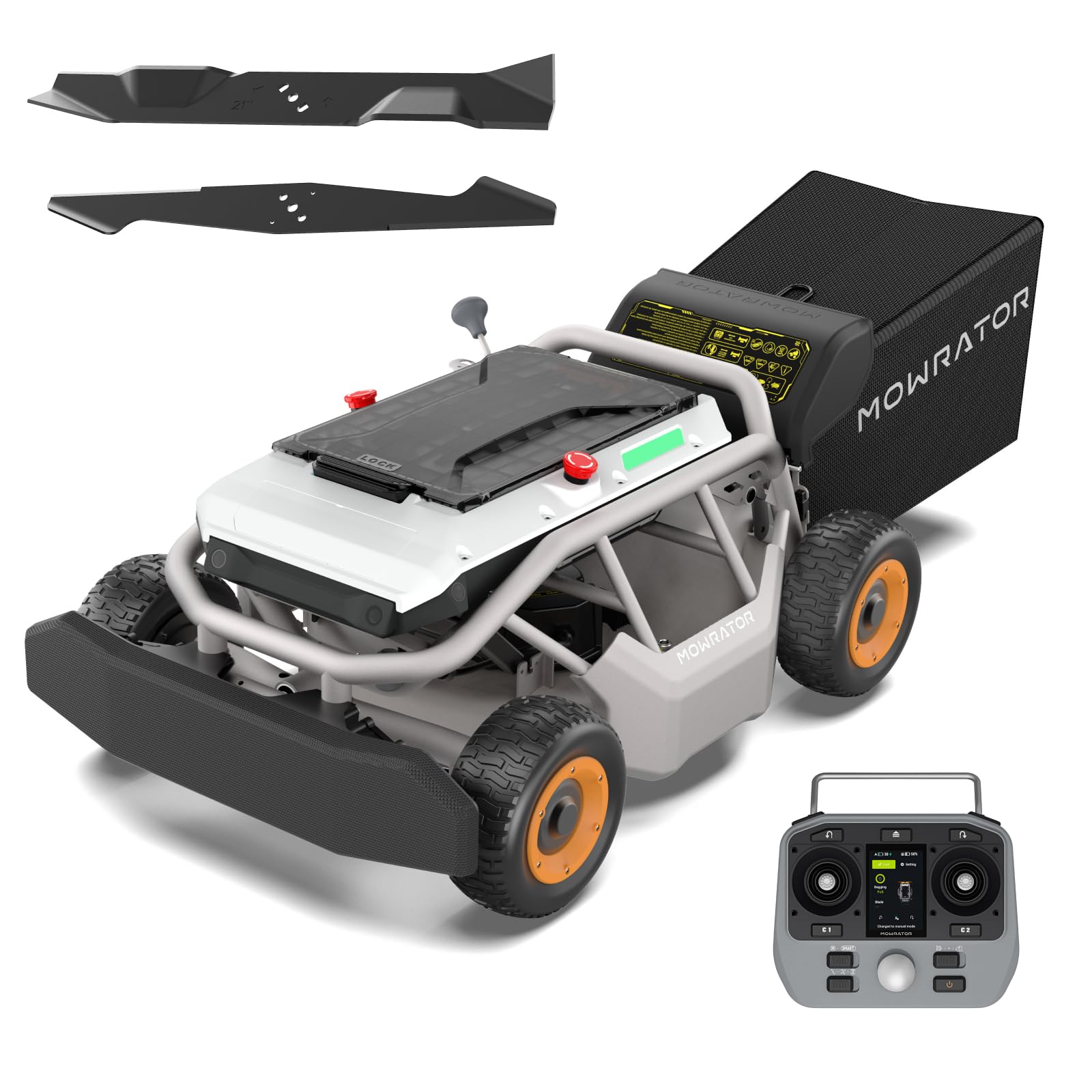
1. Mowrator S1 4WD Remote Control Lawn Mower
Our pick — 4.5+★ from 50+ verified ratings; the strongest balance of quality and price.
The tracked-terrain workhorse that climbs 37° banks and still goes home to a 90-minute recharge.
If your lawn is a ditch bank, a pond edge, or a steep wooded slope where a push mower has no safe answer, this is the machine to look at. It earns the top slot on pulling power plus a wide deck: a 1000W four-wheel-drive system (all four wheels drive it, so it grips instead of spinning) with a blade motor that peaks at 1985.6W, spinning up to 3200 RPM. That pairs with a 21-inch cut, so you cover ground fast.
The battery side is sorted too. A 56V 18Ah LiFePO4 pack (a lithium battery that holds its charge longer than older types) covers up to 1.125 acres per charge with up to 2.25 hours of runtime. The included 600W charger refills it in 90 minutes, so a big lot does not turn into an all-day recharge loop. Buyers report it clearing dense six-foot invasive grass on steep rocky ground roughly ten times faster than string trimmers. Buyers also praise how well it works on sloped front yards, and owners mention the build feels like a heavy tool, not a toy.
The honest catch is weight and turf manners. At 147.7 pounds it is 84 pounds heavier than the Segway Navimow X430 robot, and its cutting width of 21 inches runs 4 inches wider than that 17-inch robot deck. That heft buys grip, but the four-wheel drive can tear turf on tight turns — so treat slow, deliberate arcs on manicured lawn, and let it work the rough stuff where it shines.
What stands out on the spec sheet
- 21-inch cut with a blade motor peaking at 1985.6W and up to 3200 RPM for dense grass
- 56V 18Ah LiFePO4 battery covers up to 1.125 acres and recharges in 90 minutes
- 37° (75%) slope capability for banks and ditches
- Low-latency remote with response times as low as 5 ms — no RTK setup or app required
- Three mowing modes: mulching, rear discharge, and bagging
Where it asks something of you
- 147.7 pounds is a two-person lift for storage or transport
- Four-wheel drive can rip turf on tight turns — slow down on thin lawn
- Snow plow, tow hitch, and FPV camera are optional add-ons, not included
Buy it for: big, steep, overgrown ground where you currently wrestle a string trimmer.
Hold off if: your lawn is small and manicured, since the 147.7-pound frame and aggressive grip are more machine than you need.
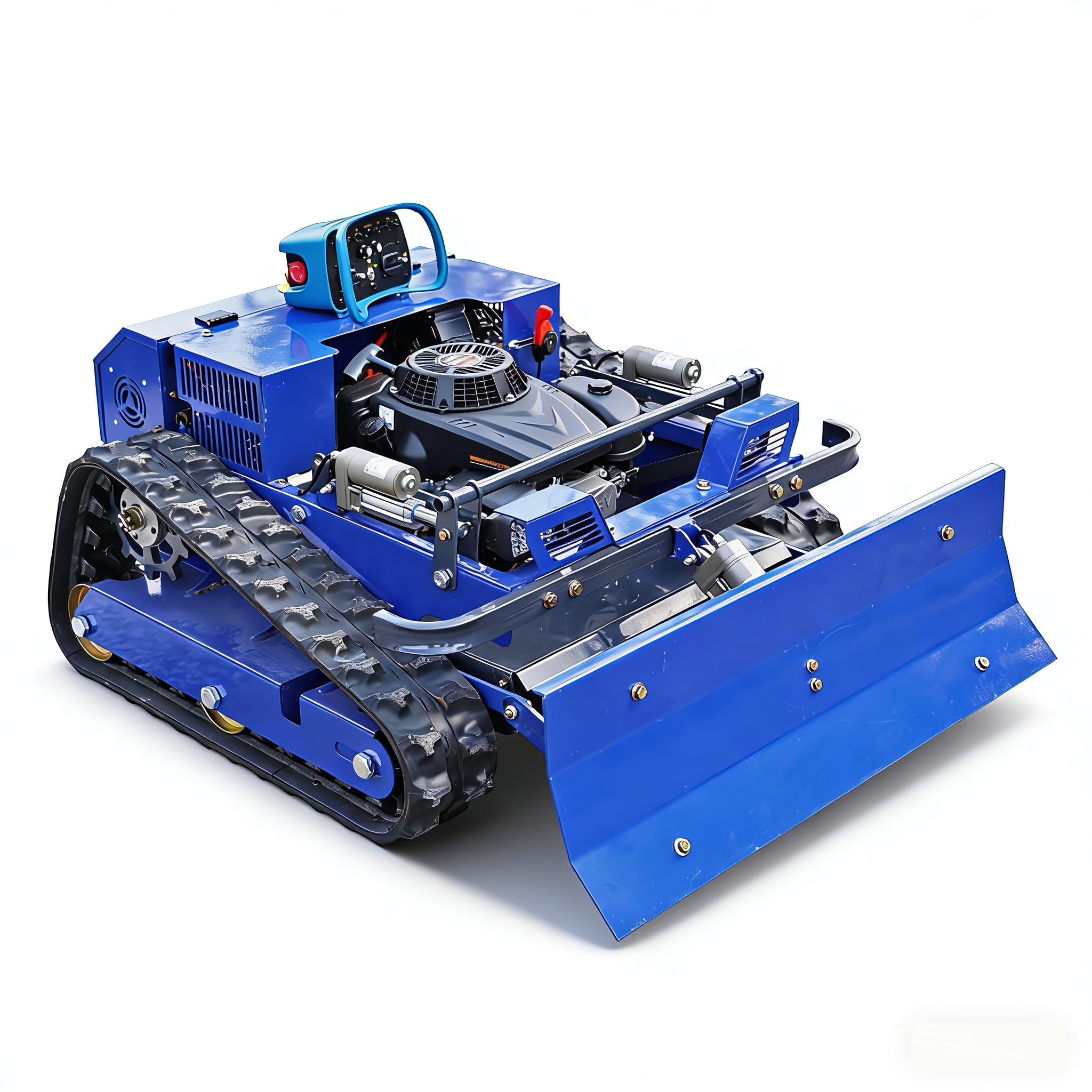
2. AIWEIYA Remote Control Lawn Mower
Rubber tracks, a 1600W brushless motor, and a 45° rating for ground you would not walk across.
If your property includes star thistle pasture, a reed-filled bank, or a hillside too steep to stand on safely, this is the machine built for exactly that. The 1600W 24V permanent magnet brushless motor drives through a gearbox for torque, and the rubber tracks spread weight wide so it holds a line on soft, waterlogged ground where wheels spin out. The cut height swings from 1.1 to 5.9 inches at the press of the remote — enough range for overgrown weed tops down to a normal lawn pass.
First, it is a hybrid: it carries gas and oil as well as electrics, and the climbing power genuinely shows on steep grades. Second, this is a heavy, purpose-built crawler, and it behaves like one — the tracks will mark a finished lawn, so it is a rough-terrain tool, not a striped-lawn showpiece.
Where it earns its keep: the 45° (100%) slope rating (it can climb a bank that steep without sliding) and 21.6-inch cut let it clear banks and brush in one pass. The two-piece manganese blade (a tough steel blade in two parts) leaves a fine finish on grass once you are on flatter ground.
The trade-off to plan for: the fuel tank is small. It runs dry in roughly 15 minutes when it is powering the alternator and mowing hard, so plan your refills. Setup instructions are thin too, so expect a YouTube session to learn the remote and the breaker switch.
Reach for it when: your worst slope is a genuine 45° climb and you want track grip plus a wide 21.6-inch cut.
Think twice if: you want a polished lawn finish or long runs between refuels — the tracks mark turf and the tank is small.
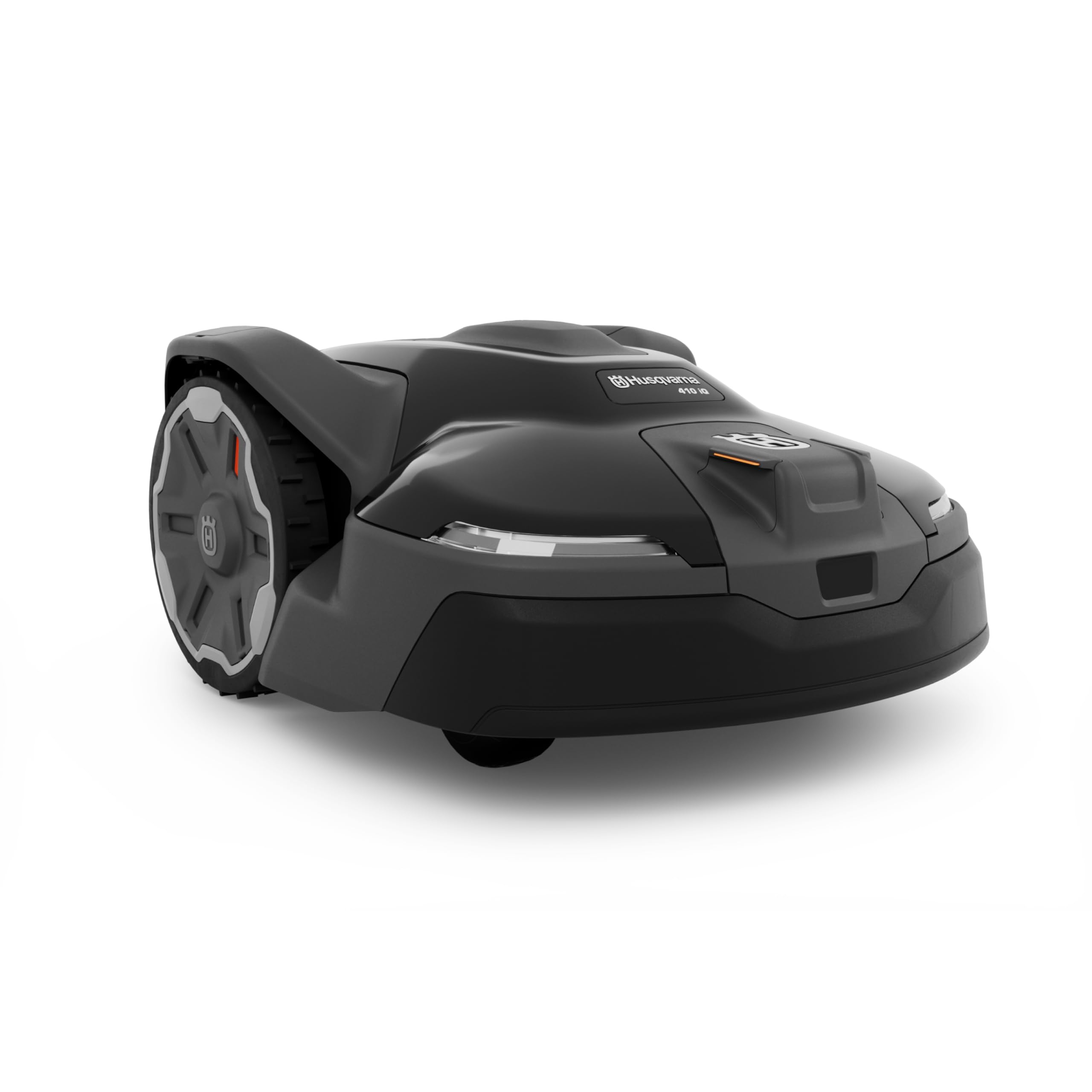
3. Husqvarna 410iQ ½ Acre Wire-Free Robot Lawn Mower
Set the schedule once and this one cuts the half acre on its own, no perimeter wire in the dirt.
Here is the pick for the buyer who does not want a joystick at all — who wants to map a lawn once and let a machine handle it on a schedule. The 410iQ uses Husqvarna’s EPOS (Exact Positioning Operating System) for centimeter-accurate location without boundary wire, plus an onboard radar to steer around obstacles. It handles slopes up to 45% across up to half an acre, and the 1 to 4 inch cut range is wide enough for a tall fescue lawn you have let grow a little too long.
The payoff shows up in time, not excitement. Owners describe it automating the weekly mow and saving hours each month, with consistent cuts and rain-pause-and-resume scheduling in the app. The app also handles pattern changes — random, striped, or checkerboard — cutting height, and software updates. A built-in anti-theft alarm with GPS tracking backs it up.
What you must respect is the sky. EPOS relies on satellite positioning, and on tight suburban lots with buildings on both sides of the house, the signal can fade where you need it most. One honest reality: a yard with heavy tree or building cover can defeat it entirely, so walk your property and note the open-sky patches before you commit. It also needs a careful first install — getting the transport path and reference point placement right, per the manual, is the difference between a smooth dock and a struggling one.
The time-saver case: a wide 1–4 inch cut range, 45% slope handling, and a hands-off schedule make weekly mowing a background task rather than a chore you plan around.
The sky-dependent catch: EPOS needs open satellite view, so a narrow, building-flanked suburban lot can leave it searching for a signal — survey your property’s open patches first.
Best suited to: a relatively open half acre where you would rather schedule the mow than drive it.
Look elsewhere if: your lawn is hemmed in by buildings or dense tree canopy that blocks satellite view.
4. Segway Navimow X430 Robot Lawn Mower
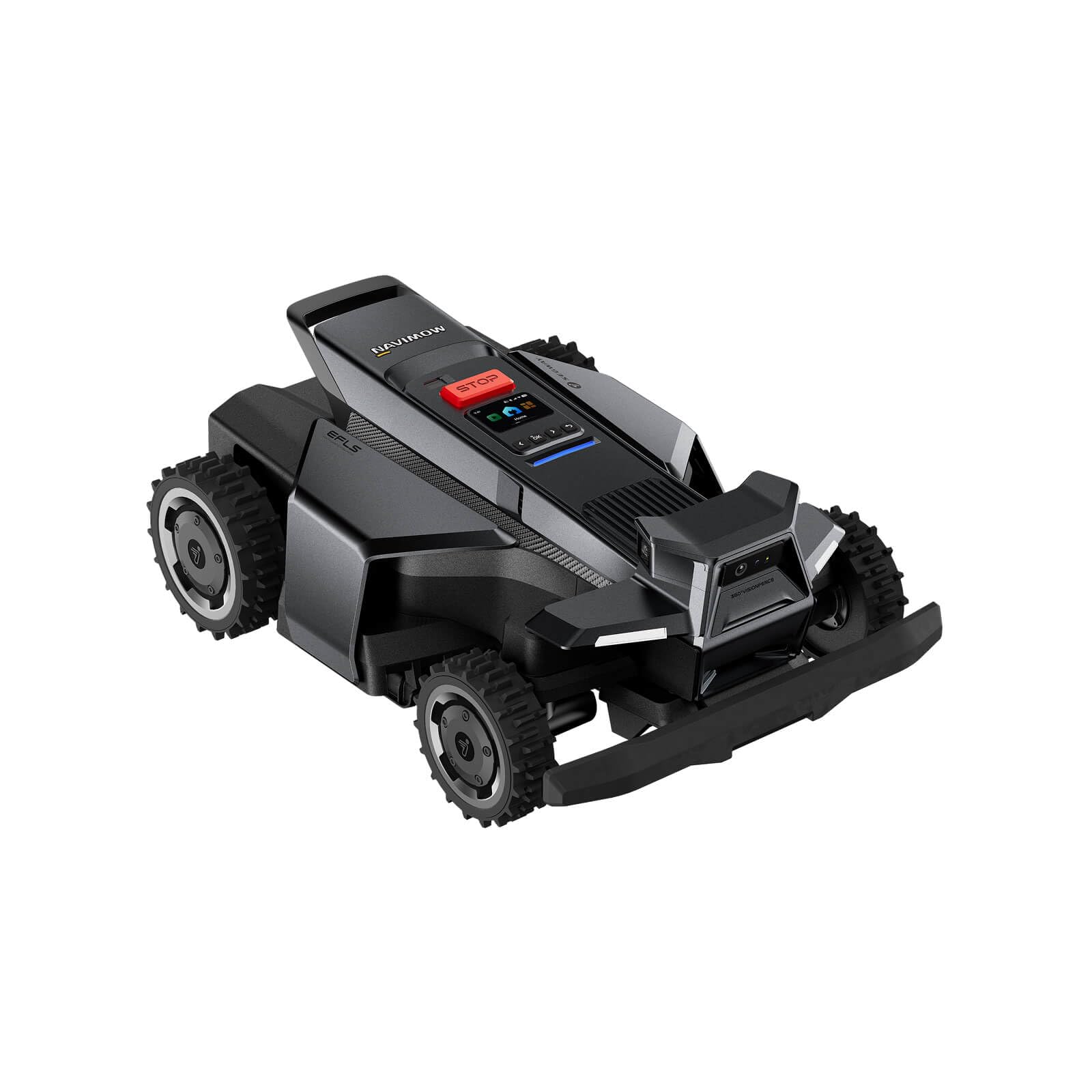
An off-road-tuned robot that climbs 84% slopes and crosses 2.8-inch obstacles without a perimeter wire.
For a rolling yard with ditches or curbs, this robot is the one that keeps its footing. An ORV-tuned dual suspension system lets it climb slopes up to 84% (40°) and cross obstacles up to 2.8 inches, while Xero-Turn all-wheel drive with eccentric front-wheel steering steers without scuffing the grass. At 63.7 pounds it is 84 pounds lighter than the Mowrator S1, and it cuts a 17-inch swath — 4 inches narrower than the Mowrator’s 21-inch deck.
Cutting comes from dual 180W motors driving two discs with 12 blades, and EdgeSense trims margins to under 2 inches. Setup is wire-free with one-tap Auto Mapping, and there is no antenna to install. The standout is how reliably it performs across uneven, wet, or narrow ground — the navigation and obstacle sensing hold the line under trees and along fences.
Two settings decisions shape your experience. First, it mows slower than a rider and can leave grass uncut in a single pass — plan on two passes for a thorough cut. Second, firmware updates do not apply automatically, so reboot the mower after each one; owners who did found straight, clean lines, while a neglected update caused veering and false obstacle alerts. Running in the heat of the day also triggers shutdowns above about 92°F in direct sun, so schedule early or late.
Why it holds a hillside
- ORV-tuned 4WD climbs 84% slopes and crosses 2.8-inch obstacles
- Xero-Turn steering minimizes turf scuffing and tearing
- Dual 180W motors drive 12 blades across a 17-inch cut with EdgeSense under 2-inch margins
- One-tap Auto Mapping with no antenna or perimeter wire
What to set up right
- Firmware updates are manual — reboot after each one or navigation drifts
- Can leave grass uncut in one pass, so budget two passes
- Shuts down in extreme midday heat above roughly 92°F in direct sun
Pick this for: a sloped, obstacle-strewn lawn where you want a robot that does not get stuck.
skip it if: you need a single-pass, wide-deck cut — this one favors steady coverage over speed.
5. ECOVACS Goat A2000 LiDAR PRO Robot Lawn Mower
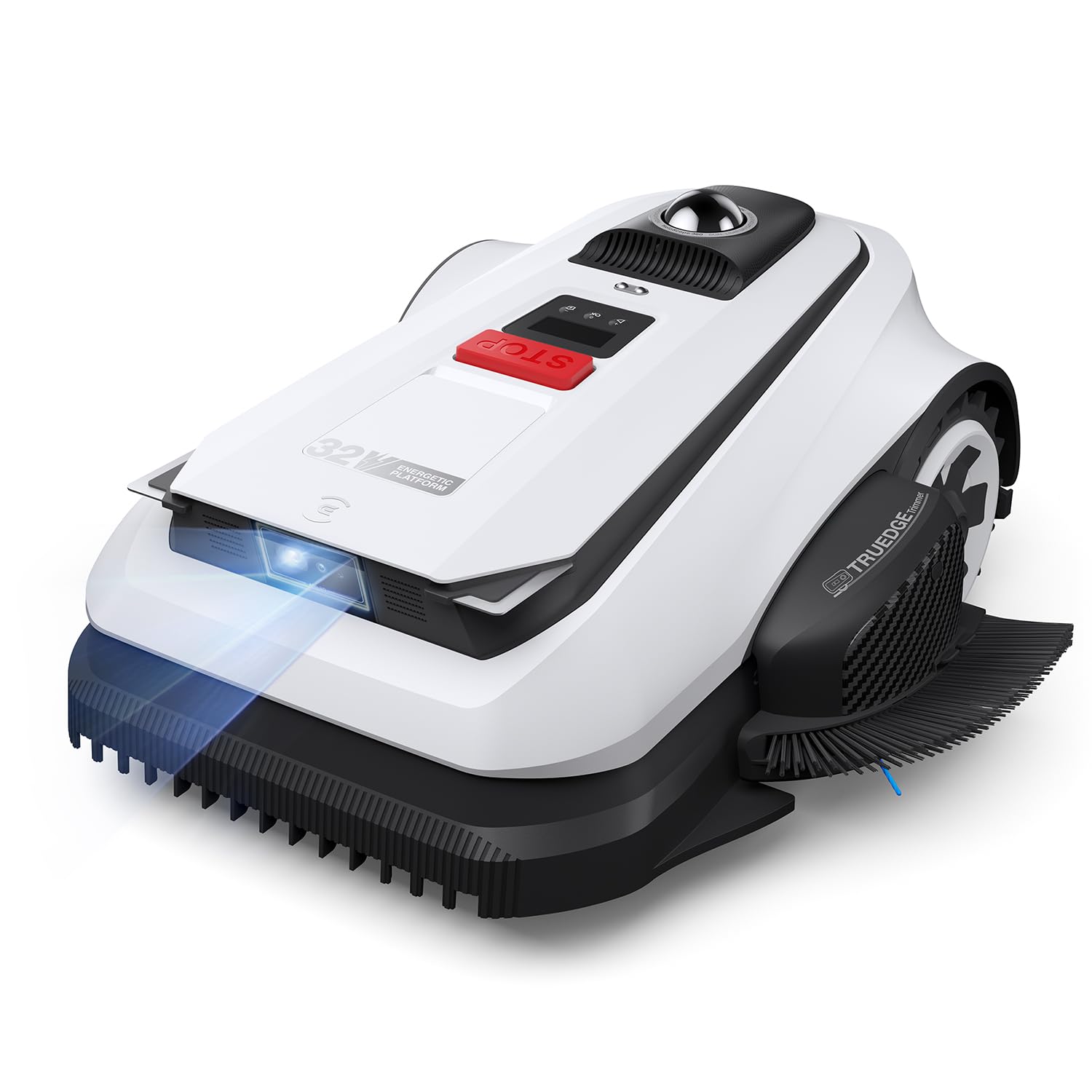
Dual LiDAR maps in the shade with 2 cm positioning, and a built-in trimmer handles the borders.
This is the answer for a complex, shaded yard where GPS-style mowers lose their bearings. The HoloScope 360° dual-LiDAR system maps and positions to 2 cm even under trees, along fences, and in shaded spots — no perimeter wire, no RTK antenna. A 32V motor drives a dual-blade disc for denser grass like Bermuda, Zoysia, Fescue, and St. Augustine, and the integrated TruEdge trimmer cuts along driveways and flower beds so you are not chasing edges with a string trimmer after every mow.
Runtime and charging are tuned for medium to large lots: a 3.0Ah battery with 113.4W fast charging recharges in about 50 minutes, so downtime between passes stays short. Owners consistently praise the build quality and value, and the app handles multiple zones, no-go areas, and schedules for an irregular layout.
The things to know: mapping itself is manual and takes patience — you cannot simply draw borders in the app, so expect a deliberate walkthrough — and blades wear out roughly monthly, with 2.8-inch-maximum blade-disc setup needing care. On wet or dewy grass the cut is noticeably worse, so dry conditions get the best result.
What makes it different: the built-in TruEdge trimmer and 360° dual-LiDAR combination handles borders and shade in one machine, with fast 50-minute recharging.
Set expectations here: mapping is a hands-on, manual process rather than app-drawn, and moist grass degrades the cut quality.
It fits: a shaded, many-cornered yard where edge trimming and LiDAR mapping both matter.
It frustrates: the buyer who wants app-drawn map boundaries and set-and-forget precision — this one needs a manual mapping pass.
6. WORX Robot Lawn Mower for 1/2 Acre, No Perimeter Wire, WR320
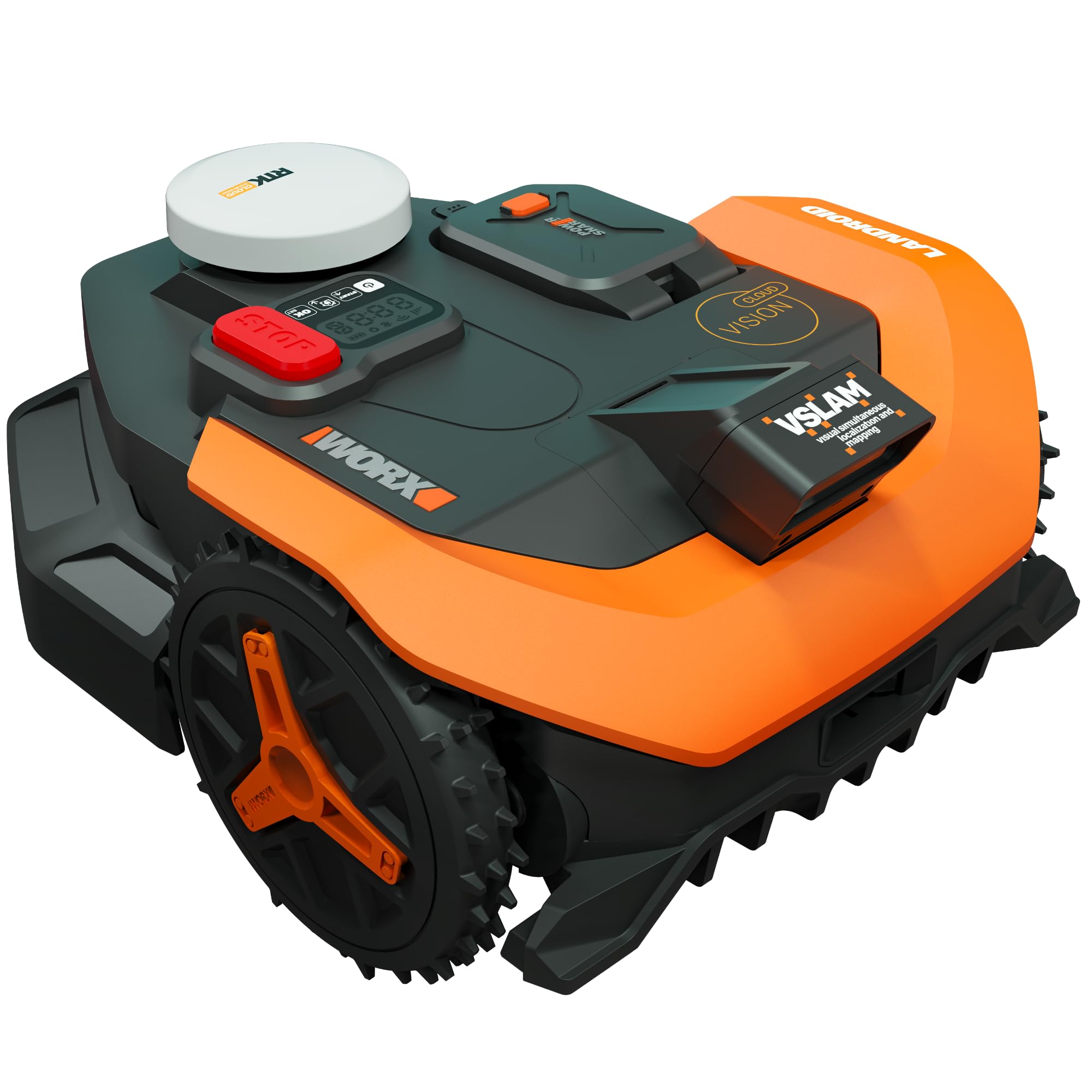
Cloud-based RTK with no local antenna and Vision AI that keeps mapping where GPS gets weak.
If you want a robot for a half acre but do not want to install an antenna, this is the draw: commercial-grade RTK delivered from the cloud, with no local antenna and no additional cloud cost. Where shade interrupts the satellite signal, V-SLAM–based sensor fusion with Vision AI takes over, so navigation continues under tree cover. Vision AI also recognizes and understands obstacles with processing power of up to 10 trillion operations per second, and it handles unlimited zones with custom pathways and no-go areas.
Stripes are a selling point — Parallel, Checkerboard, Diamond, or Natural patterns are app-selectable for a finished look. Extended-range RadioLink connectivity backs up Bluetooth and Wi-Fi for larger lawns, and cutting runs from 1.57 to 3.54 inches. Setup takes real effort though: owners describe configuring zones (often using a hose to set straight boundaries), paths, and the charging base as a genuine project before the machine works well.
Where it stumbles is the app and cloud dependency. The interface is widely called frustrating, and the mower itself needs clear sky access to the RTK cloud — a heavily treed, hill-surrounded rural property can leave it unable to connect at all. Once set up, it is quiet and its obstacle memory improves the longer it runs.
Where it saves you effort: cloud RTK with no antenna install, Vision AI obstacle handling, and app-selectable stripe patterns for a tidy half acre.
The setup reality: zonemapping and base placement are a hands-on task, and the app is the weakest link by owner accounts.
Worth it for: a half-acre yard with normal tree cover where you will invest a weekend in proper setup.
Not for: a rural property hemmed in by hills and dense trees — the cloud link fails without open sky.
7. ECOVACS Goat O1000 RTK CARE Robot Lawn Mower, 1/4 Acre
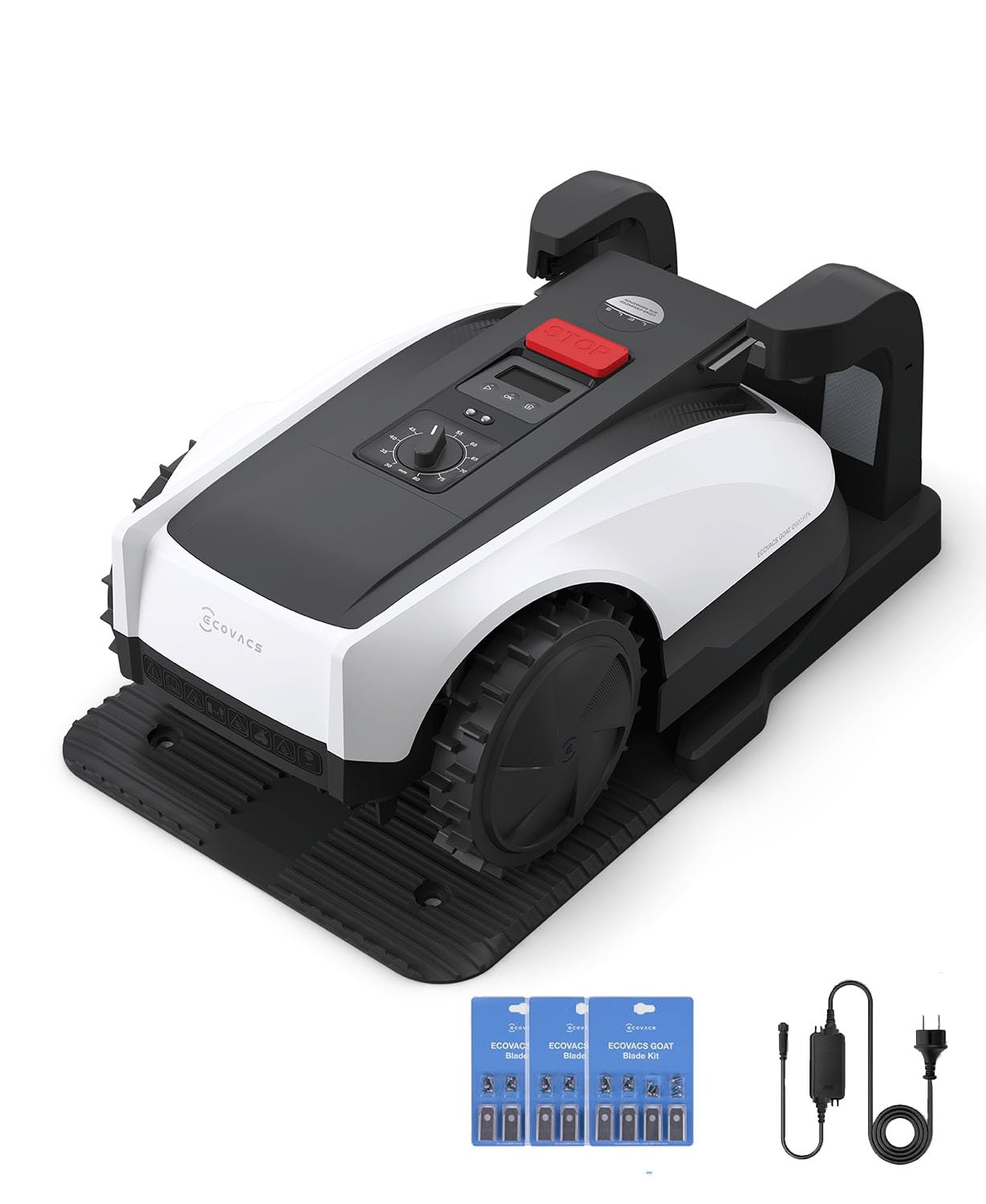
A quarter-acre starter robot that ships with 36 spare blades so you are not hunting refills.
For a small front lawn or town lot, this is the low-risk way into automated mowing. RTK technology gives centimeter-level positioning without perimeter wire, and it mows in systematic paths rather than random roaming, which produces even coverage and cleaner lines. The CARE bundle adds 36 additional replacement blades, plus an RTK extension cable so you can place the antenna for a stronger signal near trees or obstacles.
What owners like most is simply that the lawn looks good after a few weeks of scheduled runs. Setup is quick, the app learns easily, and build quality is the recurring positive note. It reaches 1.2 to 3.2 inches in cut height, runs 90 minutes on a charge, and is quiet at 62 dB.
The honest limits are on mapping and stuck recovery. Boundaries are set by remote-control walkthrough rather than drawn in the app, and moving the base station requires a full remap. It can also pause mid-mow in tall grass or debris and need a restart — so treat this as a maintainer for a small, tidy lawn, not a brush cutter for rough ground.
Why it earns a spot: wire-free RTK with systematic path mowing, a 36-blade CARE bundle, and 90-minute runtime make a quarter acre simple to keep up with.
Where it stops: mapping is a manual walkthrough, and it can stall in tall grass and need a restart.
Grab this if: you have a small, level-to-gentle lawn and want a first robot mower without wire.
Look further if: your yard is bigger than a quarter acre or rough enough to trip the mower’s stall sensors.
8. ANTHBOT M9 Robot Lawn Mower, Dual Vision + RTK, 45% Slope
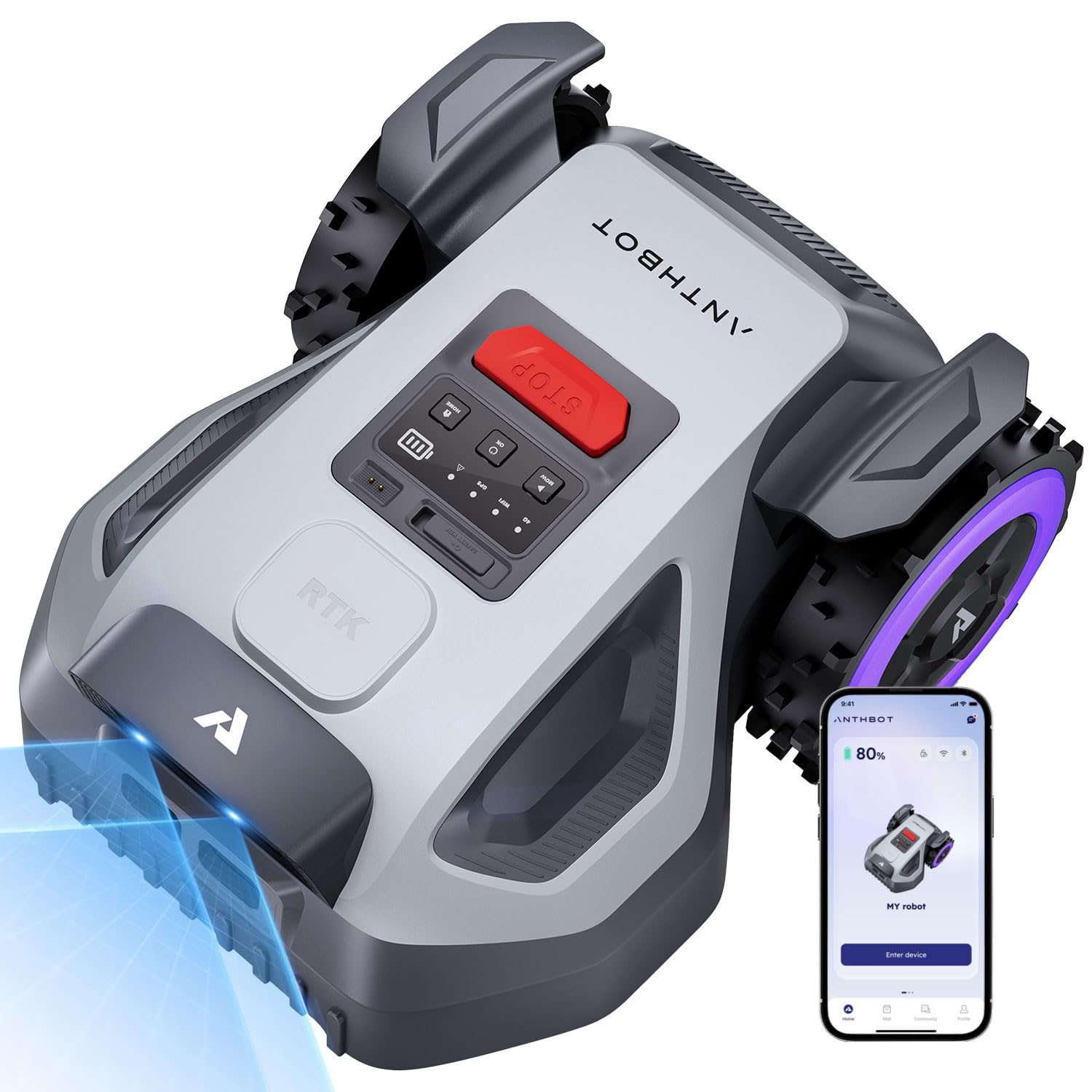
Dual HDR cameras, RTK precision, and up to 30 zones for a yard with lots of separate patches.
For a small-to-medium yard that is broken into pieces — a front strip, a fenced back, a side run — this robot’s zone management is the reason to pick it. It supports up to 30 work zones, lets you set no-go areas, and self-charges and resumes on its own, all through the ANTHBOT app. Dual 150° HDR cameras with AI recognize over 1,000 common garden objects, so it steers clear of tools and furniture it meets.
The numbers that matter: it handles slopes up to 45%, cuts from 1.2 to 2.7 inches, and uses five free-rotating blades for a carpet-like finish. Max mowing size is 0.3 acre — a genuinely small yard. It runs at ≤58 dB, so it will not bother the neighbors, and it supports over-the-air updates plus emergency braking.
Know the patience required. Auto-mapping is fast but can be rough, and many owners end up doing a slow manual map instead. It is also a maintainer rather than a speed cutter — on an uneven, rutted yard it can need retrieval after a stuck episode, and on a larger patch it takes multiple passes and recharges to finish. As owners put it, it keeps the grass tidy at a tortoise pace.
The smart-yard upside
- Up to 30 zones with no-go areas and app control for a segmented yard
- Dual 150° HDR cameras recognize over 1,000 obstacle types
- 45% slope handling, ≤58 dB, and OTA updates
- Five free-rotating blades for a carpet-like cut from 1.2–2.7 inches
The small-yard caveat
- Max mowing size of 0.3 acre limits large lawns
- Auto-mapping can be rough — plan a slow manual map
- Uneven ground can cause stuck episodes needing retrieval
Choose it for: a compact, multi-zone yard where avoidance of 1,000+ obstacle types beats raw speed.
Pass if: your lawn is larger than 0.3 acre or you want the fastest possible cut per session.
9. Neomow X2 SE 360° 3D LiDAR Robot Lawn Mower, Wire Free
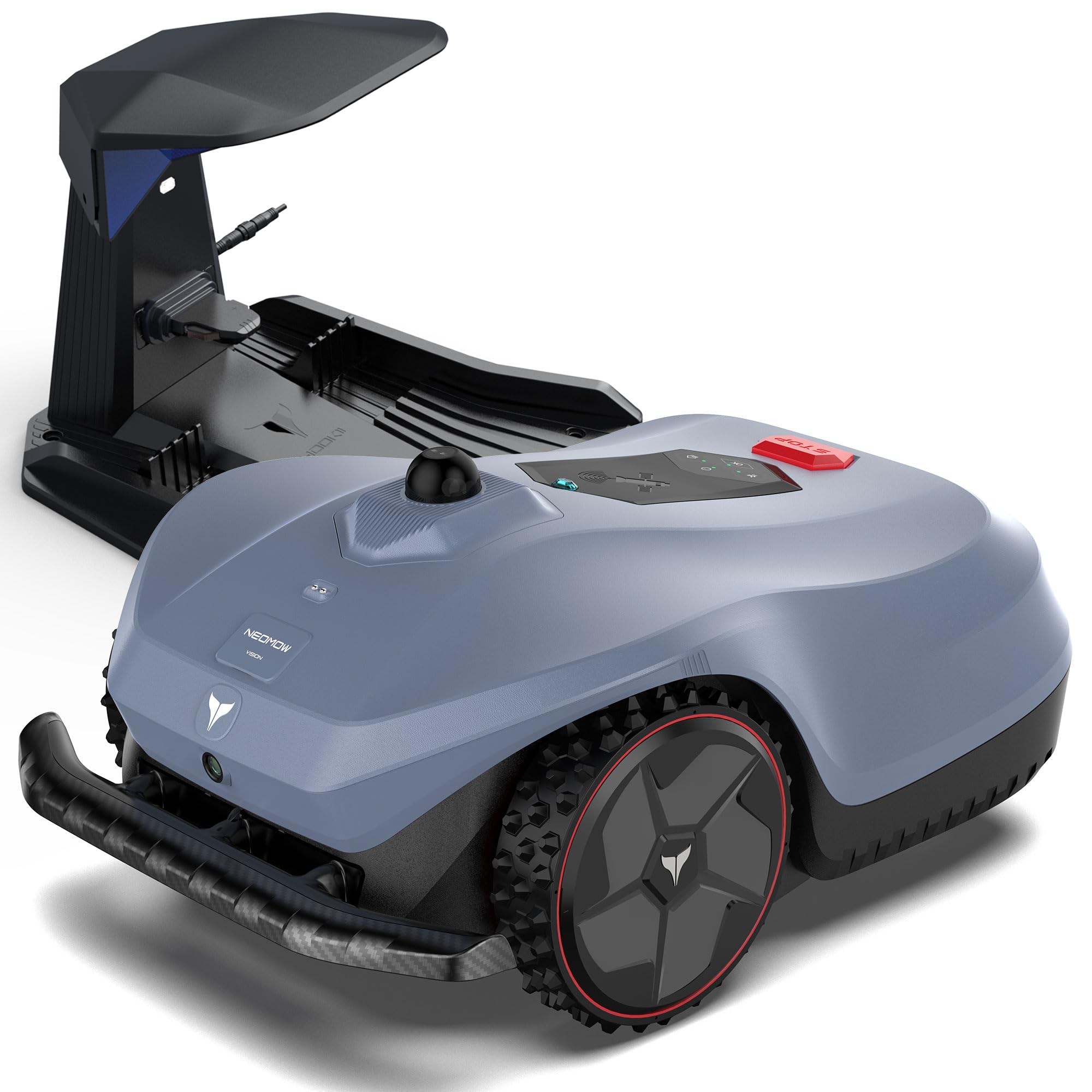
360° 3D LiDAR and a 3-hour battery map and mow without an RTK antenna in sight.
If you like the idea of LiDAR over satellite positioning, this is the lighter-touch entry point. A 360° 3D LiDAR system maps the yard with no RTK antenna needed, backed by 4G app control and GPS anti-theft. The battery is rated for 3 hours, it is IPX6 rated against rain and spray, and it cuts 1.2 to 3.3 inches — a maintenance-height range rather than a pasture height.
When it works, it works smoothly. Setup is easy, the app is straightforward, mapping the yard is smooth once it takes, and support has been quick to replace a faulty unit and arrange pickup. On a level 0.65 acre it has kept up with regular cutting on roughly a single charge.
Be realistic about the rough edges, because this robot has them in the firmware. Updates arrive frequently and can turn a one-minute start into a long wait, false obstacle detection is a known annoyance, and it can struggle on small lips and slope changes. The 4G connectivity is not free indefinitely, and the wheels need attention — they can work loose over time. This is a good fit only if you have some tolerance for troubleshooting.
The unlicensed-mapping edge: 360° 3D LiDAR means no antenna to mount, and 3-hour battery plus IPX6 shelter make it a clean sight-unseen install.
The patience test: frequent firmware updates, false obstacle alerts, and small-lip stumbling mean you should be comfortable with a tinkerer’s routine.
Consider it for: a stable, mostly level yard where LiDAR mapping beats satellite-only robots.
pass on it if: you want zero troubleshooting — the firmware churn and false alerts ask for some patience.
10. ZIPmow Remote Control Lawn Mower, AWD, 17 lb, 40% Slope
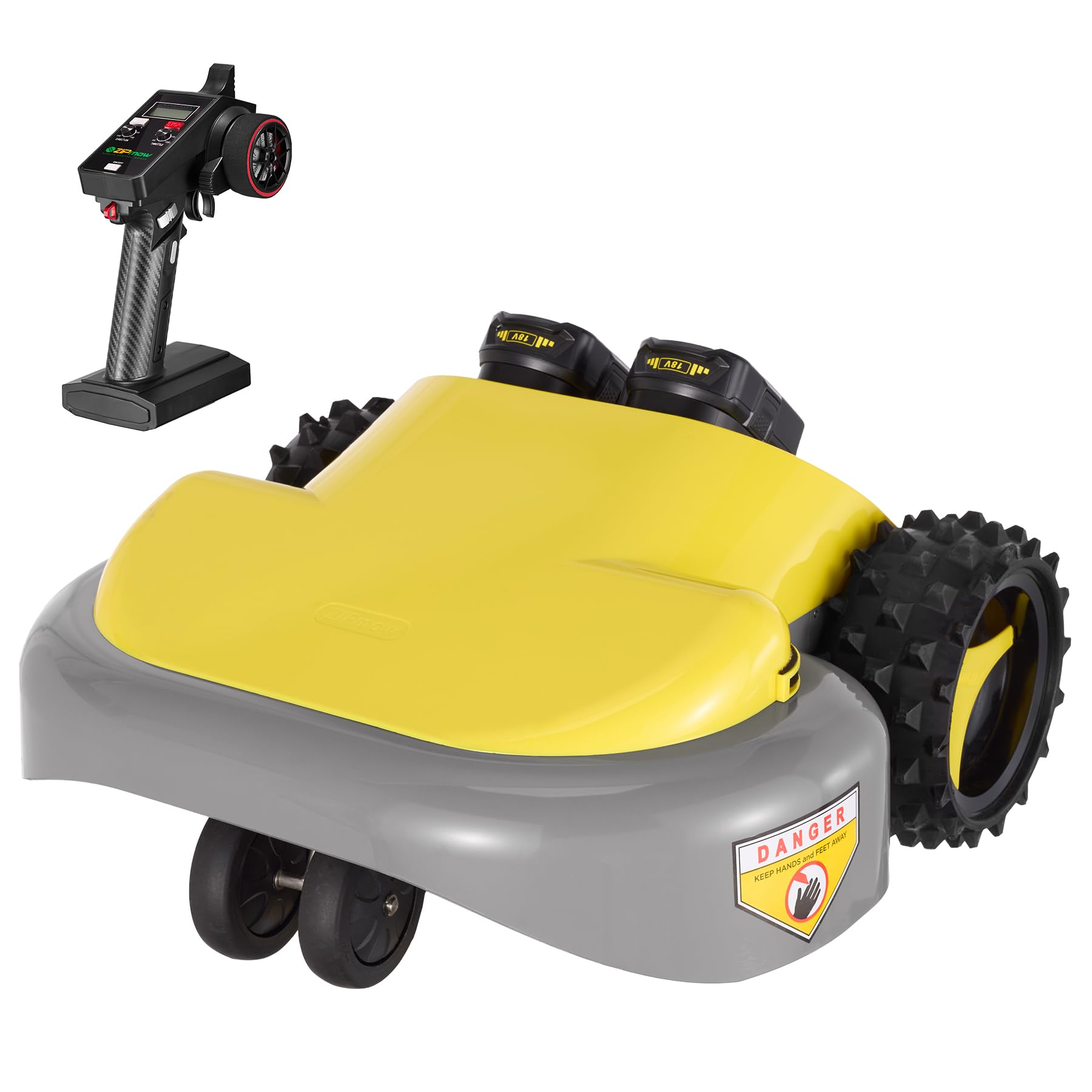
At 17 pounds this is the remote mower you can lift one-handed and store standing up.
Not every buyer has a hillside — some just want to stand with a controller and let a small machine do the walking. That is exactly what this is: a 17-pound, all-wheel-drive remote mower you steer from up to 98 feet away, with 0.5 to 2.5 mph speed control and a 2 to 3 inch cut range. The collapsible handle lets it store vertically to save garage space, and it runs on dual 3Ah batteries up to 60 minutes per charge with no gas or oil.
Owners say the maneuverability surprises them — it turns and steers with ease, so a small yard no longer means pushing and sweating. The 18-inch cutting width matches a compact lawn well, and the safety trim is thoughtful: an emergency stop button and auto shutoff if the machine tilts past 30 degrees make it safer around pets.
The limit is grass type and slope. It is best on a maintained lawn at 2 to 3 inches — tall or overgrown grass needs multiple passes. The blade setup is also fiddly, with height adjusted by repositioning three blades held by screws that are worth checking before each mow.
Why the light weight matters: at 17 pounds it hangs on a wall or stores upright, and the 0.5–2.5 mph speed plus 98-foot range keep you out of the sun.
The honest boundary: a 2 to 3 inch cut window is for maintained lawn only — tall grass will fight it.
It suits: a small, level lawn and a buyer who wants remote mowing without lifting anything heavy.
It falls short for: overgrown or steeply sloped ground, where its 30° slope limit and 2–3 inch cut are outmatched.
11. iBaeggs Remote Control Lawn Mower, AWD, 45° Slope, Dual 3Ah
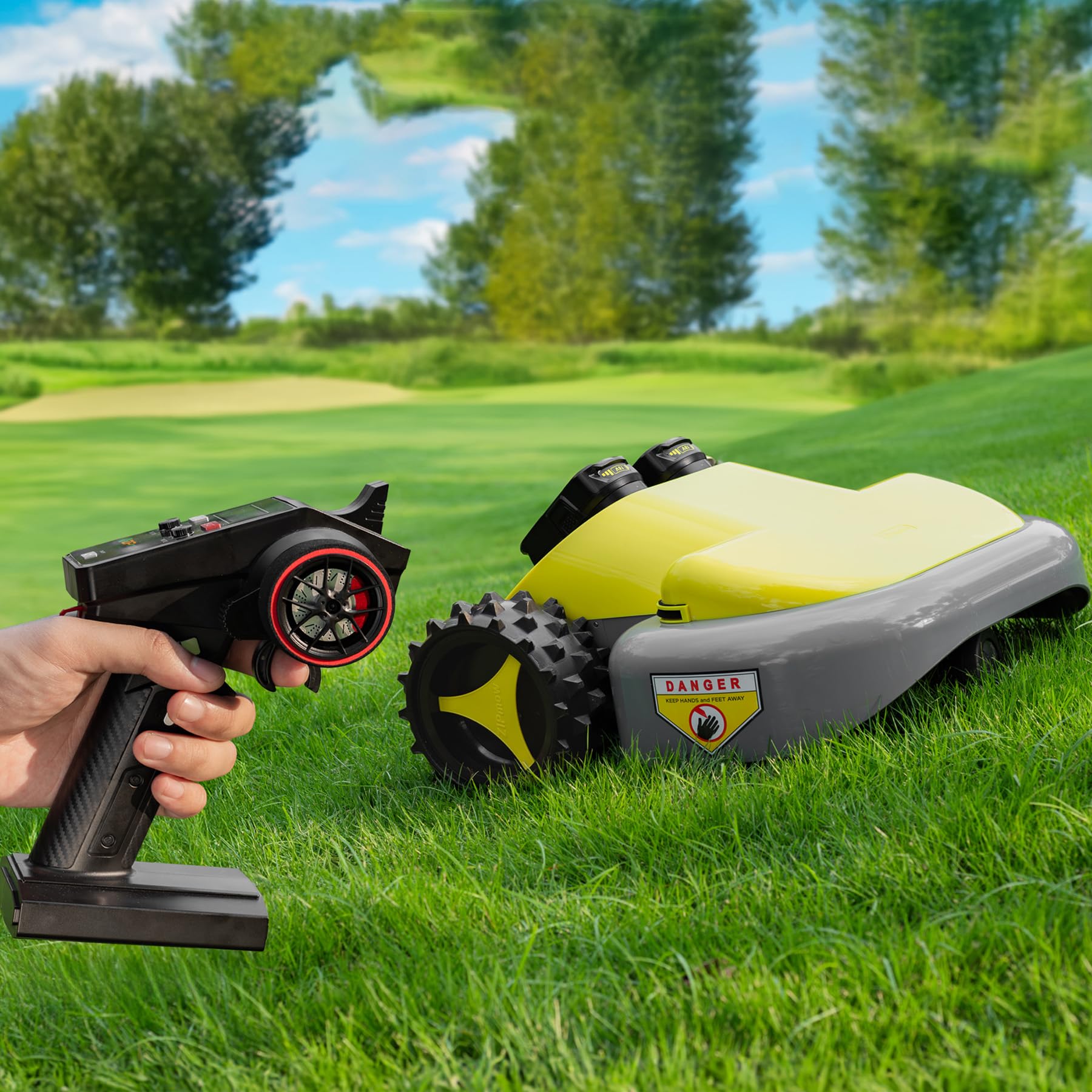
A 23-pound all-wheel-drive unit that lets you sit back and steer instead of walking the mow.
The pitch here is simple: keep the mowing job but remove the walking. All-wheel drive holds traction on uneven ground and slopes up to 45° under dry, low-speed conditions, and you steer forward, reverse, and turns from up to 98 feet with the 2.4GHz remote. Speed is adjustable from 0.5 to 2.5 mph, cut height from 2 to 3 inches, and the triple-blade deck spins at 3,400 RPM with an IPX4 rating for morning dew.
A 23-pound frame folds for vertical storage and needs no assembly. The kit is complete — mower, two 3Ah batteries with a fast charger, remote, three spare blades, blade guard, and manual — and the dual batteries give up to 60 minutes per charge. This is aimed squarely at people who find a walk-behind a strain: the up-close impression is smooth mowing with responsive control.
Two practical notes. The remote needs two AAA batteries of its own, so grab those before first use. And while the drive holds up on dry slopes, steering is sensitive until you get the feel of it — the first session is a learning curve, then it settles in.
The easy-mow case: a complete, no-assembly kit with two 3Ah batteries, 45° AWD traction, and a 98-foot remote that keeps you off your feet.
The honest note: dry-grass, low-speed conditions are where the 45° slope claim holds, and sensitivity takes a session to master.
It is built for: someone with a knee or back that makes walk-behind mowing a chore and who wants a ready-to-run kit.
Look elsewhere if: your slope is steep and often wet — the traction spec assumes dry, low-speed running.
Know the Specs
Slope Rating (Percent and Degrees)
This tells you the steepest incline the machine can climb while keeping grip, shown as a percentage or in degrees — 37° and 75% describe the same hill. A percentage is the rise over a run, so a higher number means a more aggressive climb. Match this figure to your worst bank: if your slope is steeper than the rating, the drive slips and the cut suffers.
Cutting Width
The width of grass the deck clears in one pass, measured in inches. Wider means fewer passes and faster coverage — a 21-inch deck clears far more ground per lap than an 11-inch one. Narrow decks suit tight, multi-zone yards; wide decks suit open fields and long straight runs.
Battery Capacity (Ah) and Runtime (Minutes)
Amp-hours (Ah) measure how much energy the battery stores, and runtime in minutes tells you how long it lasts under real conditions. The two travel together but not perfectly — grass height, terrain, and drive drag all shorten runtime. Plan your mowing sessions around the runtime figure, not the amp-hour number alone.
Cut Height Range
The span between the lowest and highest deck setting, in inches. A narrow window like 2 to 3 inches is for maintained lawn, while a wide 1.1 to 5.9 inch range can handle overgrown pasture and brush. Match the top of the range to the tallest grass you plan to cut, and the bottom to how short your lawn should finish.
Common Questions
Will a remote control track mower actually climb a bank steeper than a walk-behind can handle?
Do I need to install perimeter wire for these mowers?
How long does the battery last on a single charge?
Are these mowers safe to run around pets and children?
Can a track mower handle wet grass or morning dew?
What cut height do I need for tall fescue or St. Augustine?
How far away can I stand while operating a remote control mower?
Do robot mowers replace a full mowing, or just keep the lawn tidy?
What is the difference between RTK, LiDAR, and a track mower’s remote control?
How much maintenance do the blades and tracks need?
The Bottom Line
For most people shopping for the best remote control track mower, the clear winner is the Mowrator S1 4WD. A 21-inch cut, 37° climbing ability, and a 90-minute recharge from a 56V 18Ah pack let it handle steep, overgrown ground and still come back for more. If your challenge is a genuine 45° wall of pasture or reed, grab the AIWEIYA crawler for its track grip. And if you would rather schedule the mow than drive it, the Husqvarna 410iQ is the one to reach for on an open half acre. Whichever way you go, match the slope rating to your worst bank first. That is the number that keeps the machine working instead of sliding.
How we choose
We do not accept paid placement. Every pick is matched to a real buyer and a real use-case; we do not hands-on test units.
Sources
Specifications: manufacturer listings and product documentation. Review insights: verified customer reviews, as of October 2026. Pricing: not shown on this page (it changes often); check the current price via the retailer link.
As an Amazon Associate, Aappliancez earns from qualifying purchases. This does not affect which products we feature.