Disclosure: Some links in this post are affiliate links. As an Amazon Associate I earn from qualifying purchases, at no extra cost to you. Learn more
Specs are compiled from manufacturer listings and verified buyer reviews and can change over time — please confirm the key details on the product page before buying.
You want a tree that actually turns red, survives its first winter, and doesn’t arrive as a bare stick rattling around a cardboard box. This guide sorts six live red maple options by mature size, container grade, hardiness zone, and what buyers actually end up with after the box comes off — so you can match a tree to your yard instead of your hopes.
This guide is built by comparing the manufacturers’ published specifications and the patterns across verified customer reviews, so you get each pick’s real strengths and trade-offs instead of marketing spin.
The two things that trip people up are container size and hardiness zone, because a bare-root seedling and a three-gallon potted tree lead very different first seasons in your soil. Below is a straight comparison of the best Red Maple Trees for yards of every size.
Top Picks


How To Choose The Best Red Maple Trees
A red maple is not a small purchase on a shelf — it is a living plant with a root system that has to survive shipping, transplant shock, and its first full year in your soil. So you pick on four things, in this order: whether your hardiness zone fits, how big the tree will be at maturity, what grade of container it ships in, and when you are planting.
Start with your hardiness zone, not the picture
The USDA hardiness zone is a numbered band that tells you the coldest winter a plant is rated to take. A tree labelled zones 3 through 9 will handle a broad slice of the country; one labelled zones 5 through 8 wants a milder winter. Buy outside your band and the first hard frost can undo everything. Check your band before you fall for a photo of a mature canopy.
Match mature height to the space you actually have
Red maples on this list range from a compact 15-20 foot tree suited to a small yard up to a 60 foot shade tree that will eventually dominate a lawn. Plant for the tree you will have in a decade, not the sapling in the box. A compact Japanese maple belongs near a patio; a fast-growing shade maple belongs where you want afternoon cover over a whole garden.
Understand bareroot versus potted before you order
Bareroot means the roots ship bare, packed in moist material with no soil around them, and it is the lightest, most economical way to move a plant. A nursery pot means the tree comes with its own root ball in soil, so it transplants with less shock. Either can thrive — but potted stock leaves you far less to guess at in the first month.
Side-by-Side Comparison
| Model | Best For | Mature Height | Container | Hardiness Zones | Amazon |
|---|---|---|---|---|---|
| Japanese Red Maple, 3 gal, Nursery Pot★ Best Overall | Small yards and patio focal points | 15-20 feet | 3 gallon | Zones 5-8 | Amazon |
| Two Pack of Brandywine Red Maple TreesDouble Down | Planting two trees at once | 60 feet | 1 gallon (gallon pots) | Zones 3-9 | Amazon |
| 2 Red Maple Trees – 12-24″ Tall | Budget-friendly early start | — | Bareroot | — | Amazon |
| The Maple Autumn Blaze Tree, 1 gal | Quick fall color, drought tolerance | 40-50 feet | 1 gallon | Zones 3-8 | Amazon |
| Autumn Blaze Maple Tree – 1 Gallon | Established roots, fast growth | 40-50 feet | 1 gallon | Zones 3-8 | Amazon |
| American Red Maple Shade Tree | Full-size shade in a big yard | 60 feet | Shipped 3 feet tall | Zones 3-9 | Amazon |
Detailed Reviews
1. Japanese Red Maple, 3 gal, Nursery Pot
Our pick — 4.0+★ from 100+ verified ratings; the strongest balance of quality and price.
For the yard that can’t fit a giant shade tree, this potted maple arrives already substantial.
The number worth starting with is the container: a 3 gallon nursery pot means this Japanese Red Maple ships with its own root ball already sitting in soil. That matters because you skip the bare-root gamble — the tree lands with roots intact and a head start, rather than asking you to coax a naked seedling through its first month. Owners notice the size, too. One buyer reports the first tree arrived “larger than expected,” and a second order came in at five feet against a listed 2-3 foot range.
What it settles into is a compact, spreading tree that tops out around 15-20 feet in height and width, which is exactly the profile you want beside a patio or as a focal point in a smaller garden. The foliage is the draw — deep red to burgundy leaves with a delicate, lace-like look, staying red through most of summer and shifting toward greenish red in the heat of the southern part of its range. In fall the color returns to reddish tones. Zones 5 through 8 cover it, and it wants full sun or part shade in moist, well-drained, slightly acidic soil, plus mulch to hold moisture over the roots.
The catch is scale and root temperament. This is not the tree for a big open lawn you want shaded — a Brandywine two-pack grows to 60 feet, this stops at 15-20. And root strength is the one point where owner experiences split, so give it a proper planting hole and good drainage rather than cutting corners on prep. Planted right, it earns its keep through steady growth: the potted root ball arrives healthy and keeps pushing new growth.
Ships With Its Own Soil
- 3 gallon nursery pot means a live root ball, not bare roots
- 15-20 foot mature spread fits a small yard or patio edge
- Lace-like burgundy foliage stays red through most of summer
- Zones 5-8 covers a wide band of the country
Where It Asks More of You
- Root strength is the mixed note in owner feedback — prep the hole and drainage properly
- Too compact for anyone wanting full-lawn shade
- Listed at 2 feet expected height, so judge size by the pot grade, not the number
Reach for this if: you have a smaller garden, a patio corner, or a bed that needs one standout tree and you want to skip the bare-root risk.
Think twice if: you’re planting for a shade canopy over a large lawn — that’s a taller maple’s job.
2. Brandywine Red Maple Two Pack
Two red maples in one box, built for the homeowner planting a matched pair.
If you’ve priced out a single shade tree and winced, this two-pack is the arithmetic that makes sense. You get two plants, each 2-3 feet tall in gallon pots, boxed for transport — and the size gap to a compact Japanese maple is not subtle: 60 feet at maturity versus 15-20 feet. That is a real shade tree you’re starting, twice over. Zones 3 through 9 give it one of the widest hardiness bands on this list, and it wants full sun and regular watering.
The buying instruction is unusually firm, and worth respecting: put these straight in the ground, do not transplant into another container. DAS Farms backs a successful transplant for 30 days if you follow the included instructions with the right location and water, and dormant winter purchases are covered to leaf out in spring under the same conditions. The included planting guide earns genuine credit — a buyer who had lost a three-inch tree to rabbits noted this one “came in mint condition with great instructions.” Others describe trees arriving well packed and in great shape, planted and doing well.
Honest sizing note: a couple of these arrive scrawnier than the photos suggest, with one described as a straight stick with no leaves on one plant, and another buyer found the tree smaller than anticipated — though that same tree arrived on time, in perfect condition, and thriving. Treat the first season as establishment, not spectacle — these 2-3 foot gallon pots need a year in the ground before they look like shade trees. The payoff is two shade trees instead of one, cheaper per tree than any single potted option here.
Two For The Lawn: a matched pair of 2-3 foot potted trees at 60 feet mature is the value play for anyone with ground to fill.
Respect The Rule: ground only, no repotting — the 30-day transplant guarantee hinges on following that instruction.
Made for: the buyer with a long property line or a windbreak plan who wants shade trees in pairs.
Look past it if: you need one tree, or you expect a full-leafed specimen in a winter shipment — deciduous plants ship dormant.
3. 2 Red Maple Trees 12-24″

Two bareroot maples, the lightest way to start a pair of fast growers on a tight budget.
Bareroot is the detail that defines this one. The roots ship bare — no pot, no soil ball — packed in moist material and two trees per order, each roughly 12-24 inches tall. That is the opposite end of the spectrum from the 3-gallon Japanese maple, and it tells you what you’re getting: a young, light plant that costs far less and leans on you to plant it well and fast. There’s no root ball to protect it, so get it in the ground soon after it arrives.
The trade-off buys you momentum. This is billed as a rapid grower that establishes quickly, sheds its leaves seasonally, and throws vibrant red foliage in the fall — and it’s rated low maintenance with partial sun as its exposure. Two trees per order means you can stagger them or plant a matching pair. It’s GMO free, and the unit count is exactly two.
Set your expectations around the starting size, not the finished picture. At 12-24 inches tall and bareroot, these look like twigs when they land — that’s the format, not a defect. Buy this bareroot two-pack if you’re patient, want to save money up front, and enjoy watching a 12-24 inch twig put on size. skip it if you want something that looks like a tree on day one, because a potted three-gallon specimen will beat it there every time.
Best fit: the patient budget gardener planting two fast growers who doesn’t mind starting small.
Not for you if: you want instant presence in the landscape from the moment the box opens.
4. Autumn Blaze Tree 1 gal
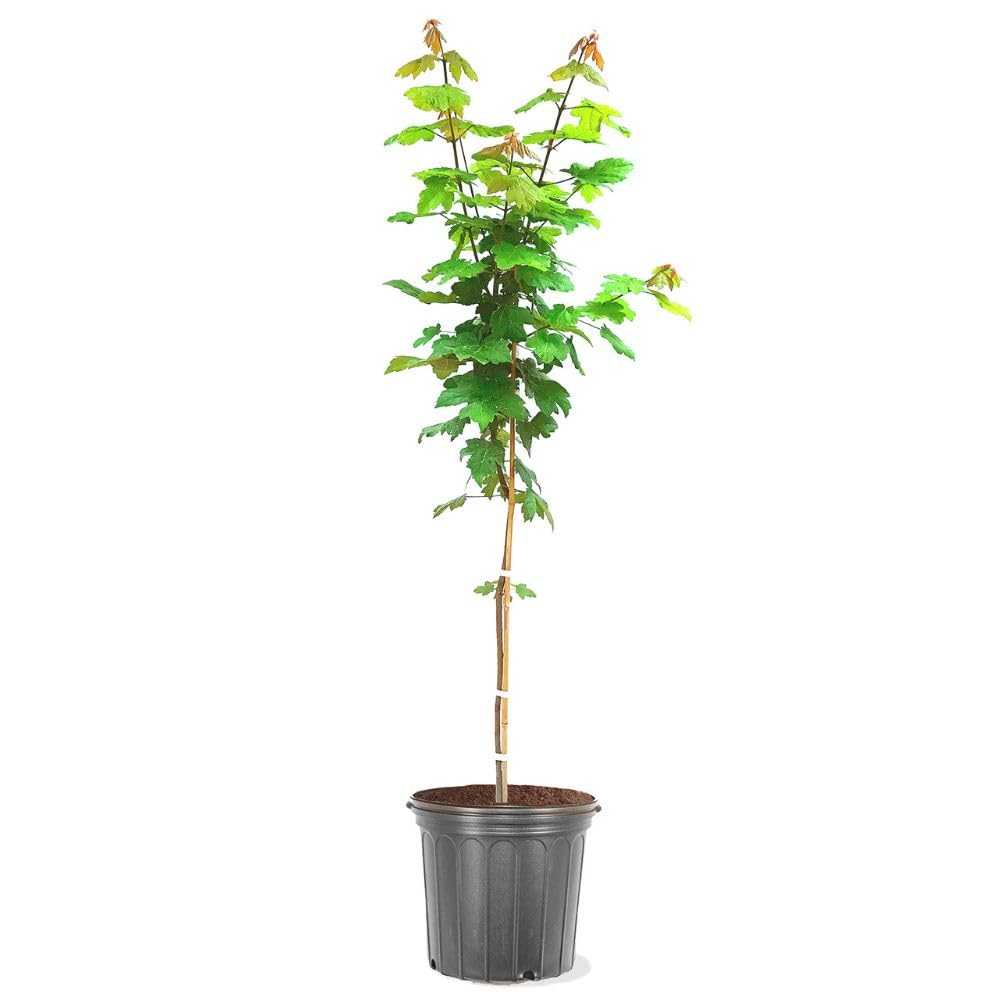
The orange-and-red fall display tree for a yard that wants shade impact quickly.
Fast growth plus a color range is the pitch here. At maturity this Autumn Blaze reaches 40-50 feet tall with a spread of 30-40 feet, forming a symmetrical, rounded canopy — and the leaves shift from green into bright orange and red each fall. Compare that spread to the Japanese maple’s 15-20 feet and you can see why this one anchors a whole yard rather than a single bed. The 1 gallon nursery pot carries five pounds of tree, versus fifteen pounds for the three-gallon Japanese maple, so it arrives lighter and younger.
What buyers describe is a plant that keeps pushing. It gets called thriving and healthy, already growing in the yard, and one shipment is described as a beautiful four-foot tree with leaves — which sits well above the small pot it ships in. Packaging gets consistent credit; a Florida-to-Virginia trip that landed “in just two days” is the kind of transit window that keeps a live plant happy. Growth is the quality that stands out most, with health close behind.
Buyers should know two real-world constraints. First, agricultural law blocks shipment to California, Arizona, Alaska, and Hawaii — check your address before you order. Second, a dormant-season shipment can arrive as a bare stick and leaf out later; that’s normal for this species, not a failed order. Plant in acidic, well-draining soil in full sun, water regularly for the first few years, and it becomes moderately drought-tolerant once established.
The Canopy Math: 40-50 feet tall with a 30-40 foot spread is a real shade tree in a fast-growing package.
The Shipping Catch: not available to CA, AZ, AK, or HI, so confirm you’re in range first — and expect dormancy if you order in winter.
Go for it if: you want fast growth, a rounded canopy, and a fall color shift into orange and red.
Choose another if: you live in California, Arizona, Alaska, or Hawaii where this can’t ship.
5. Autumn Blaze Maple 1 Gallon

The same big shade profile, sold on one promise: roots already established before it ships.
Acer x Freemanii is the hybrid name behind the Autumn Blaze, and this TriStar Plants version sells an established, potted root system in a 1 gallon container. It carries the same mature frame as the other Autumn Blaze on this list — 40-50 feet high by 30-40 feet wide, zones 3 through 8, fast growth, full sun. Reach for this one when you care more about a root system that’s already working than about which foliage shot is prettier.
The consistent report is winter resilience and steady growth. Owners describe the maple surviving its first winter and putting out new leaves after it, then growing well over the following year. Even a smaller-than-hoped tree is described as well established and doing great, and the appearance reads as pretty. That’s the whole point of paying for an established 1-gallon pot: the root system is already working before it ships.
There is one caution worth sizing correctly. These are small when they ship — one buyer called it rather small with progress only visible after a year, and a buyer who expected more found the tree short and curved rather than matching a full one-gallon container. That’s the reality of a young potted tree in a lighter container, not a bad plant. Order it to establish and grow, and plant it in the ground rather than repotting it into a bigger tub.
Why It Earns A Slot
- Established root system already potted and working
- 40-50 foot height and 30-40 foot spread at maturity
- Zones 3-8 with fast growth and full-sun tolerance
- Reports of surviving winter and leafing out reliably
The Honest Small Print
- Arrives small; a year of growth is what shows the progress
- A buyer expecting a full one-gallon fill found it short and curved
- Ships dormant in winter, so spring leaves are the real arrival
My read: a smart pick if you’d rather pay for roots that are ready than gamble on a bare-root bundle.
Fair warning: the photo shows mature plants, not the small tree you’ll unwrap.
6. American Red Maple Shade Tree

A single 3-foot shade maple with the widest hardiness range and the most owner history behind it.
Set the numbers side by side and the plan is obvious. One plant, shipped three feet tall, heading to 60 feet at maturity in zones 3 through 9 — the broadest band on this list. Compared with the Japanese maple’s compact 15-20 feet, this is the tree you plant for the next generation, not the next patio season. It’s organic-grown, adaptable to varied soil, wants full sun and regular watering, and it’s flagged deer resistant, pet friendly, and air purifying.
The first-week pattern is what buyers talk about. New leaves show up within about a week of planting, and the tree is described as healthy with several branches carrying good-looking leaves. Growing and tree quality are the two things owners single out most, with appearance and health close behind. The 30-day transplant guarantee applies here just as it does to the Brandywine two-pack — same seller, same terms: follow the included instructions with the right location and water, and winter-dormant purchases are covered to leaf out in spring.
Sizing is the one area where expectations divide: some find it smaller than expected for a three-foot listing. In practice a three-foot sapling is a stick with ambition, so buy it as a 60-foot shade tree you’ll wait on, not a specimen for this season. The ground is the only destination it wants — no repotting — and the packaging is California-regulated for shipment there. The math at 60 feet in zones 3-9 makes this the most widely plantable single shade tree on the page.
Widest Reach: zones 3-9 and a 60-foot mature height make this the safest bet across the most of the country.
Plan For The Lean Years: it ships small, so your job is to get it through the first season, not to admire instant shade.
Pick this one if: you want one full-size shade maple and live somewhere a 3-to-9 zone tree is welcome.
Pick around it if: a yard with limited room means a 60-foot tree would outgrow the space.
Know the Specs
Container Size and Root Grade
Container size tells you how much root already exists before the tree ever meets your soil. A 3 gallon nursery pot ships a full root ball in soil, so the tree transplants with less shock and starts pushing growth sooner. A 1 gallon pot carries less soil and a younger root system, and a bareroot bundle carries none at all — just moist packing around bare roots. None of these is bad; they’re a scale of risk versus cost. Bigger container, higher cost, less guesswork. Bareroot, lowest cost, most reliance on you to plant quickly and water well.
Mature Height, Spread, and Hardiness Zones
Mature height and spread tell you what the tree becomes, and that’s what you should plant for. A compact 15-20 foot Japanese maple suits a small garden or a focal bed. A 40-50 foot Autumn Blaze with a 30-40 foot spread anchors a whole yard. A 60-foot American or Brandywine maple wants serious space. Then check the hardiness zone band — the numbered range of coldest winters a tree is rated to survive. Zones 3-9 is the widest tolerance on this list; zones 5-8 wants a milder climate. Matching the band to where you live is the single biggest predictor of whether the tree comes back next spring.
Common Questions
Will a red maple shipped in winter arrive with no leaves?
What USDA hardiness zone do I need for these red maples?
Can I keep a red maple in a pot instead of planting it in the ground?
How big will each red maple get at maturity?
Is bareroot or potted better for a red maple?
Why can some red maples not ship to California or Arizona?
How much water does a newly planted red maple need?
Will a red maple give shade in the first year?
What soil does an Autumn Blaze maple prefer?
The Bottom Line
The smartest red maple buy on this list is the compact potted Japanese maple — its 3-gallon nursery pot ships a live root ball in soil, so your first season is about growth rather than rescue, and its 15-20 foot frame suits small yards and patio edges. If you want shade and speed instead, the Autumn Blaze line is your move: 40-50 feet with a 30-40 foot spread, zones 3-8, and a fall color shift that earns the name. And if you’re filling open ground for the long haul, the American Red Maple at 60 feet in zones 3-9 gives you the widest room to plant it almost anywhere. Match the hardiness zone first, the mature height and spread second, and the container grade third — do that, and whichever of these you choose has a real chance of outliving the fence it’s planted beside.
How we choose
We do not accept paid placement. Every pick is matched to a real buyer and a real use-case; we do not hands-on test units.
Sources
Specifications: manufacturer listings and product documentation. Review insights: verified customer reviews, as of October 2026. Pricing: not shown on this page (it changes often); check the current price via the retailer link.
As an Amazon Associate, Aappliancez earns from qualifying purchases. This does not affect which products we feature.