Disclosure: Some links in this post are affiliate links. As an Amazon Associate I earn from qualifying purchases, at no extra cost to you. Learn more
Specs are compiled from manufacturer listings and verified buyer reviews and can change over time — please confirm the key details on the product page before buying.
You cannot see the plant before you pay for it, so the seller often matters more than the variety when you buy a red crape myrtle online. The short answer: a three-gallon potted tree gives you the best odds of a plant that survives its first month, while cheap quart-size seedlings are a gamble. Below, the real red crape myrtles are sorted by how they arrive, how fast they grow, and the size you can actually expect on your doorstep — so you pick the one that fits your yard and your patience.
This guide is built by comparing the manufacturers’ published specifications and the patterns across verified customer reviews, so you get each pick’s real strengths and trade-offs instead of marketing spin.
A live tree is a living thing with a dormant season, a shipping shock, and a root ball that decides everything. The picks below cover both the budget seedlings and the mature potted specimens, so you know exactly what you are planting. Read on for the honest breakdown of the best Red Crape Myrtle options worth your garden space.
Top Picks


How To Choose The Best Red Crape Myrtle
Most people buying a red crape myrtle online are really asking one question: will this plant arrive alive and stay alive? Everything below boils down to pot size, hardiness zone, and how honest the listing is about what shows up in the box.
Pot size beats plant count
A six-pack of quart seedlings looks like better value than a single three-gallon tree. In practice, the bigger pot holds a more established root system, and that root system is what carries the plant through shipping and its first weeks in your soil. A quart container is a starter plant, so expect to baby it. A three-gallon container is closer to a finished landscape plant.
Check your hardiness zone before anything else
The USDA hardiness zone is a number that tells you the coldest winter your area reaches, and it decides whether a crape myrtle survives outdoors year-round. A tree rated for zones 7 through 9 will struggle in a zone 5 winter no matter how well you plant it. Match the listing’s zone range to your own before you fall for the flower color.
Dormancy is not death
Crape myrtles drop their leaves in winter and go dormant — a natural rest where the plant looks like bare sticks. Sellers ship dormant plants from late fall through early spring, and a leafless box in January is normal. A leafless box in June is a problem. Time your order to the season and you avoid most of the panic.
Red is not one color
Red crape myrtle blooms run from cherry and crimson to a deep near-black-leafed variety with vivid red flowers. Some listings also pair red blooms with dark purple-to-black foliage, which changes the whole look of your border. Decide if you want the classic green-leaf red or the dark-leaf contrast before you buy.
Side-by-Side Comparison
All five spec columns below use the same dimension across every row, so you can scan pot size, mature height, and sun needs side by side.
| Model | Best For | Container | Mature Height | Sun / Zone | Amazon |
|---|---|---|---|---|---|
| 6 Pack Red Flowering Crape Myrtle★ Best Overall | Budget hedgerows | Quart | 20+ feet | Full sun / Zone 6 | Amazon |
| Perfect Plants Black Diamond RedBest Foliage Contrast | Dark foliage contrast | 3 gallon | 10-12 feet | Full sun / — | Amazon |
| Proven Winners Center Stage RedCompact Shrub Pick | Compact shrub border | 2 gallon | 72-144 inches | Full sun to partial shade / Zones 7-9 | Amazon |
| First Editions Ruffled Red Magic | Ruffled red accents | 2 gallon | 9-12 feet | Full sun to partial shade / Zones 7-9 | Amazon |
| Dynamite Red 3 Live Plants | Multi-plant value | 3 count | — | Full sun / — | Amazon |
| Red Crape Myrtle 6-12″ Quart Pot | Single starter tree | Quart | — | Full sun / — | Amazon |
| Dynamite Crepe Myrtle by Crape Myrtle Guy | Fibrous root starter | Quart | 10-20 feet | Full sun / Zone 6-10 | Amazon |
| Black Diamond Crimson Red 3 gal. | Crimson summer-fall bloom | 3 gallon | 10-12 feet | Full sun / Zones 7-9 | Amazon |
| Red Rocket 4-Pack by Crape Myrtle Guy | Privacy screen planting | Quart | Up to 25 feet | Full sun / — | Amazon |
| 4 Pack Red Flowering Crape Myrtle | Summer heat planting | Quart | — | Full sun / — | Amazon |
| American Plant Exchange Crimson Red | Potted accent tree | 3 gallon | 1-2 feet at arrival | Partial shade / — | Amazon |
Detailed Reviews
1. 6 Pack Red Flowering Crape Myrtle
Our pick — 4.0+★ from 250+ verified ratings; the strongest balance of quality and price.
Six red crape myrtles for the price of one potted tree — if you have the patience to nurse them.
They are sold as outdoor, full-sun trees rated to USDA Zone 6, and they are suited to Southern-state growing conditions. Once established, the whole group can grow 3-4 feet per year and mature to a height of 20+ feet, which turns into a real privacy row or shade line within a few seasons.
Health and quality win people over with these six-packs, while size is the lottery. Buyers report opening the box to find plants even bigger than described, some already in bloom, and the growth after a slow start is genuinely impressive — a dormant-looking arrival can push new growth and some flowering within two months of proper watering. The honest catch is that a quart seedling is a young, thin plant, and in a batch of six you can lose a few. Owners mention the routine complaint is that a small seedling never took — treat that as the gamble of buying seedlings, not a reason to avoid the whole variety, and plant more than you need so the gaps fill in.
Where this six-pack earns its place
- Six trees in one order, which is enough to sketch out a whole border without a second purchase.
- Grows 3-4 feet per year and matures to 20+ feet, so the row fills in fast.
- Heat-tolerant and plantable any time of year, which suits a Southern summer planting.
- Full sun and moderate watering — a simple routine, no fussy soil program.
The part to go in knowing
- Quart seedlings are small and young, and thin stems are the most fragile part of the shipment.
- A winter order arrives dormant and leafless, which looks alarming until spring growth starts.
- Because you are starting small, the first season is about root establishment rather than height.
Reach for this if: you want a full row of red blooms on a lean budget and are happy to tend seedlings through their first spring.
Look elsewhere if: you want a plant that looks established the day the box opens — the three-gallon picks below are the better call.
2. Black Diamond Red Crape Myrtle 3 Gallon
Near-black leaves that make the red flowers look lit from inside — this is the showpiece of the list.
If you have ever driven past a dark-leaf crape myrtle and slowed down, this is that plant. It ships as a live three-gallon tree, which means a root ball with some weight behind it rather than a seedling you have to coax along. The foliage runs deep purple to black and catches the sun with a glossy glow, and from spring through fall it bursts with clusters of red flowers. The tree stays compact at a mature height of 10-12 feet and a width of 8 feet, so it fits a smaller section of the landscape and can go in rows to build a fence line or privacy screen. Full sun the whole day is what it wants, and it does not need fertilization to flower — a genuine relief for a first-time grower.
The detail that wins people over is the packaging. Trees arrive in a sturdy box with enough room for the leaves to move without being crushed, root balls show up well developed, and plants land full of fresh green growth as advertised. The blooms follow, and a full season in the ground brings a tree covered in red flowers. There is one important thing to know before you order: the buyer should confirm the exact variety on the order, because a substitution kerfuffle can happen and the color is the whole point of this tree. When something went wrong, the seller stepped in and scheduled a replacement promptly, so the support side holds up.
What you are really paying for: the mature footprint of 10-12 feet tall by 8 feet wide is the balance for a patio corner or a short privacy run, and the dark foliage means the tree earns its space even before the blooms open.
The one caveat worth stating: a dormant-season order can arrive looking lifeless, and if it never breaks dormancy the return window is the limit. Plant it promptly, water it in, and give it until spring before you judge it.
Top choice for a statement planting: a compact dark-leaf tree with red summer-to-fall color and a root ball that arrives ready to plant.
Just know: the mature canopy tops out at 10-12 feet, so it will not give you the tall shade wall the bigger growers on this list will.
3. Proven Winners 2 Gal. Center Stage Red Crape Myrtle Shrub
A cherry-red shrub bred to stay in a border instead of turning into a tree.
Here is the size comparison that matters: this Proven Winners shrub reaches 72-144 inches tall with a 96-inch spread, while the six-pack seedlings grow to 20+ feet. If you want a plant that stays in scale beside a porch or along a walkway, that shorter range is the feature. It is rated for USDA zones 7-9 and takes full sun to partial shade, so a spot with a little afternoon relief still works. Cheerful cherry-colored flowers run all summer, and the expected bloom period stretches spring to fall, so the color window is long. The 2-gallon pot is a mid-size start with some root mass behind it.
The strong side here is the plant itself. Quality and growth are what the review pages dwell on — healthy arrival, steady growth, and a look people like. The mixed part is size and value: customers note some arrive as decent plants and some come in very small for the pot size on the label. Durability is the one to watch, since a portion of plants do not make it. That is a shipping-and-establishment risk with live shrubs in general rather than a flaw in the variety, and the way to blunt it is the obvious one — plant it the day it arrives, water it in properly, and do not leave it sitting in the box.
Why it earns a spot: the 96-inch spread and 72-144-inch height keep it a shrub, so it fills a border without swallowing the window behind it.
Where to be careful: the plant you open may be smaller than the 2-gallon label implies, so set your expectations at “young shrub” rather than “instant hedge.”
Pick this for a low border: cherry-red flowers from spring to fall on a plant that stays under 12 feet.
Think twice if: you need a tall screen fast — the height ceiling here is the whole point of the plant.
4. First Editions 2 Gal. Crape Myrtle Ruffled Red Magic Shrub

The ruffled-petal red that looks different from every straight-petal crape myrtle on the block.
Most red crape myrtles have flat, crinkly flowers. This one is a named cultivar — LAGERSTROEMIA ‘PIILAG-VII’ PP27,303 — and the petals are the reason people seek it out. It ships in a 2-gallon pot, thrives in USDA zones 7-9, and matures to 9-12 feet high by 7-9 feet wide. That footprint is bigger than the Proven Winners shrub above but smaller than the 20+ foot growers, which puts it in a useful middle ground for a garden accent or a container on a patio. Full sun to partial shade suits it, and the expected bloom period runs spring to fall.
What stands out in owner experience is the quality of the plant that arrives, followed closely by the way it looks. Healthy, well-leafed shrubs are the norm, and the appearance is the thing people photograph. There is one honest wrinkle: healthiness splits both ways, with most plants doing well but the occasional one arriving with more dead than green wood. That is the reality of shipping a live shrub, and the fix is to inspect the wood the day it lands and plant it straight away. Expect a trimmed plant during shipping — the grower cuts them back to promote health, so a shorter, bushier arrival is on purpose.
The numbers that matter: 9-12 feet high by 7-9 feet wide with 84-108 inches of recommended spacing, so two of these make a proper gap-free screen along a property line.
The honest note: a winter-to-early-spring order ships dormant, so the ruffled blooms are a summer-into-fall payoff, not a same-week one.
Best for a distinctive accent: ruffled red petals on a shrub sized for a patio corner, a foundation bed, or a container.
Skip the rush: if you need immediate flower color, order in season rather than in the dormant months.
5. Crape Myrtle Dynamite Red 3 Live Plants
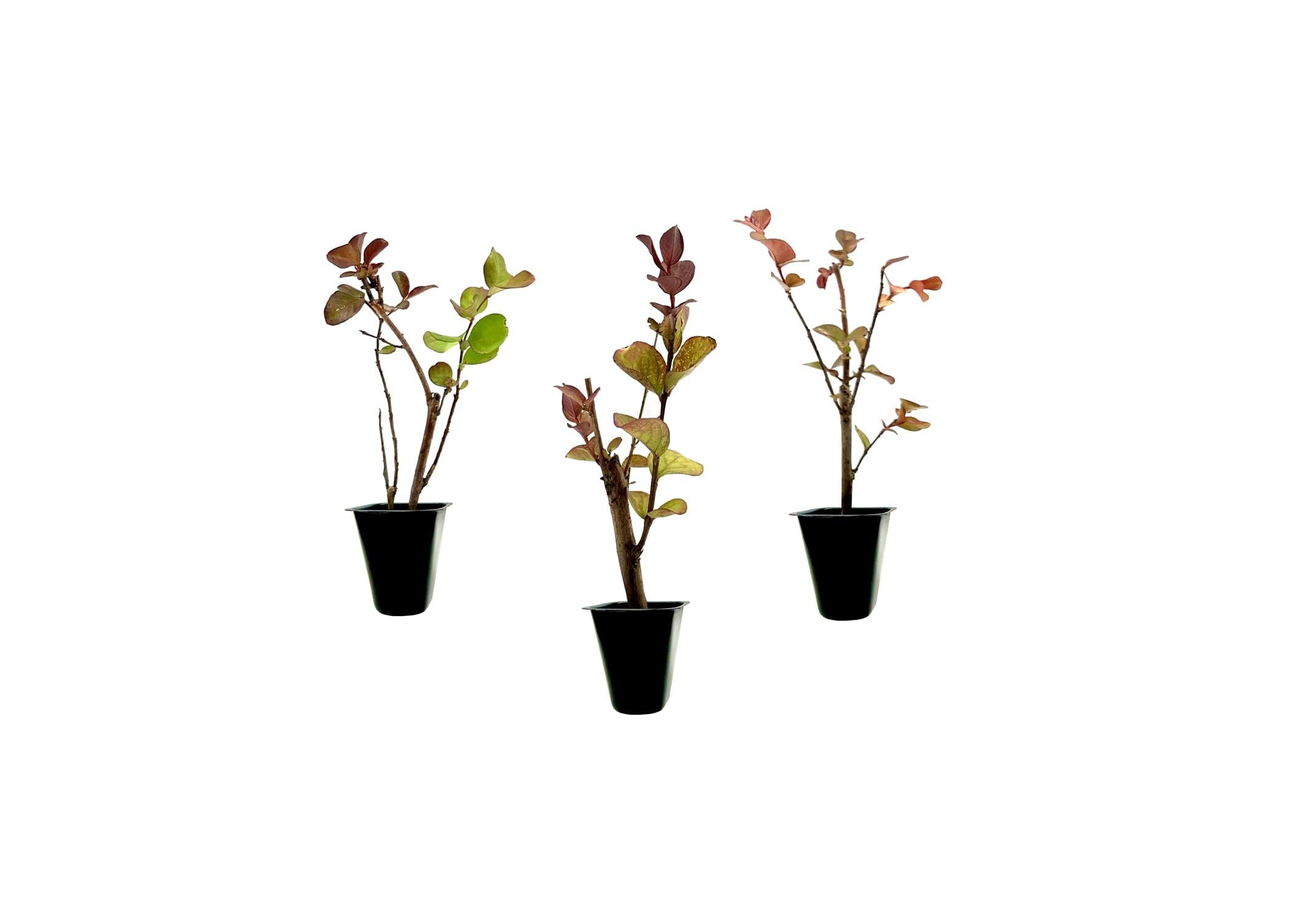
Three Dynamite Reds in one order, built for a border rather than a single specimen spot.
Dynamite Red is the fiery, saturated end of the red crape myrtle spectrum, and this listing sells it in a three-plant pack — three times the plant count of the single Perfect Plants tree. The variety carries four-season interest: attractive bark, spring growth, summer blooms, and fall color. It stands up to heat, humidity, and drought-like conditions, which makes it a realistic choice for a hot, exposed yard. As a border or hedge plant its upright branching adds structure to a bed, and it works as a standalone specimen too. These ship as live plants for full sun.
Where it does well, the leaves are durable and the plants settle in. Where it goes wrong, plants arrive dead or far smaller than the photos suggest, and the size is the most consistent letdown — these are starter plants, not landscape-ready shrubs. Expect small starter plants; at the lowest per-plant price of the multi-plant picks, that is the trade you are making. Plant them promptly, water them in, and give them a full season before you decide whether the variety suits your garden.
The case for the three-pack: Dynamite Red’s fiery blooms and multi-season bark and fall color, at a per-plant cost that undercuts the single potted trees.
The trade-off to accept: you are buying small, young plants, and a portion of any live shipment does not make it — order early enough in the season to replant if needed.
Best for a budget hedge: three heat-hungry Dynamite Reds to plant in a row for a fiery summer border.
Not for impatient gardeners: if you want flowering size this season, a three-gallon tree gets you there faster.
6. Red Crape Myrtle Tree – 6-12″ Tall Live Plant – Quart Pot
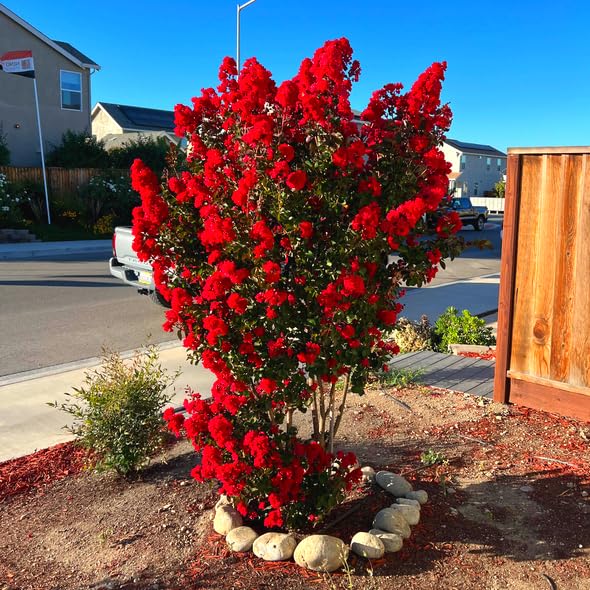
One affordable red crape myrtle in a quart pot — order it in season and it arrives leafed out.
This is the simplest way to try a red crape myrtle without committing to a multi-pack: a single tree, roughly 6-12 inches tall, shipped in a quart pot. It likes full sun, tolerates drought once settled, and draws butterflies, bees, and hummingbirds to the garden. The blooms are described as colorful and long-lasting across the summer. The listing is refreshingly direct about dormancy — order between November and mid-May and the plant arrives without leaves, and the third photo in the listing shows exactly what that looks like. That transparency is worth something, because it means you will not panic over a bare stick in February.
The in-season experience is the one to aim for. Plants that ship in warmer months arrive moist, full of green leaves, and healthy-looking, and they go into the ground with confidence. Growth in the ground is where this tree has the most mixed reputation — some plants take off and some simply do not grow, and a few die in zone 7. It is a young single plant in a small pot, so there is no backup if that one plant struggles. That is the honest ceiling on a one-plant order, and it is the reason a beginner with a single spot to fill might prefer a three-gallon tree with a more established root ball.
Where it shines: the lowest-commitment way into the category — one tree, a clear dormancy warning, and a pollinator-friendly summer bloom.
The catch to weigh: no spare plant if the single shipment fails, so time your order for the growing season.
Choose this if: you have one spot to fill and want to try a red crape myrtle without a big outlay.
Buyer beware the season: an order placed in the dormant months delivers a leafless plant, which is normal but not what a first-timer expects.
7. 1 Dynamite Crepe Myrtle Tree Quart Container

A fibrous root system in a quart pot — the seller’s answer to the transplant-shock problem.
The selling point here is the root system. These Dynamite Crepe Myrtles ship with a fibrous root system, a dense network of fine roots rather than a sparse taproot, and they ship in their original quart container — never bareroot. That matters because bare-root shipping is where a lot of live trees lose their momentum. The trees grow best in Zone 6-10, mature to 10-20 feet, and bloom all summer long. Plant in fall and the roots keep establishing through the winter, which sets the tree up to take off the following spring. It is a single tree in a quart pot, quite different from the multi-packs on this list.
Growth speed is the thing people notice — these are described as growing fast and the quality gets high marks. Health is the split: thriving plants for some, dead plants for others, and the size of the plant you receive is the recurring gripe, because it may come in under the listed one foot. That is the nature of a quart order. If you want to know the real limiter, note the shipping restriction — this seller cannot ship to CA, AZ, NV, OR, or WA, so check your state before you buy. Plant fall or summer, water moderately, and give it full sun.
The standout spec: a fibrous root system shipped in its original quart container, which is the best setup for a young tree to make the jump into garden soil.
The fine print: the plant may arrive shorter than the one-foot listing, and the seller will not ship to western states.
Best for a fall planting: buy now, let the roots establish over winter, and watch it take off next spring.
Check your address first: buyers in CA, AZ, NV, OR, or WA cannot order this one at all.
8. Black Diamond Crape Myrtle Tree, Crimson Red, 3 gal.
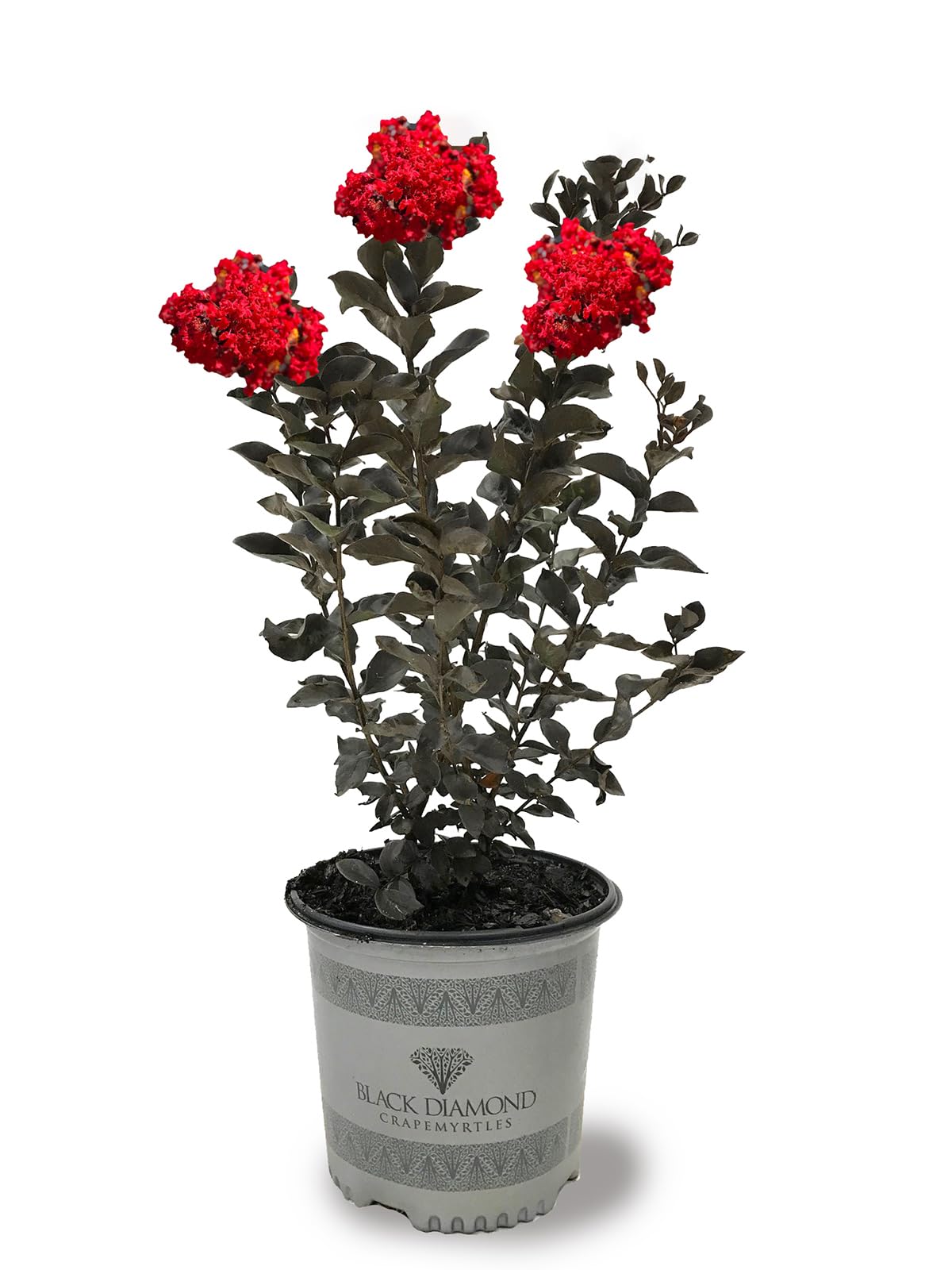
Dark foliage plus crimson bloom into fall, in a three-gallon pot that lands at 15 pounds.
This is the premium end of the dark-leaf family, and the difference from the Perfect Plants tree is the bloom window and the mature size. Both trees wear dramatic near-black foliage, but this one reaches 10-12 feet tall with a 6-8 foot spread and blooms from summer through fall with vivid crimson flowers. It is rated for USDA zones 7-9 and arrives in a three-gallon container at about 15 pounds of plant and soil. The dark leaves make the crimson flowers read like a spotlight against the foliage, and the effect holds for the whole season rather than a brief flush. Extended bloom time is the headline feature.
Health is where this tree earns its keep. Plants arrive healthy and thriving, show new growth quickly, and some come in already blooming. Quality and value hold up, and the appearance is what owners appreciate most after the health. Two practical notes deserve space before you buy: first, this seller will not ship to California, Arizona, Alaska, or Hawaii, so check your state. Second, a live tree needs planting promptly — a shipment that sits brittle on the porch for a week is a tree that struggles. Get it in the ground within a day or two of arrival and water it in deeply.
The number to hold onto: summer-through-fall bloom on a 10-12 foot tree with a 6-8 foot spread, which is the widest bloom window among the dark-leaf picks.
The honest limitation: the four-state shipping block plus the need to plant immediately — this tree does not forgive delay.
Go premium for a focal point: a healthy three-gallon dark-leaf tree that blooms from summer into fall and lands ready to plant.
Know your zone and state: zones 7-9 only, and not available in a handful of states.
9. Red Rocket Crape Myrtle Trees 4 Bundle

Four Red Rockets for a fast privacy line — up to 25 feet tall at a pace of 3-5 feet a year.
Red Rocket is the tall, fast, upright one in the red crape myrtle family. This bundle delivers four of them in quart containers, and they are built to grow into a privacy fence. The mature height reaches up to 25 feet, and the growth rate is an average of 3-5 feet per year. The bark is another reason to plant it — the unique exfoliating bark peels and shows through the winter, which adds interest long after the summer blooms fade. Full sun suits it, and it will grow in any soil, which makes it the forgiving pick for a rough patch of yard. Plant them in a row and you have a screen; give one a wide berth and you have a shade tree.
The in-ground result is what sells these. Owners plant them in late summer heat, water twice daily, and get them to establish and even leaf out nicely. Healthy, well-packaged arrivals are common. The risk is the old quart-pot story: a few arrive toothpick-thin and brittle, and half can fail to show life. That is the gamble when four thin bare-limbed sticks land in a box. The upside is real, though — if you plant all four, the strong two or three will carry the privacy line, and the growth speed makes up for lost time.
The privacy math: four trees, full sun, an average of 3-5 feet of growth per year, and a ceiling of up to 25 feet — this is a screening plant, not a patio specimen.
What you are signing up for: thin quart-size stock that can break in shipping. Plant all four and let the survivors form the line.
Best for screening a boundary: four fast Red Rockets with exfoliating bark and a tall mature height.
Not a single-plant purchase: this is a row, so buy it for a line, not for one focal spot.
10. 4 Pack Red Flowering Crape Myrtle

Four trees for a hot, sunny yard, from a grower who raises hundreds of crape myrtles himself.
This four-pack comes from a former schoolteacher in Waxahachie, Texas, a town nicknamed the Crape Myrtle Capital of Texas — a detail that says something about the grower’s roots. The plants ship in super-strong boxes and are secured in their original containers, never bareroot. They arrive 6-12 inches tall depending on variety and grow 3-5 feet a year. The seller claims you can easily double the size of your trees in just a few months, and the trees are especially tolerant of summer heat, thriving in it rather than just surviving it. Full sun and moderate watering round out the requirements.
In practice, growth is what earns this pack its spot. Plants that arrive scrawny green up and push new leaves within a couple of days once they are in the shade as directed, and new growth after just a week is the expectation. The caveat is the same one that dogs every quart multi-pack: the trees are small. A buyer who ordered four and expected a bigger plant is the usual complaint, and one batch arrived in poor condition. Water steadily through the first month and judge the pack at season’s end, not on arrival day.
What makes it different: it is the summer-heat pick — the trees are described as tolerant of summer planting, which is when most people actually buy them.
The size reality: 6-12 inches on arrival is a starter, and doubling in a few months still leaves a small tree in year one.
Best for a summer purchase: four trees that tolerate heat and ship in strong boxes, ideal if you are planting in the hot months.
Go bigger if you want instant impact: these are starter trees, and the small size is the trade-off for four plants at once.
11. Black Diamond Crimson Red Crape Myrtle 3-Gallon
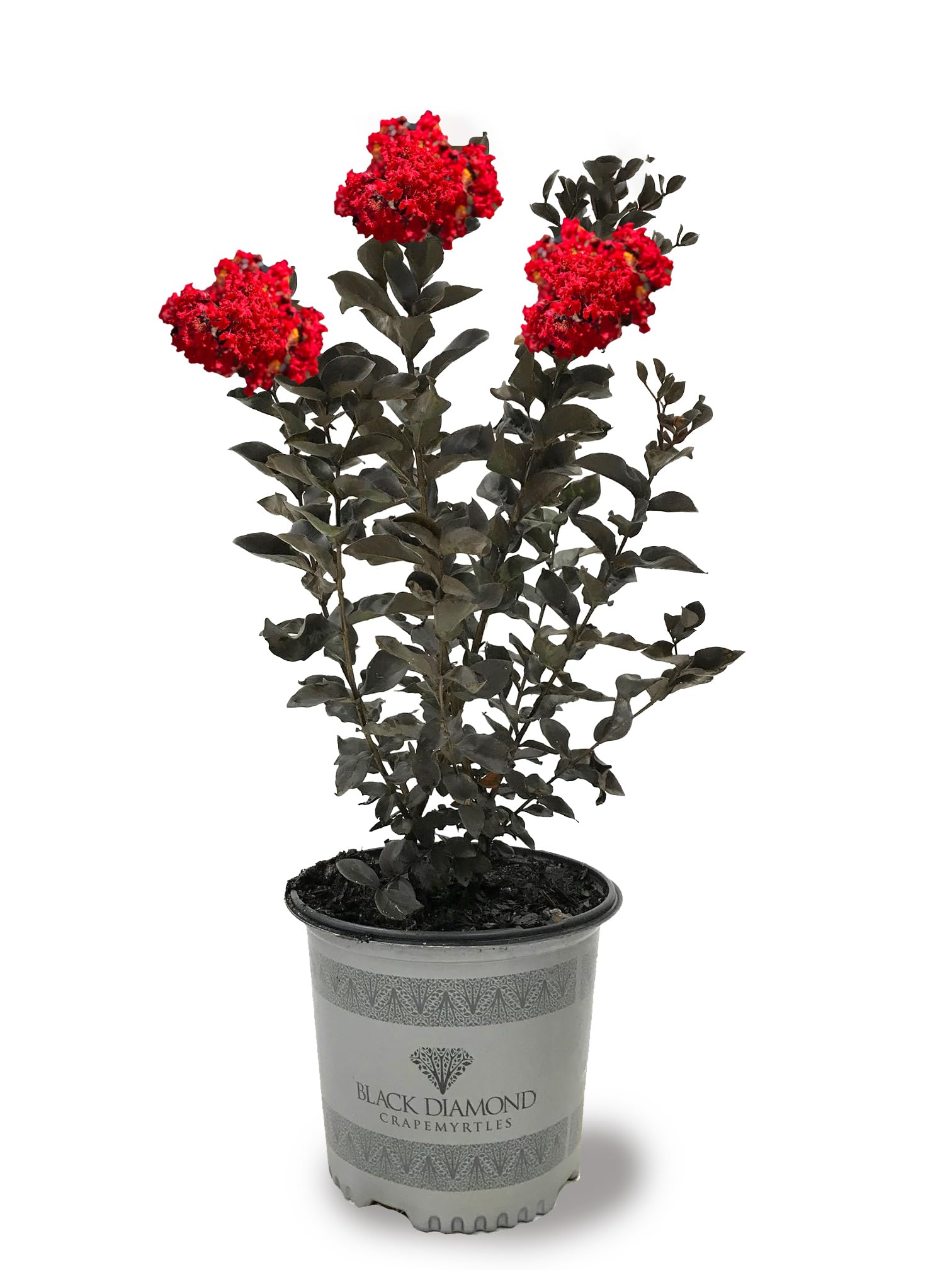
A dark-leaf crimson myrtle that survives a light freeze and blooms all spring and summer.
This Black Diamond Crimson Red ships in a three-gallon pot and stands 1-2 feet tall at arrival, which makes it the smallest of the three-gallon picks — the Perfect Plants and Black Diamond trees ship with more height behind them. What it offers instead is a potted live plant with drought tolerance and a crimson bloom the listing describes as year-round in appeal. It is a low-maintenance option for a landscape accent, and the ASPCA-verified pet-friendly label is a real detail for households with dogs or cats that chew in the yard. Sun exposure on the listing reads partial shade, so check that against your site.
The real-world reports are encouraging. Potted plants have withstood a light freeze and kept blooming through spring and summer, and the appearance matches the listing photo — arrived early, as described, and easy to plant. The one honest risk is shipping damage. A delivery that lands on its side can break branches, and the tree arrives alive but scuffed. For a pet-safe dark-leaf accent with a long bloom window, this is the pick.
The pet detail that matters: ASPCA-verified as pet-friendly, a rare and useful label for a backyard tree in a house with animals.
The catch: 1-2 feet on arrival in the three-gallon pot is modest, and rough shipping can leave branches broken even when the plant lives.
Best for a pet-owning household: a drought-tolerant, dark-leaf crimson tree that blooms through spring and summer.
Check the height expectation: if you want a taller plant from the start, the other three-gallon picks start bigger.
Know the Specs
These two labels decide how a red crape myrtle performs in your yard more than anything else on the listing. Here is what each one means in plain terms.
USDA Hardiness Zone
A hardiness zone is a number that maps the coldest winter your area reaches, and it is the single best filter for a live tree. A crape myrtle rated for zones 7-9 will not survive a zone 5 winter outdoors, no matter how carefully you plant it. Check your zone first, then shop. Trees rated for zones 6-10 give you a wider margin across the South and mid-Atlantic. Container plants offer some flexibility, but a permanent garden planting is at the mercy of the zone number on the label.
Container Size
The pot a tree ships in tells you how much root system it carries. A quart container is a young, small plant — cheap, adaptable, and slow to look like a tree. A 2-gallon pot sits in the middle, and a 3-gallon pot is closer to a landscape-ready plant with a root ball that handles shipping. Container trees can go in the ground any time of year, but they still want water and a prompt planting. Bigger pot, better odds: a 3-gallon root ball survives shipping better than a quart seedling.
Common Questions
Why did my red crape myrtle arrive with no leaves?
How tall will a red crape myrtle actually get?
How fast does a crape myrtle grow per year?
Can I plant a red crape myrtle in summer?
What is the difference between the red-flower green-leaf and Black Diamond crape myrtles?
Will a red crape myrtle survive a light frost?
Do red crape myrtles need full sun?
Are crape myrtles safe to plant where pets and kids play?
Is a three-gallon pot worth it over a quart seedling?
Why can I not order some of these red crape myrtles to my state?
Do red crape myrtles come back after dying back to sticks?
The Bottom Line
For most yards, the winner is the 6 Pack Red Flowering Crape Myrtle Trees — six plants in one box mean you lose nothing if one seedling struggles, and a 3-4 foot annual growth rate and 20+ foot mature height turn a bare fence line into a screen within a few seasons. It also carries 4.0+ stars across 250+ ratings, the strongest review record among the multi-plant picks. If you want a showpiece tree instead of a row, the Black Diamond Crimson Red gives you the dark-leaf contrast and the summer-through-fall bloom on the biggest, healthiest three-gallon plants. And for a compact shrub that stays under 12 feet beside a porch, the Proven Winners Center Stage Red is the one to reach for.
One last read on the whole shelf: every red crape myrtle here will bloom, and the real question is simply how big a plant you want on day one versus how much you are willing to nurse it. Plant each tree within a day or two of arrival and water deeply through the first month.
How we choose
We do not accept paid placement. Every pick is matched to a real buyer and a real use-case; we do not hands-on test units.
Sources
Specifications: manufacturer listings and product documentation. Review insights: verified customer reviews, as of October 2026. Pricing: not shown on this page (it changes often); check the current price via the retailer link.
As an Amazon Associate, Aappliancez earns from qualifying purchases. This does not affect which products we feature.