Disclosure: Some links in this post are affiliate links. As an Amazon Associate I earn from qualifying purchases, at no extra cost to you. Learn more
Specs are compiled from manufacturer listings and verified buyer reviews and can change over time — please confirm the key details on the product page before buying.
Blowing out sprinklers depends on one job: keep a steady wall of air moving long enough to push every drop of water out of the zone lines before the first freeze. Buy too small and you sit there cycling the pump while water settles back into the low spots. Buy too big and you have paid for a machine that is hard to move and hard to store. The picks below all hold pressure while you work through each zone, sorted by how you will really use them.
This guide is built by comparing the manufacturers’ published specifications and the patterns across verified customer reviews, so you get each pick’s real strengths and trade-offs instead of marketing spin.
The right machine depends on how many zones you run and whether the compressor has another job in your garage. Below you will find the airflow, tank size, and pressure numbers that decide whether a unit can clear a line in one pass — the practical facts behind the air compressor for blowing out sprinklers.
Top Picks

How To Choose The Best Air Compressor for Blowing Out Sprinklers
Winterizing a sprinkler system is not the same job as filling a tire or running a nail gun. You are moving a large volume of air through a buried pipe for a sustained stretch, and the compressor has to hold pressure the whole time. Three numbers decide whether a machine can do that: airflow in CFM, tank capacity in gallons, and the maximum pressure in PSI.
Start with CFM, not tank size
CFM (cubic feet per minute — how much air the pump moves each minute) is the number that clears a zone line. A big tank with a slow pump empties fast and then sits there refilling while water creeps back into the pipe. A smaller tank fed by a strong pump keeps a steady push going. Look for the CFM figure rated at 90 PSI, because that is closer to the pressure you will actually run at the heads.
Match pressure to your head height
PSI (pounds per square inch — the force behind the air) has to be high enough to lift water out of heads that sit above the valve. Most residential systems clear comfortably in the range these compressors offer, but a unit with a higher max PSI gives you more headroom on sloped yards and long runs. Never exceed the rating printed on your backflow assembly or the pipe itself.
Oil-free versus oil-lubricated pumps
A sprinkler compressor sits in the garage most of the year, so an oil-free pump (one that needs no oil changes) is the easier ownership story. Oil-lubricated models run cooler and recover faster but ask for oil checks. For a once-a-year blow-out, oil-free is the low-fuss route.
Portability and where you will park it
You have to get the unit from storage to the valve box, often across grass or gravel. Wheels and a folding or flip-up handle make the difference between a one-person job and a two-person lift. Check the weight before you commit — a 127-pound vertical tank handles fine on wheels but is not something you carry up steps.
Side-by-Side Comparison
| Model | Best For | Airflow (CFM) | Tank (gallons) | Max PSI | Amazon |
|---|---|---|---|---|---|
| ECOMAX 6 Gallon Pancake★ Best Overall | All-round home blow-outs | 3 cubic inches per minute | 6 | 150 | Amazon |
| Makita MAC5200 Big BoreShop Workhorse | Heavy shop and big lines | 5 cfm | 5.2 | — | Amazon |
| Baotree 3 Gallon Ultra QuietQuietest Small Tank | Quiet indoor and tight spaces | — | 3 | 115 | Amazon |
| Adam’s Polishes Mini Air Cannon | Handheld spot blowing | 90 CFM | — | — | Amazon |
| ONEAND 1 Gallon Portable | Trunk-sized touch-ups | 0.5 cfm | 1 | 120 | Amazon |
| VEVOR 13-Gallon | Quiet garage all-rounder | 4.6 cfm | 13 | 125 | Amazon |
| WIILAYOK 13 Gallon | Fast refill on long zones | 6.5 cfm | 13 | 115 | Amazon |
| California Air Tools CAT-4610AC | Quiet two-gun finish work | 2.2 cfm | 4.6 | — | Amazon |
| Klutch 29-Gallon | Big tank, long service life | 5.1 cfm | 29 | 175 | Amazon |
Detailed Reviews
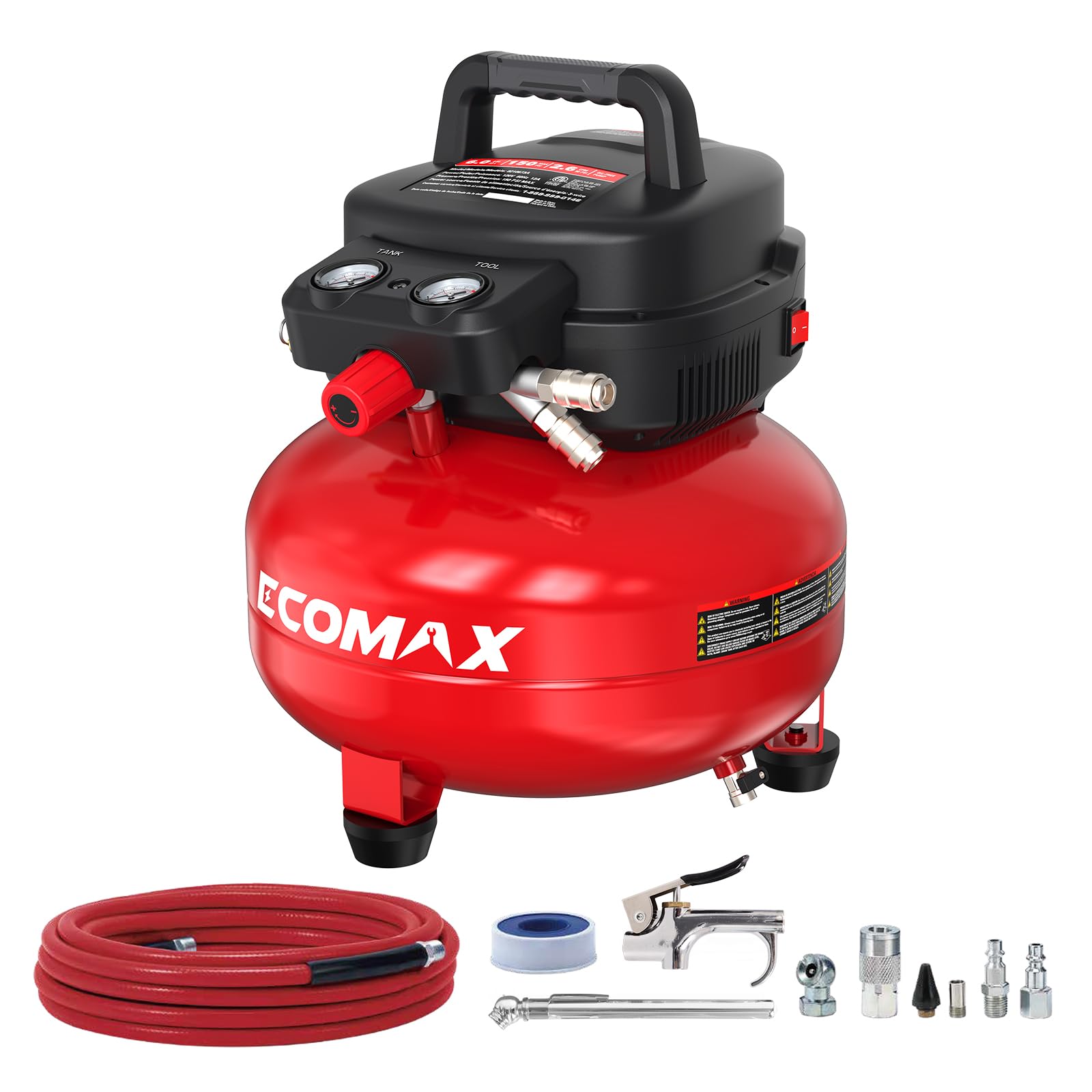
1. ECOMAX Air Compressor 6 Gallon
Our pick — 4.5+★ from 300+ verified ratings; the strongest balance of quality and price.
A 6-gallon pancake with 150 PSI and the hose already in the box.
The reason this one tops the list for winterizing a yard is simple: it arrives ready to work. The box holds a 25-foot PVC air hose, a blow gun, a tire gauge, thread seal tape, a ball foot chuck, two auto plugs and an auto coupler. That means you unbox it, thread the blow gun on, and you are clearing zones instead of shopping for fittings. The 6-gallon tank gives you a useful reserve — gallons being the storage volume of the air, so a bigger tank means more push before the pump has to run again.
On paper the numbers line up for sprinkler work. It tops out at 150 PSI (pounds per square inch, the pressure driving the air), which is well above what a residential zone needs to lift water out of a buried head. The pump delivers 3 cubic inches of air when the pressure is at 90 PSI, and a 1.5 HP motor (horsepower — how hard the pump works) drives the whole thing on 180 watts. Owners consistently describe it as portable and easy to move, helped by the flip-up handle and the 34.17-pound weight. For comparison, the Makita MAC5200 below weighs 75 pounds — this ECOMAX is 34.17, so it is the one you can carry out to the valve box without a plan.
The trade-off is that this is a home-duty machine, not a shop workhorse. You will run through each zone in sequence rather than expecting it to feed a big paint gun all afternoon. The upside of that same design is the oil-free pump: no oil changes, no oil to check before you store it for the season. The dual quick couplers let you run two hoses at once, which speeds up a multi-zone setup if you have a helper.
What earns it first place
- 10-piece accessory kit includes a 25-foot hose and blow gun — nothing extra to buy
- 150 PSI ceiling clears buried heads with pressure to spare
- 34.17 pounds with a flip-up handle makes it a one-person carry
- Oil-free pump means no oil maintenance between seasons
- Dual quick couplers for running two lines at once
Where it stops short
- Home-duty build, so it is not sized for continuous shop-tool use
- 180 watts means modest recovery compared with the bigger tanks
- Pancake shape is stable but takes up floor space on a shelf
Reach for this if: you want a plug-and-play blow-out kit for a typical residential yard, with the hose and gun already included.
Look elsewhere if: you also need to run a spray gun or impact wrench all day — step up to the Makita or the Klutch for that workload.
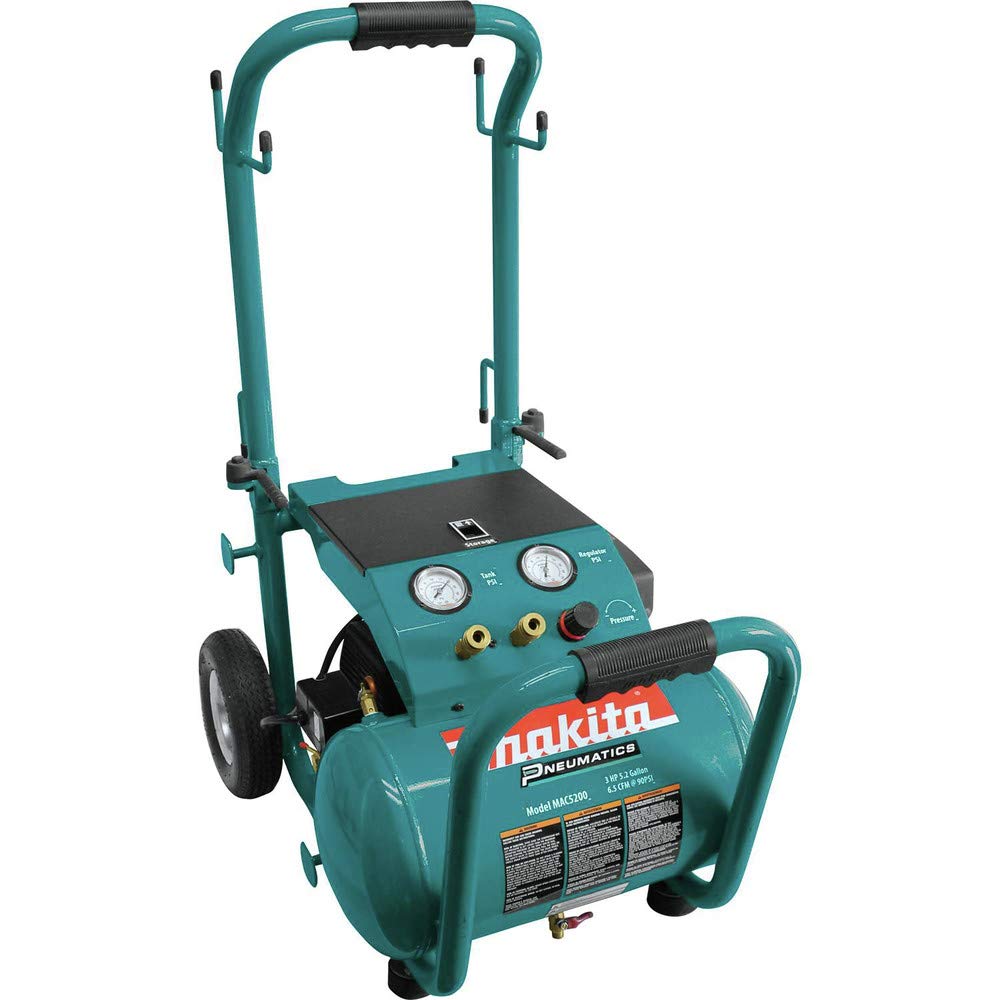
2. Makita MAC5200 3.0 HP* Big Bore™ Air Compressor
The one that out-pumps most home compressors and still fits a folding handle.
If your yard has long zones or you also run nailers and impact tools, the MAC5200 is the machine that keeps up. Its 3.0 HP motor produces 6.5 CFM at 90 PSI, and that airflow is what clears a pipe fast instead of trickling air through it. The Big Bore cylinder and piston are cast iron, which is a durability choice: cast iron runs cooler and wears more slowly than a lighter pump. A 5.2-gallon tank stores the reserve. The pump is oil-lubricated, so it runs cooler than oil-less designs and asks for periodic oil checks — a small habit for a machine this capable.
Between zones, you want pressure back fast so you are not standing around. As buyers report, the MAC5200 “Charges tank to 120 PSI plus 3/8″x50′ hose to 90 PSI in 1 min 17 sec.” That quick recharge is exactly what you want when you move from one zone to the next. The trade-off is weight: at 75 pounds it is 2.2 times the ECOMAX’s 34.17 pounds, so use the sturdy wheels and collapsible handle rather than lifting it into a truck bed. Several owners mention shipping risk on this unit — the box is heavy and rough handling can bend a wheel — so check it closely on arrival.
The lower pitch of an oil-lubricated pump makes it less shrill than a pancake, though it is still loud enough that hearing protection is sensible if you are standing next to it. For sprinkler work it is overkill on a small yard but spot-on for a large property with several zones and high head heights. It is a buy-once machine for someone who wants the compressor to earn its keep year-round.
Where it wins: 6.5 CFM at 90 PSI and a cast iron Big Bore pump give you the sustained push a long zone line needs, with a folding handle for storage.
The honest catch: 75 pounds and a heavy shipping box mean you should plan for wheels and inspect on delivery — this is not a grab-and-go unit.
Best matched to: a large yard or a shop where the compressor clears sprinklers in fall and runs air tools the rest of the year.
Think twice if: you only blow out two short zones once a year — the weight and oil checks are more machine than that job needs.
3. Baotree 3 Gallon Ultra Quiet Air Compressor
Runs at 70dB so the neighbors never hear you winterizing.
Here is the pick for a tight suburban lot where a screaming compressor draws looks. It runs at 70dB (decibels — the measure of how loud a sound is), which is roughly the level of a normal conversation, so you can clear zones on a weekend morning without annoying anyone. The 3-gallon steel tank is small, but the 1.2 HP motor fills it from cold in 50 seconds, and a top-up takes only 20 seconds. That fast refill is what keeps a small tank usable — the pump catches up quickly between bursts.
It tops out at 115 PSI, which is enough for typical residential zone lines. The oil-free design means no oil changes, and the alloy steel tank with a multi-layer anti-wear coating is built to resist leaks. It weighs 37.5 pounds with a built-in handle and rolling wheels, so moving it to the valve box is manageable. What buyers praise most is exactly that quiet running — it is the trait owners call out again and again — followed by how solid the build feels.
Understand the limit before you buy: a 3-gallon tank means less stored reserve than the 6- and 13-gallon options here. On a long zone you may cycle the pump more often, which is fine for a home system but slower on a big property. For a small yard, a couple of zones, or a compressor you also want for dusting and inflating indoors, the quiet running is worth the smaller tank.
Why it is on the list: 70dB operation and a 50-second cold fill make it the least disruptive way to clear a few zones close to the house.
What you give up: 115 PSI and 3 gallons of storage mean less headroom on long runs — plan on more pump cycling than the larger tanks.
Pick this one when: noise and size matter more than raw reserve, and your system is a modest set of zones near the house.
Step up instead if: you are clearing a large property with long runs and want the pump to sit quiet more of the time.
4. Adam’s Polishes Mini Air Cannon Handheld Blower

A handheld blower that pushes 90 CFM into spots a tank hose cannot reach.
This is not a tank compressor at all — it is a handheld forced-air blower, and it earns a place here for the parts of a sprinkler job a big unit handles badly. Think blowing grit and water out of valve boxes, drying off fittings, or clearing a head that sits in a tight bed where a stiff hose will not bend. It moves 90 CFM (cubic feet per minute of air), and compared with the Makita’s 5 cfm that is a huge airflow edge — 90 versus 5 — because it is a different tool with a different job.
At 19,000 FPM (feet per minute, the speed of the air leaving the nozzle) it strips water fast. It weighs in at just over 3 lbs, so you can hold it one-handed while you work a valve, and the 20-foot rubberized power cord gives you reach without an extension. It runs on 120V at 10 amps and 1200 watts, and it uses noise-cut technology to keep the sound manageable. Two nozzle tips — a fan tip and a round tip — cover wide sweeps and tight blasts. Owners love how much air it moves in tight spots.
The catch is obvious: 1200 watts and a cord mean it needs a nearby outlet. It also has no tank or pressure gauge, so it cannot push a sustained blast down a long buried line the way a compressor can. Use it as a companion, not a replacement, for the tank machines above.
Where it shines: 90 CFM and 19,000 FPM strip water and grit out of tight valve boxes the tank hoses cannot reach, at just over 3 lbs in one hand.
The limitation to know: no tank and no gauge — a corded blower cannot hold sustained pressure down a long line, so pair it with a tank compressor.
Handy add-on for: anyone who wants to dry off valves, fittings and tight beds fast without dragging the main compressor around.
Not a substitute for: a tank compressor when the job is pushing air through a whole buried zone.
5. ONEAND 1 Gallon 120 PSI Portable Air Compressor

A 14.9-pound cordless unit for the small jobs around the yard.
What sets this apart is that it runs on an 18V battery — no cord to drag across the lawn. That makes it the easiest machine here to grab for a quick blow-out of a single short line, and it is a natural fit for adding air to tires or clearing debris from an exposed head. It holds 1 gallon of air at a maximum of 120 PSI, reaches 120 PSI in about a minute, and weighs 14.9 pounds with a 15-foot hose. The compact body stores in a trunk without drama, and owners like the durable rubber handle and thick tank.
Airflow is where you have to be realistic. It delivers 0.5 CFM at 90 PSI — a fraction of what the tank machines push — so this is a spot tool, not a zone-clearer. On a short run it does the job; on a long buried line it will fall behind. Battery life is mixed: the pump is faster than a plug-in electric inflator, but it drains batteries quickly, and the battery and hoses are not included. Budget for the batteries if you do not already run the 18V platform.
The controls take a moment to learn — the middle knob has to be pulled out and turned fully right — so read up before you assume it is broken. For a small yard, a rental property, or a tire-and-debris tool that lives in the truck, the cordless freedom is the whole point.
What makes it handy
- 18V cordless operation — no outlet needed on the lawn
- 14.9 pounds with a 15-foot hose stores in a car trunk
- Reaches 120 PSI in about a minute
Set your expectations here
- 0.5 CFM at 90 PSI is too little to clear a long zone line
- Drains batteries quickly; battery and hoses sold separately
- Control knob takes a moment to figure out
Suits you if: you want a light, cordless unit for short lines, exposed heads, tires and cleanup on a compact property.
Skip the cordless route if: you need to push air down long buried runs — reach for a 6-gallon or larger tank instead.
6. VEVOR 13-Gallon Air Compressor, 2HP, 66dB

A 13-gallon tank that runs at 66dB and builds pressure in under three minutes.
The big capacity story lives here: a 13-gallon tank fed by a 2HP motor. That means a large reserve of air, so on a zone line you get a long sustained push before the pump has to catch up. It flows 4.6 CFM at 90 PSI, tops out at 125 PSI, and builds full pressure in under three minutes. For winterizing a multi-zone system, the extra gallons are the difference between clearing a line in one steady pass and recharging mid-way.
The quiet running is what owners praise most — the 66dB rating means it is genuinely unobtrusive inside a garage, and it is the trait that comes up again and again in the feedback. The oil-free pump needs no oil maintenance, which suits a machine that sits idle for much of the year. Two 7-inch reinforced rubber wheels roll it between indoor and outdoor spots, and the set includes the wheels, foot pads, pressure gauges and air filters, so you are not hunting for parts to assemble it. Note that 71 pounds is a lot to lift; roll it, do not carry it.
One honest note from the feedback: refill time draws mixed reactions — some find it fills without delay, others feel it takes longer than expected. The two-gauge setup lets you watch tank and line pressure closely while you work. For the price/space balance it strikes — 13 gallons of reserve without a huge footprint — it is a strong middle-ground choice for a home with several zones.
The case for it: 13 gallons and 4.6 CFM at 90 PSI give you reserve to clear a long zone in one pass, all at a whisper-quiet 66dB.
The trade-off to weigh: 71 pounds means it is a roll-it-around machine, and refill time divides opinion — worth considering if speed of recharge matters most to you.
Well suited to: a garage where noise and tank reserve both matter, and the compressor doubles as a weekend project tool.
Consider the alternative if: you prioritize the fastest possible recharge on back-to-back zones.
7. WIILAYOK 13 Gallon Portable Air Compressor, 3.7 HP
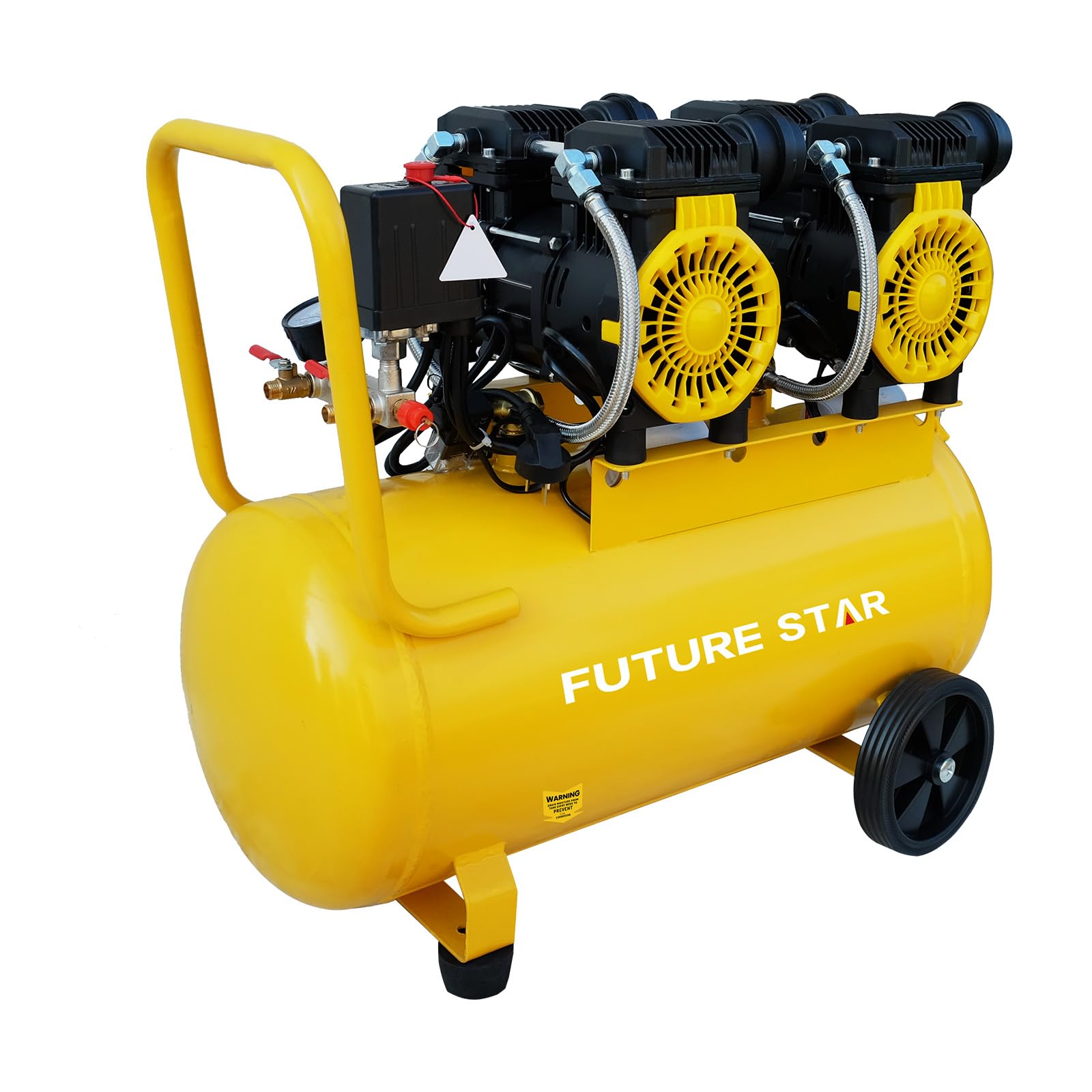
Six and a half CFM from a 13-gallon tank — the airflow leader of the tank group.
To push water down a long zone, you need strong airflow, and this unit lists 6.5 CFM (cubic feet per minute — how much air it moves) with a 13-gallon horizontal tank. That combination — big reserve plus strong flow — is built for sustained work. It runs a 115 PSI maximum (pounds per square inch — how hard it pushes) and supports dual outlets for two tools at once. The motor is listed at 3.7 HP, and an oil lubrication system (unlike the oil-free designs above) cuts friction and asks only for routine oil attention. The 3-layer reinforced steel tank with smooth welding is meant to hold pressure without leaks, and it rolls on a top handle and bottom wheels at 64 pounds.
Owners describe it as quiet compared with red pancake compressors, and the build earns consistent praise. One report has it spraying a full automotive bedliner through an HVLP gun with a 2.5 tip — a lot of sustained airflow — and filling fast. That same report notes it needs a 25A circuit with nothing else connected, so check your breaker before you run it hard. A few comments mention cosmetic shipping wear and sparse instructions, so inspect on arrival and download the manual if the box copy is missing.
For sprinkler winterizing, the 6.5 CFM flow is what separates it: it moves a large volume of air at a pressure high enough to clear a long line quickly. If your property has long zones and you want each one done in a single steady blast, this is the airflow pick.
Why airflow chasers like it
- 6.5 CFM is the strongest flow of the tank machines here
- 13-gallon horizontal tank gives long sustained reserve
- Dual outlets for running two tools at once
- Oil lubrication for cooler, lower-friction running
Fit notes before you commit
- Needs a 25A circuit with nothing else connected when run hard
- 64 pounds — roll it, do not lift it
- Some arrive with cosmetic shipping wear; check the box
Made for: long zones and large properties where you want each line cleared in one fast, high-flow pass.
Check first: a 25A circuit for hard use — if your garage is on a smaller breaker, look at the quieter VEVOR instead.
8. California Air Tools CAT-4610AC Ultra Quiet Oil-Free

The 60dB whisper — quieter than a normal conversation while it works.
Nothing else here runs this softly. At 60dB the CAT-4610AC is quieter than most refrigerators, so you can clear zones at dawn without waking the house. That calm comes from a 1.0 HP motor (2.0 HP peak) turning at a low 1680 RPM — a slow-spinning motor makes less noise and wears less. It flows 3.10 CFM at 40 PSI and 2.20 CFM at 90 PSI from a 4.6-gallon aluminum twin tank that will not rust. The oil-free dual piston pump is rated for a life cycle of over 3000 hours, and the whole unit weighs in at 44 pounds.
What wins owners over is exactly that quiet: it is the trait the review pages rave about most, and the aluminum tanks that shave weight come up often too. It runs on just 8.5 amps, so it plays nicely with a normal household 110V outlet or a 2500-watt generator. For a home system with a few zones, the low amp draw and light weight make it an easy, civil companion to the rest of the garage.
Be clear-eyed on airflow: at 2.20 CFM at 90 PSI it is lower than the VEVOR and WIILAYOK, so a very long zone will take longer to clear. This is a quiet, well-built home machine — not a high-volume shop blaster. If you value near-silent operation and light weight over raw CFM, it is the pick.
Its strong suit: 60dB, a low 1680 RPM motor, and 44 pounds make it the quietest, gentlest way to clear a home system, on a normal 110V outlet at just 8.5 amps.
What it will not do: 2.20 CFM at 90 PSI is modest, so big multi-zone properties will feel slower than the higher-flow tank picks.
Ideal for: a light-sleep neighborhood and a home with a handful of zones, where quiet and easy handling rank highest.
Better to pass if: your zones are long and you want each one cleared in a single fast pass.
9. Klutch 29-Gallon Air Compressor, 2.5 HP, 175 PSI
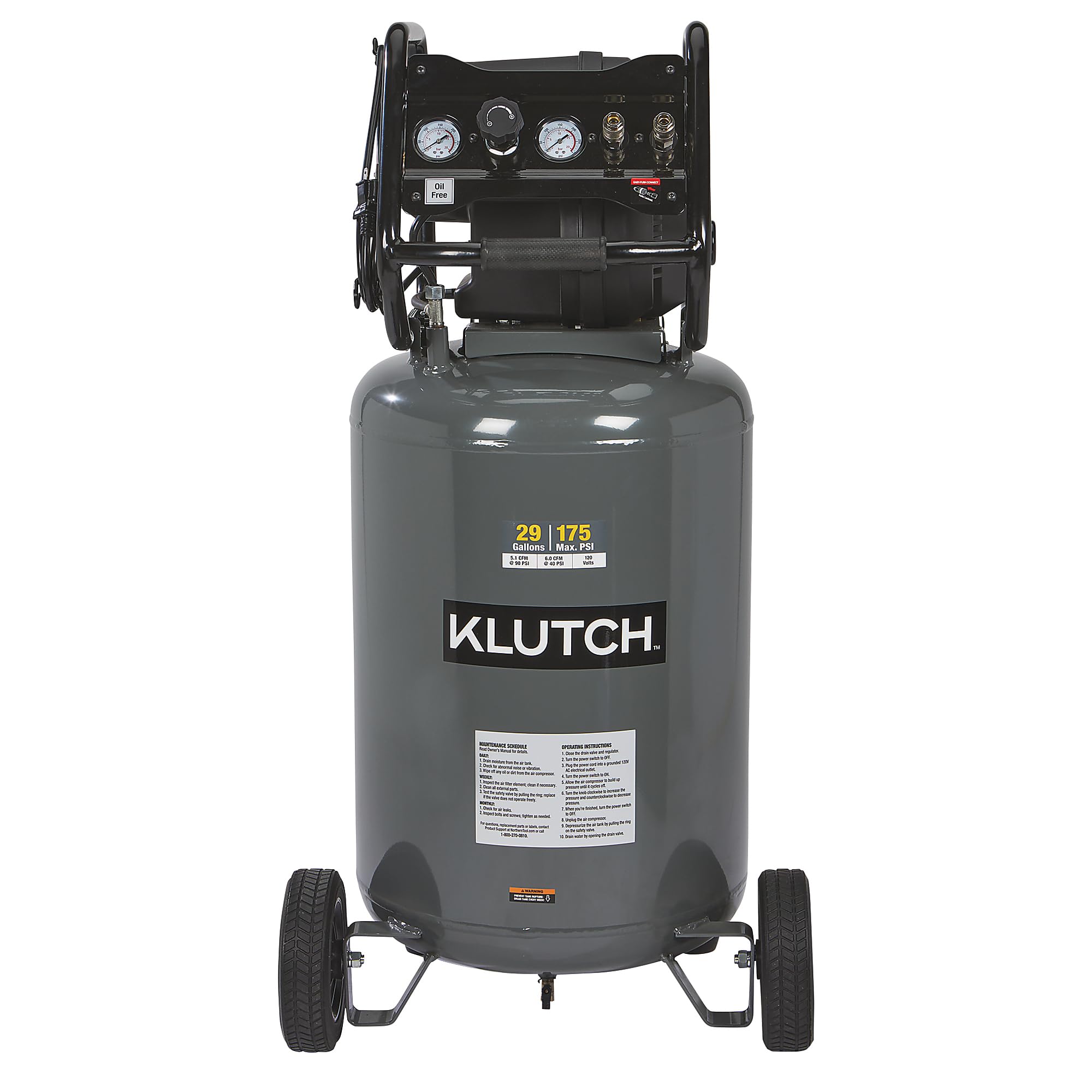
A 29-gallon vertical tower with the biggest reserve and highest pressure here.
When the property is large and you want to blast through a whole zone without touching the pump, the tank size tells the story. This one holds 29 gallons — more than double the VEVOR and WIILAYOK’s 13 — and builds a maximum pressure of 175 PSI, the highest on this list. It flows 5.1 CFM at 90 PSI from a 2.5 HP motor on 120V. A big reserve plus high pressure is the combination that clears a long buried line in one sustained, powerful push, and the vertical design saves floor space in a garage corner.
The vertical footprint and large flat-free tires make it movable despite the size — it weighs 127 pounds, so the wheels are doing the work. The oil-free pump means no oil changes, and a maintenance-friendly tank drain makes emptying condensation simple after each use. Buyers describe it as quiet and solid, with pressure holding steady at 150 PSI for a week on one report. That steady hold is exactly what matters for a machine that sits for months between seasons.
The honest caveat is that a big tank takes a while to build pressure the first time, and one note suggests the motor can run long and the CFM figure may be optimistic under load. For once-a-year blow-outs, that initial fill time is a non-issue. If you also want a machine for occasional impact-wrench work, the 29 gallons make it earn its space.
Why the big tank wins
- 29 gallons of reserve clears long zones in one sustained pass
- 175 PSI maximum — highest pressure on the list
- Vertical tower saves garage floor space
- Oil-free pump with a maintenance-friendly drain
Account for these
- 127 pounds — the wheels are essential, not a convenience
- Big tank means a slow first fill from empty
- A note suggests the CFM figure may run optimistic under load
Right for you if: you have a large property, several long zones, and want the biggest reserve and highest pressure here.
Look at the smaller tanks if: you have a compact system or limited garage space — 29 gallons is more reserve than a small yard needs.
Know the Specs
Airflow (CFM at 90 PSI)
CFM means cubic feet per minute — how much air the pump actually moves. This is the number that decides whether a zone line clears in one pass or trickles. Always compare the CFM figure taken at 90 PSI, because that is close to the pressure you will run at the heads, not the higher pressure a marketing sheet sometimes quotes.
Tank Capacity (Gallons)
Tank size is stored reserve — how long the compressor can push before the pump runs again. A bigger tank holds more air for a steady blast, while a smaller tank needs a fast pump to keep up. A 13-gallon tank clears longer zones in one pass; a 3-gallon tank asks the pump to cycle more.
Maximum Pressure (PSI)
PSI is pounds per square inch — the force pushing the air. You need enough to overcome head height and pipe length on a buried line. Never exceed the rating printed on your backflow assembly or pipe, and always regulate down to what the system safely takes.
Oil-Free vs Oil-Lubricated
An oil-free pump needs no oil changes, which suits a machine that sits idle most of the year. An oil-lubricated pump runs cooler and recovers faster but asks for routine oil checks. For a once-a-year blow-out, oil-free is the lower-maintenance route.
Common Questions
What CFM do I need to blow out sprinkler zones?
Is tank size or CFM more important for winterizing?
How much PSI do I need to clear a sprinkler line?
Can I use a small pancake compressor to blow out sprinklers?
Oil-free or oil-lubricated for a once-a-year job?
How do I hook a compressor up to my sprinkler system?
Is the highest-PSI compressor always the best?
Why does my compressor keep cycling while I blow out a zone?
How do I drain condensation after blowing out sprinklers?
Does blowing out a sprinkler system damage the compressor?
The Bottom Line
For most homes, the pick that earns the job is the air compressor for blowing out sprinklers all-rounder, the ECOMAX 6 Gallon Pancake. It ships with a hose and blow gun, pushes 150 PSI from a 6-gallon tank, and stays light enough at 34.17 pounds to carry to the valve box. If long zones are the concern, the WIILAYOK 13 Gallon leads on airflow at 6.5 CFM. And if a big property needs the biggest reserve and highest pressure, the Klutch 29-Gallon at 175 PSI is the one to reach for.
How we choose
We do not accept paid placement. Every pick is matched to a real buyer and a real use-case; we do not hands-on test units.
Sources
Specifications: manufacturer listings and product documentation. Review insights: verified customer reviews, as of October 2026. Pricing: not shown on this page (it changes often); check the current price via the retailer link.
As an Amazon Associate, Aappliancez earns from qualifying purchases. This does not affect which products we feature.