Disclosure: Some links in this post are affiliate links. As an Amazon Associate I earn from qualifying purchases, at no extra cost to you. Learn more
Specs are compiled from manufacturer listings and verified buyer reviews and can change over time — please confirm the key details on the product page before buying.
If your arch has collapsed and your ankle keeps rolling inward, the brace that helps is the one that lifts the arch and holds the ankle at the same time — not a plain compression sleeve. The BioSkin TriLok is the strongest all-round choice here because it does both jobs with one wrap. Below are seven braces, sorted by what each one actually does for a flat, painful foot, so you can match one to your own foot instead of guessing.
This guide is built by comparing the manufacturers’ published specifications and the patterns across verified customer reviews, so you get each pick’s real strengths and trade-offs instead of marketing spin.
Some braces here are built for a dropped foot and some for a fallen arch, and mixing them up is the most common mistake buyers make. The short version is that the right pttd brace has to match your foot shape, your shoe, and how much lift you actually need each day.
Top Picks


How To Choose The Best PTTD Brace
Posterior tibial tendon dysfunction (PTTD) is what happens when the tendon that holds up your arch stops doing its job, so the arch flattens and the ankle tips inward. A brace for it has to do two things at once: lift the arch from underneath and stop the ankle from rolling. A sleeve that only squeezes gives you none of that.
Arch lift versus ankle control
Look for a strap that runs under the arch and pulls it upward, plus a wrap that crosses the ankle in a figure-eight. The BioSkin TriLok is built exactly this way, with a FootLok strap for the arch and a figure-8 wrap for the ankle. If a brace only offers compression, it will feel supportive for an hour and then let the arch sag again.
Sizing is by shoe size, and width matters
These braces are sized off your shoe size rather than a tape measure around your foot. That works for most people, but a narrow foot at the bottom of a size range should size down, and a wide foot at the top should size up. A brace that is too tight around the arch band will press into the tendon instead of supporting it.
Will it fit inside your shoe?
This is where most returns happen. A soft wrap with thin straps slips into trainers and flats, while a rigid plastic footplate needs extra room. Several of the drop-foot braces here say plainly that you should pick a shoe size larger than usual. If you live in narrow dress shoes, a low-profile wrap is the safer bet.
Side-by-Side Comparison
| Model | Best For | Type | Weight | Shoe Fit | Amazon |
|---|---|---|---|---|---|
| BioSkin TriLok★ Best Overall | Arch plus ankle support | Soft wrap with figure-8 straps | 5.6 ounces | Fits most trainers, flats, boots and cleats | Amazon |
| Medical AFO Foot Drop BraceBudget Lift | Budget drop-foot support | Trimable PP footplate | 8.15 ounces | Fits most shoes; trims with scissors | Amazon |
| Tuli’s X Brace | Arch-only relief | Elastic X strap | 0.5 ounces | Wear with shoes or barefoot | Amazon |
| Orthomen AFO | Slim in-shoe drop-foot brace | Half-sole polymer shell | 6.4 ounces | Fits sneakers and loafers | Amazon |
| JOMECA Drop Foot Brace | Adjustable arch compression | Soft wrap with cross straps | — | Wear looser shoes | Amazon |
| Upgraded JOMECA AFO | Adjustable support level | Dual forefoot plates | 5.28 ounces | Thin fabric for most shoes | Amazon |
| Brace Direct Leaf Spring AFO | Trim-to-fit women’s right foot | Semi-rigid polyethylene shell | — | Open-heel, slips into most shoes | Amazon |
Detailed Reviews
1. BioSkin TriLok Ankle Brace
Our pick — 4.0+★ from 200+ verified ratings; the strongest balance of quality and price.
Two jobs, one wrap: the brace that lifts a fallen arch and locks the ankle together.
Most braces for a flattening arch pick one job and ignore the other. The TriLok does both, with a FootLok strap that pulls the arch upward and a figure-8 wrap that holds the ankle steady, and that pairing is what separates it from a plain compression sleeve. It weighs 5.6 ounces and is built from nylon and Lycra, so it sits flat enough for trainers, flats, boots and cleats.
What wins people over is comfort, and the longer stories back it up. One buyer with a lateral malleolus fracture reported pain dropping from 8 to 4 within 24 hours, and another with an avulsion fracture still wears it for sport. A runner with a strained peroneal tendon wore it through a month off running and returned pain-free, and a walker with anterior tibial tendonitis wore it daily after physical therapy and felt steadier on their feet.
Here is the honest catch: it is a four-strap wrap with a specific path, and the first few wears take some fiddling. Once you have the sequence down it goes on quickly, and there are application videos and a four-step image to follow. It works on either foot, and the sizing runs off shoe size — size down if you have a narrow foot at the bottom of a range.
What earns it first place
- Arch lift and ankle control in one brace instead of two separate pieces
- Low-profile nylon and Lycra shell fits inside trainers, flats, boots and cleats
- Bilateral design straps onto the left or right foot
- 4.3-score brace that holds up over months of daily wear
Where it asks patience
- Four straps with a set wrap path — expect a learning curve on the first two or three wears
- Sizing follows shoe size, so a wide foot at the top of a range needs to size up
Reach for this if: your arch is collapsing and your ankle rolls inward, and you want one brace that handles both without bulk.
Think twice if: you cannot manage four straps in the morning, or your foot sits at the very bottom of a size range with a narrow width.
2. Medical AFO Foot Drop Brace
A plastic footplate that holds the toe up for everyday walking, and trims to your foot.
The job here is different from the TriLok — this one holds a dropped foot up while you walk, rather than lifting an arch. The footplate is made from PP (polypropylene, a stiff but light plastic) and can be cut with scissors to shape the edges around your foot. That trim-to-fit option is the reason to pick it: you can shave the sides so the plate stops digging into your skin.
The plate weighs 8.15 ounces, and compared with the Tuli’s X Brace at 0.5 ounces it is far heavier — that weight is the plastic doing the lifting, and it is the reason this one goes in a shoe and the Tuli’s does not. Users report it corrects foot inversion for a stroke survivor with right-side weakness, and one buyer wears it overnight. It is offered in four sizes across small, medium and large, with left and right versions kept separate.
The recurring complaint is shoe room, and it is worth hearing before you buy. A person who tried a New Balance found the size chart pointed them to XL but the plate would not sit in the shoe, so a size down was the answer. The other step that trips people up is getting the plate on your own foot if you cannot easily reach your toes. If that is you, have someone help the first few times, or look at the soft wraps further down the list.
The lifting trade-off: plastic this stiff gives real toe clearance, but it needs a roomier shoe and a helping hand at first.
Where it lands: the entry point for anyone who needs a firm footplate on a budget, and it holds a 3.5+ score after years of buyers using it for stroke recovery.
Your pick when: you want a firm footplate that you can trim to your own foot shape, and you have a wide or generous shoe to wear it in.
Give it a miss when: you get dressed alone with limited reach, or you wear narrow shoes that leave no spare room.
3. Tuli’s X Brace Small

The elastic arch strap that works with a flip-flop, a heel, or nothing at all.
If your pain is the arch itself and your ankle is not rolling, this is a much simpler tool than a full wrap. The X-shaped elastic strap wraps under the arch and anchors at the heel with a patented heel strap, limiting over-stretch of the plantar fascia. It carries American Podiatric Medical Association acceptance and is made in the U.S.A.
At 0.5 ounces it is the featherweight of this whole group — a fraction of the 5.6-ounce TriLok and a sliver next to the 8.15-ounce AFO. You can wear it barefoot, in shoes, and the maker lists flip-flops, sandals and high heels too, which matters if you are not going to swap your footwear all day. The size runs off shoe size, size 8 sneakers being a common fit point, and going up a size is the usual advice. Despite the name, this is arch and heel relief, not ankle control — a rolling ankle needs the TriLok instead.
What keeps it on: the X shape holds the arch firmly, and when the heel strap does slip the band across the arch is still firm.
The heel-strap caveat: slipping off the heel is the pattern that shows up in feedback, and the fix is often just going up a size. People with wider or more sensitive arches may find the under-band tabs press in when they wear it in thin sandals rather than cushioned trainers.
Best match for: heel and arch pain from plantar fasciitis or fallen arches, especially if you want to keep wearing sandals or go barefoot around the house.
Not the one for: an ankle that tips inward — there is no ankle wrap here, so look at the TriLok or the Orthomen for that job.
4. Orthomen AFO Drop Foot Brace

A half-sole shell built to disappear into a sneaker instead of announcing itself.
This brace is a rigid support built for a dropped foot, and its selling point is how little shoe room it takes. The shell is a half-sole with a low arch profile, so it slips into sneakers and loafers, and the forefoot flexes to let your toes move. It weighs 6.4 ounces and the frame is a high-density injection-molded polyethylene — a rigid plastic you can shape by trimming the footplate.
Padding is a washable terry-cloth cushion that pulls off the shell, so you can hand-wash or machine-wash it on cold and let it air dry. The straps adjust through D-rings, and the upper calf strap secures the leg without cranking down. Left and right versions are molded separately in four unisex sizes from S to XL, so it lines up with your foot rather than being a one-shape-fits-all shell.
Some wearers find the fit narrow for a wide foot, and a large heel came up too small and had to be returned — the return was about the heel measurement not being listed, not the brace itself. You also get a fitting video and a paid or free adjustment session through Brace Direct on the leaf-spring model; here the equivalent advantage is the removable padding, which makes it easy to keep clean. The build quality is mixed in the feedback, so treat it gently around the heel edge.
Where it shines: the low half-sole shape and 6.4-ounce weight keep a rigid brace discreet, and the washable padding addresses the sweat-and-smell problem most shells ignore.
What to check first: measure your heel and your foot width before ordering — a narrow shell over a wide foot will rub, and a heel that is too small will not sit right.
Worth grabbing if: you want a firm drop-foot shell that slides into a normal sneaker and you are comfortable trimming a footplate to fit.
Look past it if: you have a wide foot or a heel that rarely fits standard sizes, since the sizing on this one does not always line up.
5. Drop Foot Brace with Arch Support
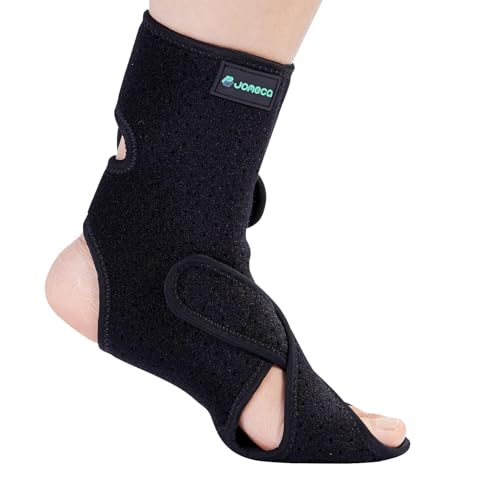
Cross straps and an arch bracket that let you dial in the correction yourself.
Where the rigid shells above hold your foot in one fixed position, this brace uses an arch bracket plus crossing Velcro straps, so you can adjust how much correction you get. The bracket compresses the arch and works against varus or valgus (the foot tipping inward or outward) while the built-in forefoot support plate holds the front of the foot. The open heel and toe design leaves room for your heel and toes to move.
It is sized for an adult foot and made of nylon, and the maker is upfront that the brace has thickness — if you want to wear it with shoes, they suggest choosing a shoe size larger than usual. That is the same advice the Medical AFO gives, and it tells you this is not a slip-in-a-dress-shoe brace. It uses hook-and-loop closure (the Velcro-style grip) so you can tighten it to your own foot shape. One buyer who walks with it found it supportive and easy to put on.
The thing to know before you order is that the support level is genuinely mixed in the feedback. Some find it fits snug and holds the foot well, while others find it too big for their foot and return it. One reviewer with foot drop could not fit it inside their shoe, and their physical therapist did not recommend it for their case. Fit and support are the two things to check against your own measurements before you commit, not something to assume.
Pick it if: you want an adjustable arch-and-foot wrap you can tighten yourself and you have a roomier shoe to wear it in.
skip it if: you need a fixed rigid shell for a severe drop, or you cannot go up a shoe size.
6. Upgraded Drop Foot Brace
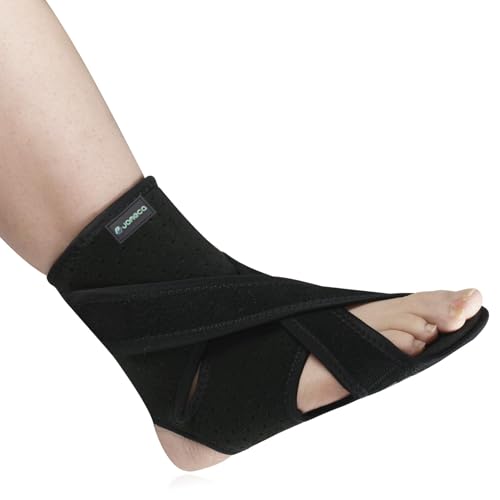
Two plates in one brace, so the support can grow with your recovery instead of replacing it.
The idea here is that your foot does not need the same stiffness in week one as it does in month three. The brace ships with two forefoot support plates of different rigidity — a stiffer one for severe cases and a softer one for mild cases — so one brace covers stages of recovery rather than one fixed level. The arch compression adjusts through Velcro, and the support plate has muscle massage spots molded into its surface to relieve foot fatigue.
It is built from neoprene and nylon and weighs 5.28 ounces, which keeps it lighter than the rigid shells above. The non-slip rubber bottom gives grip on the floor when you wear it around the house or out to the pool. You can wear it around the house without shoes, and the thin fabric is made to sit inside most shoes without bulk. It comes in a small/medium size for either left or right foot.
The honest limit is in the feedback: some users find the wrap soft and flexible to the point of not giving enough ankle support, especially in severe cases where a rigid shell is needed. A buyer with a large foot found the footplate too short, so if your foot is long, check the plate length against your own foot. For mild to moderate drop, users report it stopped the toe drag and the limp, and one bought it so a sister could walk unaided at night.
What earns its place: the two-plate setup and adjustable arch let one brace follow you through recovery, and at 5.28 ounces it stays light enough to wear all day.
The honest cut-off: this is a soft wrap, so a severe drop that needs real rigidity will want the Orthomen or the Medical AFO instead.
Try it if: your drop is mild to moderate, you are in the middle of recovery, and you want to dial the support down as you improve.
Pass on it if: you need maximum rigidity right now, or your foot runs long enough that the plate will not reach your toes.
7. Brace Direct Leaf Spring AFO

A shell you trim to your own foot, with a phone-based fitting session on the side.
This one is a semi-rigid leaf-spring style brace — a molded polyethylene shell that holds the foot up to prevent drop and improve balance. It is built for a women’s right foot, and the footplate trims precisely to size, so the fit ends up tailored rather than approximate. The open-heel shape slips into most shoe styles, staying low and out of the way. The material is a molded polyethylene, which gives firm strength without added bulk.
What is unusual here is the fitting help. Brace Direct, an American-owned company, offers a free video fitting and adjustment session with a fitting professional if you book it, so you can have someone talk you through trimming and positioning. For a first drop-foot brace, that kind of support is what makes the trim-and-fit process less of a guess.
The catch is the stiffness. The shell is flexible plastic, and there is feedback that it can be too flexible to actually raise the foot for some wearers, which is the whole point of a drop-foot brace. There is also a note that a strap arrived at an odd angle and had to be repositioned. For a mild drop where you mainly need a little lift, the sizing has been a good match for wearers — but if you need firm lift, look at the rigid Orthomen instead.
Reasons buyers choose it
- Trims to your own women’s right foot for a close, low-profile fit inside shoes
- Semi-rigid polyethylene shell keeps bulk down
- Free video fitting and adjustment session through the maker
- Open-heel design slips into most shoe styles
The limits to weigh
- Might not be stiff enough to lift the foot in a severe drop
- One model arrived with a strap at an odd angle needing repositioning
Nice fit for: a woman with a mild drop who wants a low-profile shell trimmed to her right foot, with a professional walking her through the fit.
Keep looking if: you need strong, firm lift or you have a left foot — the sizing here is women’s right only.
Know the Specs
Arch lift versus ankle control
An arch-lift strap runs under the foot and pulls the arch up, which takes strain off the plantar fascia ligament. Ankle control means a wrap that stops the foot rolling inward or outward. A brace for a collapsing arch needs both. The TriLok pairs a FootLok arch strap with a figure-8 ankle wrap. A plain elastic strap like the Tuli’s handles the arch only, which is why it does not stabilize a rolling ankle.
Shoe size versus foot width
Most braces here size by shoe size, not by a tape measurement around your foot. That works for most people, but width is the wild card. At the bottom of a size range with a narrow foot, size down; at the top with a wide foot, size up. A brace that pinches the arch band presses on the tendon instead of supporting it, so the fit has to match your foot width as much as its length.
Rigid shell versus soft wrap
A rigid shell — plastic that holds a fixed shape — gives firm lift that stays put as you walk. A soft wrap is fabric with straps that you tighten, which is more comfortable and slips into more shoes but provides less lift. The Medical AFO is the rigid end of this group, the JOMECA and Upgraded JOMECA are the soft end. Pick by how much support your foot needs, not by which looks more comfortable.
Weight and shoe room
Weight tells you how much plastic is in the brace and how much shoe it will fill. The Tuli’s X Brace is 0.5 ounces, the Upgraded JOMECA 5.28 ounces, the TriLok 5.6 ounces, the Orthomen 6.4 ounces, and the Medical AFO 8.15 ounces. A heftier shell usually means more lift and more shoe room needed. If you wear close-fitting shoes, a low-weight wrap is the safer choice.
Common Questions
Will a PTTD brace fit inside my normal everyday shoes?
What is the difference between a PTTD brace and a drop foot brace?
Should I size up or down in a PTTD brace?
Can I wear an arch brace barefoot or with sandals?
How long does it take to get used to the straps on a PTTD brace?
Is a rigid AFO better than a soft wrap for arch support?
Can I sleep in a PTTD brace?
Will a brace work on both my left and right foot?
How do I clean a padded foot drop brace?
Can I trim a rigid footplate to fit my own foot?
The Bottom Line
For most people with a falling arch, the pttd brace to start with is the BioSkin TriLok, because it lifts the arch and holds the ankle in one 5.6-ounce wrap that fits inside real shoes. If shoe room is your biggest worry and you need a firm drop-foot plate, the Medical AFO lets you trim the plate to your own foot. And if you want to keep wearing sandals or go barefoot around the house, the Tuli’s X Brace at 0.5 ounces is the lightest way to hold the arch. The TriLok is the one most likely to end up on your foot every morning — every other pick here is a specialist for a job it does not do.
How we choose
We do not accept paid placement. Every pick is matched to a real buyer and a real use-case; we do not hands-on test units.
Sources
Specifications: manufacturer listings and product documentation. Review insights: verified customer reviews, as of October 2026. Pricing: not shown on this page (it changes often); check the current price via the retailer link.
As an Amazon Associate, Aappliancez earns from qualifying purchases. This does not affect which products we feature.