Disclosure: Some links in this post are affiliate links. As an Amazon Associate I earn from qualifying purchases, at no extra cost to you. Learn more
Specs are compiled from manufacturer listings and verified buyer reviews and can change over time — please confirm the key details on the product page before buying.
When a cold pipe drips onto the floor in July, or the hot tap runs cool for a full minute, the cheapest fix is a sleeve, not a plumber. Pipe insulation is a foam or rubber tube that sits around the pipe and slows heat moving in or out — so cold lines stop sweating onto the concrete and hot lines hold their temperature on the way from the heater to the tap. The one number that decides whether yours will work is the inside diameter: too loose and the sleeve slides off and does nothing, too tight and it will not fit over your fittings. This guide covers five wraps that stay put, plus how to read that number.
This guide is built by comparing the manufacturers’ published specifications and the patterns across verified customer reviews, so you get each pick’s real strengths and trade-offs instead of marketing spin.
Getting it right depends on two choices: matching the sleeve’s inner measurement to your pipe, and picking a wall thickness that suits your climate. That is exactly what this breakdown of the pipe insulation options helps you do in a few minutes.
Top Picks


How To Choose The Best Pipe Insulation
Every wrap here does the same basic job — it slows heat moving through the pipe wall. What separates a wrap that works from one that ends up in a drawer is three things: fit, thickness, and whether the edges actually seal. Get those right and the job takes minutes.
Measure the outside of your pipe first
Put a tape measure around the pipe itself and ignore the label on the fitting. A sleeve is sized by its inside diameter, usually written as ID — plain terms, the hollow center the pipe slides through. Nominal sizes (the name the store sells it under) are approximate, so a cover sold as 3/4-inch can measure closer to an inch across the inside and sit loose on your pipe. A loose sleeve leaves gaps, and gaps let air and water vapor straight through — which is why the job gets redone.
Pick wall thickness for your climate
A thicker wall slows heat more, which matters most on cold exterior runs and hot water lines. Thinner walls bend around fittings more easily but hold back less heat. Look for the R-value — a simple score of how well the material resists heat flow. The higher the number, the more heat it holds back.
Decide between a tape and a pre-slit tube
A pre-slit tube is already cut open along one side. You wrap it over the pipe and close the seam with a self-sealing adhesive strip. A rubber tape wraps spirally, so it follows bends and valves that a rigid tube cannot. Many jobs use both: tube on the long straight runs, tape on the corners.
Side-by-Side Comparison
| Model | Best For | Form | Size | Material | Amazon |
|---|---|---|---|---|---|
| Frost King IT30/8 Rubber Insulation Tape★ Best Overall | Bends, elbows, and odd fittings | Rubber tape | 2 in. wide, 1/8 in. thick, 30 ft. long | Rubber | Amazon |
| Frost King RS512XB/6 Rubber Tubular Pipe InsulationTop Performer | Outdoor AC lines and long straight runs | Self-sealing tube | 1 in. ID, 1/2 in. wall, 6 ft. | Rubber | Amazon |
| M-D Building Products 50215 Foam Tube | Exposed interior pipes and homemade padding | Self-sealing tube | 5/8 in., 1/2 in. wall, 6 ft. | Polyethylene foam | Amazon |
| Duck Brand Insulating Foam Pipe Covers | Hot and cold household water pipes | Pre-slit sticks | 0.75 in. by 3 ft., pack of 4 | Foam | Amazon |
| Foam King Foam Pipe Insulation 12 Pack | Whole-house and RV plumbing jobs | Pre-slit tubes | 36 in. long, 3/8 in. wall, 12 pack | Polyethylene foam | Amazon |
Detailed Reviews
1. Frost King IT30/8 Rubber Insulation Tape
Our pick — 4.5+★ from 850+ verified ratings; the strongest balance of quality and price.
Thirty feet of stretchy rubber that follows the bends a rigid sleeve simply cannot.
This one earns the top spot on length alone: 30 feet of tape on a single roll, which is a 360-inch run of material. Because it is a tape and not a tube, it wraps spirally around elbows, valves, and tight corners — the spots where a pre-slit sleeve has to be chopped into pieces. The 2-inch width means fewer passes along the pipe, and the rubber stays flexible enough to hug a curved surface instead of lifting off it. It is rated for 60 square inches of coverage.
One roll does two jobs: it cuts heat loss on hot water pipes and stops cold pipes from sweating. In practice, that means a hot shower arrives fast and a cold line stops dripping a puddle on a humid day. Buyers report the quality and the gentle learning curve stand out most — it is genuinely hard to apply this stuff wrong, and the flexibility is why. If you have ever cut a foam tube trying to get it around a 90-degree elbow, you already understand.
Here is the honest catch, and it is small. Adhesion is mixed. The tape sticks well to itself in most spots, but you may want a wrap of tape at the final end. Durability and long-term value draw similar mixed notes, which is normal for a sticky-backed wrap. Do not let that put you off — on a 30-foot roll the material itself is the value, and any loose spot is a 10-second fix.
What earned it the top spot
- A full 30 feet of tape on one roll, so you wrap the bends instead of cutting around them
- 2-inch width covers ground fast and 1/8-inch thickness keeps the profile low on a pipe
- Rubber flexes around curved surfaces, which is the entire point of using tape over a tube
- Tackles both jobs: heat loss on hot lines and sweating on cold lines
Where you will need a little extra
- The peel-and-stick backing holds well in most spots but can lift at an open end
- It is a wrap, not a pipe shield — it will not cushion a pipe the way a foam tube does
- Fiddly on very long straight runs compared with sliding on a sleeve
Reach for the tape if: your pipes turn corners, your fittings vary, or you want one roll that handles the whole job without a cutting plan.
Leave it on the shelf if: you have a long, dead-straight run of pipe and would rather slide a sleeve on once.
2. Frost King RS512XB/6 Rubber Tubular Pipe Insulation
Dense rubber tubing built for the pipes that sit outside all year and catch the sun.
The weight is the whole story here, and it is why this tube beats the Duck Brand covers for exterior work: 12.64 ounces against 4.16 ounces — roughly three times the heft. That density is what handles a sun-baked air conditioner line. The 1-inch inside diameter and half-inch wall suit a full-size AC suction line, and the self-sealing strip means no separate tape to hold the seam shut. One piece runs 6 feet, or 72 inches.
Installation is quick. Owners mention it takes under five minutes to wrap both lines once the sleeve is laid out, and the material unkinks after shipping — it arrives coiled, but it straightens once it has been sitting a while. It is flexible enough to follow bends without cutting. Zip ties plus a quality tape keep it snug. One sizing note worth knowing: a piece measured 3 inches short of its 6-foot rating, which that buyer said made no difference to the job. Plan a little slack either way and you will be fine.
Adhesion is the one place reviews split, and it is the honest trade-off. Some owners find the glue genuinely strong. Others say the peel film can pull the adhesive with it during application. Still, customers note it delivers where it counts on outdoor AC lines — keeping a hot refrigerant line from radiating into the sun.
The case for it: in the head-to-head against the Duck Brand covers, this is the denser wrap — 12.64 ounces versus 4.16 — and that weight is what handles sun-baked exterior AC lines better than a light household sleeve.
Prep before you wrap: clean the pipe and have zip ties or tape standing by. The self-sealing edge does the seam, but a couple of ties at the bends keep everything cinched while you work around the awkward spots.
Buy it if: you are re-wrapping exterior AC suction and return lines and want the sturdier, higher-density tube.
Think twice if: you are working indoors on small household plumbing, where the 1-inch inner diameter will be too roomy for a narrow pipe.
3. M-D Building Products 50215 Foam Tube Pipe Insulation
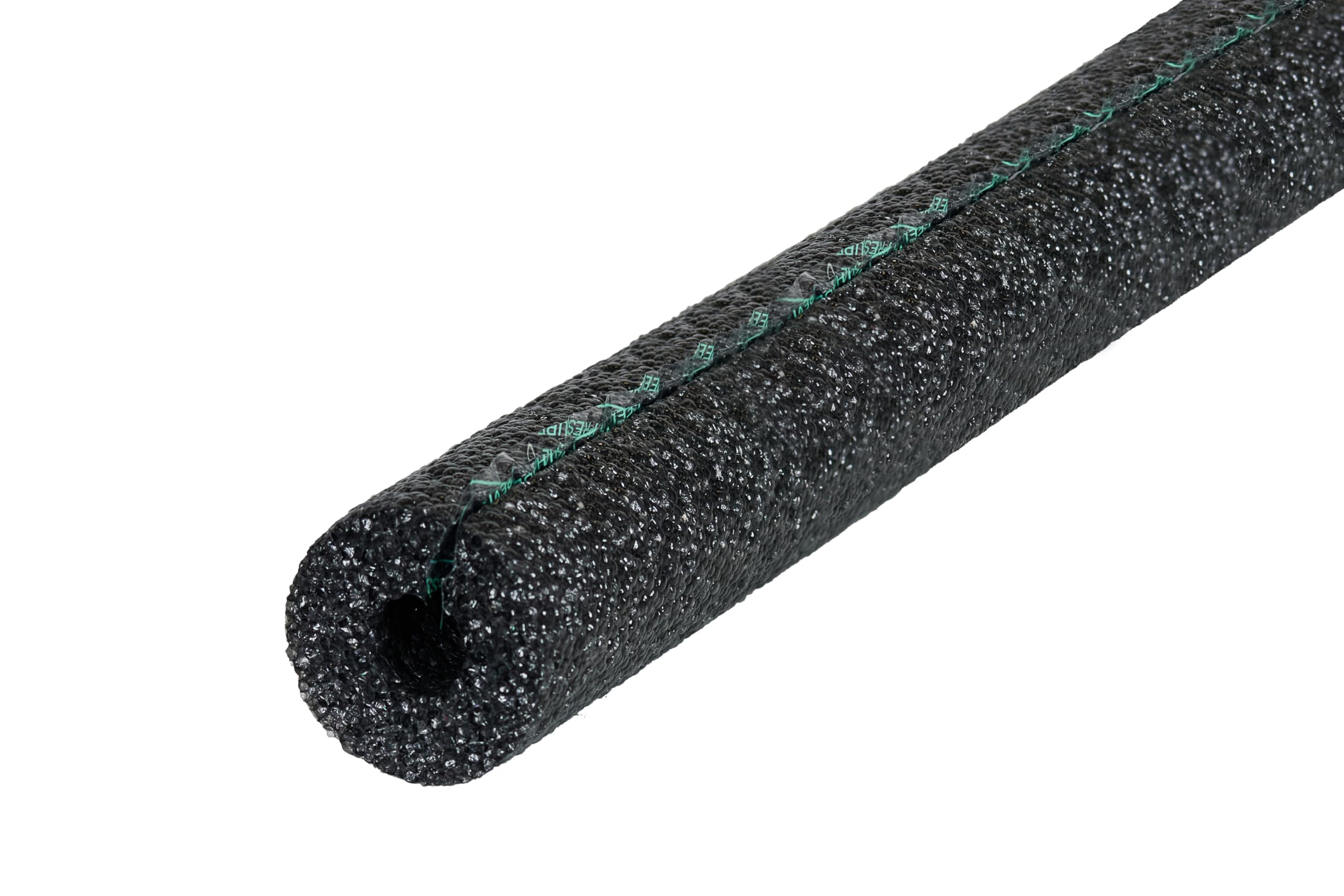
An R-3.3 foam tube that keeps showing up in jobs nobody bought it for.
Two numbers make this the sleeve to grab when you are not sure what you are wrapping: an R-value of 3.3 and a half-inch wall. It fits half-inch copper and quarter-inch PVC or iron pipe. It measures 72 inches long — 6 feet — and you cut it to length with scissors or a knife. It comes pre-slit with self-adhesive edges already in place. Because it is foam rather than rubber, it is also soft — which is why it turns up in places a plumbing aisle would never suggest.
That softness is the defining trait. Owners have sliced it down to pad a dog’s wire car seat frame, and to sleeve damaged PVC conduit protecting sprinkler wiring. The everyday job is plainer: an exposed copper pipe in a garage, sitting right where a car door can swing into it, wrapped in minutes and protected from dents. Since it is slit, you fit it over the pipe rather than threading it on, so it works on a line that is already plumbed in.
The catch is the adhesive, and it is the most-mentioned trade-off in its reviews. It does not grip as firmly as the rubber sleeves here. But the foam fits snugly enough on the pipe that many owners skip the seam entirely. It holds its shape on the run, which is the part that matters.
Where it wins: softness plus the R-3.3 core makes it the only wrap here that doubles as padding. A copper pipe that gets bumped, a conduit that needs shielding, a wire frame that needs cushioning — it covers all three.
The fit for you: household pipes you want to protect and cushion, plus any spot where a little give matters more than maximum thermal muscle.
Look elsewhere if: you are wrapping a hot line and need the seam to hold with no help — a rubber sleeve will grip harder.
4. Duck Brand Insulating Foam Pipe Covers

Four pre-slit sticks that together cover twelve feet of water pipe.
Four sticks at 3 feet each adds up to 12 feet of covered pipe — enough for a whole hot-water heater feed or a run of laundry lines. Each stick is pre-slit and self-sealing, so it opens, wraps, and closes without tools. It handles both hot and cold pipes, guards against winter freezing and summer sweating, and is safe up to 212 degrees Fahrenheit. In practice, that ceiling means you can sit it on a domestic hot water line without worry.
The fit is the question to settle before you buy. The sticks are sized for 3/4-inch inside-diameter copper, and reviewers point out two very different experiences. Some find it perfect on hot water heater copper. Others find the inside dimension runs closer to 0.9 to 1 inch and sits loose on the pipe they intended. Measure your pipe before ordering — that single step separates the buyers who love it from the ones who had to return it. Adhesive splits the same way. Some say the design is smart and holds well; others add their own tape at damaged areas.
Cold-weather duty is where it earns its place. Shoppers say these Duck Brand sticks on outdoor pipes through 11-degree-Fahrenheit nights with no freeze. It cuts with scissors or a knife and holds up through several winters. If the job is a set of household water lines and you want enough material to finish without a second order, this is the pack.
The practical wins
- 12 feet of coverage in one pack, or four separate 3-foot sticks for four different pipes
- Safe to 212 degrees Fahrenheit, so hot and cold lines are both fair game
- Pre-slit and self-sealing — no tape required for a basic wrap
- Cuts to length with scissors and holds up through multiple winters
Before you order
- Inside diameter can run wider than the advertised 3/4 inch, so it can sit loose on a snug copper pipe
- The self-sealing strip benefits from a length of duct or zip ties, especially at corners
- Not the dense rubber build needed for a sun-exposed exterior AC line
This one is for you if: you have several household water pipes to cover and you want enough pre-slit material in one pack to get through them.
skip it if: your pipe measures closer to the full advertised size — the loose fit will frustrate you and the rubber sleeve above is the tighter answer.
5. Foam King Foam Pipe Insulation
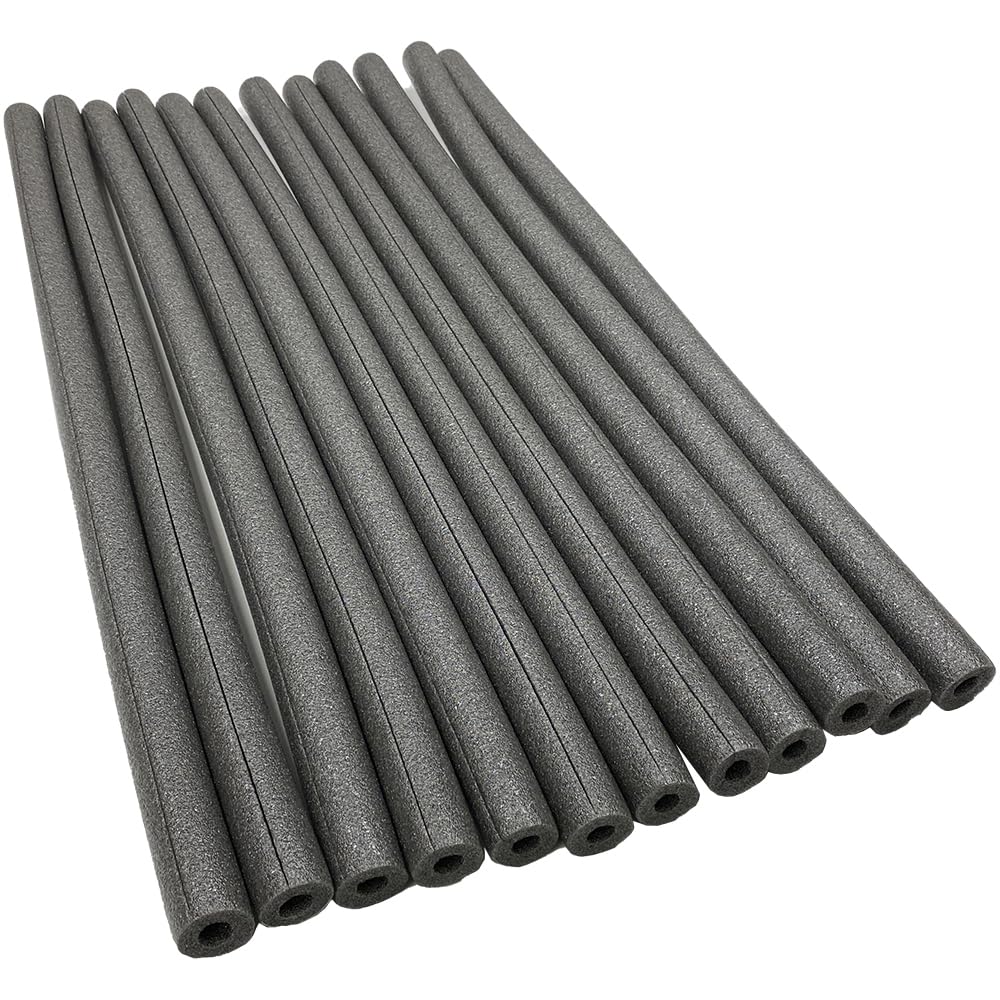
Twelve tubes in one box for the whole house, garage, or RV plumbing run.
Twelve tubes at 3 feet each is 36 feet of material in a single order — more ground covered than any other pick here. Each piece is pre-slit and ready to slide over copper, iron, or PVC. The sizes are spelled out: a 5/8-inch inside diameter with a 3/8-inch wall, fitting half-inch copper pipe or three-eighths-inch iron pipe. It carries an R-value of 2.2, and the manufacturer notes that all sizes are approximate and can shift slightly during production — so measure before you commit.
Temperature range is where this pulls ahead of the smaller packs. It is rated for service from minus 90 degrees Fahrenheit to 180 degrees Fahrenheit, which covers both winter freezing and summer sweating — the gap the single-tube options leave open. It is also flame rated Class A for flame spread and smoke under ASTM E84 (a standard test for how a material behaves in a fire) and compliant with CAN/ULC-S102.2-M88. Plain terms, it has been tested for how it behaves in a fire, which matters on a pipe running through a garage or utility space. It also quiets water hammer noise and stops condensation from sweating onto the pipe. On a hot water heater line, it holds the heat in so the tap arrives hot sooner.
The wall thickness is the one thing to note. At 3/8 inch it sits in the middle — thick enough for indoor and mild outdoor runs, thinner than the half-inch rubber tube for a hard freeze or a full-sun exterior line. For a deep-winter exterior job, step up to a heavier wall. For a whole home’s worth of interior plumbing, this is the box that finishes the job without a second order.
Why the box makes sense: the Class A flame-spread and smoke ratings are the differentiator here. On piping that runs through a garage or utility room, having that rating on the wrap is the reason to buy in bulk.
Worth having on hand if: you are covering more than a few runs — home, garage, or RV — and want one box to see the job through.
The limit to know: the 3/8-inch wall is a mid-weight option, so a hard exterior freeze wants a thicker rubber tube instead.
Know the Specs
Inside Diameter (ID) — The Fit Number
ID is the hollow measurement in the center of a sleeve — the space your pipe sits in. It decides whether the wrap grips or slides off. A sleeve that is too wide leaves an air gap underneath, and trapped air plus water vapor is exactly what causes sweating. Nominal sizes (the name they are sold under) are approximate — a cover sold as 3/4-inch can measure near an inch inside — so measure the outside of your pipe before ordering, not the label on the fitting.
Wall Thickness and R-Value — The Heat Number
Wall thickness is how much material sits between the pipe and the air, and R-value is the score of how well that material resists heat flow. A higher R-value means more heat stays in a hot line or stays out of a cold one. Thin walls suit indoor runs; thick walls suit exterior lines that see the sun or a hard freeze. Neither number rates the material’s strength — a soft foam can carry a solid R-value and still be easy to squeeze.
Pre-Slit vs. Tape — The Shape Question
A pre-slit tube opens along a seam so you can fit it over a pipe that is already installed, then close it with its own adhesive. A rubber tape wraps spirally, which lets it follow bends, valves, and elbows that a straight tube cannot. Most real jobs use both: tube on the long runs, tape on the corners. If your pipes turn frequently, budget for tape.
Adhesive and Temperature Ratings — The Real-World Limits
Self-sealing edges hold the seam shut, but the strength of that glue varies from roll to roll. Expect to reinforce an open end or a corner with a wrap of tape. Temperature ratings tell you where the material can safely sit: one wrap here is safe to 212 degrees Fahrenheit, another is rated from minus 90 to 180 degrees Fahrenheit. Match that range to the pipe you are covering, not to the weather on the day you install it.
Common Questions
How do I know what size pipe insulation to buy?
Can I put foam pipe insulation on a hot water pipe?
Why does my pipe insulation keep falling off?
Is pipe insulation tape or a foam tube better?
Does pipe insulation stop pipes from freezing?
What does pipe insulation R-value mean?
Can I use pipe insulation on PVC or iron pipe?
How long does pipe insulation last outdoors?
Do I need to tape the seam after installing a self-sealing sleeve?
What is the difference between a 3/8 inch and 1/2 inch wall pipe insulation?
The Bottom Line
For most jobs, the pipe insulation that earns its place is the Frost King IT30/8 Rubber Insulation Tape, because a 30-foot roll bends around the fittings a rigid sleeve cannot follow — one roll handles the whole run, corners included. If your pipes sit outside on an AC line, the Frost King RS512XB/6 Rubber Tubular Pipe Insulation is the denser, half-inch-wall answer. And for a whole home’s worth of interior copper, the twelve-tube Foam King Foam Pipe Insulation pack covers more ground in one order than anything else here. Whichever you pick, measure the pipe first — the fit decides everything, and the material is only as good as the grip.
How we choose
We do not accept paid placement. Every pick is matched to a real buyer and a real use-case; we do not hands-on test units.
Sources
Specifications: manufacturer listings and product documentation. Review insights: verified customer reviews, as of October 2026. Pricing: not shown on this page (it changes often); check the current price via the retailer link.
As an Amazon Associate, Aappliancez earns from qualifying purchases. This does not affect which products we feature.