Disclosure: Some links in this post are affiliate links. As an Amazon Associate I earn from qualifying purchases, at no extra cost to you. Learn more
Specs are compiled from manufacturer listings and verified buyer reviews and can change over time — please confirm the key details on the product page before buying.
The hardest part of buying a PEV (personal electric vehicle, meaning anything you stand or sit on that runs on a battery) is cutting through the speed claims. A scooter can promise 43 miles and deliver 16 on your hilly commute. So this guide sorts the picks by what holds up in daily use: real range, real hill climbing, and real suspension over cracked pavement.
This guide is built by comparing the manufacturers’ published specifications and the patterns across verified customer reviews, so you get each pick’s real strengths and trade-offs instead of marketing spin.
You will see the difference between a 40% hill-climb rating and a 25% one spelled out in plain terms.
Top Picks
How To Choose The Best PEV
Start with your round trip, not the spec sheet. Measure the miles you actually cover in a day, then look for a range figure that leaves room for hills, cold mornings, and the fact that most quoted range is measured in the gentlest riding mode available. A scooter that claims 43.5 miles in ECO mode is telling you something honest: expect less when you ride hard.
Range is a mode, not a constant
Manufacturers measure range in their softest setting with a light rider. One Cunfon model quotes 43.5 miles with a 60 kg rider in dual-drive ECO mode — that is roughly 132 pounds — so a heavier rider or a throttle-happy one will land lower. If your commute is 8 miles each way, look for a machine in the 40-plus mile class so the buffer absorbs real conditions.
Hill-climb percentage beats top speed
Top speed is the number buyers ask about and rarely use. Hill-climb percentage is the one that decides whether you make it up your street. A 25% rating and a 40% rating look close on paper, but the gap shows up the first time you hit a steep grade with groceries on your back. Match the climb rating to the steepest hill on your route, not the flat-land top speed.
Standing, sitting, or balancing
Electric scooters come in stand-up, seated, and self-balancing forms. A seat (like on the AWWSCOOTER or the Gyroor) takes the fatigue out of longer rides. A self-balancing unit (like the Segway S2 or the INMOTION E20) trades the handlebar for a lean-and-go learning curve. Pick the format that matches your body and your balance confidence first — the specs only matter once that is settled.
Side-by-Side Comparison
| Model | Best For | Claimed Range | Top Speed | Weight | Amazon |
|---|---|---|---|---|---|
| Segway ZT3 Pro★ Best Overall | All-round off-road commuter | 43.5 miles (ECO) | 24.9 MPH | 65.5 lb | Amazon |
| Cunfon RZ1000 Dual MotorHill Climb Champ | Steep hills and heavy riders | 43.5 miles (ECO) | 31 MPH | 29 kg | Amazon |
| Cunfon RS500Best Value Commuter | Everyday commuting value | Up to 35 miles | 25 MPH | — | Amazon |
| AWWSCOOTER Seat & Basket | Seated errands and seniors | 20 miles | 16 MPH | 23.34 kg | Amazon |
| INMOTION E20 | First-time self-balancing riders | 18.6 miles | 12.4 MPH | — | Amazon |
| AONIU M4 | Budgets that want speed | 31 miles | 28 MPH | 46 lb | Amazon |
| Gyroor C1S | Pet owners and families | 20 miles | 19 MPH | 48.5 lb | Amazon |
| Segway Ninebot S2 | Family fun and yard riding | 21.7 miles | 11.2 MPH | 37 lb | Amazon |
| Circooter Transio Pro | Long-distance commuters | Up to 47 miles | 32 MPH | 59.5 lb | Amazon |
Detailed Reviews
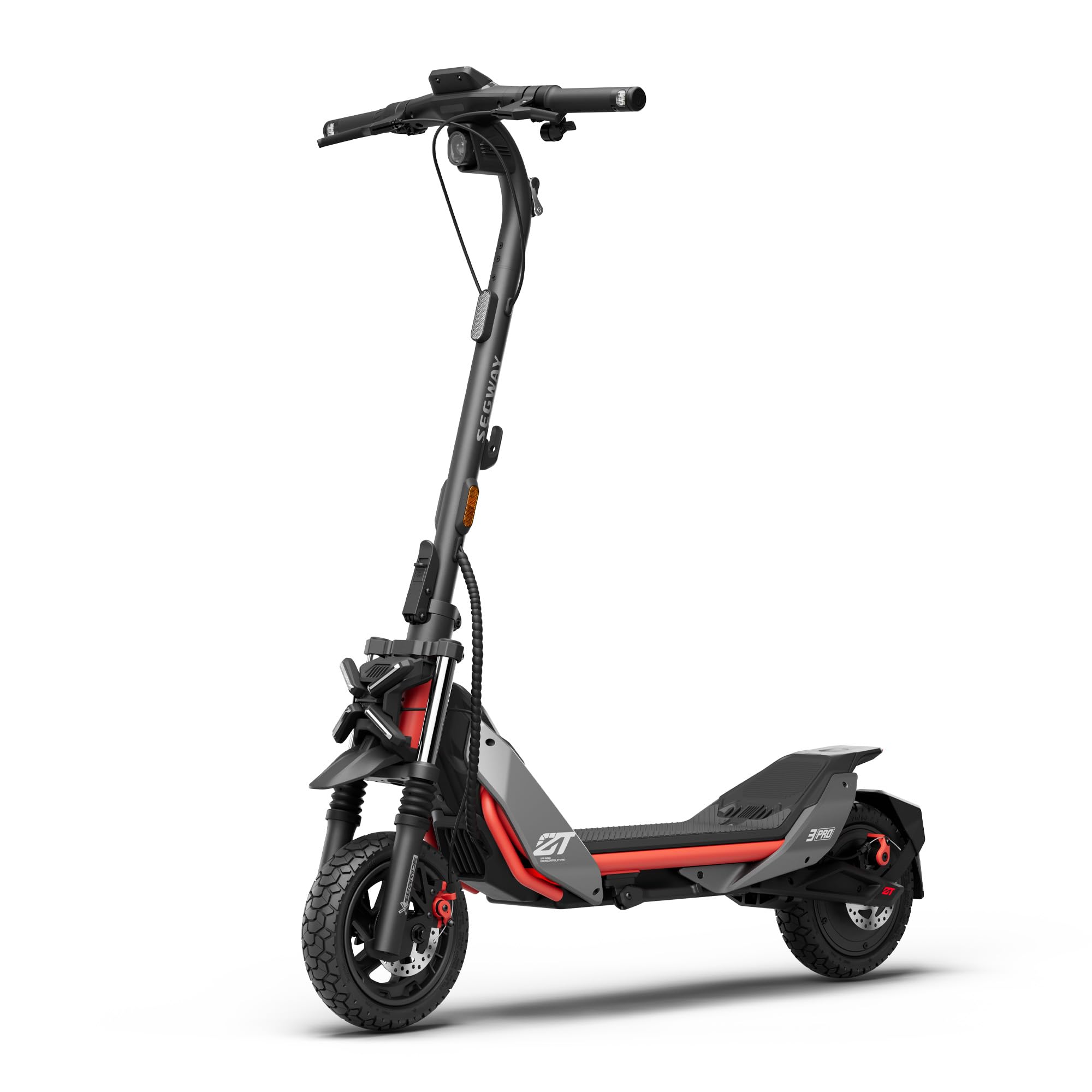
1. Segway ZT3 Pro Electric Scooter
Our pick — 4.5+★ from 400+ verified ratings; the strongest balance of quality and price.
The one that refills in four hours while the rest of the class sleeps overnight.
Here is the number that changes your week: 4 hours to a full charge. That is the Segway-Ninebot “2x Flash Charge Technology,” and it is the fastest recharge time in this lineup. Compare that to the Cunfon RZ1000’s 8 hours, and you get a scooter you can top up between an early errand and an evening ride instead of plugging it in and forgetting it until morning.
The 43.5-mile range figure is quoted in ECO mode, and owners ride it hard enough to see the other side of that. One long-term rider reported a ~19-mile trip landing with ~20% battery left, which tells you the pack has real depth even when you are not babying it. The 11-inch tubeless tires are the biggest in this group, and paired with dual front telescopic and rear spring suspension they soak up cracked bike lanes and gravel better than the smaller-wheeled picks.
What wins people over is the build — the frame earns more praise than any other single quality in its review pages, and the consensus is that it feels solid and rattle-free. The 1600W peak motor pulls to 24.9 MPH, and a 25% hill-climb rating handles the average city grade. It is also certified to ANSI/CAN/UL-2272 by TUV Rheinland, so the battery and electronics pass a recognized safety standard. At 65.5 pounds it is planted at speed but awkward to haul up stairs.
Where it earns its keep
- 4-hour charge is the fastest here — beats the Cunfon RZ1000’s 8 hours
- 43.5-mile ECO range with real depth left at the end of a long ride
- 11-inch tubeless tires plus dual suspension smooth out rough terrain
- UL-2272 certified by TUV Rheinland for battery safety
What to know before you commit
- 65.5 pounds is heavy for stairs or a daily train carry
- Range drops noticeably when you ride in the faster modes
- Hills above its 25% rating will slow it more than the Cunfon RZ1000
Go for this if: you commute daily and want the fastest turnaround between charges, with big tires for rough roads.
Look elsewhere if: your route has grades steeper than 25% — the Cunfon RZ1000 climbs harder.
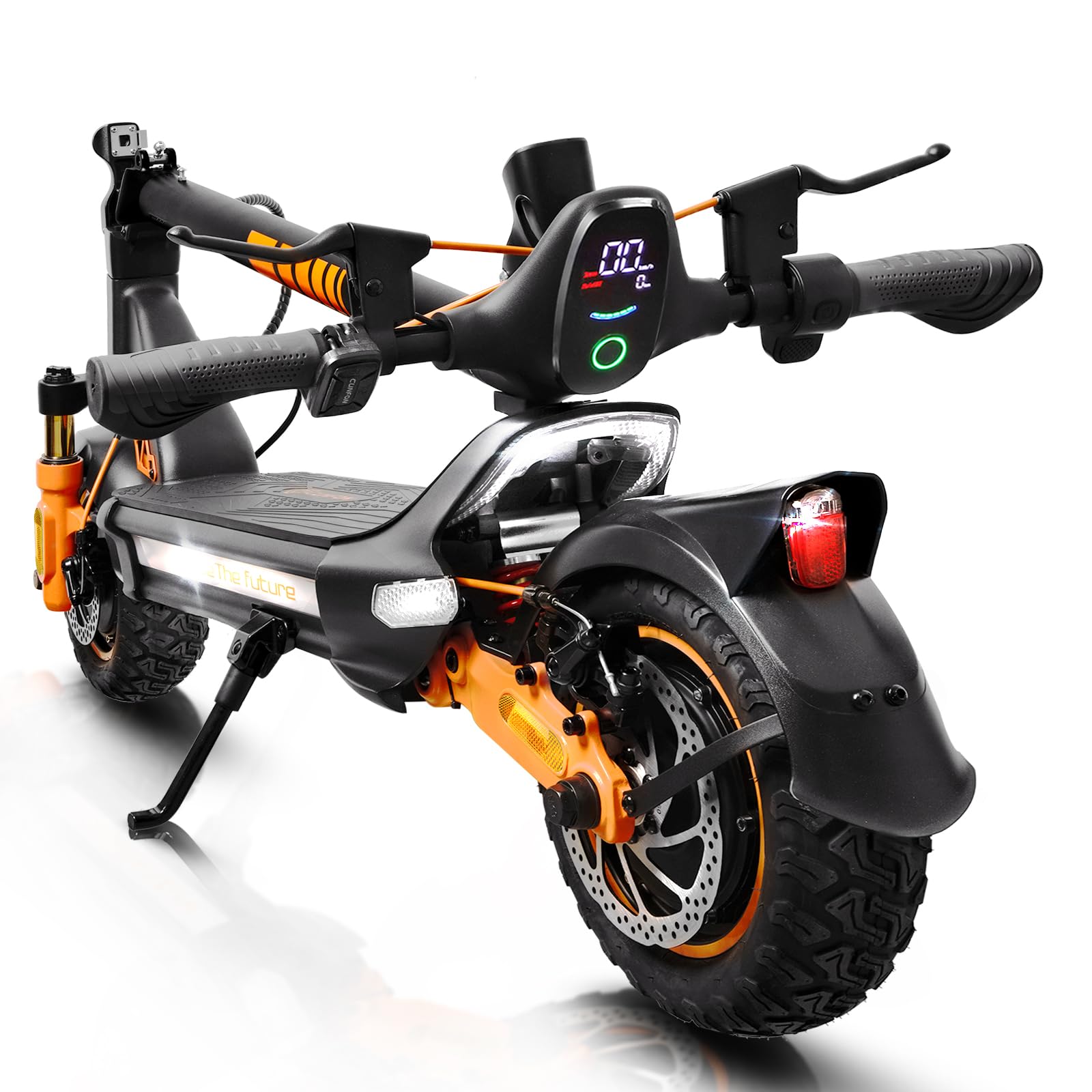
2. Cunfon RZ1000 Dual Motor Off-Road Scooter
The grade-climber that walks up a 40% slope the ZT3 Pro would labor on.
If your street looks like a ski slope, this is the one. It hits 31 MPH, which is also the fastest of the two, against the ZT3 Pro’s 24.9 MPH. The dual-motor setup with 3200W max power is what makes that climb feel casual instead of dramatic.
You get a 43.5-mile range, matching the ZT3 Pro, but that figure is with a 60 kg rider in dual-drive ECO mode. Owners put the real-world number in plain terms: “Commutes 8 miles round trip, battery lasts two round trips plus extra.” That is a working range that covers a full day with buffer, which is the honest test of any commuter.
The 10.5-inch self-sealing tires carry a puncture-resistant gel layer, and the air-hydraulic damping suspension over four shocks is a step up in bump absorption. Riders up to 440 pounds are supported under specific conditions — a stat no other pick here comes close to. Two things to plan around: it takes 8 hours on the built-in charger, and an optional 56V fast charger (sold separately) cuts that to 2.5 hours if you buy it. It is also heavier than the ZT3 Pro at 29 kg, so plan your storage around a garage or ground floor.
Climb and haul: The 40% grade rating and 440-pound support under specific conditions make this the pick for big riders and steep routes alike.
The honest snag: Eight hours is a full overnight charge, so if you forget to plug in, you are walking tomorrow unless you buy the separate fast charger.
Reach for this if: you ride hills daily, carry cargo, or weigh more than most scooters want to admit.
Pass it by if: you want fast recharge without buying an extra charger.
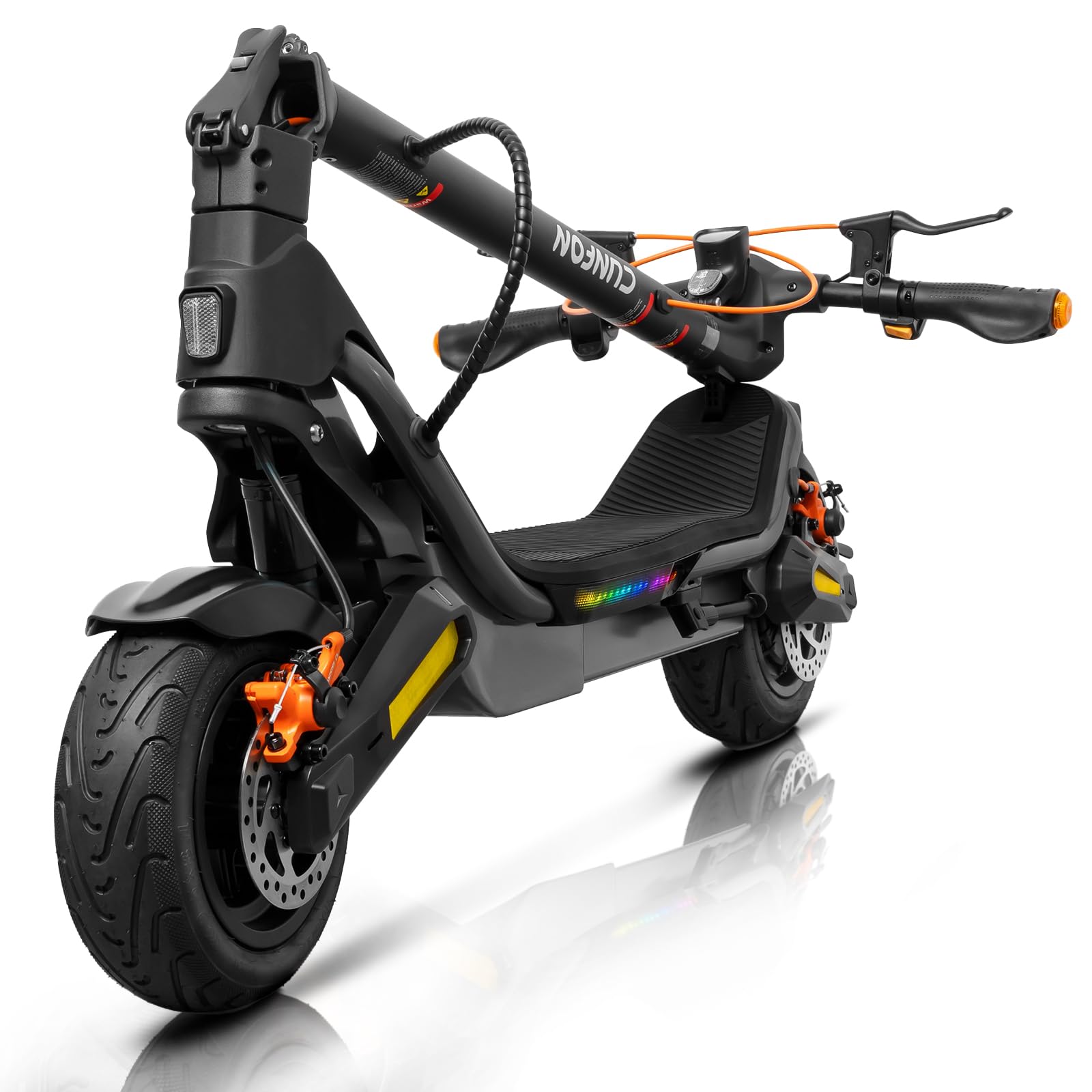
3. Cunfon RS500 Electric Scooter
The city scooter that folds down and slips onto the train with you.
This is the pick for a rider who needs a machine that is small enough to stow but still has enough punch to climb. The 624Wh battery delivers up to 25 to 35 miles, and it recharges from zero to full in 6 to 8 hours. The 1000W peak motor reaches 25 MPH and handles slopes of 15 to 20 degrees. That is the everyday grade range: apartment ramps, bridge approaches, the hill on the way home.
What makes the RS500 stand out is the riding position. The deck is roomy and the handlebars curve back toward you, so a 6-footer is not crouched and a shorter rider is not reaching. The C-type spring suspension and 9.5-inch thickened tubeless rubber tires smooth out the chatter of brick and cracked asphalt. The square-pad dual brake system is tuned to run quiet even when you grab a handful.
You also get the safety basics: UL-2272 compliance (a safety standard for the electrical drive system) and 360-degree integrated lighting with turn signals. One thing that confuses owners on day one is the low-voltage cut-off, which shuts the motor down when the battery drains — that is a safety feature, not a fault, and a few hours on the charger brings it back. The manual is thin on details, so plan to learn the controls by feel.
Comfort where it counts: The curved handlebars and wide deck make it easier to ride for hours than the narrower cockpits on budget scooters.
The trade-off: The included documentation is sparsely written, so you will figure out the light modes and cruise settings through trial rather than a clear manual.
Worth it for: commuters who fold and carry between legs of a trip and want 25 MPH in a compact body.
Think twice if: you want a plush manual and a fast-charge cycle from the start.
4. AWWSCOOTER Electric Scooter with Seat & Basket

Sit down, put the groceries in the back basket, and skip the standing commute.
This AWWSCOOTER puts you on a seat instead of a deck, with a rear basket for groceries. This AWWSCOOTER rides you on a wide adjustable seat that supports up to 265 pounds across heights from 5’1″ to 6’2″. The rear basket carries groceries or a small pet, so you are not balancing a shoulder bag while steering. For a shorter errand run or a rider with sore knees, sitting on a 265-pound-rated seat beats balancing on a stand-up deck.
The 450W motor pulls you up inclines of up to 15 degrees across three speed settings: 9, 12, and 16 MPH. Range is up to 20 miles per charge, and the dual disc brakes bring you down evenly. The whole thing is certified to UL 2272 with front and tail lights for night visibility. It folds flat and includes a cable lock and a phone holder.
The honest caveat involves reliability, which is the aspect with the most mixed feedback here. Most buyers report the scooter running as advertised, and a handful describe it stopping entirely — often a sign of a unit with a bad battery connection rather than a design flaw across the line. An 81-year-old rider summed up the easy end: “I had no problem getting use to it.” Treat the first week as a shakedown and test the brakes and battery bars before relying on it.
What makes it easy to live with
- Seat adjustable for riders from 5’1″ to 6’2″ and up to 265 lb
- Rear basket plus phone holder make errands a single trip
- Three speeds (9 / 12 / 16 MPH) rather than one throttle curve
- UL 2272 certified with front and tail lights
Where it asks patience
- 16 MPH top speed is the slowest stand-up equivalent here
- Some units have arrived with battery or connection trouble
- 20-mile range is best kept for short local errands
Built for: shoppers, older riders, and anyone who wants to sit rather than balance.
Not the one for: long-distance speed runs — the 16 MPH cap and 20-mile range limit that.
5. INMOTION E20 Electric Unicycle

Two tires under one wheel — the trick that turns a circus act into a Sunday ride.
A conventional unicycle has one wheel and one tire, which is exactly why most people never learn to ride one. The E20 uses a single wheel with dual tires and a lateral self-balancing algorithm, so it holds side-to-side balance for you. The manufacturer says you can learn in just 3 minutes; a more realistic read from a rider over 50 is multiple 30-minute sessions over 3 days. Still, the two-tire design is the difference between quitting on day one and getting it.
The 38% larger tire diameter than regular self-balancing vehicles means it clears curbs and roots that stop a smaller wheel, and the inflatable inner tubes soak up more shock than solid rubber. Power comes from a 900W peak motor with a 12.4 MPH top speed and an 18.6-mile range — short-trip territory, not a road vehicle. It is certified to ANSI/CAN/UL 2272.
Balance is what owners praise most, with ease of use close behind. The E20 carries a built-in speaker that pairs to a phone over Bluetooth for music while you ride. What to watch for: a few units have arrived with a sticky power button or an unresponsive app connection, so test the power cycle and Bluetooth in the first week. It also struggles on loose, uneven yard ground compared with smooth concrete.
Why beginners stick with it: The dual-tire balance is the difference between an afternoon of learning and a return box.
Where it wants smoother ground: Lawn and uneven turf are a struggle; concrete and blacktop are where it shines.
The right first EUC if: you want to learn balance without a one-wheel gamble.
Skip the idea if: you need road speed — 12.4 MPH is neighborhood pace.
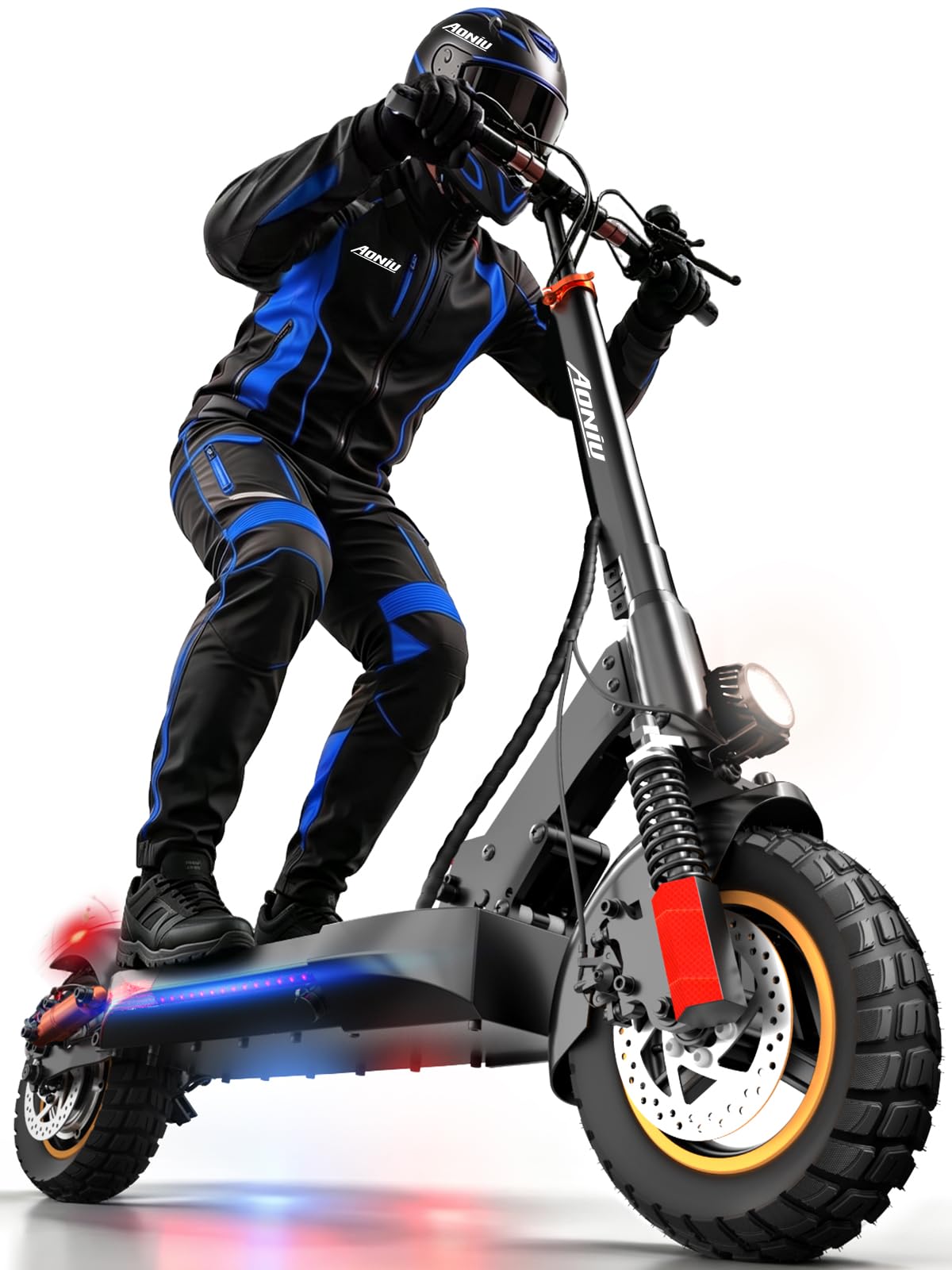
6. AONIU M4 Electric Scooter
Budget money, big-machine ambitions — with a catch you should hear up front.
The M4 packs an 800W peak motor that reaches around 28 MPH under specific conditions, a 31-mile max range, and a 330-pound-plus load rating on an aircraft-grade aluminum frame. It has 10-inch pneumatic tires, a seven-shock absorption system, and a foldable design that folds for a train carry. On paper it is the most scooter for the money in this lineup by a wide margin.
The ownership picture is where it gets complicated. Quality and fun rank as the most-praised traits — riders call it sturdy, well-built, and genuinely fun to run. Speed and battery life sit mixed: one heavier rider reports hitting 45 to 46 km/h on flat ground and an 11-mile trip eating under half a charge, while others see the battery drain fast with the lights on. Durability is the sore point, with reports of battery cells failing around the nine-month mark and the one-year warranty excluding the battery itself.
If you want the speed and load capacity and can accept that you are the one responsible for battery care, this delivers a lot for the tier. Plan to store it indoors in moderate temperatures, charge it after every ride rather than letting it sit drained, and treat the first few months as the reliability window. You get 28 MPH and a 330-pound-plus capacity for less money, in exchange for battery care the warranty will not cover.
The pitch that works: 28 MPH and a 330-pound-plus capacity at a price that undercuts every other fast scooter here.
The honest catch: The battery is the part that gives trouble, and the warranty does not cover it.
Buy it if: speed per dollar matters most and you will care for the battery like a phone.
Think again if: you want a set-and-forget pack and a warranty that covers the cells.
7. Gyroor C1S Electric Scooter with Seat
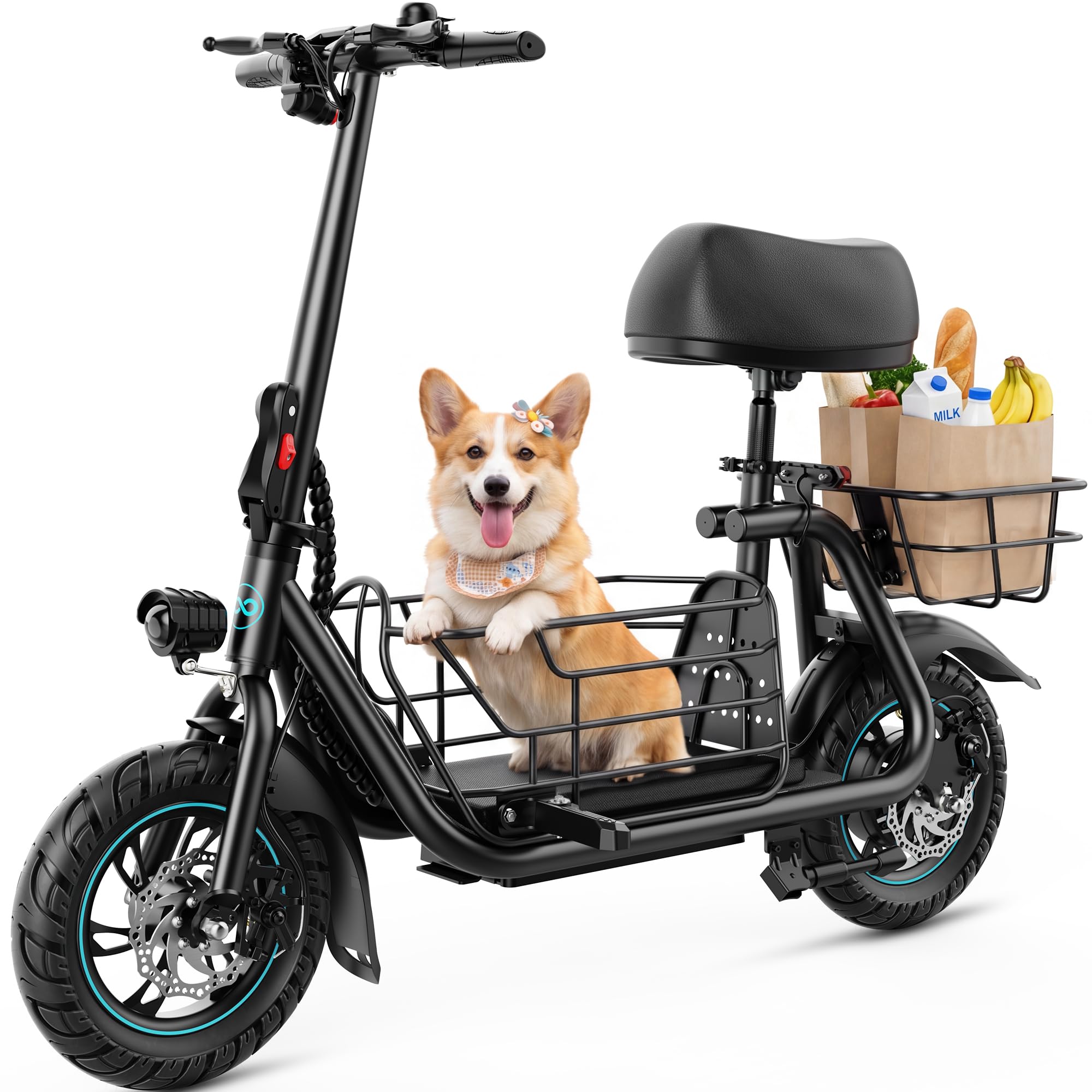
The only scooter here built around a passenger with four legs and a tail.
Most scooters treat cargo as an afterthought. The Gyroor C1S builds a large detachable middle basket and a rear cargo rack into the design, and its 9.5-inch wide deck gives a small pet space to sit. A mini dachshund owner gave the verdict: “My mini doxie loves the ride.” The seat is soft and breathable, adjustable for riders from 5’1″ to 6’1″, and the 12-inch shock-absorbing vacuum tires do the heavy lifting over bumpy pavement.
The 550W motor reaches up to 19 MPH with a 20-mile range, and it charges in 5 hours. A dual disc brake system, high-brightness LED headlight, and rear brake light cover the safety basics, and the whole scooter is UL2272 certified. The heavy-duty metal frame carries up to 265 pounds and the foldable handlebar lets the whole thing drop into a car trunk.
Battery life is the mixed note — some owners get the range they expected, while others see it drain faster than the 20-mile figure suggests. The common thread is rider weight and terrain: heavier riders on hills will land well under 20 miles. The basket weave is also loose enough that a phone can slip through, so use a pocket for anything small. For errands and leisurely neighborhood outings, a shorter real-world range and a loose basket weave are livable trade-offs.
What families like about it
- Detachable middle basket and rear rack built for pets and groceries
- 12-inch vacuum tires absorb bumps better than smaller wheels
- Seat adjusts across a wide height range for shared family use
- UL2272 certified with dual disc brakes and full lighting
Where the numbers slip
- 20-mile range is optimistic for heavier riders or hilly ground
- Basket weave is loose enough to drop a phone through
- 19 MPH keeps it in the slow-and-steady class
Made for: pet owners, families, and anyone whose errands include a passenger.
Not built for: speed or long hauls — the 20-mile range and 19 MPH cap say so plainly.
8. Segway Ninebot S2 Self-Balancing Scooter

No handlebars, no throttle — just lean and roll at walking-plus pace.
A self-balancing scooter asks you to trust your body weight instead of a handlebar. The S2 makes that easier with a learning mode that limits speed while you build the muscle memory, then opens up to an 11.2 MPH top speed. The 335Wh lithium-ion battery carries a 21.7-mile range and recharges in 4.5 hours with a Smart Battery Management System monitoring the cells. Riders from 4’3″ to 6’6″ and up to 220 pounds fit, and it handles 15-degree slopes.
The 10.5-inch off-road tubeless pneumatic tires give it traction on grass, gravel, and pavement, and the seat-to-deck height makes it a natural for yard and driveway use. It is UL-2272 certified, so the battery and electronics meet a recognized standard, and it weighs 37 pounds — light enough to lift into a trunk without a second person.
The reviews split on how fast it feels and how loud it runs. Some riders find it sturdy and quick enough around the neighborhood, while a few describe it as walking speed and mention a clicking noise. An owner of the family version put it simply: “Fun for the entire family.” Where it really rates is the battery — it lasts, which is what keeps a yard toy from becoming a shelf ornament.
Why it earns a spot: The 21.7-mile range and 4’3″-to-6’6″ fit mean the whole household can share one unit.
The honest limit: 11.2 MPH is walking-plus pace, and the 220-pound ceiling rules out sharing with full-size adults.
Great for: families who want one machine that kids and teens can share in the yard.
Wrong tool if: you need road speed or to carry a rider over 220 pounds.
9. Circooter Transio Pro Electric Scooter

The range monster of the group — 47 miles if the conditions cooperate.
If your daily distance is long enough that charging every night is a chore, the Tranio Pro is designed around that problem. It quotes up to 47 miles on a charge under certain riding conditions and 32 MPH from its 1500W peak motor (rated at 1000W). Note the gap between the 47-mile marketing figure and the 39-mile spec listing — treat the lower number as closer to reality for a heavier rider or a hilly route.
The build is aimed at heavier riders: a reinforced aluminum frame carries up to 330 pounds, 10-inch pneumatic tires and an advanced suspension system handle pavement, bike lanes, and gravel, and the app lets you tune riding modes and monitor speed, battery, and mileage on the LED display. It is certified to ANSI/CAN/UL 2272 by SGS (a safety standard for the electrical drive system).
The ride quality is what most owners talk about — it climbs hills and hits 32 MPH, and a long-distance rider clocked 870-plus miles on original parts without a flat. The downside is reliability and service: one owner had it strand them on a commute after three months, and another returned it after handlebar controls failed. Check the stem for play on arrival and lean on the app for diagnostics early.
Big distance, big capacity: The 39-to-47-mile range and 330-pound frame make it the long-haul pick for large riders.
The real risk: Service stories are inconsistent, so buy where you can get support quickly.
Pick it for: long commutes and heavier riders who need real range and a strong frame.
Hold off if: local service support is thin — this one sometimes needs it.
Know the Specs
Range in miles
Range is measured with a light rider in the gentlest riding mode available, often ECO. A scooter that quotes 43.5 miles is telling you the outer edge of what the battery can do, not what you will see on a windy day with hills. Use the quoted number as a ceiling and expect 60 to 80 percent of it in real use. If your round trip is 8 miles, look for a 40-mile class machine to keep a comfortable buffer.
Hill-climb percentage
A hill-climb rating of 25% or 40% describes the steepest grade the motor can pull you up, not the steepest grade it can stop on. A 40% rating is meaningfully stronger than a 25% rating on steep streets, especially with a heavier rider. Match the rating to the worst hill on your route, not the average one — the worst hill is the one that decides whether you make it home.
Peak watts versus rated watts
Peak watts is the maximum burst the motor can deliver for a short time. Rated watts is the sustained figure it can hold over a long ride. A 1500W peak motor rated at 1000W gives you a short burst for a hill start, then settles into its rated power. When you compare two scooters, check whether both figures are peak or both are rated, or the comparison will mislead you.
UL 2272 certification
UL 2272 is a safety standard for the electrical drive system of a personal electric vehicle, covering the battery, charger, and motor control. Certified models in this guide list it by name, sometimes through a lab like TUV Rheinland or SGS. Certification is not a guarantee of long life — it is a baseline for how the pack behaves under fault conditions, which matters most for a battery sitting under your feet.
Common Questions
How far can I actually ride a scooter that claims 43.5 miles?
Is a 40% hill-climb rating really better than 25%?
Can I ride a scooter in the rain?
What does UL 2272 certification actually cover?
Should I buy a seated scooter or a stand-up one?
How long do the batteries usually last?
Are these scooters legal on roads and bike lanes?
Can a heavier rider use these, or do I need a special model?
Is a self-balancing scooter harder to learn than a regular scooter?
The Bottom Line
For most riders, the best pev is the Segway ZT3 Pro — the 4-hour Flash Charge means you can top up between trips, and its 43.5-mile ECO range and 11-inch tubeless tires keep rough pavement comfortable. Its build quality draws the most consistent praise of any pick here, holding 4.5+ stars across 400+ owners.
If your route is steep, grab the Cunfon RZ1000 — its 40% climb rating is the strongest here. If you want the most scooter per dollar, the AONIU M4 delivers 28 MPH and a 330-pound-plus capacity at a price no other fast scooter touches.
For a rider who wants comfortable range without the speed, the Cunfon RS500 pairs a 624Wh battery and roomy deck into a compact commuter. Whichever way you go, size the range to your daily round trip and the climb rating to your steepest hill — and charge the pack after every ride rather than letting it sit drained.
How we choose
We do not accept paid placement. Every pick is matched to a real buyer and a real use-case; we do not hands-on test units.
Sources
Specifications: manufacturer listings and product documentation. Review insights: verified customer reviews, as of October 2026. Pricing: not shown on this page (it changes often); check the current price via the retailer link.
As an Amazon Associate, Aappliancez earns from qualifying purchases. This does not affect which products we feature.