Disclosure: Some links in this post are affiliate links. As an Amazon Associate I earn from qualifying purchases, at no extra cost to you. Learn more
Specs are compiled from manufacturer listings and verified buyer reviews and can change over time — please confirm the key details on the product page before buying.
Painting a PLA print is where a lot of good models go bad. Regular craft paint beads up on the layer lines, or slides off while you are still brushing. The fix is picking a paint that is thick enough to grab a printed surface and slow enough to spread flat — and the five sets below are the ones worth your bench time. Acrylic in a tube tends to sit heavier on the print than thin hobby bottles, so squeeze, thin with a drop of water, and build up in coats.
This guide is built by comparing the manufacturers’ published specifications and the patterns across verified customer reviews, so you get each pick’s real strengths and trade-offs instead of marketing spin.
You want paint that grips the layer lines, keeps its color, and squeezes out without spitting. Below you get the exact tube and bottle sizes, finishes, and drying times, plus the trade-offs worth knowing before you buy. These sets are all solid choices for finishing models, props, and painted PLA parts, which is why they earn a place on this list of the best paint for PLA.
Top Picks


How To Choose Paint for PLA Prints
The single biggest mistake you can make here is treating a painted PLA print like a flat canvas. PLA is slick, it prints in tiny ridges, and paint that is too watery will pool in the valleys and leave the peaks bare. Buy thicker, and you get away with fewer coats.
Tube Versus Bottle
Tubes hold a paste that squeezes out thick and stays exactly where you push it — great for edging a detail or filling a ridge. Bottles act like squeeze-and-drip dispensers, so you get more flow for big flat panels. If you paint a lot of small models, tubes save you waste. If you paint large scenery pieces, a bottle is faster.
Finish and Layer Lines
A matte finish (a dull, non-reflective surface) does something useful on a print — it hides the layer lines instead of lighting them up. A semi-gloss or gloss finish bounces light off every ridge, so a print needs to be smoothed first. Pick matte if you plan to paint straight onto the raw print. Pick semi-gloss if the surface has already been sanded or filled.
Drying Time Matters More Than You Think
Fast-drying acrylic — some sets list a dry time as low as 1.5 hours — lets you stack a second coat the same afternoon. Slow-drying acrylic gives you time to blend a gradient across a shoulder or a wing, which is why it suits hand-painted figures. Neither is better; they do different jobs.
Side-by-Side Comparison
| Model | Best For | Colors | Tube/Bottle Size | Finish | Amazon |
|---|---|---|---|---|---|
| Amazon Basics Acrylic Paint Tubes Set★ Best Overall | All-round starting set | 24 | 0.74 oz tubes | Matte | Amazon |
| Artkey Acrylic Paint SetBest for Blending | Blending on figures | 8 | 4.06 fl oz tubes | Semi-Gloss | Amazon |
| Verdeart Acrylic Paint Set | Kit from the start | 24 | 2 fl oz bottles | Semi-Gloss | Amazon |
| Nicpro Acrylic Paint Set | Big projects, many brushes | 24 | 59 ml bottles | Semi-Gloss | Amazon |
| DecoArt Crafter’s Acrylic Paint Set | Fast matte crafting | 18 | 2 fl oz bottles | Matte | Amazon |
Detailed Reviews
1. Amazon Basics Acrylic Paint Tubes 24 Colors
Our pick — 4.5+★ from 650+ verified ratings; the strongest balance of quality and price.
Twenty-four squeeze tubes that lay thick color onto a print without pooling in the ridges.
This is the set to buy if you want one box that covers everything from a first coat on a raw print to a touch-up on a finished model. You get 24 colors in easy-to-squeeze tubes, each holding 0.74 ounces, and the paint brushes out smooth and creamy rather than watery. That thickness matters on PLA — it sits on top of the layer lines instead of sinking between them.
The matte finish is the quiet hero here. A matte surface scatters light instead of bouncing it, so printed ridges soften visually once the coat dries. The paint is water resistant after drying, which means a painted part can survive a damp shelf or a wipe-down. And it works across paper, canvas, ceramics, wood, clay, and glass, so a print with mixed materials on it is not a problem.
Quality is what wins people over — it is the most-praised thing about this set by a wide margin, with color variety right behind it. Owners describe the paint as thicker and not watery, and report it holding up on outdoor projects. There is a decent color spread too: deep tones, brights, and enough neutrals to mix a custom shade for a printed prop.
The catch is tube economy. Tubes are small, so a big multi-part print will eat through a favorite color fast, and you will have to work up at least a couple of coats for a really saturated pop on a dark filament. Squeeze gently and cap tightly between sessions.
What earns its keep
- Thick, creamy paint that grabs printed layer lines instead of running off
- Matte finish mutes the ridge texture on unsanded prints
- 24 colors, 0.74 oz per tube — enough to mix custom shades
- Water resistant once dry, so painted parts tolerate a wipe-down
Where it pinches
- Small tubes run out fast on large prints
- Saturated color on dark filament needs multiple coats
- Not suitable for children under three years — small parts
Go-to pick: Anyone painting a handful of models or props who wants one box of thick, matte color ready to open.
Look elsewhere: You are painting large flat scenery panels and want maximum volume per container.
2. Artkey Acrylic Paint Set 8 Colors
Eight fat tubes of slow-moving, butter-thick pigment built for hand-blending a gradient.
If you airbrush or hand-paint a printed figure and want to blend one shade into the next before it sets, this is the set to reach for. Each tube holds 4.06 fluid ounces, which is the largest fill on this list — the Artkey’s tubes carry 4.06 fluid ounces against the Amazon Basics set’s 0.74-ounce tubes, so one squeeze goes a long way. The whole box weighs 2.7 pounds, 1.9 pounds heavier than the Amazon Basics set at 1.9 pounds, which tells you how much paint is actually inside.
The palette is a working artist’s eight, not a toy rainbow: Titanium White, Lemon Yellow, Scarlet, Viridian Green, Burnt Sienna, Burnt Umber, Phthalo Blue, and Black. Every tube is individually labeled with pigment information, opacity level, and lightfastness — the measure of how long a color resists fading. That labeling is what lets you rebuild the same mix on a second print instead of guessing.
Deep red and smooth application are the two things buyers call out, with consistency close behind. The paint transfers easily, which is a real help on a detailed print where a heavy-handed brush would smear a thin line. It carries a semi-gloss finish, so expect a slight sheen that catches light on an unsanded ridge.
Drying time is the honest dividing line. Some users find it sets fast; others find it lingers, and that is exactly the behavior you want for blending and exactly the behavior that frustrates someone painting a quick coat. It is formulated for ages 12 and up.
The volume argument: Four fluid ounces per tube is a genuinely different tier of paint economy, and it is why this earns a spot even with only eight colors.
Plan around the palette: Eight colors means you mix your greens, purples, and skin tones yourself — fine for a confident painter, slower for a beginner.
Built for: Figure and prop painters who blend wet-into-wet and want a big tube of every core color.
Trade-off to accept: A small palette and a variable dry time mean you mix more and wait longer.
3. Acrylic Paint Set 24 Colors 10 Brushes
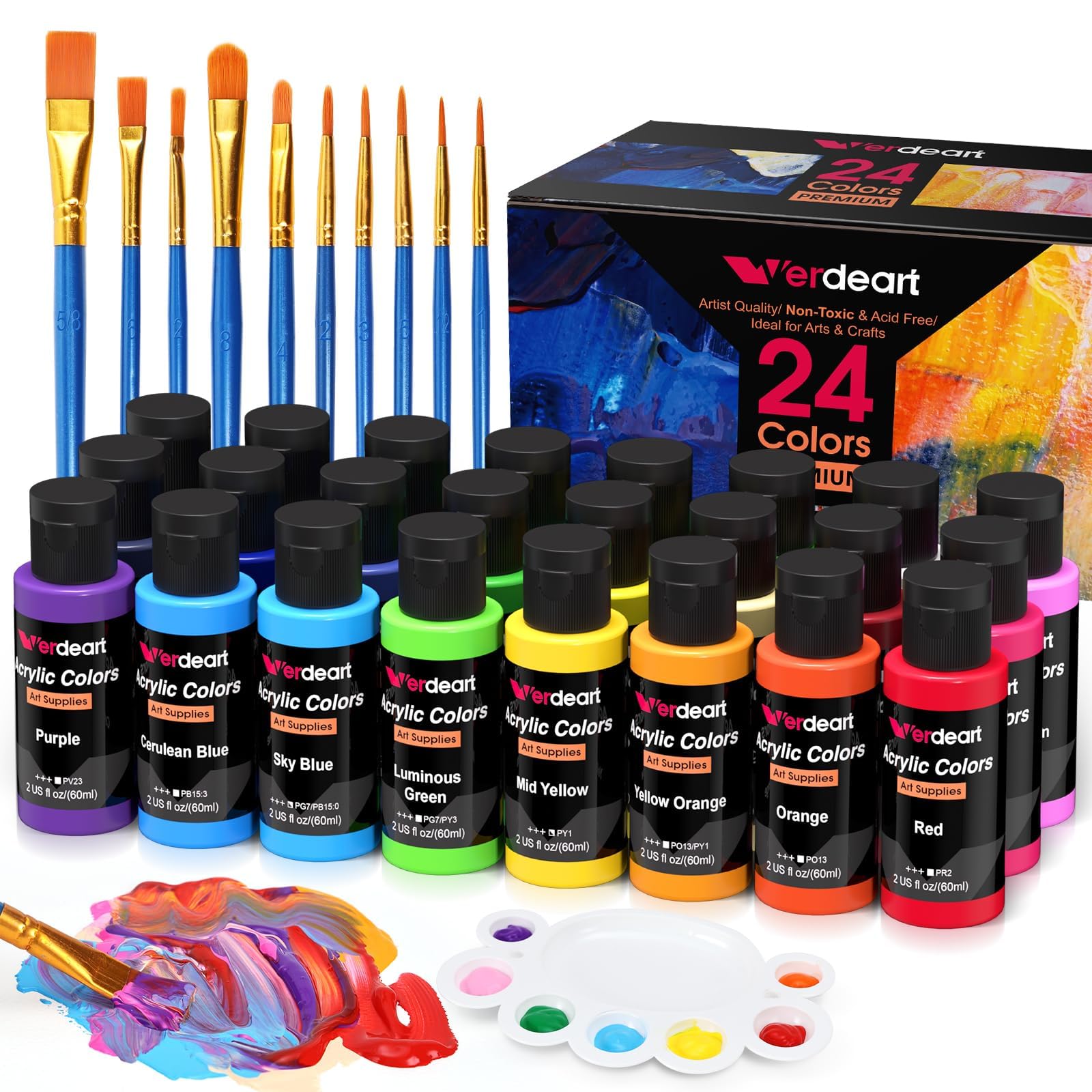
Twenty-four bottles plus ten brushes and a palette — everything on the bench in one box.
Nothing stalls a first paint job like realizing you have color but no brush. This set closes that gap: 24 bottles of acrylic, 10 brushes, and a palette in one package, so you can start on a print the day it arrives. The bottles hold 2 fluid ounces each, and the listed item volume runs to 48 fluid ounces — roughly 11.8 times the volume of the Artkey set at 4.06 fluid ounces.
The paint itself is water-based, mixes and layers smoothly, and sets to a semi-gloss finish. It is certified to ASTM D-4236 and EN71-3, both safety standards for art materials, and it is acid-free. On a printed part, that water-based formula also means you can thin a clump with a wet brush and clean up before it dries.
What buyers value most is the breadth of the color range — the second most-praised point is the selection itself, right behind overall quality. The bottles hold enough that a summer of craft sessions is covered, and the included brushes clean up easily. One touch worth noting: the paint’s thickness draws split opinions, with some finding it just right and others wanting more body.
Because the finish is semi-gloss, a raw print with visible layer lines will show a sheen along the ridges. Sand the surface first, or plan on a matte topcoat, if you want a flat look. The washability question also splits buyers — some find it easy, others find it takes more work than expected.
Ready on arrival: Brushes, palette, and 24 colors in one box removes the shopping list for a first project.
Thin it or topcoat it: Semi-gloss plus variable thickness means a matte clear coat is your friend on raw prints.
Suits: A first-time painter who wants a full kit and 24 colors to experiment with on a single print.
Skip if: You only paint with brushes you already trust and want to put the budget entirely into paint volume.
4. Nicpro Acrylic Paint Set 24 Colors
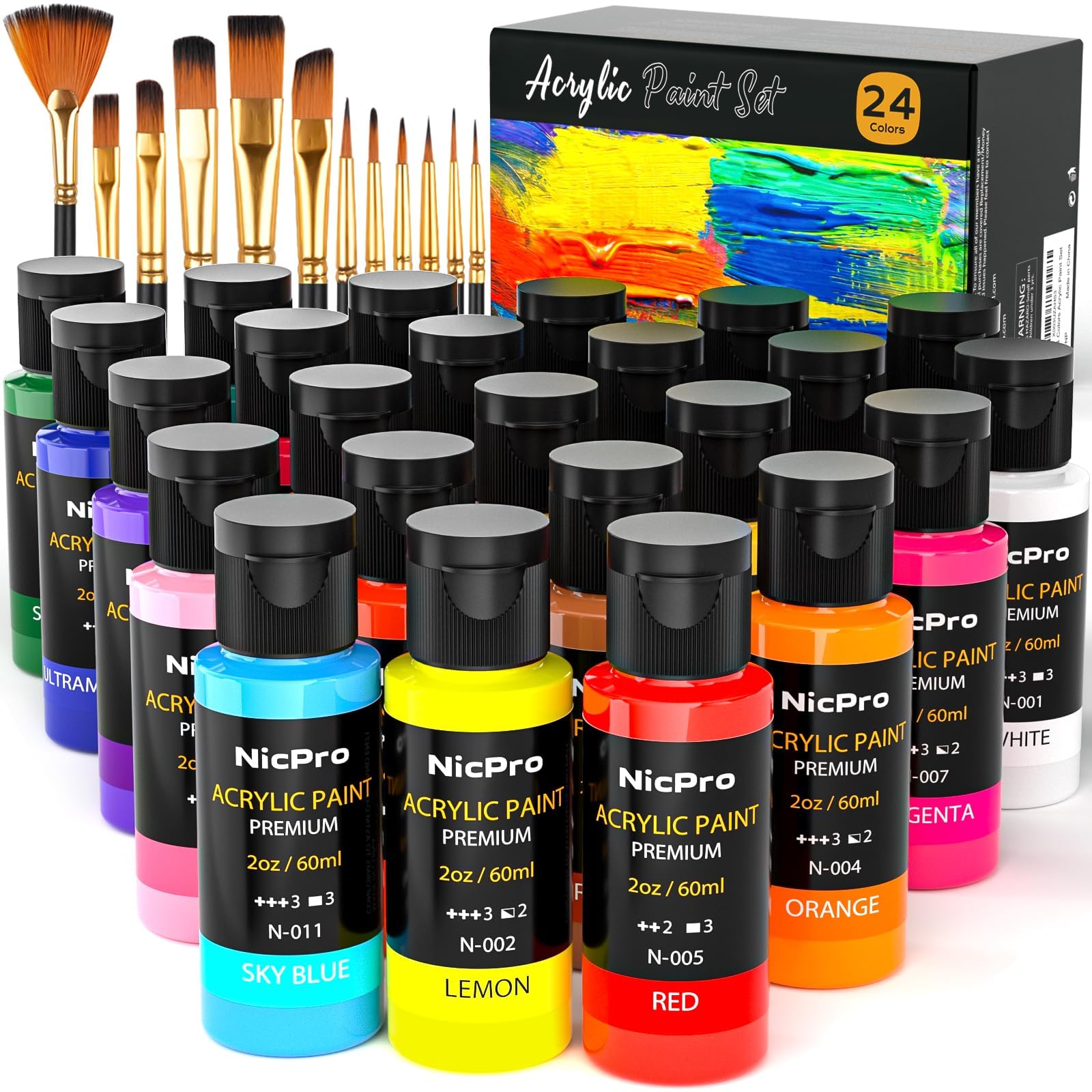
The big-brush-count set that treats a printed print like a full paint party.
Twenty-four colors in 60 ml bottles, twelve brushes of varying sizes, a palette, and a beginner’s guide with a color wheel — this is the set you buy when more than one person is painting or when you want a brush for every task from basecoat to fine detail. The listed dry time is 4 hours, the longest on this list, so plan on slow, deliberate layering.
Color selection is where buyers get excited, and quality is the most-praised trait by a clear margin. The bottles have secure tops, and the colors stay organized and separate rather than congealing into one muddy mass. Paint dries consistently on detailed pieces like fairy houses, and the semi-gloss finish is fade-resistant and water-resistant when set.
Coverage is the honest variable. Some painters report full coverage in a single pass; others need multiple coats, especially over a dark or translucent filament. Pigment strength and thickness also split opinion, so treat the first coat on a new print as a test patch before committing to the whole model.
One practical note the listing itself flags: remove the inner seal on each bottle before first use. And the mixing tray has arrived cracked for at least one buyer — check it on arrival, since the paint and brushes themselves are unaffected.
Why painters like it
- 12 brushes of multiple sizes cover basecoat to fine detail
- 24 colors in 60 ml bottles — enough volume for large projects
- Secure bottle tops keep colors clean and separate
- Water-resistant, fade-resistant finish once dry
Things to prep for
- Coverage varies — dark filament may need several coats
- Dry time of 4 hours means slow layering
- Inspect the mixing tray on arrival for cracks
Ideal for: Family paint nights or a dedicated bench that wants a brush size for every step.
Keep in mind: The 4-hour dry time and variable coverage reward patience over speed.
5. DecoArt Crafter’s Acrylic Paint Set 18 Bottles

Eighteen matte bottles that dry in about an hour and a half — fastest on this list.
When the goal is finishing a batch of prints in one sitting, dry time beats color count. This set lists a 1.5-hour dry time and a matte finish, and that combination is exactly what a raw, unsanded PLA print wants — dull surface, quick turnaround, less light bouncing off the ridges. You get 18 bottles at 2 fluid ounces each.
The color lineup is a crafter’s palette rather than a fine-art one: White, Wild Rose Pink, Christmas Red, Pure Pumpkin, Bright Yellow, Wild Green, Holiday Green, Hunter Green, Turquoise, Teal Blue, Tropical Blue, Truly Blue, Lavender, Regal Purple, Natural Beige, Burnt Umber, Storm Cloud Grey, and Black. That is enough range to paint a printed sign, a holiday prop, or a set of miniatures without mixing much.
What buyers reward most is paint quality, with color variety right behind it. The paint brushes out smooth for stamps, sponges, and stencils, so a textured print gets its look without a full brush set. It is water-based, so soap and water clean up a brush while the paint is still wet, and the formula is non-toxic for artists of all ages.
Coverage is not uniform across the range. Yellow is the one buyers flag as needing extra coats, and one purchaser noticed a slight residue on a face mask that got wet. For a printed part on a dry shelf, that is rarely an issue. It comes from a brand that has made paint in the USA for over 35 years.
Speed and dullness together: A 1.5-hour dry time and a matte finish make this the least fussy option for raw prints.
Mind the pale colors: Yellows need an extra pass, so budget more coats on light-toned prints.
Reach for it if: You paint hobby props, signs, or craft pieces and want a flat matte look finished fast.
Look elsewhere if: You need a fine-art pigment range with labeled lightfastness on every tube.
Know the Specs
Tube Size in Fluid Ounces
Fluid ounces tell you how much paint you actually get. A 0.74-ounce tube is a squeeze for a few details; a 4.06-ounce tube is a full bottle’s worth of basecoat. On PLA, thicker paint covers more per ounce, so a big tube of thick pigment goes further than a big tube of watery pigment. Match container size to project scale — small models want tubes, large scenery wants bottles.
Matte vs Semi-Gloss Finish
The finish decides how your printed ridges read. Matte scatters light, masking the stair-step lines from a printer, and it is the more forgiving choice on a raw print. Semi-gloss reflects light and makes each ridge catch a glint, so it pairs best with a sanded or filled surface — or with a matte clear topcoat over it. Neither finish is stronger; they change how the print looks, not how the paint holds.
Common Questions
Will acrylic paint stick to a PLA print without a primer?
Is it better to paint PLA with tubes or bottles?
How many coats does paint for PLA usually need?
Does the drying time matter when painting a print?
Is a matte or semi-gloss finish better on a 3D print?
Can I thin acrylic paint for PLA with water?
Will the paint stay on a printed part that gets handled?
Are these paint sets safe for kids to use on prints?
What is the difference between a 2 fl oz bottle and a 4.06 fl oz tube?
The Bottom Line
For most people painting a PLA print, the winner is the Amazon Basics Acrylic Paint Tubes Set — 24 thick matte colors in squeeze tubes that grab layer lines and hold on. If you hand-blend on figures and want the biggest tube per color, grab the Artkey Acrylic Paint Set. And when the job needs finishing in one sitting, the DecoArt Crafter’s Acrylic Paint Set with its 1.5-hour dry time is the one to reach for.
How we choose
We do not accept paid placement. Every pick is matched to a real buyer and a real use-case; we do not hands-on test units.
Sources
Specifications: manufacturer listings and product documentation. Review insights: verified customer reviews, as of October 2026. Pricing: not shown on this page (it changes often); check the current price via the retailer link.
As an Amazon Associate, Aappliancez earns from qualifying purchases. This does not affect which products we feature.