Disclosure: Some links in this post are affiliate links. As an Amazon Associate I earn from qualifying purchases, at no extra cost to you. Learn more
Specs are compiled from manufacturer listings and verified buyer reviews and can change over time — please confirm the key details on the product page before buying.
Foam board is the cheapest display material you can buy, and the fastest to ruin. Most general-purpose paints and every solvent spray will eat into the foam core within seconds, leaving a pitted, melted edge that no amount of layering can hide. The fix is simple: stick to water-based acrylics, prime the surface if you want crisp edges, and build colour in thin coats rather than one wet flood. The five options below are the ones that behave on foam, from a 24-pack workhorse to a spray for larger builds.
This guide is built by comparing the manufacturers’ published specifications and the patterns across verified customer reviews, so you get each pick’s real strengths and trade-offs instead of marketing spin.
You will see which formulas stay put on foam, which ones need two coats, and where a brush kit saves you a separate trip. Every pick here is water-based and safe on foam board, so you can choose by finish and coverage instead of guessing which formula melts your project — this guide covers the best paint for foam board with the practical details that actually matter on the craft table.
Top Picks


How To Choose The Best Paint for Foam Board
The single mistake that ruins most foam board projects is buying an oil-based or solvent paint instead of a water-based acrylic. Foam board has a polystyrene core, and polystyrene dissolves on contact with the solvents found in oil-based paints, lacquers and most general-purpose aerosols. Water-based acrylic is the safe family.
Check the base before you check the colour
Look for the words water-based or acrylic on the label. A paint that cleans up with soap and water is almost always safe on foam, because the carrier is water rather than a solvent. A paint that needs mineral spirits or thinner will attack the core.
One caveat applies even to safe paints: a very wet first coat can soften the paper facing on cheaper foam board. Load the brush lightly and work in thin layers.
Plan for two coats, not one
Foam board is porous on the paper face and slightly slick on the plastic-coated versions, so the first coat often looks patchy. That is normal. Build a thin first layer to give the second something to grip, then lay down the colour coat. Buying a paint with good opacity saves you a third pass.
Match the container to the job size
Small 12 ml tubes and 2 oz bottles suit signage, models and classroom pieces. Larger 3.4 fl oz squeeze bottles make sense when you are covering a big display panel. A spray can covers ground fast on large flat foam shapes, but you must confirm it is foam-safe and spray it in thin passes from a distance.
Side-by-Side Comparison
| Model | Best For | Format | Dry Time | Finish | Amazon |
|---|---|---|---|---|---|
| Crafts 4 All Acrylic Paint Set★ Best Overall | All-round craft and display work | 24 × 12 ml + 3 brushes | 3 hours | Satin | Amazon |
| BLUEBIRD Studio Acrylic PaintsBest for Mixing | Mixing custom shades from primaries | 6 × 3.4 fl oz | — | Matte | Amazon |
| FolkArt Multi-Surface Acrylic Set | Smooth satin finish on mixed surfaces | 10 × 2 oz | 24 hours | Matte | Amazon |
| Rust-Oleum Painter’s Touch 2X Ultra Cover | Large flat foam panels, fast | 2 cans, 24 fl oz | 20 minutes to touch | Gloss | Amazon |
| Apple Barrel Art Lessons Paint and Brush Set | Beginners and classroom projects | 34 pc kit | 4 hours | Matte | Amazon |
Detailed Reviews
1. Crafts 4 All Acrylic Paint Set 24 Pack
Our pick — 4.5+★ from 48,000+ verified ratings; the strongest balance of quality and price.
Twenty-four colours, three brushes and a dry time short enough that you finish a poster in an afternoon.
For a foam board project you usually want one thing first: enough colour range that you are not stuck mixing orange by hand. This set hands you 24 separate 12 ml tubes plus three brushes in the same box. Each tube is a small 12 ml can of satin acrylic, which sounds tiny until you realise you are painting flat board rather than a canvas. The makers state a dry time of 3 hours, so a morning coat is handleable well before dinner.
Where this earns its top spot on foam is the breadth. Set it beside the FolkArt kit and the difference is stark on paper: 3 hours versus 24 hours to dry, so the Crafts 4 All set lets you lay a second coat the same afternoon. Against the Apple Barrel 34-piece kit it is the smaller pack, but the trade is that every colour here is already mixed and ready. The 24 pack also gives you four times the tube count of the BLUEBIRD six-pack, which matters when a class or a set of signs needs distinct shades rather than three primaries.
What wins people over is the quality of the pigment itself — the colour goes on rich and blends without turning muddy on the brush. Buyers report it works across the board, from canvas paper to rocks to wood, and the same behaviour holds on a primed foam face. The honest catch is the dry time sits in the middle of the field, and the included brushes are basic rather than fine. For detail work on small foam lettering you will want a thinner brush of your own.
What lands the top spot
- 24 mixed colours in one box — no blending to reach a shade
- 3-hour dry time means a second coat the same afternoon
- Satin finish on a 12 ml tube that stays workable while you paint
- Three brushes bundled in, so a first project needs nothing else
Where it holds back
- 12 ml tubes are small — a large foam panel eats one fast
- Included brushes are coarse for fine lettering
- No dedicated orange in the range; you mix it yourself
Go for it when: you want one box with the full colour range, brushes included, for display signs or classroom foam work.
Think twice when: your foam panel is large enough that 12 ml tubes will run dry mid-project.
2. BLUEBIRD Studio Acrylic Paints 6-Pack
Six big squeeze bottles of pure primaries for anyone who would rather mix a colour than hunt for it.
Foam board work has a habit of swallowing paint, because the surface is flat, wide and thirsty. That is where volume beats variety. Each bottle here holds 3.4 fl oz of liquid acrylic, which is a far larger pour than a 12 ml tube, and the flip-top squeeze top lets you meter it out directly onto a palette. The label states coverage of 10 square metres per 100 ml, a useful guide for working out how far one bottle stretches.
The matte finish is the other half of the appeal on foam, since a flat surface catches light evenly and photographs cleanly for signage. Because you only get primaries, the set rewards anyone who likes mixing — the flip-top bottles make it easy to squeeze a small amount and adjust rather than commit a whole tube.
The trade is coverage. As owners mention: “Thickness is pretty good but you will still need 2 coats for coverage.” On a plain foam face that is realistic, and the primaries mix well enough to stretch a bottle further. Six bottles versus 24 tubes is the real decision — the BLUEBIRD gives you bigger pours of fewer colours, and the six-colour set stays wet long enough to blend on the palette. It gains nothing on brush count, though, so plan on supplying your own.
Reach for this if: you mix your own shades and want big squeeze bottles that keep giving on a large flat panel.
Look elsewhere if: you would rather open a tube that is already the exact colour.
3. FolkArt Multi-Surface Acrylic Paint Set 2oz
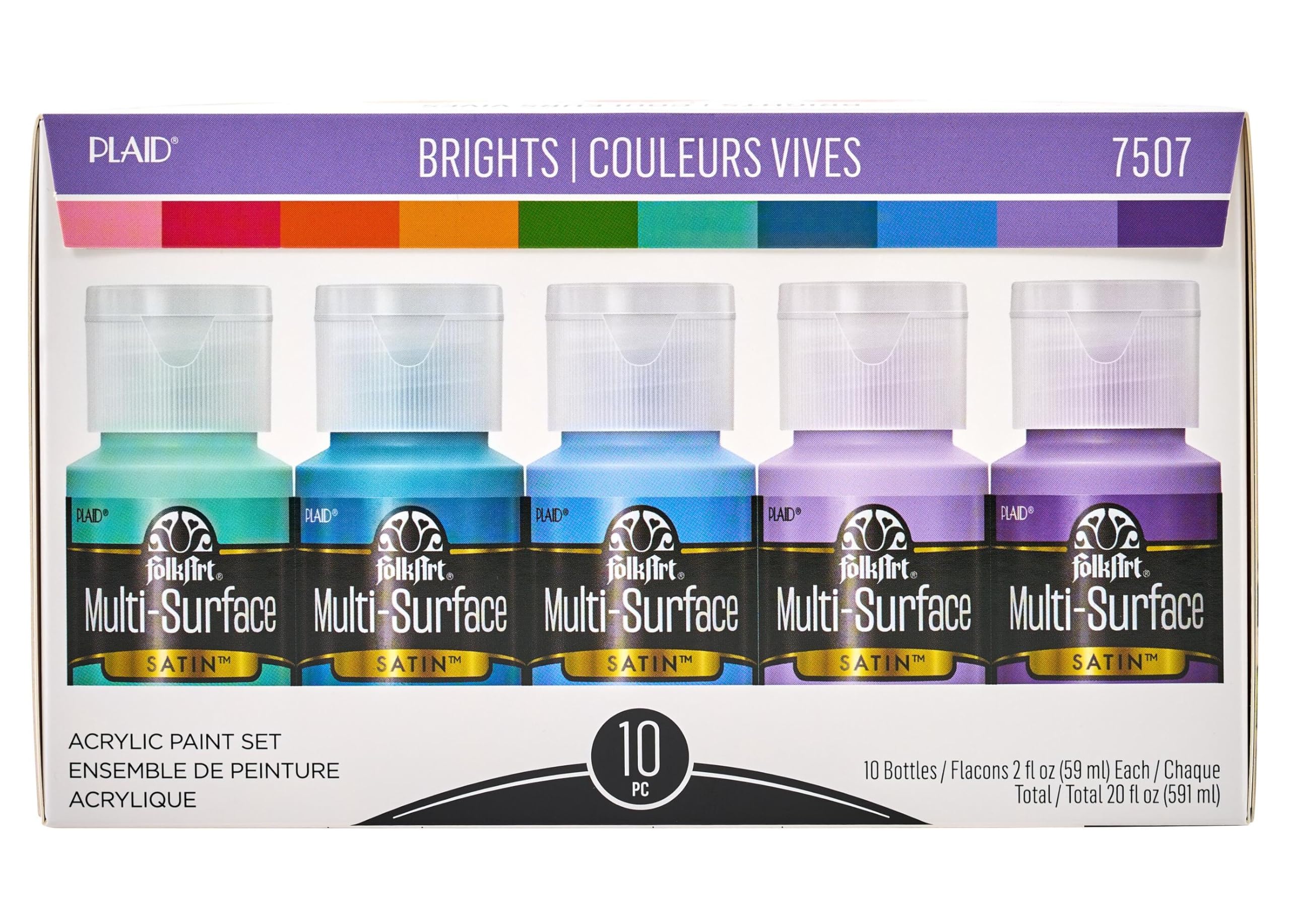
Ten two-ounce bottles built to stick to slick surfaces, which is exactly the problem a coated foam face presents.
Some foam board comes with a glossy plastic skin, and ordinary acrylic can bead on it. This set is sold as multi-surface, and the maker lists wood, canvas, paper, metal, terra cotta, plastic and more among the surfaces it takes. That matters here because the plastic-coated variant of foam board behaves much like plastic. You get ten 2 oz bottles in brights, each water-based and non-toxic.
The satin look is the standout. The colours dry to a satin rather than a flat matte, which gives a finished display a soft sheen instead of a chalky one. Buyers describe the finish as smooth and easy to work with, and the coverage leans strong enough that a primed rock goes in one to two coats. On foam, plan two to three thin passes for a solid panel. The dry time is the slowest in this group at 24 hours, against 3 hours on the Crafts 4 All set, so it suits a project you can leave overnight rather than a same-day rush.
There is a quirk worth knowing. The first coat can look thin, but it grips the surface and gives later layers something to hold, so a slightly patchy base is doing its job. One practical warning from owners: the paint is a touch thick straight from the bottle, so a flow aid helps if you want it thinner without cutting its durability.
The finish argument: satin dries with a gentle sheen that reads more finished than a chalky matte on a bright foam display, and the ten-colour brights range covers signage without a separate palette.
What to plan around: 24 hours to dry and a thick body mean slow, purposeful layers rather than a quick wet-on-wet build.
Best matched to: display pieces and mixed-material crafts where you want a smooth satin sheen on a slick-faced board.
Not the one for: a same-day deadline, given the overnight dry time.
4. Rust-Oleum Painter’s Touch 2X Ultra Cover Spray Paint
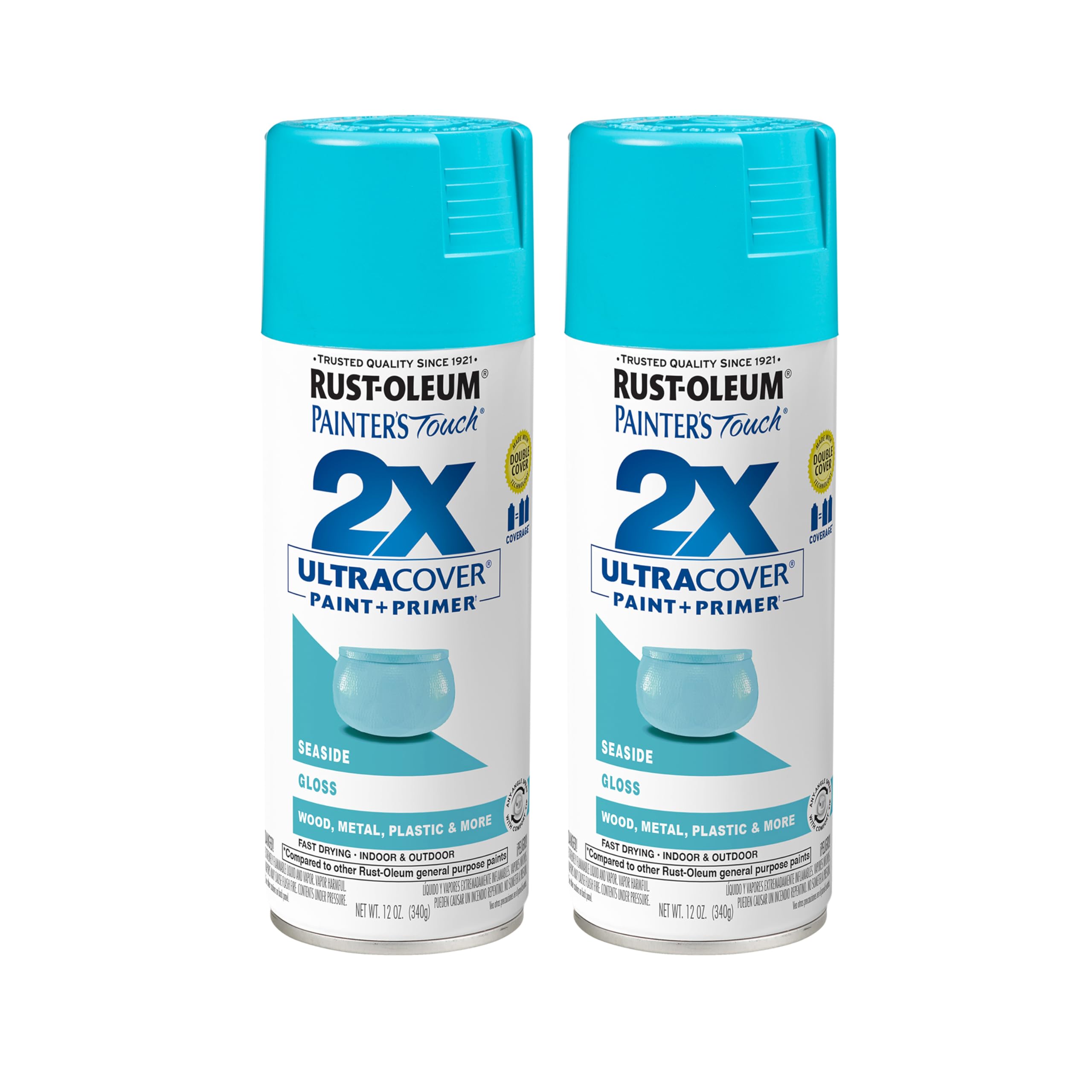
A spray that covers big flat foam shapes in minutes and dries to a hard glossy skin.
When the job is a wide backdrop or a large cut-out, a brush turns into a bottleneck. This is a two-can pack of 24 fl oz total, and the maker lists a dry time of 20 minutes to touch plus coverage of up to 12 sq. ft. per can. The gloss finish lays down a bright, even skin that makes a flat surface look newly made, and the oil-based formula is described as resisting chips. Colour here is Gloss Seaside, a blue.
Read the label before you buy, though. This is an oil-based aerosol, and the safe rule on foam is to test on scrap first, because the paper facing matters as much as the core. Spray in thin passes from a distance rather than one heavy coat, and let each pass flash off before the next.
The upside is speed and finish. The maker states 12 sq. ft. per can, so for a broad foam sign two cans give you a generous flat cover. The known snag is the nozzle, which can fail early — so keep a spare and clear it between coats. It also costs more per can than a bottle-based set, so it earns its place only when you genuinely need to spray a large area quickly rather than brush a small one.
Why big builds like it
- 20 minutes to touch — a large panel is handleable fast
- 12 sq. ft. per can of flat cover from one pass
- Gloss Seaside dries to a bright, even sheen
The honest snags
- Oil-based aerosol — always test on a foam offcut first
- Nozzles can fail early, so keep a spare
- Higher outlay than a bottle set; earns it only on big panels
Worth it for: a broad foam backdrop where brushing would take an evening and you need a hard gloss cover fast.
Skip it for: small detail work — a brush set handles lettering far better than a can.
5. Apple Barrel Art Lessons Paint and Brush Set, 34 pc Kit

A full classroom in a box, with paint, ten brushes, a sealer and video lessons to follow along.
Anyone new to foam work tends to buy paint, then discover they also need brushes and something to seal the finished piece. This kit bundles all of it. You get 23 colours of 2 fl oz Apple Barrel acrylic, a 2 fl oz bottle of Mod Podge Matte, and a 10-piece brush set. The paint is water-based and the label specifically names foam as one of the surfaces it covers, alongside wood, paper and canvas.
The Mod Podge is the smart inclusion for foam board. A matte sealer brushed over a finished sign protects the paint and gives a clean, non-reflective top coat. Dry time is 4 hours, faster than the FolkArt overnight wait and slower than the Crafts 4 All 3-hour set, so a project split across a morning and an evening fits neatly.
The lessons are the real differentiator — video tutorials covering colour theory, mixed media and collage, aimed at grades 6-12. For a teacher building a foam display with a class, that is a ready-made plan. The caution is consistency: opinions on the paint body are split, with some finding it thinner than expected and needing extra coats. If you want thick, one-pass pigment on a big panel, this is the slower route.
What the box solves: paint, ten brushes and a matte sealer arrive together, so a first foam piece needs no extra shopping trip.
The catch: the paint runs thinner than a heavy-body acrylic, so budget for an extra coat or two on a large flat face.
Ideal for: parents and teachers who want one kit that covers paint, tools and sealing for a group foam project.
Pass if: you already own brushes and just want maximum pigment per ounce.
Know the Specs
Water-based versus solvent-based
The single spec that decides whether your foam survives. Water-based acrylic cleans up with soap and water and will not attack the polystyrene core. Solvent-based paints and most general aerosols dissolve the core on contact. Even with a water-based paint, load the brush lightly on cheaper board so the paper facing does not soften.
Coverage and coat count
Coverage tells you how far the paint stretches — FolkArt lists full coverage, BLUEBIRD lists 10 square metres per 100 ml, and Rust-Oleum states 12 sq. ft. per can. On foam’s flat, thirsty face, plan two to three thin coats for a solid result, whatever the label promises. A thin first layer both grips and seals.
Dry and cure time
Dry time is how long before you can touch or recoat, and it varies widely across this group: 3 hours for Crafts 4 All, 4 hours for Apple Barrel, 20 minutes to touch for the spray, and 24 hours for FolkArt. A shorter dry lets you layer the same day. Cure time, where listed, is the longer wait before the finish is fully hard.
Finish type
Finish changes how the piece reads. Matte absorbs light and suits signage and photography. Satin gives a soft sheen that looks more polished. Gloss throws back light for a bright, hard-looking surface. On foam board, a matte or satin top coat is the more forgiving choice if you will seal it with a matte varnish.
Container format
Tubes, bottles and cans each suit a different job. Tubes in the 12 ml range suit small models and lettering. Squeeze bottles from 2 oz to 3.4 fl oz meter out larger pours for panels. Aerosol cans cover big shapes quickly. Match the format to the foam piece: 12 ml tubes for lettering and models, 2 to 3.4 fl oz bottles for panels, an aerosol for wide flat shapes.
Non-toxic formulation
Many acrylics are labelled non-toxic and water-based, which makes them a common choice for classrooms and family crafting. Check the label, keep good ventilation when spraying, and cover your work surface — these are sensible habits with any paint, not a substitute for reading the safety information on the container.
Common Questions
Will acrylic paint melt foam board?
Can I spray paint foam board directly?
How many coats of paint does a foam board sign need?
Which paint dries fastest on foam board?
Do I need to prime foam board before painting?
Can I seal a finished foam board project?
What is the difference between matte, satin and gloss on a foam display?
Is a small 12 ml tube enough for a large foam panel?
Can kids use these paints on foam board?
Will the paint stay on foam board without flaking?
The Bottom Line
For most foam board projects, the Crafts 4 All Acrylic Paint Set is the pick to beat. Twenty-four mixed colours, three brushes and a 3-hour dry time mean a display goes up in a single afternoon without hunting for a shade or waiting overnight. If you prefer to mix from primaries and want bigger pours, the BLUEBIRD six-pack gives you 3.4 fl oz squeeze bottles and a clean matte face. And when the job is a wide backdrop that needs a hard, bright finish fast, the Rust-Oleum spray covers 12 sq. ft. per can in 20 minutes — just test an offcut before you commit, since it is oil-based.
How we choose
We do not accept paid placement. Every pick is matched to a real buyer and a real use-case; we do not hands-on test units.
Sources
Specifications: manufacturer listings and product documentation. Review insights: verified customer reviews, as of October 2026. Pricing: not shown on this page (it changes often); check the current price via the retailer link.
As an Amazon Associate, Aappliancez earns from qualifying purchases. This does not affect which products we feature.