Disclosure: Some links in this post are affiliate links. As an Amazon Associate I earn from qualifying purchases, at no extra cost to you. Learn more
Specs are compiled from manufacturer listings and verified buyer reviews and can change over time — please confirm the key details on the product page before buying.
Sticky cabinet doors are almost never a paint-quality problem — they are a cure and finish problem. Paint that feels tacky weeks after you rolled it on usually went on too thick, was recoated before it had truly hardened, or simply is not the right formulation for a surface your hands grab twenty times a day. The seven paints below are the ones that actually set up hard and wipe down clean. For most kitchens, buy the General Finishes Water Based Milk Paint: 4.5+ stars across 600+ owners, a self-sealing satin that needs no separate topcoat and dries hard instead of gummy.
This guide is built by comparing the manufacturers’ published specifications and the patterns across verified customer reviews, so you get each pick’s real strengths and trade-offs instead of marketing spin.
Before you commit, you should know how cure time, sheen and primer-free adhesion decide whether a cabinet front stays slick or turns tacky. Stick with this walkthrough of the paint for kitchen cabinets that doesn’t get sticky and you will know exactly which can to open first.
Top Picks


How To Choose Paint for Kitchen Cabinets That Doesn’t Get Sticky
A sticky cabinet door is the number one regret after a DIY kitchen refresh. You can rule out most of that risk before you ever open a can, just by reading three things on the label: the finish type (how glossy or flat the dried surface is), the full cure time (how long until the paint truly hardens, not just feels dry), and whether the paint needs a topcoat (a separate clear sealing layer).
Finish type decides how the door feels to your hand
A satin or semi-gloss finish dries to a slicker surface than a flat matte one, so greasy fingers and damp cloths wipe away instead of grabbing. A pure matte is beautiful on a display shelf, but cabinet door fronts take constant handling. Pick a finish that has at least some sheen if you want to avoid that grabby feeling at the pull.
Full cure time is not the same as dry time
Every product here lists a dry time you can measure in minutes or hours. Full cure is the longer clock, and it is what makes the paint hard and non-tacky. Rust-Oleum, for instance, is touch-dry in 1 hour but needs up to 4 hours to fully cure per its spec, and buyers report the real-world figure runs longer in a cool room. If you rehang the doors too early, the film stays soft under the weight and pressure.
Does it need a topcoat?
A self-sealing formula saves you a whole extra step, but a topcoat can add real hardness on high-use cabinets. General Finishes markets its milk paint as self-sealing and does not require a topcoat. Heirloom Traditions’ ALL-IN-ONE is not water resistant on its own and asks for a clear topcoat to hold up. Read that line carefully, because the wrong answer here is exactly how tacky cabinets happen.
Do you really need to sand and prime?
Several of these claim you can skip primer entirely. INSL-X Cabinet Coat advertises super adhesion on hard-to-coat surfaces without primer. Rust-Oleum says it can usually be applied immediately without elaborate primer. That saves you hours, but a quick degrease still matters. Grease and cooking oil sit on kitchen cabinets and will block adhesion no matter what the can promises.
Side-by-Side Comparison
| Model | Best For | Finish | Coverage | Cure Time | Amazon |
|---|---|---|---|---|---|
| General Finishes Water Based Milk Paint★ Best Overall | Self-sealing, no topcoat | Satin | 1 Quart (32 fl oz) | Not listed | Amazon |
| INSL-X Cabinet CoatTop Performer | Factory-like cabinet finish | Satin | 350 to 450 sq ft per gallon | 24 hours | Amazon |
| Nuvo Plus Cabinet Paint Kit | All-in-one kit with tools | Satin | 100 sq ft of cabinets | Not listed | Amazon |
| Rust-Oleum Washable Kitchen Cabinet Paint | Budget kitchen refresh | Satin | Up to 14 sq metres per litre | 4 hours | Amazon |
| Heirloom Traditions ALL-IN-ONE Paint | No sand, no prime | Matte | 140 sq ft | Not listed | Amazon |
| Diamond Brite Kitchen and Bath Latex Paint | Walls and ceilings too | Gloss | 300 sq ft per gallon | Not listed | Amazon |
| BACKDROP Premium Cabinet & Door Paint | Washable semi-gloss | Semi-Gloss | 400 sq ft per gallon | 4 hours | Amazon |
Detailed Reviews
1. General Finishes Milk Paint Antique White
Our pick — 4.5+★ from 650+ verified ratings; the strongest balance of quality and price.
The self-sealing satin that skips the topcoat and still hardens up.
This is the paint to reach for if you want to refinish cabinet doors without adding a separate topcoat step. General Finishes markets this 32 fluid ounce quart as self-sealing, so once the final coat is down, the job is done. It arrives in a satin finish and in Antique White — a colour code the maker lists as #FFFEEF. The one label warning worth heeding: do not apply a clear topcoat over bright white paint, because the manufacturer flags a risk of yellowing due to a reaction to the substrate.
This quart earns its spot on a cabinet front because it levels out: it settles flat instead of holding brush ridges, so your doors look sprayed rather than hand-rolled. That flat settling is why so many owners describe it as furniture-store quality after a few coats. The Antique White reads as a creamy off-white rather than a stark appliance white, so it will not clash against a beige kitchen. A 20-year painter’s take, echoed across the reviews, is to lay on 3 light coats — or 4 over a darker cabinet — using a foam roller or brush. Expect the wet paint to look a little yellow until it dries to that creamy tone.
The honest catch sits in the durability question. The maker sells a separate High Performance TopCoat that some owners add on cabinet fronts that see heavy use, because the plain finish can chip and scratch in high-traffic spots over time. Owners mention a waterproof topcoat on a dining table “lasted 16 years, still great,” so add the optional topcoat on hard-working cabinet fronts even though it is not required. It also leads the field on ratings by a wide margin: 674 to BACKDROP’s 42, and 4.7 stars to its 4.3.
What wins people over
- Self-sealing formula saves you a full extra topcoat step
- Levels flat for a smooth, brush-stroke-free finish
- Antique White dries to a creamy off-white, not stark white
- Cleanup is just water
Where you pay attention
- High-use cabinets can chip; an optional topcoat helps
- Do not topcoat bright white — the maker warns of yellowing
- The value side of the ratings is mixed
Go for it if: you want a smooth, self-sealing satin finish and a warm off-white without a topcoat step.
Add the topcoat if: your cabinets see constant handling, because the plain finish can chip over time.
2. INSL-X Cabinet Coat White
The gallon that chases the factory finish, advertised to shrug off grease and stains.
If a normal kitchen’s worth of cabinet fronts is on your list, INSL-X is built for it. A single gallon covers 350 to 450 square feet, so one can usually stretches across a whole kitchen — and owners routinely report one gallon doing the job. It is a urethane acrylic paint that cures to a satin sheen, described by the maker as an ultra smooth, durable finish that resists chipping, scuffing, food stains, grease and water. In a room where splattered sauce and sticky fingers land daily, that grease and water resistance is the feature doing the real work.
Where this paint earns its keep is self-leveling. It goes on and settles flat rather than holding brush drama, which owners describe as a factory-like finish on bathroom and kitchen cabinets. It also advertises super adhesion on hard-to-coat surfaces with no primer, so a melamine or older painted cabinet can be tackled without a full stripping session. Watch the temperature: the maker specifies applying only when air, product, or surface is above 50 °F (10 °C) and below 90 °F (32 °C), so a cold garage in winter is not the place for it.
The recurring note is coat count. The label suggests 1 to 2 coats, but customers note needing up to 4 over oak to hide the grain, and the fix is to apply thin, even layers — too much paint in one pass causes runs. Full cure takes 24 hours, so leave the doors off and let the film harden before you hang them again. Its value side is the one mixed note in the ratings; the performance is otherwise praised for quality, dry time and appearance.
My read: a factory-like satin that self-levels, resists grease and water, and covers a whole kitchen from one gallon — with a coat count that may run higher than the label suggests on grained wood.
Reach for this one if: you want a durable, brush-mark-free satin and one gallon to cover a typical kitchen.
Plan around it if: your cabinets are grained oak or your workspace runs cold — budget extra coats and check the temperature range first.
3. Nuvo Plus Cabinet Paint Kit (Celadon Cove)

Everything in one box for a typical kitchen — paint, primer and the tools.
The first-timer who does not want to assemble a toolkit should look here. Nuvo’s kit bundles water-based acrylic paint plus primer for superior hiding, even on dark or stained cabinets, and includes all the tools you need to brush and roll. It also comes with a colour card so you can see the shade in your own kitchen light. Coverage is listed at 100 square feet of cabinets, or 40 linear feet — the typical size of most kitchen cabinets.
What makes this kit different from a plain can is the built-in primer and the curated colour. It is tune for a smooth, even coat without drips or streaks, and it dries in a soft satin finish with no additional topcoat needed. The listed Celadon Cove is a soft mint, and the formula is built for durability on high-traffic surfaces subject to wear and tear. It is Ultra low VOC and odor, which matters if you are painting inside a lived-in home rather than a workshop.
The one thing to size honestly is colour and amount. Buyers’ feedback on the colour is mixed — some love it while others find their shade leans too white. Coverage is counted for a typical kitchen rather than a sprawling one with lots of drawers, so measure your actual cabinet faces first. The formula is also specifically built for wood, laminate, MDF and particle board, plus primed or painted metal, so a metal-framed cabinet front is in bounds while a bare glossy plastic panel is not.
The all-in-one advantage
- Paint and primer in one, so no separate priming step
- Tools included — brush, roller, all in the box
- Ultra low VOC and odor for indoor use
- Satin finish needs no additional topcoat
The planning caveats
- Colour feedback is mixed — order a swatch before committing
- Counted for a typical 100 sq ft kitchen, not a large one
- Dark cabinets may need several coats for full hiding
Best for the first-timer: a single box that carries paint, primer and tools for a normal kitchen’s worth of cabinet fronts.
Measure first: the coverage is sized for a typical kitchen, so a larger run of cabinets means adding a second kit.
4. Rust-Oleum Kitchen Cabinet Paint Graphite
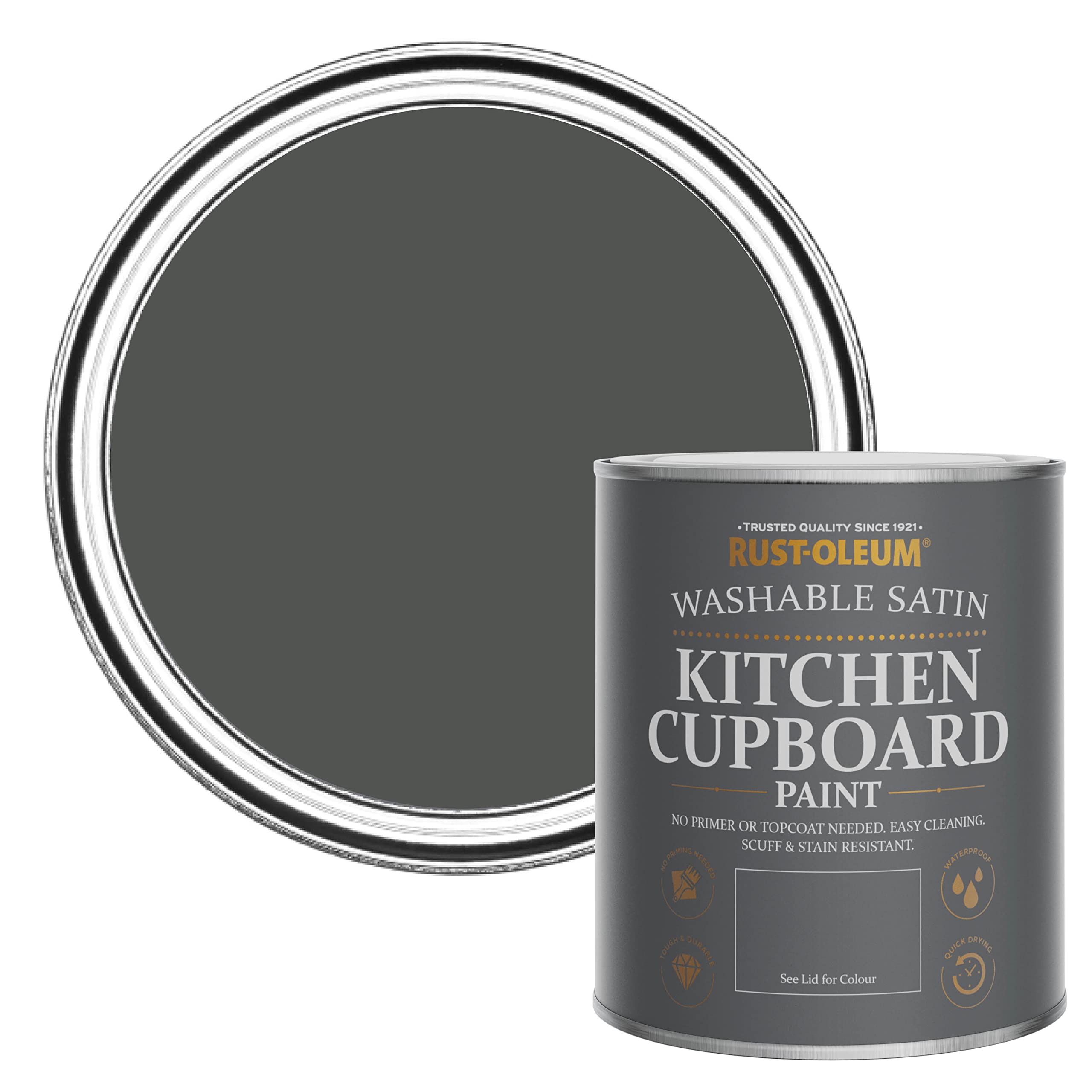
The quick-drying washable coat that makes old graphite cabinets look new again.
For a fast, affordable kitchen refresh, this Rust-Oleum 750 ml can is hard to argue with. It is a water-based paint labelled for melamine, wood and laminate cabinets, and the maker says it can usually go on immediately without elaborate primer and does not require sealing. It is highly pigmented and easy to apply by brush or roller, and it is made in Belgium in an unlimited recyclable can. The graphite hue is a rich dark grey that reads modern against light counters and backsplashes.
On the sticky question, this one is not tacky once it has cured — but the timeline is longer than the label’s quick dry. It is touch-dry in 1 hour per the spec (dry to a light touch), yet the full cure runs to 4 hours, and reviewers point out the real-world figure running up to 3 days depending on room temperature. One buyer notes the first coat can seem to scuff after 24 hours, but the cured paint is “tough and is standing up to spills,” and three coats on cupboards still looked good almost a year later.
What you should plan for is the quantity and the brush cleanup. Shoppers say that 750 ml ran short for a full cabinet run and they had to buy a second can. The plastic-like consistency means brushes harden and cannot be washed out, so use rollers and cheap disposable brushes and stir the paint before you start. None of that undercuts the result, though — this is a budget-friendly way to give dated cupboards a second life.
What I like: the washable, stain-resistant finish on a water-based, no-sealing-required formula that is easy to roll by hand.
The honest catch: it can look patchy on the first coat, and brushes are throwaway, so the real trade-off is patience and cheap tools rather than any lack of toughness.
Pick it for: a budget-friendly dark-grey refresh where you want a washable, water-based paint and are willing to budget extra time for the cure.
Buy two cans if: your cabinets run wide, because 750 ml tends to come up short on a full kitchen.
5. ALL-IN-ONE Paint by Heirloom Traditions, Linen, Quart

Wipe and paint, no sanding — the one for old cabinets and impatient weekends.
If sanding is the step you dread, this is the can that lets you skip it. Heirloom Traditions markets ALL-IN-ONE as no sanding, no priming and no topcoat required, in a low luster velvet sheen finish. It is rated for walls, doors, cabinets, counters, furniture, metal, glass, ceramics, and floor and wall tile, and it comes with a 30-colour card so you can see the shades in your own kitchen lighting. The Linen colour is a soft neutral that suits a calm kitchen palette.
The reason it may suit your kitchen is how it handles older wood. It wipes on and covers without the full sand-and-strip routine, and it does not streak or peel, so a dated cabinet front gets a fresh face with minimal prep. Drying is listed at 3 hours, and it stretches to cover smooth fabrics, vinyl and leather as well as hard surfaces. As one buyer put it: “I love how easy it was to paint it no sanding just wipe and paint.”
One thing to note before you choose it for cabinets: the Linen matte finish is not water resistant by itself and needs a clear topcoat where water and cleaning are regular. That topcoat step is the very thing the label says is not required — so it is fair to say the name oversells the finish for a wet kitchen. Coverage is also listed at 140 square feet, which is fine for a modest run of cabinets but tight for a large kitchen. The quality of the paint itself earns strong praise; the water-resistance side is the mixed one.
Why it fits cabinet projects
- No sanding, no priming — ideal for old woodwork
- Does not streak or peel on the front
- Works across furniture, tile, metal and glass too
- 30-colour card lets you sample shades first
Where it falls short for wet zones
- Matte Linen is not water resistant — add a clear topcoat
- Coverage is 140 sq ft, tight for a large kitchen
- Value and coverage are the mixed parts of the ratings
Best for the sanding-averse: old wooden cabinets and furniture that need a fresh face without a full prep session.
Remember the topcoat: this matte is not water resistant, so wet or heavily cleaned cabinet fronts need a clear protective coat.
6. Diamond Brite Kitchen and Bath Paint

The white that covers stained ceilings and cabinet fronts in one tidy project.
If your kitchen refresh touches more than just the doors, this gallon does double duty. Diamond Brite is a kitchen and bath latex in Brite White, built with a moisture-resistant formula to help prevent brown spotting from humidity, and a high-hiding, durable washable finish for water splashes and steady cleaning. Coverage is about 300 square feet per gallon with a two-coat application, and it works on drywall, plaster and wood in a semi-gloss finish. It is made in Cary, Illinois, in a recycled plastic can from Chicago.
What makes it easy to live with is a nearly odorless film, which owners have used for indoor winter projects with the windows shut. It is also strong at hiding. Two coats over a fresh skim coat of veneer plaster covered every stain on a busy ceiling, which is why some buyers keep it for the worst spots in the house. The semi-gloss is the reason it wipes clean in a small kitchen where splatters are frequent.
There is a hard line in the label you must respect: it is not intended for bathtubs, showers or sinks. The paint itself is not waterproof, and the moisture resistance is aimed at humidity, not standing water. The one honest downside on cabinet fronts is that its consistency can spread thick and feel sticky in the can, even after shaking and stirring, so plan on good blending and a clean prime on bare wood. The result still works well for the surface it is made for.
Where it shines: a moisture-resistant, washable white that covered stubborn ceiling stains in two coats and barely smells.
Know the limit: it will not go on tubs or sinks, and its thick feel means cabinet doors want a little extra blending care.
Choose it when: your project spans cabinet fronts and stained walls or ceilings and you want one nearly odorless white.
Do not use it on: tubs, showers or sinks — the label rules those out and it is not waterproof.
7. BACKDROP Cabinet & Door Paint KISMET
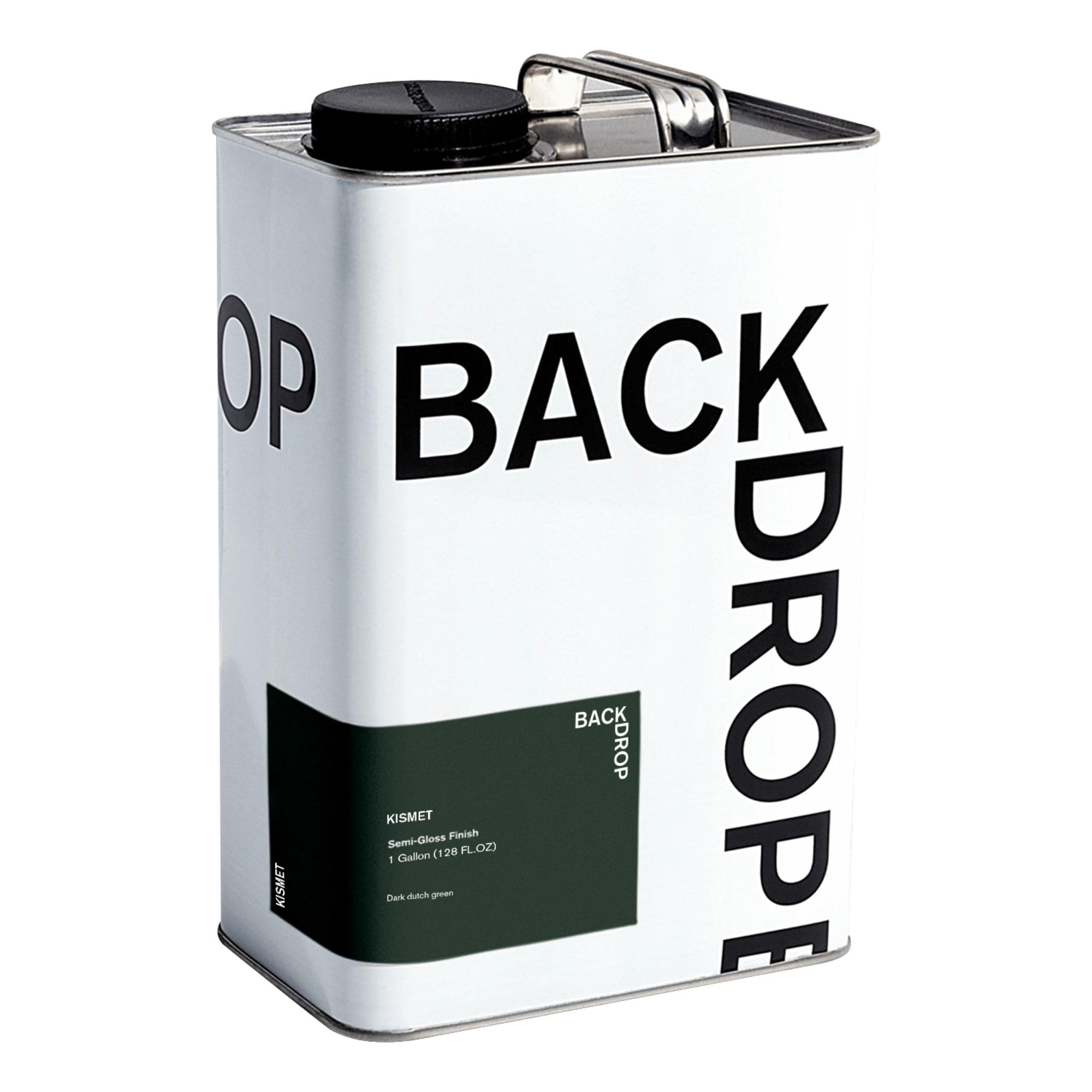
A deep dutch green built for washing, so smudges never settle in.
This is the pick for a kitchen that wants colour and wipe-down toughness in one coat. BACKDROP’s KISMET is a dark, dutch green with a cool, laidback look, in a semi-gloss finish the maker says is tune for washability and maximum durability while keeping the shine down. A premium acrylic resin gives it stain resistance and intense pigment, and one gallon covers 400 square feet — the largest area of any semi-gloss or coat here. It is self-priming, low odor, and Green Wise certified as Ultra Low VOC, and Backdrop is the first Climate Neutral Certified paint company.
What makes that washable sheen practical is how it wears on a door front. The semi-gloss forms a harder, slicker surface than a matte, so a damp rag slides over splashes instead of dragging. The self-priming part is a real time saver too — owners have painted a bathroom vanity over dark blue chalk paint with only a wipe-down and no prep, and reported the same result on a front door. The pour design and easy-open, close can (no tool needed) make top-ups during a multi-door session simpler than a standard screw-top.
The trade-off is that it needs a patient hand on tricky surfaces. The maker advertises it as thick and high-coverage with only 2 coats over white, but owners note it can dry a different shade on each coat and turn streaky on some jobs. Apply it consistently and let each layer fully dry. The screw-top lid is the other physical gripe, and a few find the can awkward to reseal. It is also the priciest per gallon here and rated below the front-runners — 4.0+ stars on 40+ ratings against General Finishes’ 4.7 on 674 — so buy it for the KISMET green, not the ratings.
What I like: a washable semi-gloss that wipes clean, self-primes, and covers 400 sq ft in one rich KISMET green.
Best if colour leads: you want a deep dutch green with a washable semi-gloss and self-priming prep in a single gallon.
Think twice if: you need a simple to use, streak-free result from the first coat — this one rewards even, patient layering.
Know the Specs
Finish type and sheen
The finish type — matte, satin or semi-gloss — is the main thing that decides whether a cabinet front wipes clean or grabs your hand. A satin or semi-gloss dries to a slicker, harder surface, so grease and damp cloths slide off. A true matte can look softer, but it is more likely to hold a sticky feel under constant handling. When shopping, match the sheen to the way you use the door, not just the way it looks in a photo.
Full cure time
Dry time means the paint is safe to touch. Full cure is the longer clock that makes the film hard and non-tacky, and it can run well beyond the printed dry time in a cool or humid room. Look for the listed full cure time and then add more time in a cold kitchen. Hanging the doors or restocking the cupboard before the cure is done is the most common reason a paint that should be slick ends up sticky.
Coverage per can
Coverage is listed in square feet per gallon, or per quart or can, and it tells you how far a single container stretches. A typical kitchen’s cabinet faces take a set amount of area, so measure your doors and drawers before you buy. If you underestimate, you will end up re-ordering mid-project, or laying it on too thin to hide the old colour. Always plan for one extra pass on a colour change or on grained wood.
Priming and adhesion
Self-priming and no-sand paints save the biggest chunk of time in a cabinet refresh, but they still ask for a clean surface. Cooking grease and oil block adhesion no matter what the can says, so a degrease and a light scuff is cheap insurance. Primer-free adhesion matters most on hard, shiny surfaces like melamine or old gloss cabinets, where paint struggles to grip. Read the label’s prep line, then do one extra cleaning pass.
Common Questions
Why do my kitchen cabinets still feel sticky after the paint has dried?
Is a satin or semi-gloss finish better for cabinet doors that get touched a lot?
What does self-priming actually mean, and do I still need to sand?
How much paint covers a full kitchen of cabinets?
Can I paint kitchen cabinets that are laminate or melamine?
Do I need a topcoat on kitchen cabinets?
Will painting over white cabinets need more coats?
Is low-VOC cabinet paint actually safe to use indoors?
Why does the paint look a different colour on each coat?
Can kitchen cabinet paint be used on furniture or walls as well?
The Bottom Line
For most kitchens, the winner is the General Finishes Water Based Milk Paint. Its self-sealing satin levels flat, skips the topcoat step, and dries to a creamy off-white that holds up with a little care on hard-working cabinets. If a full kitchen’s worth of doors is your project and you want a factory-like satin that resists grease, grab the INSL-X Cabinet Coat. And if you want an all-in-one kit with paint, primer and tools in a box for a typical kitchen, the Nuvo Plus Cabinet Paint Kit is the one to reach for.
The General Finishes quart is the crowd favourite — 4.5+ stars across 600+ owners, with appearance and colour drawing the most praise. That is exactly what you want on a cabinet front you will look at every day.
How we choose
We do not accept paid placement. Every pick is matched to a real buyer and a real use-case; we do not hands-on test units.
Sources
Specifications: manufacturer listings and product documentation. Review insights: verified customer reviews, as of October 2026. Pricing: not shown on this page (it changes often); check the current price via the retailer link.
As an Amazon Associate, Aappliancez earns from qualifying purchases. This does not affect which products we feature.