Disclosure: Some links in this post are affiliate links. As an Amazon Associate I earn from qualifying purchases, at no extra cost to you. Learn more
Specs are compiled from manufacturer listings and verified buyer reviews and can change over time — please confirm the key details on the product page before buying.
You want windows you can actually see through — not a streaky map of last week’s rain. The right outdoor window and screen cleaner depends on three formats: a foaming spray that clings to vertical glass, a hose-end bottle that reaches the second floor, or a concentrated refill that stretches your budget. This guide lines up five different tools that do those jobs, tells you which surfaces each one handles, and shows where the real strengths and trade-offs sit.
This guide is built by comparing the manufacturers’ published specifications and the patterns across verified customer reviews, so you get each pick’s real strengths and trade-offs instead of marketing spin.
Some formulas cling and dry quickly, while others need a hose and a steady rinse, and the difference decides whether you finish the job in one pass or three. Below you’ll find the realistic picks for every type of glass on your property: outdoor window and screen cleaner.
Top Picks

How To Choose The Best Outdoor Window and Screen Cleaner
Outdoor glass gets a different kind of dirt than indoor glass. You are dealing with pollen film, dust blown onto screens, and hardened grime that baked on over a windy season. That means the formula has to grab onto vertical surfaces, and the delivery method has to put it where your arm cannot reach.
Pick the delivery method before you pick the brand
A foaming spray gives you the most control on a car windshield or a mirror — you spray, it clings, you wipe. A hose-end bottle mixes concentrate with your garden water and throws it at second-story windows, so you never climb a ladder. A refill jug only works if you already own the matching hose-end bottle, so check what is already in your garage before adding to the shelf.
Know what your screens and siding can take
Screens are woven mesh, and a cleaner that requires scrubbing can push grit deeper into the weave. Look for a formula that says you can spray and rinse rather than remove the screen. On siding, pay attention to whether the maker lists non-porous surfaces only — a foam that lifts mold off vinyl may do little on brick or bare concrete.
Understand what “streak-free” really depends on
Streaks usually come from three places: cleaning in direct sun so the liquid dries before you wipe, using too little rinse water, or buffing with a towel that is already damp and dirty. A good formula helps, but rinse water and a dry microfiber buff still decide the finish.
Side-by-Side Comparison
| Model | Best For | Format | Size | Surface Focus | Amazon |
|---|---|---|---|---|---|
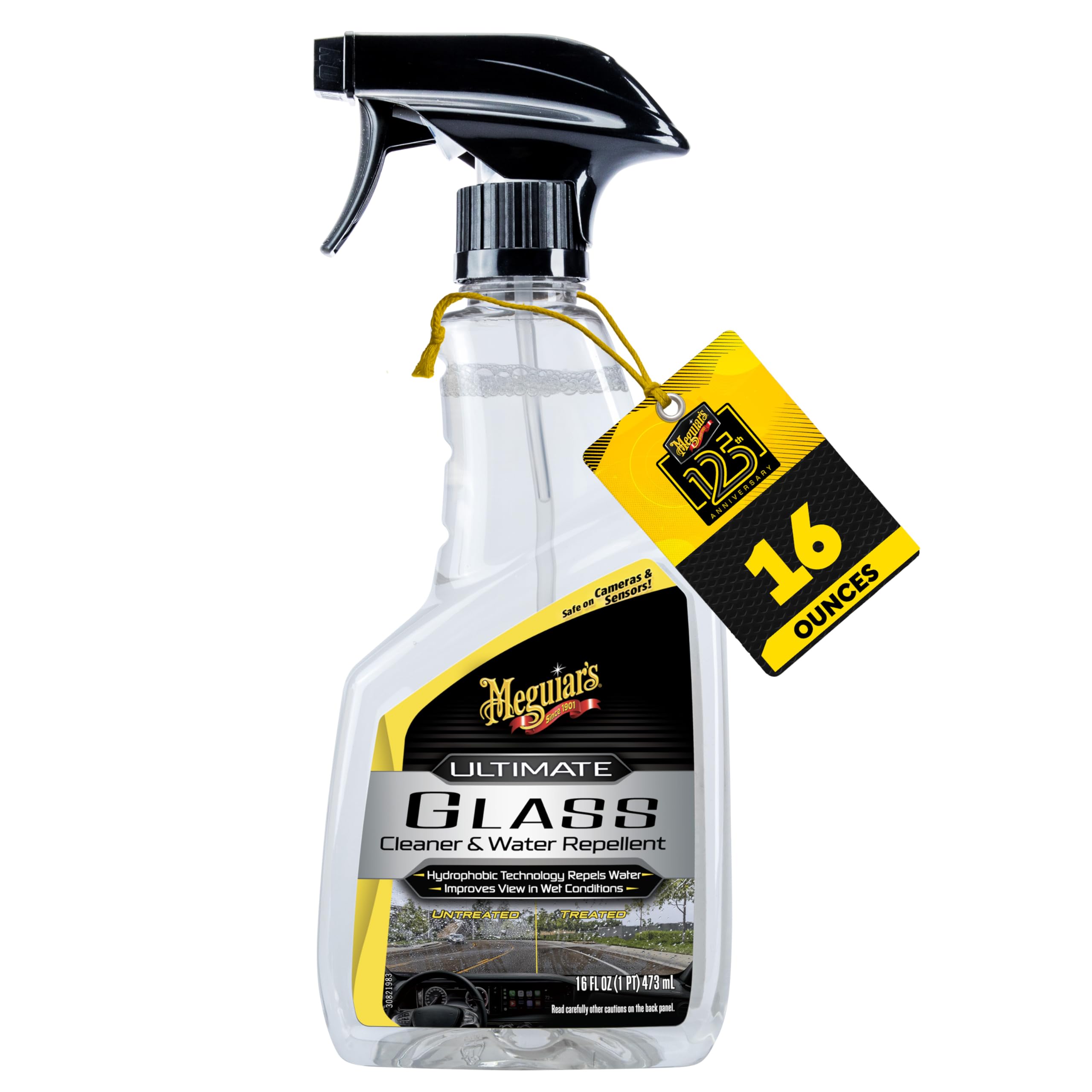
| Meguiar’s Ultimate Glass Cleaner & Water Repellent★ Best Overall | Car glass and house windows with a water-beading finish | Spray bottle | 16 oz | Exterior glass, cameras, sensors | Amazon |
| MICROBAN Outdoor Surface Care Multi-Purpose Foaming CleanerWhole-House Power | Siding, decks and fences with algae or mold stains | Foaming spray, 64 fl oz | 64 fl oz | Non-porous exterior surfaces | Amazon |
| Rejuvenate Dual System Outdoor House Wash & Window Cleaner | Whole-house wash and windows from the ground | Hose-end sprayer, dual bottle | 64 oz | Vinyl siding, painted surfaces, windows | Amazon |
| 30 SECONDS Outdoor Window & Screen Cleaner Refill | Large homes with many screened windows | Concentrated refill jug | 1.1 gallon | Glass, patio doors, fiberglass, furniture | Amazon |
| BullSnot! VizABull Glass Cleaner Foam Spray | Clinging foam for cold, damp or vertical glass jobs | Foam spray can | 19 fl oz | Auto glass, showers, mirrors | Amazon |
Detailed Reviews
1. Meguiar’s Ultimate Glass Cleaner & Water Repellent,16 Oz
Our pick — 4.5+★ from 650+ verified ratings; the strongest balance of quality and price.
The one spray that cleans the glass and then keeps rain sliding off it.
Two jobs in one bottle is the whole reason this sits at the top. The formula cleans exterior glass, then leaves a hydrophobic layer — that means the surface actively pushes water away — so rainwater beads up and rolls down instead of sheeting and drying into spots. For a car windshield or a camera housing that faces the weather, that layer is what keeps your view clear between washes.
It is built for more than vehicles. You can use it on exterior glass, vehicle cameras, and sensor housings, and the manufacturer lists it as safe and effective on those surfaces. The spray-and-wipe routine needs no towel grabbing, and Meguiar’s points you to a microfiber glass towel for the wipe-down. A 16 oz bottle weighing 1.19 pounds is easy to hold one-handed at the top of a ladder.
What wins people over is how hard it works — owners rate the cleaning itself far and away the strongest part of the product, and plenty say it cleans more decisively than the rain repellents they used before. The application is quick and forgiving, and the faint scent doesn’t foul the air. The recurring gripe, though, is streaking. The review pages sum it up: “It definitely makes the rain bead up but it was streaky.” Owners who get the best results buff it out with a dry cloth after the first wipe.
Where it earns its keep
- Leaves a hydrophobic layer so rain beads and rolls off exterior glass
- Cleansing strength is the thing buyers talk about most
- Works on vehicle cameras and sensor housings as well as windows
- 16 oz, 1.19 pounds — easy to carry up a ladder
The honest trade-off
- Streaks show up for some owners, so the buff-out matters
- It is a spray bottle, not a hose-end system, so upper-story house windows still need reach
Reach for it if: you want a clear view off the car, the cameras, and lower house windows in one spray-and-wipe pass.
Think twice if: your main job is a two-story wall of glass — you’d want a hose-end tool for that height.
2. MICROBAN Outdoor Surface Care Multi-Purpose Foaming Cleaner
A foaming spray that goes after siding stains, not just glass.
Here’s the number that decides this pick: 4,500 square feet of coverage from one 64 fluid ounce bottle. That is the surface area of a whole suburban house, and it comes from a wide spray pattern. Rather than washing one window at a time, you spray the side of the building, wait, and rinse.
The foam clings so it can lift dirt away instead of running straight down, and Microban says you get bright, clean results in minutes with no ladder or scrubbing. You can point it at vinyl siding, decks, fences, painted brick, wood, stone, stucco, and gutters. When used as directed, Microban lists it as safe around plants, grass, trees, and shrubs.
Buyers report the time savings are the real story — one cut a pressure-washing job down from hours to a short wait-and-rinse. The catch is surface type. It works on non-porous surfaces like vinyl, and it does much less on wood, brick, and concrete. The spray also reaches only what your hose pressure can hit, so second-floor windows above a low-psi line stay out of range. One note: the mist can irritate your nose, so a mask is a smart add-on for big jobs.
What owners prize most: the effectiveness on pavers and siding — a single bottle handles a lot of real estate, and the bright result shows up fast.
Where it falls short: porous surfaces. If your house is brick or bare concrete, this is the wrong formula.
Best for: houses with vinyl siding, a deck, or a fence that needs an annual scrub-down before the season starts.
Skip if: you’re cleaning masonry, or your only target is a 2nd-floor window out past your hose’s reach.
3. Rejuvenate Dual System Outdoor House Wash
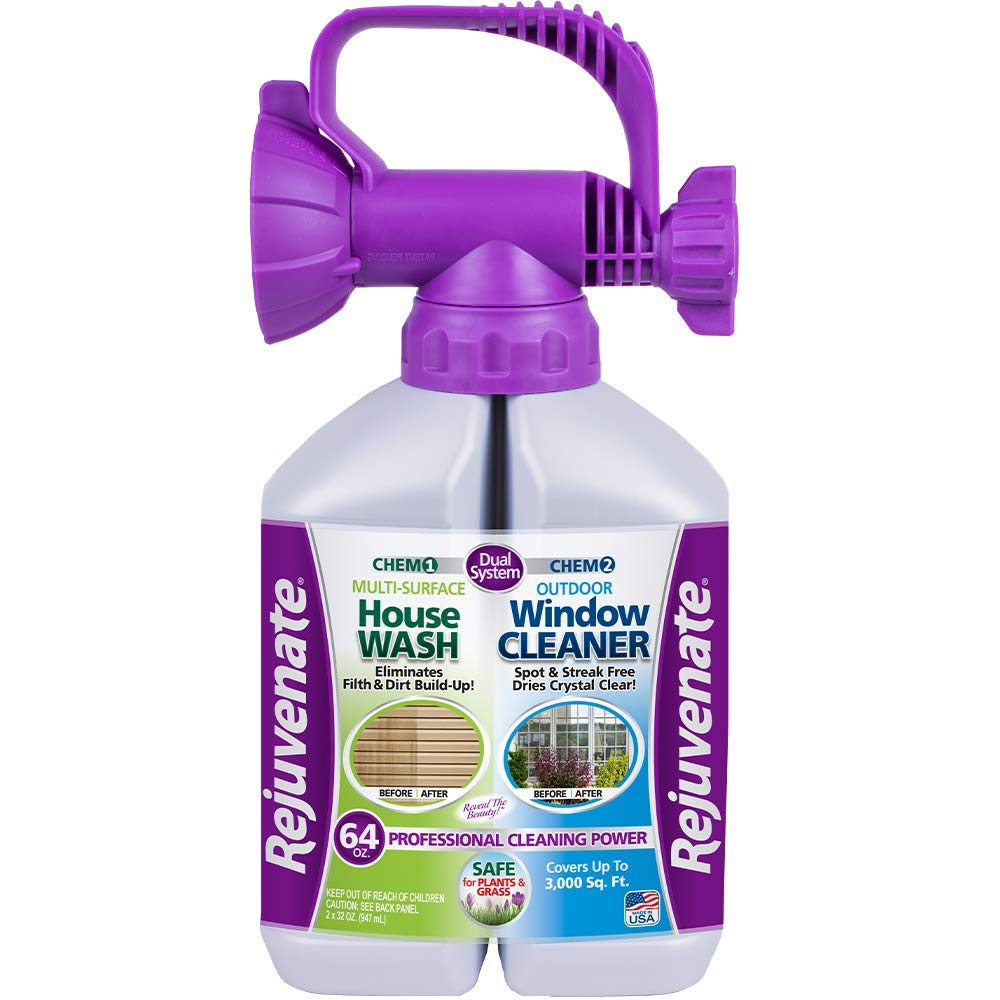
Two concentrates, one hose, zero ladders — the siding-and-glass combo kit.
The attraction here is the design: a hose-end sprayer with two concentrated cleaning solutions in coupled bottles, so a single nozzle switches from Rinse to Chemical 1 to Chemical 2 and back. You get cleaning power for the walls and a gentler mix for the glass, and the whole system is built around staying on the ground. The maker covers 3,000 square feet of cleaning.
On paper it is a tidy solution for how most houses actually get dirty — walls first, then windows. Owners praise the ease of it: “Just cleaned 15 very large windows. I am 83 so this product was easy for me to use.” A 4.5 pound sprayer stays comfortable to carry around the perimeter.
Now the honest part. Windows dry clear when you rinse thoroughly, but the rinse setting comes in weak on some units, so you may end up hosing off with a separate sprinkler head. Vinyl siding is the mixed bag — some owners find it brightens up, others find it barely lifts the grime, and the heavy mold needs a brush either way. The hose attachment is also the weak link; a few units develop leaks at the coupling. Treat the connector gently and set your pressure low.
What it gets right: streak-free windows and no ladder work. A well-rinsed pane dries clear, and the dual concentrates let you wash siding and glass in one session.
What to watch: weak rinse pressure and a delicate hose coupling. Both are manageable, but neither is the point of the system.
Good fit for: a one-story home with vinyl siding and a set of windows above ground level.
Not ideal for: heavy mold on masonry, which needs a brush and a stronger mix than the kit carries.
4. 30 SECONDS Outdoor Window & Screen Concentrated Cleaner

The gallon jug that lets one spray reach the second floor without a screen coming off.
Two features drive this pick. First, the 1.1 gallon concentrated refill is meant to top up a 30 SECONDS hose-end sprayer bottle you already own, so you get a long season of window washing from one jug. Second, the maker lists a reach of 24+ feet — meaning you can stay on the ground and still hit upper-floor glass from the hose. The claim depends on your hose type and water pressure.
The formula is designed to start working in seconds and dry spotless, and the screen-friendly part is the real selling point. You spray and rinse the window without removing the screen, which saves time on a big house with a lot of mesh. It also works on glass patio tables, fiberglass, and furniture, and 30 SECONDS says it is safe around plants and lawn when used as directed.
Results depend on how dirty the glass already is. Windows washed regularly come out clean, but a season of baked-on grime will need a hand pass with a rag after the spray. Water spots can also hang on if your hose water carries calcium in it. On a large home, a single 1.1 gallon jug can go fast, so two levels may take two containers. Check the sprayer bottle you own matches this refill before you buy.
The strong hand this plays
- No screen removal — spray and rinse the window in place
- 24+ feet of reach keeps your feet on the ground
- 1.1 gallon refill stretches for a full season of regular washes
- Safe around plants and lawn when used as directed
What to plan around
- Needs the matching 30 SECONDS hose-end bottle, sold separately
- Heavy grime can leave spots and need a hand wipe
- A large home can go through the jug in a couple of runs
Buy it when: you own the sprayer, have more windows than patience, and want to leave the screens on.
Pass it over: if you’re starting from scratch — get the bottle first, or the jug has nothing to pour into.
5. BullSnot! VizABull Glass Cleaner Foam Spray
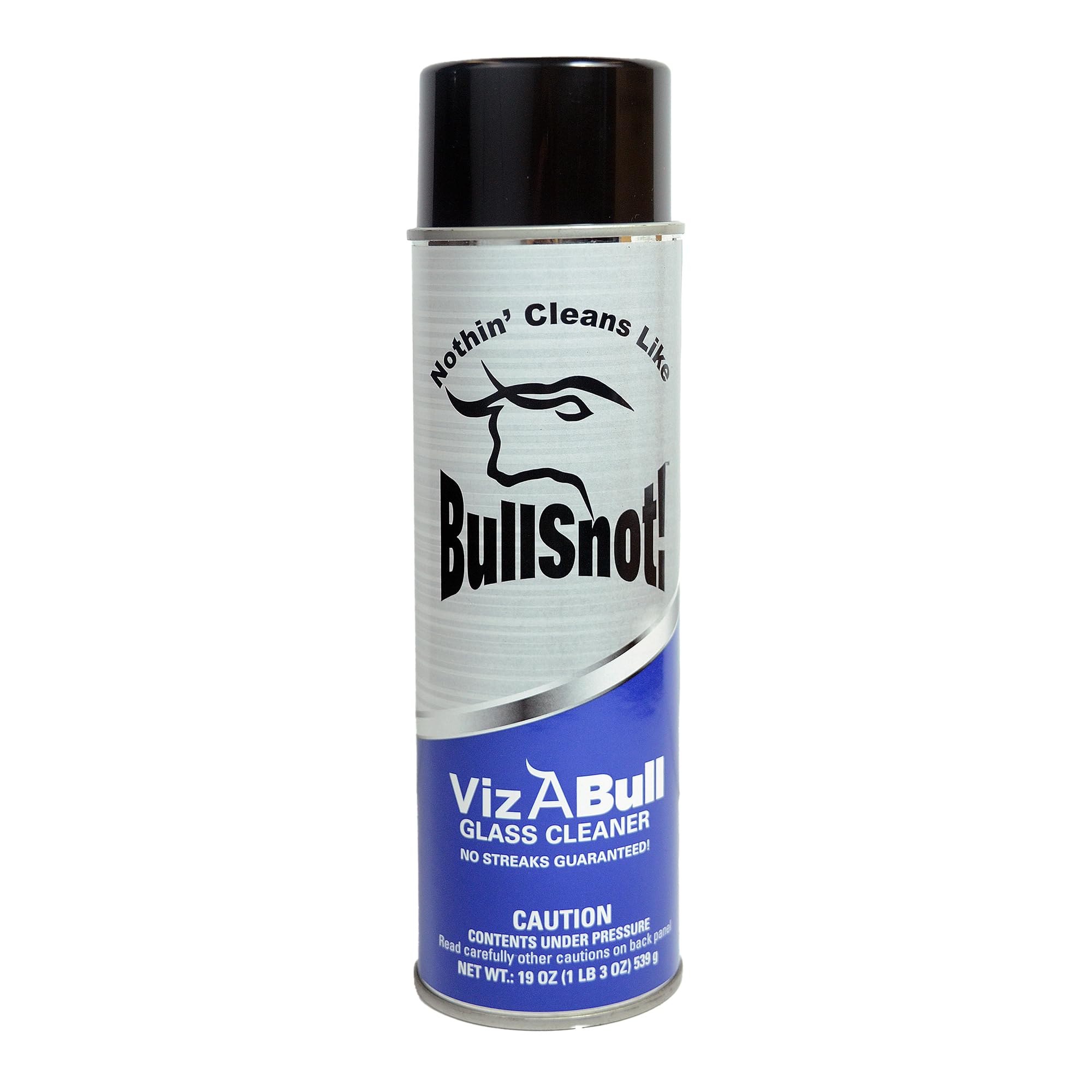
A clinging can of foam that breaks down grime without a bead of drip.
Vertical glass is where most sprays fail — they run down the pane before they can lift anything. This one foams on contact and stays where you put it, splitting the dirt and grease before you wipe. The formula is ammonia-free, so it is a sensible choice for car glass, shower doors, fireplace glass, and mirrors where you want the clean without the sharp smell of a standard window spray. It comes in a 19 fl oz can.
What owners rave about is the cleaning itself: the foam scrubs off bug film and road grime decisively, and the wipe finishes with no smear left behind. The vertical cling is a large part of why it beats a thin spray on a tilted windshield, and the dry finish means fewer passes with the cloth.
The one honest note is the price-to-volume read. It is priced at the premium end for a single can, and a few owners find the per-use cost steeper than a big jug of generic spray. You’re paying for the clinging foam and the ammonia-free formula, not for volume. One more thing: a can runs down faster than a refill jug, so keep a spare in the garage for shower day.
Where the money goes: into the foam that clings and the streak-free finish — the two things buyers single out most, alongside the cleaning power on stubborn grime.
The fair caveat: this is a premium-priced can, not a bulk-economy tool. Buy it for the no-drip foam and streak-free finish, not for cost per ounce.
Worth grabbing for: windshields, shower glass, and mirrors where you want the foam to hold still while it works.
Look elsewhere for: a whole-house exterior wash — this is a detail tool, not a siding sprayer.
Know the Specs
Format — spray, foam, or hose-end
A spray bottle gives you control on a car glass or a mirror. A foam spray clings to a vertical pane so it can lift grime before running. A hose-end bottle mixes concentrate with your garden water and reaches upper-floor glass without a ladder. Choose the format first, because it sets the heights and surfaces you can actually reach.
Reach — how high your hose can go
Hose-end sprayers advertise a reach figure, and that number depends on your hose type and water pressure. A cleaner can promise a 24-foot reach while your actual low-pressure garden hose delivers far less. If second-floor windows are your goal, check your hose first.
Surface compatibility — porous vs non-porous
A cleaner built for non-porous surfaces like vinyl and glass can brighten a ceiling of siding. On bare brick, wood, or concrete it can do little. Look at the maker’s surface list — siding, decks, fences, stucco, glass — and match it to what your house is made of before you buy.
Streak resistance and rinse technique
Even a formula that claims a streak-free finish depends on your rinse. Rinsing thoroughly with clean water and avoiding direct sun while you work keeps spots off the glass. A weak rinse setting is a real drawback on some hose-end kits, so budget to finish with a sprinkler head if needed.
Common Questions
Can a hose-end cleaner really reach my second-floor windows?
Do I have to take my window screens off to clean them?
Will an outdoor window cleaner also clean my vinyl siding?
Is there a difference between a glass cleaner and a water repellent?
How do I stop my windows from streaking?
Are outdoor window cleaners safe to use near plants and grass?
Does a foaming cleaner work better than a spray on vertical glass?
Can I use these cleaners on my car windshield?
What is the gallon refill for — and do I need a special bottle?
Are these cleaners safe on fiberglass and patio furniture?
The Bottom Line
If you only buy one, the Meguiar’s Ultimate Glass Cleaner & Water Repellent handles the most common job — car glass, house windows, and camera housings — and leaves a water-beading finish that keeps rain from spotting the pane. Owners consistently rate its cleaning strength as the standout feature. If your goal is a whole-house siding wash, the MICROBAN Outdoor Surface Care covers a lot of square footage from one bottle on non-porous siding. For windows you can wash without removing the screens, the 30 SECONDS refill is the tool built for that, provided you own the bottle. And for a clinging, ammonia-free foam on a vertical pane, the BullSnot VizABull is the detailer to keep on the shelf.
How we choose
We do not accept paid placement. Every pick is matched to a real buyer and a real use-case; we do not hands-on test units.
Sources
Specifications: manufacturer listings and product documentation. Review insights: verified customer reviews, as of October 2026. Pricing: not shown on this page (it changes often); check the current price via the retailer link.
As an Amazon Associate, Aappliancez earns from qualifying purchases. This does not affect which products we feature.