Disclosure: Some links in this post are affiliate links. As an Amazon Associate I earn from qualifying purchases, at no extra cost to you. Learn more
Specs are compiled from manufacturer listings and verified buyer reviews and can change over time — please confirm the key details on the product page before buying.
The fastest way to waste money on outdoor cat food is to leave it sitting in an open bowl. Rain turns kibble to mush, birds and raccoons clean you out, and your cat ends up eating a soggy mess or nothing at all. Any feeder worth owning has to do two jobs at once: keep the food dry and keep the four-legged thieves out.
This guide is built by comparing the manufacturers’ published specifications and the patterns across verified customer reviews, so you get each pick’s real strengths and trade-offs instead of marketing spin.
Some of these are simple shelters that cover a bowl, others are gravity bins or app-controlled dispensers, and sorting them means matching the design to your cat and your local wildlife. My pick for most people living with rain and roaming raccoons is the outdoor cat feeder shelter from K&H, which covers a bowl in a slanted-roof frame and stays put.
Top Picks


How To Choose The Best Outdoor Cat Feeder
An outdoor feeder has to survive rain, wind, and wildlife, not just portion out meals. You are not choosing a feeding schedule — you are choosing a structure that has to survive rain, wind, and animals that are smarter and stronger than your cat.
Start with the honest question: is your cat fed on a porch you can see, or out on a driveway for a feral colony you visit once a day? That single answer rules out half the options below.
Weather cover before anything else
A slanted roof and a raised floor edge are what keep kibble crunchy through a wet night. A shelter with a solid roof and walls of vinyl-backed nylon or oxford fabric shrugs off rain, while an open gravity bin relies on its own lid and body to do the same job.
Whatever you pick, check that water can drain away rather than pooling around the food. Standing water means soggy kibble and a bowl you have to scrub.
Height, weight, and the animals that don’t need an invitation
Raccoons climb and pry; birds simply land. A lid with a secure latch, a magnetised door, or a platform raised well off the ground are the three real ways sellers keep pests away, and each works differently.
Weight is part of this too. A station that tips in a gust spills dinner, so a heavier metal frame or ground anchors matter if you live somewhere windy. A sturdier build is heavier to move — the GDLF station is 45 pounds of metal, which resists wind but takes two hands to reposition. Think about how much lifting you want to do before you commit to a heavy frame.
Capacity for how often you actually visit
A covered shelter holds whatever bowl you put inside it, so capacity is your choice. A gravity dispenser stores a fixed load in its hopper, and that number decides how many days you can disappear. A gravity bin with 42 cups of dry food is for a colony or a holiday; a small 12-pound hopper is for one dog or a couple of cats you see daily.
Match that to a schedule you can keep, not one you wish you could.
Side-by-Side Comparison
| Model | Best For | Capacity | Food Protection | Weight | Amazon |
|---|---|---|---|---|---|
| K&H Outdoor Cat Dining Room★ Best Overall | Covered bowl for a porch | Bowl-based (no hopper) | Slanted roof, vinyl-backed nylon | 2.8 lb | Amazon |
| Dreyoo Outdoor Cat Feeding StationBest Compact Shelter | Small patios and balconies | One small bowl | Slanted roof, oxford material | 2.5 lb | Amazon |
| KHEARPSL Automatic Cat Feeder | Multi-cat colonies | 42 cups / 10L | Galvanized steel body, no-power gravity feed | 6.2 lb | Amazon |
| Pet Lodge Chow Hound Feeder | Pest-proof daily feeding | 12 lb of dry food | Magnetised door and angled chute | — | Amazon |
| oneisall Cordless Automatic Cat Feeder | Off-grid, cordless placement | 5L / 20 cups | Sealed hopper + desiccant, dual stainless bowls | — | Amazon |
| PETKIT Multi-Cat Camera Feeder | Watching a cat remotely | 3 liters | Triple fresh-lock hopper, 1080P camera | 2.51 kg | Amazon |
| GDLF improve Feral Cat Feeder | Wildlife-heavy yards | Bowl-based on raised platform | Raised platform, all-metal body | 45 lb | Amazon |
Detailed Reviews
1. K&H Outdoor Cat Dining Room
Our pick — 4.5+★ from 650+ verified ratings; the strongest balance of quality and price.
The lightest thing here at 2.8 pounds, and the one that keeps a heated bowl dry.
If your cat eats on a porch and you want the food covered without any wiring or batteries, this is the pick. It is a small fabric-and-frame shelter that sits over whatever bowl you already own, and its slanted roof sheds rain and snow away from the dish inside.
The build is polyester with vinyl backing, which is what makes it weather-resistant without being heavy. Assembly is hook-and-loop panels and roof, no tools, so you can have it up in the time it takes to fill a bowl. At 2.8 pounds it stays light enough to lift with one hand, and the internal frame means it does not simply blow over in a gust.
What wins people over is that the simple cover keeps the food dry and the birds off. Someone feeding feral cats on a driveway reported that covering the food with this eliminated a flock of roughly 50 birds raiding the dish, and kept both the food dry and the water clean. Other owners pair it with a heated bowl and find the kibble stays warm and dry through wind, mist, and snow — one added silver insulation sheets to hold more heat. The catch is size: the shelter is 14 by 20 inches and 16.5 inches tall, which covers dishes comfortably but is shallower than some buyers picture. As one put it, it would be nice if it were large enough for the cat to be protected while they ate. Cats also cannot see through the side walls, so expect a few nervous looks before they settle.
What earns it first place
- Sheds rain and snow off the dish with a slanted roof
- Goes up in minutes with no tools at all
- Light enough to move, framed enough to resist wind
- Leaves you free to use any bowl, including a heated one
Before you order
- Shallow inside — it shelters the food more than the cat
- Solid side walls mean no view out for a nervous cat
- Heated bowl shown in listings is sold separately
Reach for this if: you feed on a porch or carport and want a dry bowl without power.
Look elsewhere if: you need the cat itself fully sheltered from weather while it eats.
2. Dreyoo Outdoor Cat Feeding Station
Balcony-sized cover with two ground stakes and a hole for a heat cord.
This is the smallest shelter on the list, and that is the point. At 17 inches long, 17 wide, and 15.5 tall it slides into a backyard corner, a narrow patio, or an apartment balcony where a bigger station would not fit. The material is oxford fabric over a density board, which gives it a bit more body than a plain fabric tent.
What buyers praise most is that it simply functions: keep the kibble dry, set it down, done. Rain resistance is the second thing owners value, which is why a slanted roof on a station this small counts for a lot. Assembly is collapsible, touch-fastener, no tools, and you can break it down again in seconds if you move it to shelter for a storm. Two ground anchors hold it down when the wind picks up, and there is a rear hole sized for a heated bowl or pad cord.
Here is the honest part. Capacity tops out around one small bowl, and the weight and value notes come up as mixed in owner feedback. A minority feel it looks sturdier online than it feels in the hand — “very flimsy, seems very cheaply made,” as one buyer described it — so treat it as a fair-weather cover rather than a fortress. Buyers with cats who like space should look at a wider shelter.
The one-bowl trade-off: two cats will not eat side by side here; plan for one dish and top it up.
The wind answer: the included stakes are doing real work — anchor it before the first storm and not after.
It suits: a patio, balcony, or small yard where one dry dish for a stray is enough.
Leave it if: you need more than a single small bowl inside the shelter.
3. KHEARPSL Automatic Cat Feeder

Forty-two cups of dry food, two feeding ports, and not a single battery in sight.
If you feed a colony, leave for a holiday, or only see your cat once a day, how much food the feeder holds decides everything. This gravity feeder holds 42 cups or 10 liters of dry food, so you can fill it and walk away for days. The body is galvanized steel (steel dipped in a zinc coating so it resists rust) with a weather-resistant coating, so rain does not ruin the kibble. It drops food into two separate ports, so two cats eat without fighting over one dish. It needs no electricity — the food falls as it is eaten, so a power cut changes nothing.
The galvanized steel body is what holds up to weather and chewing. Sturdiness is the thing it does best, and it shows when the wildlife arrives: a buyer who wedged it between bricks found that raccoons could not open the lid or shift the unit. Another, feeding a cat colony, noted the secure latch held when a skunk pulled the whole feeder over. As a gang of raccoons learned, though, the food still goes fast when they are clever about it.
Two things to know before you fill it. Ease of use is genuinely mixed — the food does not always drop cleanly, and a few owners find it needs a shake or a nudge to feed. And this thing is a bin, not a fortress: the birds and raccoons can still get at an open port if the food piles up. The 6.2 pounds of steel is 3.7 pounds heavier than the Dreyoo shelter above, which is why it stays put on windy nights.
The number that carries it: 42 cups means a colony can eat for days between refills, and you can leave on a trip without hiring help.
The real caveat: gravity feed has no lid lock at the port, so clever nighttime visitors can still finish a hopper faster than you plan.
The right call for: multi-cat feedings and long stretches between refills, with no power outlet needed.
Think twice if: raccoons are regulars and you need the food physically locked away.
4. Pet Lodge Chow Hound Feeder

A magnetised steel door that lets your dog in and keeps the mice out.
This is the odd one out on a cat list, but it earns its place because it solves the pest problem structurally rather than with a roof. Twelve pounds of dry food sits in a galvanized steel hopper, and the food only comes out when an animal noses the magnetised door open and the angled chute lets it slide into the trough. It arrives fully assembled and can be mounted to a wall or frame.
The magnetised door is the whole design: it opens only when an animal pushes through. It shuts birds and mice out completely — one owner describes it as the only thing that finally kept field mice out of the dog food after other containers failed — and it resists tipping. The steel body is thick enough that owners describe it as chew-proof, and it holds up in outdoor sun and rain.
The real hurdle is training your cat to use it. Some cats will not push a door open on their own. Owners describe the fix as patience: hold the flap slightly open so your cat gets used to the touch on its nose, then back off over a few days. A rare unit arrives with a loose magnet or a door that sticks open at first. That usually means bending or reseating the door, not replacing the feeder. It is designed for medium breeds, and the 12-pound model stores a decent stretch of food; the listing also comes in 25 and 50 pound sizes.
Where the steel pays off
- Magnetised door keeps mice and birds out of the food
- Galvanized steel body resists chewing and rust
- No assembly — mount it and fill it
- Holds 12 pounds of dry food per fill
Where it asks something of you
- Needs a few days of training before some pets use it
- Occasional magnet or door adjustments on arrival
- Fitted for medium-size pets rather than a tiny cat
Pick it when: mice, magpies, or possums are cleaning out the bowl and you want a physical barrier.
Only if: you are willing to spend a few evenings teaching the animal to push the flap.
5. oneisall Cordless Automatic Cat Feeder
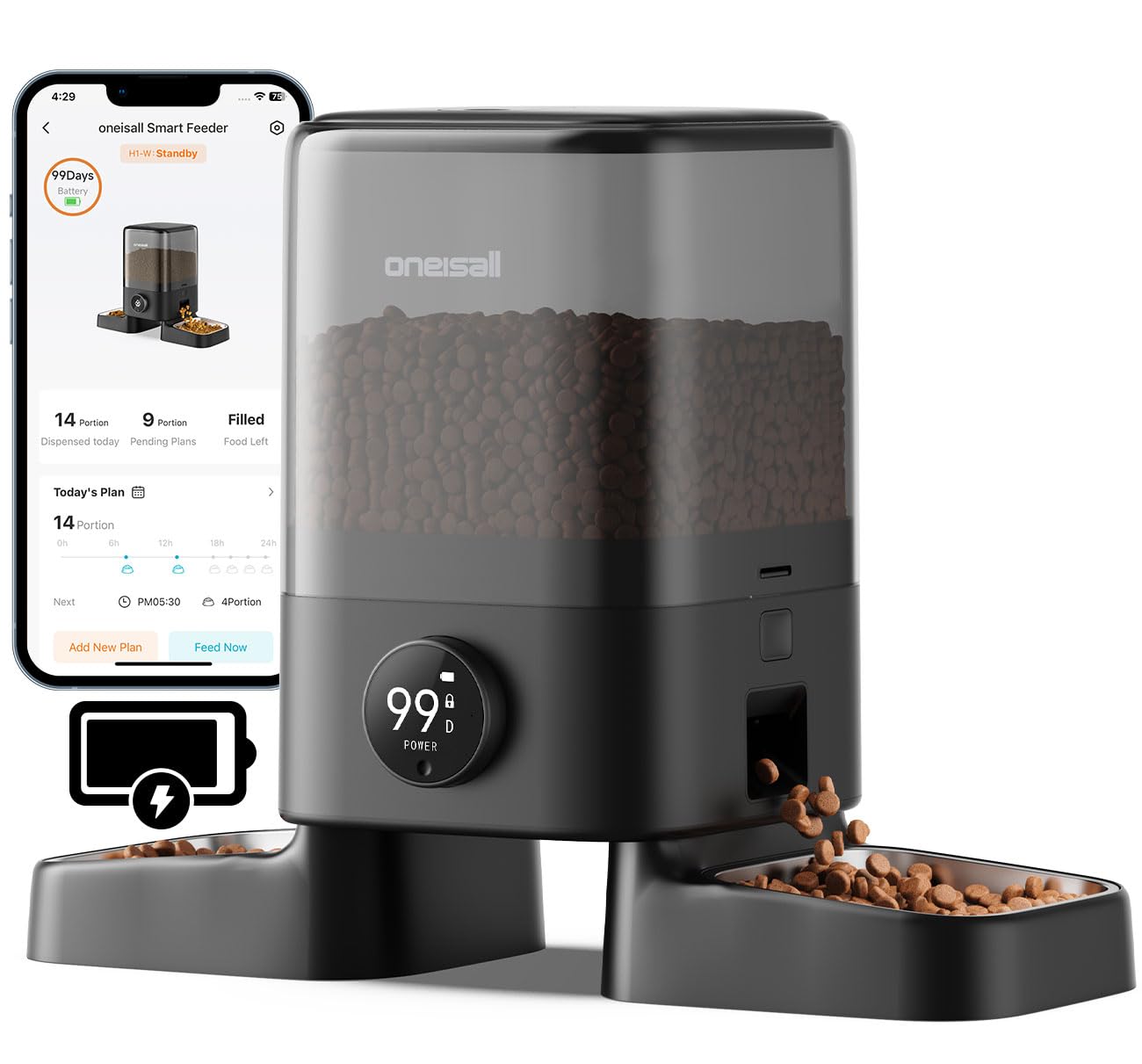
No cord for a cat to chew and 100 days of battery per charge.
If your cat eats somewhere a plug cannot reach — a shed, a carport, the far end of a porch — cordless is the feature that decides the purchase. A 5000mAh rechargeable lithium battery gives this feeder its place, and the maker rates it at 100 days of use per charge. The display shows the remaining battery in days, so you can see the recharge coming instead of discovering it after the food stops.
It holds 5 liters or 20 cups of dry food and dispenses into two opposing stainless bowls set 16 inches apart, so two cats get equal room and no queue at one dish. The app runs on 2.4GHz Wi-Fi and lets you schedule up to 10 meals a day at 1 to 12 portions each, with real-time meal data logged so you can see who ate what. A multi-layer seal and desiccant keep the kibble crisp, and the stainless bowl is dishwasher-safe.
Two honest notes before you buy. Buyers report that portion sizes run inconsistent, so a scoop that should be one size can come out slightly long or short — weigh the food for a few days if your cat is on a strict diet. The kibble also lands loudly on the stainless dishes, which scared a couple of cats for the first few feedings before they adapted. A handful of owners mention app-save glitches during setup. On the upside, the build survives wildlife: one unit was dragged down steps by a raccoon and came back with scratches and a still-locked lid.
The standout spec: a 5000mAh battery with a days-left readout, for placements nowhere near an outlet.
The daily-use catch: portions can drift, so a strict diet needs a scale rather than trust in the numbers on the screen.
Best matched to: two cats and a feeding spot with no outlet nearby, where you want scheduled meals anyway.
Not the one if: you want dead-simple operation with no app and no charging cycle to remember.
6. PETKIT Multi-Cat Camera Feeder

A feeder that tells you which cat ate — and shows you the proof.
When more than one cat shares a bowl, the real question is not whether food came out but who got it. This feeder answers that with a 1080P HD camera and 140-degree wide-angle lens, plus AI-powered facial recognition for cats and dogs across up to 15 pets. Upload their photos, and the app shows who has eaten and who has not.
The 1080P camera with IR night vision is the reason to buy this over a plain timer feeder. IR night vision captures movement in the dark, the app classifies motion into feeding, eating, and pet visiting, and you get before-and-after shots of the bowl so you can see how much was left. Two-way audio lets you call the cat over, and you can record a voice message of up to 20 seconds to play at mealtime — up to 5 saved messages.
What catches buyers out is the connection. Wi-Fi setup is the single most frustrating step in owner feedback, with some needing several tries before it held, so set it up at home before it goes outside. There is a 3-liter hopper, and the fresh-lock seal plus desiccant needs replacing roughly monthly. A paid cloud plan is optional for video history, and the app works without the pro subscription. What makes people glad they bought it is the reassurance — one owner used it for a month while studying abroad with no trouble, and another credits it with ending early-morning cat screaming by holding a strict schedule.
Why the camera changes the job
- 1080P camera with 140° view and IR night vision
- Facial recognition tracks up to 15 pets
- Before-and-after bowl photos plus meal logs
- Runs the feeding schedule even offline on battery
What you should plan for
- Wi-Fi pairing can take several attempts on setup day
- Desiccant needs a monthly swap to keep food fresh
- Video history beyond the basic view is a paid add-on
Go for it if: you have several cats and you want to check in on them from your phone, not just trust a schedule.
Pass it over if: a single cat and a simple timer are all you actually need.
7. GDLF improve Feral Cat Feeder

Forty-five pounds of metal that raccoons have to climb to reach.
This is the heaviest option on the list, and that weight is the strategy. A 45-pound all-metal frame on a raised platform puts the food above wet ground and above the easy reach of animals that cannot or will not climb. Raccoon resistance is one of the two things owners praise most about it, and this is where the design earns that reputation.
Owners who feed feral cats describe the same scene. A group of up to six raccoons made attempts for a month and then gave up. It survived hail and stayed dry through heavy rain with no water getting to the food. Cats jump up easily onto the raised ledge, and the station withstands wind without tipping once it is anchored with the included ground and cement anchors.
This one suits some yards and not others, so check before you buy. Bold raccoons that climb can still get in — more than one buyer watched raccoons scale the post and clean out the food — so height only stops animals that will not climb. Assembly uses a lot of threaded fasteners (screws and bolts you turn by hand or with a tool), and the sloped roof can go on the wrong way if you follow the instructions literally. The metal floor is slick for claws, which most people solve with a scrap of carpet. The height itself draws mixed reactions: some find it too tall for their cats to reach, others feel it is not tall enough for the raccoons.
What it does beautifully: a 45-pound metal station with anchors that survived hail and a month of raccoon attempts.
The honest limit: climbing raccoons defeat it, so if your local wildlife climbs fences and posts, height alone will not stop them.
Worth it for: a feral colony in a yard with raccoons that cannot climb, plus a spot that will not be moved often.
Look past it if: your raccoons scale posts or your cats are not confident jumpers.
Know the Specs
Capacity (cups, liters, or pounds)
Capacity tells you how long the food lasts between refills, and it comes in different units depending on the feeder type. Gravity bins measure in cups or liters, while steel hoppers measure in pounds of dry food. A shelter has no hopper, so its capacity is simply whatever bowl you place inside — one small bowl is a daily top-up, while a 42-cup bin is a week or more.
Weatherproofing and cover
Weatherproofing means water cannot reach the kibble. A slanted roof and a raised edge shed rain away from the dish, and a fabric shelter like vinyl-backed nylon or oxford cloth adds another layer. For a sealed hopper, weatherproofing means a tight lid, a fresh-lock seal, and clean desiccant inside. Water pooling around the food means soggy kibble you will be scrubbing out.
Pest deterrence: door, latch, or height
There is no single way to keep pests away, so match the method to your problem. A magnetised door keeps small climbers and birds out by making the animal push its way in. A secure lid latch stops raccoons opening a hopper from the top. A raised platform works on animals that will not climb — and fails on the ones that will. Pick the one aimed at the wildlife you actually see.
Power: gravity, battery, or app
A gravity feeder needs no power at all — the food falls as the bowl empties, so a storm or power cut changes nothing. A battery feeder lets you place it away from an outlet, and the maker’s claim of 100 days per charge on a 5000mAh battery is the figure to weigh. An app feeder adds scheduling and camera access, but it also depends on Wi-Fi holding up, so set it up at home first.
Common Questions
Will an outdoor cat feeder keep raccoons out completely?
Does a covered shelter keep kibble dry in rain and snow?
Can a gravity feeder work for two cats at once?
Do I need to train my cat to use a feeder with a door?
How long does a rechargeable feeder battery last per charge?
Is a camera feeder worth it for a cat that goes outside?
Does a heavy steel feeder tip over in strong wind?
Can an outdoor feeder work in a power cut?
How big a bowl does the covered shelter hold?
Will a covered shelter keep kibble dry through rain and snow?
The Bottom Line
For most people feeding a cat outdoors, the outdoor cat feeder that gets the basics right is the K&H Outdoor Cat Dining Room. It covers your bowl with a slanted roof, so rain runs off instead of into the food. It goes up without tools, and it stays light enough to move. If you need the food to last days, the KHEARPSL gravity feeder holds 42 cups in a steel bin. And if raccoons are the problem and they cannot climb, the GDLF improve station puts a 45-pound frame between them and the kibble.
How we choose
We do not accept paid placement. Every pick is matched to a real buyer and a real use-case; we do not hands-on test units.
Sources
Specifications: manufacturer listings and product documentation. Review insights: verified customer reviews, as of October 2026. Pricing: not shown on this page (it changes often); check the current price via the retailer link.
As an Amazon Associate, Aappliancez earns from qualifying purchases. This does not affect which products we feature.