Disclosure: Some links in this post are affiliate links. As an Amazon Associate I earn from qualifying purchases, at no extra cost to you. Learn more
Specs are compiled from manufacturer listings and verified buyer reviews and can change over time — please confirm the key details on the product page before buying.
Hotel rooms and airport gates give you one working outlet, and you show up with a phone, a tablet, a laptop, and earbuds that all want power at once. That is the real problem this shopping list solves. The short answer: an Anker 65W three-port block handles most travelers beautifully, and a 12-in-1 station earns its place if your whole family needs to plug in. Below you get seven picks sorted by how you actually travel, plus the wattage and port math that decides which ones are worth carrying.
This guide is built by comparing the manufacturers’ published specifications and the patterns across verified customer reviews, so you get each pick’s real strengths and trade-offs instead of marketing spin.
Every pick here has been checked against real published specs and repeated traveler feedback, so you can spot the wattage claims that hold up from the ones that quietly shrink.
Top Picks


How To Choose The Best Multi-Port USB Charger for Travel
Before you compare any of the seven picks below, lock in three things: what you carry, where you are going, and how much power your biggest device actually pulls. Get those straight and the right charger almost picks itself.
Total wattage versus per-port wattage
A charger’s headline number is the total it can share, not what each port gives you at the same time. The USB C Charger Block 10 Ports, 450W lists 450W across ten ports, while the Anker 65W Max 3-Port tops out at 65W — a 6.9x gap in total capacity. That single ratio tells you who they are for: the 450W brick is a desk and family-hub charger, and the 65W block is a pocket-size one-device-at-full-speed machine. Match the total to your heaviest device plus a little headroom, and ignore anyone selling you a number you will never use.
Port count and port types
Five Type-C plus five USB-A is a different animal from three mixed ports. Count your cables before you buy. The 10-port brick lists 10 ports versus 3 on the Anker 65W block — a 3.3x gap that only matters if you really are feeding a crowd. If you travel with a laptop, a phone, and a watch, three ports is plenty and the extra bulk of ten is dead weight in your carry-on.
Plug type, voltage, and cruise rules
Travel chargers earn their keep by working on foreign wall current, not by sitting on a desk. A universal adapter that switches between plug types and runs from 100-250V (volts, the measure of electrical pressure in the wall) keeps you covered in Europe, the UK, and Australia without carrying three separate bricks. Two warnings trip up most buyers. First, adapters with no surge protection (a built-in guard against power spikes) are the ones you are allowed to use on a cruise ship. Second, a plug adapter does not change the voltage coming out of the wall — it only changes the shape of the plug. Check your device’s own voltage range before you rely on it.
Size, weight, and cable management
A charger that does not fit the outlet behind the hotel nightstand is useless, no matter what it promises. Flat plugs and 45° angled plugs slip into tight spaces and stop you from blocking the second socket. Look for a foldable plug or a built-in cord-wrap if you want the charger to disappear into a backpack pocket instead of tangling with your clothes.
Side-by-Side Comparison
| Model | Best For | Total Power | Ports | Plug / Cable Style | Amazon |
|---|---|---|---|---|---|
| Anker 65W Max 3-Port USB C Charger Block★ Best Overall | One-bag travelers with a laptop | 65W max | 3 | Foldable plug | Amazon |
| ORICO 65W GaN Travel Power StripBest Value | Hotel rooms with one outlet | 65W USB-C / 45W+12W USB total | 7 (3 AC, 2 USB-A, 2 USB-C) | 45° flat plug, 4.43ft cord | Amazon |
| USB C Charger Block 10 Ports, 450W | Whole family on one wall outlet | 450W total | 10 (5 Type-C, 5 USB-A) | 5ft detachable flat plug | Amazon |
| 12-in-1 Charging Station USB C Power Strip | Splitting devices between rooms | 200W total | 12 (4 AC, 4 USB-C, 4 USB-A) | 0.7in flat plug, 5ft cord | Amazon |
| Baseus 70W Universal Travel Adapter | Multi-country and cruise trips | 70W max | 6 (2 AC, built-in cable, USB ports) | 4 plug types C/A/G/I | Amazon |
| Anker 100W Max USB C Charger with Smart Display | Having the fastest possible single-device charge | 100W max | 3 (2 USB-C, 1 USB-A) | Foldable plug, cable included | Amazon |
| USB Charging Station, 100W 20-Port | Loading up twenty devices at once | 100W / 20A total | 20 | Wide 100-240V input | Amazon |
Detailed Reviews
1. Anker 65W Max 3-Port USB C Charger
Our pick — 4.5+★ from 22,500+ verified ratings; the strongest balance of quality and price.
The crowd favorite for one-bag trips — a 65W block smaller than a pack of cards.
If you are packing a single carry-on and one charger has to cover a phone, a tablet, and a USB-C laptop, this is the one to buy. It delivers 65W to one device at a time — enough to run a 2020 MacBook Pro 13″ at full speed — and splits that power when you add more. Three ports cover the realistic travel load: one laptop, one phone, one set of earbuds. The foldable plug means it tucks into a jacket pocket without snagging anything.
What makes this pick the winner is how much power it puts into a frame the size of an AirPods Pro case. Anker’s GaN II material — gallium nitride, a chip material that runs cooler and crams more power into less space — is what makes that shrinking possible. Slide it into a tight hotel outlet and it will not fall out or block the second socket, which is the small frustration that ruins cheaper bricks. The 240-volt input range also means it works on wall current in most of the world, not just in the US.
At 65W (watts, the measure of charging power), this is the strongest genuinely pocketable charger on this list, so a laptop and a phone both top up from one small block. It trails the Anker 100W Max with Smart Display for outright single-device speed, though. The 240-volt input also sits well above the 110-volt rating on the 10-port 450W brick, so if the wall voltage overseas is the deciding factor, this handles it. Buyers report the same three things again and again: fast charges, a compact build, and a cord that finally stays in the bag — as the review pages put it, “it can fit In my pocket and it works perfectly fine.”
Where This Pick Wins
- Its 65W output fast-charges a USB-C laptop, a phone, and earbuds from one brick the size of an AirPods Pro case.
- The foldable plug and GaN II build mean it stows flat in a backpack and behaves itself in tight outlets.
- 240-volt input keeps it working on wall current in most countries, not just at home.
What To Keep In Mind
- Three ports only — a family of four will want more slots than this.
- Power splits between ports when all three are busy, so your laptop charges slower with everything plugged in.
Reach for this if: you travel with a USB-C laptop and want one charger that disappears into a pocket.
Look elsewhere if: you need to feed more than three devices at once — a wider station will serve you better.
2. ORICO 65W GaN Travel Power Strip
Turns one hotel outlet into a seven-device charging hub with a cord built to stay tidy.
Here is the hotel-room scenario every traveler knows: one socket, and it is hidden behind the nightstand. This strip solves that with 3 AC outlets and 4 USB ports — 2 USB-A at 18W and 2 USB-C at 65W — running from a 45° angled flat plug just 0.39 inches thick. That angle is the underrated detail here, because it lets you plug in without blocking the second wall socket. The 4.43ft undetachable cord reaches where you need it, and the winding-and-tying design with a dedicated strap keeps the whole thing bundled in your suitcase.
Its 65W USB-C port runs a laptop, while the USB-A ports share 45W+12W so phones and watches top up alongside. Angled tabs stay put in the wall, and the compact 4.84″ x 2.28″ body slips into a pocket or the front of a cabin bag. Owners mention the same instinct — that it collapses the tangle of cords a trip normally creates, and that the flat angled plug frees up the second outlet in cramped hotel rooms.
The trade-off list is honest: a few buyers find the port layout tight and wish the side plugs were three-prong and spaced further apart. The strip uses no surge protection, which is actually what lets it stay usable on a cruise ship where surge-protected strips are often turned away at the gangway. Weigh the port spacing before you commit if you travel with bulky plugs.
Portable where it counts: at 10.19 ounces it fits a pocket or backpack side pocket, and the cord wrapping means it packs flat instead of sprawling.
Mind the port spacing: the side outlets are two-prong only, so chunky three-prong adapters will not fit the way you might expect.
Buy this one if: you want to charge a laptop and several small devices from one cramped hotel outlet.
Wave it off if: you travel with oversized three-prong plugs that need room to breathe.
3. USB C Charger Block 10 Ports

Ten ports and a 450W ceiling — the desk charger that empties a whole family’s gear at once.
When the destination is a rented house, a dorm, or an office corner, this is the brick you want on the wall. Its 450W total across five Type-C and five USB-A ports dwarfs the 65W ceiling of the Anker 65W Max, replacing ten single-device wall blocks with one unit. A 5ft detachable flat plug cord on the mains side and a slim body mean it lives flat against a wall or desk edge without hogging a socket.
A built-in smart chip (a small circuit that reads each device) senses what you plug in and hands it the current it needs, with safeguards against overcharging, overheating, short circuits, overcurrent, and overvoltage. That is what buyers keep coming back to — it happily charges a fan, a laptop, a tablet, and a stack of phones without any of them cooking, and it does it while sitting flat against the wall without putting weight on the socket. The 110-volt input suits US wall current, and the 5ft cord gives you reach most bricks do not.
One caution worth the fine print: the label advertises 140W-capable ports, but not every port runs at that ceiling at the same time, and a few buyers have found the real-world total falls short of the headline number when everything is lit up. For most household and desk charging that gap never shows up in daily use, but if you are buying this specifically to hit the 450W figure on paper, temper your expectations.
Built for crowds: ten total ports (5 Type-C plus 5 USB-A) and a slim flat plug make it a natural fit for a shared desk or a bedside table with a small army of devices.
The fine-print caveat: the advertised per-port ceilings do not all stack to the advertised total at once, so plan for realistic simultaneous draw rather than the marketing number.
Choose it for: a shared desk, dorm room, or rental where a whole household plugs into one outlet.
Pass on it if: you travel light and want a charger that fits a pocket — this one lives on a wall.
4. 12-in-1 Charging Station USB C Power Strip

Four AC outlets plus eight USB ports in a slab the size of a paperback — dinner-table tidy.
Most travelers do not just need USB — they need somewhere to plug a lamp, a hotel kettle, or a travel projector too. This 12-in-1 handles both jobs at once: 4 AC outlets (standard wall sockets for mains-powered gear) and 8 USB ports (4 USB-C, 4 USB-A) sharing 200W, in a body measuring 5.04 x 3.02 x 1.18 inches. If you are moving between home office, dorm, and lets, that flexibility beats a pure charging brick, and the 0.7-inch flat plug plus 5ft cord lets it serve from the wall behind a nightstand or the edge of a desk.
The 65W USB-C port is the one that matters for serious gear: it can take a MacBook Pro to 50% in 30 minutes, so a quick top-up before a meeting is realistic. The safety layer — GaN IV cooling (a gallium-nitride chip design that runs cooler than older silicon), voltage sensing, and a 1382°F fire-resistance PC shell — keeps that from being a worry. The 15A amp rating (amps, the measure of current flow) and 14AWG copper cord (a thicker wire gauge) mean the mains side is built for real house-level loads, not just phone chargers. It charges a laptop, a tablet, and a phone together while keeping the desk clean, and the compact slab format means it does not sprawl.
Sound buyers describe it as reliable and well-built, and the routine complaint is that some buyers find a slow charge — one reason is the way 200W divides across twelve ports at once. One buyer counted only 1 dedicated laptop output among the USB-C ports, which is worth knowing if two laptops travel with you. Confirmed owners also flag that it is light but chunky — convenient for a desk but not something you want to carry long distances.
The right fit is: a home office or shared desk that wants USB charging and real AC outlets in one tidy slab.
Skip it when: the whole point is a travel charger — this one stays on the desk.
5. Baseus 70W Universal Travel Adapter
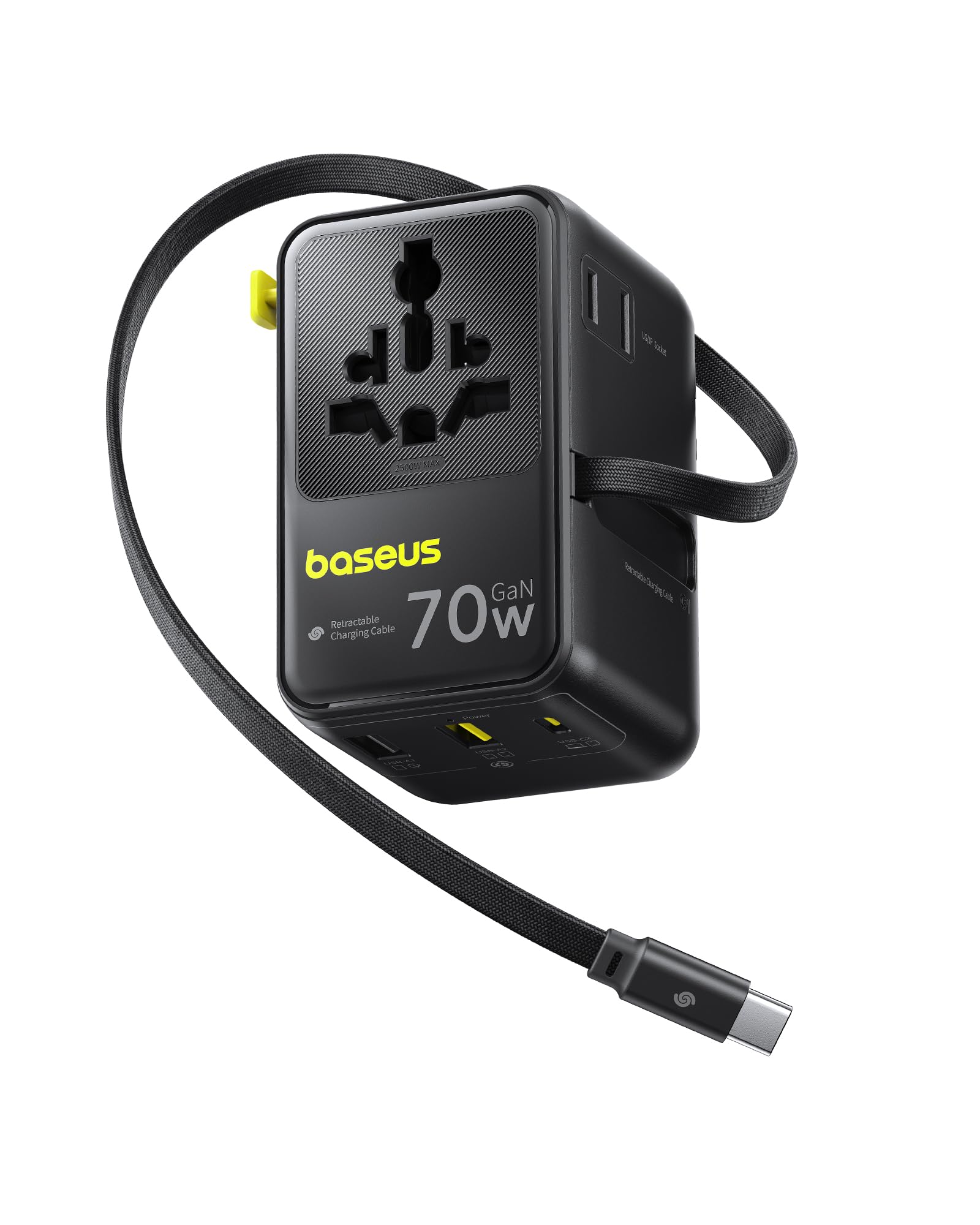
One adapter, four plug types, and a cable that retracts — the multi-country problem solved.
If you are moving between England, Europe, and home in a single trip, this is the pick that earns its slot. It carries four plug types — Type C, Type A, Type G, and Type I (the pin shapes used across Europe, Asia, the USA, and Australia) — so a single adapter replaces the pile of country-specific blocks. That is exactly the traveler’s problem it exists to solve.
The built-in retractable USB-C cable is braided in nylon and pulls out up to 70W, so you do not have to hunt for a spare cable at the hotel. Two AC outlets and USB ports round out a six-in-one fit that can feed a laptop, a phone, and a watch at once. Fireproof PC shell, dual 10A fuses, and protections against over-power, short-circuit, and overheating handle safety, and CE and FCC certifications sit alongside them. Buyers confirm it is easy to switch between plug configurations and that the retractable cable keeps everything neat for family trips.
Two honest things to note before you pack it. This is a plug adapter, not a voltage converter — it changes the shape of the plug, not the voltage coming out of the wall, so check your device’s range before using the AC outlets overseas. And a small number of buyers have had the retractable cord stop retracting after a few uses, so treat the mechanism gently. It also lacks surge protection, which is what makes it safe to use on a cruise ship.
Built for the trip: four plug types, dual 10A fuses, and a 70W retractable USB-C cable make this the only adapter you need to pack for a multi-country hop.
One moving part to watch: the retractable cable is the feature people love, and it is also the part to handle with care if you want years out of it.
Pack it for: trips that cross more than one country and need to plug anything into unfamiliar sockets.
Leave it home if: you only travel domestically and want a brick with more USB ports — an all-USB charger fits that job better.
6. Anker 100W Max USB C Charger
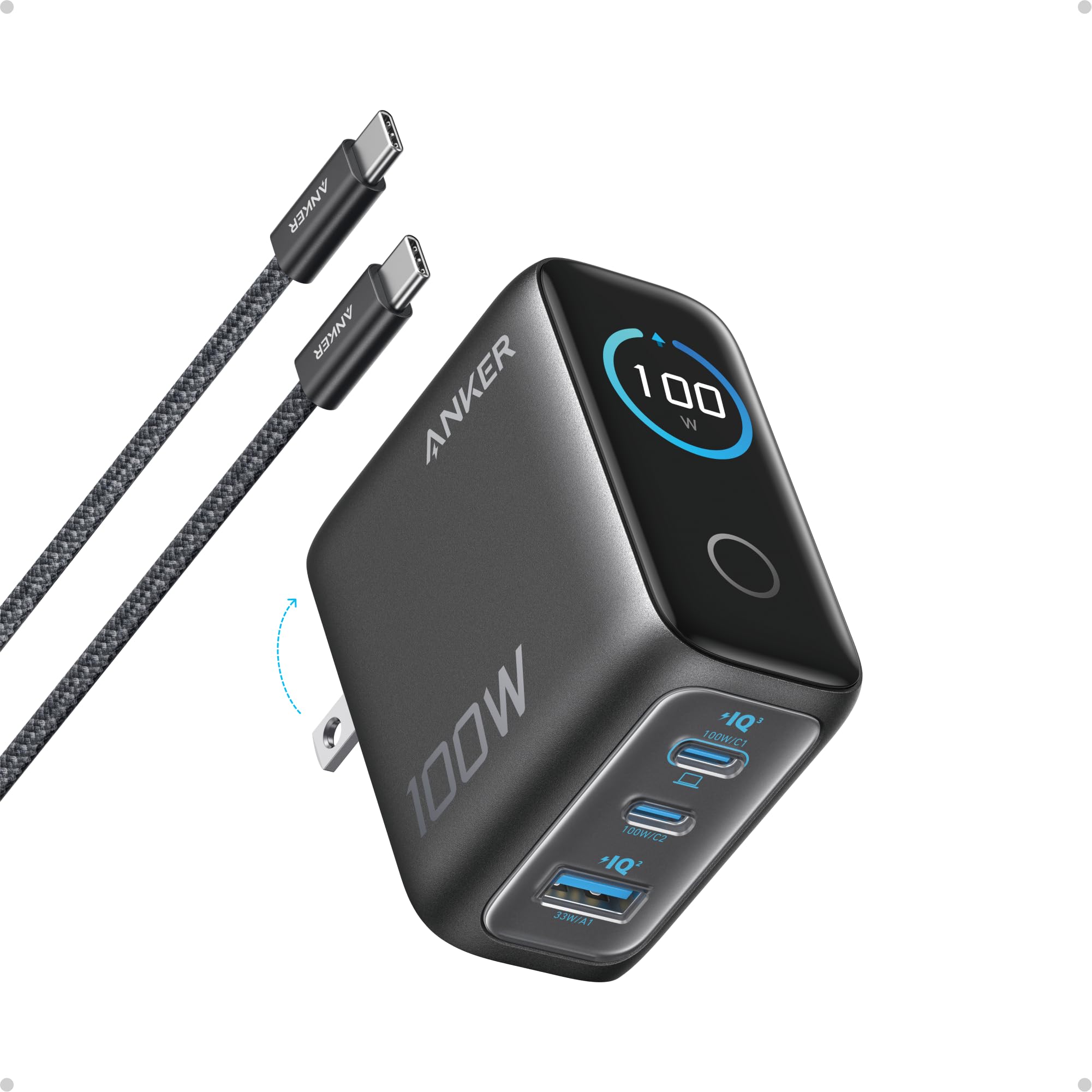
A 100W brick with a live display — fast-charge your laptop on one port and never guess why.
When you want the fastest possible charge for one big device, this is the ceiling of the list. Any USB-C port here delivers a steady 100W — enough to run a laptop at full speed, and well ahead of the 65W per-port caps on the Anker 65W Max and ORICO. GaN technology (a gallium-nitride chip design that runs cooler than older silicon) sustains that peak for longer than a typical 100W charger, so it does not sag mid-charge on a demanding tablet or a gaming handheld.
The standout feature is the display. It shows real-time status on charging speed, temperature, and port performance — instant visibility, no guesswork. If you are the sort of person who wants to know whether your cable or your device is the bottleneck, that little screen answers it on the spot. A foldable plug and a body measuring 2.72 x 2.17 x 1.34″ mean it still slips into a backpack or coat pocket, and it comes with a 4.9ft USB-C cable so you do not need to buy one.
Two honest caveats. This power is overkill for a smartwatch or earbuds — most small devices pull only about 10W regardless of what the charger can supply, so a cheaper Anker 20W brick does the same job for lighter gear. And a handful of buyers felt full retail was steep for what it does, though nearly all agreed it was worth the sale price. A watch cable left touching an unused cable caused melting on one account, which means you should not leave open magnetic contacts lying against a live port. This one also carries 120V-240V input, so it travels internationally.
What Makes It Shine
- A full 100W of steady output on any USB-C port — enough to drive a laptop without slowing down.
- The smart display shows live charging status, temperature, and port performance so you can spot a weak cable instantly.
- Compact body at 2.72 x 2.17 x 1.34″ with a foldable plug and a cable in the box.
Where The Money Goes
- Genuinely overkill for watches and earbuds, which draw only a small fraction of what it can supply.
- It is the priciest pick of the bunch, though the value is clearer at sale prices than full retail.
Pick it up for: a fast laptop charger that also gives you a live read on what is really happening on the port.
Leave it on the shelf if: you mostly charge watches and earbuds — a lower-wattage Anker brick will do that perfectly well.
7. USB Charging Station 100W 20-Port

Twenty ports in one compact strip — the charger for classrooms, offices, and gear-hoarding households.
For the person who fills a shelf with USB lights, watch bands, headphones, tablets, and speakers, this is the machine you plug in and forget. It holds twenty ports at once, each delivering up to 2.4A (amps, the measure of current flow), on a total ceiling of 100W/20A — more than the three-port blocks and the ten-port brick, so it is the fix when your problem is quantity, not speed on any one device.
The safety package is deliberate: fireproof PC shell, intelligent chip managing overcharge, overload, overcurrent, and overheating protection, plus vents for heat dissipation. That is what buyers key on — the way it hoists a pile of small devices off a tangle of charging cubes and frees up several wall outlets at once. It is small, light at 12 ounces, and silent in use, and a wide 100-240V input means it can travel internationally too, even though most of its life will be spent plugged in on a shelf or desk.
Two real things a buyer should know before committing. It is designed for phones, pads, watches, and other low-voltage devices — not for high-demand laptops — so do not plan to run a MacBook off it. And there is no emergency power cutoff, so if a magnetic watch cable is left touching an unused cable’s contact, melting can occur. The routine habit is to unplug cables with open magnetic contacts when they are not in use, and to keep total per-port draw in mind.
For the tidy-up job: shelves of USB lights, headphones, watches, and tablets all running off one strip instead of a dozen wall cubes.
Meet it halfway: it handles low-voltage devices beautifully, but plug your laptops into something built for high draw.
Know the Specs
Total Wattage vs Per-Port Wattage
A charger’s headline figure is the total it can share, not what each port gives you. When every port is busy, that wattage is divided — so a 65W charger feeding three devices splits the 65W rather than handing out 65W to each one. That is why a laptop can slow down the moment you add a phone and earbuds. To avoid the trap, work out the wattage your heaviest single device needs at full speed and buy a charger whose total leaves a little room above that number.
What GaN Actually Does
GaN (gallium nitride, a chip material that runs cooler and packs more power into a smaller space) is why a 65W charger can be the size of an AirPods Pro case. Newer versions promise longer peak performance before the charger throttles down. None of it changes the charge speed you feel in the wall — the ports and the wattage do that — but GaN is what decides how small and cool the charger runs with that power inside.
Common Questions
Will a 65W charger power my laptop while I use it?
Do I need a voltage converter to use a travel charger abroad?
Can I use a multi-port charger on a cruise ship?
What is the difference between a charging block and a power strip with USB?
Why does my phone charge slower when other devices are plugged in?
Will a foldable plug charger fit a tight hotel outlet?
How many ports do I actually need for a family trip?
Are GaN chargers safe to leave plugged in?
Can I charge a laptop and a phone from the same 100W charger at full speed?
What does the smart display on a USB-C charger actually show?
The Bottom Line
For most travelers, the best multi-port usb charger for travel depends on how many devices you actually carry. If one USB-C laptop and a phone are your travel kit, go with the Anker 65W Max 3-Port USB C Charger Block — it delivers 65W of laptop charging in a pocket-size, foldable body with 240-volt input that spreads across most of the world. If you are crossing countries and plug types, the Baseus 70W Universal Travel Adapter replaces a pile of country blocks with four plug types and a retractable 70W cable. And when a family needs every tablet, watch, and phone topped up from a single wall outlet, the 12-in-1 Charging Station is the one to reach for, with 4 AC outlets and 8 USB ports that keep a hotel room tidy. Whichever you choose, match the total wattage to your heaviest device and count your ports before you pack — that is the whole game.
How we choose
We do not accept paid placement. Every pick is matched to a real buyer and a real use-case; we do not hands-on test units.
Sources
Specifications: manufacturer listings and product documentation. Review insights: verified customer reviews, as of October 2026. Pricing: not shown on this page (it changes often); check the current price via the retailer link.
As an Amazon Associate, Aappliancez earns from qualifying purchases. This does not affect which products we feature.