Disclosure: Some links in this post are affiliate links. As an Amazon Associate I earn from qualifying purchases, at no extra cost to you. Learn more
Specs are compiled from manufacturer listings and verified buyer reviews and can change over time — please confirm the key details on the product page before buying.
You want protein that mixes without clumps, tastes like something you would actually drink, and tells you honestly how much protein is in each scoop. Every pick below is a real milk-based protein powder — whey isolate, whey concentrate, casein, or a blend — with the protein grams per serving, the BCAA count, and the texture quirks laid out in plain language.
This guide is built by comparing the manufacturers’ published specifications and the patterns across verified customer reviews, so you get each pick’s real strengths and trade-offs instead of marketing spin.
Below is the straightforward read on the best milk protein powder for building, cutting, or simply hitting your daily grams.
Top Picks
How To Choose The Best Milk Protein Powder
The single biggest mistake buyers make here is shopping by tub size instead of by serving size. A bag of whey isolate can be small and still give you 25 g of protein per serving, while a bigger-looking tub can hide a scoop that delivers far less. Read the nutrition panel for grams per scoop first, then work out how many scoops a serving really needs.
Read the protein grams per scoop, not the tub
Protein per serving is the number that decides whether a powder fits your day. A 25 g serving covers a solid chunk of a typical daily target. A 20 g serving is lighter and works better as a between-meals top-up. Check whether the label counts one scoop or two as a serving — several formulas here list 2 scoops per serving, which changes how long the bag actually lasts.
Whey isolate, concentrate, or a blend
Whey isolate is filtered to remove more lactose and fat, so it tends to sit lighter. Whey concentrate keeps more of the natural milk fractions and usually costs less per gram. A blend that adds micellar casein (a slower-digesting milk protein) releases over a longer window, which suits people who want a shake to carry them through several hours. If you are lactose-sensitive, isolate and blends with added digestive enzymes are the usual first stop.
Flavoured or unflavoured
Flavoured powders are ready to drink with water. Unflavoured ones disappear into coffee, soups, oats, and baking without changing the taste — but they can taste flat in plain water. If you plan to cook with your powder, an unflavoured isolate gives you the most freedom. If you want a shake you enjoy straight from the shaker, a flavoured formula earns its place.
Mixability and texture
Instantized powders are processed so the particles wet out fast, which is why they shake smooth in about 20 seconds. Unflavoured and cold-processed powders often need a blender or a good shaker ball. Grittiness is not a defect — it is usually a sign of less over-processing, and it often disappears when you blend the powder into something thicker than water.
Side-by-Side Comparison
| Model | Best For | Protein Per Serving | BCAAs | Format | Amazon |
|---|---|---|---|---|---|
| Optimum Nutrition Gold Standard Whey★ Best Overall | Everyday all-rounder | 24 g | 5.5 g | 2 lb tub | Amazon |
| AGN Roots Grass Fed Whey IsolateCleanest Label | Clean-label purists | 25 g | 6.5 g | 1 lb pouch | Amazon |
| Premier Protein Powder Plus FiberBest Fiber Boost | Gut-friendly daily shake | 25 g | — | 17 servings, tub | Amazon |
| Simply tera’s Pure Whey Protein | Natural vanilla taste | 22 g | — | 24 oz tub | Amazon |
| Jocko Fuel Whey Protein | Time-release blend | — | — | 25 servings, bag | Amazon |
| FlavCity All-in-One Protein Smoothie | Meal-replacement scoop | 25 g | — | 20 servings, tub | Amazon |
| Animal 100% Whey Protein | Value bulk tub | 20 g | 4.6 g | 4 lb tub | Amazon |
| Livingood Daily Hydrolyzed Collagen | Collagen plus vitamins | — | — | 30 servings, tub | Amazon |
| Ancient Nutrition Multi Collagen Lean | Collagen with cinnamon | — | — | 1.21 lb tub | Amazon |
| Micro Ingredients Pea Protein | Plant-based bulk value | 27 g | — | 5 lb bag | Amazon |
| UpNourish Strawberry Banana Vegan | Dairy-free superfood blend | 21 g | — | 15 servings, bag | Amazon |
Detailed Reviews
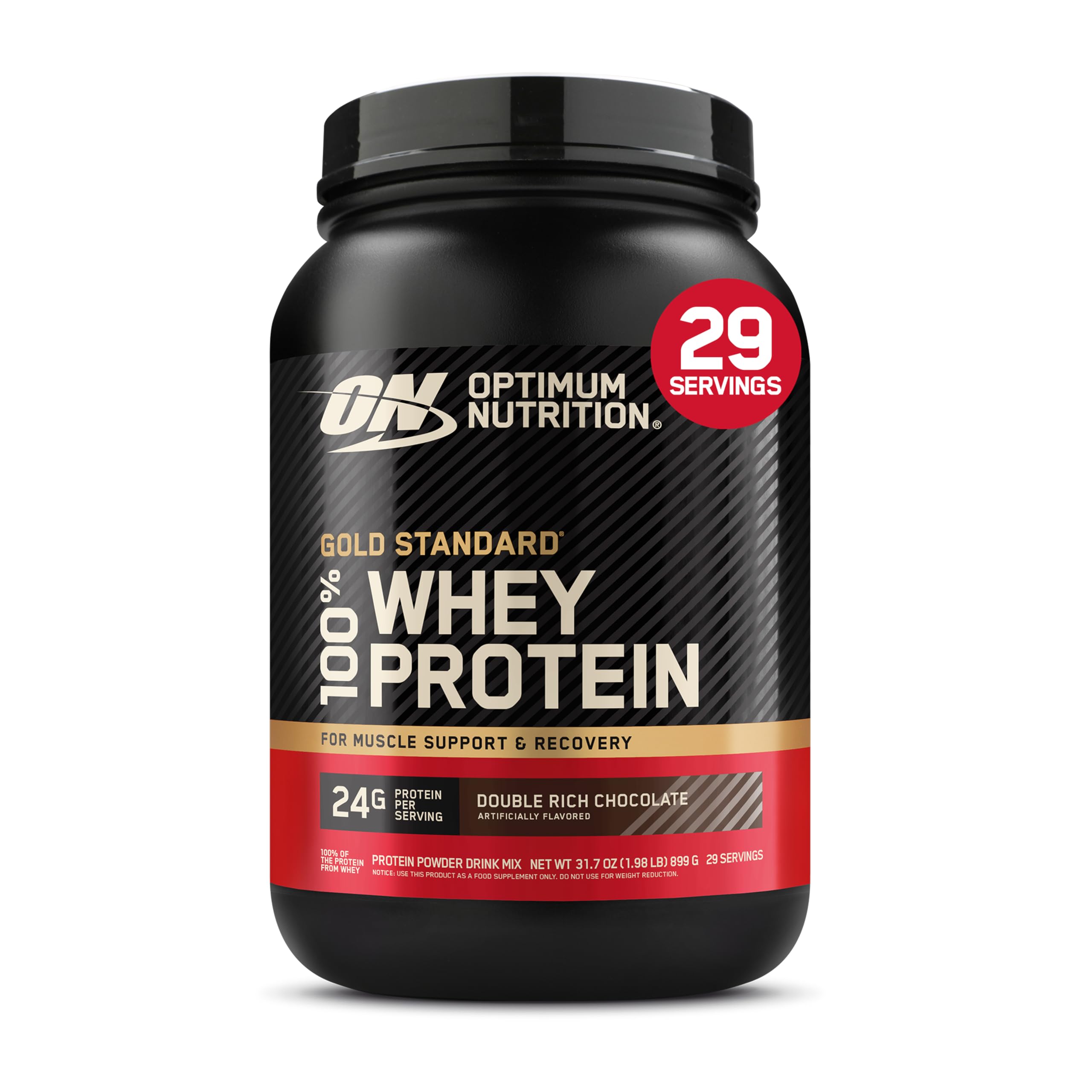
1. Optimum Nutrition Gold Standard Whey Protein 2 LB
Our pick — 4.5+★ from 100,500+ verified ratings; the strongest balance of quality and price.
The chocolate shake that became the default for a whole generation of gym bags.
On paper this is the easiest formula here to defend: 24 g of whey protein per scoop, drawn from whey isolate and whey concentrate, with 5.5 g of BCAAs (branched-chain amino acids — the three amino acids muscle uses during and after training) and 11 g of essential amino acids. That combination is why it works as a post-lift shake, a between-meals top-up, or a straight breakfast replacement. It has been on shelves since April 2004 and holds a 4.5+ star score across 100,000+ ratings, which is the crowd verdict in one line.
What wins people over is the mixing. This is an instantized formula, meaning the powder is processed so the particles wet out fast, and the maker’s own instructions call for one scoop in 6–8 oz of water, milk, or your preferred liquid for about 20 seconds of shaking. In practice that is a shaker bottle and no blender. The Double Rich Chocolate is the flavour that carries the reputation — buyers describe it as thick and genuinely chocolate rather than fake-sweet, and a fair share say it earns a permanent spot in their coffee as well as their shakes.
The catch is that flavour and water quality travel together. With plain water the chocolate reads thinner and less convincing than it does in milk or almond milk, and that is a recurring note in the review pages. Compare that with the AGN Roots isolate below: at 6.5 g of BCAAs versus 5.5 g here, the AGN edges ahead on amino density per serving, and it does so in a 1 lb pouch that weighs half of this 2 lb tub. If you want pure unflavoured protein for cooking, AGN wins. If you want a flavoured shake you will look forward to, this stays the pick.
What earns the top spot
- 24 g of whey protein per scoop from isolate and concentrate, with 5.5 g of BCAAs and 11 g of EAAs
- Instantized — one scoop in 6–8 oz of liquid shakes smooth in about 20 seconds
- Double Rich Chocolate is the flavour most owners keep coming back to
- Banned-substance tested, so it is cleared for tested athletes
Where it thins out
- In water alone the chocolate tastes noticeably flatter than in milk
- The 2 lb tub takes up real counter space compared with a 1 lb pouch
Reach for this one if: you want a single flavoured whey that handles post-workout, mid-afternoon, and breakfast without a blender.
Think twice if: you blend into plain water only — the chocolate is built to shine in milk.
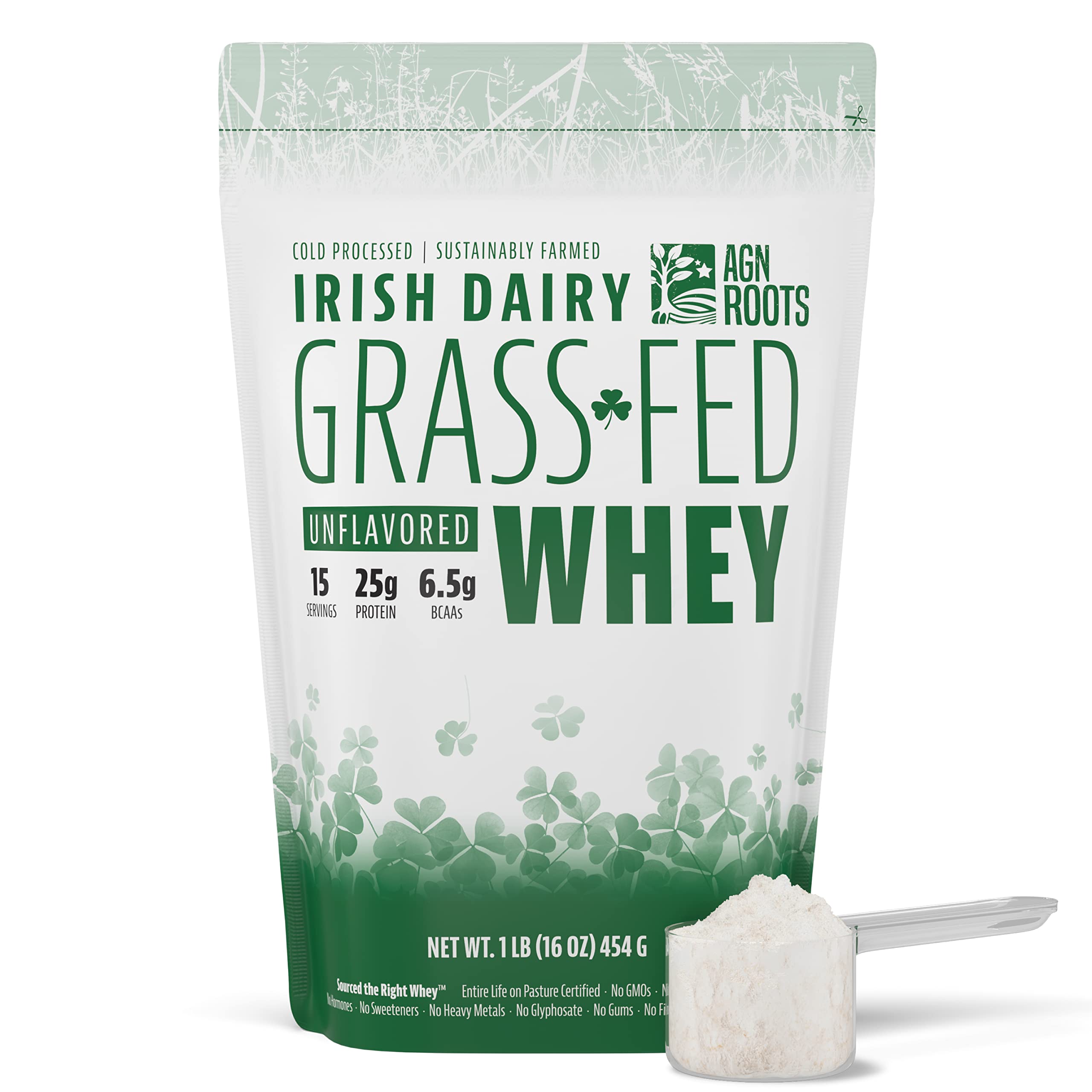
2. AGN Roots Grass Fed Whey Protein Powder Isolate 1 LB
Two ingredients, 6.5 g of BCAAs, and a pouch that smells of fresh cream.
For anyone who cooks with their protein, this is the pick that disappears. It is unflavoured and unsweetened, so it folds into smoothies, coffee, soups, and baking without changing the taste of anything. The amino density is the strongest in this whole list: 6.5 g of BCAAs per 25 g of protein, which puts it ahead of the Optimum Nutrition tub’s 5.5 g. The brand also cold-processes rather than over-drying, and the maker notes a moisture content around 5.4% against competitors’ dusty < 2%, which is why it pouches soft rather than powdery.
The certifications are where this formula earns its premium tier. It is Certified Animal Welfare Approved by A Greener World, Informed-Sport and Informed-Protein certified, and on the ASPCA’s Shop with Your Heart list. For a buyer who cares where the milk comes from, that paper trail is the whole point. It also arrives in an air-tight, thermally protected pouch rather than a plastic tub, which keeps heat and UV off the powder and makes it easier to store in a small kitchen.
Here is the honest adjustment you will need to make: the bag holds 1 lb, and a serving is 2 scoops, which works out to 15 servings per pound. If you drink a shake daily, that goes quickly. Cost per serving is the recurring grumble in the reviews, and it is a fair one — this is a premium price for a small bag. The trade is quality over volume, and for a buyer who wants clean dairy and no fillers, that trade reads clearly.
The buying math: 2 scoops per serving, 15 servings per 1 lb bag, 25 g of protein each time. Plan your reorder around that, not around the bag size.
Best suited to: the cook, the coffee stirrer, and the label reader who wants protein with nothing added.
Look elsewhere if: you want a sweet shake straight from the shaker — this one is deliberately tasteless and needs a base with flavour.
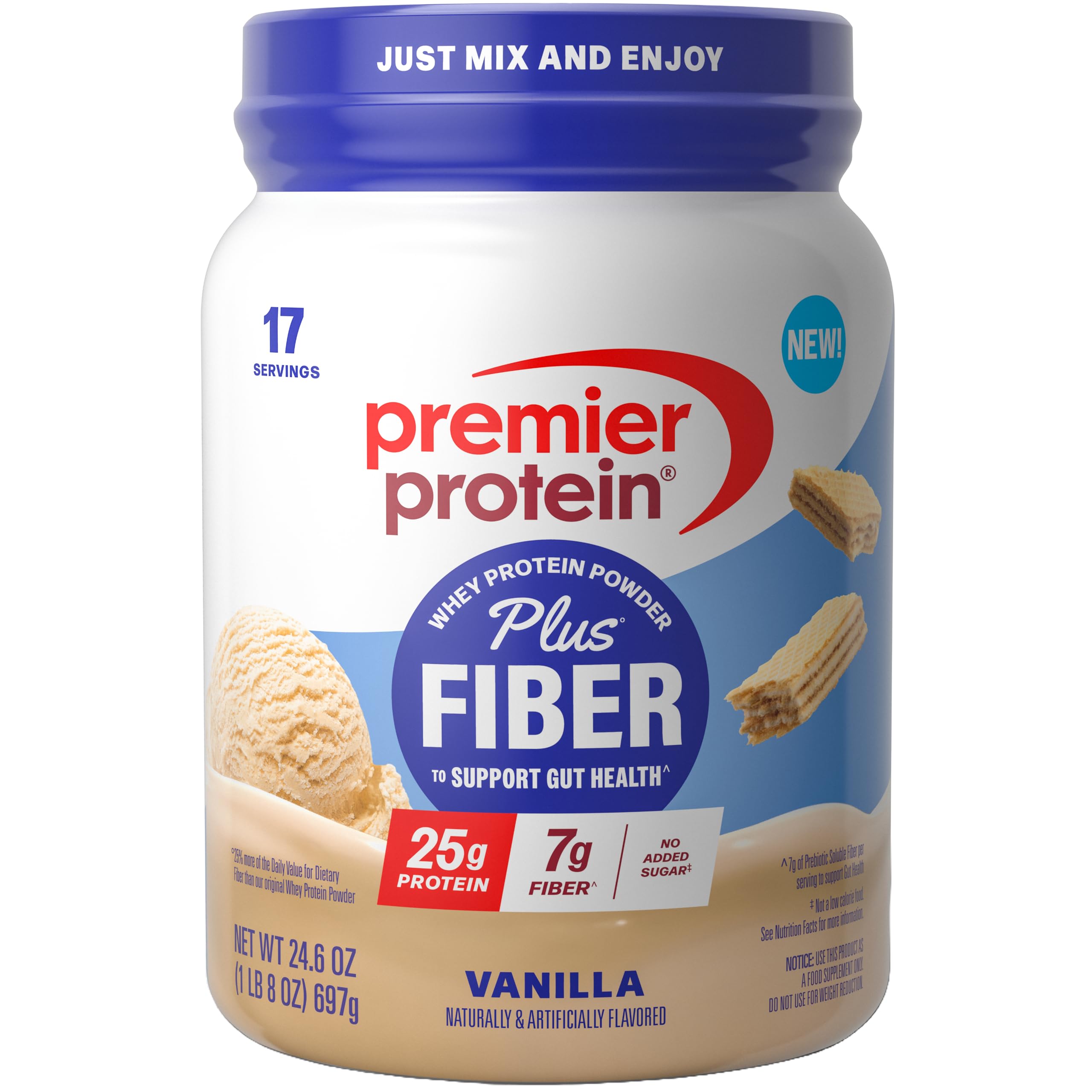
3. Premier Protein Powder Plus Fiber Vanilla
A vanilla whey that quietly adds 7 g of prebiotic fiber to every scoop.
The pitch here is simple and genuinely uncommon: 25 g of whey protein and 7 g of prebiotic fiber in the same serving, with no added sugar. The fiber comes as a blend of three types, and the maker states it delivers 25% of your daily value of fiber per serving. In plain terms, that is one shake doing two jobs — protein for muscle and fiber for the gut — instead of you buying a separate fiber supplement. The brand also carries an American Masters of Taste Gold Medal for the flavour, which tells you it was built to be drunk, not endured.
Most of what owners talk about is the taste, and the light vanilla is the reason. It blends into berries, yogurt, coffee, and oatmeal without dominating, which is exactly what a versatile vanilla should do. The texture comes out smooth rather than gritty, and a few people note it takes a little patience to dissolve fully in hot coffee. In a shaker with water or milk it comes together fast.
The one thing to weigh is digestibility. Fiber is the whole selling point here, but adding 7 g of prebiotic fiber to a shake is a real change to your routine, and some stomachs take a few days to settle into it. Start with one serving a day rather than two. Compared with the Simply tera’s tub below, this one gives you 25 g of protein to its 22 g, and adds the fiber the tera’s formula does not carry — different jobs, and the fiber is the deciding line.
What owners keep saying: the vanilla is light enough to blend into almost anything, and the added fiber is the reason many of them switched from a plain whey at the same protein count.
The right fit if: you want one scoop covering protein and daily fiber, with a vanilla that will not fight your coffee.
Pass on it if: you already take a dedicated fiber supplement — you would be doubling up.
4. Simply tera’s Pure Whey Protein Powder 24 Oz

Four ingredients, vanilla from the Bourbon Islands, and 22 g of grass-fed whey.
Strip a vanilla protein powder back to its essentials and you get this. The label lists only 4 ingredients — grass-fed whey, vanilla sourced from the Bourbon Islands, organic stevia, and one more — with no artificial sweeteners anywhere. That is the clean-label promise made concrete. Each serving carries 22 g of protein and the full set of 18 amino acids, including the 9 your body cannot make on its own, which is more complete amino coverage than many competitors at the same protein level.
The vanilla is what people love. It is sweetened with organic stevia rather than sucralose or aspartame, and the bourbon vanilla gives it a warmer, more rounded flavour than a flat artificial vanilla. Owners mix it into smoothies with 2% milk, stir it into oatmeal, and bake with it, and the through-line is that it does not upset their stomach. The whey comes from pasture-raised, grass-fed cows on small family farms in the USA.
Nothing here is perfect, though: the natural stevia can leave a faint aftertaste if you are used to sugar-sweetened powders, and the powder has a noticeable smell straight from the tub that a few buyers find off-putting until it is mixed. Neither is a deal-breaker — the flavour holds up once it is in milk or a smoothie. At 22 g of protein it is 3 g under the Optimum Nutrition scoop above, so if raw grams per serving is your deciding number, ON leads. If natural ingredients lead, this one does.
Choose it for: the best-tasting natural vanilla here, with a 4-ingredient label and complete amino coverage.
Skip it when: you want maximum protein per scoop — 22 g sits below the 24–25 g leaders.
5. Jocko Fuel Whey Protein Powder Chocolate Peanut Butter
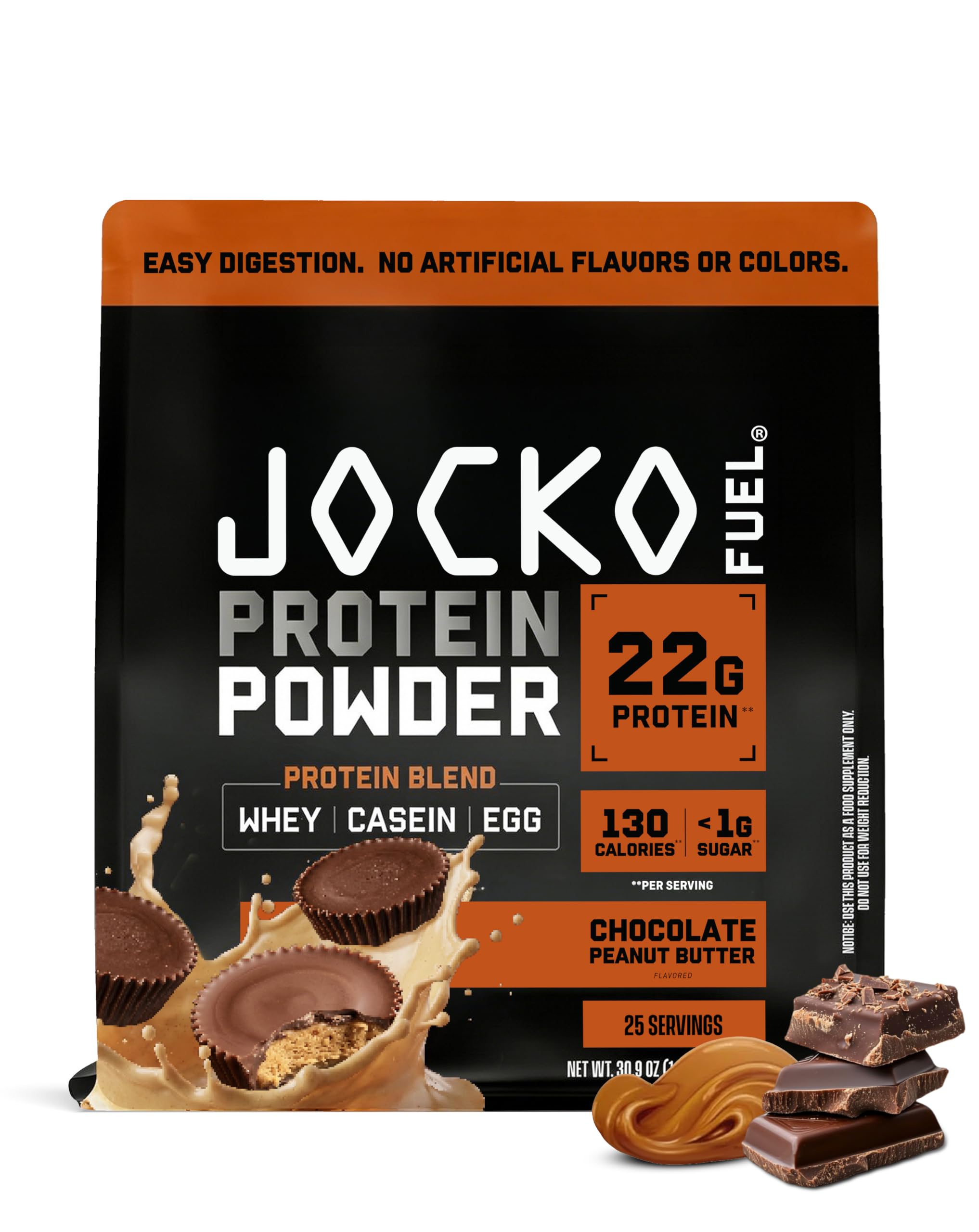
Four protein sources, digestive enzymes, and a chocolate peanut butter cup in a bag.
This is the most engineered formula in the milk-based lineup. Instead of one whey source, it blends whey concentrate, whey isolate, micellar casein (a slow-digesting milk protein), and egg white, so the protein releases over a longer window instead of all at once. That time-release design is why it works as an all-day fuel rather than just a post-workout hit. It also packs digestive enzymes and probiotics to help your gut handle the dairy, and it is sweetened with a blend of allulose, monk fruit, and reb-M rather than sugar.
The chocolate peanut butter flavour is the one that built the reputation — owners describe it as a rich chocolate peanut butter cup with no chemical aftertaste, and it mixes clump-free in water as well as milk. Cookies & Cream and Banana Cream draw similar praise. The quality of the ingredients is what dominates the conversation, and it is easy to see why: no hormones, no soy, a genuinely long ingredient panel, and 25 servings per bag.
The honest wrinkle: sweetener tolerance varies. A couple of buyers find it too sweet, and the digestive enzymes that help most stomachs still leave a small number of people with some discomfort. The bag closure is also a recurring weak point — the zipper can fail to seal, so have a clip or a spare container ready. It sits at the premium end of the milk-protein price band, but the multi-source formula is the reason.
What the blend buys you: whey fast, casein slow, egg in between — one shake that keeps feeding muscle for hours rather than minutes.
Made for: anyone who wants one shake doing recovery and sustained fuel, with gut support built in.
Look past it if: you want a spare, minimalist formula — this is a long ingredient list by design.
6. FlavCity All-in-One Protein Smoothie Powder Berries & Cream
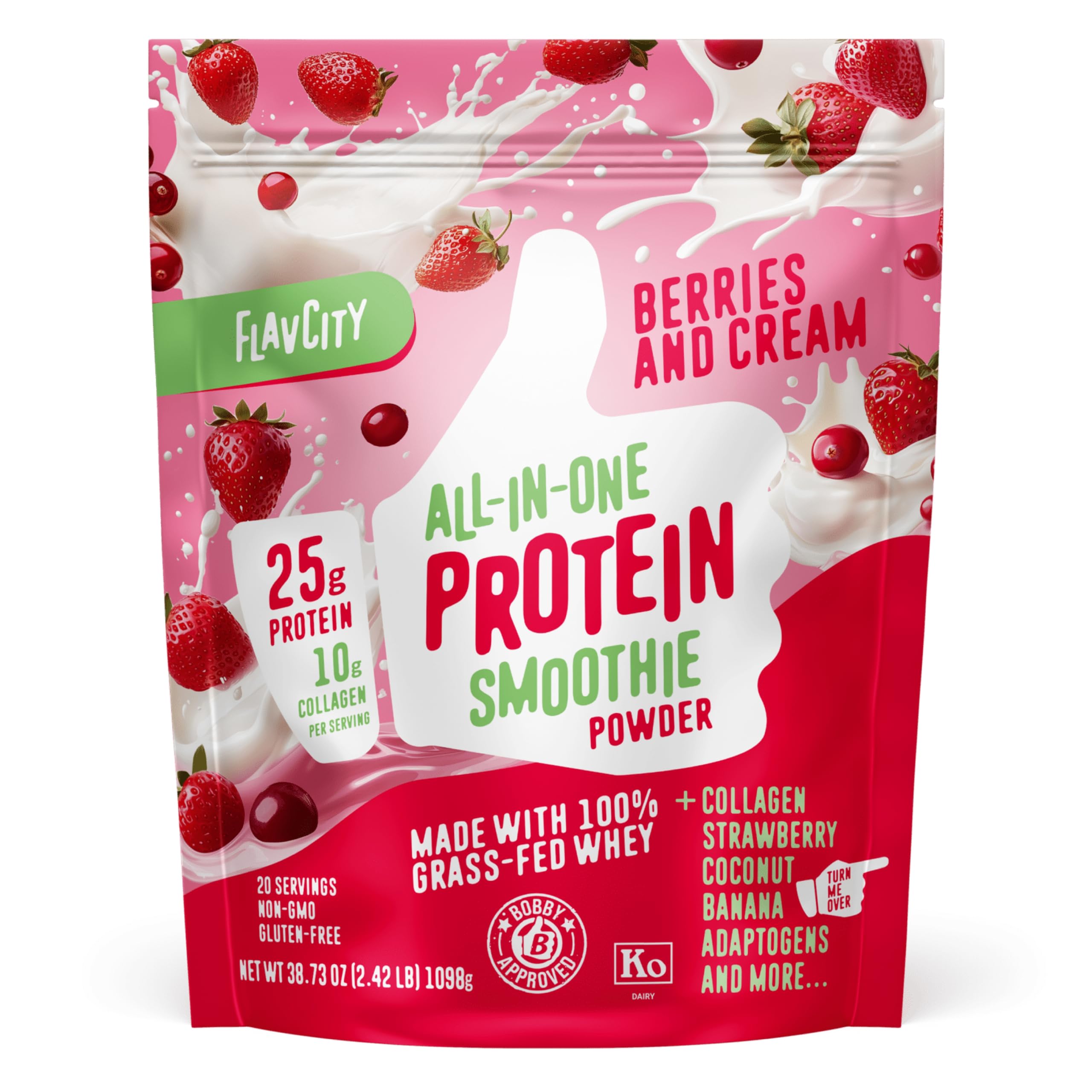
One scoop carrying 25 g of protein, 10 g of collagen, and functional mushrooms.
If you want a single scoop to do more than protein, this is the one that tries hardest. Each serving stacks 25 g of grass-fed whey, 10 g of collagen peptides, and organic reishi and cordyceps mushroom powders, all in one 20-second shake with 12 oz of water or milk. It is built as a meal-replacement or post-workout drink, and the label is gluten-free, non-GMO, with no added sugars or artificial sweeteners, colours, or fillers, and it is third-party tested.
The Berries & Cream flavour is the star. People describe it as berries floating in fresh cream, with no artificial protein taste, and it mixes clean in a shaker without a blender. It also blends into yogurt and baking without complaint. The founder, Bobby Parrish, built the brand around real ingredients, and that shows in the flavour quality rather than the marketing.
Now the part that catches people out: there is real sugar in the mix, and buyers are surprised by how much per serving given the “no added sugar” positioning — read the nutrition panel before you commit to it as a daily meal replacement. Mixability is good but not flawless; a few shakes come out slightly lumpy without a blender. It is a premium-priced tub for 20 servings. If you want pure protein without the extras, the Optimum Nutrition tub above is simpler and cheaper per gram. If you want one scoop replacing a meal, this is built for it.
Buy it if: you want a single scoop covering protein, collagen, and mushroom powders in a flavour you will look forward to.
Check the panel first if: sugar per serving is something you track closely.
7. Animal 100% Whey Protein Powder Vanilla 4LB

A 4 lb tub built for daily drinkers who count grams per dollar.
If your protein habit is a daily one, the size of this tub changes the math. It is a 4 lb bag of whey blend, giving 20 g of protein per scoop with over 4.6 g of naturally occurring BCAAs and only 1 g of sugar. The grams per scoop are lower than the 24–25 g leaders here, so you may take two scoops for a full post-workout dose — but the cost per pound is where it earns its place. It is produced in a GMP-certified US plant, and every batch is third-party lab tested in a pharmaceutical-grade facility.
The vanilla is the flavour most people come back to, and owners describe it as tasting like vanilla ice cream with no chalky aftertaste. It mixes easily into a shaker without clumps, which matters when you are drinking it every day. Owners also report no bloating or discomfort, and two scoops keep them full for hours.
What to know before you buy: this is a whey blend rather than a pure isolate, so the texture is a little grainier than the AGN Roots isolate above, and it can clump if you mix it into ice-cold milk without a good shaker. Over-blending makes it foam, which is not harmful but is annoying. It also carries more lactose than an isolate, so if you are sensitive, the isolate is the safer route. For everyone else, this is the value workhorse.
Why daily drinkers like it
- 4 lb tub with 20 g of protein and over 4.6 g of BCAAs per scoop
- Only 1 g of sugar, with no chalky aftertaste on the vanilla
- Every batch third-party lab tested in a pharmaceutical-grade facility
- Mixes without clumps in a shaker and digests without bloating for most
What to watch
- 20 g per scoop is lighter than the 24–25 g leaders, so heavy users often take two
- Clumps in ice-cold milk unless you shake hard, and foams if over-blended
The pick for: the everyday athlete who drinks protein daily and wants the most grams per tub.
Choose an isolate instead if: lactose sensitivity or gritty texture is a deal for your stomach.
8. Livingood Daily Hydrolyzed Collagen Peptides Powder Vanilla
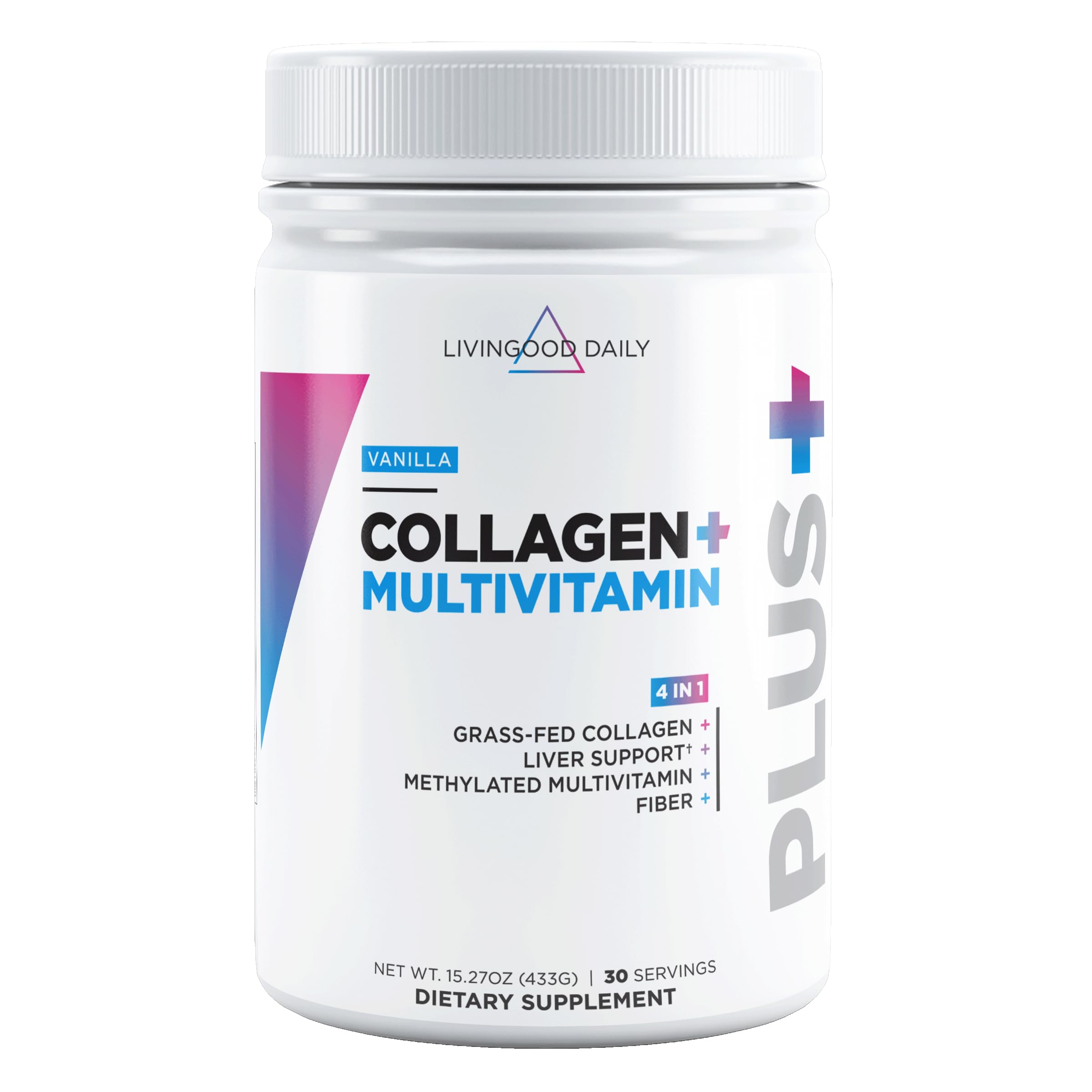
A vanilla collagen that doubles as a daily multivitamin scoop.
This one is not really a protein powder in the whey sense — it is a collagen peptide formula that also carries a full bottle of multivitamins and minerals, plus milk thistle. The collagen is grass-fed types I and III, and the added vitamin C supports absorption. One scoop is 14.4 g, mixed into 8–12 oz of water or your drink of choice, and each tub holds 30 servings.
The vanilla flavour is what buyers talk about most, and it is sweet enough to carry a coffee on its own without extra creamer. It disappears into smoothies and shakes, and the fact that it doubles as your multivitamin removes a separate pill from your morning. Owners describe it as smooth and not clumpy, and the ingredient list is short and clean.
The real adjustment is solubility. Collagen peptides dissolve well in cold drinks but can settle at the bottom of hot coffee if you do not stir, and a few buyers find it clumps in cold liquid unless they whisk it. It is also the most expensive formula per serving here, and that price is the single most common note in the review pages. Compare it with the Ancient Nutrition tub below, which adds the same sort of vitamin support but flavors with cinnamon — different daily ritual, similar premium positioning.
The daily ritual: one scoop in your morning coffee, your vitamins included, your skin and hair routine handled in the same stir.
Best for: the buyer who wants collagen and vitamins in one scoop, with a vanilla that sweetens coffee for free.
Weigh the cost if: you want pure protein grams — collagen is a different job and priced as a premium.
9. Ancient Nutrition Advanced Hydrolyzed Multi Collagen Peptides Lean
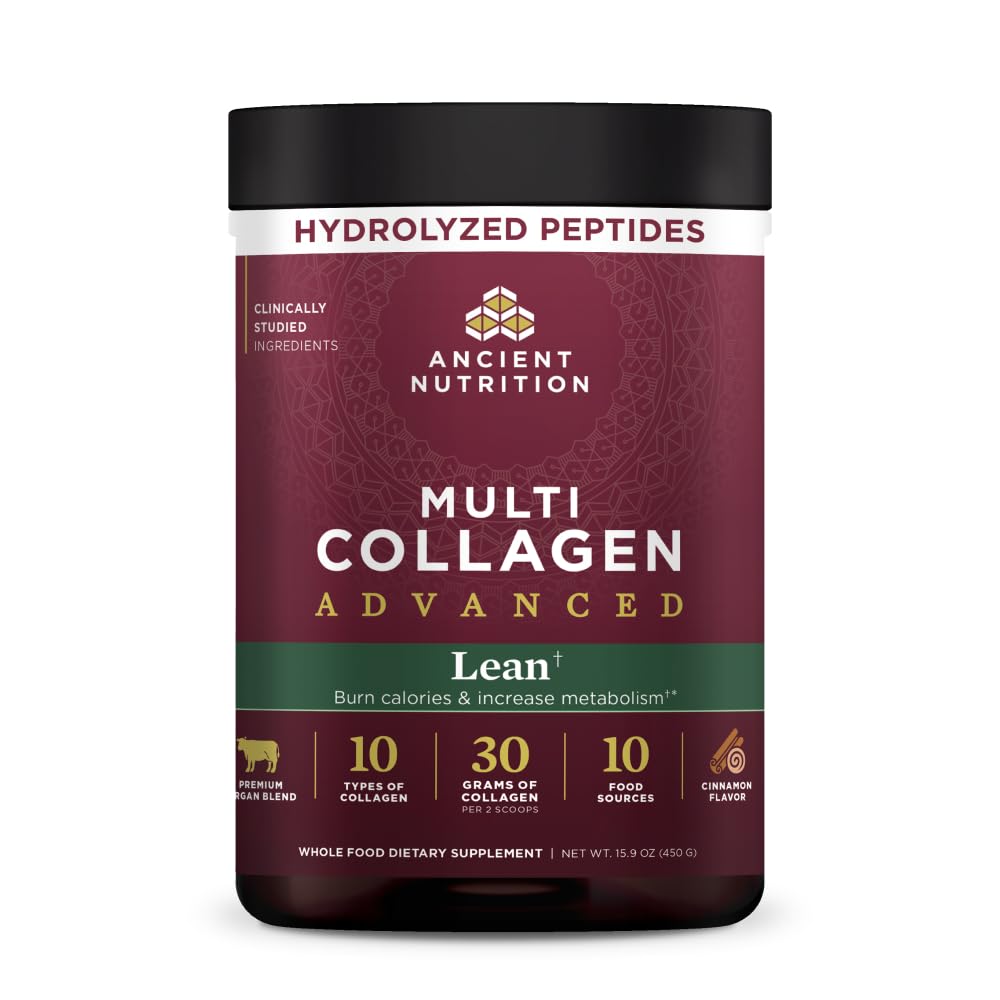
Ten kinds of collagen in a cinnamon scoop built for coffee.
This formula takes a different approach to the milk-protein shelf: it combines 10 types of collagen from 10 food-based sources with organic ashwagandha root extract and organic Ceylon cinnamon, and it is designed to work alongside regular exercise as part of an active lifestyle. It also adds clinically studied vitamin C and SBO probiotics. One scoop goes into 10–12 oz of liquid, and the mild cinnamon flavour is made to pair with coffee rather than fight it.
The cinnamon is the dividing line. Coffee drinkers describe a horchata-like drink and less stress eating — the cinnamon-and-ashwagandha effect the formula targets. In tea or oatmeal it works too. It is made in the USA with globally sourced ingredients and third-party tested in a cGMP-certified facility, and the tub holds 1.21 lb.
The honest catch is dissolving. It does not fully dissolve in hot coffee for everyone — it floats and clumps and leaves a slight grit unless you stir constantly, and a few buyers find the cinnamon flavour is too faint for what the label promises. If you want a collagen that vanishes completely, an unflavoured formula is the safer choice. If you want a cinnamon coffee ritual with ashwagandha built in, this is a distinctive pick in a crowded category.
Worth it for: the coffee drinker who wants collagen, cinnamon, and ashwagandha in one morning stir.
Step away if: you need a collagen that dissolves completely in hot liquid without constant stirring.
10. Micro Ingredients Pea Protein Powder 5lb
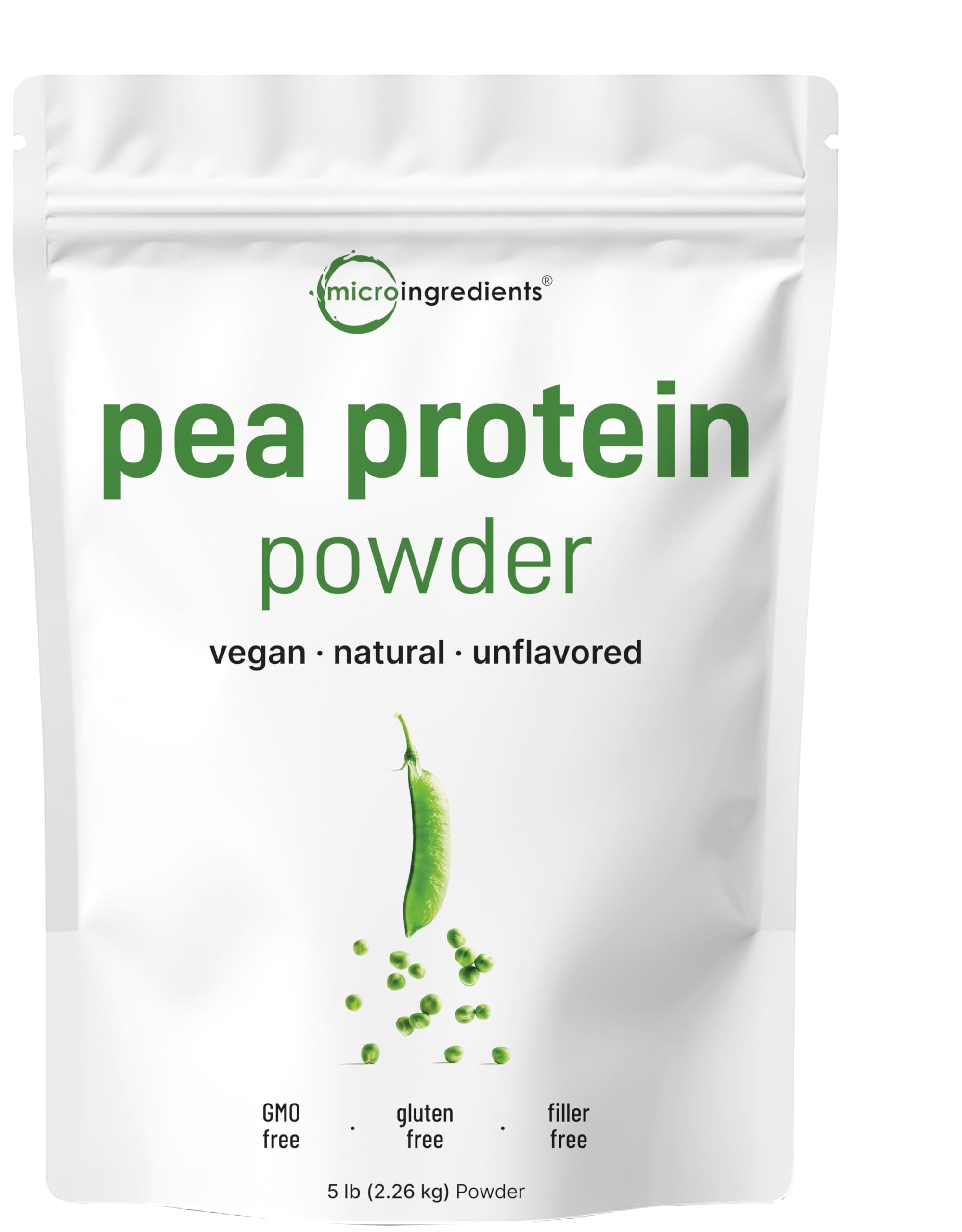
Unflavoured pea protein in a 5 lb bag — the macros-first bulk buy.
If dairy is off the table and you count grams per dollar, this bag is the answer. It holds 5 lb (2,268 g) with 68 servings, and each serving delivers 27 g of pea protein from a 2-scoop measure. It is unflavoured, vegan, dairy-free, gluten-free, and soy-free, with no GMOs, and a scoop is included so you can measure consistently. Pea protein is a complete plant protein that mixes into smoothies and liquids without changing their taste.
The taste is where expectations matter. In baking and soups it is neutral and disappears. In a smoothie with fresh fruit it can read earthy, and the texture is grainier than a whey isolate. Owners who stick with it describe it becoming neutral after a couple of weeks of use, and the value and quality are what keep people coming back. It is also a good pick for anyone who wants to add protein to baked goods without sugar or flavour.
What you should know: this is an isolate-style pea powder, which is not the same nutritional profile as whole peas — it lacks some of the B vitamins and other micronutrients that whole plant foods carry, so it should top up a varied diet rather than stand in for one. The texture is clumpier than the premium pea isolates, and one buyer notes it can be hard to stir. It delivers 27 g of protein per serving against the 21 g in the UpNourish vegan blend below. If raw protein per scoop is the number you track, this wins.
The numbers that matter: 68 servings, 27 g of plant protein per 2-scoop serving, one 5 lb bag — this is the cheapest per gram on the list.
Choose this if: you are dairy-free, count grams per dollar, and eat protein mostly in baked goods or blended shakes.
Look elsewhere if: mouthfeel matters and you want a pea protein that pours smooth into a shaker.
11. UpNourish Strawberry Banana Vegan Protein Powder

A fruit-flavoured vegan scoop with 54 superfoods and 1.5 billion CFU probiotics.
This is a protein powder for people who want their shake to feed more than muscle. Each serving carries 21 g of plant-based protein alongside 54 superfoods — alfalfa, broccoli, Brussels sprouts, kale, spinach, blueberry, goji berry, raspberry, and more — plus 1.5 billion CFU of probiotics, all with no sugar, no dairy, no gluten, and no soy. It is made in the USA and built as a meal replacement that fits vegan and keto diets.
The strawberry banana flavour is the main draw. With 10 oz of almond milk it shakes into a thick, creamy drink without the chalky, gritty texture that turns people off plant powders, and it keeps hunger away for hours. The 21 g of protein is plant-based and lower than the pea powder above, but the superfood and probiotic blend is the extra you are paying for. The whole tub gives 15 servings.
Where it wobbles is the flavour. Strawberry banana is genuinely polarising — the people who love it really love it, and the people who do not find it bland or faintly synthetic compared with the coffee flavour. Texture is a touch on the thin side without a blender, and a few bags have arrived with a reseal defect. If you need 27 g of pure protein per serving, the pea powder above gets you there. If you want a fruity, superfood-loaded vegan shake, this delivers.
What’s inside the scoop: 21 g of plant protein, 54 superfoods, 1.5 billion CFU of probiotics, and zero sugar — a meal replacement first, a protein hit second.
Go with this: if you want a fruit-flavoured vegan shake that carries greens, berries, and probiotics in one scoop.
Stay on pea powder if: you need max protein per serving and would rather mix your own fruit in.
Know the Specs
Protein Per Serving
The grams of protein your body actually receives from one serving. Watch whether the label counts one scoop or two as the serving, because a 2-scoop serving halves the number of shakes in a bag. A whey isolate or a blend with 24–25 g per serving covers a solid share of your daily target, while a 20–21 g serving works better as a between-meals top-up.
BCAAs and EAAs
BCAAs (branched-chain amino acids) are three amino acids your muscles use during and after training, and EAAs (essential amino acids) are the ones your body cannot make on its own. Look at the grams of BCAAs on the panel — 6.5 g sits at the high end, and 4.6 g is respectable. More BCAAs per gram of protein generally means a more complete source for recovery.
Whey Isolate vs Blend vs Casein
Whey isolate is filtered to remove most lactose and fat, so it digests quickly and sits light. A blend adds casein, a slow-digesting milk protein, so the protein releases over hours rather than minutes. Whey concentrate keeps more natural milk fractions and usually costs less per gram. Your choice depends on if you want fast post-workout delivery or sustained all-day fuel.
Mixability
Instantized powders are processed so the particles wet out fast, which is why the label says shake for about 20 seconds. Unflavoured and cold-processed powders often need a blender or a shaker ball. Grittiness is not a fault — it usually means less processing — and it often disappears when you blend the powder into something thicker than water.
Common Questions
Does milk protein powder go bad, and how long does an open tub last?
Is whey isolate better than whey concentrate for lactose sensitivity?
Can I mix this protein powder with hot coffee instead of water?
Does the serving size count one scoop or two?
Can I use a milk protein powder as a meal replacement?
Is unflavoured whey protein better for cooking and baking?
What is the difference between BCAAs and essential amino acids?
Do I need a blender for these protein powders, or will a shaker work?
Will a whey protein powder upset my stomach?
Should I choose a plant-based powder over a milk protein powder?
The Bottom Line
For most people, the milk protein powder winner is the Optimum Nutrition Gold Standard Whey because it delivers 24 g of protein per scoop with 5.5 g of BCAAs, an instantized formula that shakes smooth in about 20 seconds, and a chocolate flavour that has kept it on top for decades. If you want the cleanest label with the highest BCAA count, grab the AGN Roots Grass Fed Whey Isolate at 6.5 g of BCAAs in a 1 lb pouch. And if you want one scoop to cover protein and daily fiber, the Premier Protein Powder Plus Fiber is the one to reach for.
For a daily drinker who counts grams per tub, the Animal 100% Whey 4 lb tub gives you the most protein per bag, and for a time-release shake that keeps feeding your muscles for hours, the Jocko Fuel blend earns the premium. Match the powder to your daily habit, then your protein grams, then your flavour.
How we choose
We do not accept paid placement. Every pick is matched to a real buyer and a real use-case; we do not hands-on test units.
Sources
Specifications: manufacturer listings and product documentation. Review insights: verified customer reviews, as of October 2026. Pricing: not shown on this page (it changes often); check the current price via the retailer link.
As an Amazon Associate, Aappliancez earns from qualifying purchases. This does not affect which products we feature.