Disclosure: Some links in this post are affiliate links. As an Amazon Associate I earn from qualifying purchases, at no extra cost to you. Learn more
Specs are compiled from manufacturer listings and verified buyer reviews and can change over time — please confirm the key details on the product page before buying.
Buying a meat processing knife is mostly a decision about what you plan to break down. If you buy whole chickens and trim briskets at home, a curved boning knife with a stamped blade will do everything you need. If you process deer or break down primal cuts every season, you want a full-tang blade, a handle that survives wet hands, and a steel that takes an edge back quickly. The picks below cover that whole range.
This guide is built by comparing the manufacturers’ published specifications and the patterns across verified customer reviews, so you get each pick’s real strengths and trade-offs instead of marketing spin.
What separates a knife that lasts from one that frustrates you is blade geometry and how the handle grips when your hands are wet and greasy. That is exactly what these meat processing knives were chosen to solve, from trimming silver skin to carving a whole roast.
Top Picks


How To Choose The Best Meat Processing Knives
Most people who give up on home butchering quit because they used the wrong blade for the cut. A 12-inch slicer cannot maneuver around a hip joint, and a short flexible fillet blade will wander through a brisket. Pick the blade shape for the cut first, then choose steel and handle.
Curved versus straight blades
A curved edge rocks through a joint and follows the line of a bone without you forcing it. That is why boning knives and breaking knives carry a curve — it lets the blade sweep along a contour rather than dig in. Straight cleavers and cimeters do the heavy chopping and portioning work instead. If you cut whole chickens weekly, a 6-inch curved boning knife covers nearly everything.
Boning, breaking, and slicing lengths
A short 5.9 to 6.5-inch boning blade gives you control around bones and silver skin. A 7 to 8-inch breaking knife adds the reach and weight to divide primal cuts into roasts. A 12-inch slicer is built for long, single-stroke passes through a brisket or a ham. Most households get by with one boning knife and one longer blade; serious processors end up wanting all three.
Steel hardness and edge care
Higher hardness numbers hold an edge longer but resist sharpening. The F. DICK sits at 56 HRC, which the maker describes as a deliberate balance between staying sharp and being easy to bring back. Softer steel dulls faster but hones back in seconds on a rod. For most home processors, a mid-hardness German or Japanese steel is the friendlier choice than a rock-hard blade that needs a stone.
Handles that stay put when wet
Raw meat coats everything in a slick film, so grip matters as much as sharpness. A textured synthetic grip, a Pakkawood or oak shape with a generous swell, or a rubberized handle all fight slip. On wet trimming and breaking work, a molded textured handle holds where a smooth one slips.
Side-by-Side Comparison
| Model | Best For | Blade Length | Construction | Blade Steel | Amazon |
|---|---|---|---|---|---|
| Victorinox Fibrox 8-Inch Curved Breaking Knife★ Best Overall | All-round breaking and slicing | 8 inches | Stamped | High Carbon Stainless Steel | Amazon |
| KYOKU 6.5″ Boning KnifeTop Performer | Precision deboning and trimming | 6.5 inches | Full Tang | High Carbon Stainless Steel | Amazon |
| Mercer Culinary Ultimate White 6 inchBest Value | First boning knife on a tight budget | 6 inches | Stamped | High Carbon Steel | Amazon |
| DRAGON RIOT 3-Piece Boning Butcher Set | Full starter kit for outdoor processing | 8 inches | Stamped | Stainless Steel | Amazon |
| F. DICK ErgoGrip Trimming Knife | Frequent trimming and game work | 5.9 inches | — | Alloy Steel | Amazon |
| SMI 7 inch Solingen Butcher Knife | Carving and general meat prep | 7 inches | Stamped | Stainless Steel | Amazon |
| Huusk Meat Cleaver Knife | Heavy chopping and campfire cooking | 6.3 inches | Forged | Alloy Steel | Amazon |
| imarku Fillet Knife 6 Inch | Fish filleting and poultry deboning | 6.8 inches | Forged | High Carbon Stainless Steel | Amazon |
| OUTDOOR EDGE WildPak 8-Piece Set | Hunters processing whole game | 1.75 inches | — | Stainless Steel | Amazon |
| Kai PRO 7″ Cleaver | Bone-in cuts and whole poultry | 7 inches | Forged | Stainless Steel | Amazon |
| Dalstrong 7-Inch Flexible Fillet Knife | Fish filleting and silver skin | 7 inches | Forged | High Carbon Steel | Amazon |
| HOSHANHO Carving Slicing Knife 12 Inch | Brisket and large roast carving | 12 inches | Forged | High Carbon Stainless Steel | Amazon |
| Dexter Russell 3 Piece Knife Combo Set | A working trio for home processing | 6 inches | Forged | Stainless Steel | Amazon |
| Cutluxe 5-Piece Butcher Knife Set | Pitmasters breaking down primals | 12 inches | Forged | High Carbon Stainless Steel | Amazon |
| DRGSKL Serbian Chef Knife Set | A complete forged kit with accessories | 8 inches | Forged | High Carbon Stainless Steel | Amazon |
Detailed Reviews
1. Victorinox Fibrox 8-Inch Curved Breaking Knife
Our pick — 4.5+★ from 4,000+ verified ratings; the strongest balance of quality and price.
The one blade that splits roasts and slices cooked meat without skipping a beat.
This is the crowd favorite for a reason: 4.5+ stars across 4,000+ owners who buy it for exactly one job and find it does several. The 8-inch curved blade sits in the useful middle — longer and heavier than a common 6-inch boning knife, shorter than a 10-inch slicer — so it breaks primal cuts into roasts and then serves them. The blade is stamped high-carbon stainless steel from Switzerland, with a wider profile than a boning knife. That extra width adds weight up front, which keeps long slicing strokes straight and stops the meat from tearing.
What wins people over is the handle. The Fibrox Pro grip is textured and holds firm with wet, greasy hands, and the ergonomic shape is aimed at reducing wrist strain during a long session at the block. It is NSF approved and dishwasher safe, so a working kitchen can spray it and move on. Buyers report breaking down six tenderloins, rib roasts, and a 10 lb round for jerky with only occasional honing — that is a real day of butchering on one edge.
The honest catch: no sheath comes in the box, which is a genuine safety concern if kids or careless hands grab around your block. Buyers also note the blade is not flexible enough for true fillet work, so it will not replace a dedicated fish knife. It is also a stiffer, softer steel than a high-end Japanese blade — easy to hone to razor sharp, but it wants that honing now and then.
What earns it first place
- 8-inch curved blade in stamped high-carbon stainless steel — wide enough to add slicing weight.
- Textured non-slip Fibrox handle keeps grip in wet conditions and reduces wrist tension.
- NSF approved and dishwasher safe for real kitchen cleanup.
- Hones back to a razor edge quickly, so dulling never becomes a project.
- 4.16 ounces keeps a full day of butchering from wearing your arm out.
Where buyers hit a wall
- No sheath included — you will want an edge guard for safe storage.
- Too stiff for fillet-style work on fish.
- Softer steel than premium Japanese blades means regular touch-ups.
Best for: Home processors who break down primal cuts and want one blade to do both the heavy work and the carving.
Worth knowing: At 13.15 inches overall it is a long knife — measure your drawer or block before it arrives.
2. KYOKU 6.5″ Boning Knife
A full-tang boning blade ground to a 13–15 degree edge that slides between meat and bone.
Start with the sharpness, because that is where this knife lives. The blade is honed to 13–15 degrees per side, a steep, thin grind aimed at slipping through pork shoulder, lamb chops, and beef ribeye with little resistance. Sharpness is what wins people over here, with quality a close second — this is a knife people describe as a razor from the start. The 6.5-inch curved blade is shorter than an 8-inch breaker, so it works around joints and up under silver skin where a long blade turns clumsy.
The full-tang build runs steel through the entire handle, which adds stability and lets you lean into controlled cuts. At 3.84 ounces it is lighter than the Mercer below, so your wrist holds up through a pile of chicken thighs. The Pakkawood handle with its mosaic pin gives a warm, secure feel in extended sessions, and a protective sheath plus gift box come in the package.
The trade-off is edge retention against a premium Japanese blade. Owners note the steel is easy to sharpen but does not hold quite like a high-end santoku — expect to touch it up after heavy sessions. It is also a specialist’s length: at 6.5 inches it is not a brisket carver, so pair it with a longer slicer if brisket is on your list.
Sharpness first, control second: The 6.5-inch curved blade and 13–15 degree grind are built for one job — separating flesh from bone. Boning over a dozen chicken thighs with little effort is the report that keeps coming back, and that is exactly what this geometry is meant to do.
The check to weigh: Full-tang stability and Pakkawood comfort are strong, but edge longevity under hard use is the part owners leave unproven. Treat it as a trimming and deboning specialist rather than a do-everything blade.
Reach for this if: Poultry, pork shoulders, and silver skin are your daily work and you want a full-tang grip you can steer precisely.
Pair it with: A longer slicer, because 6.5 inches will run out of reach on big roasts.
3. Mercer Culinary Ultimate White, 6 inch Curved Boning Knife
The entry-level boning knife that trims a brisket like a blade costing several times more.
If you are just starting to break down meat at home, this is where to put your money. The 6-inch curved blade is high-carbon Japanese steel, stamped so it flexes just enough to follow the contours of a brisket and work under a fat cap. At 4.6 ounces it is the heaviest boning blade in this lineup, which adds a planted, controlled feel.
What earns it the value crown is the grip. The polypropylene handle carries textured finger points that hold firm when your hands are slick, and the bright white handle is easy to spot on a crowded board. The blade comes sharp enough that one owner compared it favorably to an electric cutter going through a chuck clod. It is also a blade you can hand-wash and dry without fuss, and the Japanese steel takes an edge back quickly.
Two honest limits. First, Mercer recommends hand washing only — the dishwasher and long soaking are out, which matters if you expect appliance-level convenience. Second, the blade flexibility gets mixed feedback: some buyers love the follow-the-bone flex, others want a stiffer blade for heavy joint work. Factor in your cutting style before you commit.
The value case in one line: A 6-inch curved blade in high-carbon Japanese steel with a textured non-slip handle, and it costs the least of any single knife here. For a first boning knife that is a very low-risk way in.
What to accept: Hand wash and dry only, and the flex is polarizing — great for trimming, less ideal if you want a rigid blade for heavy joints.
Start here if: You are buying your first dedicated boning knife and want real performance without a premium commitment.
Look elsewhere if: You want a stiff, rigid blade for tough joint work or expect to toss it in the dishwasher.
4. DRAGON RIOT 3-Piece Boning Butcher Knife Set
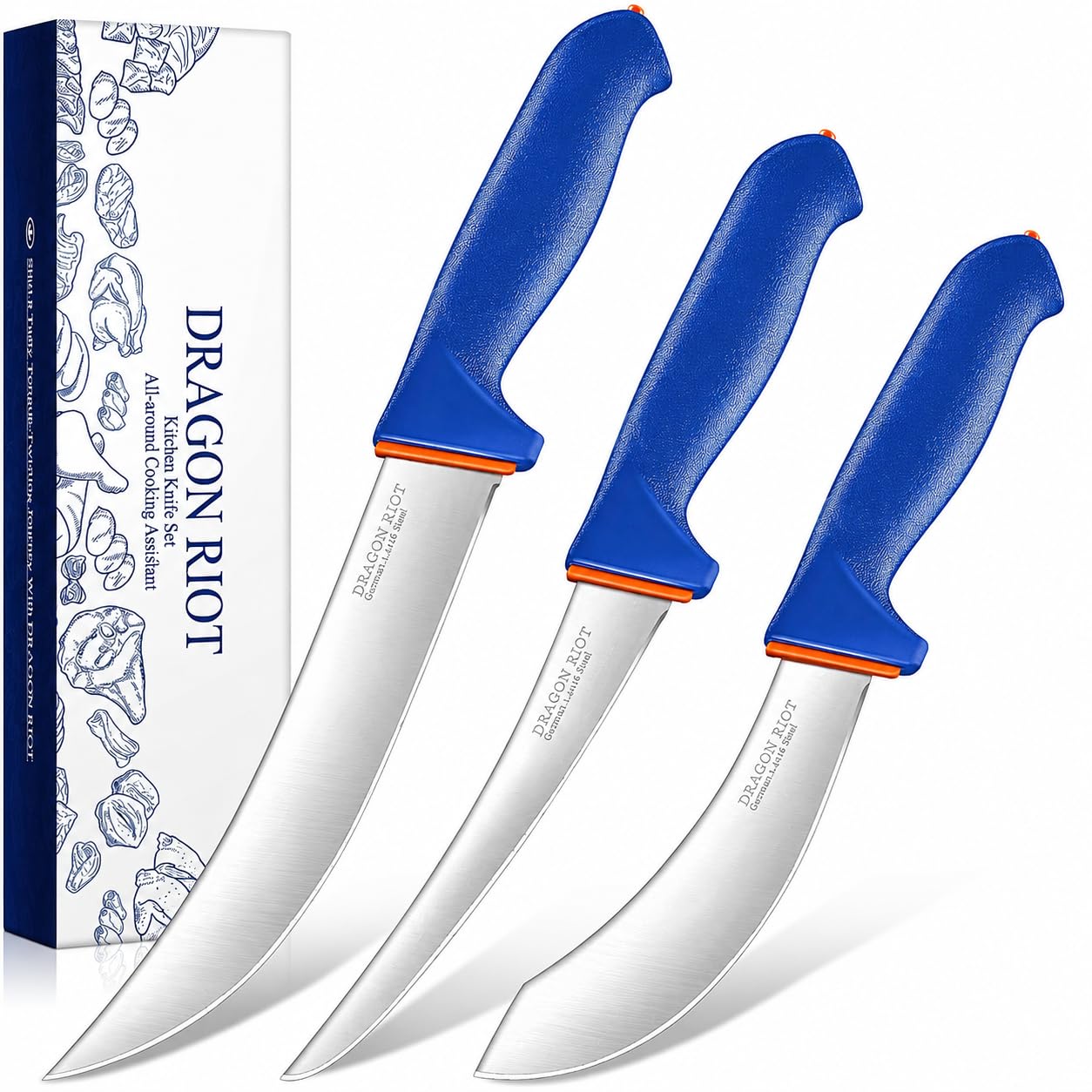
Three blades that cover boning, skinning, and breaking without you buying each one separately.
One knife rarely covers a whole animal, and that is the case for this set. You get a 6-inch boning knife, a 6-inch skinning knife, and an 8-inch breaking knife — the three shapes that handle separating, skinning, and portioning a deer or a big beef primal. The 8-inch breaking blade is 33% longer than the Mercer’s 6-inch boning blade, giving you the reach to divide a shoulder into roasts.
The steel is where the money went. German DIN 1.4116 high-carbon stainless at 58–60 HRC hardness, hand-polished to a 14–16 degree edge per side. That harness range is a real step up from entry stamped steel and is aimed at holding an edge through heavy cutting. Quality is what buyers praise most, with sharpness right behind — and the handle is a textured non-slip PP grip backed by a lightweight, balanced build. As owners put it, one school barbecue fundraiser trimmed and prepped 1700 chicken pieces and the knives “performed great.”
The catch is straightforward: ease of use drew mixed feedback, and the hardness that helps edge retention means a dull blade takes more effort on the hone than a soft one. There is also no full-tang claim here, so it is not a buy-it-for-decades heirloom. It is a strong first kit, not a pro-shop replacement.
Best for: Anyone processing whole game or large primals who wants the three core shapes in one package.
Not quite: A lifetime heirloom — the hard steel rewards maintenance and the handles are entry-tier.
5. F. DICK ErgoGrip Trimming Knife

A German workshop knife built for the wet, repetitive work of a real butcher’s block.
This one is aimed squarely at the person who stands at a block for hours. The 5.9-inch blade curves upward and widens toward the tip, which gives you more surface for long pulling cuts through fat and sinew. The handle is nonslip synthetic with an extra-wide thumb rest and finger protection — the safety details a working butcher notices on day one and a home cook notices after a close call. Owners mention it handles wet work without slipping and works well for processing game.
The steel sits at 56 HRC, and the maker is refreshingly direct about why: it is the compromise between holding an edge and being easy to resharpen. If you sharpen often rather than rarely, that trade works in your favor. The polished blade resists residue and corrosion, and the handle absorbs neither grease nor dirt — which is why the ErgoGrip line carries the American NSF hygiene seal.
The real caution is weight. At 0.86 kg it is by far the heaviest knife here — you are buying a dense, industrial tool, not a featherweight. That mass helps a long pulling cut but tires a casual cook. It is also a small-footprint blade at 5.9 inches, so it will not cover brisket or whole-roast carving.
The workshop logic: 56 HRC and a polished, low-residue blade make this a knife that sharpens back fast and cleans up faster. For someone processing frequently, that is the right compromise to choose.
Choose it if: You trim often, care about NSF hygiene and grip safety, and want a blade you can bring back to sharp quickly.
Think twice if: You want one knife for everything — 5.9 inches is a trimmer’s blade.
6. SMI 7 inch Solingen Butcher Knife

A 2.8 mm Solingen blade that carves and chops without asking much of your arm.
A 7-inch blade is the middle ground between a boning knife’s control and a slicer’s reach, and that is what makes this SMI versatile. The 1.1416 stainless steel is made in Solingen, Germany, and the 2.8 mm stock gives the blade enough rigidity to cut through bone and tough vegetables while still slicing meat cleanly. At 6.4 ounces it carries real presence in the hand without feeling like a cleaver.
What buyers consistently note is the cut quality — meat parts under it the way a hot blade goes through butter. The quality and sharpness are the two things people name, and the blade is described as sturdy and well-balanced with an edge that holds. The yellow polypropylene handle is ergonomic and bright enough that you will not lose it in a full sink, and the knife stretches to poultry, fish, vegetables, and fruit when meat is not on the menu.
Here is the fit note: the handle runs larger than most. A professional meat cutter found the 7-inch grip slightly wider than typical, which cut into control for smaller hands, while a larger-handed colleague loved it. If you have big hands, this is a comfortable pick; if you do not, handle it before committing. One long-term note also lands in its favor — a buyer who bought a small SMI knife years ago says it is still sharp, which says something about the steel and the way it was finished.
Reasons buyers stay happy
- 7-inch, 2.8 mm Solingen-ware blade cuts meat, bone, and produce.
- 1.1416 stainless steel that holds an edge through heavy sessions.
- Bright yellow handle is easy to find and easy to grip.
- Balanced at 6.4 ounces for controlled, low-effort carving.
The size footnote
- Handle runs large — a real fit issue for smaller hands.
- Not a dedicated boning blade despite the length.
Made for: Carvers who want one German-steel blade for roasts, poultry, and general prep.
Hold off if: Your hands are on the small side and a wider grip throws off your control.
7. Huusk Meat Cleaver Knife with Sheath

A thick-spined, hand-finished cleaver that chops chicken bones and holds its edge through it.
Start with the number that defines this knife: 58±2 HRC. That is a hard Japanese alloy steel, and the maker leans into the blade’s defining feature — unusual thickness. A thicker blade is stronger and less likely to break under a chop, which is exactly what you want when you are going through a chicken or turkey bone rather than around it. The 6.3-inch blade is hand-finished and manually sharpened.
The oak handle is the other half of the story. The arc is shaped to tuck into your palm and the maker weight-tests each knife to keep control in the cut. Quality is what buyers praise most, with sharpness right behind, and the weight and balance come up again and again as the thing that separates it from thin kitchen knives. For camp cooking and backyard grilling it makes a solid, confidence-inspiring tool.
Be clear-eyed about what it is: a thick, heavy chopper, not a delicate trimmer. Owners note the blade arrives with a protective coating you must wash off, and it is hand-wash and oil only — never the dishwasher. It is also too small for large cuts like big beef ribs, so it will not replace a proper breaking knife for a full animal.
The honest read: A 6.3-inch blade at 58±2 HRC with genuine thickness makes it a confident chopper for poultry and camp cooking. The same thickness that gives it strength makes it a poor choice for fine trimming.
Care commitment: Wash off the shipping coating, hand wash only, and oil the blade — this is a knife that asks for upkeep.
Good pick for: Outdoor cooks and grilling enthusiasts who want one rugged chopper for poultry and camp meals.
Skip if: You want a precision trimmer or plan to break down large beef cuts.
8. imarku Fillet Knife 6 Inch
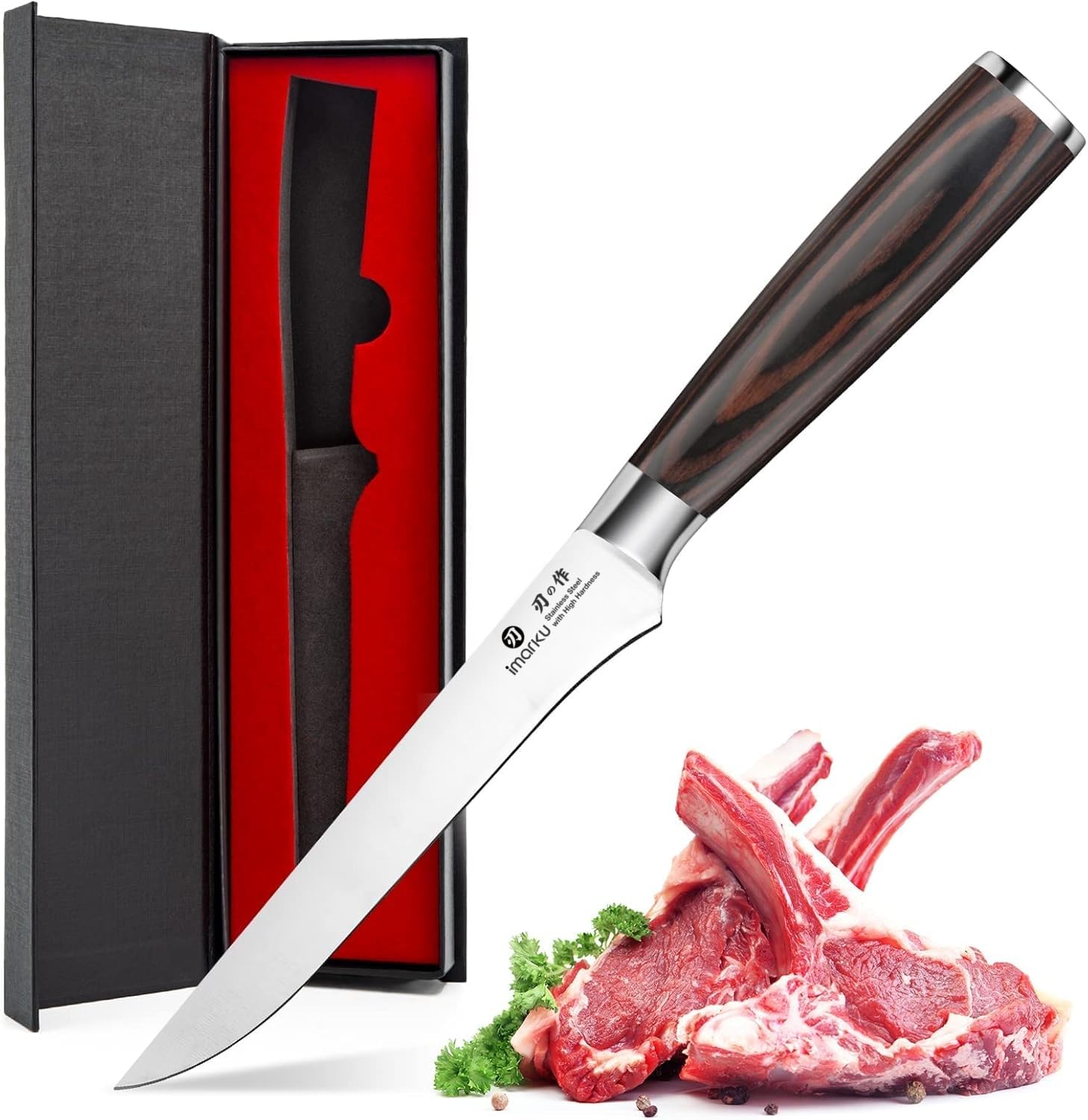
A narrow, forged Chinese-German steel blade that stays close to the bone when you fillet.
This is a deboning and filleting specialist, and the geometry tells you why. The 6.8-inch narrow blade is forged from high-carbon German stainless steel at 56 Rockwell hardness, and the forging process is aimed at both edge retention and corrosion resistance. The narrow profile and balance let you slice tight against a bone without wandering into the flesh. It handles filleting, skinning, trimming, and butterflying one after another.
The Pakkawood handle is a real upgrade at this point in the lineup — polished, non-slip, and built for maximum control with minimum effort. A forced tang and full forged construction give it a solid feel, and the knife arrives in a gift box with a satisfaction guarantee. Buyers describe it as luxurious to chop with, sharp from the start, and easy to hone — the kind of feedback that tells you the blade arrives ready to work.
Two things to plan for. First, hand washing is recommended; the dishwasher can damage the precise cutting edge. Second, at 0.31 kg it is heavier than a light stamped fillet knife, so if you want a featherweight that floats in the hand for a whole cooler of fish, you will notice the difference. It is a forge-weight tool, not a whisper-light one.
The forged advantage: 56 Rockwell German steel in a forged, narrow 6.8-inch blade gives you both edge retention and close-to-bone control. That combination is why it works equally on fish and poultry.
The habit it needs: Hand wash only, and respect the weight — this is a substantial forged blade, not a light stamped fillet knife.
Pick it for: Fish filleting, poultry deboning, and anyone who wants a forged blade with a polished Pakkawood grip.
Pass if: You want a thin, light fillet knife for hours of continuous filleting.
9. OUTDOOR EDGE WildPak 8-Piece Set

The field-to-freezer kit that covers caping, skinning, boning, and sawing a whole deer.
If you process game, this set is built for the job from gut to freezer. The eight pieces include a caping knife, a gut-hook skinner, a boning knife, a wood/bone saw, a ribcage spreader, game cleaning gloves, and a tungsten carbide sharpener — all in a hard-side carry case. The knives are full-tang 420J2 stainless steel, heat treated and taper ground, finished by hand to a shaving-sharp edge. High-visibility blaze-orange TPR handles stay grippy in the slickest field conditions, which is the difference between a safe cut and a bad one.
The case is the piece that makes this a system: every tool snaps into place so the kit stays organized, clean, and dry between trips. Hunters who have run this set for years call it durable and ready to use straight from the box. For the average hunter or processor it is a complete kit rather than a high-end single blade, and the edge will need occasional sharpening — but the included tungsten carbide sharpener means you touch it up in the field.
The trade-offs are honest. The steel is not premium, so edge retention falls short of an old high-end blade, and the case latch is the part most likely to give out first. There is also a learning curve: the gut-hook skinner and rib spreader take a little practice before they save you time. Still, as a single package for field dressing, it removes the guesswork of assembling a kit piece by piece.
What makes it a system
- Eight pieces cover caping, skinning, boning, sawing, and spreading in one case.
- Full-tang 420J2 stainless with heat-treated, taper-ground blades.
- Blaze-orange TPR handles stay visible and grippy when wet.
- Includes a tungsten carbide sharpener and hard-side carry case.
Limits to respect
- Edge retention trails premium steel — expect to touch up.
- The case latch is the weak point over years of use.
- Field-tool shapes take practice before you can work fast.
Built for: Hunters who want one complete, organized kit for field dressing and processing.
Not for: Someone who wants a single premium blade and nothing else.
10. Kai PRO 7″ Cleaver

A 7-inch cleaver with the mass and heat-treated edge to go through bone-in meat.
This is the knife for breaking down whole poultry and bone-in cuts, and its spec sheet explains why. The blade is a large, thick 7-inch slab of heat-treated German DIN1.14116 stainless steel, hand-sharpened to a 20-degree edge — a steeper angle than a thin fillet knife, chosen for strength. Twenty degrees is the kind of geometry that survives meeting a chicken rib cage over and over.
The contoured POM handle is riveted to a full-tang blade, so the whole tool is one stiff, confident piece in the hand. The maker puts it under the Kai PRO line, from the people behind Shun, and backs the blades with free sharpening and honing. Owners describe it as heavy, durable, and cutting through bone easily — which is the whole point of a cleaver.
The obvious caveat: a cleaver is a one-job tool. It is not a trimmer and it is not a slicer, so it is an addition to a processing kit, not a replacement for a boning knife. Its weight is part of the deal — you want mass for bone, and that mass makes delicate work impractical.
The heavy-lifting case: Thick, bone-ready steel at a 20-degree edge, riveted to a full tang, is exactly what you want standing over a bird with a cleaver. Free sharpening support underlines that this is a working tool.
Weight as a feature, not a bug: The mass that crushes bone is the same mass that makes it wrong for fine trimming — plan it as a companion blade.
Built for: Cooks who break down whole poultry and bone-in cuts and want one credible cleaver.
Add something else if: You also need to trim — this is not a boning knife.
11. Dalstrong 7-Inch Flexible Fillet Knife

A narrow, slightly flexible 7-inch blade that follows a fish’s contours and slides around pin bones.
Fillet work is its own discipline, and this knife is built for exactly that. The 7-inch blade is deliberately narrow with a slight flex, so it follows the contour of a bone and separates flesh cleanly. The tapered tip handles detailed trimming around bones and cartilage in fish and other proteins. The full-tang high-carbon blade is hand-polished to 16–18 degrees per side, a precise preparation grind, and the whole thing weighs 170 g.
What owners rave about is the feel — the ergonomics and craftsmanship get named over and over, with comfort that holds up in long sessions. The black G10 handle is triple-riveted to give a defined grip, so the blade does what you steer it to do. Customers note filleting rockfish and cod with little waste, and one professional says it glides through the tendons and silver skin on tenderloins and butterfly steaks.
The honest note: it does not hold an edge as long as a top-tier Japanese blade — one fillet regular notes it sharpens easily on a stone but does not retain like a Shun or Glestain. And flexibility is the whole point here; if you want a stiff blade for bone work, this is the wrong shape.
Why fish people keep it
- Narrow 7-inch blade with slight flex that follows fish contours.
- Hand-polished 16–18 degree edge for precise preparation cuts.
- Triple-riveted G10 handle gives a defined, lasting grip.
- Two sheaths included, so storage and transport are covered.
What to know before you buy
- Edge retention trails premium Japanese fillet blades.
- Flexible by design — not a tool for stiffness-dependent bone work.
Made for: Regular fish filleting and silver-skin trimming where feel and flexibility matter.
Wrong pick if: You need a stiff blade for hacking through bone and joints.
12. HOSHANHO Carving Slicing Knife 12 Inch

A 12-inch blade with a 15-degree edge that turns a brisket into clean, even slices.
Length is the whole argument here. A 12-inch blade lets you make one long pulling stroke through a brisket, a turkey, or a ham instead of sawing back and forth — and sawing is what shreds a good roast. The high-carbon Japanese steel is heat treated to stay hard while keeping enough toughness to resist breakage under pressure, and the edge is hand-sharpened at 15 degrees to cut with less resistance and less ingredient waste.
What buyers notice is how much less effort carving takes. The long blade handles roasts and poultry with fewer passes, and the engineered wood handle fits the hand well enough to keep control through the stroke. Quality is what buyers praise most, with sharpness right behind, and a working butcher singled it out as one of the sharpest edges they had used with a well-balanced weight.
The honest sizing note: this knife is nearly sword-length. It is excessive for small jobs and awkward to store — reviewers point out it can protrude from a magnetic block top and bottom. The included sheath is thin plastic that will wear. Great for big cuts, overkill for a chicken breast.
The long-stroke advantage: A 12-inch blade at a 15-degree edge means fewer passes through big cuts and cleaner slices. That is a real upgrade when brisket and whole birds are on your table.
Storage reality: It is a long knife — confirm your block, drawer, or wall magnet can take it before ordering.
Right choice for: Brisket, ham, turkey, and large roasts where a long single stroke matters.
Wrong fit if: Small everyday jobs dominate your prep — the length gets in the way.
13. Dexter Russell 3 Piece Knife Combo Set

Three workhorse blades — a flexible boner, a wide trimmer, and a 10-inch steak knife.
This set reads like a butcher’s starter drawer: a 6-inch curved flexible boning knife, a 6-inch wide trimming knife, and a 10-inch steak knife. The hollow-ground edge is the common thread, and a sani-safe polypropylene handle on each blade keeps the grips slip-resistant and easy to clean. For anyone who wants to break down chicken and primals without buying blades one at a time, this covers the three most-used shapes.
The reputation here is durability. Owners run these through dishwasher cycles and years of use, and the knives keep taking an edge. Quality is what buyers praise most, with sharpness close behind, and the set is described as cutting cleanly and smoothly rather than chopping — a sign of a good hollow grind and a stiff enough blade. For processing deer, shoppers say these outperform knives that cost considerably more.
The one to flag is cutting performance, which drew mixed feedback — a few owners found the geometry less ideal for certain tasks, though that is a small voice against a strong overall record. The larger caution is that this is a working set, not a showpiece; the white polypropylene handles are functional rather than pretty. If you want a knife you can leave out on display, look elsewhere.
What this set brings
- Three core shapes: 6-inch flexible boning knife, 6-inch wide trimmer, and 10-inch steak knife.
- Hollow-ground edges that take and hold an edge for a long time.
- Sani-safe handles are grippy and easy to clean.
- Durable enough that buyers keep them in rotation for years.
The practical catches
- Cutting performance drew mixed feedback from a minority of owners.
- Functional white handles, not display-grade looks.
Good for: Home processors who want three proven working shapes and care more about performance than polish.
Skip if: You want a single premium blade or display-worthy handles.
14. Cutluxe Butcher Knife Set, 5-Piece
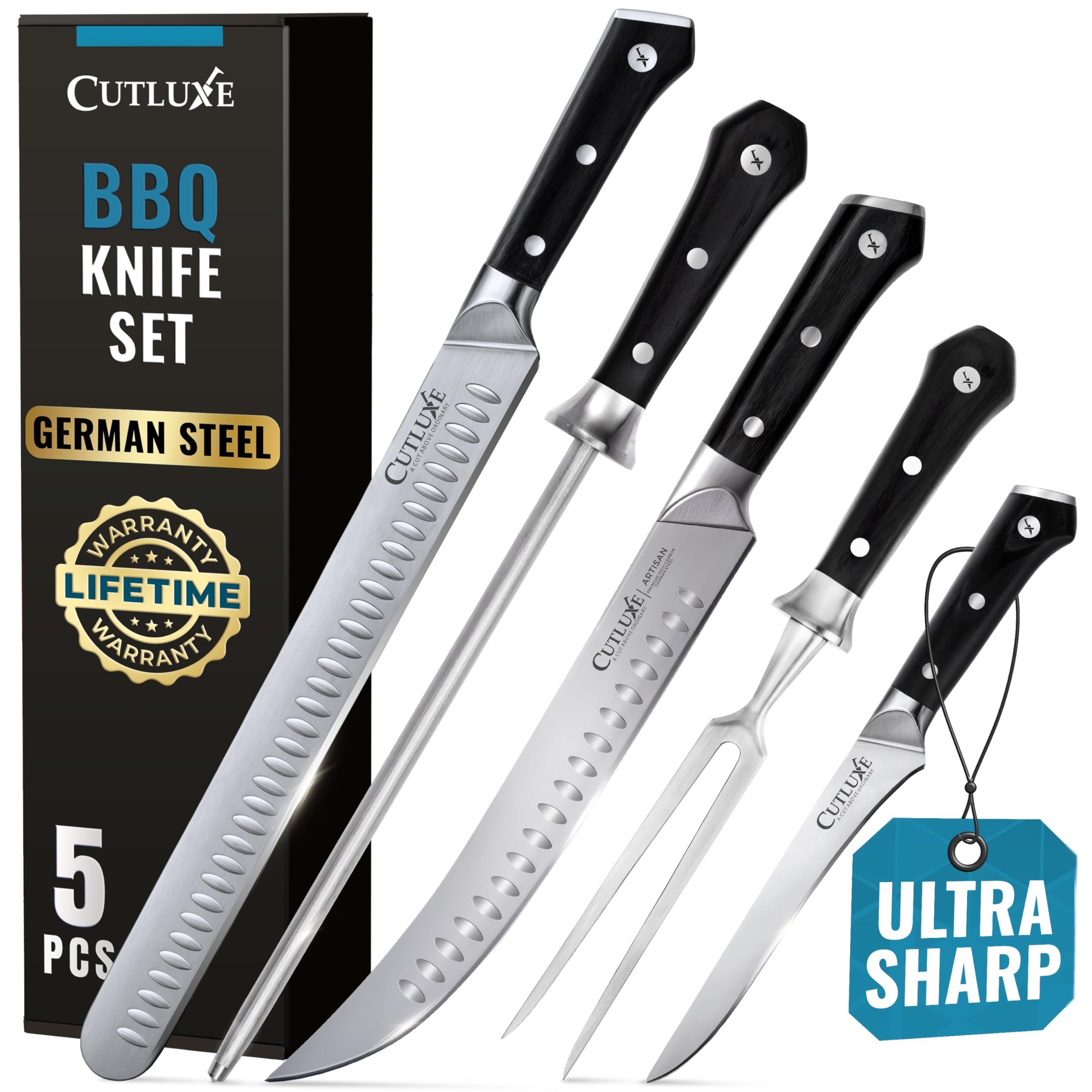
A five-piece barbecue kit that covers primals, brisket, trimming, and honing in one box.
Buy this if you cook whole primals and briskets, because the set is built around those jobs. You get a 12-inch brisket knife, a 10-inch breaking cimeter, a 6-inch boning knife, plus a 10-inch honing rod and a BBQ fork. The high-carbon German steel is rust resistant and full-tang, and the Pakkawood handles give a secure grip while you work through a long cook.
The knives are sharp enough that one buyer describes cutting through an 18 lb brisket like butter, and the steel quality is called out as exceeding top brands with good edge balance. The honing rod matters too: with a set this size, keeping every blade sharp between jobs is what makes the kit earn its place. Slicing knives here go thin and smooth through brisket, tri-tip, and corned beef, and the short blade handles fat trimming and vegetable prep.
The catch is the honing rod’s grit — one owner found it coarser than ideal for daily maintenance. It is also a set that assumes you are cooking big; if you mostly cut chicken breasts and vegetables, the 12-inch slicer and cimeter are more knife than you need.
The cookout case: A 12-inch slicer, a 10-inch cimeter, a 6-inch boner, a honing rod, and a fork form a complete brisket-and-primal kit in high-carbon German steel. That is the right shape for someone feeding a crowd.
What to accept: The included honing rod is coarser than some prefer, and the long blades make this a big-cook set rather than an everyday one.
Best suited to: Pitmasters and BBQ cooks breaking down primals and portioning briskets.
Not needed if: You mostly do small prep work and want a compact single blade.
15. DRGSKL Serbian Chef Knife Set, 10 PCS

Ten forged pieces in ATS-34 steel, hand-finished to a 16-degree edge and packed with a full accessory kit.
The number that matters here is 10. This is a full forged collection: ten cutters of various types, a portable leather pouch, a honing steel, a double-sided mini sharpening stone, a pair of cut-proof gloves, and poultry shears. The blades are forged from ATS-34 carbon steel and hand-finished to 16 degrees per side using a three-step Honbazuke process — a traditional sharpening sequence — then nitrogen cooled for hardness and flex. The full-tang build runs steel through the ebony handles, and a laser-carved index finger hole gives extra control.
What buyers praise most is quality, with sharpness second, and the appearance draws its own attention — the hammered texture on the blade both cuts resistance and looks the part. Buyers report the blades stay sharp after a year of daily use, and the set values up well against its price. The poultry shears turn out to be one of the standouts.
Two honest notes. First, the blades arrive pre-oiled to protect the carbon steel in transit — you must wash off that coating with dish soap before use. Second, durability drew mixed feedback: the knives themselves hold up, but the included roll bag is the weak link, with rivets reported popping after a few weeks. It is also a heavy, substantial set at 9.9 pounds, so plan storage space.
Why the kit lands
- Ten forged ATS-34 blades hand-finished to 16 degrees per side.
- Full accessory kit: leather pouch, honing steel, sharpening stone, gloves, and shears.
- Hammered blade texture reduces drag and looks striking.
- Full-tang ebony handles with a finger hole for control.
Where the kit falls short
- The roll bag is flimsy — rivets have been reported popping.
- Blades ship pre-oiled and must be washed before first use.
- A heavy, substantial set at 9.9 pounds.
Made for: Anyone who wants a complete forged kit with all the accessories in one purchase.
Look past it if: You want a minimal, premium two-knife drawer — this is a full set.
Know the Specs
Blade length and curve
Blade length decides which job a knife can do. A 5.9 to 6.5-inch curved blade handles boning and trimming because it turns tight around bones. A 7 to 8-inch breaking blade adds reach and weight to divide primals. A 12-inch blade is a slicer, built for long single passes through a brisket or ham. Choose the blade length for the cut you make most, not the other way around.
Steel hardness (HRC)
The HRC number is the Rockwell hardness of the steel — how well it resists dulling. Higher hardness (like 58–60 HRC) holds an edge longer but takes more effort to resharpen. A mid value like 56 HRC is the maker’s balance between edge retention and easy resharpening. Harder steel holds an edge longer; softer steel hones back faster — pick based on how often you want to touch up the blade.
Stamped versus forged, full-tang
A stamped blade is cut from a sheet of steel — lighter, more flexible, less expensive. A forged blade is shaped from heated steel — denser, stiffer, and usually pricier. Full-tang means the steel runs all the way through the handle, which adds balance and durability. Stamped knives flex nicely for trimming; forged full-tang knives feel solid for heavy chopping.
Edge angle per side
An edge angle is how steeply the blade is ground down to the cutting edge. A 13–16 degree edge is thin and slices quickly. A 20-degree edge is stronger and more likely to survive hitting bone or a cutting board over and over. Match the angle to the job: thin for fish and trimming, steeper for cleavers and bone-in work.
Common Questions
What is the difference between a boning knife and a breaking knife?
Do I need a flexible blade or a stiff one for deboning?
Can these meat knives go in the dishwasher?
What does the HRC number mean on a meat knife?
How long should a meat processing knife last?
Is a cleaver better than a boning knife for breaking down chicken?
What blade length is best for slicing brisket?
Do I need a honing rod with a meat knife set?
Are these knives safe to use with wet hands?
Can I sharpen these knives at home myself?
The Bottom Line
For most people breaking down meat at home, the meat processing knives pick that earns your attention first is the Victorinox Fibrox 8-Inch Curved Breaking Knife, because its curved 8-inch stamped blade handles both the heavy breaking work and the carving, and its non-slip Fibrox handle stays steady when the board gets slick. If you want a full-tang precision deboner for poultry and silver skin, reach for the KYOKU 6.5″ Boning Knife. And for processing whole game from field to freezer in one organized kit, the OUTDOOR EDGE WildPak 8-Piece Set is the one to carry. The short version: the Victorinox is the crowd favorite, and it is the one worth starting with.
How we choose
We do not accept paid placement. Every pick is matched to a real buyer and a real use-case; we do not hands-on test units.
Sources
Specifications: manufacturer listings and product documentation. Review insights: verified customer reviews, as of October 2026. Pricing: not shown on this page (it changes often); check the current price via the retailer link.
As an Amazon Associate, Aappliancez earns from qualifying purchases. This does not affect which products we feature.