Disclosure: Some links in this post are affiliate links. As an Amazon Associate I earn from qualifying purchases, at no extra cost to you. Learn more
Specs are compiled from manufacturer listings and verified buyer reviews and can change over time — please confirm the key details on the product page before buying.
For roasting, bread baking and stews for a family of four, the Römertopf 3.2-quart clay roaster is the one to buy. It is the crowd favorite at 4.5+ stars across 700+ ratings, and it holds up to 500 degrees Fahrenheit (hot enough for most oven recipes). Everything else on this list is a specialist: a bean olla for frijoles, a cazuela for serving, a dolsot for bibimbap, a tagine for slow braises. Pick the dish you actually cook most, then buy the pot built for it.
This guide is built by comparing the manufacturers’ published specifications and the patterns across verified customer reviews, so you get each pick’s real strengths and trade-offs instead of marketing spin.
Clay cookware rewards a little patience up front and punishes sudden temperature swings, so the first thing to learn is how each pot wants to be heated. Here is how the leading clay pots for cooking actually perform in a normal kitchen.
Top Picks


How To Choose The Best Clay Pots for Cooking
Clay is not one material. The pot that makes perfect frijoles will crack on a ripping gas burner, and the bowl that sizzles bibimbap is the wrong shape for a chicken. Before you compare any two pots, settle three things: what heat source you own, how many people you feed, and whether the inside is glazed or bare.
Glazed versus unglazed, and why it changes everything
A glazed base is sealed with a glass-like finish, so it wipes clean and will not soak up sauce — that is why the Römertopf and the Eurita glaze only the bottom and leave the lid bare. An unglazed pot is porous on purpose. It breathes, releases steam slowly and picks up the character of what you cook in it, but it needs seasoning and gentle washing. Neither is better; they suit different dinners.
Match the pot to your burner
Gas flames and electric coils hit a clay base unevenly. Many of these pots ask for a heat diffuser — a simple metal disc that sits between burner and pot and spreads the heat. Some, like the 1.9-quart BSONEDO and the Korean dolsot bowls, state their limits plainly, and induction is off the table for several. Check the burner compatibility line before you fall for the shape.
Capacity is the spec buyers misjudge most
A 1.5-quart curry pot looks generous online and arrives small enough for two modest servings. The 15.2-ounce cazuelas are appetizer dishes, not dinner pots. If you cook for four, aim for the 3.2- to 4.5-quart range; if it is rice for one, the sub-2-quart sizes are right. Read the quarts, ignore the adjectives.
Plan for the learning curve
Clay heats slowly and holds heat long after the burner is off — that is the whole point, and also the whole risk. Never add cold water to a hot pot. Never dry-heat an empty one. Let it cool before washing. Follow that routine and an earthenware pot survives years of oven heat.
Side-by-Side Comparison
| Model | Best For | Capacity | Material / Finish | Heat Sources | Amazon |
|---|---|---|---|---|---|
| Römertopf Clay Roaster 3.2 qt★ Best Overall | All-round roasting and bread | 3.2 quarts | Ceramic clay, glazed base | Oven and microwave to 500°F | Amazon |
| Ancient Cookware Mexican Lidded Cazuela 4.5 qtBest for Big Batches | Big-batch stews and beans | 4.5 quarts | Natural clay, glazed finish | Gas, electric, glass top, oven, microwave, grill | Amazon |
| Ancient Cookware Bean Olla 3 qtBest Bean Pot | Frijoles de la olla | 3 quarts | Clay, lead-free glaze | Gas, electric, glass top, oven, microwave, grill | Amazon |
| Ancient Cookware Indian Curry Pot 1.5 qt | Dal and fish curry | 1.5 quarts | Unglazed clay, lead free | Stovetop, oven | Amazon |
| Restaurantware-Terra Tek 15.2 oz Cazuelas (2) | Tabletop serving dishes | 15.2 ounces each | Terracotta, glazed interior | Oven and microwave | Amazon |
| Vyatka Stoneware Ramekin with Lid | Single-serve soups and yogurt | 500 ml (16.9 fl oz) | Natural clay stoneware | Oven, stovetop, microwave | Amazon |
| BSONEDO 1.9-Quart Clay Pot | One-pot meals for two | 1.9 quarts | Ceramic, uncoated | Gas, electric, oven — not induction | Amazon |
| ElinCube Korean Stone Bowl with Lid & Tray | Sizzling tabletop serving | 37 oz | Stoneware, natural finish | Gas, oven, microwave, dishwasher | Amazon |
| OnggiJonggi Clay Hot Pot 1400 ml | Rice and Korean stews | 1400 ml | Terracotta, polished | General stovetop cooking | Amazon |
| Crazy Korean Cooking Stone Bowl 44 fl oz | Bibimbap and one-pot meals | 44 fluid ounces | Stoneware, double-fired glaze | Gas, electric, oven, broiler, microwave, dishwasher | Amazon |
| Toque Blanche Chamba Pot 1.5 qt | Stove-to-table soups | 1.5 quarts | Black earthenware, uncoated | Gas, electric, oven, microwave | Amazon |
| Swadeshi Blessings Clay Pot 2.8 L | Slow-cooked curries and dal | 2.8 liters | Unglazed clay, stone-polished | Gas, microwave, traditional chulha | Amazon |
| Hakan Suphan 7.6-Quart Clay Pot | Huge batches and rice | 7.6 quarts | Unglazed terracotta | Stovetop and oven | Amazon |
| Kamsah Moroccan Tagine 5.5 qt | Slow braises and presentation | 5.5 quarts | Lead-free clay, non-stick ceramic | Stovetop and oven | Amazon |
Detailed Reviews
1. Römertopf Clay Roaster, 3.2 Quarts
Our pick — 4.5+★ from 750+ verified ratings; the strongest balance of quality and price.
The 3.2-quart clay roaster that feeds four and doubles as a bread oven.
Here is the pot to buy if you have not decided what kind of clay cook you are yet. The Römertopf holds 3.2 quarts — enough for a 5.5 lb roast, a casserole, or a loaf — and the glazed base means it wipes clean instead of soaking up the pan juices. It goes in the oven or the microwave and takes heat up to 500 degrees Fahrenheit.
The method is the interesting part. You soak the unglazed lid in water first. During cooking that water evaporates into a mantle of steam that bastes the food from above, and the lid is deliberately loose so a little escapes. That is why the quality of the clay is what wins people over — the soaked lid bastes a 5.5 lb roast without basting. Cooking performance follows: roasts brown evenly and need little added fat.
Compared with the BSONEDO 1.9-quart below, this is the wider, longer vessel — 13.7 inches of length against a compact 10-inch round — so it fits a whole chicken or a full loaf where the smaller pot cannot. It is not a stovetop pot, so no searing on the burner, and the loose lid means you should not expect a pressure-tight seal.
The reasons it earns the top slot
- 3.2-quart capacity feeds up to four people, with room for a 5.5 lb roast
- Glazed base cleans easily; the lid is the only part that needs soaking
- Oven and microwave safe up to 500 degrees Fahrenheit
- Made without lead, cadmium or fillers and safety-tested in Europe and the USA
Where it asks for patience
- The lid is intentionally not a tight fit, so steam escapes by design
- Oven-only — there is no stovetop searing step in this pot
Buy this one if: you want a single do-everything clay vessel for roasting, casseroles and bread.
Pass if: you want to brown meat on a gas flame first — this one lives in the oven.
2. Ancient Cookware Mexican Lidded Cazuela, 4.5 Quarts
Eleven and a half inches of clay that goes from flame to grill to table.
This is the biggest all-round pot on the list, and the one that shrugs off the widest range of heat. The 4.5-quart cazuela measures 11.5 inches across and takes gas, electric, glass stovetops, the oven, the microwave and the grill. Nothing else here covers that spread.
Set it beside the Indian curry pot further down and the difference is stark: 4.5 quarts against 1.5 quarts, and 6.8 pounds against 3.3 pounds. That extra heft is the mass that keeps stew warm through a long second helping — the pot is made to hold heat, and it does.
It is handcrafted in Hidalgo, Mexico from natural clay, certified lead free and glazed, and it arrives with a care and use sheet. The look is a large part of the appeal — the finish and shape get called out as bonita, and it earns its place as a serving piece as much as a cooker. Behind all of that, what people keep coming back to is plain function: beans, stews and braises come out right.
The honest friction point: at 6.8 pounds empty and 15 inches wide edge to edge, this is a two-handed lift when it is full of hot stew. On an electric stove, it also needs a heat diffuser (a metal plate that spreads the burner’s heat) so the pot heats evenly.
Where it wins: the largest capacity here paired with the most forgiving burner list makes it the family pot.
Reach for this if: you cook for a crowd and want one vessel that handles beans, stew and a grill finish.
Think twice if: your cabinet space is tight — this one wants a wide shelf.
3. Ancient Cookware Traditional Mexican Bean Olla, 3 Quarts
A belly-shaped olla whose only job is to turn a pound of beans into something worth waiting for.
Three quarts, and it is aimed at one job: simmering. The olla shape narrows at the neck and widens at the belly, which is why cooks use it for frijoles de la olla — the pot is listed with a simmering purpose and a lead-free glaze inside. It works on gas, electric, glass tops, the oven, the microwave and the grill.
What people rave about is the design as much as the cooking — it looks handmade because it is, and it goes straight to the table. As for capacity, buyers report it is “just the right size for 1/2 pound of beans,” which is the honest read: this is a bean pot, not a party cauldron. Expect the usual clay ritual of curing it first; the garlic-rub method some owners follow takes an afternoon but sets the pot up for years.
A heat diffuser is not optional on an electric range — that comes up again and again because a direct coil concentrates heat in one spot and clay does not like it. There is also a mixed feel about the value question, so size your expectations to three quarts rather than assuming restaurant-scale output.
What makes it worth the shelf space
- 3-quart olla shape purpose-built for simmering beans
- Lead-free glaze; certified safe for food use
- Handmade in Hidalgo, Mexico, and handsome enough to serve from
- Gas, electric, glass top, oven, microwave and grill compatible
Set your expectations straight
- Needs a heat diffuser on electric ranges to protect the base
- Must be cured before first use, which adds a day to the process
The right buy for: anyone chasing that slow-simmered bean flavor that a metal pot never quite delivers.
Look elsewhere for: large-volume cooking — three quarts is family-side-dish territory.
4. Ancient Cookware Indian Clay Curry Pot, 1.5 Quarts

A small unglazed pot that makes dal taste like it took all day, because it does.
Unglazed, 100 percent lead free, and made the rustic way — the listing says so plainly, and that is the whole charm. This medium pot holds 1.5 quarts, which is the right amount for dal or a fish curry for two. Where it shines is flavor: owners mention that “food tastes really good when cooked in this,” and the same cooking habits earned one customer a pot that was still “in great shape” after two years of regular use.
The trade-off is time and temperature control. Slow cooking is the point, so dishes take longer than they would in metal, and a burner that cannot go low enough will push a simmer into an overflow. Several owners end up finishing in the oven for that reason. Be aware, too, that this size is genuinely small — one buyer found it “very small size than expected,” so measure your servings before you commit.
Unglazed clay is also the most demanding of the pot types here: it wants a full seasoning, gradual heat, and no shortcuts. Season it fully and heat it gradually and dal tastes deeper than enamel gives; skip either step and thermal shock splits the unglazed clay.
Why curry cooks like it
- 1.5-quart size suits dal and fish curry for two
- 100% lead-free unglazed clay for a traditional result
- Flavor is the standout — dishes taste notably better than in metal
- Holds up: still in good shape after two years of regular use
What to budget for in patience
- Slow by nature — expect longer cook times than metal pots
- Unglazed clay calls for full seasoning and careful, gradual heating
- Runs small; confirm 1.5 quarts covers your portion size
Choose it when: flavor matters more to you than speed, and you cook Indian dishes regularly.
Not the one if: you want a low-maintenance pot you can bang around — unglazed clay wants gentle handling.
5. Restaurantware Terra Tek 15.2-Ounce Cazuelas, Set of 2

Two shallow terracotta dishes that go from oven to table and straight into the dishwasher.
At 6.3 inches across and 1.6 inches tall, these are shallow bowls, not cooking pots, and you should buy them knowing that. Each holds 15.2 ounces — a roasted tomato appetizer, a small dip, a single portion of cazuela. Compare them with the 8-inch bean olla above and the gap is obvious: these are serving vessels first.
What they bring is convenience that the deeper clay pots cannot. They are oven-ready, microwavable, freezable and dishwashable, so the cleanup is a rinse-and-rack job. The glazed interior looks good on the table, and buyers are “super happy with these” — though the same buyer noted they are “a little small,” and admitted the measurements were the thing they had not checked.
Quality is the strength here relative to the price; size is where it goes mixed. Measure your intended portion before ordering, and remember that a rare shipment can arrive with a cracked rim — terracotta in transit is a fragile thing, so inspect on arrival.
Cleanup and serving: dishwashable and freezable, with a glazed interior that dresses up a table — rare in clay this affordable.
Measure before you buy: 15.2 ounces per bowl is appetizer scale, so four people means two sets.
Buy them for: tapas nights, dips and small baked appetizers where the dish is also the presentation.
Look past them for: main-course cooking — this set is small on purpose.
6. Vyatka Ceramics Stoneware Ramekin with Lid, 500 ml

A lidded clay bowl that turns a single portion of soup into something presented.
Stoneware behaves differently from raw earthenware: it is fired at high temperatures, which makes it resist chipping and scratching, and it is non-porous, so it will not hold onto the smell of garlic or onion. That matters if you plan to make yogurt in it one day and a curry the next — as one buyer does, and reports it “works great” for yogurt.
The capacity is 500 ml, about 16.9 fluid ounces, which is one generous bowl of soup or a dip to share. It is safe on the oven, stovetop and microwave, and it goes in the dishwasher. The lid is natural clay and the whole thing weighs just 1.2 pounds.
The one honest catch is fragility in shipping — one owner found it “came chipped around the mouth of the bowl” even though the pot itself was as pretty as the listing. Inspect the rim on delivery. Beyond that, this is a small, well-made single-serving piece, and the size is the constraint rather than the build.
Suits you if: you want individual bowls that can go from fridge to oven to table without picking up yesterday’s flavors.
Skip if: you cook for more than one — 500 ml is a single serving.
7. BSONEDO 1.9-Quart Clay Pot with Lid

The compact black pot that earns its keep from beans to oatmeal to a grill.
You get 1.9 quarts and no synthetic nonstick coating — the ceramic is fired uncoated, which means it is meant for slow simmering and finishing on the table. It handles gas and oven heat, and the listing says plainly it is not compatible with induction. Heat gradually over low to medium and it behaves.
The versatility is what people keep bringing up: owners use it for beans, split peas, oatmeal, rice and casseroles, and one runs it in a large toaster oven, a propane grill and on the cooktop. It weighs 4.4 pounds, so it is stable in the oven and steady on the burner. The black finish looks good enough to serve from, and the pot is generally reported as easy to clean.
The caution flag is durability under heavy use — chips and staining are the recurring story, and one pot developed a crack on its first use. That is not a reason to walk away, but it is a reason to treat it gently: no dry heating, no cold water into a hot pot, and hand wash after it cools. Season it fully before first use and heat it slowly; skip either step and the uncoated ceramic chips or stains.
The everyday case: 1.9 quarts and 4.4 pounds makes this the easiest pot here to move from cabinet to oven to table.
Babysitting required: avoid dry heating and sudden temperature changes, and wash it by hand once it has cooled.
Pick this for: one- and two-person households that want a stovetop-and-oven clay pot for daily use.
Choose something else if: you need induction compatibility — this one is gas, electric and oven only.
8. ElinCube Korean Stone Bowl with Lid and Tray, 37 oz

A 37-ounce sizzling bowl that comes with the tray your table needs under it.
Dolsot cooking works on a simple principle: the heavy stoneware bowl gets hot, the food goes in, and the residual heat keeps it sizzling while you eat. This set gives you 37 ounces of high-density ceramic stoneware plus a heat-resistant serving tray built for exactly that — the tray protects your table from a bowl that is still radiating after it leaves the stove.
Inside the bowl, quality is what owners notice first, and the heat retention second — soup and rice stay hot long enough that the flavor deepens as you eat. It works on gas, in the oven, in the microwave and in the dishwasher, though not induction. The lid is clay and the whole set is built to look traditional on a modern table.
The friction point is handling. The bowl is 3.7 pounds and the side handles are small, so carrying it hot takes care and a proper grip. There is also mixed feedback on size — one serving to some, too small to others — so think of 37 ounces as one substantial portion rather than a shared dish.
What lands well
- 37-ounce capacity for one generous bibimbap or stew serving
- Heat-resistant tray included, so a hot bowl can go straight to the table
- High-density stoneware holds heat well past the first bite
- Dishwasher safe and compatible with gas, oven and microwave
The handling caveat
- Small side handles make a hot bowl awkward to carry
- Size reads as single-serving to most, not family scale
The one for: a Korean-food cook who wants the real sizzle-and-serve ritual at home.
Look past it if: you want a pot you can pick up confidently with bare hands — this bowl runs hot.
9. OnggiJonggi Korean Earthenware Clay Hot Pot, 1400 ml

An onggi-style earthenware pot that makes plain rice taste like more than rice.
Handmade by the traditional Onggi method, this pot is 1400 ml — roughly 1.5 quarts — and made from natural materials that the listing describes as toxic-free, chemical-free and lead-free. The earthenware body releases its heat slowly, which is why it is prized for stews, soups, braises and rice.
The rice is the killer feature. Customers note it keeps rice at temperature without turning sticky or dry. The heat distribution is the standout technical story: an even spread across the base so the bottom does not scorch while the middle catches up. Cleanup is easier than you would guess from a bare-clay pot. It is a classic in Korean kitchens for a reason.
Temper the enthusiasm with reality: size runs smaller than some expect for a 1.5-quart vessel, and durability is a mixed picture with some pots doing fine and others not. Warm it gradually over low heat and it keeps rice hot for years.
Rice is the specialty: even heat distribution and a porous terracotta body keep grains separate and hot through the meal.
Watch the size: 1400 ml reads large but delivers about 1.5 quarts — smaller than the number suggests.
For you when: rice is the dish — this is a dedicated earthenware vessel for it.
Not the one for: large stews feeding a family; 1400 ml is a small pot.
10. Crazy Korean Cooking Stone Bowl (Dolsot), 44 fl oz
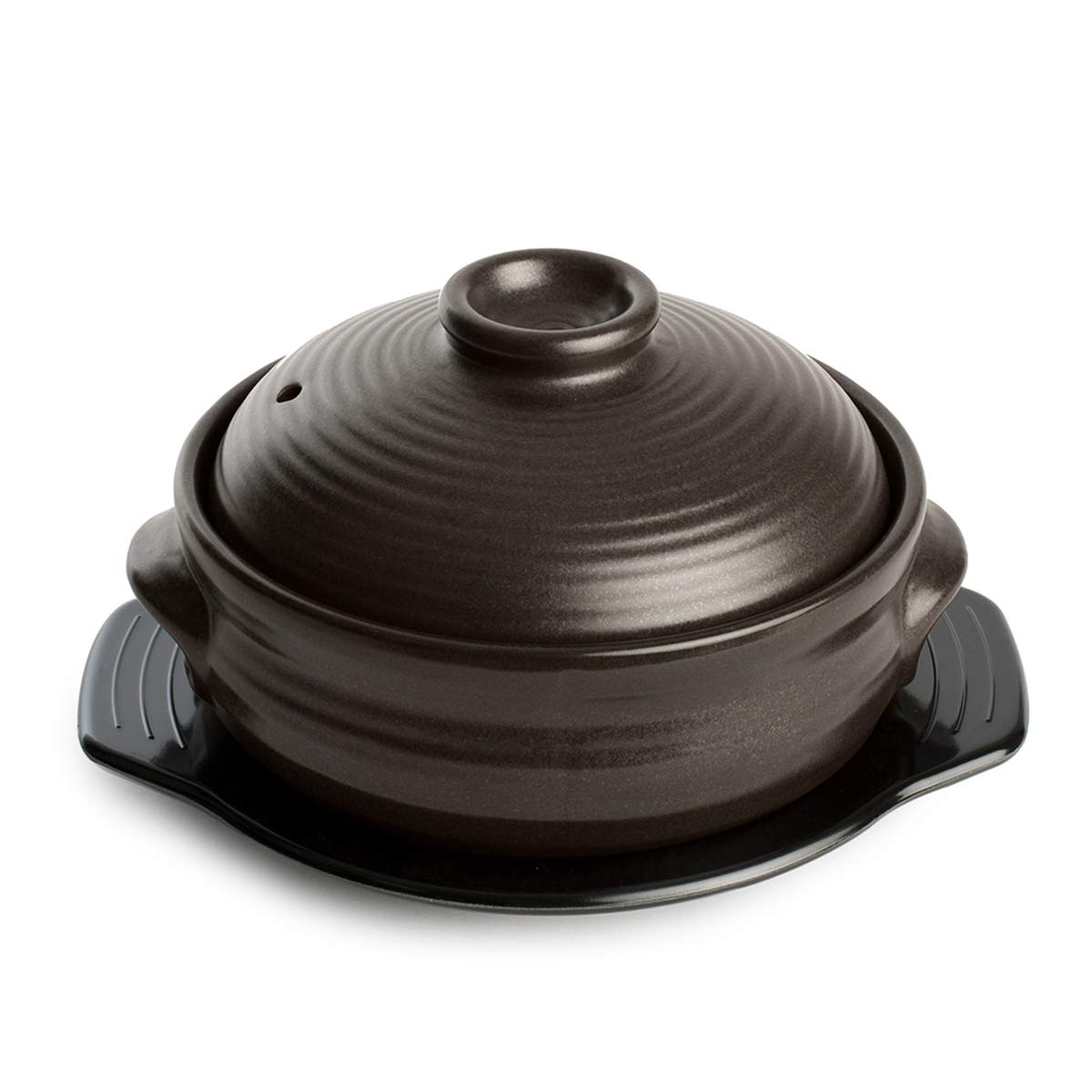
Forty-four ounces of double-fired stoneware that keeps a stew sizzling to the last spoonful.
This is the dolsot that Korean-cooking enthusiasts reach for when they want the real thing. It holds 44 fluid ounces, is made in Korea from fine clay glaze-fired twice, and comes with a heat-resistant trivet so the bowl can go from the burner to the table without a scorched surface. Lead, cadmium and arsenic are all out; the finish is a natural glaze.
What makes it worth the higher price is the combination of heat retention and versatility. It works on gas or electric stovetops, in ovens, under a broiler and in the microwave, and it is dishwasher safe — a rare set of permissions for a stoneware bowl. Food keeps more of its heat and flavor than it would in metal, and it does not pick up a metallic taste.
There is one manufacturer note worth remembering: the plastic trivet that comes with it must not go on the stove or in the oven. Also, like all dolsot bowls, the handles are small; grip the sides with a thick cloth, not bare fingers. The size is generous for one big bibimbap or a shared soup.
The case for it
- 44-ounce capacity — large for one hearty bibimbap serving
- Works on gas, electric, oven, broiler and microwave; dishwasher safe
- Double-fired natural glaze; lead, cadmium and arsenic free
- Includes a heat-resistant trivet so it can go straight from stove to table
Know before you buy
- Plastic trivet must never touch the stove or oven — a manufacturer warning worth heeding
- Handles are small, so a hot bowl needs a thick cloth to lift safely
Get this if: you want a dolsot that is equally at home under a broiler and on a dinner table.
Be careful if: you plan to pass it around the table — it is heavy when full and hot.
11. Toque Blanche Chamba Soup & Bean Pot, 1.5 Quarts

A black clay pot from Central Colombia that turns soup into something slow and earthy.
Handmade from local clays and fired in a traditional method by artisans in Central Colombia, this 1.5-quart pot is uncoated earthenware with handles and a lid. It works on gas and electric stoves, in the oven, in the microwave, and even on the tabletop — which means the transition from cooking to serving involves no extra dishware.
The unglazed interior is the reason to choose it. Because the clay is porous, steam can evaporate naturally while the pot holds heat, so a stew comes out moist and tender rather than boiled. The black finish has a character all its own, and every piece is slightly different because it is fired by hand.
The catch on a pot this size is that 1.5 quarts feeds one or two, not a family, and the 6-pound weight makes it a substantial lift when full. It also needs the normal clay courtesies — gradual heat, and no cold water into a hot pot.
Best suited to: cooks who want a serving vessel and a cooking pot in one rustic black-clay piece.
Think twice if: you need volume — 1.5 quarts is a small pot for the shelf.
12. Swadeshi Blessings Handmade Unglazed Clay Pot, 2.8 L

The pot that comes with a woven rest, a cleansing ritual, and a grandmother’s-flavor promise.
This is a 2.8-liter handmade unglazed clay pot, rubbed with stone until it takes on a mirror-like finish. It comes with a palm leaf stand to rest the hot pot on, plus clear pre- and post-care instructions that one owner called out specifically. That guidance makes the first week with clay far less intimidating.
What reviewers point out is the flavor. One reviewer noted food cooked in it “reminded me of my grandmas cooking,” and that is the appeal of bare clay: it breathes, it holds heat, and it develops character. The pot is compatible with gas stoves, microwaves and traditional chulhas, and it can double as tableware for serving or storage.
The honest reality is a split verdict on value and function. Several people find it needs patience compared with ordinary cookware — you season it, you heat it gradually, you clean it carefully. One owner simply did not get along with it at all. That is not a reason to avoid the pot, but if you want no-fuss cookware, this is not it.
Where it shines: the mirror finish, the palm leaf stand and the care sheet make it feel like a considered piece rather than a commodity pot.
Where it divides opinion: bare clay demands seasoning and gradual heat, which some cooks find rewarding and others find tedious.
A good fit for: traditional slow-cooking of curries, dal and rice, especially where you want a serving piece too.
Not for you if: you want a pot that behaves like a nonstick pan — this one wants care.
13. Eurita Clay Roaster, 4 Quarts

Four quarts and enough room to hold a bird, a roast, or a sourdough loaf.
If the Römertopf at the top of this list is the sensible all-rounder, the Eurita is its bigger sibling. Four quarts of capacity holds up to 11 pounds, and the glazed bottom is lined with glass frit so it wipes clean. It takes oven and microwave heat up to 500 degrees Fahrenheit, and it ships with a free recipe guide and a digital instruction set.
The method matches the Römertopf: soak the unglazed lid, let the water evaporate into a blanket of steam, and rely on the deliberately loose lid to release a little along the way. Where it proves itself is in the oven — tender roast chicken, beef and pork roasts, and sourdough bread with a crust that is hard to get without steam. Buyers also find it easy to clean and simple to use.
Compared with the BSONEDO 1.9-quart pot above, this is more than twice the capacity at 4 quarts — enough for a whole chicken rather than a two-person stew. Its 8-pound weight is the trade: lifting a full roaster out of a hot oven takes both hands. A minority of owners have seen cracks appear in the ceramic coating, so treat temperature changes respectfully.
What makes it a serious roaster
- 4-quart capacity holds up to 11 pounds of food
- Oven and microwave safe up to 500 degrees Fahrenheit
- Glazed glass frit bottom makes cleanup easy
- Recipe guide and instructions included — no guesswork
Weigh these before ordering
- At 8 pounds empty, a full roaster is a two-handed lift from the oven
- Its loose lid lets some steam escape, so it is not a sealed vessel
The fit for: anyone roasting a whole bird or baking sourdough who wants capacity and a steam lid.
Skip if: you cook small portions — four quarts is a lot of pot for one.
14. Hakan Suphan Handmade Clay Cooking Pot, 7.6 Quarts
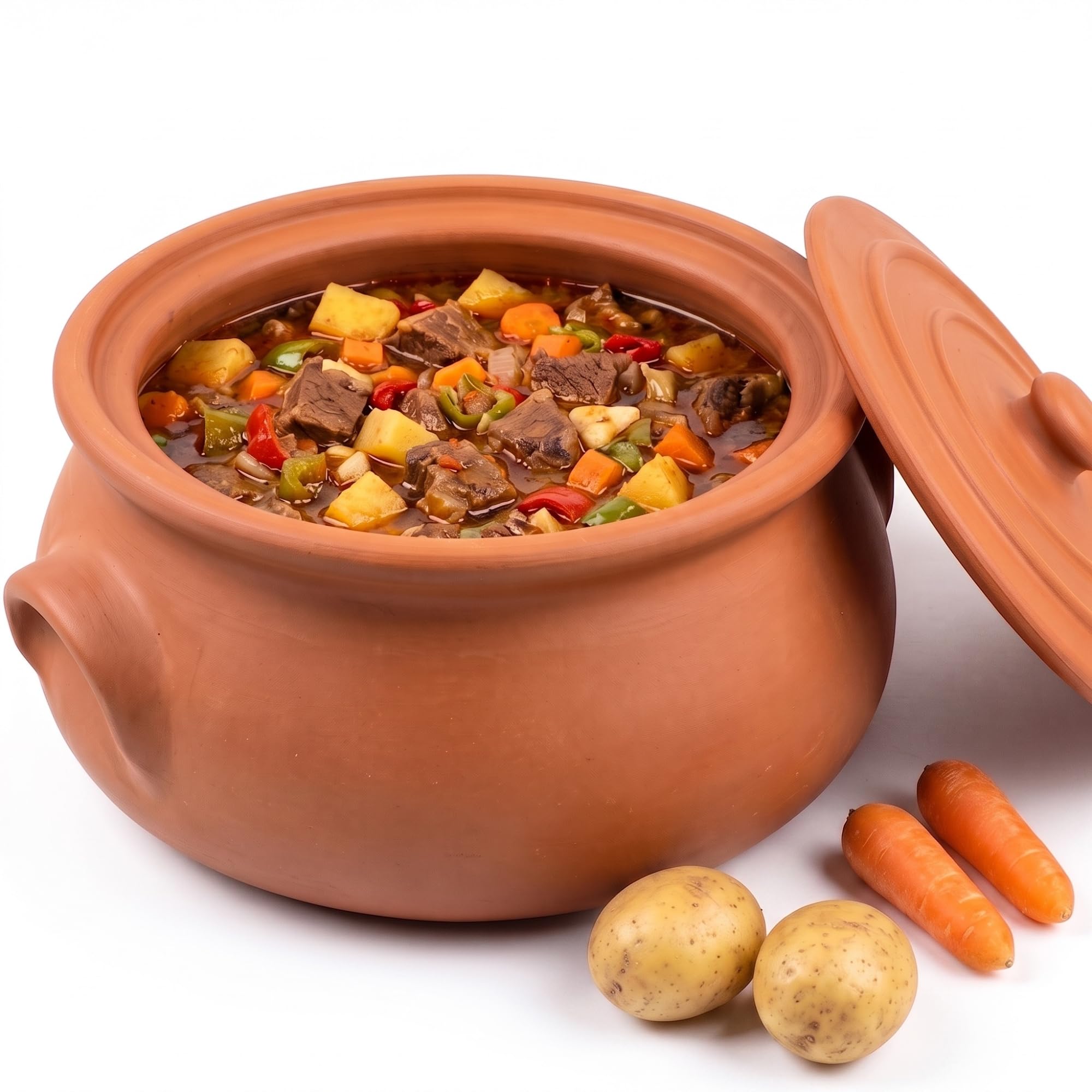
Seven and a half quarts of unglazed terracotta, hand-thrown in the Cappadocia region of Turkey.
No other pot on this list comes close to the size. The Hakan holds 7.6 quarts — 243.5 fluid ounces — which means a double batch fits with room to spare, or a whole holiday meal, or a big pot of rice. It is made from whole natural unglazed terracotta, so it is porous on purpose and works on the stovetop and in the oven.
Owners who put in the effort report good things: the flat bottom works nicely on a warming tray as a slow cooker, and rice cooked in it comes out tasting excellent. The flavor-enhancement from slow cooking is the main draw, and it does that job well when you give it time.
The complications are real and worth naming. The bare clay has an initial smell that takes about five uses to fade — one owner confirms it does not affect the taste of the food. It darkens and smooths with use, so it needs the same care you would give cast iron: scraping, coarse-salt scrubbing, and thorough drying. A few pots have cracked under thermal stress, and some owners found the price hard to swallow. This is a pot for someone who wants to learn it, not for someone who wants it to behave from the start.
The draw: 7.6 quarts of handmade terracotta is a genuinely huge cooking vessel, and the flavor from slow cooking is what buyers talk about.
The learning curve: expect a faint smell for the first handful of uses, and plan on cast-iron-style care and a gradual heat-up.
Buy it for: huge batches, traditional rice cooking and anyone who enjoys the ritual of natural clay.
Give it a miss if: you want a pot that is forgiving from the start — this one asks for seasoning and respect.
15. Kamsah Moroccan Tagine Pot, 5.5 Quarts

A twelve-inch hand-painted tagine that is as much a centerpiece as a cooking vessel.
The conical lid is the whole engineering idea: steam rises, condenses on the inside of the cone, and runs back down onto the food, so the dish bastes itself. That is what gives a tagine its concentrated, aromatic character. This one is 5.5 quarts and 12 inches across, made from lead-free clay with a non-stick ceramic finish, and it works on the stovetop and in the oven.
Hand-painted by women artisans in Tunisia and part of a fair-trade practice, it earns its keep on presentation too — people describe the Supreme Red finish as a work of art, and the size is genuinely generous. Like all tagines, it likes gentle, low heat and a slow build.
The honest caveat here is fragility. Multiple owners have had the pot crack on first use, which is the risk of any large, thin-walled ceramic over direct heat. The fix is method, not brand: start low, warm it slowly, and never move a hot tagine onto a cold surface. Do that and the payoff is slow-braised meat and vegetables with a depth you cannot fake in a metal pan.
What you are buying
- 5.5-quart, 12-inch tagine — plenty for a family-sized braise
- Conical lid circulates steam so food bastes itself
- Hand-painted by women artisans in Tunisia under fair-trade practice
- Lead-free clay with a non-stick ceramic finish; stovetop and oven capable
The fragility reality
- Cracks on first use have been reported — thin ceramic over direct heat is unforgiving
- Needs a slow warm-up and careful handling; not a fast-weeknight pot
Get it if: you want a genuine Moroccan braiser that doubles as a table centerpiece.
Choose differently if: you want a sturdy pot for high heat. A tagine is built for slow, low cooking.
Know the Specs
Capacity in quarts versus liters
Capacity tells you how much the pot can actually hold, and it is where buyers get burned. A “large” label can mean 1.5 quarts or 7.6 quarts, so read the number, not the word. Quarts and liters are both common on clay cookware. A quart is a little larger than a liter, which is why a 1.5-quart pot looks small next to a 1400 ml one even though they are in similar territory. For a family meal, look above 3 quarts; for a single serving, 500 ml to 2 quarts is right.
Glazed versus unglazed surfaces
A glazed surface — often on the base of a roaster — is sealed with a glass-like coating, so it wipes clean and will not absorb flavors. An unglazed surface is porous on purpose: it lets steam escape and develops a patina over time, but it needs seasoning and gentle washing. Some pots mix the two, with a bare lid and a glazed base, which gives you steam retention at the top and easy cleanup at the bottom.
Oven, stovetop and the heat diffuser
Most clay pots are safe in the oven, and many are safe on gas or electric burners — but a direct flame or coil concentrates heat, which cracks earthenware. That is why many cooks use a heat diffuser, a metal disc between burner and pot that spreads the heat. Induction is off-limits for several pots here, so check the compatibility line before you buy. When in doubt, heat slowly and keep the flame low.
Thermal shock and how to avoid it
Thermal shock is the sudden change in temperature that makes ceramic crack — pouring cold water into a hot pot, or setting a hot pot on a cold countertop. The way to prevent it is boring but effective: preheat gradually, never dry-heat an empty pot, let it cool before washing, and dry it fully before storage. Follow those four steps and the pot avoids the cracks that kill most earthenware.
Common Questions
Do I have to soak the lid of a clay roaster before every use?
Can a clay pot go directly on a gas flame?
Why did my clay pot crack after only a few uses?
Is unglazed clay safe to cook in, or does it absorb bacteria?
Can I use a clay pot on an induction cooktop?
What is the difference between a cazuela, an olla, a dolsot and a tagine?
How do I season a new clay pot before first use?
Can I wash a clay pot in the dishwasher?
Will a clay pot keep food warm after it comes off the heat?
Is a bigger clay pot always better for a family?
The Bottom Line
For most cooks, the clay pots for cooking winner is the Römertopf Clay Roaster, because 3.2 quarts handles roasts, casseroles and bread, it goes into a 500-degree-Fahrenheit oven, and the glazed base makes cleanup simple. If you want the biggest all-round pot that handles gas, oven and grill, grab the Ancient Cookware Mexican Cazuela. And for sizzling Korean tabletop cooking, the Crazy Korean Cooking Stone Bowl is the one to reach for. Whichever you choose, learn its heat rules first — a pot warmed gradually lasts years and gives stews a depth metal cannot match.
How we choose
We do not accept paid placement. Every pick is matched to a real buyer and a real use-case; we do not hands-on test units.
Sources
Specifications: manufacturer listings and product documentation. Review insights: verified customer reviews, as of October 2026. Pricing: not shown on this page (it changes often); check the current price via the retailer link.
As an Amazon Associate, Aappliancez earns from qualifying purchases. This does not affect which products we feature.