Disclosure: Some links in this post are affiliate links. As an Amazon Associate I earn from qualifying purchases, at no extra cost to you. Learn more
Specs are compiled from manufacturer listings and verified buyer reviews and can change over time — please confirm the key details on the product page before buying.
Foil that peels, patches, or refuses to shine is almost never a foil problem — it is a roller problem. Foiling needs steady heat and even pressure across the whole sheet, and most cheap laminators only give you two rollers and a single heat setting. The picks below are ranked by how reliably they actually bond foil to a laser-printed page, so you can stop wasting expensive foil on test runs.
This guide is built by comparing the manufacturers’ published specifications and the patterns across verified customer reviews, so you get each pick’s real strengths and trade-offs instead of marketing spin.
You will see four-roller machines, dual heat settings, and one dedicated foiling kit that skips laminating bags entirely. A few of these also laminate, which matters if you want one machine on the desk. Here is the honest breakdown of the laminator for foiling.
Top Picks

How To Choose The Best Laminator for Foiling
Foiling is a pressure-and-heat job, not a speed job. The machine has to press foil against toner evenly enough that every part of the design grabs. Get that wrong and you get the classic result: half the card gleaming, half of it dull and dotted.
Roller count is the first thing to check
A four-roller machine splits the work into heating rollers and pressing rollers, so heat and pressure land across the full sheet instead of in a narrow band. Two-roller models can foil, but they tend to leave patchy areas on larger designs. If foiling is your main reason for buying, four rollers is the safer starting point.
You need a laser printer — the machine cannot fix that
Toner-reactive foiling works because the foil sticks to laser toner when it is heated. An inkjet print will not grab the foil, no matter which machine you run it through. Before you shop, confirm your designs are printed on a laser printer. This single point sinks more first foiling attempts than any machine setting.
The 10 mil setting is your foiling setting
Pouch thickness is measured in mil — thousandths of an inch of laminate film. Foiling usually runs on the thickest setting the machine offers, commonly 10 mil, because that setting delivers the most heat. A machine that tops out at 5 mil is a laminator first and a foiling tool second.
Side-by-Side Comparison
| Model | Best For | Rollers | Warm-Up | Max Thickness | Amazon |
|---|---|---|---|---|---|
| SINCHI 13-Inch Thermal Laminator & Foil Applicator★ Best Overall | All-round foiling and lamination | 4 | 55 seconds | 10 mil | Amazon |
| Amazon Basics 12-Inch Thermal LaminatorBest Value | Home and school lamination on a budget | 2 | 5 minute | 5 mil | Amazon |
| Scotch Thermal Laminator, Extra Wide 13 Inch | Wide-format documents and photos | 2 | 1 Minute | 5 mil | Amazon |
| Qfun Office Presentation Laminator 11×17 | Teachers and high-volume offices | 2 | 60s | 5 mil | Amazon |
| Heidi Swapp 9.5″ Foil Applicator Starter Kit | Dedicated card and paper foiling | 4 | — | 5 mil | Amazon |
| Chilino 13inch Heavy-Duty 4-Roller 11×17 | Fast batch lamination | 4 | 60 seconds | 10 mil | Amazon |
| SINCHI 13-Inch 4-Roller with LCD Display | Fine-tuning tricky foil and paper | 4 | 55 sconds | 10 mil | Amazon |
Detailed Reviews
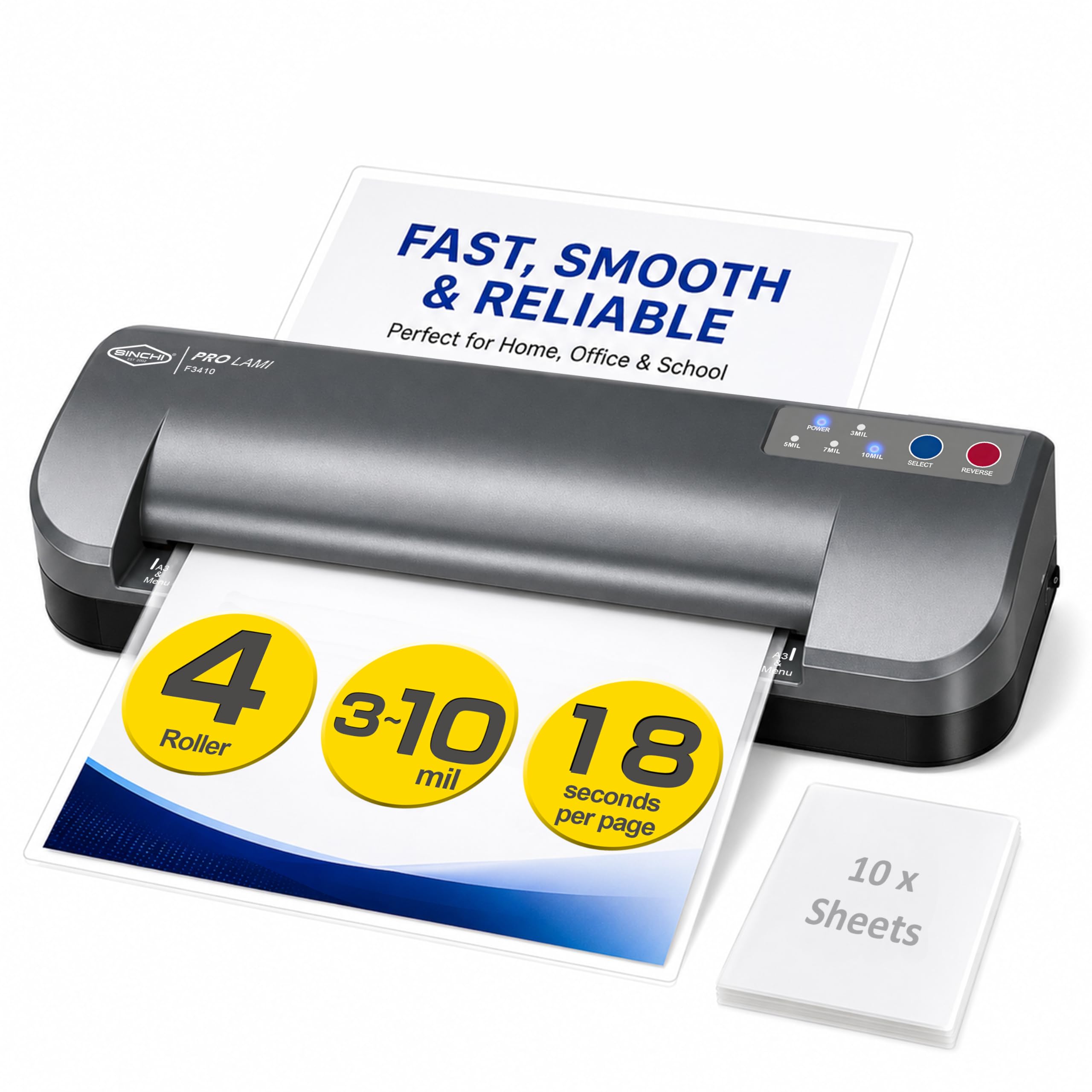
1. SINCHI 13-Inch Thermal Laminator
Our pick — 4.5+★ from 350+ verified ratings; the strongest balance of quality and price.
Four rollers, a 55-second warm-up, and a foil setting that actually reaches 10 mil.
This is the machine to buy if foiling is the whole point. It runs four rollers — two heating and two pressing — so heat lands evenly across the sheet instead of in one narrow strip. That is exactly the gap between a foil design that gleams and one that comes out patchy. It also reaches 10 mil thickness per side, and 10 mil is the setting you use to bond metallic foil to laser-printed toner.
The name on the box says SINCHI, but a chunk of the review pages refer to it as the ProLami F3410 — same commercial-grade machine, same 4-roller build. One buyer reports it sealing a seventeen-page project cleanly in a single pass after another laminator wrecked it across three or four. That is the case for four rollers in a sentence: fewer passes means fewer chances to curl or bubble a sheet you already printed.
It warms in 55 seconds and settles onto a new pouch thickness without an extra wait once heated. Ten letter-size sheets at 3 mil go through in about four minutes. A 30-minute auto shutoff handles the forgetting-to-turn-it-off problem, and a cleaning sheet plus ten 3-mil pouches are in the box. There is a 12-month warranty against manufacturing defects and support that runs seven days a week. Expect a loud machine — the metal gearbox that makes it durable also makes it noisy, and SINCHI says so plainly rather than pretending otherwise. It also needs a US 120V plug, and it is not built for DTF decals, sublimation film, or vinyl rolls. Foiling on this machine is done with SINCHI Heat Transfer Foil Rolls.
Where this one earns its keep
- Four rollers give even heat and pressure — the whole reason to pick it over a two-roller model
- Reaches 10 mil per side, the setting foiling needs
- 55-second warm-up and a 40 inch-per-minute top speed
- No extra wait when you switch pouch thicknesses mid-project
- Cleaning sheet and ten 3-mil pouches included from day one
What you should know before ordering
- Deliberately loud — the metal gearbox trades quiet for reliability
- 120V US plug only; running it on other voltage voids the warranty
- Not for DTF decals, sublimation film, or vinyl rolls
The verdict: Buy this if foiling is a real part of your workflow and you want a machine that will not make you re-print cards.
Think twice if: you need a whisper-quiet unit on a shared desk — this one announces itself.
2. Amazon Basics 12-Inch Thermal Laminator Machine
The workhorse that laminates artwork and worksheets for years — but foiling is not its job.
Read the fine print on this one before you buy it for foil. Amazon’s own listing states plainly that the machine cannot laminate foil. It tops out at 5 mil, with two heat settings marked 3 mil and 5 mil, and it runs just two rollers. As a foil applicator that is the wrong tool: foiling wants the heaviest heat setting you can get, and 5 mil is the ceiling here.
As a laminator, though, it is a genuinely sensible buy. It takes paper up to 12 inches wide, so legal and letter sizes both fit, and twenty 3-mil pouches ship in the box. Warm-up runs a stated 5 minutes — the slowest in this group, and roughly five times the wait of the Scotch below. A jam release lever means a misfeed is a quick fix rather than a ruined afternoon.
Parents report a six-year-old can run it unsupervised. One long-time owner says it outlasted several big-box laminators that quit after a few uses. One owner ran about fifty laminations without a jam, and the 12-inch feed takes legal-size sheets. The recurring gripe is durability over the long haul, with some units eventually breaking down or jamming. Size every caveat that way: most owners get years of school projects out of it, and a few hit the wall. Note the paper-thickness limits too — 50–160g at 3 mil, 50–100g at 5 mil.
Buy it for: homeschool worksheets, chore charts, and kids’ art you want wipe-clean and reusable.
Do not buy it for: metallic foil work — the maker rules foil out and the 5 mil ceiling backs that up.
3. Scotch Thermal Laminator, Extra Wide 13 Inch Input

Ready in a minute, wide enough for a 13-inch sheet, and quiet about it.
Warm-up is the headline: one minute, against a stated 5 minutes on the Amazon Basics. When you are foiling a run of cards and want to check alignment after the first pass, that difference is the whole rhythm of the session. The 13-inch input takes letter-size and larger work without trimming first, and two heated rollers are built to give bubble-free and wrinkle-free results.
What it will not do is foil at high thickness. It laminates pouches up to 5 mil, which caps the heat below what toner-reactive foiling usually wants. It handles the wide-format lamination jobs and doubles as the everyday machine. The carry handle, cord storage, and auto shutoff are the sort of details you notice after the third time you pack it away. Safe on photos, per the maker.
Owners describe it as light and quick — 4.2 pounds, a bit heavier than the 3.1-pound Amazon Basics, but still easy to move between rooms. One detail worth checking on arrival: this is the TL1302X, not the earlier TL1302 that was recalled, and buyers are told to verify the label. A handful of reports describe a unit arriving in a crushed box and failing partway through a job, which reads as a shipping problem rather than a design one. Most sessions finish clean and flat.
The wide-angle case: if your foiling or lamination projects start at 11×17 and go up, the 13-inch feed plus one-minute warm-up makes this the least fiddly machine here.
The honest limit: 5 mil is the thickness ceiling, so treat this as a laminator that can lend a hand with foil rather than a dedicated foiling press.
Reach for this if: you want one quick, wide machine for documents, photos, and light foil accents.
Look elsewhere if: you need 10 mil heat for full-sheet metallic foil.
4. Qfun Office Presentation Laminator Machine 11×17

A 60-second warm-up, a 13-inch throat, and a drawer of tools bolted to the top.
For a classroom or a busy office, the appeal here is the whole kit. Sixty seconds to heat, then 450mm/min — enough to laminate an 8.5×11 sheet in about thirty seconds. The 13-inch input handles anything from ID cards up to 11×17, and the 3 mil or 5 mil settings reach a total laminate thickness of up to 0.6mm. There is also a cold mode for heat-sensitive items like receipts and old photos, using self-adhesive film you supply yourself.
The top storage tray holds a paper cutter, corner rounder, hole puncher, three binder rings, and thirty 3-mil sheets. It is a small thing, but not losing the corner rounder every week is a real quality-of-life win for a teacher. NTC real-time temperature control keeps the rollers evenly heated, which the maker credits for the smooth, unbubbled output. Auto shutoff kicks in after 45 minutes idle, and two anti-stick coated rollers plus an ABS jam-release handle handle the bad days.
Owners praise its reliability more often than its 60-second heat-up. It is light enough to carry between rooms, and owners like the gray-and-purple finish. The caveats are real but sized: a strong plastic odor at first use that fades over several sessions, and a cool-down cycle after power-off that can look like a fault if you have not read the manual. Triple-check the switch is truly off, since one unit appeared dark while still running.
Why teachers tend to keep it: 60-second heat, a 13-inch feed for 11×17 signs, and all the trimming tools stored on the machine instead of in a drawer somewhere.
What to expect on day one: a plastic smell that fades, and a cool-down phase that is normal, not broken.
Fits best: teachers, crafters, and small offices running a mix of sizes every day.
Not the pick for: anyone who needs 10 mil heat for foil — this tops out at 5 mil.
5. Heidi Swapp 9.5″ Foil Applicator Machine Starter Kit

The only machine here built for foil first and lamination second.
This is a dedicated toner-reactive foil applicator, not a laminator with a foil feature bolted on. Print your design on a laser printer, lay foil over the toner, feed it through, and the 4-roller system presses heat and pressure across the whole sheet. Four rollers against the two on a standard model is the difference between even adhesion and patchy shine, and the maker is explicit that this is the point of the design. It takes letter-size work up to 9.5 inches.
The kit means you can start the day it arrives: the machine, test projects, six foil sheets, a transfer folder, laminating pouches, and a manual. It supports both 3 mil and 5 mil pouches, so it doubles as a small laminator. The 9.5-inch width is a deliberate choice — most laser printers only handle standard 8.5×11, so a wider machine would mostly sit unused.
Here is the honest part, and it matters. This is the lowest-rated machine in the group, and the two problems owners hit are jams and a fiddly release lever. Foil that is fed crooked catches in the four rollers, and the lever that should free it does not always cooperate. Some sessions end in smoke and a return. Against that: one owner finished 8 practice cards in thirty minutes on first setup, another got clean foil on the first try, and it takes Minc and off-brand foil. Use sharp scissors, cover every bit of toner, and practice first — that advice comes straight from the people who got it working.
The foiling-first design
- Four rollers built specifically for even foil adhesion
- Starter kit includes six foil sheets, a transfer folder, and pouches
- Works with Minc and off-brand foil, not just the maker’s own
- Doubles as a 3 mil and 5 mil laminator for small jobs
The feed-it-straight discipline
- Jams are the most-discussed issue, and the release lever is not always reliable
- Four rollers punish a crooked feed; a burned first-use smell is normal per the instructions
- 9.5-inch width caps you at letter-size work
Pick it for: card makers and scrapbookers whose main goal is metallic foil on laser-printed paper.
Skip it for: high-volume foil production or anyone who wants a big 13-inch bed.
6. Chilino 13inch Heavy-Duty 4-Roller 11×17 Laminator Machine
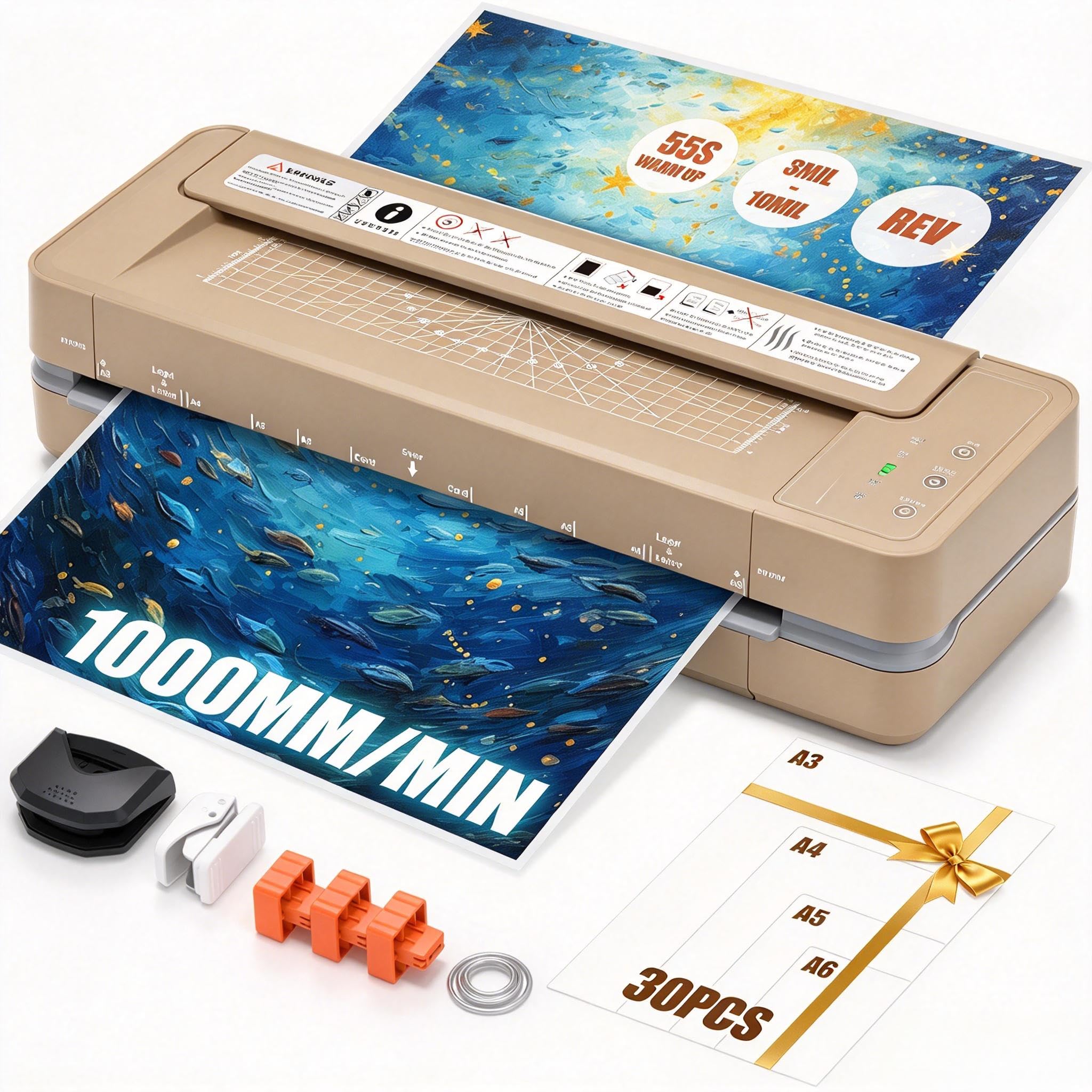
Batch lamination at 1000mm/min, with a reverse button for when a sheet fights back.
Speed is the reason this one exists. It heats in 55 seconds and then runs at 1000mm/min — roughly seventeen seconds for a 3-mil A4 sheet. For a studio pushing certificates or menus through in a stack, that pace changes what a lunch break can accomplish. Four rollers handle the pressure side, and the 13-inch feed swallows A3 and 11×17 alongside small cards.
The REV reverse function is the feature that earns a second look. One button turns the rollers backward to eject a misfed sheet, so a jam does not become a torn certificate. Auto shutoff after 30 minutes and an overheat sensor round out the safety side, and the box includes thirty sheets in A3, A4, A5, and A6, plus a corner rounder, paper cutter, hole punch, and binder rings.
Now the part that needs saying. This is the lowest-rated pick in the group, and it earns that rating in the reviews. Jamming shows up repeatedly, and some units tear apart and get trashed after a few months. A few owners describe wrinkled sheets that never came through clear, and one called the paper cutter worthless. The 4-roller build and the speed are real, and the cold and thermal modes work for owners who got a good unit. Treat this as a machine to buy with a return window open and to test hard in the first week. If clean, flat output is your whole goal and you are not chasing speed, the SINCHI four-roller is the safer buy.
What it does well: 55-second heat, 1000mm/min throughput, and a reverse button for rescuing jammed work.
What to weigh carefully: a lower overall satisfaction rate than the four-roller SINCHI, and jams are the most-discussed problem, so give it a thorough test before the return window closes.
Best matched to: high-volume shops that care most about sheets per hour and can live with a fussy feed.
Not for: careful foiling work on expensive stock, where a jam ruins a sheet you already printed.
7. SINCHI 13-Inch Thermal Laminator LCD Display
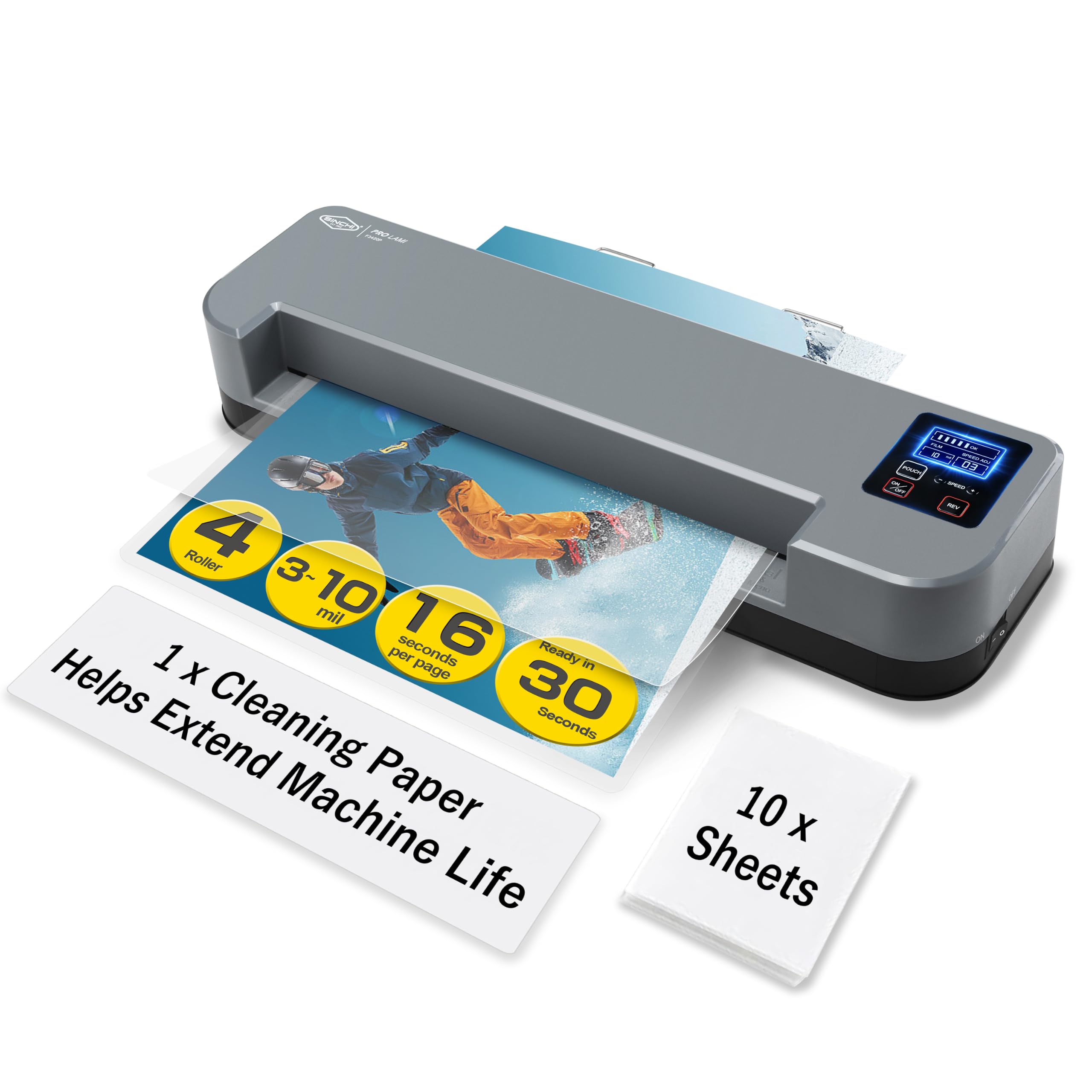
An LCD and up to eighteen modes turn foiling into a dial you can fine-tune.
If your foil comes out wavy or you keep seeing tiny bubbles on dark card stock, this is the machine built to fix that. The LCD screen lets you pick pouch thickness and then nudge speed up or down with micro-adjustment controls — up to eighteen modes in total. That range is the point. A slower feed with more heat is often the difference between foil that bonds and foil that lifts, and being able to dial it in per paper type and color is what separates this from a fixed 10-mil setting.
The speed side is not slow either. Thirty-second warm-up, then up to 43 inches per minute, so ten 3-mil letter sheets finish in under four minutes from cold. Four rollers deliver the even heat and pressure foiling needs, and the 13-inch feed takes everything from ID cards to posters at 3 to 10 mil per side. Ten 3-mil pouches and a cleaning sheet are included, backed by a 12-month warranty and seven-day support.
One owner foiled laser-etched metal bookmarks about 0.33mm thick with no air pockets in the etched detail. The stock speed setting of 3 is the reliable one, with adjustable speed for the tricky jobs. There is a mandatory cool-down cycle after laminating, and the machine must stay plugged in through it. Note the noise: a metal gearbox that lasts also gets loud. On value, buyers split — several find it expensive for what it does. That is the trade for the LCD and the fine-tuning, and only you can say if foiling precision is worth it.
The precision argument: eighteen modes and micro-adjust speed let you chase out waviness on a specific paper stock, which no fixed-setting machine in this list can do.
The price honesty: this is the priciest route to foiling here, and the value verdict in the reviews is genuinely divided.
Go with this if: you are tuning foil across several paper types and want the LCD and speed controls to dial it in.
Stay with the basics if: a single 10-mil setting already foils your card stock cleanly — you will not use the extra modes.
Know the Specs
Roller count and why it decides foil quality
Rollers are the heated drums the pouch and foil pass between. A two-roller machine heats and presses in one pass, which can leave strips of uneven pressure. A four-roller model separates heating from pressing, so both land more evenly across the full width. For foiling, four rollers is the difference between clean metal shine and a dotted, half-bonded result. It also matters for lamination — flat, uncurled pages versus wavy ones.
Mil, the thickness unit foiling lives on
Mil measures pouch film thickness in thousandths of an inch. A 3 mil pouch is thin and flexible; 10 mil is stiff and heavy. Foiling generally runs on the thickest setting because more thickness means more heat reaching the toner. Machines here range from a 5 mil ceiling to 10 mil, so check that top number before you buy if foil is the plan. The 3 and 5 mil settings also cap what paper weight the machine can handle — thinner paper at higher settings.
Warm-up time and session rhythm
Warm-up is the wait between switching on and the ready light. One minute versus five minutes sounds minor until you are checking foil alignment between passes. Faster warm-up suits short, repeated foil jobs where you test, adjust, and re-run. Slower machines suit longer lamination sessions where you set a stack and work through it. Either way, never feed a sheet before the ready indicator says the rollers are up to temperature.
Speed and what it changes
Feed speed is the rate sheets move through the rollers, in inches or millimeters per minute. Faster is better for volume lamination — certificates, menus, classroom sets. Slower is often better for foil, because more time under heat means a stronger bond into the toner. That is why the adjustable-speed machines matter: they let you trade throughput for a cleaner foil edge. Pick speed on the job, not on the spec sheet.
Common Questions
Can I use any laminator for foiling?
Do I need a laser printer to foil?
What does mil mean on a laminator?
Why does my foil come out patchy or bubbly?
Is a 4-roller laminator better than a 2-roller one?
Can these machines laminate as well as foil?
How wide a sheet can each machine take?
Do I need to wait between changing pouch thickness?
What voltage do these laminators need?
Can a laminator foil vinyl or DTF film?
The Bottom Line
For most buyers, the laminator for foiling winner is the SINCHI 13-Inch Thermal Laminator & Foil Applicator because its four rollers and 10 mil setting are exactly what foil needs, and it laminates cleanly in the same pass. If you want to fine-tune foil across tricky paper, the SINCHI with LCD Display gives you the modes to dial it in. And for dedicated card-and-paper foiling, the Heidi Swapp Foil Applicator Starter Kit is built for exactly that job.
How we choose
We do not accept paid placement. Every pick is matched to a real buyer and a real use-case; we do not hands-on test units.
Sources
Specifications: manufacturer listings and product documentation. Review insights: verified customer reviews, as of October 2026. Pricing: not shown on this page (it changes often); check the current price via the retailer link.
As an Amazon Associate, Aappliancez earns from qualifying purchases. This does not affect which products we feature.