Disclosure: Some links in this post are affiliate links. As an Amazon Associate I earn from qualifying purchases, at no extra cost to you. Learn more
Specs are compiled from manufacturer listings and verified buyer reviews and can change over time — please confirm the key details on the product page before buying.
You printed the photo, you trimmed it square, and then the glue turned it into a rippled mess. That is the whole problem with photo adhesive: most glues hold fine but pull moisture into the paper and leave it wavy forever. The five options below split into two camps: liquid glues that dry clear and flat, and tapes and corners that never touch the print with moisture at all.
This guide is built by comparing the manufacturers’ published specifications and the patterns across verified customer reviews, so you get each pick’s real strengths and trade-offs instead of marketing spin.
Some products here grip paper with a liquid bond, while others hold it mechanically without a drop of moisture. Below are the five picks, sorted by how each one behaves on paper.
Top Picks

How To Choose The Best Glue for Photos
The one thing that decides whether a photo survives its own mounting is moisture. Liquid glue carries water into paper fibers, and paper swells when it gets wet, then dries unevenly. That is where the ripples come from. Pick the delivery method that matches the job: a fine tip for tiny paper pieces, a spray for a flat sheet onto board, or a mechanical hold for a print you may want back later.
Match the adhesive to what you are mounting
A thin sheet of photo paper glued to cardstock needs very little adhesive and a lot of control. A heavy print on foam core needs a broader, stronger bond. And a print you plan to swap out of a frame should never get a permanent liquid bond in the first place. Decide whether the mount is permanent or temporary before you pick a format.
Understand what archival really means
Archival means the adhesive is formulated not to yellow or break down over time, and often that it is acid-neutral so it will not stain the print. An acid-neutral glue is the safer bet for anything you plan to frame or store long term. Clear-drying matters too, because a glue that stays milky shows through thin paper.
Check the cure time before you plan your day
Some photo adhesives grab in seconds and let you reposition for a moment; others need a long full cure before the bond is final. A 24-hour full cure is common for craft and spray adhesives. That does not mean you wait a day to touch it — it means you give it a day before you hang it or stack weight on it.
Watch for the wrinkle trap
Even a good glue will wrinkle thin paper if you flood it. The reliable habit is a conservative application: a thin, even line or a light spray, pressed flat under weight while it sets. Several of the products below are formulated to resist wrinkling, but every one of them asks you to use less rather than more.
Side-by-Side Comparison
| Model | Best For | Format | Full Cure Time | Photo-Safe Claim | Amazon |
|---|---|---|---|---|---|
| Bearly Art Precision Craft Glue Original 4 fl oz★ Best Overall | Precision paper and card work | Liquid glue with swappable tips | 24 hours | Acid neutral, archival safe | Amazon |
| P7yaumy 300LSE Double Sided Tape 1in x 36ftBest Removable Hold | Removable, repositionable mounting | Double-sided PET tape | — | — | Amazon |
| Scotch Photo Mount Adhesive 10.3oz | Flat spray mounting onto board | Spray adhesive | 24 hours | Photo safe to ISO Standard 18916 | Amazon |
| Scotch Scrapbookers Glue with Two-Way Applicator (Pack of 3) | Scrapbook pages and mixed media | Liquid glue with dual tips | — | Designed for paper and photos | Amazon |
| Lineco Archival Polypropylene Mounting Corners 1.25 Inches | Damage-free archival framing | Adhesive photo corners | — | Archival polypropylene, non-yellowing | Amazon |
Detailed Reviews
1. Bearly Art Precision Craft Glue Original 4 fl oz
Our pick — 4.5+★ from 11,500+ verified ratings; the strongest balance of quality and price.
The bottle that lets you place a drop exactly where a photo corner needs it.
This is the pick for anyone who works small — cards, die cuts, photo corners, layered paper. The reason is the tip kit: multiple-sized precision tips twist and snap onto the bottle, so you go from a fine line to a broader bead without changing bottles. If you have ever tried to control a standard craft glue nozzle on a 4×6 print, you already know why that matters.
What wins people over is the quality of the bond itself, and the drying behavior backs it up. It is formulated to dry clear rather than milky, which is what keeps it invisible under thin photo paper. It is also acid-neutral and archival safe, so a mounted print is not sitting on an adhesive that will yellow years later. Bearly Art states a 1 year shelf life and a full cure time of 24 hours — plenty of working time if you press the piece flat under weight while it sets.
The honest catch is volume versus cost. A 4 fl oz bottle with the tip kit is priced as a specialty art supply, not a bargain glue, and a few buyers find that steep. The flip side, repeated across the reviews, is that a little goes a long way. The other thing to know: wrinkle resistance depends on you. The maker explicitly says to be conservative with application when you want no warping, so a heavy hand on a thin print can still ripple it. Crafters who need the finest control over where glue lands, on paper and cardstock and metal, are the ones this bottle serves best.
What the tip kit buys you
- Multiple twist-and-snap tips give you fine detail and broader coverage from one bottle
- Dries clear and is acid-neutral archival safe, so prints stay clean over time
- Formulated wrinkle and clump resistant — with a conservative application
- Made in USA, freeze/thaw stable for 5 cycles, 1 year shelf life
Where it asks more of you
- Specialty art-supply pricing rather than value-bin pricing
- Wrinkle-free results rely on using less glue, not on the formula alone
- 24-hour full cure means planning ahead before you hang or stack
Reach for this if: you mount paper in small, exact placements and want a clear, archival bond.
Think twice if: you are covering a large flat sheet — a spray does that job with less fuss.
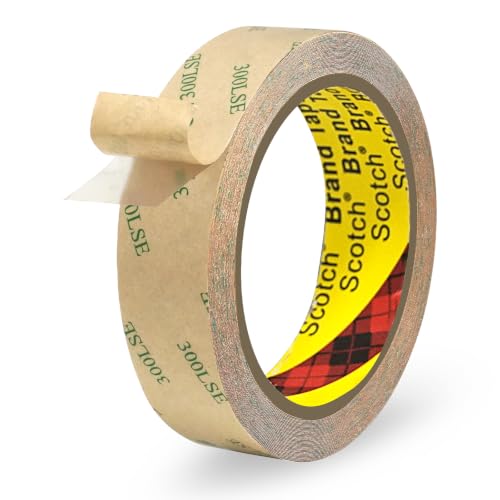
2. P7yaumy 300LSE Double Sided Tape 1in x 36ft
For photos you want to change out without peeling the backing board.
If the ripple problem has ever ruined a print for you, take note: this tape puts zero liquid near the paper. It is a clear double-sided tape, 1 in wide and 36 ft long, with a 0.17 mm thickness and a PET carrier holding the adhesive on both faces. The bond is strong enough for scrapbook paper, picture hanging strips, poster mounting, and LED strips along a wall.
What makes it genuinely different from a liquid glue is reversibility. The adhesive is engineered as a medium-to-strong grip that does not permanently bond — it can be worked off by rubbing or rolling, and it loosens when you warm it with a hairdryer. That is exactly the behavior you want when a photo sits on a mat board you may redo later. Pages of buyers hang things in damp basement storage and report the hold survives the trip, and the tape is rated to hold up to 200°F (93°C).
Here is the fair warning, and it is a small technique issue rather than a defect: the brown backing liner is stubborn to lift. The trick buyers pass around is to fold back about a half inch of the backing, then pull it off while laying the strip down. A push pin or a thin knife edge under the liner works too. Get past that, and it is a clean, invisible hold on glass, plastic, ceramic, painted wall, and metal.
What it does that glue cannot: a removable, moisture-free grip on thin flat items, with a documented 180° peel adhesion of around 13N/cm (about 2.7 lbs on a half-inch square sample).
What to expect on day one: budget a couple of minutes to separate the liner from the tape before you work fast.
Best fit: scrapbookers and framers who reposition prints and want a strong hold with no dry-down risk.
Poor fit: anyone mounting a print where a liquid bond is required by the recipient or the frame maker.
3. Scotch Photo Mount Adhesive 10.3oz
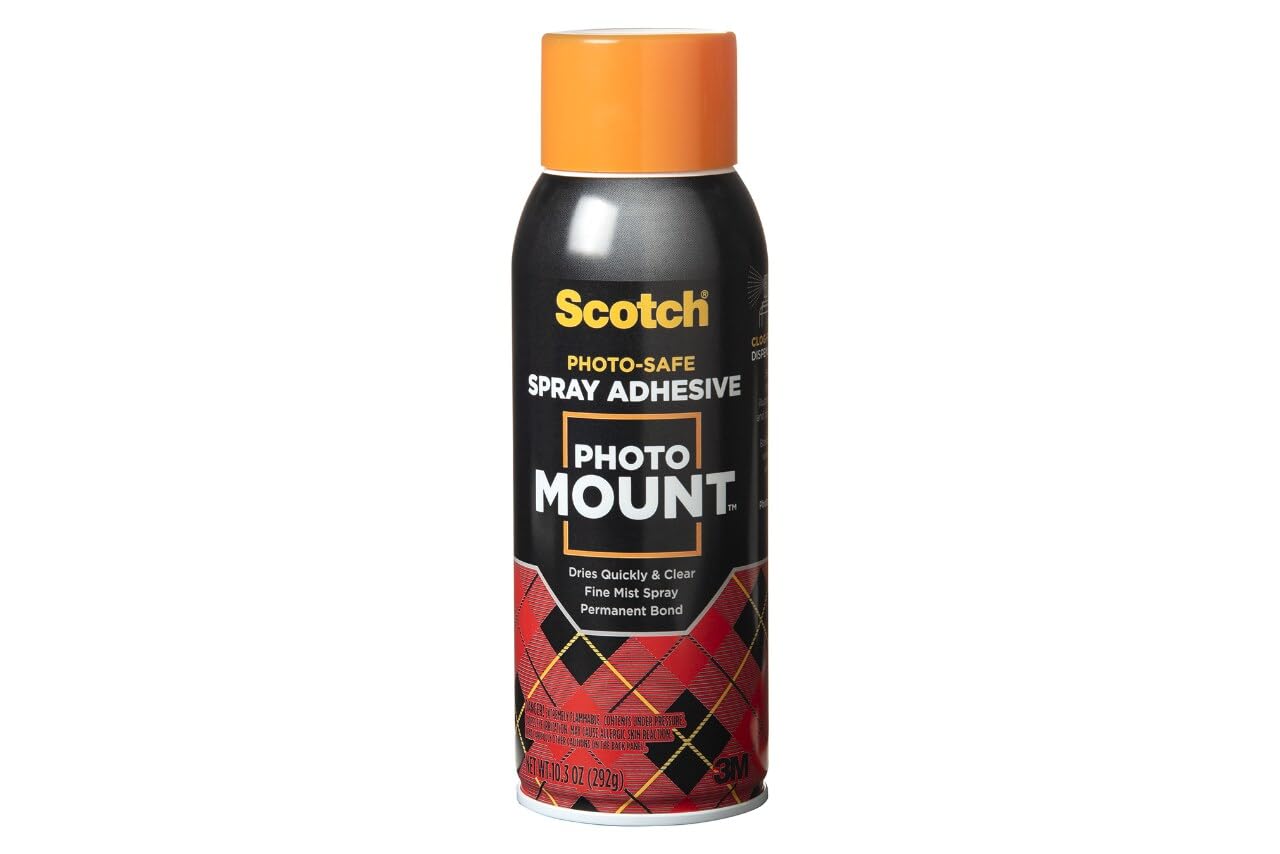
An even, controllable spray for getting a full print flat onto foam core.
When the job is a whole sheet rather than a corner, spraying beats squeezing. This can delivers a clear permanent bond, and Scotch states it is photo safe in accordance with ISO Standard 18916 and conforms to ASTM D-4236. It is built for good quality cardstock board, plastic, glass, clean metal, and foam core with a smooth surface. The one hard limit: it is not suitable for outdoor use.
Owners describe exactly the behavior you want from a spray. It adheres quickly, and there is a brief window to reposition the print before it grabs for good. That window is the whole difference between a straight mount and a crooked one. It also sprays evenly enough that you can coat a sheet without globs soaking through and ruining the print — which is the usual failure of cheaper sprays. One 8×10 on foam core is a minute of work, and the result stays put even hung over a fan vent.
The trade-off is the air itself. This is a solvent spray, so overspray and fumes are part of the deal. Spray outside, or somewhere with strong airflow, and wear a mask if you are sensitive to fumes. Full cure time runs 24 hours, so mount the print, stack it flat, and leave it. Buyers report the spray stays even and predictable, which is the whole point with a fine art print you cannot afford to reprint.
The verdict on this one: the most reliable way to lay a full print flat, as long as you treat it as an outdoor or ventilated job and give it its full day to cure.
Choose this for: full-sheet mounting of color photos and illustrations onto foam core or board.
Pass on it for: small detail work or anything headed outdoors.
4. Scotch Scrapbookers Glue Two-Way Applicator Pack of 3
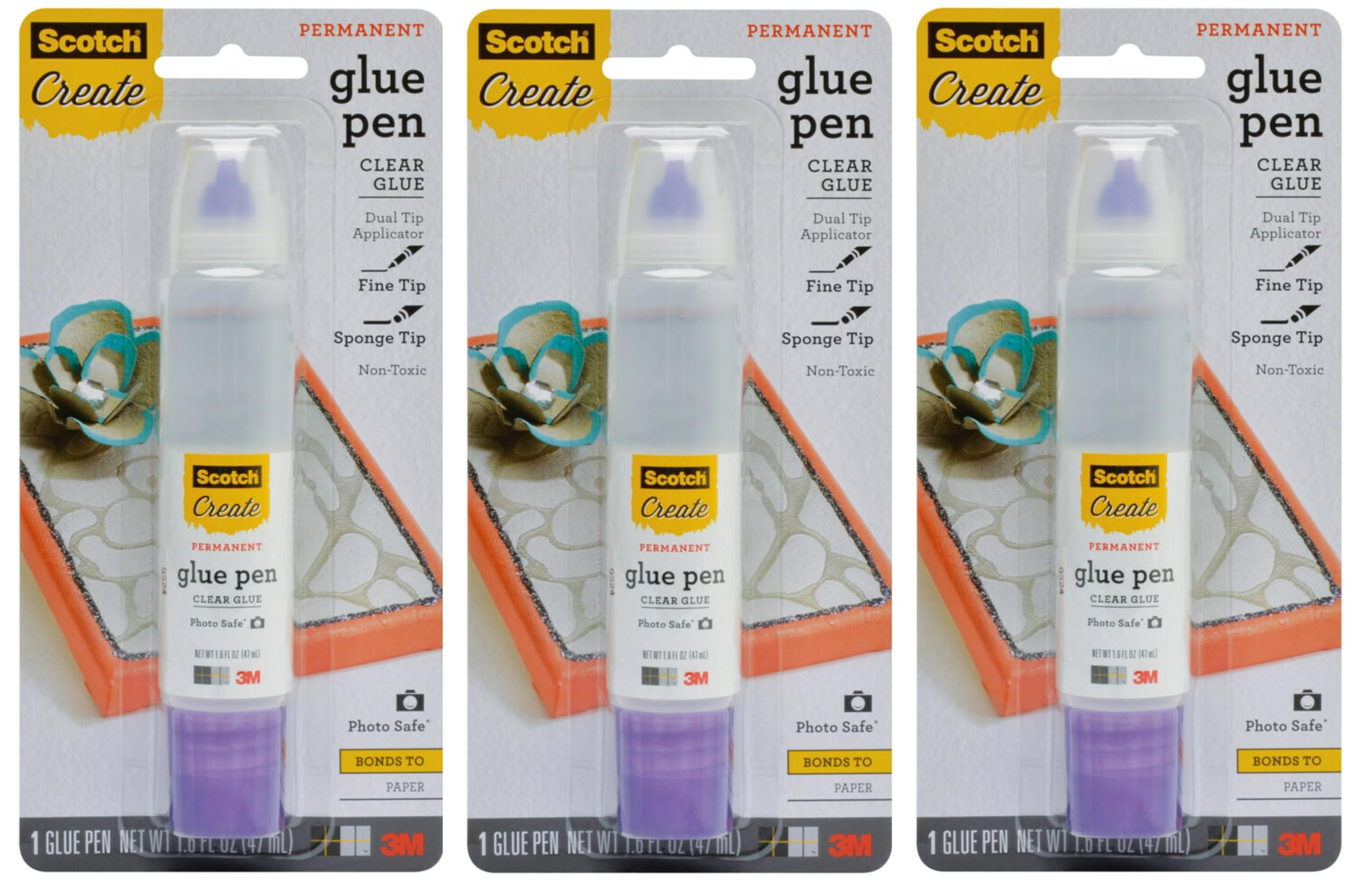
Two tips on one bottle — precision dots for small photos, a sponge tip for big surfaces.
Scrapbookers tend to want two glues: one for a tiny detail and one for a big background sheet. This bottle gives you both — a precision tip for small dots and a sponge tip for broad coverage — and it comes as a pack of three 1.6 ounce (47 ml) bottles. It is a polyvinyl acetate (PVA) formula, designed for paper and photos, and it is a favorite of mixed media crafters who want a strong, fast grab.
What earns it a spot is the speed. The adhesive grabs quickly and the two-tip design keeps application clean, so pages do not slide around while you work. It is made for the layered, paper-on-paper building that scrapbook pages are made of.
Be realistic about the wrinkle risk. This is a water-based PVA glue, and the reviews that ding it point at paper wrinkling during application, especially with thin stock. The fix is the same as everywhere else: a thin, even layer, and a weighted flatten while it dries. Apply it sparingly and the pages come out flat. Slather it and a light sheet will buckle. If your pages use heavyweight cardstock and layered cardstock tiles, this is where it shines. For a single delicate photo on thin paper, the precision pick above gives you more control.
Why scrapbookers keep buying it
- Two applicator tips — precision and sponge — cover small dots and large backgrounds
- Strong, quick grab so layered pages stay aligned
- Three bottles per pack keeps you stocked through a big album project
The part to manage
- A water-based PVA glue that can wrinkle thin paper with a heavy-handed layer
- Wants a conservative, even application and a weighted press while drying
Right for you if: you build layered scrapbook and mixed media pages and want speed plus two tips per bottle.
Off the mark for: a single thin photo where even one ripple is unacceptable.
5. Lineco Archival Polypropylene Mounting Corners 1.25 Inches

No adhesive touches your print at all — the corners do the holding.
For a print you may want to remove someday without a trace, this is the answer in the whole guide. These are 1.25 inch clear photo corners made from archival polypropylene with an acrylic adhesive. The acrylic adhesive is non-yellowing, and the corners sit on the backing board rather than across the face of the print, so they hold the corners and minimally cover the paper. No adhesive touches the face of the print, which is what damage-free means in practice.
Artists use them for real work. A print as large as 22×18 inches fits and sticks to the backing board without trouble. They have been used to mount double-sided painted pages for a framed gallery exhibit, and to swap 8×12 prints on a 12×16 mat board instead of committing them to permanent tape. Because the corners come off the print without tearing, they suit any piece you rehearse in a frame before you commit.
The honest friction is technique: the corners are fiddly the first couple of times. The center section has to be removed to expose the border, and the two border sides need to be opened before you insert the print. Positioning and repositioning take care. The working method that solves it is to place the photo on the mat, weight the center down, then apply the corners to the photo first — not the mat. Once you learn the trick, they are clear, acid-free, and very firm. You get 256 corners in the pack, which is a lot of framed work.
The standout fact: 256 archival corners of 1.25 inches each, with a non-yellowing acrylic adhesive and no adhesive touching the print itself.
Where patience is required: the first few mounts go slowly while you learn to open and position each corner cleanly.
Pick these up for: framing, gallery pieces, and any photo you may need to remove undamaged.
Look elsewhere for: a fast, permanent, invisible full-surface bond — that is a spray or tape job.
Know the Specs
Acid-Neutral and Archival Safe
A photo is paper plus dye, and both can react with an adhesive over time. An acid-neutral, archival formula is made not to stain or degrade the print, and a non-yellowing claim means the bond will not turn amber in a frame. For anything you plan to keep or display for years, treat archival as the first checkbox rather than a bonus.
Full Cure Time
Full cure time is how long the adhesive needs before the bond is final — 24 hours is typical for craft and spray glues. It does not mean the photo is wet for a day; it means you press the piece flat under weight and leave it a day before you hang or stack it. Press the piece flat under weight for that day, and the mount stays flat.
Peel Adhesion
Peel adhesion measures how hard it is to pull an adhesive off a surface at an angle. It is the number that tells you whether a tape will hold a poster on a painted wall or let go. On the P7yaumy tape it is rated around 13N/cm, which is roughly 2.7 lbs on a half-inch square sample — strong enough for flat paper and light objects, not for a heavy frame.
Tip Types and Control
The applicator is your hand’s control over the glue. A precision tip lays a fine line for small photo pieces; a sponge tip covers a broad background fast; a spray coats a full sheet evenly in one pass. Match the tip to the size of the piece and you cut down both waste and wobble.
Common Questions
Will glue for photos make prints wrinkle?
What does acid-free mean for a photo I plan to frame?
Can I use double-sided tape to mount a photo instead of glue?
Is spray adhesive better than liquid glue for mounting a whole print?
How long before a mounted photo is safe to hang?
Do mounting corners damage the photo when removed?
Is glue for photos safe for color prints specifically?
Can I use these products outdoors?
What is the difference between a precision tip and a sponge tip glue?
How much glue should I use on a small photo?
The Bottom Line
For most people mounting prints, the glue for photos that earns the top spot is the Bearly Art Precision Craft Glue because its swappable precision tips, clear archival dry-down, and acid-neutral formula handle paper and cardstock without leaving a milky or yellowing bond. If the print may come out of the frame later, grab the P7yaumy Double Sided Tape for a removable, moisture-free hold. And for a full sheet going flat onto foam core, the Scotch Photo Mount Adhesive is the one to reach for — spray it outside, press it flat, and give it the day to cure.
How we choose
We do not accept paid placement. Every pick is matched to a real buyer and a real use-case; we do not hands-on test units.
Sources
Specifications: manufacturer listings and product documentation. Review insights: verified customer reviews, as of October 2026. Pricing: not shown on this page (it changes often); check the current price via the retailer link.
As an Amazon Associate, Aappliancez earns from qualifying purchases. This does not affect which products we feature.