Disclosure: Some links in this post are affiliate links. As an Amazon Associate I earn from qualifying purchases, at no extra cost to you. Learn more
Specs are compiled from manufacturer listings and verified buyer reviews and can change over time — please confirm the key details on the product page before buying.
Pick the wrong keycap profile and your fingers feel it within an hour — a stretched reach to the number row, a wrist that sits cocked, a spacebar that rubs. The profile is the shape and height curve of the caps across the rows, and it changes how far your fingers travel, how your keyboard sounds, and whether you can type at speed without looking down. Below you’ll find eleven sets sorted by what actually matters: MOA for rounded comfort, Cherry for low-effort speed, SA and CSA for deep thock, silicone for silence, and flat DSA for a clean retro look.
This guide is built by comparing the manufacturers’ published specifications and the patterns across verified customer reviews, so you get each pick’s real strengths and trade-offs instead of marketing spin.
Each set below names its profile, its material, and the exact layouts it fits, so you can match it to your board before you spend a thing. The goal is simple: find the keycap profiles that fit your fingers, your switches, and your case without a mismatch.
Top Picks


How To Choose The Best Keycap Profiles
Your keyboard’s switches decide how a key feels when it bottoms out. The keycap profile decides everything above that — how tall the cap sits, how deeply it cups your fingertip, and how far your finger has to lift between rows. A profile that fights your hand shows up as fatigue by mid-afternoon.
Sculpted versus uniform height
A sculpted set changes height and angle row by row, usually labelled R1 through R4. The taller number row sits further from your fingers and the home row sits closest, so your hand rests in a natural arc. A uniform set keeps every cap the same height, which makes swapping keys around easy but removes that built-in slope.
How tall is too tall
Tall spherical caps like SA and CSA cup your fingertip and push out a deeper, lower sound. Short caps like Cherry keep finger travel small and reward fast typing. Whichever way you go, check that the caps clear your case and that your wrist rest still lines up.
Material and legend printing
PBT is the harder, more wear-resistant plastic and it holds a dry matte surface. ABS is softer and can develop a shine over time. Legends printed by dye-sublimation sink into the plastic, while double-shot caps mold the letter into a second layer of plastic so it cannot rub off.
The bottom row trap
Most fit problems land on the bottom row. Standard boards use a 1.25U Ctrl and Alt, while some compact boards use 1U. A set with only one size will leave those keys bare or mismatched, so read the key count and the included modifier list before you commit.
Side-by-Side Comparison
| Model | Best For | Profile | Material | Key Count | Amazon |
|---|---|---|---|---|---|
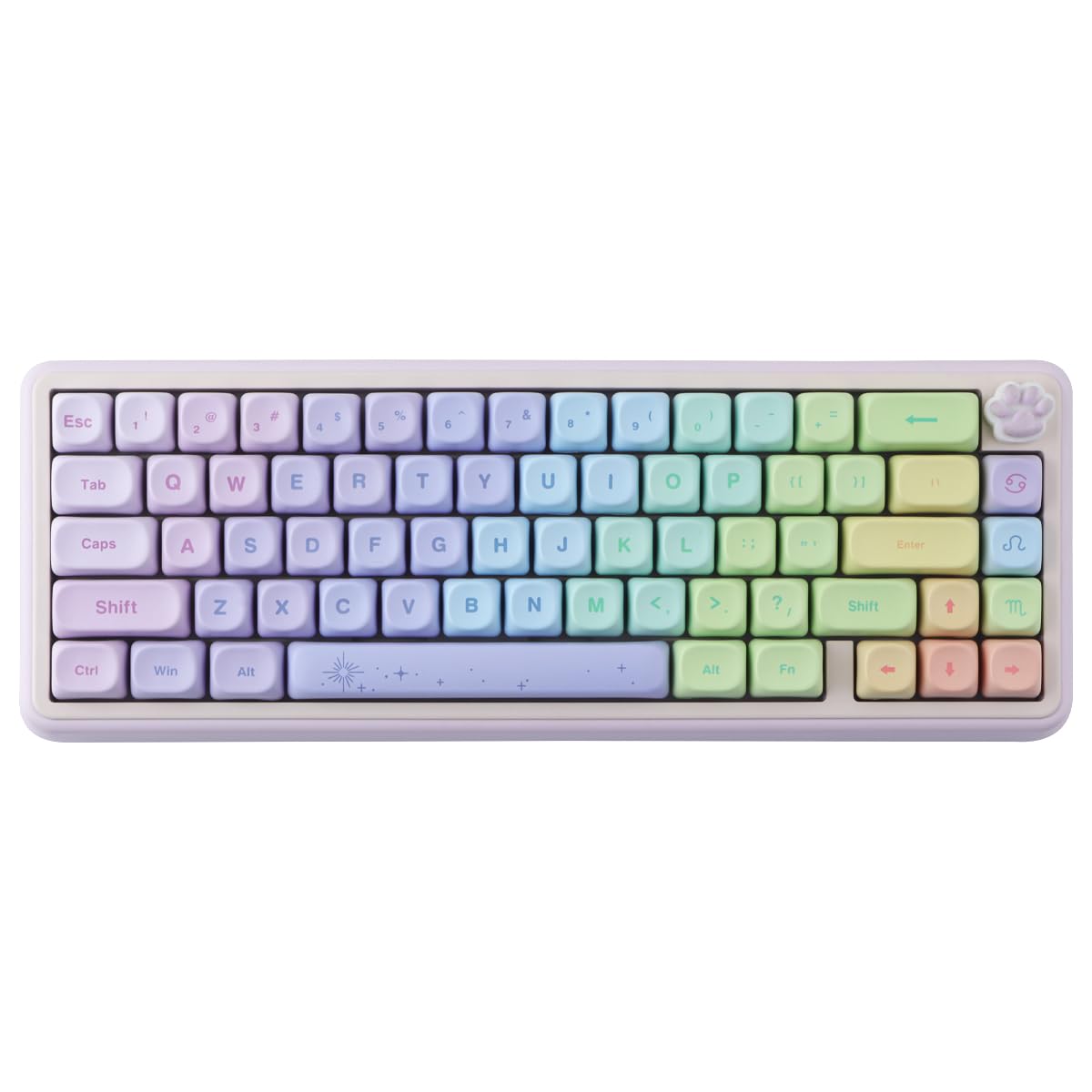
| Hyekit PBT Kawaii Keycaps★ Best Overall | Rounded, quiet everyday typing | MOA | PBT | 130 | Amazon |
| Fogruaden Red SamuraiDeepest Thock | Deep thock with vintage looks | CSA | PBT double-shot | 160 | Amazon |
| Owpkeenthy Retro CarbonBest for UK Layouts | UK layouts and split spacebars | ASA | ABS double-shot | 150 | Amazon |
| TIMSEKER Retro Minimalist Gray | Tall typewriter feel on Mac | MA | PBT | 119 | Amazon |
| Sumgsn Apollo | Fast low-travel typing | Cherry | ABS double-shot | 163 | Amazon |
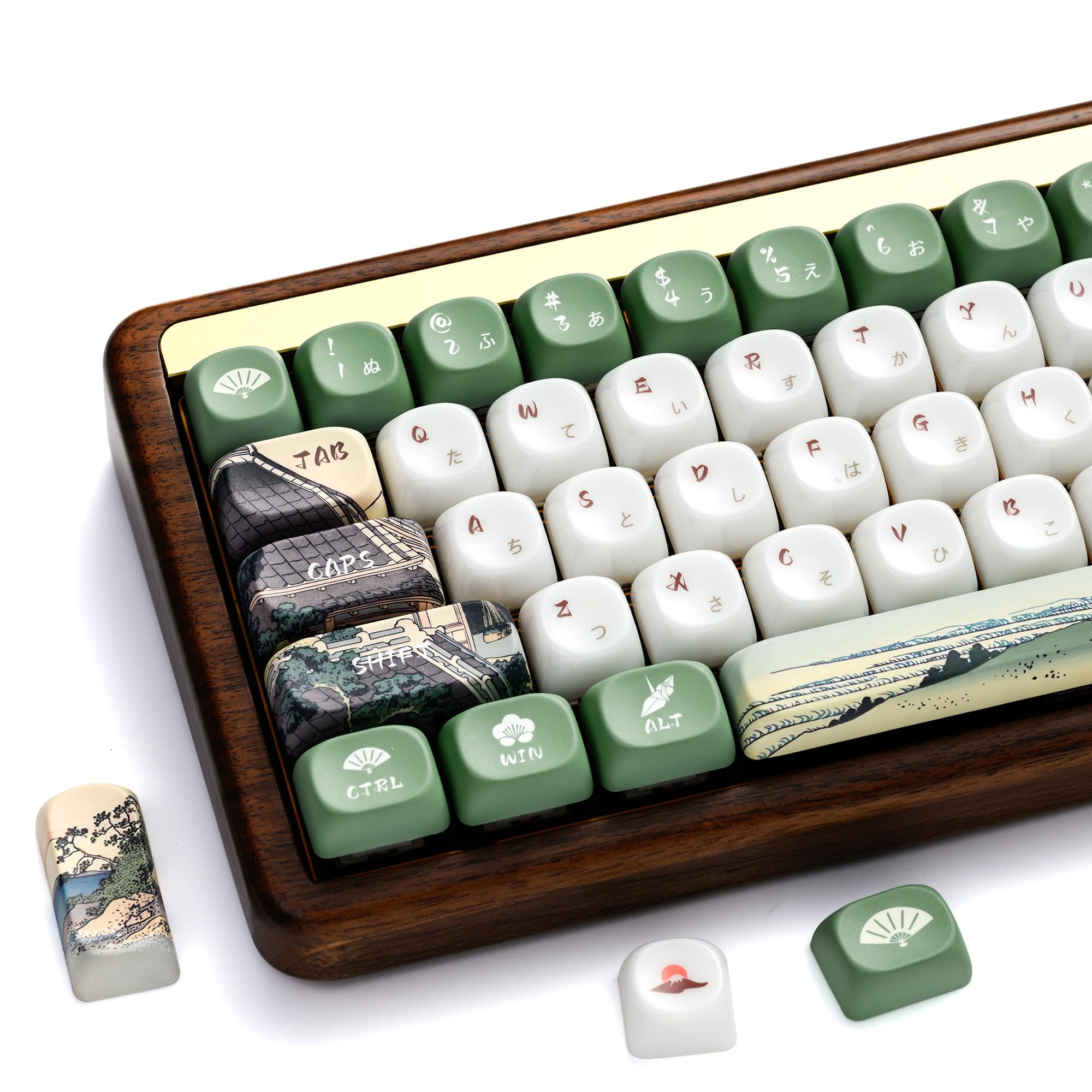
| OHY XVX Mount Fuji | RGB shine-through with art | MOA | PBT + frosted PC | 129 | Amazon |
| EPOMAKER AegisSil | Quiet offices and dorms | Cherry | Silicone | 113 | Amazon |
| Rainbow Candy MOA Keycaps | Color experiments and remixing | MOA | PBT | 126 | Amazon |
| Glorious ABS Doubleshot | RGB glow on a black deck | OEM | ABS | 123 | Amazon |
| JSJT Ink Lotus | ISO layouts on a budget | OEM | PBT | 140 | Amazon |
| YMDK 125 DSA 9009 Retro | Flat retro spherical caps | DSA | PBT | 125 | Amazon |
Detailed Reviews
1. Hyekit PBT Keycaps
Our pick — 4.5+★ from 1,000+ verified ratings; the strongest balance of quality and price.
Round-edged MOA caps that soften every strike and quiet the whole deck.
The shape is the whole story here. Owners describe the result as soft and notably quieter than the taller stock caps on boards like the Nuphy Halo 96 V2. If your keyboard currently sounds sharp and clicky, this set is the cheapest way to change that without touching the switches.
The build backs up the feel. Textured high-grade PBT resists wear, friction and solvents, and the walls come in around 1.5mm thick — a real figure that translates into a denser, more solid strike rather than a hollow plastic tap. Dye-sublimation printing pushes the colour into the plastic instead of sitting on top, so the legends stay put. A 130-key count covers 60%, 65%, 75%, 80%, 96% and 100% boards across Mac, PC and Windows layouts, including sizes like 61, 64, 68, 84, 87, 96, 980, 104 and 108.
What wins people over is the sound. Typing on this set produces a deeper, softer tone than most stock caps, and the consistency of the colour and legends is what keeps buyers coming back for second and third sets. The trade-offs are small but real: MOA sits tall, so expect a day of adjustment before your fingers relearn the reach, and there is no raised notch on the F and J keys on some versions. It also has a distinctly playful look, which is not what everyone wants on a work desk.
Where it earns its keep
- Rounded MOA edges cradle the fingertip and cut down typing noise
- 1.5mm walls give a dense, solid strike instead of a hollow tap
- 130 keys fit 60% through full-size boards on Mac and PC
- Dye-sublimation legends hold their colour over long use
What to weigh first
- Tall MOA height needs a short adjustment period
- No raised bumps on F and J on at least one variant
- The cute styling is not for every desk
Reach for these if: you want a softer, quieter typing sound without buying new switches, and your board is a standard 60% to full-size layout.
Look elsewhere if: you rely on F and J bumps to find home row without looking.
2. Fogruaden PBT Red Samurai Keycaps
A vintage mainframe look with the tallest, most cupped caps on this list.
Pick CSA when you want weight under your fingers. These caps sit higher than Cherry at a stated 9.5mm to 12.5mm, landing between a short Cherry set and a full SA set. That extra height plus a deeper scoop is where the heavy, low-pitched sound comes from. Buyers report the sensation as typing on a 1970s mainframe, which is exactly the point of the blood red, black and tan colourway.
This set also carries the largest key count in the lineup at 160. The double-mold construction pairs two layers of PBT so the legends are molded in rather than printed, which is what keeps them from developing that greasy shine.
Not every key will land where you expect. The most common fit complaint is the bottom row, where the right Ctrl and Alt come in a 1U size on a board that expects 1.25U, leaving those two keys short. Durability and legend readability also draw a mixed response — the caps feel substantial, but a few owners want more reassurance about long-term wear on a translucent base. If your board uses standard 1.25U bottom keys, this is a striking set that sounds as good as it looks.
The honest trade-off: 160 keys sounds generous until you hit a 1U bottom row, and the high CSA wall needs a wrist rest or a flatter desk angle to stay comfortable over a long session.
Made for vintage-keyboard fans: you want a tall, cupped, deep-sounding cap in a strong retro palette.
Check your bottom row first: boards that use 1U right Ctrl and Alt will leave two keys mismatched.
3. Owpkeenthy Retro Carbon Keycaps
SA looks, OEM height, and a split spacebar most sets never include.
Most tall, spherical keycaps force you to choose between the classic look and a comfortable typing height. ASA sidesteps that: it matches OEM height while keeping the spherical top of a classic SA cap. In practice that means the vintage Carbon colourway without the wrist ache you get from a full-height SA set, and as buyers put it on a Corsair board, they fit nicely, look good and feel sturdy.
Where this set genuinely stands apart is layout coverage. The 150 keys cover 61, 68, 84, 87, 98, 100 and 108 sizes, and it includes both ANSI US and ISO UK layouts — a full-size UK Enter key is in the box. It also ships with a split spacebar, which is rare at any tier and useful if you want a shorter space key for a custom build. Double-shot ABS keeps the Carbon legends sharp and high-contrast.
The catch is material and colour accuracy. ABS is the softer plastic, so a long, heavy typist will eventually see shine on the most-used keys where a PBT set would hold its texture longer. Some owners also note the colours read less bright than the product photos suggest. Legibility in a dark room is limited too, since these caps are not translucent.
Why UK buyers should look here: a genuine ISO UK layout with a large Enter key and a split spacebar is a rare combination, and the ASA height keeps the retro shape usable for real work.
The honest limit: ABS will polish up on the heavy-use keys over time, and the colours are warmer in person than in the listing shots.
Pick it for: ISO UK boards, split-spacebar builds, or anyone who wants SA attitude at a typing-friendly height.
Pass if: you need legends that glow in a dark room.
4. Retro Minimalist Gray PBT Keycap Set

Typewriter round tops with genuine Mac keys already in the box.
MA sits higher than both XDA and DSA, and it borrows the round spherical top of an SA cap while keeping a squared base. The result is the arc you see on a vintage typewriter, and it is genuinely hard to find at this height — tall keys that are not full SA are a narrow slice of the market. The grey and white Retro Grey colourway keeps that shape quiet rather than costume-like.
For anyone on a Mac, the inclusion of Command and Option keys saves the usual hunt for replacements, and those keys can be remapped under macOS. The set carries 119 keys across 61, 64, 68, 84, 75, 87, 96, 98, 104 and 108 sizes, plus a 6.25U spacebar and an extra 7U space for ANSI and ISO boards. Dye-sublimation printing on PBT means the legends sit in the plastic and resist fading.
Two things to know before you buy. The surface is a dry, slightly frosted matte, and some owners find it rougher than they prefer on the first few days. And these caps are not shine-through, so if your board’s LEDs are the main event, this set will mute them rather than show them off.
What the shape gives you
- MA height with a round top sits above XDA and DSA for a true typewriter arc
- Command and Option keys included for Mac users
- 6.25U and 7U spacebars cover ANSI and ISO boards
- Dye-sublimation PBT legends resist fading
Where it asks for patience
- Matte surface feels rougher than some expect
- No shine-through, so backlighting stays hidden
- 119 keys is the smallest count among the tall-profile sets here
Best matched to: Mac desks and retro-styled builds where the silhouette matters as much as the sound.
Think twice if: your RGB lighting is the reason you bought the keyboard.
5. Sumgsn Apollo Keycaps

The shortest travel here, aimed squarely at speed over show.
Cherry profile is the low, gently sculpted shape most people picture when they think of a serious typing keyboard. It keeps the total height down, which shortens how far each finger has to lift between rows — and that is what makes it feel fast. Buyers moving from flat or tall caps to Cherry height report less wrist strain and better accuracy once the shorter reach becomes automatic.
This is the biggest set in the lineup at 163 keys, aimed at 60%, 65% and 95% ISO and ANSI boards plus Alice layouts. The caps are roughly 1.5mm thick and built with double-shot ABS, so the legends are molded in with a clear finish. It arrives in an ABS tray with a cover and a key puller, which protects the caps in transit and keeps them from arriving scratched.
Be clear about what ABS means in practice. It is not backlit, so there is no glow to see in the dark. The printing quality is the most criticized part of this set, with a handful of owners finding letters worn, scraped or slightly misaligned on the wider keys. On the plus side, the low profile and smooth, lightly textured surface make the actual typing experience the strongest draw, and the compact height leaves plenty of room for a wrist rest.
Why speed typists like it: a Cherry-height cap cuts finger travel, and the 163-key spread fits nearly every standard layout plus Alice.
Fit this to: touch typists chasing accuracy and lower hand fatigue on a 60% to TKL board.
The trade-off to accept: no backlight pass-through and legends that can vary slightly key to key.
6. OHY XVX MOA Profile Keycaps Set
Frosted caps that scatter your backlight instead of blocking it.
Most themed sets treat the artwork as the whole product. This one pairs the Mount Fuji design with a two-material build — PBT for the shell and frosted translucent polycarbonate where the light passes through. The practical effect is a soft, diffused glow around the legends rather than a harsh pinpoint of LED, and the PBT side resists wear, fading and oil buildup.
The MOA layout here uses a concave arc that increases how much of your fingertip touches each cap, which is the design reason it feels comfortable during long sessions. Coverage runs to 60%, 65%, 75% and 80% boards in the 61, 64, 68, 78, 80, 84 and 87 sizes, and the set works with all standard cross-switch stems. A keycap puller comes in the box, and the 129 keys include Mac-specific keys and function-row markings.
The lighting is also the likeliest disappointment. Owners with dark or black legend caps report the backlight contrast is poor and the stem shadow shows through unless the whole cap is lit. If your board has bright per-key RGB and you like the glow, this set rewards it. On a dim or single-colour board the artwork does more work than the lighting.
What you are really buying: a themed set with genuine dual-material construction, where the frosted PC layer turns lighting into atmosphere rather than a hard highlight.
Where it can let you down: legend contrast under dim backlighting and the occasional spacebar fit problem on non-standard boards.
Choose this when: your keyboard has bright RGB and you want the caps to soften and spread that light across the desk.
skip it if: you type in the dark on a dim board and need legends you can read clearly.
7. EPOMAKER AegisSil Keycap Set

Silicone caps that swallow the clack and leave the thock.
This is the only silicone set on this list, and that single material choice changes everything. Silicone damps each strike against the switch and plate, muting the sharp nail-on-plastic tap that carries across an open office. On boards like the Aula F99 and EPOMAKER TH99, the effect is a creamy, quiet sound that still keeps its low-end thock.
The surface adds grip. It has a slightly tacky feel that resists slipping and sweat, which is why it holds up well for gaming and long stretches of input. The semi-transparent body diffuses RGB into a soft halo rather than hard points, and the legends sit printed beneath the silicone layer so they cannot rub off. Cherry profile keeps the height wrist-friendly, with a taller R1 that shortens the reach to F1–F12 and a lower R2–R3 that takes pressure off your wrists.
Two habits come with silicone. It attracts dust, so plan on a regular wipe with a damp cloth. And the 113 keys cover 60%, TKL, 104 and 108 ANSI layouts, but the bottom-right Ctrl, Alt and Fn are the recurring shortfall — some compact boards need 1U replacements that are not in the box. The caps also need a short adjustment period before the softer, bouncier feel stops feeling foreign.
What the silicone does for you
- Damps the impact clack while keeping a deep thock
- Grippy surface resists slipping and sweat during long sessions
- Legends printed under the silicone, so they cannot rub off
- RGB diffuses into a soft glow instead of hard points
The upkeep it asks for
- Attracts dust — needs regular wiping
- No 1U Ctrl, Alt and Fn for some compact boards
- 113 keys is the smallest coverage here alongside the MA set’s 119
Choose these for: shared offices, dorms and late-night rooms where a loud keyboard is a real problem.
Double-check your board: compact layouts with 1U right-side modifiers may need keys that are not included.
8. PBT Keycaps 126 Keys MOA Profile

Rounded MOA caps in a candy palette you can reshuffle whenever you like.
Rainbow Candy is a remix set. The 126 MOA-profile caps share the same rounded, curved edge as the Hyekit set, so your fingertip gets that soft cup — but the mix-and-match colour spread gives you far more ways to break up a flat deck. Owners change them out simply because they get bored of one look, which is a fair sign the set is easy to live with.
Under the colour it is standard PBT with an anti-grease coating and a matte finish, so it resists wear and stays dry rather than slick. Dye-sublimation printing puts the colour inside the plastic for clear legends that hold up. The 126 keys fit most Cherry MX and any ‘+’ stem switches across 61, 64, 68, 75, 84, 87, 96, 98, 104 and 108 boards, and a puller is included.
The one repeated note is the spacebar. A few owners find it sounds a touch shallower and twangier than the rest of the set, which a small foam mod usually settles. Otherwise the feel is smooth and the fit is precise — the same rounded MOA height, with a shorter adjustment curve than the taller caps on this list.
The value read: you are getting the rounded MOA feel and a full PBT build with a palette that lets you restyle the board without buying a second set.
Suits you if: you want MOA comfort with the freedom to change the look as your mood shifts.
Know beforehand: the spacebar may need a small damping tweak to match the rest of the set.
9. GLORIOUS Gaming ABS Doubleshot 123-Keycap Set

Black OEM caps built to let your backlight do the talking.
OEM is the familiar, gently stepped height most mechanical keyboards ship with, so it feels natural straight away — no relearning curve. What makes this set worth a look is the transparent legends: the letters let the LED shine directly through so the glow reads as bright lettering rather than a wash around the keys. On a black deck, that is the cleanest RGB look in this group.
Construction is double-shot ABS, so the legends are molded into a second plastic layer and will not rub off. The 123 keys target full-size ANSI layouts. The set ships arranged row by row, which makes installation faster and less error-prone when you are swapping a whole board at once. If you own a Glorious 65% board, the 1.75U left shift is covered.
The thin font is the most repeated note. Letters are more slender than some buyers want, especially across the F1–F12 row, and the caps lock legend is an arrow. Bottom-row compatibility is the bigger watch-point — owners on non-standard boards like a Logitech G710+ report the spacebar and right Ctrl do not line up. It is also ABS, so heavy use will eventually shiny up the most-tapped keys.
The RGB payoff: transparent legends and a black body turn bright per-key lighting into crisp, readable letters across the whole board.
What to check before you buy: that your bottom row uses standard ANSI spacing, since extra caps in alternate sizes may not rescue a non-standard layout.
Pick it when: you have a standard ANSI board and want the backlight to shine through clean lettering.
Look past it if: you need a bold font or your board has a non-standard bottom row.
10. JSJT Ink Lotus Keycaps

A 140-key OEM set that covers ISO boards with an Ink Lotus print.
The Ink Lotus theme is what pulls people in, but the layout coverage is the practical draw. With 140 keys, it includes a large ISO Enter key, then covers GK61, 64, 84, 87, 96, 98, 104 and 108 boards and works with Cherry MX switches and clones from Gateron and Kailh. The R1–R4 OEM sculpt changes height and angle row by row, which is the standard ergonomic slope most typists adapt to instantly.
The PBT shell is oil-resistant and harder than ABS, with better wear and heat resistance — that matters if you are replacing caps that went greasy on the home row. Dye-sublimation printing puts the lotus artwork deep into the plastic, so the detail stays sharp instead of flaking. Owners mention the dye-sub legends still looking sharp after years of daily use, long after the board they were mounted on was replaced.
Two fit notes recur. The spacebar can rub against the case wall on some boards and stick, and the replacement spacebar has shown the same issue for a few owners. The other is a taller non-standard spacebar that looks slightly off beside the rest of the row. Both are fixable, but they are worth knowing if your board has tight spacebar clearance.
What makes it last
- 140 keys with a large ISO Enter key for UK and EU boards
- Oil-resistant PBT holds its matte surface better than ABS
- Dye-sublimation lotus artwork stays legible over years
- Works with Cherry MX, Gateron and Kailh switches
The spacebar caveat
- Spacebar can rub and stick on tight-clearance boards
- Replacement spacebar has shown the same issue for some
- Non-standard taller spacebar can look mismatched
Best for: ISO layouts and anyone who wants a long-lasting PBT set with a distinctive print.
Check clearance: tight spacebar wells can make the middle key stick.
11. YMDK 125 DSA Dye Sub 9009 Retro PBT Full Keycap Set

Ball-shaped, uniform-height caps for the classic flat retro look.
DSA is the low, uniform-height spherical profile — every key is the same height and the top is gently ball-shaped, sitting lower than XDA. That flatness is a deliberate style choice, and it produces the clean grid look of the classic 9009 Retro colourway. The PBT shell comes in around 1.4mm thick, with the legends applied by dye-sublimation for sharp, fade-resistant text.
Compatibility runs through most ANSI Cherry MX boards with a 6.25U spacebar, roughly 11.7cm wide, and it fits 104, TKL and 61 sizes plus popular compact kits like the KBD75, Tada68, YMD96, Melody96 and Kira96. One hard limit to respect: it is explicitly not compatible with Corsair, Razer or Logitech keyboards, so a mainstream gaming deck is a no.
The honest care is in the finish. Edges can be inconsistent from key to key, and the caps can sit unevenly on some switch and case pairings, which is the recurring complaint. F and J use a scooped dent rather than a raised bump, so touch typists who rely on a physical nub will want to adjust. The payoff is a 1.4mm-thick PBT set with dye-sub legends and a uniform ball-shaped top that customers note steadies their aim on the keys.
Why the flat top works: a uniform, gently cupped spherical top gives a large contact patch, which some typists find steadies their accuracy and reduces mis-hits.
The honest limit: finish consistency and F/J scoops take getting used to, and mainstream gaming brands are not supported.
This one is for: retro-styled custom builds on Filco, Ducky, IKBC or YMD-type boards that want a flat, ball-topped cap.
Walk away if: you own a Corsair, Razer or Logitech keyboard, since these caps will not fit.
Know the Specs
Keycap profile and row sculpting
The profile is the shape, height and angle of the caps across the rows. Sculpted sets change height from R1 (the top number row) down to R4 (the bottom row with the spacebar), which is what lets your hand rest in an arc. Uniform sets like MOA, DSA and XDA keep every cap the same height for a flat, clean look. Taller profiles like SA and CSA cup the fingertip and push out a deeper, lower sound, while shorter Cherry caps reduce finger travel for faster typing.
PBT versus ABS plastic
PBT is the harder, more wear-resistant plastic, and it holds a dry matte texture that resists oil. ABS is softer, and over long use its most-tapped keys can develop a shine. Both can carry legends well: double-shot caps mold the letter into a second plastic layer so it cannot rub off, while dye-sublimation sinks the colour into the cap surface. If you want a set that looks the same after a year of heavy typing, PBT with double-shot or dye-sub printing is the safer pick.
Common Questions
Will a 130-key MOA set fit my 65% keyboard?
Is MOA better than Cherry profile for typing?
Why do some keycaps leave my right Ctrl and Alt empty?
Do silicone keycaps actually make a keyboard quieter?
Can I use tall keycaps like SA or CSA on a low-profile keyboard?
What does it mean when a keycap set is not shine-through?
Is double-shot better than dye-sublimation printing?
Will these keycaps fit Corsair, Razer or Logitech keyboards?
Do I need a keycap puller to install a new set?
How long will a PBT keycap set last before the legends fade?
Why do some sets have scooped F and J keys instead of bumps?
The Bottom Line
For most people, the keycap profiles winner is the Hyekit MOA set because its rounded, uniform MOA shape softens the strike, quiets the whole board and covers 130 keys across 60% to full-size layouts — all without changing a single switch. If you want the deepest, most vintage-feeling thock, the Fogruaden Red Samurai brings 160 keys and a tall CSA cup that sounds like a 1970s terminal. And for shared rooms and quiet offices, the EPOMAKER AegisSil silicone caps are the one to reach for, damping the clack while keeping a rich low-end tone.
One honest nudge before you decide: match the profile to how you actually type. Speed typists get more from the short Cherry travel of the Sumgsn Apollo, Mac users get the built-in Command and Option keys of the TIMSEKER Retro Gray, and anyone on an ISO UK board should go straight to the Owpkeenthy Carbon for its large Enter and split spacebar. Check your bottom-row key widths first, and the rest of the choice becomes easy.
How we choose
We do not accept paid placement. Every pick is matched to a real buyer and a real use-case; we do not hands-on test units.
Sources
Specifications: manufacturer listings and product documentation. Review insights: verified customer reviews, as of October 2026. Pricing: not shown on this page (it changes often); check the current price via the retailer link.
As an Amazon Associate, Aappliancez earns from qualifying purchases. This does not affect which products we feature.