Disclosure: Some links in this post are affiliate links. As an Amazon Associate I earn from qualifying purchases, at no extra cost to you. Learn more
Specs are compiled from manufacturer listings and verified buyer reviews and can change over time — please confirm the key details on the product page before buying.
The quick answer: for most people the DIVEVOLK SeaTouch 4 Max Plus is the one to buy. It is the only housing here that lets you use the entire iPhone touchscreen underwater, it is rated to 60 m (about 196 ft), and it carries 4.0+ stars across 600+ ratings. If you want a hard-shell backup with a shutter button and a leak alarm instead, the Sealife SportDiver is the strongest second choice. Everything below is built around one real question: will your phone come back dry, and will the controls still work when you are ten metres down.
This guide is built by comparing the manufacturers’ published specifications and the patterns across verified customer reviews, so you get each pick’s real strengths and trade-offs instead of marketing spin.
Seals, touch sensitivity at depth, and battery-hungry apps decide whether your footage survives the trip. Here is how each housing actually behaves in salt water, ranked by real-world results, in this iphone underwater housing comparison you can take straight to the dock.
Top Picks


How To Choose The Best iPhone Underwater Housing
The wrong assumption most first-time buyers carry is that a deeper rating automatically means a safer case. It does not. A 196 ft (60 m) housing with a dirty O-ring will flood at three metres, and a 50 ft (15 m) housing with a clean seal will come back dry from a full snorkel session. Depth rating is the ceiling, not the guarantee.
Match the housing to how you actually get wet
If you snorkel and free-dive, a 50 ft (15 m) case is plenty and it will usually be smaller and lighter in your bag. If you scuba dive, look at 130 ft (40 m) or deeper, because that is where rental dive profiles actually sit. Anything rated to 196 ft (60 m) is genuinely dive-grade, and that ceiling also means the case was built with thicker walls and a stiffer latch.
Decide if you need touch or buttons
Touch housings use a gel or glass screen layer that passes your fingertip through to the iPhone display. You get every app, every setting, and pinch-to-zoom exactly as on land — but the gel layer can feel less sensitive at depth, and you must remove your phone’s own screen protector first. Button housings trade that freedom for physical controls and a Bluetooth app, which is steadier with thick gloves but means you are shooting inside one app, not iOS.
Budget for the two extras nobody mentions
Every hard housing here needs a fresh moisture-absorbing capsule or desiccant pack for a multi-day trip, and most include spare O-rings in the box. Buy the spares before you fly. A flooded phone costs far more than a handful of capsules, and the seal is only as good as the maintenance you do on the kitchen table the night before.
Side-by-Side Comparison
| Model | Best For | Depth Rating | Control Type | Leak Alert | Amazon |
|---|---|---|---|---|---|
| DIVEVOLK SeaTouch 4 Max Plus★ Best Overall | Full touchscreen diving | 60 m / 196 ft | Touchscreen | — | Amazon |
| Seafrog SF-PH-01 ProBest Value | Snorkel and shallow dives | 40 m / 130 ft | Shutter button + app | Yes | Amazon |
| ProShot Dive 2.0 | Divers wanting hard-shell control | 40 m / 130 ft | Volume-button app | — | Amazon |
| Pro Shot Touch 2.0 | Snorkeling and water sports | 15 m / 50 ft | Touch above water, app below | — | Amazon |
| Sealife SportDiver | Scuba divers who want alarms | 40 m / 130 ft | Shutter lever + Bluetooth app | Yes | Amazon |
| DIVEVOLK SeaTouch 4 MAX Plus Filter Kit | Serious underwater colour work | 60 m / 196 ft | Touchscreen | — | Amazon |
| Oceanic iPhone Waterproof Case | Dive-computer style logging | 60 m / 196 ft | Directional pad + app | Yes | Amazon |
Detailed Reviews
1. DIVEVOLK Underwater Touchscreen housing Seatouch 4 Max Plus
Our pick — 4.0+★ from 650+ verified ratings; the strongest balance of quality and price.
The only housing here that leaves your whole iPhone screen alive underwater.
For divers who want to shoot with the same camera app they already know, the SeaTouch 4 Max Plus is the pick. It works with a long list of iPhones, from the 12 and 12 Pro through the 16 Pro and 16 Pro Max, and it uses a polycarbonate bumper shell that weighs 1.2 pounds. That weight is the trade-off for a case sealed to 60 m (196 ft), which is 20 m deeper than the Seafrog’s 40 m (130 ft) ceiling. No buttons anywhere, so pinch-to-zoom, the built-in compass and Live Photos all keep working down there.
The full touchscreen is what wins people over, and the build quality is the aspect praised most often. Owners describe it as feeling heavy duty and professional grade, and one diver who took it shore diving in Bonaire came back delighted with the photos and video from an iPhone 16 Pro Max. You can shoot with the back or front camera, and you can upload and share from the surface without opening the case.
Water getting past the seal is the recurring complaint across reviews, and it is not small. “During the first trip I used this case to dive with, it leaked on the third dive,” buyers report. The fix is always the same: remove your phone’s screen protector before you load it, inspect the O-ring (the rubber ring that seals the case), and do a freshwater test at home first. Several divers also say the phone can feel stuck inside when you try to pull it out. Treat the seal like a ritual rather than a formality and it holds.
What holds up under pressure
- Full iOS touchscreen underwater — every app, every setting, no button translation
- 60 m (196 ft) rating, the deepest in this group
- Front and back camera both usable, plus instant upload once you surface
- Heavy-duty polycarbonate bumper that owners describe as professional grade
Where it demands care
- Seal failures show up in reviews — screen protector must come off before loading
- Several divers report the phone is stubborn to remove after a dive
- iPhone home button does not respond inside the case
Buy it for: anyone who wants to dive with the iPhone camera app they already trust, at a 60 m ceiling, with no buttons to learn.
Plan around: the O-ring routine — strip the screen protector and test in a bucket before your first real dive.
2. Seafrog SF-PH-01 Pro Diving Phone Case
A one-button shutter and a leak alarm for snorkellers who want a hard shell.
This is the housing to look at if you mostly snorkel and take the occasional shallow dive, and you want to press a real shutter rather than poke a screen. It seals to 40 m (130 ft) with a stainless steel body that weighs 684 g, and it runs on two 3V AAA batteries you supply yourself. Those batteries are only for the electronics, because the case delivers a direct connection to the phone rather than relying on an app for every shot. Compatible with iOS 13.0.0 and above, so a wide spread of iPhones qualify.
Where it earns its place is the big shutter lever — you press it and you shoot, with no menu hunting. One diver took it to 95 ft and reported “No issues with water leaking in at 95ft.” A separate snorkeller rated the setup above a Canon compact with an expensive housing for honest value. The leak alarm and the composite metal fasteners are the details that separate it from the soft pouch world.
The truth is that the controls are where it splits opinions. Some divers find the buttons simple; others say they are completely backwards once you are upside down with a regulator in. The case can also trap heat when it is sealed, which locks the phone after enough shooting. It is a good tool for a snorkel trip and a shallow profile, and a fussier one for a full multi-dive day.
What it fixes: a physical shutter button and a leak alarm in a stainless steel shell — two things soft pouches simply do not offer.
The honest snag: button layout can feel inverted underwater, and a sealed phone can overheat and lock itself on a long session. Plan shorter bursts.
Reach for this if: your trips are snorkel-heavy with a shallow dive thrown in, and you want a real shutter button with an alarm watching the seal.
Look elsewhere if: you need to shoot long continuous video at depth — the heat build-up inside a sealed metal body is the limiting factor.
3. ProShot Dive 2.0

Volume buttons become your camera controls, and the mount accepts GoPro gear.
Buy the ProShot Dive 2.0 if you dive with gloves and want your thumb on a physical control, not a gel screen. It seals to 130 feet (40 m) in a hard shell with side clips, and it fits across the iPhone range right up to the 16 Pro Max and the SE. There is no touchscreen access inside at all, which sounds like a downgrade until you realise the bundled ProShotCase app hands you the camera through the volume buttons instead.
The app is the whole point. The minus button switches camera modes, the plus button fires photos and video, and long-holding either one zooms. The case itself weighs 16 ounces and ships with a floating hand grip, an adjustable wrist strap, two foam inserts for smaller iPhones, a microfiber cloth and a custom travel case. There is also a 12-month protection plan. Add the optional red filter set and you can dial out the blue cast before the shot rather than after.
What buyers describe as fragile is the clasp that holds the seal shut, and that is the one thing to inspect before every dunk. A snorkeller who replaced a soft dry pouch with this case found the sound and image quality far better and the controls easy, so the payoff for the hard shell is real. Just handle the latch like a component, not a lid.
Strengths on the dive
- Volume-button controls work through gloves
- 130 ft (40 m) rating with secure side clips
- GoPro mount compatible for hands-free filming
- Floating grip, wrist strap and travel case all included
Slower points
- No touchscreen access inside the case
- The clasp is the wear point — inspect it before each dive
- Zoom is stepped rather than smooth in the app
Made for: scuba divers and snorkellers who would rather press buttons through neoprene than fight a touch layer at depth.
Know before buying: you live inside the ProShotCase app underwater, so learn its button map on land first.
4. Pro Shot Touch Case 2.0

A 50 ft ceiling case built for the surface crowd, not the deep end.
The Touch 2.0 knows exactly who it is for: snorkellers, paddleboarders and water-park parents who want the phone dry and usable at the surface. It seals to 50 feet (15 m) with side clips and an acrylic, polycarbonate and silicone build, and it fits every iPhone from the 6S onward. Above water the touchscreen works like a normal case — you can use the stock camera app or anything else. Below the surface you must switch to the free ProShotCase app and turn on Underwater Mode, which disables the touchscreen so the app stays put.
That app discipline is the entire learning curve. One snorkeller on a Puerto Rico trip said it was easy once learned, with a caveat to test in water first. Another praised it as 100% waterproof after ruining a phone in a cheaper case. The included floating hand grip, wrist strap, O-ring tool and silicone grease cover the maintenance basics for the money.
The catch is depth and app stability. This is a 15 m case, so it is not for scuba profiles, and the app can freeze underwater — one diver lost roughly three-quarters of a shoot to freezes before the phone stayed dry. Bring a spare phone if the footage matters, and practise the Underwater Mode switch in the shallows.
The value read: you get the full Pro Shot accessory kit — grip, strap, grease, O-ring tool, travel case — in a smaller 15 m body for surface adventures.
Set expectations: underwater, you are shooting through one app with the touchscreen off, so learn the volume-button map before you get wet.
Best fit: snorkellers and casual water-sports users who want a dry phone and normal touchscreen control at the surface.
Skip the deep stuff: at 15 m this is not a scuba housing, and the underwater app should be learned before it matters.
5. Sealife SportDiver Underwater Smartphone Housing
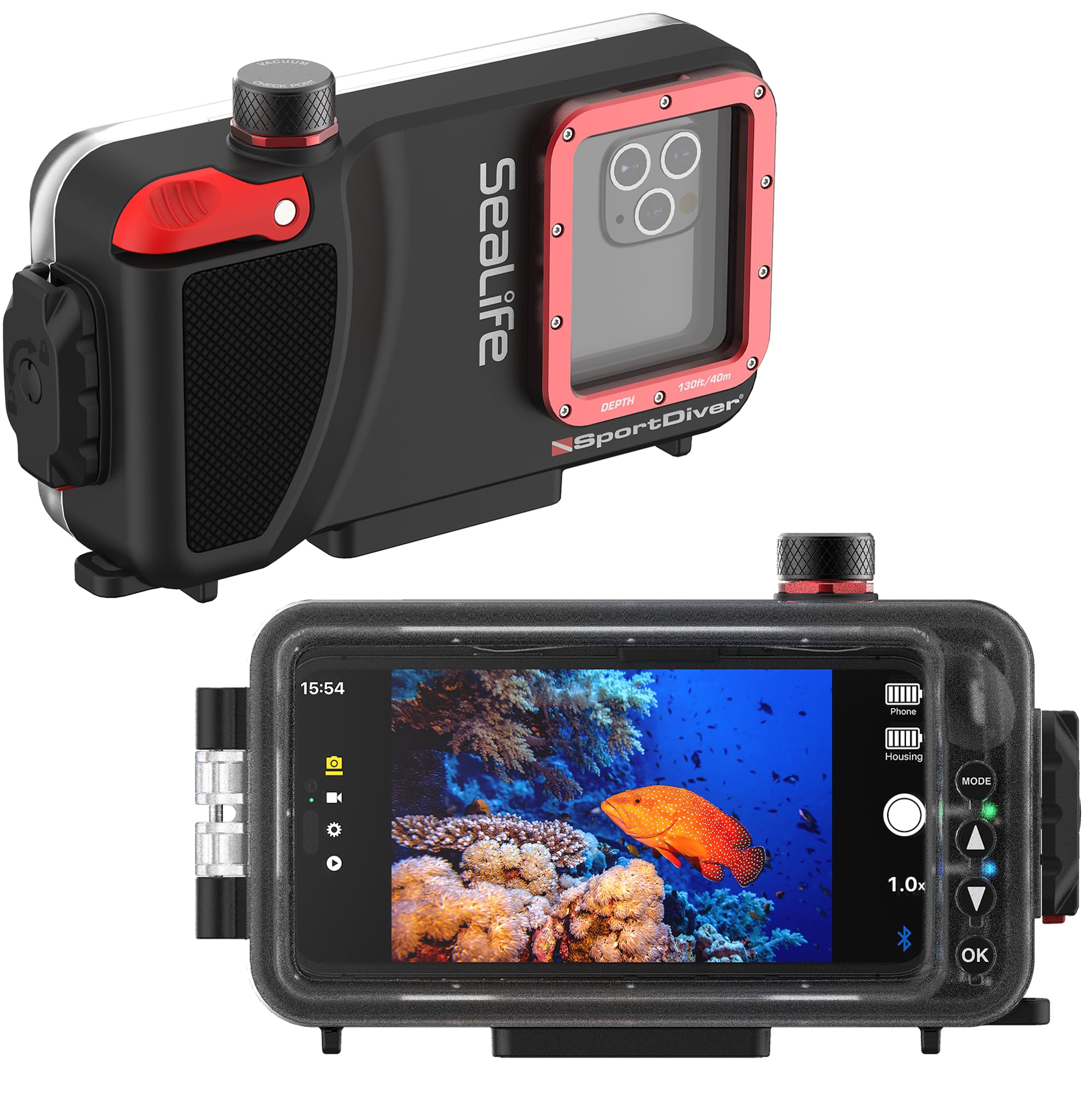
The scuba-first housing that shouts at you before the water reaches your iPhone.
If you dive regularly and want the case to warn you rather than trust you, the SportDiver is the pick. It seals to 130 feet (40 m) with a cam-lock mechanism, and it fires both an audible and a visual moisture and pressure alarm if the seal is not right. A vacuum check port lets you pull a seal before you ever get in the water, and the anti-fog Moisture Muncher capsule fights internal condensation. It runs on two AAA batteries with up to 50 hours of continuous use and talks to the free SportDiver app over Bluetooth.
What owners praise most is the build. It feels scuba-designed rather than adapted, and the interior tension spring plus rubber grip tabs hold the phone and add shock protection. The large shutter lever works with gloves, and the three 1/4-20 tripod mounts open up arms and lights. A longtime GoPro shooter switched after years of connection and file headaches and called the video quality and ease a pleasant surprise.
The fair caveat is the electronics budget. The housing runs on AAA batteries and the app drains phone power, with one diver noting the battery lasted 1.75 dives at 100%. The leak detection also draws mixed feelings — some trust it, some want more from it. It does not float, so add a lanyard. Treat the vacuum check as a pre-dive ritual and it earns the price.
Why divers pick it: the vacuum check port plus audible and visual alarms means the seal is verified before you splash, not discovered at 20 m.
The follow-up question: will the app last a full dive day? Bring spare AAAs and manage phone power, because one diver’s battery ran dry inside two dives.
Pick it for: scuba divers who value a pre-dive vacuum check and an alarm that tells them something is wrong while there is still time to surface.
Add to the cart: spare AAA batteries and extra Moisture Muncher capsules, because a dive day eats both faster than you expect.
6. DIVEVOLK SeaTouch 4 MAX Plus Filter Kit

The same full-touch housing, bundled with the filters that bring the colour back.
This is the SeaTouch 4 MAX again, but packaged as a filter kit with optical glass in the shell and a set of colour-correcting filters. It holds the same 60 m (196 ft) depth rating as the Best Overall pick, and it covers the iPhone 12 through the 16 Pro Max. The difference is the colour kit — red and purple filters that put the warm tones back into blue-water shots so you spend less time editing and more time looking at the photos on the boat.
The performance with filters fitted is the part worth hearing about. A diver shooting an iPhone 13 Pro found the red filter balanced colour well even at 100 ft, and another reported flawless execution as deep as 90 feet. A free diver liked the full touchscreen and the custom adapter fit, and several owners point to the foam-lined hard case as the reason it survives the flight.
The honest asterisk is the purple filter. Owners tend to say the red one does the work and the purple one is a curiosity. Also, DIVEVOLK ships the correct adapter only when you tell them which iPhone you have, so email the company at purchase if you want the right fit from the start. High quality, a 4.5+ rating, and the extra filter set make this the colour-focused buy.
Where it shines
- 60 m (196 ft) depth rating with optical glass in the shell
- Red and purple colour filters included for warmer underwater tones
- Full touchscreen still works, same as the Best Overall housing
- Foam-lined hard case protects it in transit
Small print worth knowing
- You must confirm your iPhone model so the right adapter ships
- The purple filter draws mixed reactions; the red one does most of the work
- Premium pricing sits at the top of this list
The right buyer is: a diver or free diver who wants the full-touch screen and is willing to pay extra for the colour filters and glass in one box.
Worth knowing: the purple filter is a minor add-on — the red filter is what fixes most blue-water footage.
7. Oceanic iPhone Waterproof Case for Snorkeling & Diving
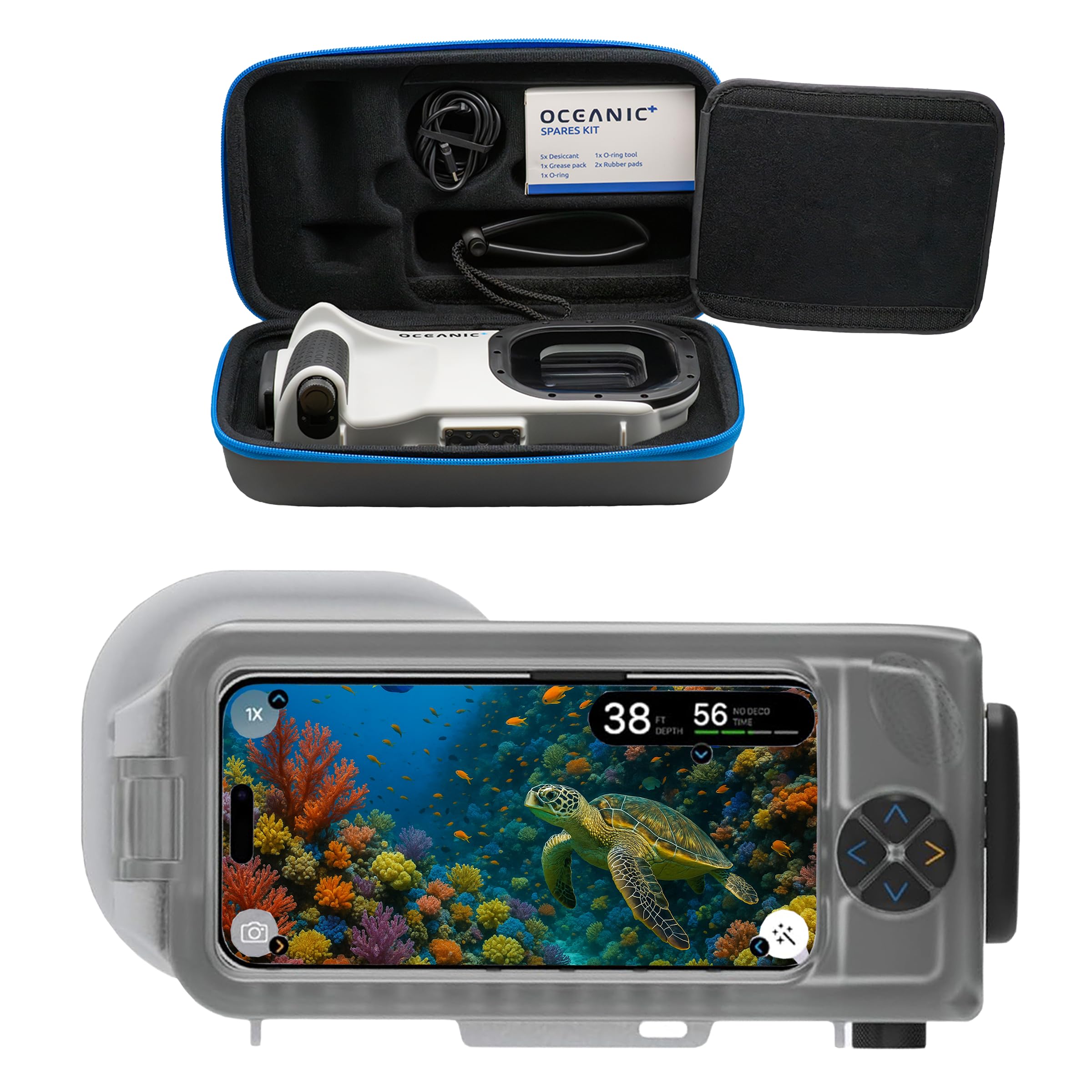
A housing that wants to be your dive computer as well as your camera.
The Oceanic case is the one for divers who like data alongside their footage. It is built from reinforced glass-fiber polymer and sealed with an automatic vacuum pump, rated to 196 feet (60 m), and it adds a directional pad for navigating instead of a touchscreen. The Oceanic+ app handles digital colour correction, multiple shooting modes and a logbook of your dives, and the same app, with a subscription, turns the setup into a full dive computer covering depth, time and no-decompression limits.
The build is the draw. It ships with an integrated leak detector and a retrofit kit in the box, and it handles snorkelling, diving and free diving without an extra purchase for the app’s photo features. The button interface is responsive, so you are not fighting a gel layer with wet hands, and the vacuum pump gives a mechanical seal check on the boat, not a guess.
The size is the obvious question. It weighs 16 ounces and divers describe it as awfully big, with one noting it made finding a light mount harder. The heavier concern is the app — a diver on an iPhone 17 Pro reported crashes three to five minutes into a dive, and because you cannot reboot the phone through a sealed case, a crash means surfacing. If you are logging dives as well as shooting them, keep the phone as a backup rather than the only brain in the water.
The draw: vacuum-pump sealing, a leak detector and a d-pad controller, plus a colour-correcting app with a logbook built in.
The fair warning: app crashes are the recurring theme in reviews, and a sealed case means no restart until you surface. Plan for shorter dives or a backup camera.
Choose it for: divers who want depth and dive-time data tied to their footage, with a mechanical seal check before every entry.
Think twice if: you need uninterrupted shooting on a long dive — the app stability and the lack of a touchscreen make it the least forgiving pick in this group.
Know the Specs
Depth Rating (m / ft)
The depth rating is the maximum pressure the case is built to survive, stated in metres and feet. A 60 m (196 ft) case is dive-grade and has thicker walls; a 50 ft (15 m) case is fine for snorkelling but not for a scuba profile. The rating is a ceiling, not a pass — the seal, the O-ring and your pre-dive check do the real work.
Touchscreen vs Buttons
A touchscreen housing passes your fingertip through a gel or glass layer so you can use any app underwater. A button housing uses physical keys or a lever tied to a Bluetooth app, which is steadier with gloves but limits you to one shooting app. Match this to how you dive, not to what sounds more advanced.
Leak Alarms and Vacuum Checks
A leak alarm is a sensor that tells you water has entered the case, sometimes with sound and light. A vacuum check port lets you pull a seal on land and watch for pressure loss before you enter the water. Both are early-warning systems, not life rafts — they buy you time to surface with a dry phone.
Colour Filters
Red and magenta filters sit over the lens to restore warm tones that blue water strips away. Red filters target blue water at depth; magenta targets green water; and a pink filter is for shallow snorkelling. They cut down editing later, so the right filter can be more useful than an extra megapixel.
Common Questions
Will an iPhone underwater housing fit my phone if I use a case?
Do I really need to remove my screen protector for a touchscreen housing?
How deep can I safely take an iPhone underwater housing?
Why do my underwater photos come out blue or green?
Does the touchscreen work underwater on every housing?
What kind of batteries do these housings need?
Will a red filter work at 100 ft?
Do I need to test the seal before every dive?
Can I use my iPhone underwater housing as an everyday case?
Which housing is best for a first-time diver who snorkels mostly?
The Bottom Line
For most people, the iphone underwater housing winner is the DIVEVOLK SeaTouch 4 Max Plus because it is the only case here that keeps the whole touchscreen alive at 60 m (196 ft), and the build feels professional grade in the hand. If a pre-dive vacuum check (a test that pulls air out to confirm the seal) and an audible leak alarm matter more than touch, the Sealife SportDiver is the scuba-first choice at 40 m (130 ft). And for ocean colour work with the filters already in the box, reach for the DIVEVOLK SeaTouch 4 MAX Plus Filter Kit and shoot with confidence that the red filter handles the blue. Whichever you choose, the seal is your responsibility — inspect the O-ring, test in freshwater, and pack the spare capsule.
How we choose
We do not accept paid placement. Every pick is matched to a real buyer and a real use-case; we do not hands-on test units.
Sources
Specifications: manufacturer listings and product documentation. Review insights: verified customer reviews, as of October 2026. Pricing: not shown on this page (it changes often); check the current price via the retailer link.
As an Amazon Associate, Aappliancez earns from qualifying purchases. This does not affect which products we feature.