Disclosure: Some links in this post are affiliate links. As an Amazon Associate I earn from qualifying purchases, at no extra cost to you. Learn more
Specs are compiled from manufacturer listings and verified buyer reviews and can change over time — please confirm the key details on the product page before buying.
If you carry more weight than the average shoe insert was designed for, you already know the failure mode: the arch flattens out by lunchtime and your heels take the beating. The insoles that survive daily life at a heavier weight share one thing — a stiff support plate under the cushion, not just soft foam. Below are the picks that hold their shape, plus the honest catch on each one.
This guide is built by comparing the manufacturers’ published specifications and the patterns across verified customer reviews, so you get each pick’s real strengths and trade-offs instead of marketing spin.
A heavy-duty insert only earns its place if the arch does not pancake under you by mid-afternoon. Here is what actually holds up when you are shopping for insoles for heavy people.
Top Picks
How To Choose The Best Insoles for Heavy People
Weight changes everything about how an insole behaves. A soft gel pad that feels great in the store can bottom out within a week once 250 lbs presses down on it every step. What you want is a stiff spine under the soft layer — a support plate that keeps the arch from collapsing.
Look for the support plate, not the cushion
Insoles built for heavier bodies use a rigid TPU (a hard plastic that springs back) or PU base to hold the arch shape. That plate is what stops the insert from flattening. Soft foam alone compresses and stays compressed, which is why cheap gel inserts stop helping so quickly.
Match the arch height to your break-in patience
A tall arch support — the 36MM and 3.5cm heights listed in these picks — gives strong lift but takes days or weeks before your feet stop noticing it. If you have never worn an orthotic before, plan on short wear sessions at first and build up.
Buy for the shoe you actually wear
A thick insert eats volume inside the shoe. Work boots and looser sneakers handle that easily; tight dress shoes and slim runners may not. Check the shoe’s removable liner — most of these replace it rather than stack on top of it.
Side-by-Side Comparison
| Model | Best For | Weight Rating | Support Build | Trim to Fit | Amazon |
|---|---|---|---|---|---|
| Dr. Scholl’s Heavy Duty Support★ Best Overall | Everyday work and casual shoes | Over 200 lbs | Shock-absorbing foam cushion | Yes | Amazon |
| GVIIPK 280+lbs Plantar FasciitisBudget Pick | First-time orthotic wearers | 280 lbs+ | TPU plate with dual-layer PORON | Yes | Amazon |
| archepaid Heavy Duty Plantar Fasciitis | Flat feet that need lift | 240 lbs+ | Hard TPU with 36MM arch | Yes | Amazon |
| Welnove 220+ lbs Heavy Duty | All-day standing on hard floors | 220 lbs+ | Gel heel pad with PU base | Yes | Amazon |
| VALSOLE Heavy Duty Plantar Fasciitis | Stiff support for flat feet | Over 230 lbs | Reinforced arch support structure | Yes | Amazon |
| PCSsole Plantar Fasciitis Insoles | Long shifts on concrete | 230 lbs | Firm arch with soft gel layer | Yes | Amazon |
Detailed Reviews
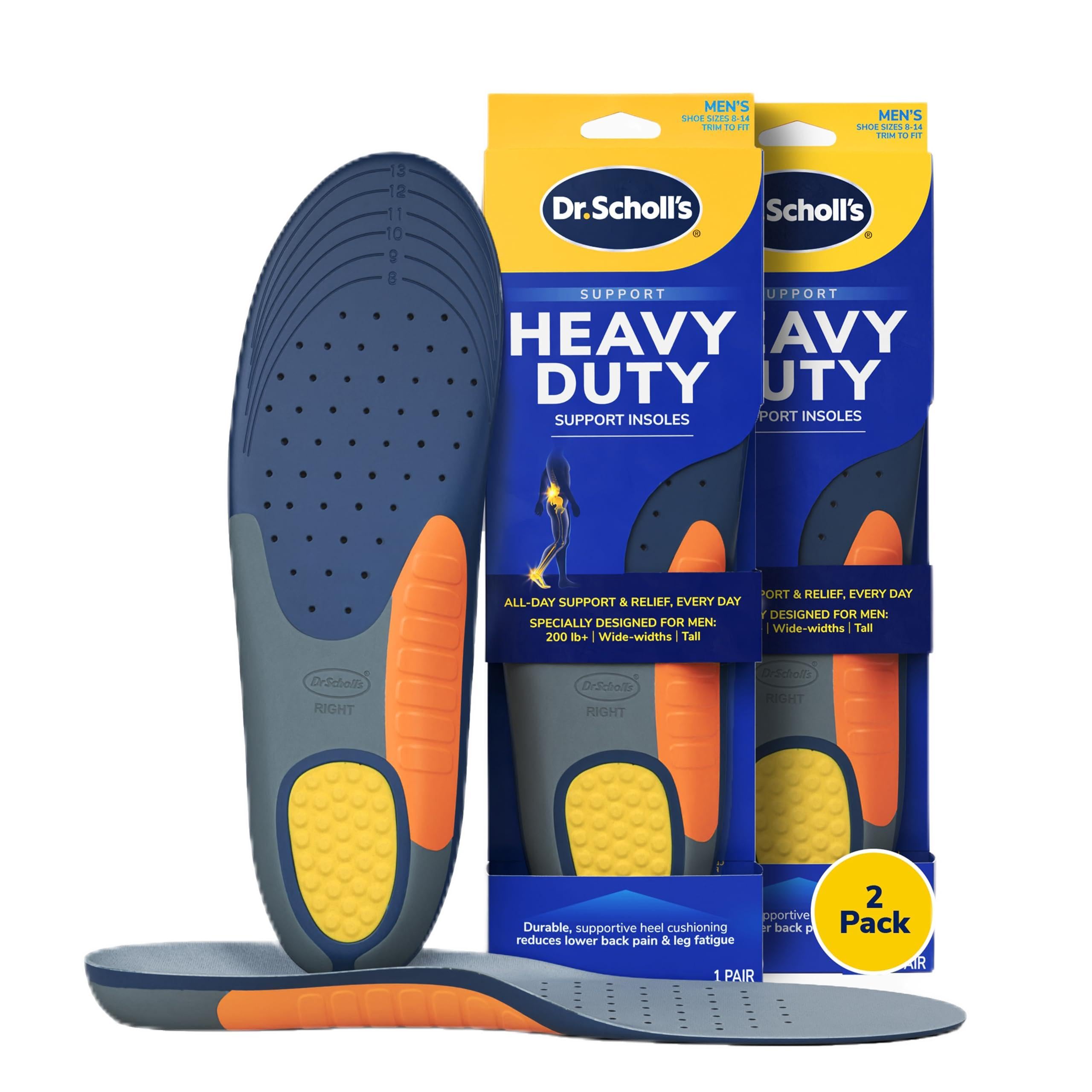
1. Dr. Scholl’s Heavy Duty Support Insole
Our pick — 4.0+★ from 88,000+ verified ratings; the strongest balance of quality and price.
The known-name insert built for big-and-tall frames, and it shows in the thick cushion.
This is the one to start with if you have never bought a heavy-duty insert before and just want something that works in your work boots. It is rated for people over 200 lbs, tall stature, or wide feet, and it fits any arch type — high arches and fallen arches both. The build is a shock-absorbing foam cushion with extra heel support, so every step lands softer.
Where most inserts fail a heavier buyer is the flattening: the arch gives way and you are back to heel pain. Foam cushioning does the shock work here, and the heel block is there to take the landing. What wins people over is the overall build quality — it is the most-praised thing about this insert by a wide margin, with pain relief right behind it. It is also the heaviest insert in this lineup at 14.4 ounces, which is the trade-off for that dense cushion — you feel it in the shoe, but it is what keeps the pad from bottoming out.
The honest catch is fit. People are split on whether the arch is high enough and whether the insert makes shoes too tight. You trim it to your shoe, and tracing your old insole beats trusting the printed guide — one size-11 owner had to cut to the line marked 8. The other recurring note is squeaking in some shoes; a thin barrier between insert and shoe solves it. Otherwise this is a workhorse: buyers report “I purchase these for hubby. He uses one pair every year or so.”
Where It Wins
- Rated for over 200 lbs with a dense shock-absorbing foam cushion
- Extra heel support aimed at lower-back and leg fatigue
- Trims to fit athletic shoes, work boots, casual shoes and slippers
Where It Asks More of You
- Fit is hit-or-miss for some — arch height and shoe volume split opinion
- At 14.4 ounces it is the heaviest insert here, so you notice it underfoot
- Some shoes squeak until you add a barrier between insert and shoe
Made for: the big-and-tall buyer who wants a proven, comfortable insert in boots and sneakers without a long break-in.
Plan around: trace your old insole before trimming — the printed cut lines run large.
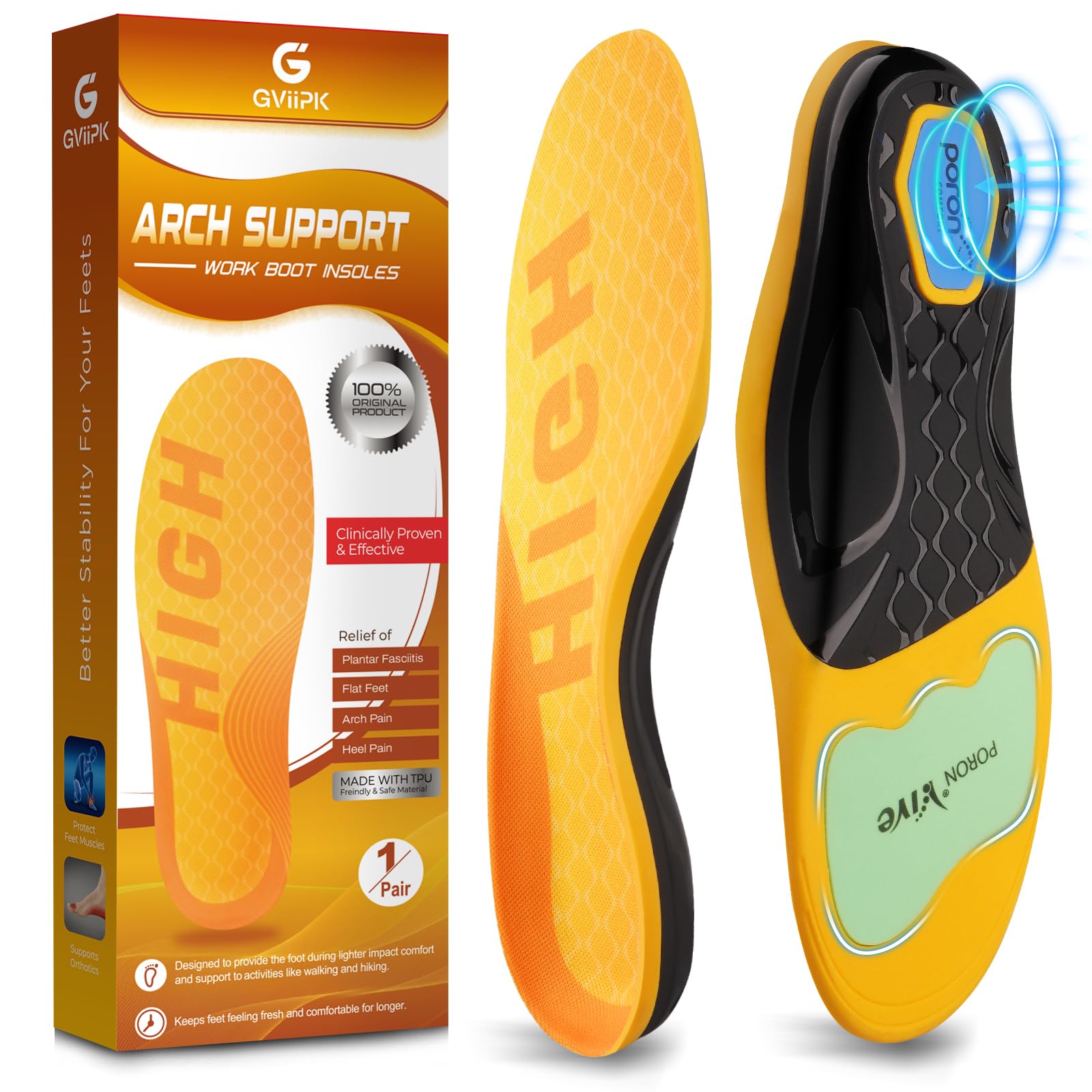
2. 280+lbs Plantar Fasciitis High Arch Support Insole
Two arch heights in one pair, so you can ease in before committing to full lift.
That is the smart part: these ship with a 3.5cm high-support plate and a 3.1cm medium-support plate. You start on the taller one to rebuild the arch, then drop to the shorter one for daily upkeep. For a heavier buyer who has never worn real orthotics, that gradual on-ramp is a big deal — jumping straight to a stiff arch is what makes people give up.
The support underneath is a high-strength TPU plate that runs into the arch core, and the maker states it holds up under 280 lbs+ without collapsing. Cushioning comes from a dual-layer PORON pad. It is also the lightest insert in this group by a huge margin — 0.63 ounces versus 14.4 ounces for the Dr. Scholl’s — so it disappears underfoot in a way the heavy foam inserts do not.
Now the honest part. This one is for lighter-duty use, and the feedback splits hard. Plenty of people are impressed for the money, but some find the support short-lived — a warehouse worker on ten-hour shifts walked away from it, and an insert that did not stay put once was another recurring note. The read: a smart, featherweight starter for someone easing into arch support, not the last word in durability.
What sells it: the two-height system — a 3.5cm plate for correction and a 3.1cm plate for maintenance, both trimmable, at an entry-level price.
Good fit if you’re: new to arch support and want to ramp up slowly without spending much to try it.
Look elsewhere if: you need an insert that survives ten-hour shifts on your feet — this one leans light-duty.
3. Heavy Duty Plantar Fasciitis Insoles Women
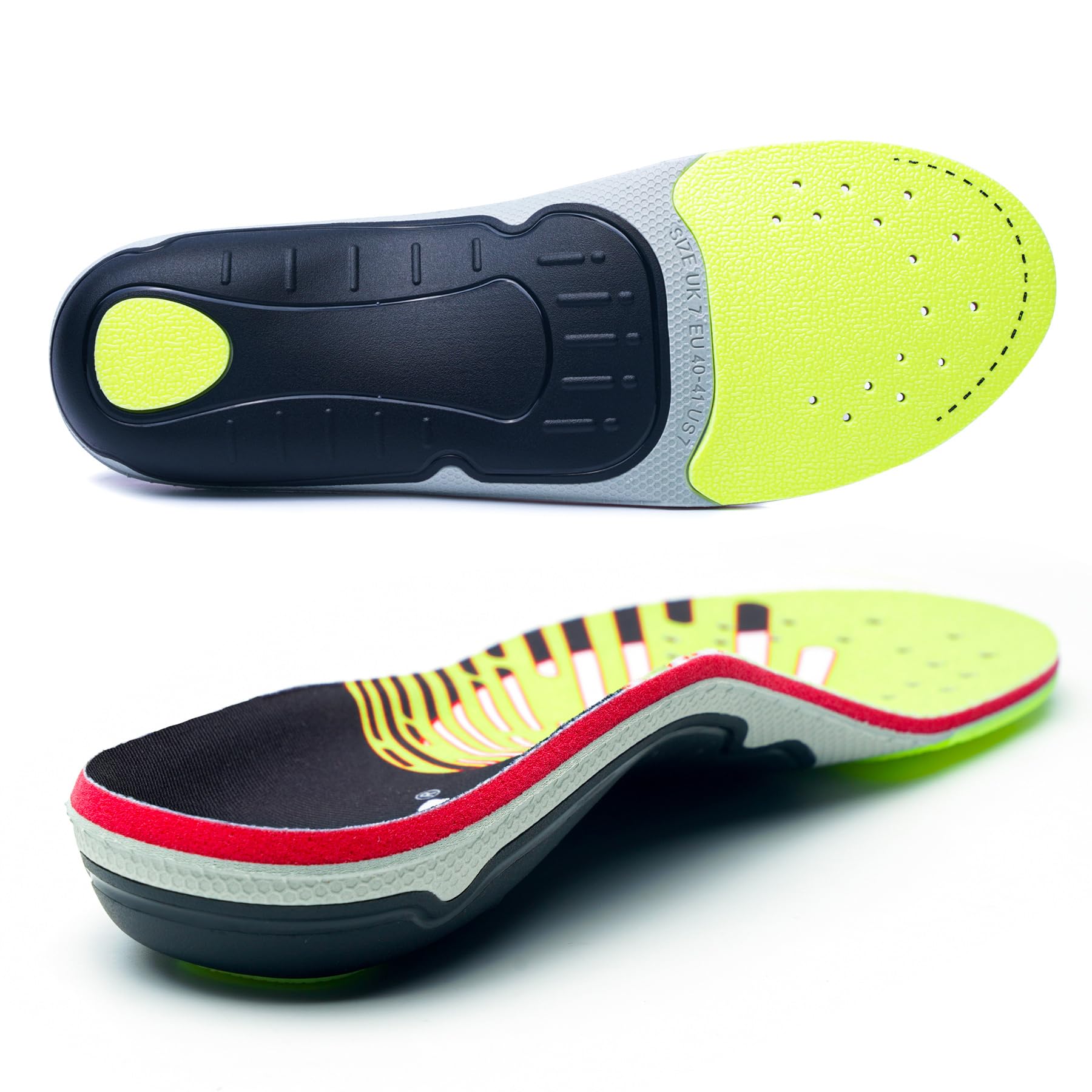
A 36MM arch is a serious amount of lift — expect your feet to feel it at first.
This insert is built for people over 240 lbs, and the hard TPU reinforcement on the inside is what gives it the backbone to hold that arch under load. On top sits a full-length EVA cushioning layer with a heel pad for shock absorption, plus an extra TPU layer on the bottom. The arch is the star at 36MM, which is tall — great for flat feet that need real correction, less great if you want instant comfort.
The fit is the thing buyers praise most here — far more than any other strength, with day-in comfort right behind it. The sizing does run a touch off for some people, so trimming matters, and this insert is happy to be cut down to your shoe. A size-10 wearer got a clean fit without any trimming at all.
Expect a break-in period. The support is firm by design, and feet that have been flat for years need roughly 10 days to settle into it — one wearer described it as hard at first but molding over time, and softening the back and foot pain significantly after that. It is the flat-foot pick, not the pillowy one. The one real caution is that the stiff arch can press into the heel and arch after a long day in a tight shoe, so pair it with footwear that has a little room.
The flat-foot answer: a 36MM hard-TPU arch with a full EVA cushion layer, for anyone who wants the arch to actually lift rather than just pad.
The break-in truth: it is firm, and it does not feel soft on day one — that firmness is the point, but it is not for someone who wants instant plush.
The right call for: flat feet above 240 lbs that genuinely need the arch raised, in shoes with a bit of breathing room.
Skip the stiffness if: you want a soft, neutral insert with no adjusting period at all.
4. Welnove Plantar Fasciitis Insoles XL
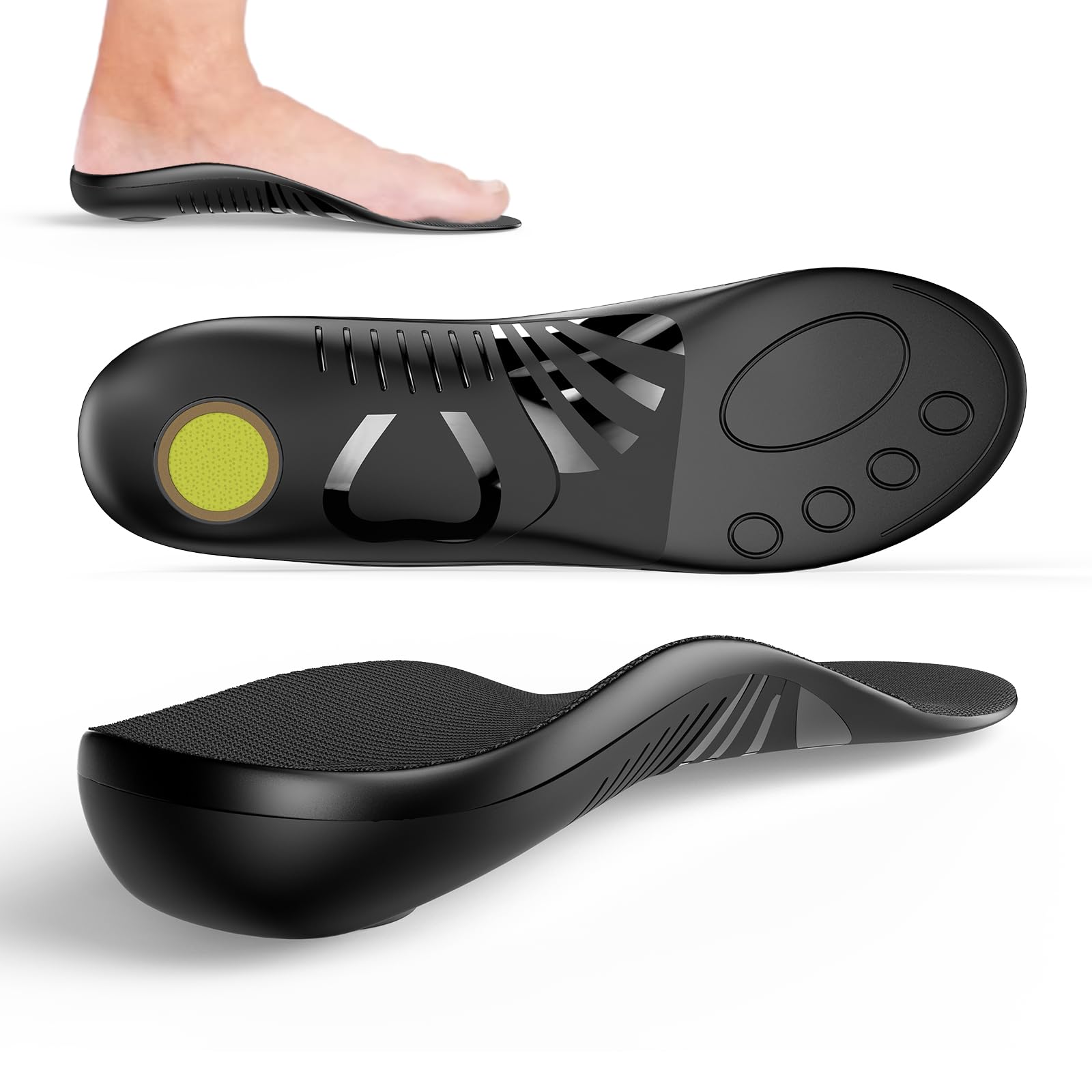
Gel under the heel and a stiff PU base — the combo for people who stand all day.
Welnove aims this at the 220 lbs+ crowd and the all-day standers, and the design reflects it. A gel heel pad takes the landing, a PU base gives the arch its structure, and a deep heel cup holds the foot steady so it does not roll. The gel heel pad and deep heel cup make it a heel-first insert, aimed at heel and lower-body pain from long shifts rather than at lifting a flat arch.
What earns it a spot here is the all-day factor. It targets lower body pain and foot/leg fatigue, and it slots into casual shoes, work boots, running shoes, and high-volume dress shoes without a fight. It weighs 14.07 ounces, close to the Dr. Scholl’s in heft, so it feels substantial in the hand and in the boot.
The trade-off worth knowing is the break-in. Welnove tells you to start at 3-5 hours a day and build up, because the new arch shape is a change your feet have to adapt to. A few people find it too thin for many hours, and value-for-money is a split verdict — some call it money well spent after a few weeks. A 260 lb wearer who also tried gel inserts rated these the better support. Best for the stander whose priority is heel comfort and stability.
Reasons It Earns the Spot
- Gel heel pad plus deep heel cup for stability during long standing
- PU base holds arch support under 220 lbs+
- Fits work boots, running shoes, dress shoes and hiking shoes
What to Weigh First
- Needs a 3-5 hour ramp-up before full-day wear
- Some find it too thin for very long stretches on concrete
- Value-for-money splits both ways depending on how hard you work it
Reach for it if: your heel is the problem and you are on your feet for a shift at a time.
Think twice if: you want a tall corrective arch — this one prioritizes heel cushion and stability.
5. VALSOLE Heavy Duty Plantar Fasciitis Insoles

Stiff, structured and built to re-train your gait if your feet roll inward.
VALSOLE designs these for people over 230 lbs, with a reinforced arch structure and a springy cushioning layer on top. It is built for overpronation — the inward ankle roll that twists your stride and loads the knees and hips. The support layer is meant to stabilize the foot, tame that roll, and take pressure off ankles, knees and hips. If your ankles roll inward and your stride has felt off for years, this insert is built to correct that roll.
The build follows the natural contours of the foot and balances the heel and midfoot so you get a stable base. It trims to fit walking shoes, running shoes, work boots and hiking boots. At 3.53 ounces, it is far lighter than the heavy-foam inserts — closer to the GVIIPK in weight than the 14-plus-ounce Dr. Scholl’s — so it does not drag down the shoe.
Budget a week for your feet to adjust; VALSOLE suggests starting at 2-3 hours a day and building. The consistent feedback is stiffness — one user found it stiffer toward the toes but liked the shock absorption on uneven ground and the fact it needed no trimming. The real friction is shoe volume: the added support makes some shoes feel tighter, so check the space before you commit. One smart tip from wearers — measure your existing insole length rather than your shoe size when ordering.
Built for the roller: a reinforced arch aimed at overpronation, so the ankle stays put and the knees get less twist.
The catch: the support adds bulk, so tight shoes will feel tighter until you size the shoe around it.
The pick for: flat feet that roll inward, or anyone who wants a firm, corrective feel over softness.
Not the one for: a plush, zero-adjustment insert, or very slim shoes.
6. PCSsole Plantar Fasciitis Insoles

A firm high-arch insert with a gel layer, popular with nurses, warehouse staff and other all-day standers.
PCSsole puts a firm arch and a soft gel layer together, and it is the combination that keeps people coming back. The firm part gives the arch stability, the gel part handles the shock, and the moisture-wicking fabric keeps the shoe from turning swampy. It fits flat shoes, sneakers and boots, and it corrects overpronation to spare the knees during long standing.
Its edge over the cheaper picks is durability: the firm arch keeps its shape long after soft foam inserts collapse. Its firm arch and gel layer hold their shape over months of daily standing, and most wearers feel the difference within days rather than weeks. At a light weight for a heavy-duty insert, it adds support to a work shoe without the drag of a dense foam slab. For a heavier buyer whose last inserts flattened within weeks, that months-long shape retention is the reason to buy.
Two things to plan for. It is thick, so it takes up shoe space — the reviewers who love it wear looser shoes for that reason. And it wants a gradual break-in; jumping to all-day immediately is where people stumble. As one wearer put it: it “helped ease plantar fasciitis discomfort” and the quality felt on par with pricier brands. Pair it with a roomy work boot or sneaker and it just works.
Why It’s Worth a Look
- Firm arch plus soft gel absorbs shock without going flat
- Moisture-wicking fabric keeps feet dry through the day
- Holds its shape over months and starts helping within days
Go In Knowing
- Thick build eats shoe volume — slim shoes are out
- Wants a gradual break-in, not an all-day jump
- Firmness splits people who want a harder vs softer feel
the balance for: long-shift standers who want a firm arch that lasts and a soft gel layer under the heel.
Only if your shoes have room: this is a thick insert, so give it a boot or a loose sneaker, not a tight dress shoe.
Know the Specs
Weight rating — the lbs figure
Every insert here carries a weight rating: over 200 lbs, 220 lbs+, 230 lbs, 240 lbs+, and 280 lbs+. That number is the maker’s guide to how much load the support is built to handle before it starts to flatten. Match it to your body weight and the kind of work you do — a 250 lb stander wants a rating with headroom above them.
The support plate — TPU, PU, or EVA
This is the backbone of the insert. A TPU plate (a hard, springy plastic) or a PU base holds the arch shape under load. EVA is the softer foam cushion that sits on top. A thin soft insert with no stiff layer is the one that bottoms out. When an insert promises support at a heavy weight, the plate is what makes it real.
Arch height — measured in MM or CM
Taller arches give more lift and more correction but take longer for your feet to accept. A 36MM or 3.5cm arch is a big change for a flat-footed wearer; a lower arch is gentler. If you are new to orthotics, start shorter and build up, or pick an insert that offers two heights in one pair.
Trim to fit and shoe volume
Most inserts here can be cut to match your shoe, and the reliable method is to trace your old insole rather than trust the printed lines. Thicker inserts eat space inside the shoe, so the roomier your footwear, the better a heavy-duty insert sits. Check the shoe’s removable liner before you swap it in.
Common Questions
Will heavy-duty insoles fit inside my work boots?
How do I know which weight rating to pick?
Why do heavy-duty insoles feel hard at first?
Is a higher arch support better for flat feet?
Can insoles for heavy people cause foot or back pain to get worse?
Do these insoles replace the liner that comes in my shoe?
How long should a heavy-duty insole last?
What is the difference between a foam cushion and a TPU support plate?
Are these insoles good for standing all day on concrete?
Should I size my insole by my shoe size or by measuring?
The Bottom Line
If you carry a heavier frame and want the safe starting point, the Dr. Scholl’s Heavy Duty Support is the one to reach for — it is rated for over 200 lbs, trims to your boots, and has the deepest bench of happy tall-and-wide buyers. If you are flat-footed and need real arch lift, go with the archepaid Heavy Duty and its 36MM arch. And for long shifts spent standing, the firm-arch-plus-gel PCSsole is built to keep its shape when other inserts go flat. Whichever you pick, trace your old insole before you cut, and give the arch a week to win you over.
How we choose
We do not accept paid placement. Every pick is matched to a real buyer and a real use-case; we do not hands-on test units.
Sources
Specifications: manufacturer listings and product documentation. Review insights: verified customer reviews, as of October 2026. Pricing: not shown on this page (it changes often); check the current price via the retailer link.
As an Amazon Associate, Aappliancez earns from qualifying purchases. This does not affect which products we feature.