Disclosure: Some links in this post are affiliate links. As an Amazon Associate I earn from qualifying purchases, at no extra cost to you. Learn more
Specs are compiled from manufacturer listings and verified buyer reviews and can change over time — please confirm the key details on the product page before buying.
An ice dam is a ridge of ice that forms at the roof edge and traps melting snow behind it, so the water backs up under your shingles and drips into the ceiling. The fix is a self-regulating heat cable that runs through the gutter and down the downspout to keep meltwater flowing. This guide covers the seven cables worth considering and, just as importantly, the two specs that decide whether one works in your climate: watts per foot and total length.
This guide is built by comparing the manufacturers’ published specifications and the patterns across verified customer reviews, so you get each pick’s real strengths and trade-offs instead of marketing spin.
Most first-time buyers fixate on length and pick the longest reel they can find, when the wattage rating and the clips are what actually decide the job. Below you will find a quick comparison table, seven in-depth reviews, and a plain-English breakdown of what each spec means for your roof — everything you need to choose the right heat tape for gutters.
Top Picks

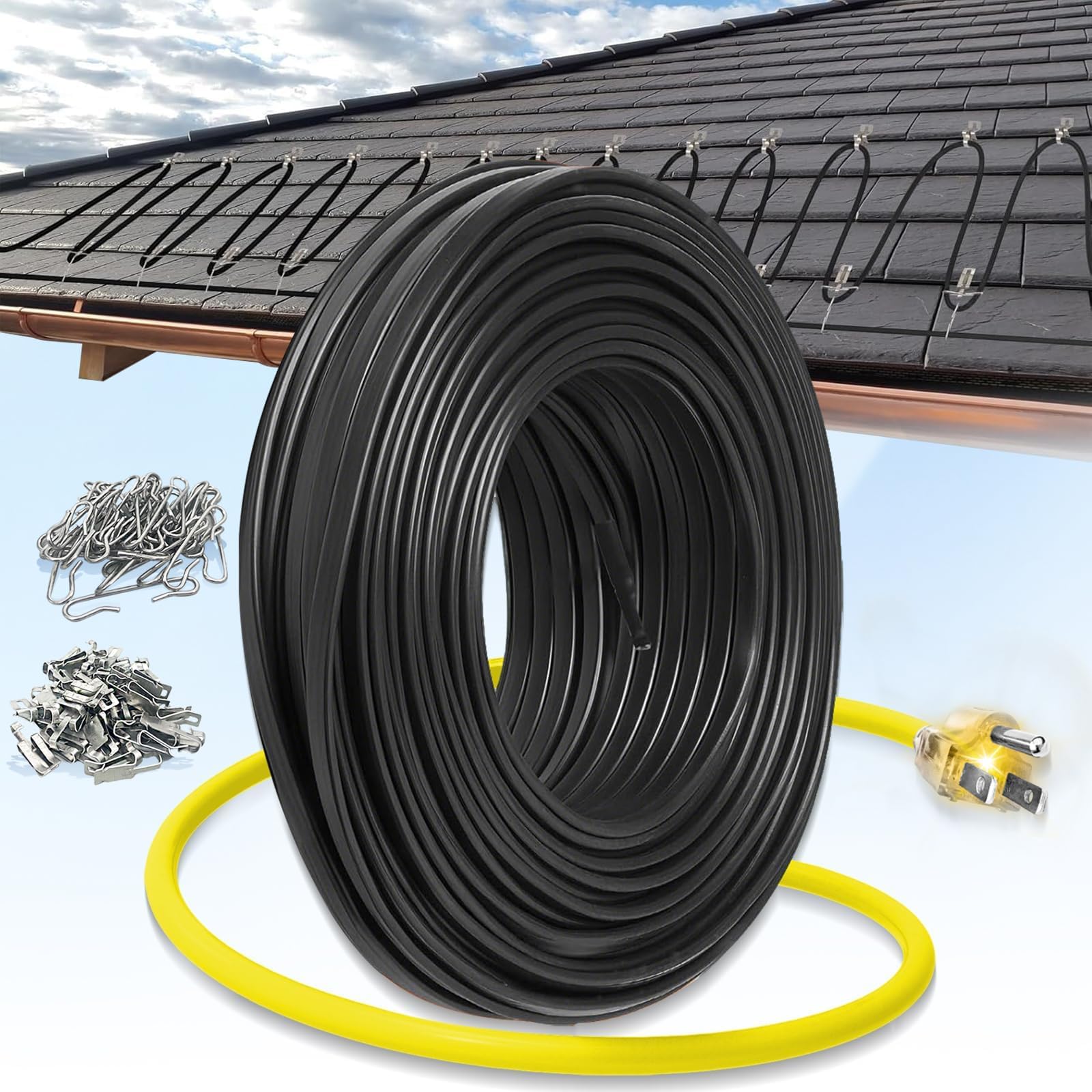
How To Choose The Best Heat Tape for Gutters
You are buying a heating element that sits outdoors in water, ice and sun for years, so the buying decision is mostly about heat output and how the cable is held in place. Get those two right and the rest is arithmetic — adding up the linear feet you need to cover.
Watts per foot sets your cold-weather headroom
Wattage per foot is the cable’s heat output for every foot of its length, and it is the number that decides whether the tape keeps up in a hard freeze. A 5W/ft cable is a mild-climate tool, while an 8W/ft cable like the H&G lifestyles unit throws considerably more heat per foot. The 65 FT YeloDeer and the 100FT Eastrexon both rate 8W/ft, and the 36 FT YeloDeer delivers 6W per foot at 50 °F. Match that figure to how cold your winters actually get, not to the price tag.
Self-regulating versus fixed power
A self-regulating cable adjusts its own heat output as the air temperature around it changes. That means it throttles back on a mild day and works harder in a deep freeze, which cuts wasted electricity and lowers the risk of overheating. A fixed-power cable outputs the same heat no matter what, so it can run hotter than needed and still fall short on the coldest nights. The H&G listing puts that gap plainly: fixed-power designs often sit at only 5W/ft while its own self-regulating cable is rated 8W/ft.
Length is a sum, not a guess
You need enough cable to run along the gutter, down the downspout and, on stubborn roofs, back up in a zig-zag over the overhang. The 100FT Eastrexon and the 120-foot Easy Heat ADKS-600 kit suit larger rooflines, while the 6 ft HEATIT is built for a pipe or a small trouble spot, not a full gutter run. Measure twice, because joining two shorter cables is not how these are designed to work.
Clips and mounting hardware decide how it holds
Loose cable drooping off the roof edge is where most installations fail, so check what comes in the box before you buy. The 100FT Eastrexon ships with 45 clips and spacers, the Easy Heat kit includes 6 clips and 2 mounting screws, and the HEATIT does not include clips at all. On a long run, budget for extra clips even when some are supplied.
Side-by-Side Comparison
| Model | Best For | Length | Heat Output | Clips Included | Amazon |
|---|---|---|---|---|---|
| HEATIT JHSF1★ Best Overall | Pipes and small problem spots | 6 ft | 5W/ft | No | Amazon |
| 36 FT YeloDeer Gutter KitBest Kit Value | One-run gutter and downspout coverage | 36 ft | 6W/ft at 50 °F | Yes | Amazon |
| 65 FT YeloDeer Industrial Grade | Medium roofs and downspouts | 65 ft | 8W/ft | Not included | Amazon |
| H&G lifestyles 80FT | Long runs on large roofs | 80 ft | 8W/ft | Yes, on 60–140 ft lengths | Amazon |
| Easy Heat ADKS-600 | Complete large-roof de-icing | 120 ft | — | 6 clips, 2 screws | Amazon |
| Radiant Solutions HeatTapePro | Troubleshooting and built quality | 12 ft | — | No | Amazon |
| 100FT Eastrexon Kit | Big rooflines with full clip kit | 100 ft | 8W/ft | 45 clips and spacers | Amazon |
Detailed Reviews
1. HEATIT JHSF1 Heating Cable 6FT
Our pick — 4.5+★ from 700+ verified ratings; the strongest balance of quality and price.
Six feet of self-regulating cable that quietly earns the top spot.
The HEATIT JHSF1 is the pick here because the crowd is behind it, at 4.5+ stars across 700+ ratings, and because it turns on automatically at 50 degrees F. That 50F trigger is the whole point: you plug it in and it takes over as the air cools, then eases off as it warms, so there is no dial to watch during a storm. At 6 ft it is a short length, but the job it does best is the one that matters most — keeping a pipe or a small vulnerable stretch from freezing solid.
What it is genuinely certified for is worth checking closely. The cable itself holds ETL certification, and the plug carries UL certification, which is a stronger position than the plug-only certification some cheap tapes carry. You can wrap it straight, spiral it around a pipe, or overlap it — and it is rated to protect pipes up to 2 1/2 inches in diameter. If the ambient temperature drops below -20 degrees F, HEATIT advises a full inch of insulation instead of half an inch.
The build quality is what the review pages keep circling back to. It is well made and easy to work with, and the heat distributes evenly rather than concentrating in one hot patch. The honest catch is the box itself: no clips come included, and without them you cannot attach it to a roof, which is why several owners buy fasteners separately. One owner also wired it to a smart plug set to cycle at 35F rather than let the 50F trigger run all the time, which is a sensible move for anyone thinking about the electric bill.
Where it wins
- ETL certification on the full cable, not just the plug
- Auto-heats at 50 degrees F with self-regulating output
- Works straight, spiral-wrapped, or overlapped
- Rated for pipes up to 2 1/2 inches in diameter
What to plan around
- No mounting clips in the box — buy them with the cable
- The 6 ft length is too short for a full gutter run
- Below -20 degrees F, HEATIT asks for 1 inch of insulation
Worth owning if: you need protection on exposed pipes, a crawlspace, or a short trouble spot and want certified safety at an entry-level tier.
Keep looking if: your gutters need a long continuous run — the 6 ft span will not stretch across a roofline.
2. 36 FT Self Regulating Heating Cable Kit
The one-run kit that arrives ready to mount on the gutter.
You get everything you need to install in one box with the 36 FT YeloDeer kit, which includes clips and spacers. It sends 6W per foot at 50 degrees F (6 watts of heat for every foot of cable) and measures 36 ft — six times the length of the 6 ft HEATIT, at 1.98 pounds against that cable’s 1.03 pounds. That extra bulk means you can cover a full gutter-and-downspout run, not just patch a pipe. The build includes a copper core, inner shielding, a copper-wound blast guard (a protective layer that resists damage) and a fluoropolymer exterior (a tough plastic coating) that resists both high and low temperatures.
Buyers report it working through a rough upstate New York winter; one put it plainly: “Put it in the bottom of my gutter and the ice dams have mostly stopped.” It also does the everyday job well — a porch roof that used to build up ice now stays clear. It handles flat, metal, asphalt, rubber, slate, stone and ceramic roofs.
This is a preventive tool: it stops a dam from forming and slowly clears existing ice. But asking it to melt a deep, established dam in a mild storm is a stretch. A few owners found the clips small for shingle grip and the double coil stubborn to unwind. Expect to spend more time on the install than the box implies, and to supplement clips if your roof pitch is steep.
The real draw: a complete, in-the-box gutter setup with the copper core and armored exterior a long outdoor run needs.
Size it honestly: it is a prevention cable for a single roofline, so measure your gutter plus downspout before you assume 36 ft covers it.
Reach for this if: you have one gutter-and-downspout run and want a kit that includes the hardware.
Look elsewhere if: you are fighting a deep, already-formed ice dam and need maximum heat per foot.
3. 65 FT Self Regulating Heater Cable
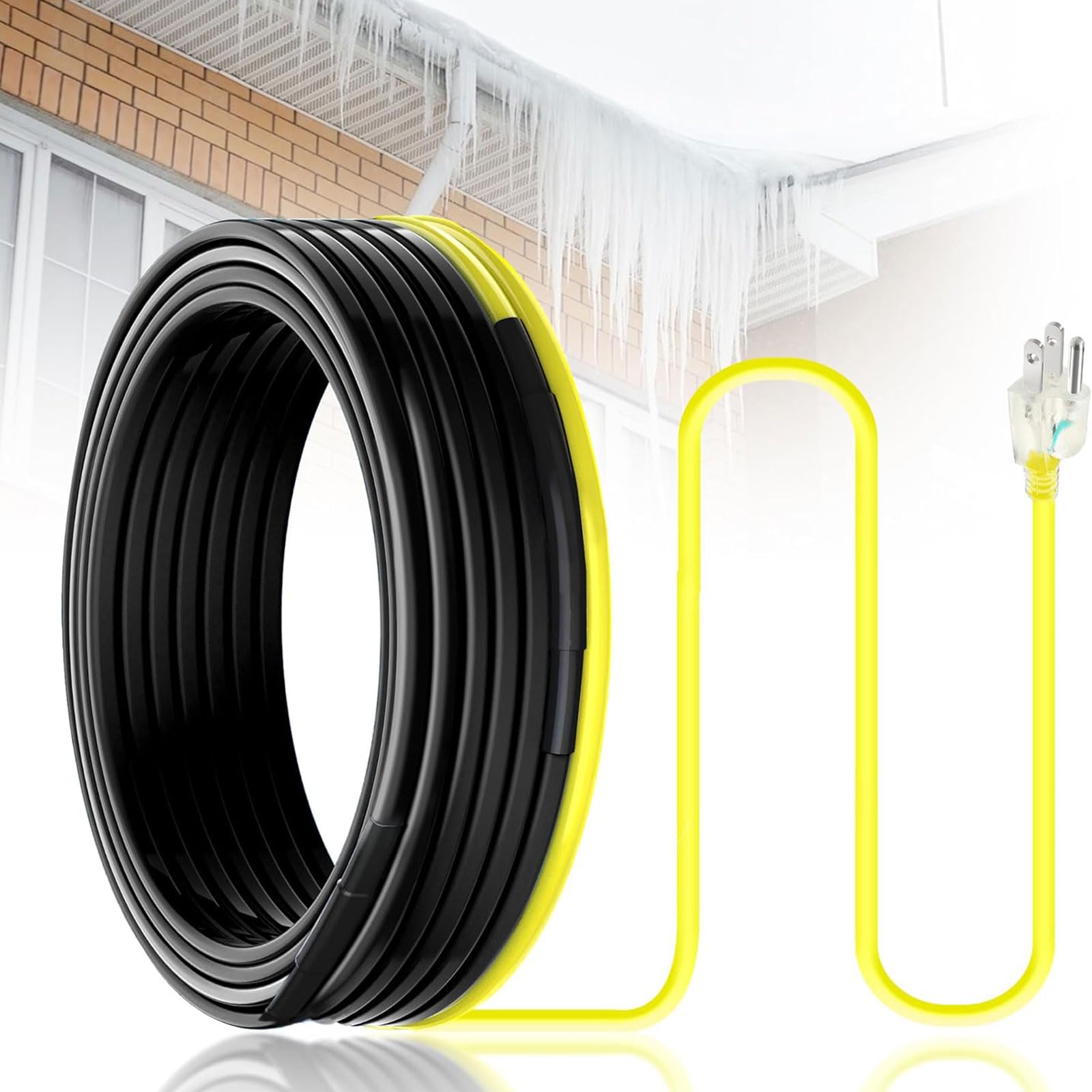
Eight watts per foot across 65 feet of medium-roof coverage.
For a roof that needs real heat, not just a trickle, the 65 FT YeloDeer delivers 8 watts per foot — eight watts of heat for every foot of its run — and stretches 65 feet, a serious step up from the 36 FT kit above. That combination carries a medium roofline and its downspouts through a proper winter. The build backs it up: polyolefin inner insulation (a plastic heat barrier), a PE protective layer (a polyethylene jacket) and a tinned copper core (copper coated with tin for corrosion resistance), all wrapped around a 6 ft power cord with a light indicator so you can see it is live.
Owners describe exactly the job you would want. The most repeated review line: “Strung this up and downspout and across my gutters. First snow of the season with no challenge for this heat tape. Kept my gutters running clear.” Another simply says the rain gutter does not freeze anymore, and the cable is described as heavy duty, with consistent heat from beginning to end rather than hot spots.
The catch is in the packaging, and it is worth knowing before you order. Clips and hangers are not included for roof de-icing, so budget for them, and the aluminum shingle clips that do turn up with some orders are noted as weak. Plan on buying sturdier clips and this cable does its job cleanly. It also pairs with a YeloDeer WiFi 110-120V smart de-icing control if you want to manage it from your phone.
Why it earns a mid-pack spot
- 8W per foot of heat output across 65 feet
- Polyolefin, PE and tinned copper construction
- 6 ft power cord with indicator light
- Consistent heat from one end to the other
Before you mount it
- Clips and hangers sold separately for roof use
- Supplied aluminum shingle clips can flex
The right call for: a medium roof and downspout run where 36 ft falls short and you want 8W/ft of output.
Think twice if: you want everything in the box — you will be sourcing clips separately.
4. H&G lifestyles 8W/FT Heat Cable 80FT

Built for long rooflines that need steady heat from end to end.
The headline figure here is 8W/FT held steady even on runs up to 140ft, a design H&G says keeps output from sagging over distance the way other long cables can. At 80 ft with a 5.4ft power cord, this cable is aimed squarely at large roofs where shorter tapes would need joining. It also runs hot: the maker rates it up to 158 degrees F as it adjusts to temperature drops, well above a 5W/ft cable.
The construction holds up in real use. Polyolefin inner insulation, a TPE protective layer and a tinned copper core make it thick and durable, and owners say it is best installed on a warm day so the cable stays flexible. One used it on a roof deck and partly in a downspout to stop ice dams and reported it working well. Another looped an 8W roof cable over an 8-inch ice dam that was causing a ceiling leak, and the ice cleared fully in 90 minutes.
Two practical notes belong in any honest write-up. First, there is no built-in thermostat, which H&G frames as a reliability choice in freezing weather — add a plug-in thermostat outlet if you want automatic on/off. Second, clips are included only on the 60–140 ft lengths, matched at roughly one every 4 ft, so check your size before assuming they are in the box. And this cable draws real power; plan to run it around storms rather than all season.
The standout: stable 8 watts per foot on extra-long runs, paired with a heat ceiling of 158 degrees F for serious ice.
The trade-off: no thermostat in the cable, so automatic control means buying a separate plug-in outlet.
Suits you if: your roofline is long and you need heat that does not fade toward the far end.
Not your pick if: you want the cable to switch itself on and off without any extra parts.
5. Easy Heat ADKS-600 120-Foot Roof Snow De-Icing Kit

A 120-foot kit for roofs where shovelling has stopped being an option.
The ADKS-600 is a complete de-icing kit rather than a bare cable, and it covers ground: 120 feet of run, 3.95 pounds, plus 6 clips and 2 mounting screws to start you off. Easy Heat positions it for most roof and gutter configurations, and the job it does is keep an uninterrupted path for meltwater to run off the roof rather than backing up into the shingles. It needs no maintenance once installed.
What owners actually describe is the end of a chore. People use it to replace back-breaking roof shovelling that ruins shingles, running multiple sets through heavy snows and keeping gutters and valleys ice-free. The installation is measured in hours, not days — One owner fitted it in 1.5 hours the day before a 16-inch blizzard, and it held. Owners also call it a genuine ice-dam fix in shaded roof areas where an 18-inch dam was routine.
The honest caveat is running cost. This is a big, thirsty kit, and the electric bill is the one downside owners raise repeatedly — the advice is to switch it on before a storm and off after, not leave it running all winter. Routing the cable neatly through a long, multi-turn downspout also takes patience and, on some setups, partial disassembly, so plan a dry, mild day for the install.
The case for it: a long, complete kit that turns a multi-day shovelling job into a switch you flip before the snow arrives.
Plan for the bill: this draws serious power, so run it around storms rather than leaving it on all season.
Best for: a large roof with a history of ice dams where you would otherwise be up a ladder with a shovel.
skip it if: you want a low-draw cable you can leave running unattended for weeks.
6. Radiant Solutions HeatTapePro Heat Cable 12 ft

A short premium cable with a light at the end that tells you it is alive.
HeatTapePro’s defining feature is its GlowCap — a light at the far end of the cable that confirms it is working the whole way along, not just at the plug. That is a real troubleshooting shortcut on a roof, where the alternative is climbing up to feel for warmth. It is a commercial-grade self-regulating cable with injection-molded connections rather than heat-shrink tubing, and it carries a 10-year warranty with UL listing. The safety point worth noting: it will not short or burn out if the cable is overlapped, and it is certified for flat, metal, asphalt, wood and rubber roofs.
At 12 ft, this is a specialty pick for a specific problem area — a short gutter section or a pipe line — not a whole-roof solution. It is a premium-tier cable where the build quality is worth the outlay. Owners point to exactly that: the thickness, the lights at both ends, and the regulating feature (a thermostat that adjusts heat output) set it apart from cheaper cables that have failed on them. It held through a polar vortex on an HVAC condensate line and cleared a window-frame ice dam on a 62 ft run.
Two things to weigh honestly. First, cost: this is the priciest tier of cable per foot, and the clips are not included — sold separately and expensive on a large job. Second, even a well-built cable depends on correct setup. One buyer found it cleared almost no snow in a light, intermittent storm, a result that usually traces back to spacing, thermostat timing, or expecting it to melt an established dam. Get the install right and pair it with an outdoor timer, as owners do, and it earns its keep.
what separates it: the GlowCap end light (a light at the plug that shows power is on), molded connections and a 10-year warranty — real confidence on a cable you cannot easily inspect.
The cost side: premium per-foot pricing and clips sold separately mean this is a deliberate splurge, best on a small job.
Pick this for: a short, awkward run where knowing the cable is live matters and you want the longest warranty on the list.
Look past it for: a full roofline on a budget — the per-foot cost and separate clips add up fast.
7. 100FT Heat Tape 8W/FT

The one that ships with 45 clips so a long run actually stays put.
Clip shortage is the most common frustration with gutter heat tape, and this Eastrexon kit answers it head-on: 45 clips and spacers in the box with a 100 ft, 8W/ft, 120V cable and a 9.8 ft power cord. The four-layer build — waterproof outer jacket, insulation layer, a shielding layer and a PTC layer with an AL-MG alloy wire core and tinned copper — is designed to sit outdoors in weather. And crucially, it will not short or burn out if the tape overlaps, which matters because overlapping is easy to do in a tight gutter.
For a specific problem it does the job. Owners describe it clearing the spot where a gutter froze and icicles spilled over the lip, and they appreciate the self-regulating design for preventing ice dams across roof and gutter configurations. The 100 ft length gives you room to cover more roofline than the 36 FT or 65 FT YeloDeer options.
The caveat here is mixed feedback on installation and heat. The tape is stiffer than some — threading it under gutter brackets takes effort, and several say it needs to be warm outside to install comfortably. A few also found the heat modest for deep snow and the metal attachment clips on the soft side. This is a big-roof, broad-coverage pick; if you want maximum heat in a hard freeze, the H&G lifestyles or the YeloDeer 65 FT may serve you better, but for covering a lot of gutter with hardware in the box, it holds its own.
Where it delivers: 100 feet of 8W/ft cable with 45 clips and spacers — a long run that arrives ready to mount.
Set expectations: the tape is stiff to work with and the heat is moderate, so install it on a warm day and do not expect it to melt a deep established dam quickly.
Best for: a large roofline where you want maximum coverage and the clips to go with it.
Look elsewhere if: you need the hottest output per foot or a cable that lies flat and flexible during the install.
Know the Specs
Watts per foot (W/ft)
This is how much heat the cable makes for every foot of its length, so an 8W/ft cable out-heats a 5W/ft one foot for foot. Pick higher wattage for colder climates and bigger roof areas, lower for mild winters and short pipe runs. It also drives how much electricity the whole run pulls, which is why the longer, hotter kits are the ones owners switch on around storms rather than all season.
Self-regulating versus fixed power
A self-regulating cable changes its heat output as the air temperature moves, easing back when it warms and working harder in a freeze. A fixed-power cable outputs a set amount no matter what. Self-regulating is the safer default on a roof because it reduces overheating risk and wasted energy, and several picks here are rated for overlap without shorting.
Length and coverage
The listed length is the cable run you get, and it has to cover your gutter, downspout and any zig-zag over the overhang. A short 6 ft cable is a pipe or spot-fix tool; 36 ft handles a single gutter-and-downspout run; 80 to 120 ft suits larger rooflines. Measure the full path before choosing, and remember joining two lengths is not how these cables are built to work.
Clips, spacers and certification
Clips and spacers hold the cable where it needs to be, and loose cable drooping off the edge is where installs fail. Check whether they are included — some kits supply 45, some 6, some none. Certification matters too: an ETL or UL listing on the whole cable, not just the plug, is the safety mark to look for, since that covers the part that actually sits on the roof.
Common Questions
Will heat tape work with my gutters if they are plastic or metal?
Can I overlap the cable on itself?
What watts per foot do I need for a harsh winter?
How much cable length do I need for my gutters and downspouts?
Do these cables come with the clips I need to mount them?
Will the cable cut my electric bill or raise it?
Does heat tape stop ice dams or just melt the ice already there?
Can I use roof and gutter heat tape on my water pipes too?
The Bottom Line
For most buyers, the strongest pick is the HEATIT JHSF1 — certified on the full cable, self-regulating, and priced for an entry-level budget. It is the shortest cable here at 6 ft and it has no clips in the box, so it suits a pipe or a spot fix, not a full gutter run. If you need one gutter-and-downspout covered, the 36 FT YeloDeer kit includes the hardware and handles the job. For a medium roof with more heat per foot, the 65 FT YeloDeer at 8W/ft is the one. And if maximum length and output matter most, the H&G lifestyles 80FT holds its 8W/FT across long runs. Match the length and wattage to your roofline, add clips if they are not included, and run it around storms.
How we choose
We do not accept paid placement. Every pick is matched to a real buyer and a real use-case; we do not hands-on test units.
Sources
Specifications: manufacturer listings and product documentation. Review insights: verified customer reviews, as of October 2026. Pricing: not shown on this page (it changes often); check the current price via the retailer link.
As an Amazon Associate, Aappliancez earns from qualifying purchases. This does not affect which products we feature.