Disclosure: Some links in this post are affiliate links. As an Amazon Associate I earn from qualifying purchases, at no extra cost to you. Learn more
Specs are compiled from manufacturer listings and verified buyer reviews and can change over time — please confirm the key details on the product page before buying.
If your hearing loss sits in the severe-to-profound range, the hardest part isn’t the silence — it’s the listings that warn an over-the-counter aid “may not meet your needs.” That warning is printed in the listings themselves. So the real question is which of these aids pushes the most gain (how much louder it can make sound), survives daily wear, and gets you back into conversation without an audiologist on call. This guide compares what each device actually delivers and says plainly who it fits — and who should look at prescription options instead.
This guide is built by comparing the manufacturers’ published specifications and the patterns across verified customer reviews, so you get each pick’s real strengths and trade-offs instead of marketing spin.
Gain, feedback control and battery endurance are the three specs that decide whether an aid works for a deeper loss. Below you’ll find a clear-eyed comparison of the hearing aids for severe to profound hearing loss worth serious attention.
Top Picks

How To Choose Hearing Aids for Severe to Profound Hearing Loss
Start with the honest caveat the listings themselves print: most over-the-counter aids are intended for mild to moderate loss. A severe-to-profound buyer pushes those devices to their gain ceiling. So look for the unit with the most headroom (spare gain left before the aid maxes out): the highest gain figure, the strongest feedback control (circuitry that stops the squeal), and a dome that seals properly — while accepting that a prescription route may still be the right answer for one ear.
Read the gain figure first, not the marketing line
Gain is measured in dB (decibels — the unit of loudness). A maximum gain of 43 dB or 50 dB tells you how much louder the aid can make a sound than it arrives at your ear. Higher headroom means the aid can lift speech in a busy room without running out of gain. A listing that says only “clear sound” with no dB figure leaves you guessing, so treat it as a soft signal.
Feedback control decides whether you can actually wear it turned up
Whistling happens when amplified sound leaks back into the microphone. The louder you push gain, the more likely that loop closes. Look for named feedback suppression, sealed dome sizes in the box, and an app that lets you tune per-ear tone rather than one global preset.
Battery hours fall fast once Bluetooth is switched on
Listings quote two very different numbers: hearing-mode runtime and streaming runtime. One device here claims up to 23 hours in hearing mode and 12 hours in streaming mode. If you plan to take calls through your aids all day, budget from the streaming figure — not the headline one.
Match the fit style to your ear canal, not to the photo
A receiver-in-canal (RIC) aid places a wire and dome inside the canal, which suits a deeper loss better than a tiny completely-in-canal shell. A behind-the-ear body gives more room for electronics and a bigger battery. Whichever you choose, the dome has to seal — a loose fit leaks sound, causes feedback and squanders the gain you paid for.
Decide up front if you need Bluetooth
Some devices here are explicitly not Bluetooth earbuds and will not stream calls or music. If phone conversations through your aids matter to you, confirm streaming is listed before you buy. If they don’t, you can spend your budget on gain and fit instead.
Side-by-Side Comparison
| Model | Best For | Gain / Output | Battery (hearing mode) | Bluetooth | Amazon |
|---|---|---|---|---|---|
| Yeasound RIC800★ Best Overall | Everyday conversation plus calls | Not listed (8000Hz audio, 5.3ms processing) | Up to 23 hours; 12 hours streaming | Yes (iOS 14+, Android 10+) | Amazon |
| EARGO 8Discreet Pick | Discreet in-canal wear | Not listed | Up to 16 hours; case holds up to 14 recharges | No | Amazon |
| Jabra Enhance Select 700Support Included | Clinic-style audiology support | Not listed | Not listed | Yes (LE Audio, Auracast) | Amazon |
| ELEHEAR Beyond | Budget-friendly speech boost | Up to 50 dB; 24 dB noise attenuation | Up to 20 hours; 4 case cycles | Yes (iOS & Android app) | Amazon |
| Vivtone Xpure | Music and call streaming | Not listed | Up to 24 hours; 3 hours streaming | Yes (iOS 12, Android 11+) | Amazon |
| ELEHEAR Beyond Pro | High-frequency detail and fast top-ups | Not listed (up to 8500Hz, 8ms latency) | Up to 20 hours; 4 case charges | Yes (iOS & Android app) | Amazon |
| Audien Ion Pro 2 | Simple button control | Not listed | Up to 16 hours; 48 hours with case | Yes (iPhone 11+, Android 13+) | Amazon |
| iBstone AuraLink | Rugged, dust-and-water-resistant build | 25–85 dB HL range listed | Not listed | Yes (Bluetooth 5.4) | Amazon |
| Sennheiser All-Day Clear | Full-day wear with a known audio brand | Not listed | Up to 24 hours | Yes (iOS & Android) | Amazon |
| Sirnaigs Rechargeable OTC | Budget on-the-go backup | Not listed | 24 hours per charge; 96 hours with case | Yes (app control) | Amazon |
| NVBOTY M2219 | Button-simple volume control | 43dB±5dB | Up to 25 hours; 100 hours with case | Not listed | Amazon |
Detailed Reviews
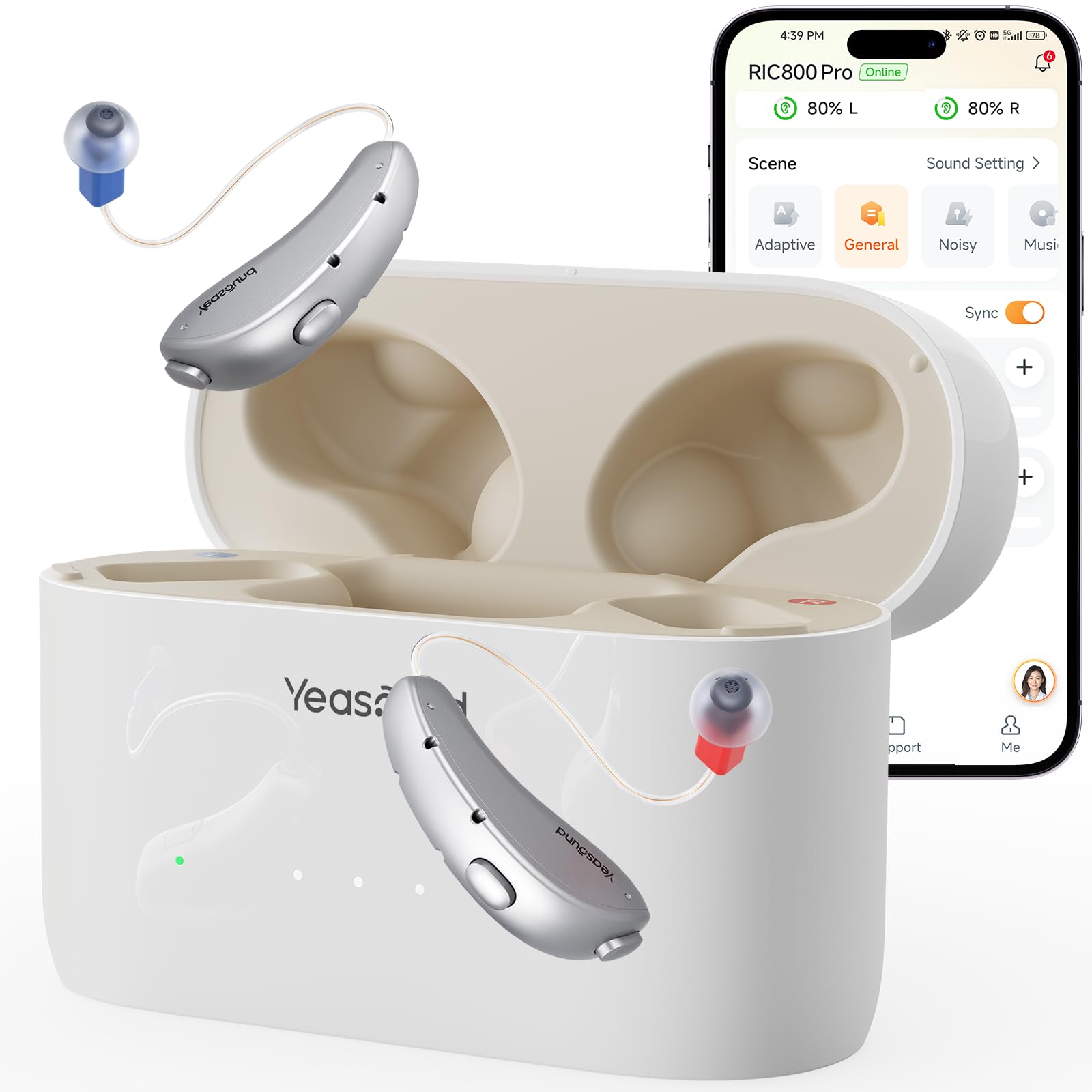
1. Yeasound RIC800 Hearing Aids
Our pick — 4.0+★ from 80+ verified ratings; the strongest balance of quality and price.
A 0.088-ounce body that hides behind your ear and still streams your calls.
The headline here is audio speed: 5.3ms processing. In plain terms, the aid takes about five thousandths of a second to turn sound into something you hear, so conversation and TV audio stay in sync with lip movement instead of trailing behind. That matters when you are already working hard to follow speech. Yeasound pairs it with up to 8000Hz audio (the top of the pitch range where consonant detail lives, the difference between “cat” and “hat”), and a set of five named profiles — Adaptive, General, Noisy, Music and Outdoors.
For a severe-to-profound buyer, the practical strength is control. Each earpiece runs independently, so a worse ear can be pushed harder than a better one. Volume sits on tactile buttons rather than buried in a menu, which is the difference between adjusting mid-conversation and giving up on the app. The AI picks a mode for you in real time, and manual selection stays available when you disagree with it. It weighs 0.088 ounces and measures 1.23 inches long, so it sits light and flat against the head. Bluetooth covers iOS 14+ and Android 10+, and an IPX8 rating (waterproof enough to survive full immersion) covers sweat and rain.
Runtime is the other reason it takes the top spot. Up to 23 hours in hearing mode, or 12 hours when you stream. The portable case adds three more full charges, stretching total use to 4-5 days. Compare that with the EARGO 8, which runs up to 16 hours and needs its case every night — the Yeasound gives you a wider margin before you have to think about charging. What wins people over most is straight effectiveness, the sense that speech actually arrives instead of getting smeared into noise. An occasional gripe is the wire’s shape, which can make insertion fiddly at first. One important reality check: this is an OTC device, and the honest limitation is that a profound loss in one ear may still want a prescription fitting.
What earns it first place
- 5.3ms processing keeps speech and TV audio in sync
- Up to 23 hours hearing mode, 12 hours streaming, plus three case charges
- Each earpiece tunes independently — useful when one ear is worse
- IPX8 waterproofing and a 0.088-ounce build
Where it asks patience
- The receiver wire can take a few tries to seat comfortably
- Streaming volume defaults loud and needs trimming in the app
- Pair through the iPhone Hearing Devices menu, not the Bluetooth list
Worth it for: anyone who wants the most runtime and the fastest speech processing in this group, with call streaming on top.
Think twice if: your loss is profound and one-sided — have an audiologist check that ceiling before you commit.
2. EARGO 8 Self-Fitting CIC Hearing Aids
Sits so deep in the canal that nobody sees it — including you.
This is the pick for the buyer whose real objection is visibility. Eargo 8 is a completely-in-canal design, and the entire pitch rests on that: a device small enough that colleagues, grandchildren and strangers never notice it. The trade-off arrives instantly, and you should know it before you buy — this aid is not a Bluetooth earbud. It will not stream calls or music. If you want phone audio in your ears, jump to the Yeasound or the Jabra instead.
What it does do is hold up well over a long day. Up to 16 hours of listening on one charge, and the extended-life charger carries up to 14 full recharges — roughly two weeks away from a wall outlet. It carries an IP68 rating, the top dust and water resistance tier, so sweat and rain are not a concern. Self-fitting runs through the Sound Match tool in the Eargo app, which shapes the sound to each ear separately; if you would rather skip the app entirely, four preset programs are ready to go on day one. Three sizes of Trumpet eartips come in the box, and the design is what most impresses people — a listener with moderate loss who had been fighting larger aids describes the fit as snug enough to forget.
Be clear-eyed about one thing: the seal is everything with an in-canal aid. Fit is the mixed note in the reviews — snug for most, but a canal shape that doesn’t match the shell can leave it working loose. That’s a sizing problem, not a defect. The other honest consideration is the app dependency for anything beyond presets, and the company’s US support situation is a live concern worth checking before you buy. The 2-year warranty covers unlimited repairs plus one-time loss or damage, which softens the risk on a device this small.
Where it shines: the vanishing act. IP68 protection, 16-hour runtime, 14 case recharges and a genuinely discreet profile make it the least fussy thing to wear all day.
The trade you accept: no Bluetooth at all, and fit depends on your canal matching one of the three tip sizes.
Reach for this if: discretion outranks streaming, and you want a self-fitting aid you can set up at the kitchen table.
Look elsewhere if: you take calls in your ears daily — this one isn’t built for it.
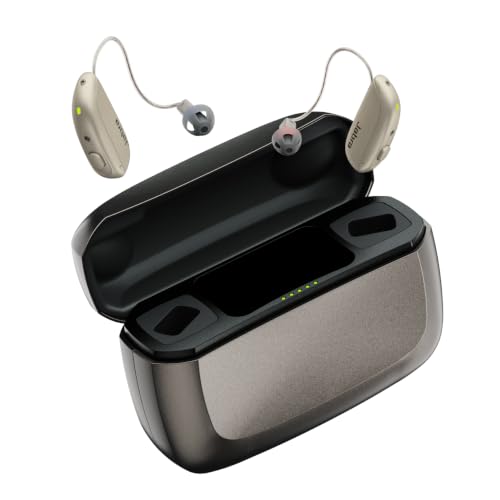
3. Jabra Enhance Select 700 Hearing Aids
The one that brings an audiologist to your phone instead of your calendar.
Here’s the case for the Select 700 in one line: licensed audiology services are included, so a real specialist can tune these remotely to your ears rather than you guessing at sliders alone. For a severe loss that is not a small thing. The hardware is the smallest rechargeable receiver-in-ear design Jabra makes, each aid weighs 2.12 g, and the body measures 1.04 inches long by 0.3 inches wide — light enough that people report forgetting they have them on.
Sound is the part that earns the most praise by a wide margin: hearing every word clearly is the recurring theme, and that holds up in restaurants and in the car. Adjustability is the second strength — the aids are tuned specifically to your ears, and programming changes can be pushed remotely within days without a phone call. Bluetooth covers calls, music and media on Apple and Android, with LE Audio and Auracast support (the newer broadcast standard that lets venues beam audio straight to your aids). TapControl lets you answer a call by double-tapping your ear, which is genuinely useful when your hands are full.
The honest caveat is reliability. Units failing after roughly a month are a real pattern in the feedback, though the warranty replacement path moves fast once it starts. The app also needs an internet login, so it is useless in a dead zone even while Bluetooth still connects. Music playback is the weakest use — one long-time wearer of pricier prescription aids rates them better than expected for speech, then recommends separate earbuds for music and video calls. Notably, the same user came from aids costing far more at a clinic and found these better in noisy rooms.
Bottom line: sound quality and remote audiology support make this the closest thing here to a clinic experience without the clinic.
Best suited to: a first-time wearer who wants professional ears on the tuning and is willing to be patient with the occasional hardware swap.
Skip the music use: keep separate earbuds for playlists and workouts.
4. ELEHEAR Beyond OTC Hearing Aids

Fifty decibels of gain and 24 decibels of noise cut, in a receiver-in-canal shell.
Two numbers tell the story of the Beyond: a maximum gain of up to 50 dB (decibels, the unit of loudness) and 24 dB of noise attenuation (how much background sound it can cut). Those are the figures that decide whether a deeper loss gets usable speech. Pair them with VocClear AI processing (the brand’s automatic sound-sorting chip) and feedback control, and you get a device that is trying to raise voices and cut background rumble at the same time — the exact job description for someone straining to follow conversation. Fifteen dB more gain is not a marketing badge; it is headroom you can actually use in a noisy room.
Battery is where it stretches out. Up to 20 hours on a single charge, and the case adds four more charging cycles for a total of up to 100 hours — enough that a weekend away doesn’t need the charger. It auto-powers on when you lift it out and off when you drop it back, so there is no button ritual. The ElePro remote care service connects you with audiologist support for tuning, and the app carries volume control, telephone speech enhancement and user-customized compensation (settings you adjust to your own ears) — a way to shape the sound to your ears rather than accept a factory preset. Multiple dome sizes (the soft tips that seal the ear) are included.
Now the part the listing says plainly: this is an OTC aid and may not meet the needs of a severe loss that really wants a prescription device. The reviews split on sound — plenty of people report crisp, clear speech, and a common thread is that the aids hold their own against prescription models costing far more. Others describe a tinny edge and difficulty hearing in hard-surfaced rooms. If your loss is profound, treat this as a capable bridge rather than the finish line.
Worth knowing: automated on/off and 100 total hours of case-backed power make it the least fiddly device in this group to live with.
The honest limit: the manufacturer itself points severe losses toward prescription aids.
Good fit for: a moderate loss that needs real gain and all-day power without a charging routine.
Look to a prescription path if: speech in loud rooms still defeats you on the strongest setting.
5. Vivtone Xpure Bluetooth Hearing Aids

Built to fill your ears with calls and music first, speech second.
The Xpure is the streaming-first option: receiver-in-canal design to cut distortion and feedback, with phone calls and music piped in over Bluetooth from iOS 12 and Android 11.0 or newer. Its headline number is charge speed. Both the aids and the case fill in 2.5 hours, which powers up to 24 hours of hearing-aid use — or just 3 hours of Bluetooth streaming. That split is the thing to understand: the moment you switch streaming on, your day shrinks sharply.
Adjustment is where it fights back against its price. You can fine-tune volume and frequency through the companion app or the onboard buttons, and multiple preset modes cover quiet conversation, noisy restaurants and outdoor settings. Tuning per ear matters here, because it lets you pour more gain into the ear that needs it. Real-human phone support is available if the setup stumps you, and the case holds roughly a week of standby power.
Here is where honesty earns its keep. The one review that speaks directly to a deeper loss is blunt: this aid is underpowered for severe loss, with the maximum power output capped well below what a profound ear needs. That is the single most important line in the whole listing. Sound quality draws a split verdict too — some hear thin, noisy output rather than clean speech, and a couple of units have died early. Comfort and fit are generally fine, but a large ear canal can leave the included domes too loose to seal. For a mild-to-moderate streamer this is a sensible buy. For a severe-to-profound ear, it is not the tool.
Where it earns a spot: fast 2.5-hour charging, per-ear frequency tuning and preset modes for real rooms.
The limit that matters: output tops out short of severe-loss demand, and streaming drains the battery to 3 hours.
Choose it for: a lighter loss with a heavy call-and-music habit, where fast top-ups beat long runtime.
Pass it over if: your audiogram reads severe — the gain ceiling is simply too low.
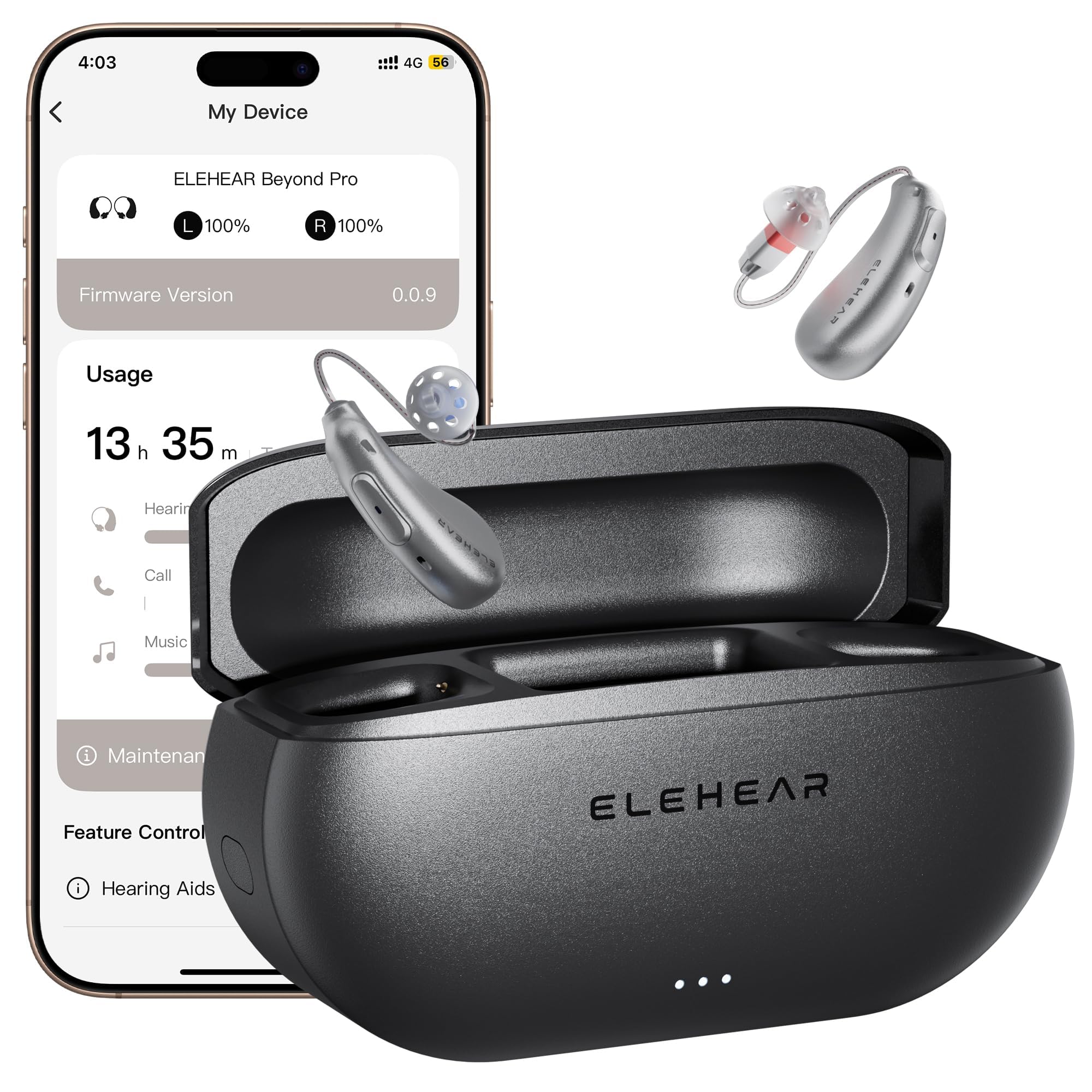
6. ELEHEAR Beyond Pro Bluetooth Hearing Aids
Fifteen minutes on the charger buys you six more hours of hearing.
Beyond Pro pushes two specs hard: high-frequency detail up to 8500Hz, and latency of just 8ms. Translated — you get more of the consonant brightness that separates words, and sound that reaches you almost without a perceptible delay. Both matter more than they sound. High-frequency detail is how you tell “sip” from “ship” in a crowded room, and low latency keeps a conversation feeling live rather than processed.
The charging behaviour is genuinely different from the rest of this list. Fifteen minutes of fast charge gives up to 6 hours of use, and a full charge runs up to 20 hours with four more charges in the case. That’s the answer to the morning you forgot to plug in. The app offers per-ear customization, saved profiles and 20 soundscapes for masking and focus, plus real-time AI translation across 20 languages. Remote support from hearing care specialists is available through the app for tuning help.
The realistic picture comes from longer-term wear. Some users with a severe loss in one ear report having to lower the volume and high-frequency amplification (the boost that sharpens consonants) to stop chirping in tight spaces like a car — a sign that this aid will serve a moderate loss well and strain at the edge of a severe one. Durability over months is the recurring weak point; buyers report a failed receiver and a second failure after a wire replacement. The app’s channel count and presets draw criticism from power users, and frequent feedback with heavy coats is a small everyday annoyance.
Reasons it climbs the list
- 15-minute charge delivers up to 6 hours
- Up to 8500Hz detail with 8ms latency
- Per-ear profiles plus 20 soundscapes in the app
- 20-language AI translation built in
Reasons to look closely
- Chirping in small enclosed spaces at higher gain
- App presets feel limited to experienced users
- Long-term reliability shows up as a concern in longer use
Best for: a busy day where charging is unpredictable and you want a fast top-up to keep you in conversations.
Not ideal if: you need sustained high-gain amplification — the top end will ask you to pull back the treble.
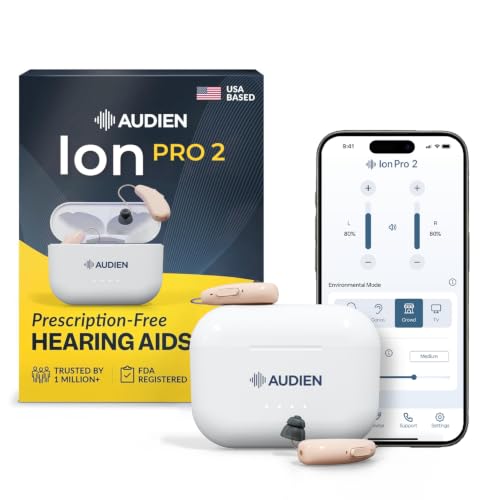
7. Audien Ion Pro 2 Hearing Aids
Two buttons, three modes, six profiles — nothing buried in a menu.
For anyone who has watched a parent give up on a hearing aid because the app was too confusing, the Ion Pro 2 answers that directly. The dual-button design switches modes and fine-tunes volume with a quick press, no tiny dials. Behind it sit three hearing modes and six custom hearing profiles, adjustable by phone if you want depth, but never required. The charging case includes UV sanitizing that runs while the aids charge — automatic upkeep with no separate tools.
Battery lands at up to 16 hours of hearing on a charge and 7+ hours of streaming, with up to 48 hours of total power once you count the case. Streaming output is enhanced over the previous generation, while amplification stays at FDA-compliant levels. The dome kit is generous: rounded domes in small, medium and large plus a coned option, along with a wax guard kit and a cleaning brush. Compatibility runs to iPhone 11 or newer on iOS 13+, and select Android devices on Android 13+, including Galaxy S20 or newer.
Where it separates from the cheaper options above is background noise. Cutting ambient sound rather than simply lifting everything is what owners consistently rate highest, and that is the difference between following a dinner conversation and surrendering to it. There is a comfort-versus-reliability split in longer feedback: some units lose charge quickly and one ear can develop static, though the replacement process is described as polite when you push. Also budget for a learning curve if the wearer is not a tech person — several people say the aids work perfectly for someone patient enough to learn the controls.
The selling point: physical buttons plus UV cleaning in the case make this the least intimidating device here for a first-time wearer.
Keep in mind: it is built for mild to moderate loss, and phone compatibility is narrow enough that you should check your model first.
Suits: a senior who wants to press a button and hear better, with the phone app as an optional extra.
Reconsider if: your phone is older than the listed models, or you need more than a moderate boost.
8. iBstone AuraLink Bluetooth Hearing Aids
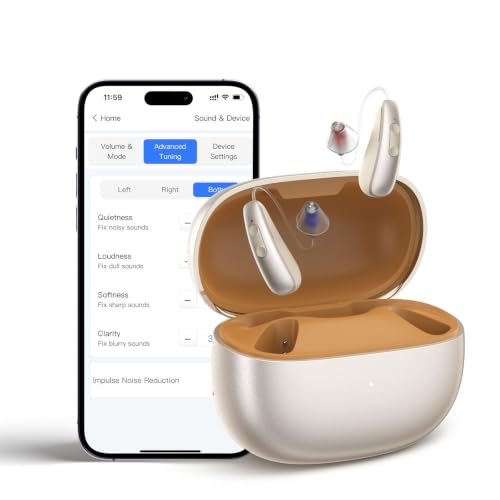
The one you can wear through a downpour and drop without a second thought.
AuraLink is the durability play. IP68 sealing (the highest dust and full-immersion water tier) covers sweat, rain and dust, and the body is built to withstand drops with SGS certification on that claim. Pair it with a UV-sanitizing charging case and you have a device aimed at an active wearer rather than a careful one. Bluetooth 5.4 handles calls and music on both iOS and Android, and the newer standard is chosen for lower power draw and more stable connections than older versions.
The fitting story is app-led. The free AuraFit app runs a hearing check, builds a precise fit per ear and can enable tinnitus masking — all without a clinic visit. The RIC design sits discreetly behind the ear, with multiple dome shapes and sizes in the box so you can find a seal that lasts all day without fatigue. The listed suitability range is 25-85 dB HL, which is deeper than most OTC aids will claim on paper.
Sound is where the honest split shows. Some wearers describe excellent clarity and effective background-noise reduction in crowds, with the app’s fine-tuning allowing a custom sound profile. Others find the output sharp and piercing, and one household reports it did not work as a backup aid for a spouse with an extensive loss. Accessories are the practical snag — wax guards specific to this model can be hard to source, and a replacement aid can take a month to ship. Treat the listed hearing range as paper capability, not a promise.
Why it belongs here: IP68 plus drop certification is a combination no other aid in this group offers, and the 25-85 dB HL claim is the widest on paper.
What to plan for: spare wax guards and the possibility of a slow replacement turnaround.
Pick this for: an outdoor, active life where the aid takes knocks and weather and needs to keep working.
Think again if: you need proven results at the deep end — the range on paper outruns what some ears report.
9. Sennheiser All-Day Clear Bluetooth Hearing Aids

A name you already know from headphones, aimed squarely at all-day wear.
If the audio brand on the box is what tips your decision, this is the one. Sennheiser’s receiver-in-canal design runs up to 24 hours on a charge and self-fits in a few minutes through the app, with no audiologist appointment required. The box is unusually complete: eight ear tips across small, medium and large, wax guards, a cleaning brush and the charging case. Automatic adjustment to the surrounding sound environment handles most of the mode switching for you.
Long-day comfort is the strongest report, and reliability is the second most praised trait. People who came from far more expensive prescription aids describe the sound as comparable to established hearing-aid brands, with effective voice enhancement and Bluetooth calls that work cleanly on a modern phone. The eight tip sizes are the reason the seal can be dialled in properly — a real advantage for a deeper loss where a loose dome wastes gain.
The weaknesses cluster around longevity and the ageing design. A receiver wire can fail in time, and support beyond the 12-month warranty has been reported as limited to a discount on a new pair rather than a repair. The case carries no battery of its own, so it must stay plugged in for charging, and the aids can wake and connect to your phone while still docked. Sound in noisy environments and a background hiss are the recurring sound-quality complaints, and the app offers only two sound profiles with no advanced directional settings.
The case for it: 24 hours of runtime, eight ear tips for a proper seal, and self-fitting that takes minutes.
The case against: only two sound profiles and a case that needs a wall outlet.
Go for it if: you want a familiar audio brand, all-day runtime and a simple three-step setup.
Weigh carefully if: you expect a rich set of tuning profiles or a case you can carry unplugged.
10. Sirnaigs Rechargeable OTC Bluetooth Hearing Aids
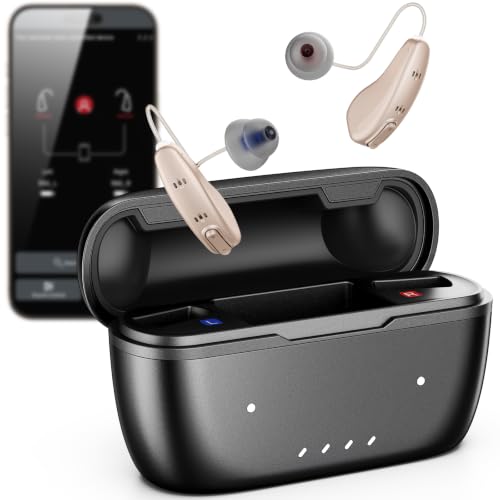
Ninety-six hours of case-backed power for a fraction of the big-brand ask.
Run the battery numbers and this one stands out: 24 hours on a single charge, 96 hours once the case is counted. For a traveler or someone who regularly forgets the night-time routine, that margin is the whole point. It is an app-controlled behind-the-ear design (the body sits behind your ear) with AI noise cancellation and an in-app hearing test that shapes the sound to your ears — the setup most people expect at this point, delivered at the budget end of the shelf.
The physical build is light and skin-safe silicone keeps it comfortable against the head. Auto on/off with the charging case removes a daily chore, quiet mode and dual noise reduction live in the app, and Bluetooth handles calls and music. The honest scope note sits in the listing itself: it is an FDA-registered OTC aid intended for mild to moderate hearing loss, not a prescription-class device.
Setup is where buyer experience diverges. A recurring theme is that the receiver wires run short, which makes the fit uncomfortable for some ear shapes, and the Bluetooth link to the app can drop and need reconnecting. Yet the service response is the surprise — a unit that whistled and echoed was replaced without a fight, and the replacement arrived clear with no feedback. Give it a week or two of adjustment; the ear and the brain need time to settle into any new aid.
The best of it: 96 total hours of playtime, auto on/off and app-based noise control at the lowest end of the shelf.
The catch is the wires: short receiver leads cause discomfort for some ear shapes.
Ideal for: a backup pair or a budget-first first aid where runtime matters more than premium sound.
Move up the list if: you have a deeper loss or a channel that needs a longer receiver.
11. NVBOTY M2219 Rechargeable Hearing Aid
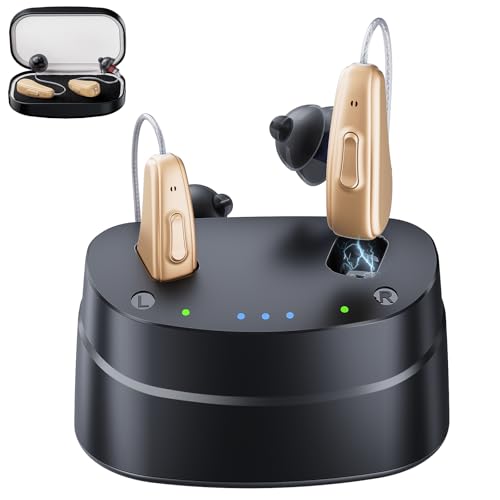
Press, hold, done — five volume steps with none of the app fuss.
For a buyer who wants nothing to do with an app, the M2219 is the plainest device here. Five volume levels, adjusted with a single click of the Volume+ button, and a three-second press to power it on or off. A smart memory function restores your last-used level automatically, so you are not re-dialling the volume every morning. Rated gain is 43dB±5dB, with active noise cancellation and chip-based feedback reduction.
Endurance is competitive: up to 25 hours on one charge, up to 100 hours total once the charging case is counted, and a 3-hour charge brings it back. Three ear tip sizes are in the box, and the case is compact enough for a pocket. Its real case for a spot on this list is simplicity — a button you can press without reading a manual beats a feature list you never open.
The honest picture is that comfort and honest gain are where it wobbles. The housing is bulky around the ear by one description, and a critical reviewer reports the volume steps arriving far louder than needed while the noise-cancelling claim did not filter background noise as expected. On a device advertising 43dB±5dB, the variance in that figure is the difference between comfortable and overwhelming at the top setting. If you need subtlety in loud rooms, look to the Audien or the Jabra.
Best for basic use: five volume levels, a smart memory function and 100 hours of case-backed power with no app at all.
Where it falls short: the casing is bulky for some ears and the loudest steps overreach.
Consider it if: the wearer wants one button, no phone and a simple top-up routine.
Look up the list if: you need refined noise handling rather than raw volume.
Know the Specs
Gain and MPO (the ceiling that decides everything)
Gain is how much louder the aid makes a sound, measured in dB. Maximum power output (MPO) is the loudest it can go before it clips. A severe loss pushes both close to their limit, so the published figure — 50 dB on the ELEHEAR Beyond, 43dB±5dB on the NVBOTY — tells you the size of the engine. If your audiogram sits near the top of a device’s ceiling, expect strain. Some listings here state plainly that a severe loss may need a prescription device, and that sentence is worth taking seriously.
Feedback suppression and the seal
Whistling is a loop: amplified sound escapes the ear, hits the microphone and gets amplified again. Every aid on this list claims feedback reduction, but the fit does half the work. That is why the dome and ear tip sizes in the box matter so much — eight tips on the Sennheiser, three sizes on several others, multiple dome shapes on the iBstone. A loose seal throws away your gain and invites the whistle. Fit it properly before you judge the sound.
Hearing runtime vs streaming runtime
These are two different numbers, and the gap is large. The Yeasound runs up to 23 hours in hearing mode and 12 hours streaming. The Vivtone runs up to 24 hours in hearing mode and 3 hours streaming. Bluetooth radio is the drain. If you take calls in your ears every day, plan your charging around the streaming figure. If yourarely stream, the headline number holds.
IP ratings decoded
The two digits tell you different things. The first is dust and solids; the second is water. IP68 is the top tier on both counts — the EARGO 8 and the iBstone AuraLink both carry it, which is why sweat, rain and dust are all covered. IPX8 on the Yeasound means full water immersion protection, with the X marking dust as untested rather than unprotected. In everyday terms, a high rating means you can wear the aid through a wet commute or a sweaty afternoon and not think about it.
Bluetooth versions and LE Audio
Bluetooth is the link that streams calls and music from your phone into the aid. A higher version number — 5.4 on the iBstone, LE Audio and Auracast on the Jabra — generally means lower power draw and more stable connections. Auracast, in particular, lets a venue broadcast audio straight to your aids. But check compatibility before you buy: each listing names its own limits, from iOS 14+ on the Yeasound to Android 13+ on the Audien. An older phone can leave you with a streaming feature you cannot use.
Common Questions
Can an OTC hearing aid really handle severe to profound hearing loss?
What gain figure do I need for a severe loss?
Why does my hearing aid whistle and how do I stop it?
Do these hearing aids work with my iPhone or Android phone?
How many hours will a hearing aid last once I stream calls and music?
Can I get an audiologist to tune these without visiting a clinic?
Is a completely-in-canal aid better than a behind-the-ear aid for a deeper loss?
What happens if one of my hearing aids fails after the warranty runs out?
Will Bluetooth hearing aids stream TV audio directly?
Do I need a hearing test before buying an OTC hearing aid?
The Bottom Line
If you want one dependable pick, the hearing aids for severe to profound hearing loss winner is the Yeasound RIC800 because it pairs 5.3ms processing (the delay before sound reaches you, short enough to feel live) and up to 23 hours of hearing-mode runtime with per-ear tuning on tactile buttons — the most complete package here for the money. If professional ears on the tuning matters more than anything else, the Jabra Enhance Select 700 bundles licensed audiology services and remote programming. And for a discretion-first wearer who never streams, the EARGO 8 hides completely inside the canal.
One honest word before you decide: every aid on this page is an over-the-counter device with a gain ceiling, and several listings say outright that a severe or profound loss may need a prescription fitting. Use this list to find the device that gets you talking again — the Yeasound’s 12-hour streaming runtime or the ELEHEAR Beyond’s 50 dB of gain are real reasons to start there — but let your audiogram (your hearing test chart), not the marketing, make the final call.
How we choose
We do not accept paid placement. Every pick is matched to a real buyer and a real use-case; we do not hands-on test units.
Sources
Specifications: manufacturer listings and product documentation. Review insights: verified customer reviews, as of October 2026. Pricing: not shown on this page (it changes often); check the current price via the retailer link.
As an Amazon Associate, Aappliancez earns from qualifying purchases. This does not affect which products we feature.