Disclosure: Some links in this post are affiliate links. As an Amazon Associate I earn from qualifying purchases, at no extra cost to you. Learn more
Specs are compiled from manufacturer listings and verified buyer reviews and can change over time — please confirm the key details on the product page before buying.
If you have profound hearing loss, the wrong device turns every conversation into a guessing game — the right one lets you follow dinner-table talk again. This roundup covers ten over-the-counter (OTC) hearing aids, which are hearing devices you buy without a prescription or clinic visit, and it explains in plain words which ones fit which ears, how long their batteries really run, and where each one asks you to compromise.
This guide is built by comparing the manufacturers’ published specifications and the patterns across verified customer reviews, so you get each pick’s real strengths and trade-offs instead of marketing spin.
You will see how charging cases, Bluetooth streaming (wireless audio from a phone), and noise reduction separate the strong options from the weak ones, so you can choose the best hearing aids for profound hearing loss with far less second-guessing.
Top Picks

How To Choose The Best Hearing Aids for Profound Hearing Loss
Profound hearing loss means even loud speech is hard to follow, so a device that merely makes everything louder will not help you — it will just make the room noisier. The three things that decide whether a device actually works for you are gain, MPO, and processing speed, and none of them appear in a marketing headline. Here is what each one does in daily life.
Gain: how much quiet sound gets lifted
Gain is the amount of amplification a hearing aid applies to soft sounds. It is measured in decibels (dB), a unit for loudness, and a higher gain figure means the aid can lift the quietest speech higher before it reaches your ear. If whispers and soft footsteps vanish for you, gain is the number to check first.
MPO: the ceiling that keeps sound comfortable
MPO stands for Maximum Power Output, the loudest the device will ever let a sound get. This is the safety valve that stops a passing truck horn from becoming painful. Buyers chasing more power often push MPO up, then hear distortion — the audible crackle when an aid is pushed past its clean limit.
Cases, streaming, and what you plug in
A charging case is the pocket charger that tops the aids up between wears. Some cases hold several extra charges, and some are just a dock that needs a wall outlet. Bluetooth streaming is the feature that pipes phone calls and music straight into your ears. Both matter for daily convenience, so check whether the case actually carries its own power.
Side-by-Side Comparison
| Model | Best For | Battery Life | Charging Case | Fit Style | Amazon |
|---|---|---|---|---|---|
| EARGO Eargo SE★ Best Overall | Nearly invisible in-canal wear | 16 hours per charge | 5 extra full charges | Completely-in-canal | Amazon |
| NVBOTY M2219Budget-Friendly Pick | Button-only simplicity | 25 hours per charge | Up to 100 hours total | In-ear | Amazon |
| Yeasound RIC700Longest Battery | Marathon battery plus streaming | 279 hours per charge | — | Receiver-in-canal | Amazon |
| BlaidsX Neuro | App audiograms and DSP tuning | 12 to 20 hours per charge | Rechargeable case | Behind-the-ear | Amazon |
| Vivtone Xpure | Bluetooth calls and music | 24 hours per charge | 1 week standby | Receiver-in-canal | Amazon |
| ELEHEAR Beyond Pro | Translation and 20 soundscapes | 20 hours per charge | 4 extra full charges | Receiver-in-canal | Amazon |
| Audien Ion Pro 2 | UV self-cleaning case | 16 hours per charge | 48 hours total | Behind-the-ear | Amazon |
| iBstone AuraLink | Bluetooth 5.4 with IP68 defense | — | UV-sanitizing case | Behind-the-ear | Amazon |
| Sennheiser All-Day Clear | Automatic environment adjustment | Up to 24 hours | Plug-in charging case | Receiver-in-canal | Amazon |
| Jabra Enhance Select 700 | Included audiology support | — | Charging case | Receiver-in-ear | Amazon |
Detailed Reviews
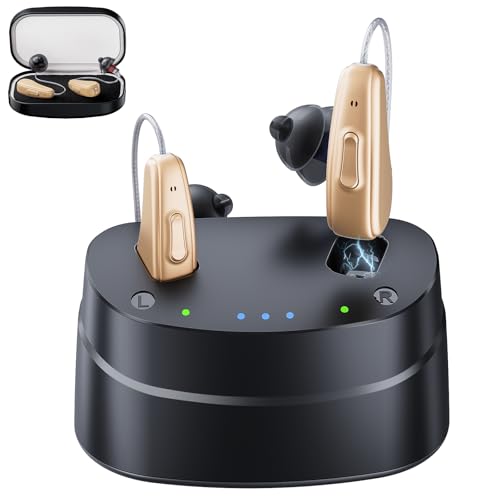
1. EARGO Eargo SE Hearing Aids
The disappear-into-your-ear pair for buyers who refuse to look like they are wearing hearing aids.
Eargo SE is the model to pick if invisibility is your dealbreaker. It sits completely inside the ear canal, so it vanishes from view, and it weighs just 1 g with a 0.4 g battery — light enough that most owners say they forget it is there. Each charge runs 16 hours, and the charging case holds 5 full extra charges, so a weekend trip does not need a wall outlet.
What wins people over is the build quality and the day-one usability. The Sound Match feature in the free Eargo app tunes the settings to your own hearing, per ear, with no clinic visit. You get 3 sizes of Trumpet eartips in the box, and switching between listening programs takes a single tap. Owners describe setup in about 15 minutes, and one buyer ran the process three times to land on the “just right” setting rather than trusting the first pass.
The honest catch is twofold. Sound quality splits buyers — some hear clear voices and others describe a tinny edge, and a handful report a chirping noise once volume climbs. The charging contacts also need care: seating the aids so they actually charge takes a little practice, and the recurring gripe is the charger losing capacity over months. Eargo backs the set with a one-year warranty and support that owners repeatedly call award-worthy.
Where It Earns Its Place
- Completely-in-canal body at 1 g keeps it out of sight in meetings and photos
- Sound Match app tuning skips the clinic visit entirely
- Charging case carries 5 full extra charges for travel
- Three eartip sizes included for a custom-feeling seal
Where It Asks Patience
- Sound quality is genuinely split — some hear tinny tones as volume climbs
- It does not stream music or take phone calls at all
- Seating both aids for a reliable charge rewards a steady hand
Reach for this if: you want the least visible option here and you mainly need speech lifted in the room, not in your earphones.
Look elsewhere if: Bluetooth calls and music matter to you, because the SE does not stream — the Yeasound RIC700 and Vivtone Xpure exist for exactly that.
2. NVBOTY Hearing Aids, Rechargeable with Noise Cancellation
Simple buttons, a pocket-sized charging case, and enough runtime to skip a daily charge.
If you want zero apps and zero pairing, the M2219 is built for a single button press. Holding the Volume+ button for 3 seconds powers it on or off, and a single click walks you through 5 volume levels. A smart memory function restores the last volume you used, so you are not hunting for your level every morning. It is the least fussy control scheme in this group.
Runtime is the standout here. You get up to 25 hours per charge, and the included charging case lifts total listening to 100 hours, which means a full workweek without hunting for a cable. A full recharge takes about 3 hours. The audio sensitivity rating is 43 dB, and three ear tip sizes are included for a snug fit. The specs list a volume gain of 43dB±5dB, and the plastic body keeps it light in the ear.
Here is the part that matters before you click buy. Buyer feedback is radically split, and the loud-volume complaint is the one to take seriously: buyers report the volume levels run “super loud, way too loud, eardrum-breaking,” and that the aid amplifies every background sound rather than cutting through it. If your loss is profound, this device may not give you the controlled lift you need, and several buyers with moderate loss found it unusable within an hour. The one clear plus is that returns are straightforward.
What the specs say: 25 hours per charge, a 100-hour total with the case, 5 volume steps, and a 43 dB sensitivity figure.
What buyers flag: the volume starts far too hot for comfort, which makes this a fit question more than a defect — worth testing early so you stay inside the return window.
Who it suits: the shopper who wants a cheap, app-free trial of amplification and will send it back fast if the loudness profile does not match.
Who should look on: anyone with profound loss chasing precision, since this aid is geared toward gentler hearing needs.
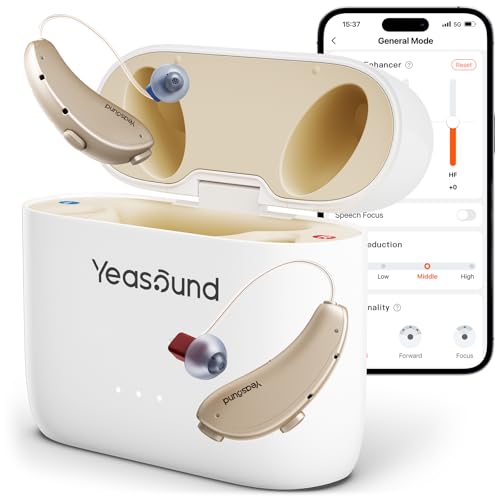
3. Yeasound RIC700 Hearing Aids with AI Noise Reduction
The number that ends battery anxiety outright: a single charge that outlasts almost every rival in this roundup.
Yeasound did not just stretch the runtime — it lapped the field. One full charge runs 279 hours, the longest figure in this roundup, and that is against the Eargo SE’s 16 hours. Bluetooth streaming alone runs 162 hours. Yeasound packages that endurance into a body weighing only 0.088 oz and measuring 1.23 inches — a device light enough to forget and small enough to disappear. Charging back to full takes three hours.
The audio side is engineered for clarity: it handles up to 8000Hz — the high end of the audible band, which is exactly where the speech sounds that many people lose first sit — and its 5.3ms processing speed keeps conversation and TV audio in near real time instead of drifting behind. It streams audio to iOS devices and controls through tactile buttons plus the Yeasound app. It is IPX8-rated, so a splash, a rainstorm, or a sweaty workout won’t damage it.
What earns the strongest praise here is the sound. Owners repeatedly say the clarity outpaces hearing aids that cost far more, especially in loud conversation. The critical caveat is fit rather than performance: reports describe a snug behind-ear placement that works for many, while a few note the built-in online hearing test covers moderate loss rather than deep, profound-level loss. It’s a reasonable mismatch for your goals, not a device failure — and most owners say the support team responds quickly when a wire acts up.
The standout-spec verdict: 279 hours off one charge is a category-leading figure, and for anyone tired of charging daily, that single number justifies the pick.
The honest caveat: the companion hearing test is aimed at moderate loss, so verify your own levels fit before committing.
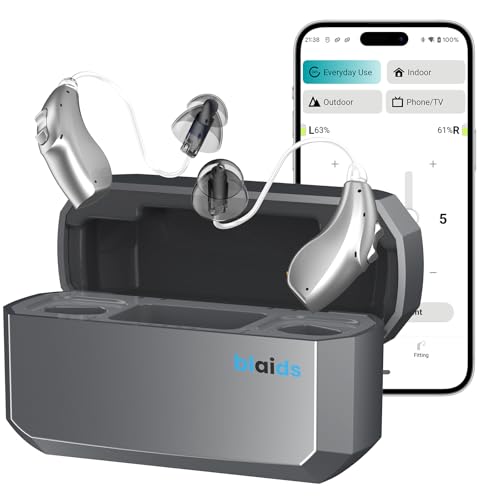
4. BlaidsX Neuro Bluetooth Rechargeable OTC Hearing Aids
Clinic-style tuning built into an app, with the channel count to shape sound precisely.
The BlaidsX Neuro puts 32 DSP channels at your disposal, which means it slices the audio spectrum into 32 separate slices and tailors each one — the kind of control you normally only get in an audiology office. It pairs that with dual microphones for directional pickup and a WDRC sound-processing system that adjusts louder and softer sounds independently. An audiogram matching range from 250Hz to 8kHz lets you pick a fitting curve that matches your hearing profile.
On the outside, this is a behind-the-ear model with a receiver that fits in the canal. It runs 12 to 20 hours per charge, and the case is rechargeable. Phone and TV audio stream over Bluetooth, using the ASHA protocol for up to 12 hours of streaming, though that head-to-head against the Yeasound RIC700’s 162 streaming hours shows where the endurance gap sits. It’s rated IP67 for sweat and dust.
Sound quality is where owners agree it shines: clear voices without the shrill edge that plagues cheaper amplifiers. Where it gets tricky is reliability and support. A notable pattern in the owner reports is units failing early, and the support experience has been uneven — some get resolution, others wait. This isn’t a reason to dismiss it, but it is a reason to be ready to use the warranty. And do note the manufacturer’s own framing: the Neuro is for adults with mild to moderate hearing loss, not deep profound loss.
For the spec hounds: 32 DSP channels, WDRC compression, and a 250Hz–8kHz audiogram range deliver the granular control that plain amplifiers lack.
For the cautious: 12–20 hours per charge is decent, but the mixed reliability picture means registering the warranty early is smart.
The right shopper: someone who wants app-driven audiogram fitting with serious processing behind the sound.
The wrong fit: buyers who want the simplest possible ownership — the support history suggests some patience may be needed.
5. Vivtone Xpure Bluetooth Hearing Aids

Turns your phone into a control room for calls, music, and preset sound modes.
Vivtone’s selling point is flexibility — it draws sound to your ears through a receiver-in-canal design with angled tubing, which reduces the squeal you sometimes get with simpler in-ear models. You get phone calls and music streaming over Bluetooth (compatible with iOS 12 and Android 11.0 or newer), plus on-device buttons for volume and tone. Pressing those buttons or using the companion app puts you in one of the preset sound modes, from quiet conversations to restaurants to outdoor scenes. A full charge takes 2.5 hours and runs 24 hours of hearing time or 3 hours of Bluetooth streaming, while the case acts as a spare-battery bank holding roughly a week of standby.
Where it wins over a simple amplifier is its adjustability. You can refine volume and frequency through the app to shape the sound toward your own profile. That said, the picture here is mixed rather than universal: buyers with severe-to-profound loss consistently report this device is underpowered for their needs, with one noting the maximum output had to sit near 80% to avoid distortion. Others report tinny tones and a persistent background hiss. Owner support experiences have been strong (one buyer tracked down a replacement on their own dime and got the company to send a new one after a return), but some owners mention the aids arriving with a dead unit.
The app’s hearing test plus auto-tuning is the reason to consider this one if your loss is at the top edge of moderate. It is a value pick for Bluetooth streaming, not a prescription-class replacement — so go in knowing that.
Why Owners Reach For It
- Streaming phone calls and music at a price point below most rivals with the same feature
- App plus on-device tone and volume control for hands-on tuning
- 2.5-hour full charge and 24 hours of hearing runtime per cycle
- Charging case carries roughly a week of standby power
Where It Runs Into Limits
- Not enough output for severe or profound loss — most complaints cluster there
- Some buyers describe tinny tones and background hiss
- The app’s headroom runs out if you push the output near the top
The value read: for a phone-streaming hearing aid, the feature set is strong relative to what you pay.
Who should skip ahead: shoppers with profound loss — the Vivtone is engineered around moderate needs, so look toward the Jabra Enhance Select 700 instead.
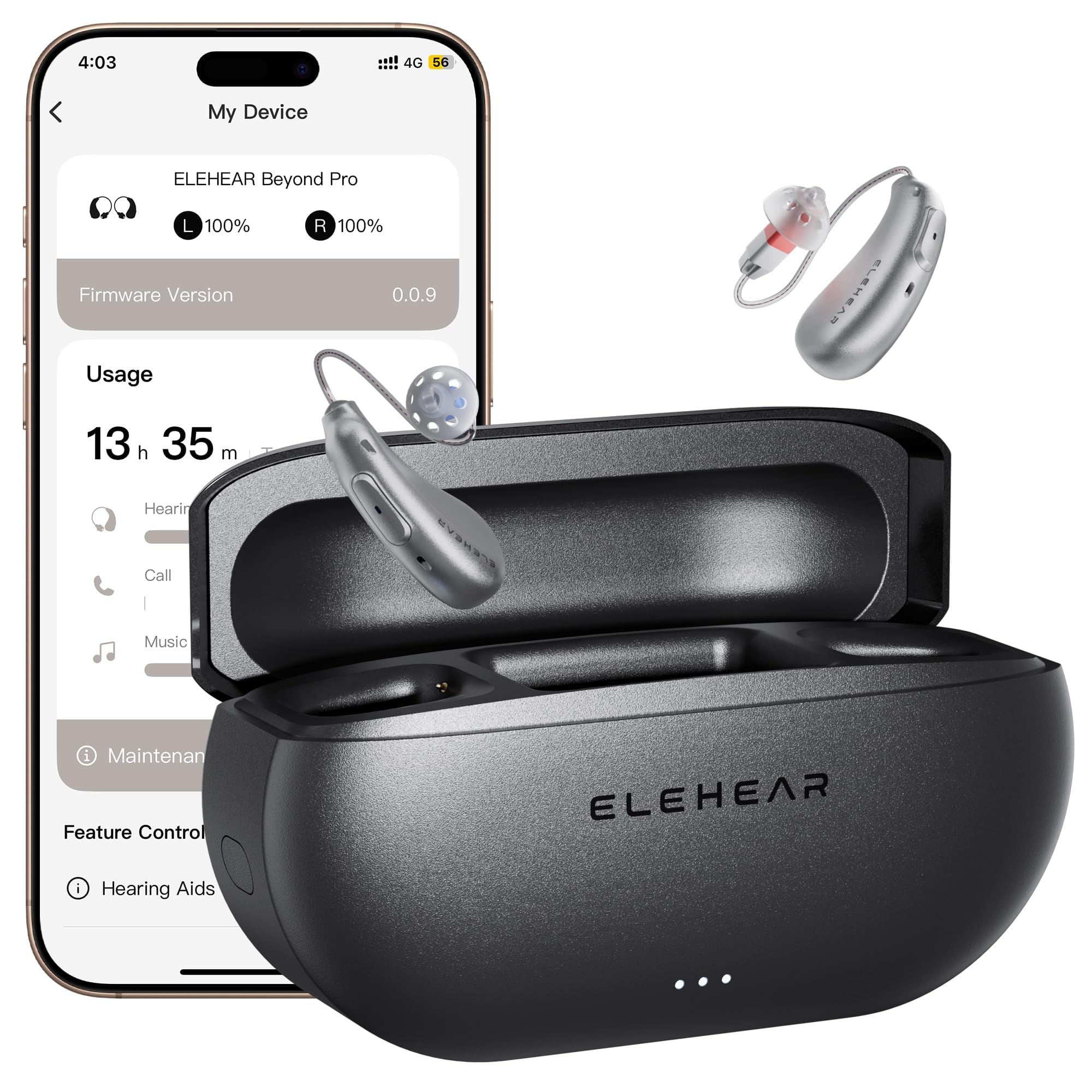
6. ELEHEAR-Beyond Pro Bluetooth Hearing Aids for Seniors
A twenty-hour run time, four case charges, and the speech clarity figure the brand keeps repeating.
ELEHEAR’s Beyond Pro runs VocClear 2.0, a processing engine the brand claims delivers 30% clearer speech than its own prior tuning. That claim is a manufacturer figure, not an independent measurement — treat it with the same skepticism as any brand number. What the spec sheet does confirm is real: the aid handles frequencies up to 8500Hz, which matters because sibilants like “s” and “f” live in the high end and are usually the first sounds people lose. Latency (the delay between a sound arriving and reaching your ear) sits at 8ms, low enough to keep lip movements and audio in sync.
The practical side is generous. You get 20 hours on a single charge, and 15 minutes of fast charging adds 6 hours — useful when you’re running late. The charging case holds 4 additional full charges, so a long weekend is covered. Fifteen-minute top-ups, automatic turn-on when the aids leave the case, and remote support from hearing specialists through the app round out the package.
The app is where this one gets interesting: 20 soundscapes including rain and breeze, and a real-time translation feature covering 20 languages. Reviewers with mild-to-medium age-related loss describe the app hearing test and specialist-set profile landing almost perfectly. Just note: the bulkier body can interfere with glasses arms, though swapping from a size #2 to a size #3 wire tends to solve it.
For the frequent traveler: the 20-language translation function and 20 soundscapes turn a hearing aid into a pocket interpreter.
Where it asks a small concession: the receiver’s bulk can clash with thick glasses temples, and the fix is a wire swap rather than a whole new purchase.
Best for: someone who wants rich features — translation, soundscapes, remote specialist tuning — in one device.
A note for the cautious: feedback can appear when a coat collar brushes the aid, so make sure your receiver wire length is dialed in from day one.
7. Audien Ion Pro 2 Advanced OTC Hearing Aids
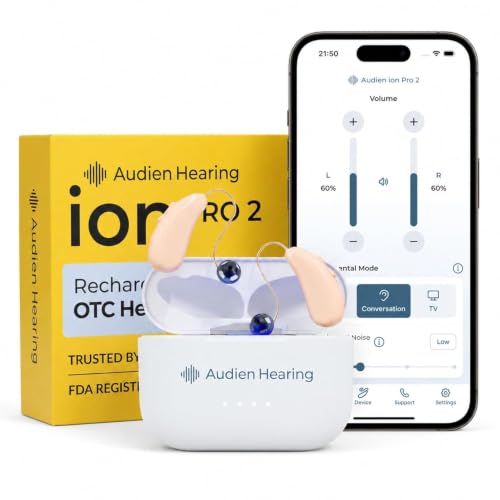
A UV-cleaning case and a two-button controls scheme that skips menus entirely.
The Ion Pro 2 dispenses with app-first control. You get two physical buttons and no menus: press once to change a mode, press again to adjust volume. There are 3 hearing modes and 6 custom hearing profiles, which lets you dial in conversation, noise, and music without digging through a phone. The charging case sanitizes the aids with UV cleaning while they charge, so the parts that sit in your ear canal get automatic handling between wears.
Runtime is capable but not class-leading: 16 hours per charge, extending to 48 hours total with the case, and about 7 hours of streaming per session. On the physical side, the battery cell weighs 0.5 g. It is FDA-registered as an OTC hearing aid for adults 18 and up with perceived mild-to-moderate loss, and carries a 1-year warranty. Compatibility covers iPhone 11 or newer on iOS 13+ and select Android phones from Android 13 onward, including Samsung Galaxy S20 and newer.
Owners are emphatic about comfort and hearability — the sensory reports describe hearing “100 percent better” and wearing them all day. The counterweight is the app. Its functionality gets mixed marks, and when the app acts up, the phone-side adjustments can drop out. Value is judged as middle-of-the-road too. The recurring lesson: use the on-device buttons as your primary control and treat the app as a bonus.
Standout feature: UV sanitizing built into the charging case is a rare convenience here, and it takes one chore off your plate.
One thing to know: the Ion Pro 2 is specced for mild-to-moderate loss, so this is not the device for profound needs.
Confident verdict: the button-first design plus UV case makes this a low-hassle pick for anyone who hates phone menus.
Only if you’re honest with yourself: if your loss is profound, the mild-to-moderate scope of the product means this won’t be the one to move to.
8. AuraLink Bluetooth Hearing Aids by iBstone
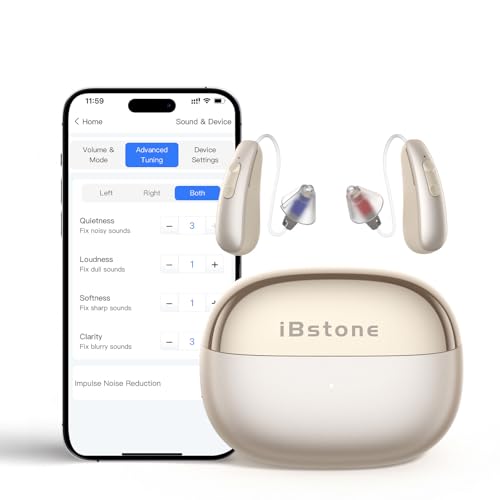
IP68 defense and Bluetooth 5.4 hidden behind a discreet receiver-in-canal shell.
If your hearing aids live near water or dirt, the AuraLink is built for that life. It carries IP68 protection, which means it stands up to dust and fresh water — a standard that surviving a splash, a sweaty workout, and a rain-soaked walk without harm is written into. That, plus SGS-certified drop resistance, matches the manufacturer’s recommended uses: noisy settings, TV, outdoor activities, family dinners, and windy environments. A UV-sanitizing charging case handles cleaning between charges.
The Bluetooth 5.4 connection (a newer version of the same wireless standard) delivers lower power use and more stable calls and streaming than earlier revisions, and the free AuraFit app runs a hearing check, performs the fitting, and can switch on tinnitus masking. You get multiple dome shapes and sizes for the receiver-in-canal fit, and the recommended uses range from crowded restaurants to morning walks to golf.
Owner reports are positive on clarity, noise reduction, and the app’s fine-tuning. They also flag a sharp, piercing tone that not everyone can dial out — a small share of buyers returned it on those grounds. The bigger note is a copycat warning shared by reviewers, where a similarly named online outfit took payment without shipping. Buy from the Amazon listing to stay protected.
What stands out: the IP68 and SGS-certified protection make this the outdoor-friendly pick, and Bluetooth 5.4 keeps drops and stability in good shape.
The small catch: tone is subjective, so test the sharpness early — and buy from Amazon so you’re covered if it doesn’t fit your ear.
Best for: active users who need water and dust protection and a stable wireless connection.
A word to the wise: buy from the Amazon listing — reviewers warn of lookalike sellers elsewhere.
9. Sennheiser All-Day Clear Bluetooth Hearing Aids

A premium brand’s OTC swing — 24-hour runtime, app setup, and a case with one notable limitation.
Sennheiser’s All-Day Clear brings a familiar audio-brand name into the OTC space. It’s built for adults with mild-to-moderate hearing loss, sets up in minutes through an app with no audiologist visit, and streams Bluetooth audio for hands-free calls and music from iOS or Android phones. The RIC (receiver-in-canal) design places a small wire assembly in the ear canal for a discreet, secure fit, and the charge lasts up to 24 hours of continuous use. A 30-day risk-free trial is included, along with a full accessory kit for maintenance.
What’s impressive is the sound. Sennheiser’s tuning earns praise from owners who describe the clarity as close to prescription aids, and the app walk-through is simple enough to run in three short steps. Owners also like how the aid automatically adjusts to your surroundings.
The single biggest gripe targets the charging case: it does not hold its own battery, so the case has to be plugged in to top up the aids — a real annoyance if you’re used to a case you can pocket. A small share of owner reports raise the same pattern seen with other brands: an aid that stops charging after several months, and access to replacement ear tips that runs dry. Because the aids are capable, though, this depends on careful daily handling.
Reach for this if: you want an established audio brand’s tuning and a 30-day risk-free trial to test it comfortably.
Look elsewhere if: you want a charging case with its own battery — this one needs a wall outlet, which changes how you carry it.
10. Jabra Enhance Select 700 Clinic-Quality Hearing Aids
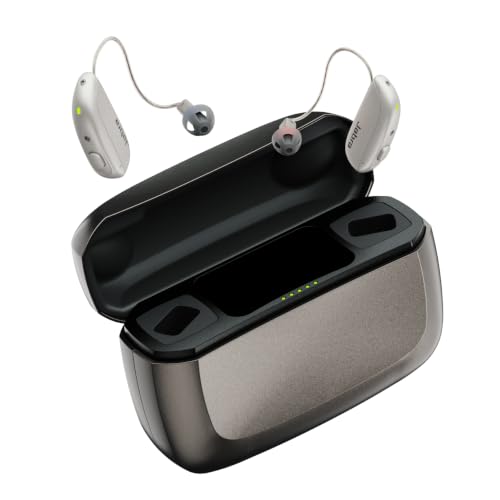
The only pick here with licensed audiologists baked into the purchase — plus the smallest RIE build in the lineup.
What you pay for with the Select 700 is the support layer. The purchase includes licensed audiology services, so a specialist tunes the aids to your audiogram instead of leaving you to guess. The hardware backs it up: SoundScape with Auto Focus adapts the sound to your environment in real time, and the aids support Bluetooth LE Audio and Auracast, two newer standards for higher-quality, lower-latency streaming than classic Bluetooth. At 2.12 g and 1.04″L x 0.3″W, Jabra calls this its smallest receiver-in-ear design, and the battery runs to a larger 4.26 g cell for stamina. Hands-free calling works via TapControl — double-tap your ear or the aid to answer, no phone in hand.
Owners who find their fit describe hearing every word in noisy restaurants and say the device matches clinic-grade aids. The adjustability earns praise too — iPhone users report instant changes with zero lag through the app.
The uneven part is support follow-through. Some owners get fast help and quick replacements, while others report slow responses and delayed refunds when a unit fails. When it works, the enhancement is real — that’s the difference between a value pick and a full-service premium one.
Where it earns the premium: audiology support included, small RIE chassis, and hands-free TapControl calls make this the most premium fit here.
Where buyers should stay alert: support response times have not been as consistent as the hardware quality, so keep your activation paperwork handy.
Know the Specs
These are the four specs that quietly separate a device that helps from one that sits in a drawer. Read them before you compare models.
Gain (dB)
Gain is how much a hearing aid lifts quiet sounds, measured in decibels — the unit used for loudness. A higher gain number means the aid can push soft speech up further before hitting its limit. For profound loss, gain is the first spec to check, because low-gain devices simply run out of room. Some models advertise a gain figure in a range, such as 43dB±5dB, which means the actual output can land anywhere in that window.
MPO (Maximum Power Output)
MPO is the loudest sound the aid will ever let through — the volume ceiling before distortion sets in. If a device is underpowered for your loss, you will hear squelch, chirping, or a tinny edge once you push the volume up. That distortion is often a sign the MPO ceiling is being hit, not a sign that your hearing has changed.
Battery and Streaming Runtime
Battery life is usually quoted two ways: hearing hours per charge, and streaming hours per charge. Streaming (piping phone calls and music over Bluetooth) drains faster than plain listening, so a device with a big hearing number may have a much smaller streaming number. Some aids are rechargeable, so the charging case becomes a spare battery too.
Fit and IP Rating
Fit comes in three common shapes: completely-in-canal (CIC), which hides deepest; receiver-in-canal (RIC), which puts a small wire in the ear; and behind-the-ear (BTE), which rests outside the ear. The IP rating — such as IP67 or IP68 — tells you how much dust and water the aid tolerates.
Common Questions
Will an over-the-counter hearing aid work for profound hearing loss?
What is the difference between a hearing aid and a hearing amplifier?
Which Bluetooth version do these hearing aids use?
What does the IP rating on a hearing aid actually mean?
Is a charging case with its own battery worth caring about?
How long do the batteries last on these hearing aids?
Do I need a prescription or a clinic visit to buy these?
Can I wear a hearing aid and glasses at the same time?
Do these hearing aids stream music and phone calls?
What happens if one hearing aid stops working?
The Bottom Line
For most shoppers, the hearing aids for profound hearing loss decision depends on two things: whether the aid can actually deliver the power you need, and whether the case and controls fit how you live. If in-ear invisibility is the priority, the EARGO Eargo SEis the one to strap on. It slips completely inside the canal at just 1 g, tunes itself through the Sound Match app, and carries 5 extra charges in the case — the small trade-off is that it does not stream music or calls.
If runtime is what keeps tripping you up, grab the Yeasound RIC700. One charge delivers 279 hours of hearing support and 162 hours of Bluetooth streaming, and its 8000Hz ceiling catches high-frequency speech that cheaper aids flatten. And if your loss sits deeper on the scale and you want a specialist in the loop, the Jabra Enhance Select 700 is the one to reach for — licensed audiology support comes with the purchase, and the SoundScape Auto Focus system adapts to your surroundings as you move through your day.
One honest nudge before you commit: use the trial windows these brands offer. Every pick here lets you test the fit and the tone in your own rooms, and that is the only way to know which one your ears will keep reaching for.
How we choose
We do not accept paid placement. Every pick is matched to a real buyer and a real use-case; we do not hands-on test units.
Sources
Specifications: manufacturer listings and product documentation. Review insights: verified customer reviews, as of October 2026. Pricing: not shown on this page (it changes often); check the current price via the retailer link.
As an Amazon Associate, Aappliancez earns from qualifying purchases. This does not affect which products we feature.