Disclosure: Some links in this post are affiliate links. As an Amazon Associate I earn from qualifying purchases, at no extra cost to you. Learn more
Specs are compiled from manufacturer listings and verified buyer reviews and can change over time — please confirm the key details on the product page before buying.
Brown circular patches that lift like loose carpet mean grubs are eating your lawn’s roots from underneath, and the fastest way to stop the damage is a product whose active ingredient actually targets them. This guide ranks eleven grub-control options by what they kill, how long they last, and how much lawn each bag or bottle treats, so you can pick the one that matches your yard instead of guessing at the garden aisle.
This guide is built by comparing the manufacturers’ published specifications and the patterns across verified customer reviews, so you get each pick’s real strengths and trade-offs instead of marketing spin.
You will see how granular and liquid formulas differ, which active ingredients handle grubs versus surface insects, and where each pick works best. Our coverage of the grub control options worth putting down this season starts with the fastest-acting concentrate and ends with professional-grade granules.
Top Picks

How To Choose The Best Grub Control
Grub control is not one product, it is two families of product. One family kills white grubs already chewing your roots right now. The other family stays in the soil and blocks the next generation before it hatches. Knowing which one you need this month saves you from buying the wrong bag twice.
Match the formula to the season
Granules are the standard choice for full-lawn treatment because they broadcast evenly with a spreader and water down into the root zone. Liquids and concentrates reach further into the soil profile and let you spot-treat problem edges, tree rings, and foundation bands with a sprayer you already own. The label on every product below states its own window of use, and that window matters more than the brand name.
Read the coverage number, not the bag size
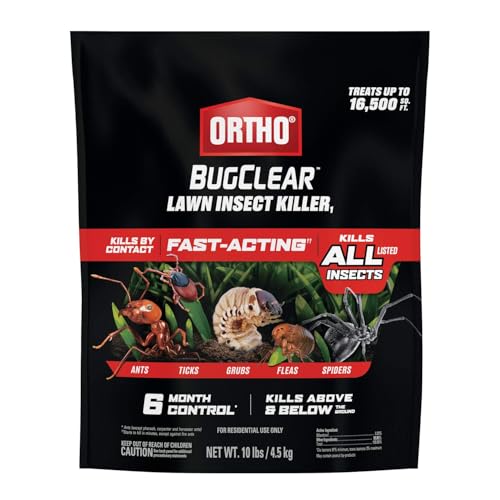
A heavy bag is not automatically more lawn. The Ortho BugClear bags are rated to treat up to 16,500 sq. ft. while DuoCide covers up to 9,000 sq ft, and those two figures tell you more about value than the scale at the counter. Measure your square footage first, then divide it into the coverage figure on the label.
Check what else lives in your yard
Three different products here target different menus. Some work on grubs plus ants, fleas, and ticks. Some go after Japanese beetle grubs specifically. One is a natural spore that works on Japanese beetle grubs alone. Decide whether you are fighting grubs only or the whole insect list, because you are paying for that list.
Watering and timing decide half the result
Granules need light watering immediately after application to sink the active ingredient into the soil where grubs feed. Apply too close to a heavy downpour and the product washes away before it works. Applying on a forecast of steady, gentle rain is the pattern that shows up again and again in the reviews that report fast kills.
Side-by-Side Comparison
| Model | Best For | Form | Active Ingredient | Coverage / Size | Amazon |
|---|---|---|---|---|---|
| Spectracide Triazicide Concentrate, 40 Oz★ Best Overall | Sprayer owners covering a large lot | Concentrate | Gamma Cyhalothrin | 40 fluid ounces | Amazon |
| Ortho BugClear Lawn Insect Killer1, 10 lbsBest Coverage | Whole-lawn grub and ant cleanup | Granules | — | Up to 16,500 sq. ft. | Amazon |
| BioAdvanced Season Long Grub Control, 10 lbGrub Specialist | Grubs plus mole crickets and chinch bugs | Granules | Lambda-cyhalothrin | 10 lb bag | Amazon |
| Spectracide Triazicide Granules, 20 lb | Big yards with mixed insect pressure | Granules | — | 20 lb bag | Amazon |
| Milky Spore 80010-9 Japanese Beetle Killer | Japanese beetle grubs only, natural approach | Spore powder | Bacillus Popilliae | 10.1 ounce container | Amazon |
| Liquid Harvest Pro Grub Control, 32 oz | Spot-treating trees, shrubs, and turf | Concentrate | Imidacloprid 21.4% | 32 fluid ounces | Amazon |
| St. Gabriel Milky Spore Granular, 15 lb | Long-haul natural grub suppression | Granules | Bacillus Popilliae | 15 lb bag | Amazon |
| Bonide Insect and Grub Control, 6 lb | Foundation bands and small lawns | Granules | Imidacloprid + Lambda-Cyhalothrin | 6 lb bag | Amazon |
| The Andersons DuoCide, 18 lb | Wide pest list on a mid-size lawn | Granules | Bifenthrin + Carbaryl | Up to 9,000 sq. ft. | Amazon |
| Quali-Pro Imidacloprid T&O 2F | Turf pros and large properties | Liquid concentrate | Imidacloprid 21.8% | 128 fluid ounces | Amazon |
| Bayer Merit 0.5 Granular, 30 lb | Systemic control across a big property | Granules | Imidacloprid | 30.1 lb bag | Amazon |
Detailed Reviews
1. Spectracide Triazicide Insect Killer 40 Oz
Our pick — 4.5+★ from 3,000+ verified ratings; the strongest balance of quality and price.
One bottle that kills grubs and 260-plus other listed insects for a whole lot less than a spray service.
The headline here is a 40-fluid-ounce concentrate that kills more than 260 listed insects on contact, including grubs, ants, fleas, deer ticks, and Japanese beetles. That is a wide swath for a single bottle, and it is why this takes the top spot: it covers above-ground pests and soil-dwelling grubs in one pass. Mix it in a tank sprayer with water at the label rate and you can treat lawns, vegetables, fruit and nut trees, roses, flowers, shrubs, and foundation edges.
Weight tells the practical story when you compare it with the BioAdvanced 10 lb bag — 2.9 pounds versus 10 pounds, so this is a bottle you can carry in one hand and keep on a shelf between uses. It also stays non-staining to most home siding depending on age and cleanliness, per the label, which matters if you are spraying along a wall or walkway. What wins people over is straightforward effectiveness; it is the thing owners talk about most, and mixing it well in a sprayer comes up right behind.
The catch is honest and worth stating plainly. Duration is genuinely mixed — some yards hold for the advertised stretch and others need a reapplication about every 10 days, so plan for that possibility. The odor draws mixed reactions too, noticeable but not overwhelming; one buyer’s mask advice is worth taking if you are sensitive. And it does not play favorites among insects, so keep it away from garden beds where you want beneficial ladybugs to stay.
Where it earns its keep
- More than 260 listed insects covered by contact, grubs included
- 40 fluid ounces of concentrate stretches across a large property
- Only 2.9 pounds, so it stores and carries without fuss
- Mixes cleanly through a pump or tow-behind sprayer without clogging
What to plan around
- Duration varies; some yards need reapplication every 10 days
- Noticeable odor while spraying, so a mask helps
- Broad contact kill can take out beneficial insects too
Go with this if: you already own a tank sprayer and want one bottle that handles grubs plus the rest of the listed pest list across a large yard.
Look at granules instead if: you would rather not mix concentrate or if a friendlier scent profile matters more than coverage breadth.
2. Ortho BugClear Lawn Insect Killer1, 10 lbs.
A single 10-pound bag rated to cover up to 16,500 square feet — that is a lot of lawn per bag.
If square footage is your deciding metric, start here. A 10 lb bag of these granules treats up to 16,500 sq. ft, which puts it well beyond the 9,000 sq. ft. DuoCide bag further down this list. You spread it with a Scotts Spreader or another compatible model when you first spot insect activity, then water it in to activate. The listed targets include grubs, ants, spiders, ticks, fleas, and armyworms.
Timing is the useful part of the spec sheet. It delivers up to 6 months of ant control and 3 months of residual protection against other listed pests, with knockdown in minutes except against fire ants. No scent is detectable to most noses, and the lawn-friendly side effect people keep bringing up is a greener, healthier-looking yard after application. The general verdict from the review pages is that it does its best work on ants, fleas, and grubs in the front yard, and it is an easy spread for regular maintenance.
Two things to know before you buy. The granules can track indoors on wet shoes or into a vehicle, so keep everyone off the treated lawn until it dries — the manufacturer also frames it as safe for pets once applied per the label. And the straggler report is real: coverage sometimes falls short of total elimination, with beetles and cutworms surviving in some yards. Treat it as very good suppression rather than a guaranteed clean sweep.
Best value per square foot: at up to 16,500 sq. ft. per 10 lb bag, this is the most lawn per bag on the list, and it doubles as a lawn greening treatment.
The shoes-to-carpet issue: wet granules migrate indoors, so water it in and let the lawn dry before anyone walks across it.
Reach for this if: you have a medium-to-large lawn, a spreader in the garage, and a broad pest list you want knocked back in one pass.
Think twice if: grubs are the only problem and you want a product built solely for soil-dwelling larvae.
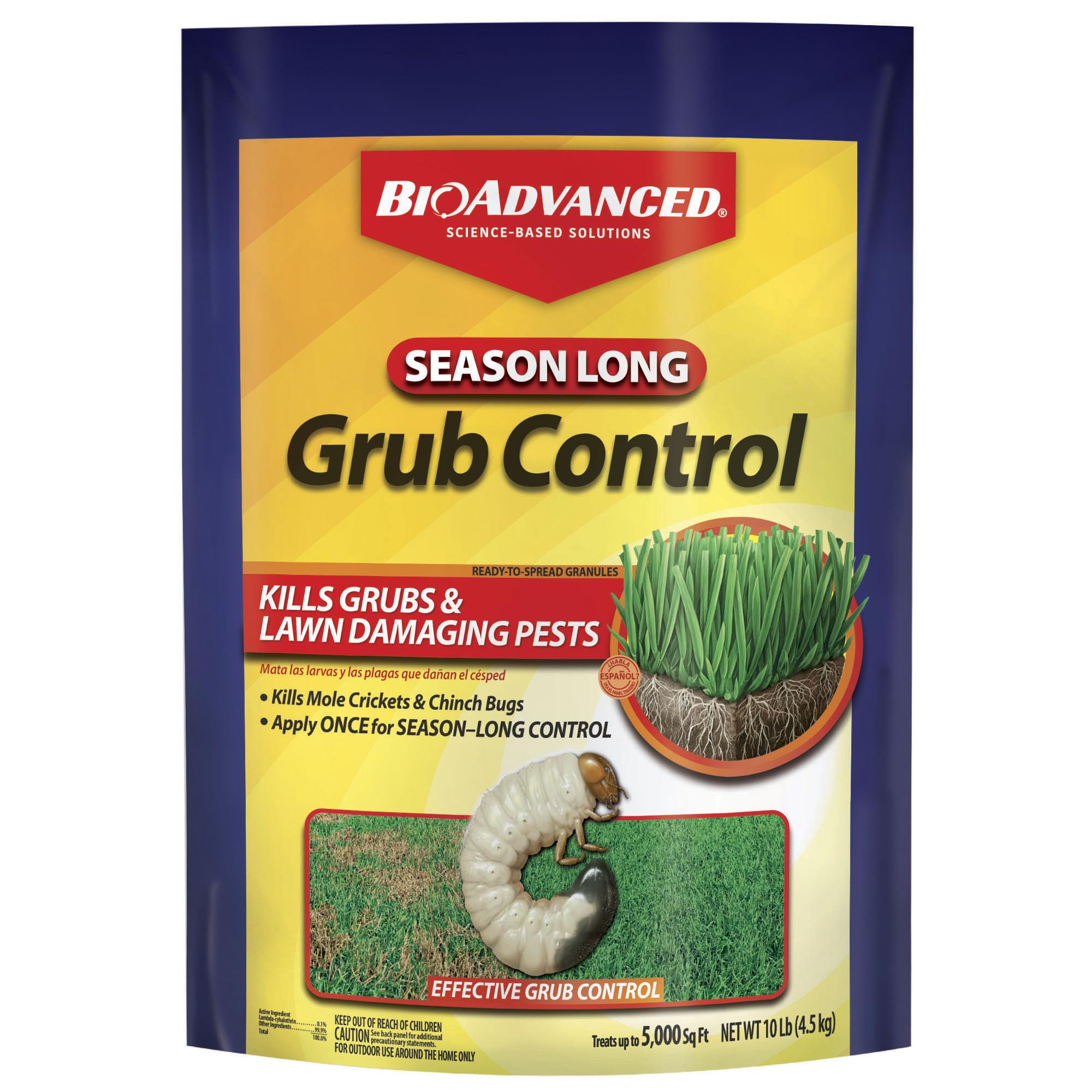
3. BioAdvanced Season Long Grub Control Granules – 10 lb Bag
Built for the grub problem specifically — kills 40-plus lawn insects and lays down a barrier that lasts the season.
Where the Ortho bag spreads across the widest territory, this one aims straight at grubs and the pests that come with them. Lambda-cyhalothrin is the active ingredient, and it goes after grubs above and below the surface plus mole crickets, chinch bugs, European crane fly larvae, ants, ticks, and crickets. Apply it with a rotary or drop spreader and water lightly afterward. Works on all lawn types.
The results owners describe are the kind you want from a grub product. Brown circular patches that had been dying back fill in with green grass within about a week and stay filled. Japanese beetles that survived years of other treatments get wiped out when this goes down before a soaking rain. And the chain effect shows up in the pest count: kill the grubs and the moles and skunks that dig for them thin out too. Grub reduction is the second most-discussed aspect after effectiveness, which tells you the product does the job it is named for.
The limitation is the word “season” in the name. A few buyers report it does not hold all season as advertised, so a fall reapplication is a reasonable expectation rather than a waste. Plan on a second pass and the timeline stays honest. Also be aware it kills by contact and barrier action rather than moving systemically through the plant, so it protects the lawn surface and soil, not the leaves of your ornamentals.
Why it leads the grub-first field
- Targets grubs plus 40+ listed lawn insects in one application
- Watering in after spreading pushes it down to the root zone
- Moles and digging animals often clear out once the grubs die off
- Brown patches typically fill back in within about a week
The honest asterisk
- Some yards need a fall reapplication to hold the full season
- Spreader required; not a hand-shake product
- Contact and barrier action only, not a plant systemic
This one for: a lawn with visible grub damage, brown circular patches, or a mole problem caused by grubs underneath.
Pass it by if: you want a product that also moves into tree and shrub foliage, which is a different kind of formula.
4. Spectracide Triazicide Insect Killer Granules 20 lb

The granular sibling of the top pick — a 20-pound bag that kills more than 100 insect types above and below ground.
Same brand, different delivery. Where the 40-ounce concentrate mixes with water, this 20-pound bag spreads dry and covers more than 100 listed insect types, grubs, ants, crickets, armyworms, cutworms, and ticks included. It works above and below the soil line, so it handles both the lawn surface and the root zone where grubs feed. Use it on lawns or as a band treatment around the house foundation.
What buyers like most is the plain value: the same bag treats repeatedly and owners mention comparable or better results than the liquid version for perimeter pest control. Cicadas, grasshoppers, and ant hills all come up in the successes. Timing is flexible — you can treat grubs any time between late July and early October, which is a wider window than several other picks here offer. Distribute the granules evenly, then water in lightly right after.
Two caveats worth knowing. Duration is mixed — several yards report it does not last more than 6-8 weeks, so this is a repeat-application product rather than a once-a-season barrier. Fleas are a weak spot; one account reports it works for roughly 24 hours after drying on those. It is strongest on ticks, ants, and grubs, so if fleas are your main enemy, treat that expectation separately.
Value that stacks up: the wide pest list and 20 lb bag make it an economical repeat-treatment choice for larger properties, and the late-July-to-early-October grub window is generous.
Plan on repeat passes: 6-8 week duration and weaker flea performance mean this one goes down more than once a season.
Reach for this if: you have a large yard, a spreader, and a mixed insect problem spanning ants, ticks, grubs, and cicadas.
skip it if: fleas are your top concern or you want a set-and-done season-long barrier.
5. Milky Spore 80010-9 Japanese Beetle Killer
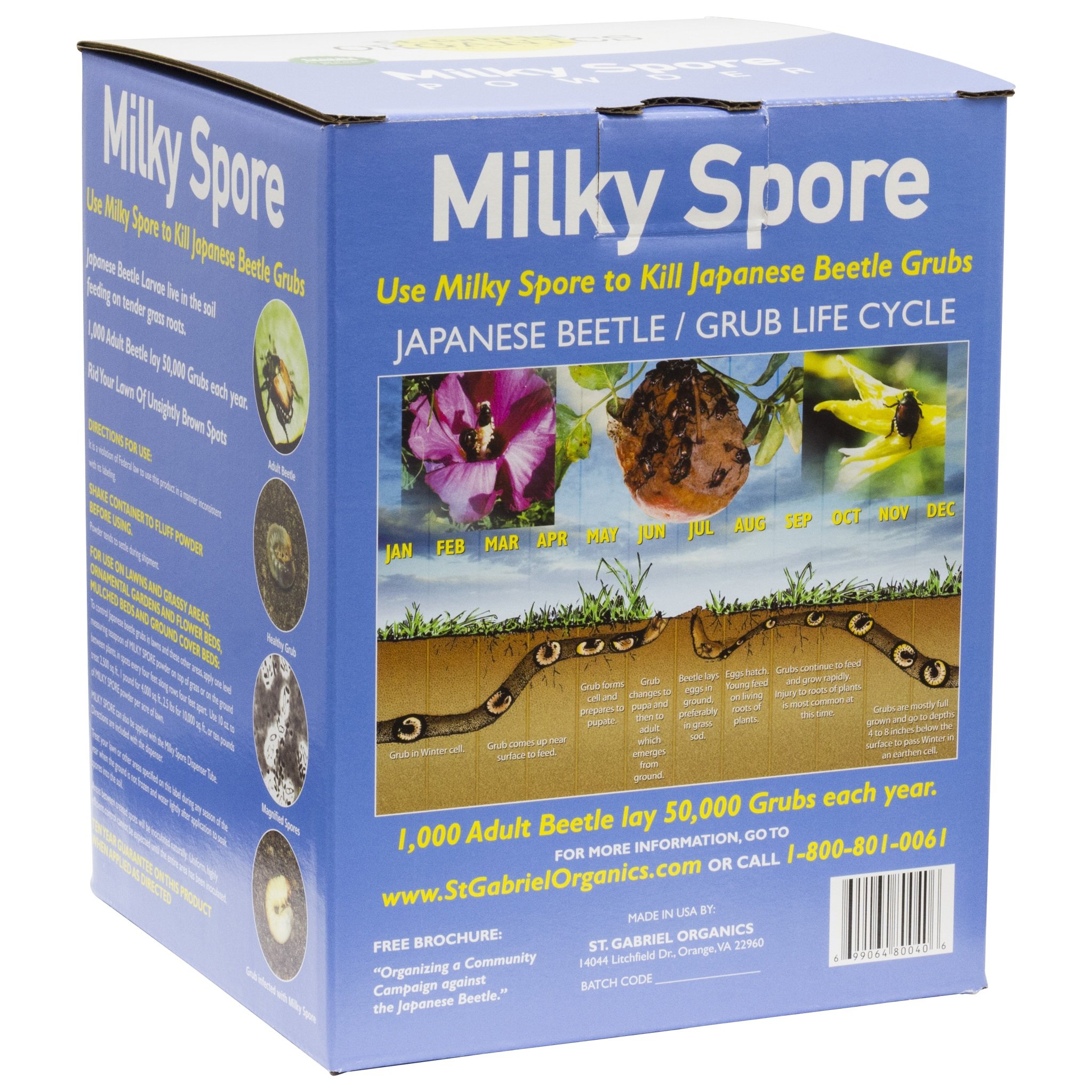
A living spore that settles into the soil and takes Japanese beetle grubs out year after year.
This is not a contact killer and it does not pretend to be. Milky Spore is Bacillus Popilliae, a natural bacterium that infects Japanese beetle grubs specifically, and once it establishes in your soil it keeps working. The container holds a single count, and the application rate is small — one owner’s report cites roughly 1 teaspoon per 4 square feet, watered in gently. Soil needs to be above 50°F for the spore to activate.
The payoff is patience-based. Yards that have run this for a full season report Japanese beetles essentially gone, and the effect extends into moles and armadillos that stop digging because their food source vanished. One long-running account reports nine years without Japanese beetles after applying the spores. It applies just as well raked into the top inch as scattered on the surface, so a rake and a watering can is enough equipment.
Set honest expectations. This only works on Japanese beetle grubs — if your yard has masked chafers or crane fly larvae, it will not touch them. The instructions are also thin: some containers ship without a usage sheet and the box shown in the listing is not always included. And the small container size means reapplication takes a little persistence, so factor in the space and the time before you commit.
The upside of going natural
- Living spore establishes in the soil and keeps working season after season
- Works on Japanese beetle grubs specifically, not on beneficials
- Small application rate — roughly 1 tsp per 4 sq. ft. in owner reports
- Moles and armadillos often stop digging once the grubs die out
Where it asks for patience
- Targets Japanese beetle grubs only, not every grub species
- Instructions can be sparse; soil above 50°F is required to activate
- Container is small, so refills may be needed for larger lawns
Right for: yards where Japanese beetles are the confirmed problem and you want a product that builds up in the soil instead of resetting each season.
Wrong for: a quick knockdown of a mixed grub population, or an application you want to see working by the weekend.
6. Liquid Harvest Pro Grub Control, 32 oz

A 21.4-percent imidacloprid concentrate that lets you dial in the dose for turf, foliage, or a tree’s root zone.
For anyone treating shrubs and trunks alongside turf, this is the flexible pick. The active is imidacloprid at 21.4 percent in a 32-fluid-ounce bottle, and the label gives separate mixing rates for three uses: up to 1.6 pints per acre on turfgrass, 1.5 fl oz per 100 gallons for foliar spraying, and up to 0.4 fl oz per gallon of water per inch of trunk diameter for soil applications. That means you can protect a lawn’s root zone and the root zone of a tree in the same afternoon.
What it does well is grubs and the soil-dwelling larvae behind them. Customers note it working on Florida-friendly lawns like Floratam, on adelgids attacking hemlocks, and on beetles in agave and yucca. The dual-shape bottle also draws praise for making the measuring and cleanup easier than a plain jug. It is genuinely cost-efficient — one reviewer diluting it for hemlock protection called it a supply that lasts.
The bottle is the honest downside. The liquid is the same color as the container, which makes the measuring spout nearly impossible to read, so plan on a dedicated measuring cup. It is also a highly concentrated product that deserves gloves and a calm, unhurried mixing session. And timing is not flexible — it is labeled for seasonal use rather than fall application, so put it down in the right window.
Where it shines: 32 fluid ounces of 21.4-percent imidacloprid stretch across trees, shrubs, and turf with three separate labeled mixing rates.
The measuring catch: the liquid matches the bottle color, so the spout is hard to read; keep your own measuring cup on hand.
Pick it if: your yard has ornamentals and trees carrying the same pest pressure as the lawn, and you want one concentrate that treats all three.
Leave it if: you only need a straightforward spread-and-water lawn treatment with no mixing math.
7. St. Gabriel Organics Milky Spore Granular Grub Control, 15lb

The granular version of Milky Spore in a 15-pound bag, rated to keep working on Japanese beetle grubs for up to 15 years.
This is the same Bacillus Popilliae spore as the small container above, now in a 15-pound bag you can broadcast. That is the practical upgrade: the bigger bag spreads through a standard spreader instead of by hand, and the organic-format sachet makes it easier to cover a whole lawn in one sitting. It is USDA-certified organic and described as harmless to pets, beneficial insects, and other wildlife.
The 15-year duration claim is what sets this bag apart from the small Milky Spore container. No other product here claims up to 15 years of Japanese beetle grub control from one sustained program. Once the spore establishes, weather does not affect it and no further treatments are needed. The spore persists in the soil and spreads as it infects Japanese beetle grubs.
What the label does not say loudly enough is that this is a program, not a one-shot. It takes multiple applications, spread across two years in repeated seasonal rounds, for the spore to build up to effective levels — some yards run six applications to get there. Granule texture is dusty, so a mask while spreading is sensible. It is also a Japanese-beetle-specific tool; other grub species will not be touched. And the price draws mixed feelings, which is fair given the multi-year ramp.
The case for the big bag
- Up to 15 years of Japanese beetle grub control from a sustained program
- USDA-certified organic granule format
- 15-pound bag spreads evenly through a standard spreader
- Needs no repeated treatment once the spore establishes
The catch
- Multi-application program over two years, not a single dose
- Dusty during spreading, so a mask helps
- Japanese beetle grubs only; other grub species are unaffected
This suits: a homeowner planning to stay put for years and ready to build the spore up in the soil for the long haul.
Look elsewhere if: you need the grub population knocked down inside a single season rather than across two.
8. Bonide (BND60360) Insect and Grub Control, 6 lb.

Two active ingredients in one granule — kills in about 24 hours and holds the soil and surface for up to 3 months.
What makes this formula different from the single-active picks is the pair. It combines imidacloprid (the systemic that moves into the soil) with lambda-cyhalothrin (the fast contact killer), so it works on both fronts at once. The label rates it to kill listed insects within 24 hours and protect the soil and surface for up to 3 months. The target list is broad: ants, crickets, chinch bugs, billbugs, cutworms, earwigs, fleas, roaches, grubs, sod webworms, and ticks.
Where it fits best is around a foundation or in a small raised bed. The 6-pound bag is the smallest here, and it works well for a barrier band around the house or a flower bed where grubs and skunks keep showing up. The results pattern matches the spec: owners find dead grubs the next day after applying and watering, and earthworms reportedly stay alive through the treatment. Moths laying eggs in the lawn and skunks digging at plant roots also come up as solved problems.
The honest limit is size. Six pounds does not go far on a large lawn — this is a targeted-quantity tool, not a whole-acre spread. The price-per-pound also sits higher than the bigger bags, which is expected for a smaller, dual-active formula. And read the label carefully before applying around kids and pets, because it is an outdoor-only product not intended for indoor use.
What the two actives buy you: a 24-hour kill window plus up to 3 months of soil and surface protection in a single 6-pound bag.
Size is the trade-off: six pounds is a foundation-and-bed quantity, not a whole-lawn treatment, so buy accordingly.
Good match for: a foundation barrier, a flower bed, or a small lawn where you want fast death plus a few months of cover.
Not the one for: a large yard, which needs the bigger bags further up this list to cover the footage.
9. The Andersons DuoCide Lawn Insect Control 18 lb

Two professional-grade actives in one granule, aimed at more than 50 common lawn pests above and below the surface.
DuoCide is built around the twin actives bifenthrin and carbaryl. Bifenthrin is the long-residual surface insecticide, carbaryl is the fast contact killer, and together they cover both the thatch layer and the root zone. The pest list is long — grubs, ticks, fire ants, mole crickets, fleas, and 50-plus other common lawn pests. DG granules disperse quickly and completely when watered, pushing the actives straight into the soil.
The coverage number is worth noting: up to 9,000 sq. ft. per 18-pound bag. That lands it in the middle of the field here — plenty for a typical suburban lawn, but not the widest reach on this list. Owners who apply before rain report grubs surfacing and dying within a day, and the effect carries over: no more grubs means no more armadillos digging and no more patchy dead spots. What comes up most on the review pages is effectiveness, easy spreading, and the sense that it beats what you would pay a service.
The catch is consistency. Ant control is genuinely mixed — fire ants knock back for six months then return, and some applications barely put a dent in a new colony. Coverage is also disputed by a couple of owners who found the actual spread thinner than the 9,000-square-foot claim suggests. Finally, it is not approved for sale in California, so check before ordering. Apply before rain and reapply every 3-4 weeks from August through October if you want the grub window covered.
Where DuoCide delivers
- Bifenthrin plus carbaryl covers surface and soil at the same time
- Grubs typically surface and die within a day of application
- Longer pest list than the single-active picks here
- Reapply every 3-4 weeks Aug-Oct to keep the grub window covered
What to expect less of
- Fire ant control is mixed; colonies sometimes return
- Not for sale in California
- Requires reapplication through the fall grub window
Worth it if: you want the professional two-active formula for grubs, ticks, mole crickets, and fire ants across a mid-size lawn.
Step back if: fire ants are the whole problem, since that is the weakest result in the mix.
10. Quali-Pro Imidacloprid T&O 2F Insecticide (Generic Merit)

A 128-ounce jug of pro-grade imidacloprid, the same active as Merit, at a fraction of the brand-name rate.
Quali-Pro is what lawn care technicians buy when they want the active ingredient without the branded packaging. The active is imidacloprid at 21.8 percent in a 128-fluid-ounce jug — a large supply that mixes into a pump sprayer for systemic control of grubs, chafers, Japanese beetles, European chafer, and crane fly larvae. Systemic here means the plant takes the chemical in, so grubs feeding on the roots get a fatal dose.
The use cases reviewers point out are wide. Crape myrtles covered in aphids recover after a couple of soakings spaced three weeks apart. Agaves and yuccas survive beetle attacks. Laurels and hemlocks pull through pest pressure that other products could not touch. The easy-pour spout, large font on the chemical label, and the lack of a chalky residue after shaking get specific praise from owners who have compared it to other imidacloprid brands.
The real considerations are careful mixing and coverage. It is a thick, glue-like consistency that demands gloves and a proper measuring cup, and it is not labeled for edible plants. Systemic products also carry a side-effect risk — one owner noted not knowing what else the chemical killed. And because this is a professional-grade format, read the label thoroughly before opening. For a heavy-duty user with a lot of square footage, the supply lasts a very long time.
Supply for the long haul: 128 fluid ounces of 21.8-percent imidacloprid goes into a pump sprayer with plenty of applications to spare.
Handle with care: thick, glue-like consistency, gloves required, and not labeled for edible plants.
Best suited to: homeowners with large properties, tree collections, or repeated seasonal applications who want pro-grade active at a bulk rate.
Better to skip if: a first-time user wants a simple, low-fuss spread; this asks for careful handling and measuring.
11. Bayer Merit 0.5 Granular Systemic Insect Control

Thirty pounds of granular imidacloprid — the commercial-standard systemic for grubs, chinch bugs, and turf pests.
Merit is the brand most turf managers reach for by default, and this 30.1-pound bag puts that granular systemic into a homeowner-friendly format. The active is imidacloprid, the same class as the Quali-Pro liquid above, delivered as granules you spread and water in. It goes to work in and around turfgrasses, trees, shrubs, evergreens, flowers, foliage plants, and ground covers. Target pests are grubs, chinch bugs, and other small turfgrass pests plus a longer label list.
Where it really shows its value is the ratio of product to coverage. Thirty pounds treats a large property in a single application, and the granules broadcast cleanly by hand or seeder. What comes up over and over is effectiveness — grubs gone, moles gone, spittle bugs disappearing for several months at a time. Owners also report extending the bag across seasons when stored well, and using it around individual plants like irises when timing is right.
The one cost you pay for the big-bag convenience is price — this is the most expensive pick on the list, and value is the point on which opinions split most sharply. The other reality is that timing is everything with imidacloprid. Apply at the wrong point or just before a heavy rain and the product washes away, and a few buyers blame the product when the timing was the issue. Get the calendar right and the results hold. Store the unused portion dry and the bag carries over into the next season.
The pro-standard systemic: 30.1 pounds of granular imidacloprid for turf, trees, shrubs, evergreens, and flower beds.
Timing is not optional: apply at the right point in the season and avoid a heavy rain, or the active ingredient washes away before it works.
Go for it if: you have a large property and want one premium systemic granular that treats turf and ornamentals together.
Not the right call if: you want a quick-contact kill this week; granular imidacloprid needs the right seasonal window to pay off.
Know the Specs
Active ingredient and what it does
The active ingredient label tells you the mode of action. Contact actives like lambda-cyhalothrin and bifenthrin kill insects on touch, so they work above ground and in the thatch. Systemic actives like imidaclopridare absorbed into the plant, so a grub feeding on the roots gets a fatal dose. Bacillus Popilliae, the active in Milky Spore products, is a living spore that infects Japanese beetle grubs specifically and stays active in the soil for years once established.
Granules versus concentrate
Granules are dry particles you broadcast with a spreader and then water in, which makes them the practical choice for a full lawn. A concentrate is a liquid you dilute in a tank sprayer with water at the rate on the label, which lets you spot-treat edges, foundations, and individual plants and trees. Neither is better in general — the right form depends on whether you are covering ground or aiming at a specific spot.
Coverage ratings explained
A coverage rating is the square footage the manufacturer says a bag or bottle can treat. It matters more than the weight on the box, because granules carry different amounts of active ingredient at different dilution rates. Divide your lawn’s square footage by the coverage figure to see how many bags you need, and remember that a slightly heavier application is often worth doing on a bad grub infestation.
Seasonal timing for grubs
Grubs are most vulnerable when they are small and feeding near the surface, and the label on each product tells you when it is designed to go down. Spectracide granules list late July through early October; Milky Spore products ask for soil above 50°F and a multi-season program; imidacloprid products are wired for the spring-to-summer window. Match the calendar to the product and the product does most of the work.
Common Questions
How do I know if I actually have grubs and not just drought damage?
What is the difference between a grub killer and a grub preventer?
How much lawn does a single bag or bottle treat?
How soon after applying grub control should I water?
Are these grub products safe around pets and children once they dry?
Will these products kill earthworms and other helpful soil life?
Why do some products kill Japanese beetles and others do not?
How many applications does a Milky Spore program take?
Can I use grub control near a vegetable garden or fruit trees?
Do I need to reapply grub control in the fall?
The Bottom Line
For most yards, the grub control winner is the Spectracide Triazicide Concentrate, 40 Oz, because one 40-ounce bottle covers grubs plus more than 260 listed insects when mixed in a sprayer you already own, and the 2.9-pound bottle stores quietly between seasons. If you want the widest coverage per bag, grab the Ortho BugClear 10 lb — up to 16,500 sq. ft. and a fast knock on ants and grubs is a lot of lawn for one spreader session. And for the patient, natural approach, the St. Gabriel Milky Spore 15 lb is the one to reach for, with its organic spore rated to hold Japanese beetle grubs for years once it establishes in your soil. The one honest nudge: the top pick earns its spot on breadth and value, but it needs reapplication in some yards, so if you want a set-and-done season barrier, the BioAdvanced Season Long or the Bayer Merit 30 lb will ask less of your calendar.
How we choose
We do not accept paid placement. Every pick is matched to a real buyer and a real use-case; we do not hands-on test units.
Sources
Specifications: manufacturer listings and product documentation. Review insights: verified customer reviews, as of October 2026. Pricing: not shown on this page (it changes often); check the current price via the retailer link.
As an Amazon Associate, Aappliancez earns from qualifying purchases. This does not affect which products we feature.