Disclosure: Some links in this post are affiliate links. As an Amazon Associate I earn from qualifying purchases, at no extra cost to you. Learn more
Specs are compiled from manufacturer listings and verified buyer reviews and can change over time — please confirm the key details on the product page before buying.
If you have ever been sideswiped in a parking lot or blamed for a lane change you did not make, you already know the pain: a normal two-lens camera films the front and back and misses the one angle that would have settled it. A four-channel setup adds a lens pointed at each flank, so the whole car gets watched at once. The tricky part is that “four channel” means wildly different things across listings — some record 4K up front and plain 1080p on the sides, some swap resolution for extra coverage, and a few quietly drop out of 4K the moment you plug in the rear camera. Below you will find the nine units genuinely worth your attention, ranked by what each one actually does well.
This guide is built by comparing the manufacturers’ published specifications and the patterns across verified customer reviews, so you get each pick’s real strengths and trade-offs instead of marketing spin.
Most buyers overspend on a headline resolution and under-buy on side coverage, mounting and parking power. This breakdown sorts the nine strongest 4 channel dash cam options by the angles they truly cover and the footage they hold up with.
Top Picks

How To Choose The Best 4 Channel Dash Cam
Four lenses sounds like twice the protection of two, but only if the extra two point where trouble actually comes from. The first decision you make is not brand or resolution — it is which two extra angles you need. Get that wrong and you have paid for cameras aimed at empty space.
Decide which two extra angles you actually need
A “four channel” camera splits its lenses between the road ahead, the road behind, the cabin, and the flanks. Some put the extra pair low on the side windows to catch a door scrape or a lane-change impact. Others aim them into the cabin to film passengers and the back seat. Rideshare drivers usually want the cabin angle. Anyone who parks on a busy street usually wants the side angles. Read the lens description word by word, because “360°” gets printed on both layouts.
Check what resolution each channel records at once
The front lens often records 4K on its own and drops to a lower resolution when all four run together. That is normal — the processor splits its power four ways — but the drop varies a lot between models. One unit here holds 4K on the front and 1080P on the other three. Another steps the front down to 2K once every channel is live. Neither is wrong, but you should know what you are actually recording before an incident, not after.
Plan for parking mode power before you buy
Almost every model in this category needs a separately sold hardwire kit to keep watching while the engine is off. Without it, the camera shuts down the moment the ignition cuts and your parked car is unwatched. Two failure modes show up in owner reports again and again: a unit wired to an always-on socket that keeps drawing power and flattens the battery, and a unit that shuts itself off to protect the battery and misses the scratch. Match the parking mode you want to the power wiring you are willing to pay for.
Budget your microSD card for four streams at once
Four cameras writing at the same time fill a card far faster than two. A free card bundled in the box helps you start on day one, but check the supported ceiling and buy a high-endurance card rated for constant rewrites. Cheap cards are the single most common cause of corrupted or missing clips in this category.
Side-by-Side Comparison
| Model | Best For | Max Front Resolution (all channels live) | Field of View | Included Card | Amazon |
|---|---|---|---|---|---|
| BOTSLAB 4 Channel 360° Dash Cam★ Best Overall | Widest coverage and touch playback | 3K | 560 degrees | 128GB | Amazon |
| REDTIGER VP40 4 ChannelTop Performer | Night-time side coverage | 2.5K (front and rear) | 360 degrees | None | Amazon |
| Vantrue N5 4 Channel 360°Cabin Watcher | Full cabin and trunk monitoring | 2.7K (1944P) | 360 degrees | None | Amazon |
| IIWEY N5 PRO 4K 4 Channel | Fast WiFi transfers | 4K | 170 degrees | 128GB | Amazon |
| HUPEJOS 4K 4 Channel | Budget four-camera coverage | 4K | 360 degrees | 128GB | Amazon |
| N300Pro 4K 4 Channel | Driver fatigue alerts | 4K (3840×2160P) | 360 degrees | 64GB | Amazon |
| Driveye D7 4K 4 Channel | Heat-heavy climates | 4K + 2K (front and rear) | 360 degrees | 128GB | Amazon |
| Roadwitness 4K 360° | Long rideshare shifts | 4K (3840×2160P) | 360 degrees | 128GB | Amazon |
| Vantrue S1 Pro Max | Front-and-rear 4K detail | 4K + 4K | 155 degrees | None | Amazon |
Detailed Reviews
1. BOTSLAB 4 Channel 360° Dash Cam
Our pick — 4.0+★ from 750+ verified ratings; the strongest balance of quality and price.
The only camera here that watches past the rear bumper — 560° in a class of 360° claims.
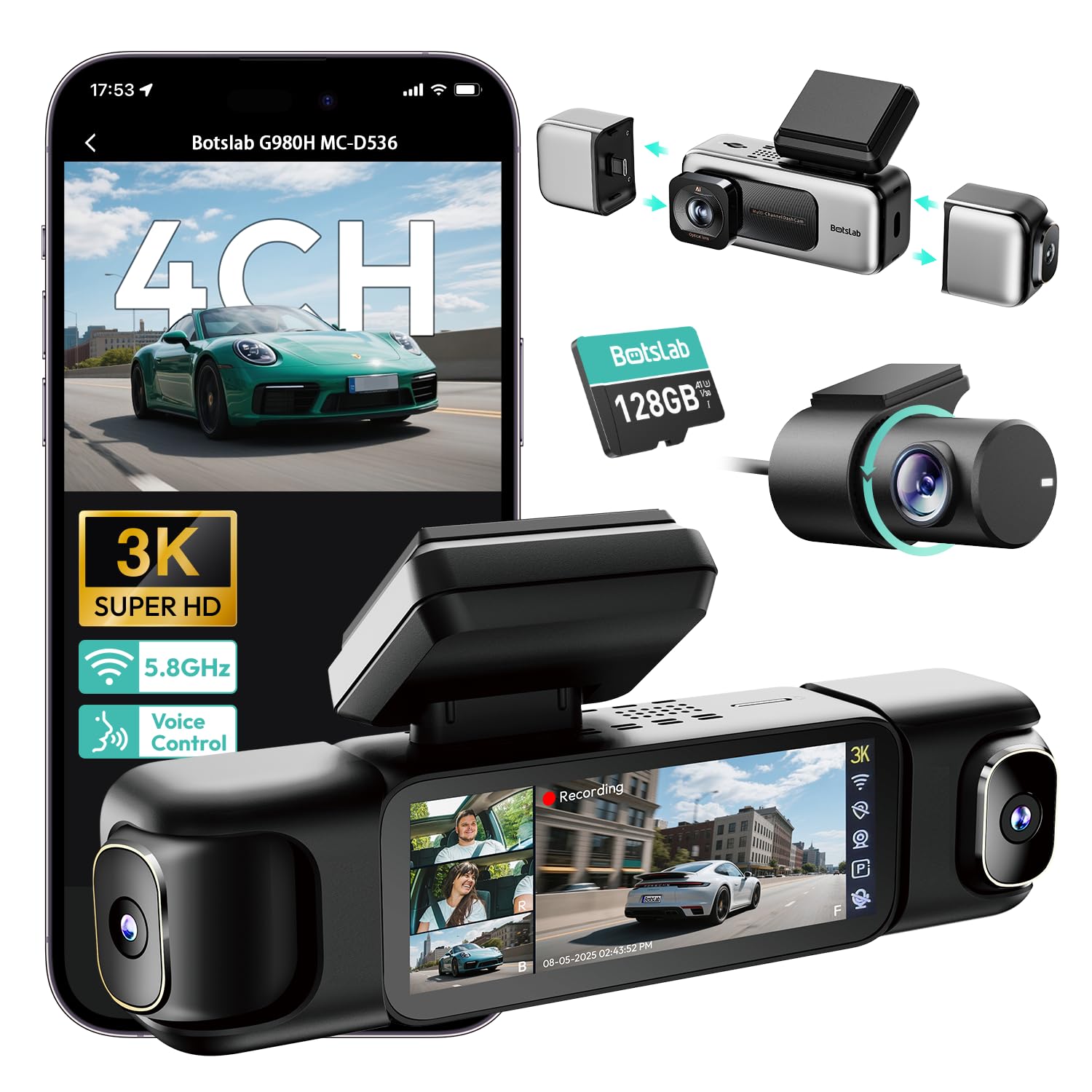
That 560-degree field of view is the number that sorts this camera from the pack. It comes from a 170° front lens, dual 120° side lenses, and a 150° rear, all recording at once. The widest rival here tops out at 360°, so the BOTSLAB sees a whole extra slab of real estate beside and behind you. If your worry is a mirror-clip or a car sliding up your blind quarter, this is the lens layout that catches it.
You get 3K resolution on all four channels, which is a step below the 4K front cameras on other picks here. In exchange, a 3.18″ touchscreen shows a four-way split view, so you can watch every angle at once instead of tabbing between clips during an on-road argument. Voice control handles the basics without taking a hand off the wheel. The 5.8GHz WiFi moves footage to your phone, and the maker claims it beats older 2.4GHz chips, though the maker notes the signal only reaches 3-5m. A free 128GB card and static-cling mounts (no sticky residue on the glass) round out the box.
The thing people rave about is the coverage itself — the review pages are full of owners pointing out how much of the car gets watched at once. Owners of big vehicles push it further than the maker intended. As owners put it: “I put this on a 36 foot motorhome.” The honest catch is heat and parking power. The unit is designed to shut down inside a hot parked car as a safety measure, which is inconvenient mid-trip, and the always-on sentry mode can flatten a car battery if wired to a permanent live feed. Treat parking mode as an add-on you wire with care, not a default.
Where it pulls ahead
- 560° field of view — the widest coverage of any pick here, with the side lenses magnetically detachable so you can run 3 or 2 channels when you prefer
- Four-way split playback on the 3.18″ touch screen means every angle is visible in one view during a dispute
- 8-second pre-recording kicks in when the G-sensor (a bump detector) fires, saving the footage from before the impact, not just after
- Super capacitor instead of a battery for stable running from -20°C to 70°C
Worth weighing up
- 3K across all four channels, not 4K like several rivals
- WiFi range of 3-5m means you sit in or beside the car to pull clips
- Shuts down in a hot parked cabin and sentry mode can drain the battery
Go for it if: you want the most angles covered in one recording and you like reviewing them on a built-in screen.
Think twice if: you need every channel at 4K or you plan to leave parking surveillance running unattended.
2. REDTIGER VP40 4 Channel 360° Dash Cam
Two STARVIS 2 sensors and infrared side cameras — the night-time side-hit specialist.
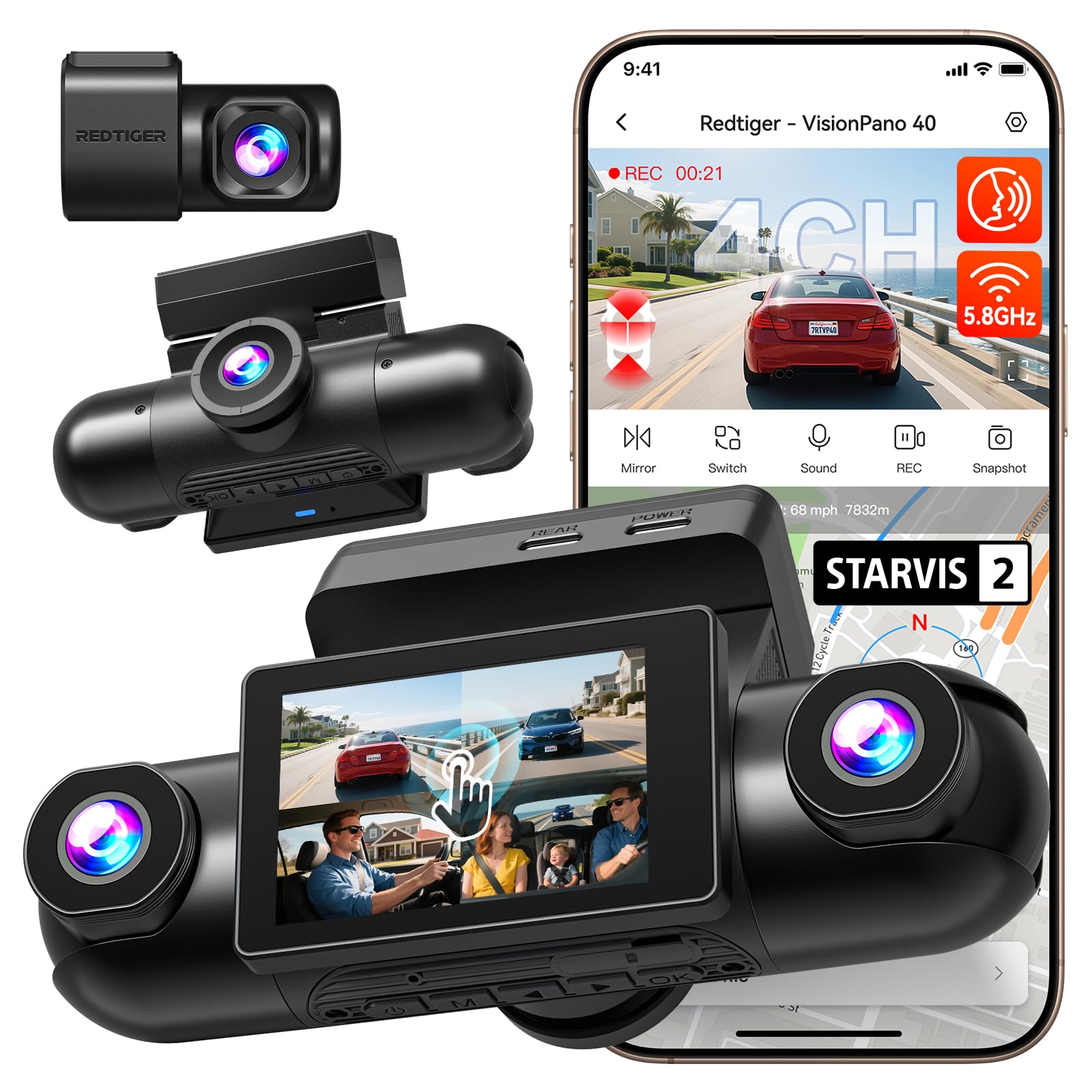
Most four-lens cameras get blind at night on the flanks, because a tiny side lens with no help cannot pull a plate out of the dark. The VP40 gives each side camera infrared night vision and fits two STARVIS 2 IMX675 image sensors, which the maker rates at a step up in light sensitivity over standard sensors. The front and rear both record 2.5K (2560×1440), with the side lenses at 1080P. A dual HDR setup (a mode that balances bright highlights and dark shadows in one frame) keeps plates readable in tunnels and rain, which is where cheap cameras turn license plates into white smears.
One number to plan around: no SD card ships in the box. The maker recommends its own high-endurance card, and with four channels writing at once, a slow card is the fastest route to corrupted clips. On the connectivity side, the 5.8GHz WiFi is rated at four times the transfer speed of common 2.4GHz WiFi, which matters when you are pulling a four-channel clip at the roadside instead of at your desk.
Owners come back to brag about the evidence it captures. One owner used the 1080P side footage to settle a T-bone insurance claim, and the side clip held up next to the sharper front lens. The recurring gripes are smaller but worth knowing: the adhesive mount can let go in strong heat, so some owners bolt the unit straight to the windshield with the bracket removed. A long slim body can also block part of the driver’s side window view. Neither is a deal-shaker if you mount it thoughtfully.
Night-time role: if the flanks of your car get hit most often after dark, the IR side cameras and dual STARVIS 2 sensors earn their spot ahead of cheaper 4K units that only shine up front.
Card caveat: budget for a high-endurance microSD card the same day you buy — the box is empty of storage and four streams need the durability.
Reach for this if: nighttime side scrapes and door knocks are your main worry and you want the strongest low-light coverage on the flanks.
Look elsewhere if: you want a card in the box or a mount that shrugs off a heat wave without a fix.
3. Vantrue N5 4 Channel WiFi 360° All Sides Dash Cam
A rear cabin lens that watches your trunk, back seat and side windows in one frame.
The N5’s defining trick is where its fourth lens sits. Alongside a 158° front camera, it adds a front cabin camera, a rear cabin camera, and a 165° rear camera, all recording together at a top resolution of 2.7K (1944P) plus 1080P on the other three channels. That rear cabin lens covers the trunk, the back seat and the side windows — the spot a thief reaches through. If you carry kids, pets or luggage, or you drive rideshare with a full cab, this is the only pick here built around the inside of the car rather than just the road.
Owners who have run it for a long stretch point to two things: the image quality holds up well enough to read plates, and it survives serious heat without overheating. For connectivity, a 5G WiFi link is rated at four times the transfer speed of an older 2.4GHz standard. A dual-system GPS logs your speed and route for a mileage report you can hand to an insurer. A magnetic mount lets you lift the camera off its base without disturbing the cables.
The honest trade-offs on this one are about accessories and fine print. Some owners note the newer version’s cigarette adapter is now permanently attached and larger, which can block a center console organizer, and the rear camera is stiffer to angle than the last generation. A few have also been caught out by the total lack of live view — this model records and stores footage, but it does not stream you a live feed. Read that spec against your needs before you commit.
Pick this one if: passengers, pets or trunk contents matter as much as the road, and a cabin camera is a genuine need rather than a nice-to-have.
One real limit: no live-view streaming, so you review stored footage after the fact, not in real time.
4. IIWEY N5 PRO 4K 4 Channel Dash Cam
WiFi 6 rated at 10MB/s and a true 4K front lens — the fastest download in this lineup.
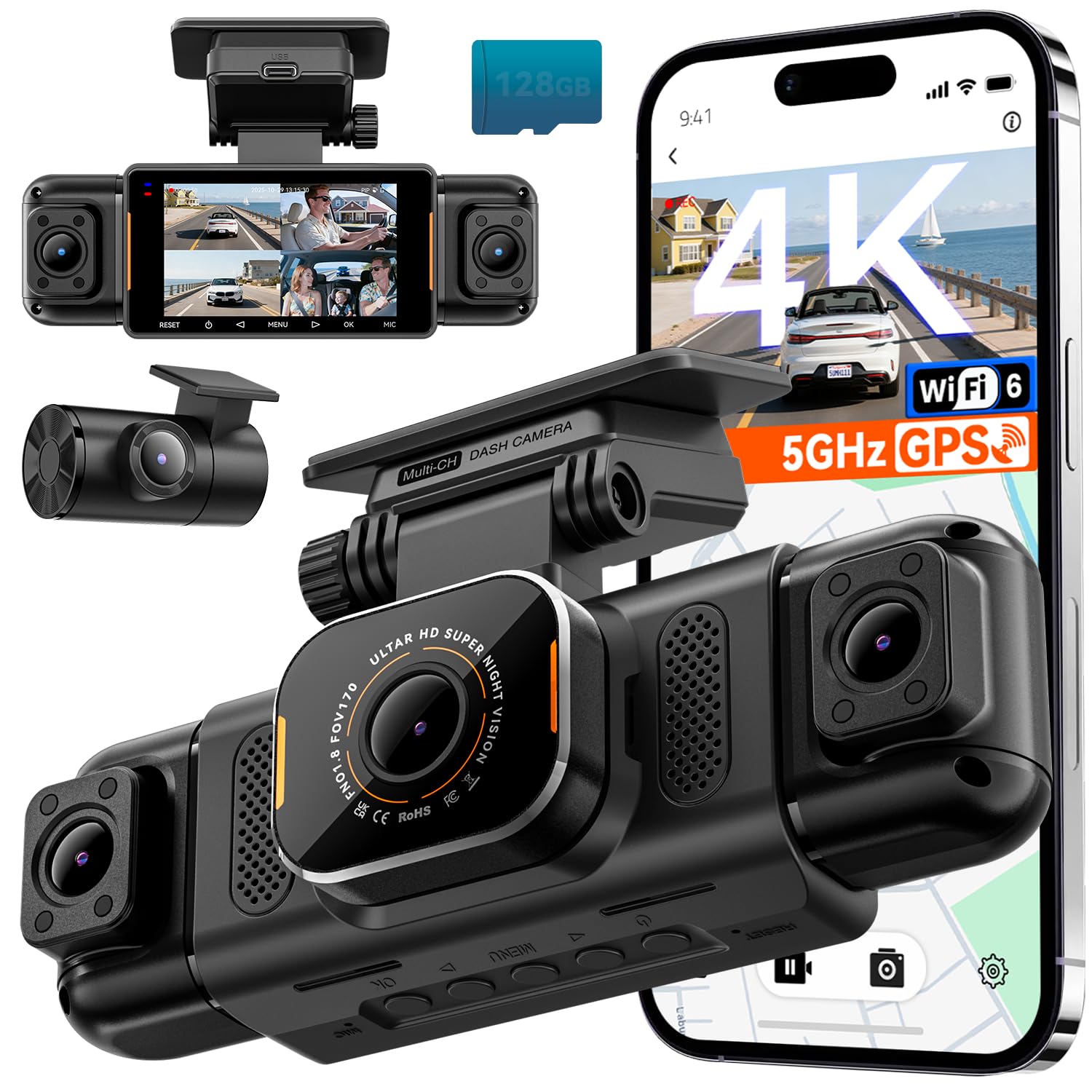
When you need a clip off the camera and into an insurance email, speed is the whole game. The N5 PRO’s WiFi 6 link is rated at up to 10MB/s for downloads, with 5GHz and 2.4GHz backing it up, and the free IIWEY app sits on both Google Play and the App Store. Meanwhile the front lens records 4K (2160P) with 1080P on the other three channels, or a longer-running 2K+1080P*3 option if you prefer more minutes of footage per card. A 128GB card is included, so storage is ready on day one.
Coverage comes from a 170° front lens, a 170° rear and 150° side cameras, which together put a much wider frame on the road behind you than the narrow rear views elsewhere. Night vision runs through an FNO1.8 lens (a wide-open aperture that lets more light in) plus four IR lamps on each side camera, and it switches to black-and-white mode automatically when the light drops. Mounts rotate freely — 90° up front, 360° at the rear, 180° on the sides — so you can aim each lens where you need it.
Where this camera wins people over is build and picture quality — the sharpness on the front lens is what gets talked about most, and the included card means you are recording from the start. The catch is parking mode. It needs a separately sold hardwire kit and is not in the box, so if your plan is to catch a door dent while parked, factor that purchase in. Front-lens sharpness here also beats the wider but softer coverage of the BOTSLAB above, which trades resolution for 560° reach.
Head-to-head read: the IIWEY front lens leads on raw clarity against the BOTSLAB’s broader sweep — 4K against 3K up front — while the BOTSLAB returns the favor with 560° of angle versus the IIWEY’s 170° front and rear.
Parking hitch: the hardwire kit is a separate purchase, so budget for it if 24/7 protection matters.
Best fit for: anyone who regularly needs to hand clips over fast and wants a sharp 4K front frame.
Not for you if: you expect parking mode to work straight from the box — the kit is sold separately.
5. HUPEJOS 4K Dash Cam Front and Rear
A true 4K front lens, three 1080P sides and a free 128GB card at entry-level money.
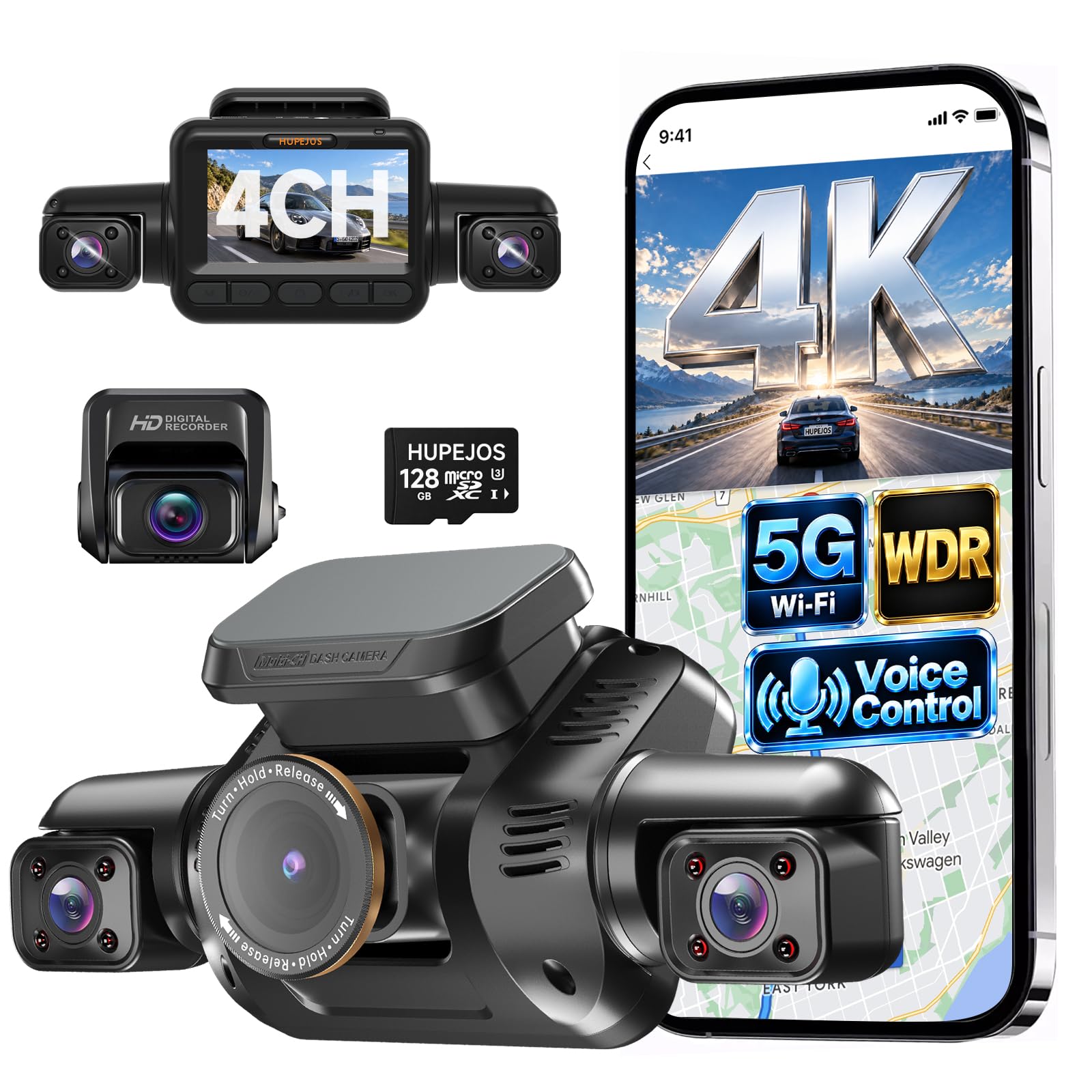
Resolution-for-money is the HUPEJOS story. The front records 4K while the left, right and rear lenses each record 1080P, with 150° ultra-wide lenses on all four. A 128GB card, CPL filter (a screw-on glass that cuts windscreen glare), and eight IR lamps are all in the box, plus hands-free English voice commands for start, stop, photo and lock.
Coverage runs 360° across front, left, right and rear, and the built-in 5GHz WiFi pairs with an app on iOS or Android for live preview. GPS logs location, speed and route, and GXPlayer on Windows or Mac shows the drive on a map. Loop recording runs in 3-minute chunks, and the G-sensor locks footage on a collision so the clip does not get overwritten. Night vision includes an automatic exposure adjustment plus the CPL filter, though you have to switch IR on in the menu for black-and-white night recording.
The one thing buyers should plan for is resolution compromise once every channel runs. With the rear camera installed, the front steps down from that 4K headline — a detail worth knowing before an incident, not after. Mounting is straightforward, and the package ships with the rear cable, trim tool and a static sticker. For a first four-camera kit on a tight budget, it covers the fundamentals well.
Choose it if: a free 128GB card and a genuine 4K front lens matter more than the last stretch of side sharpness.
Know going in: the front drops below its 4K headline when all four channels record at once.
6. N300Pro 4K 4 Channel Dash Cam
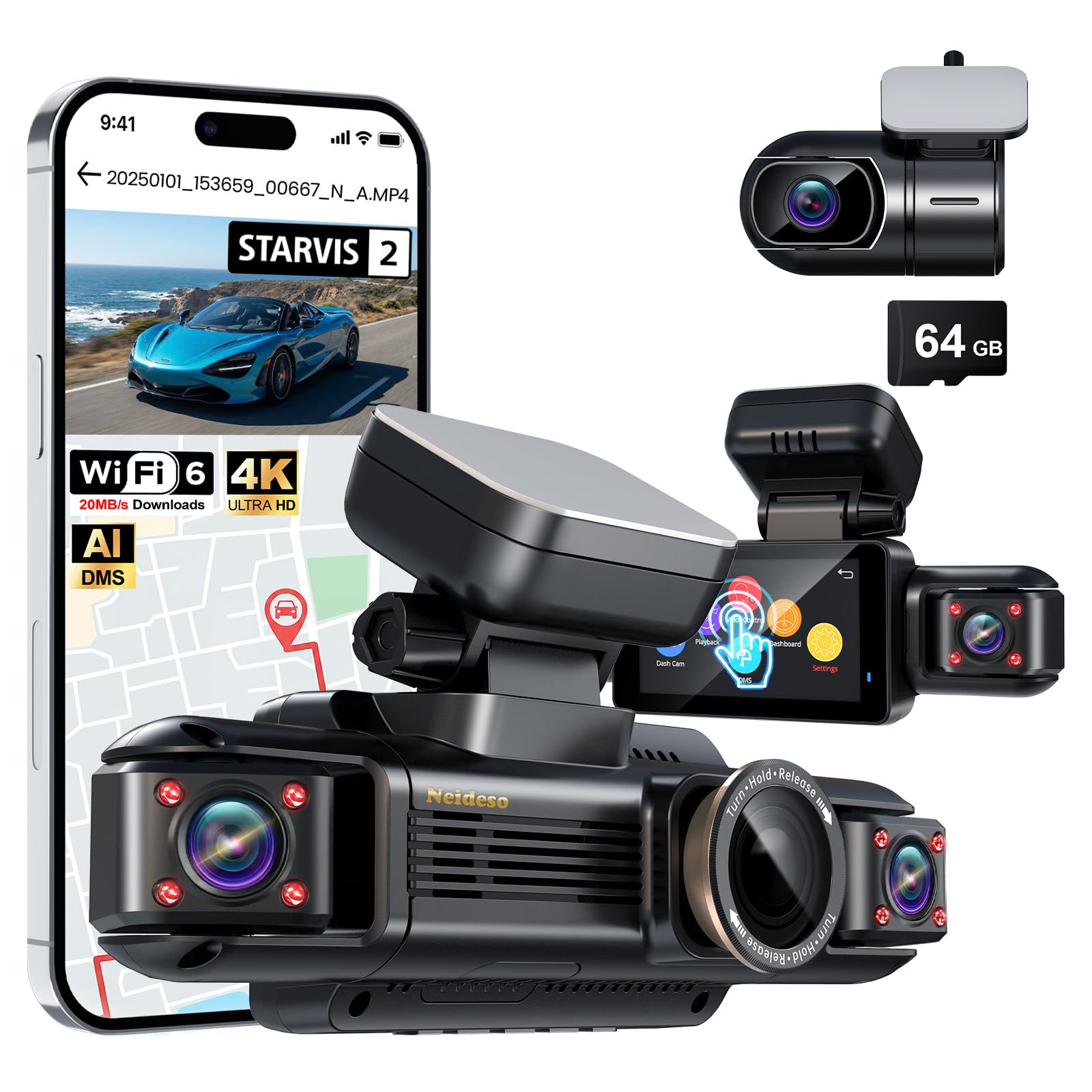
The only pick that watches you back — a driver monitor that flags yawning, distraction and phone use.
Four lenses are standard here, but the N300Pro adds a fifth kind of watchdog: an AI Driver Monitoring System that looks for fatigue, yawning, distraction and phone use, then alerts you in real time. It fires above a set speed and can be switched off if you find it fussy. The road cameras themselves record true 4K (3840×2160P) up front and 1080P on the left, right and rear, each lens 150° wide. A free CPL filter, 8 IR lights and an F1.8 aperture carry it through night driving.
Its front display measures 3″, smaller than the BOTSLAB’s 3.18″ panel, and inside beats touch, voice and full manual buttons. WiFi 6 runs on both 5.8GHz and 2.4GHz, rated up to 20MB/s transfers on iOS and Android. GPS tracking rides along, with playback on Windows or Mac through the GXplay player. A free 64GB card is in the box, and the slot supports up to 512GB if you want more headroom.
The watch-point here is reliability. The units that work, work well — footage is clean and the touchscreen is quick. But a number of owners have had a monitor stop functioning inside the first month, and GPS speed readings can drift by a couple of miles per hour at freeway pace. If you are buying primarily for a teen driver or a fleet, the monitoring feature is a genuine differentiator; just keep the 18-month warranty and seller support in mind as your safety net.
Safety extra: the AI driver monitor is a feature no other pick here offers, and it is the reason to choose this over a plainer 4K four-channel unit.
Firmware note: the maker recommends an OTA update through the app on first use to smooth out early bugs.
For the safety-minded: teen drivers, fleet cars and long-haul commuters who benefit from fatigue alerts.
Weigh the risk if: you want bulletproof first-year reliability above all — a share of units have needed warranty attention.
7. 4K Dash Cam 360° View
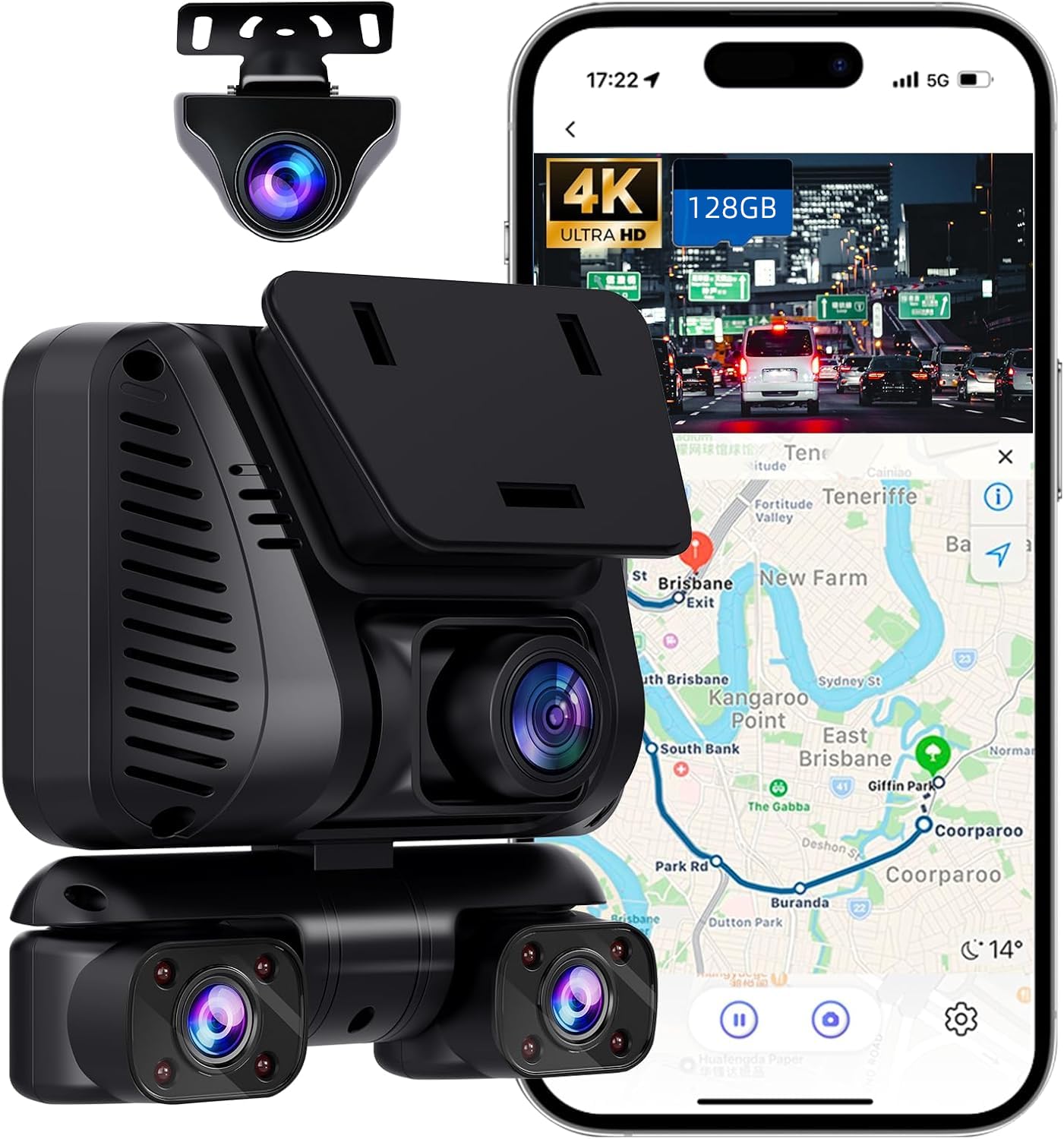
A heat-tuned body that runs from -22°F to 158°F without dropping its recording.
Dashboard heat is the quiet killer of four-lens cameras, so Driveye built the D7 around dissipation. The maker rates it from -22°F to 158°F and spreads heat to cut the WiFi dropouts and recording gaps that overheating causes. Four 150° lenses record 4K + 2K when the front and rear run together, or 4K + 1080P×3 when all four channels record at once. Side cameras each carry four infrared lights that flip to black-and-white in low light.
The control set is broad: 13 English voice commands cover save, start/stop, photo and more, and the 5GHz WiFi is rated at a faster step than standard. GPS logs location and speed, loop recording runs in 1, 3 or 5-minute chunks, and a free 128GB card ships in the box. Parking mode keeps a 24/7 watch — four cameras light up and record together on impact — but needs a separately purchased kit to run while parked.
Owners who run it daily come back to one thing: reliability. The camera starts recording the moment the engine turns over, and the compact windshield footprint means it tucks out of the way. On downsizing, the main unit is described as chunky by some, and the GPS works through the phone app, which can mean glancing at a screen while driving. Neither undermines the core job, but the compact-car driver should check the fit before mounting.
What holds up
- Rated from -22°F to 158°F, built for hot dashboards and cold mornings
- Four 150° lenses with four IR lights per side camera for low-light flanks
- 128GB card included, records 4K + 2K front-and-rear or 4K + 1080P×3 all-live
What to expect
- Main unit is bulky enough that pickup and tight-windshield owners notice
- Parking mode needs a separate hardwire kit
Suits: hot-climate drivers who have lost a camera to overheating and want one built for the heat.
Only if: you have the windshield room for a larger main unit and will add the parking kit yourself.
8. 4K 360° Dash Cam for Cars
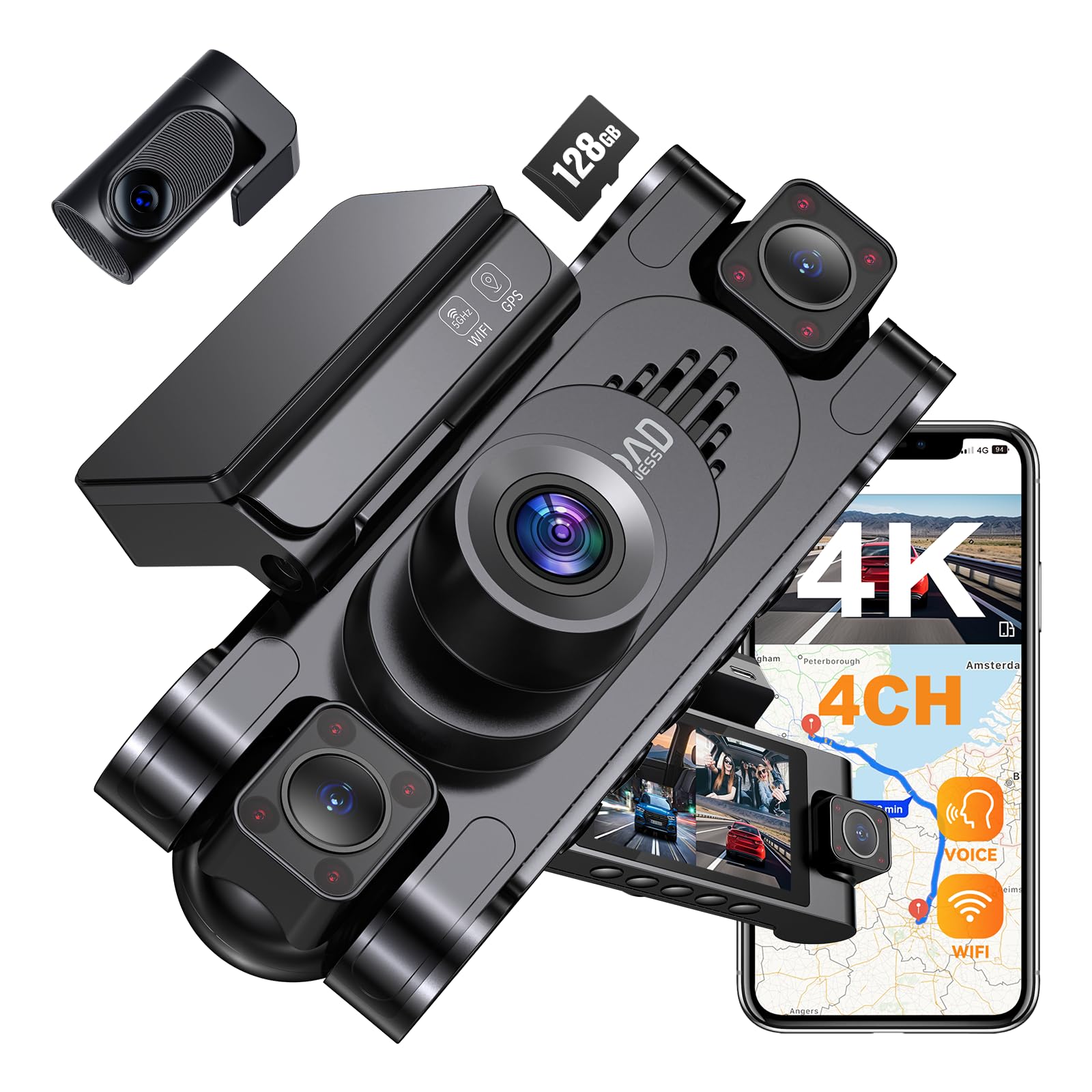
Built for long rideshare shifts — a 166° front lens and a 24-month warranty to back it.
Rideshare driving puts four cameras through the wringer, and Roadwitness aimed the D7 at exactly that. The front lens is a 166° unit, the rear is a 158° rotatable camera, and dual side cameras can be angled to watch the cabin and the flanks. Together they record 4K (3840×2160P) up front with adjustable inside and rear lenses, backed by 8 IR LEDs and WDR (a mode that balances harsh light and deep shadow) for night shifts. A 128GB card is included, and the system tops out at 256GB if you want more storage.
The cooling system is built for the kind of heat a day-long shift generates. Its pro-grade cooling processor is rated for 12+ hours of non-stop recording at dashboard temperatures. Dual-band 5.8GHz/2.4GHz WiFi keeps previews live. Voice control covers 8 commands including lock and photo. GPS logs speed in KM/H or MPH. Parking mode runs time-lapse recording at 1fps to stretch card space (a separately sold kit is needed to power it while parked). The maker backs it with a 24-month warranty.
Owners who use it heavily point to the 4K picture and the clean day-and-night night vision as the reasons it earns its place, and the build feels substantial in the hand. The honest caveat is in that weight — the mount can flop vertically under it, and some owners have fixed that with a dab of glue. Side-camera angles are snug enough that a few want wider grips, and the audio could be louder. None of that breaks the camera; it is the kind of thing you adjust early and stop noticing.
Built for: full-day professional drivers who want the camera to keep rolling through a scorching shift.
Be ready for: a heavier unit that may need a firmer mount than the one in the box.
9. Vantrue S1 Pro Max 4K+4K Dash Cam
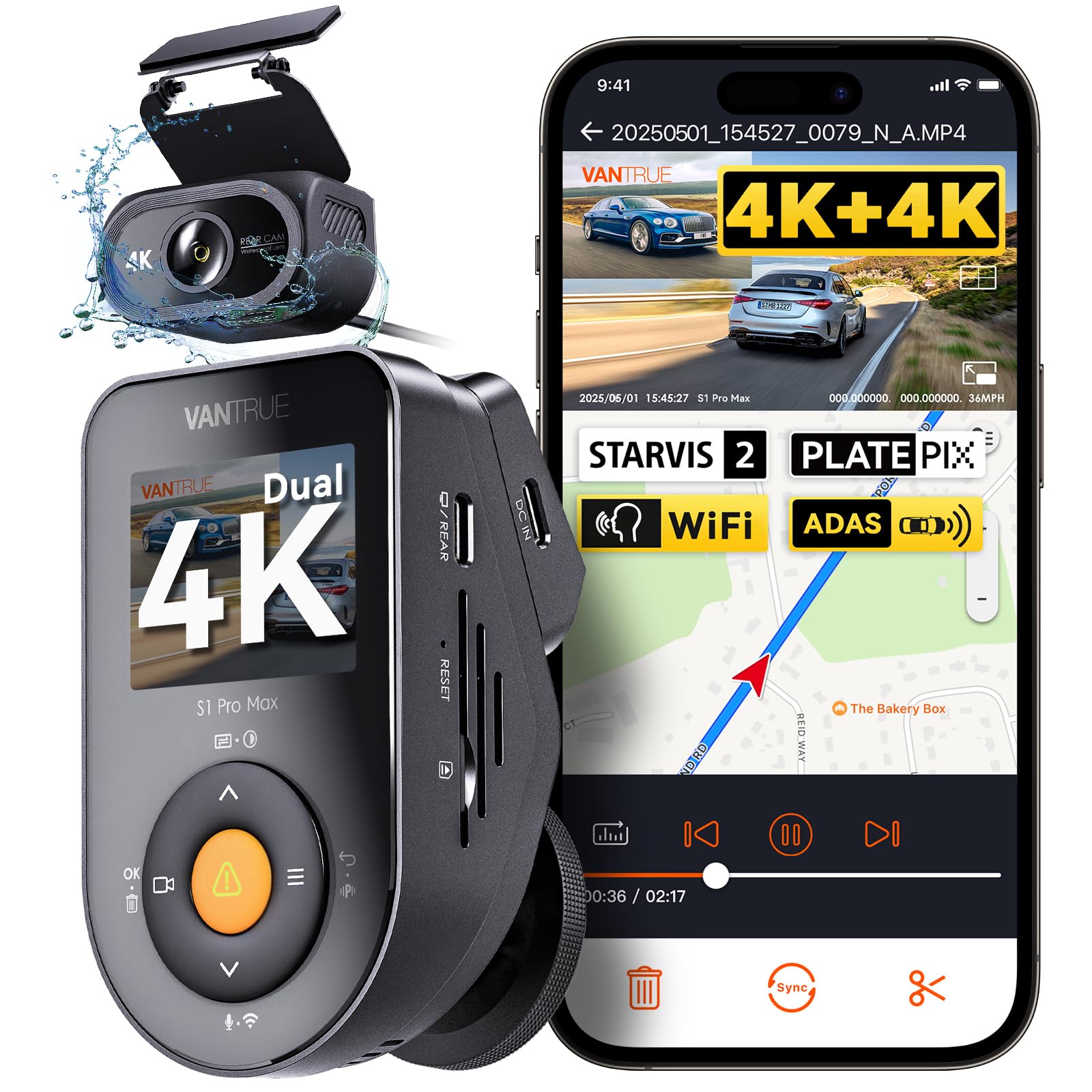
Two full 4K sensors aimed front and back — plate detail up to 30 meters away.
The S1 Pro Max is the purist’s pick: two cameras, both recording 4K at 30fps, with the maker rating plate detail out to 30 meters. Where the four-channel picks spread their pixels across all four corners, this one concentrates them on the road ahead and behind. Dual STARVIS 2 IMX678 sensors and the maker’s PlatePix sharpening pull seriously detailed footage out of dim streets, and dual HDR balances overexposed highlights. Wide 155°+160° lenses cut blind spots front and back. If your real worry is a rear-end hit at speed or a plate you need to read in bad light, this does that job better than a camera splitting four ways.
Two hardware touches stand out. The rear camera carries an IP67 waterproof rating (built to shrug off dust, rain, car washes and snow), so it survives mounted outside in the elements, and the 6-meter cable gives plenty of reach. The front records with a supercapacitor instead of a battery for heat-safe running, and the storage ceiling is 1TB — enough, per the maker, for up to 86 hours of continuous 4K footage. A 15-second buffered recording saves the moments before a collision is detected in parking mode, and the free app moves clips over 5G WiFi.
Buyers should know the trade-off on durability. The footage quality is described as excellent, but a share of buyers report repeated restarts, overheating in hot climates, and a sliding mount that can loosen over time — a few have needed a replacement unit. A smaller front body tucks behind the rearview mirror nicely. If your installation is careful and the cabin stays cool, the footage is as good as it gets in front-and-rear terms.
Footage edge: dual native 4K front and rear beats the four-channel alternatives on raw plate detail, which is the number that wins insurance disputes.
Heat watch: the same small body that hides neatly behind the mirror can run hot — park in shade where you can.
Best for: front-and-rear detail purists who would rather have two sharp 4K views than four softer ones.
Skip your shortlist if: you need side or cabin coverage as well — this one only looks forward and back.
Know the Specs
Channel count and resolution split
Four channels means four lenses recording at once, but the processor shares its power across them. That is why a camera rated at 4K can drop to 2K or lower once all four run together, and why a 3K four-channel unit can look softer than a 4K two-channel one. Read the “all channels live” resolution, not the front-only headline, because that is the frame you will actually have when it matters.
Field of view
Field of view (the angle a lens can see) is usually measured in degrees. A single lens at 360° is impossible — a wide lens only reaches around 170°, so 360° in a four-channel listing means four lenses together cover the circle. A 560° figure means the four frames overlap heavily, which helps catch a car sliding up your blind quarter and keeps a plate readable at the edge of a frame.
Parking mode and the hardwire kit
Parking mode keeps watching after you switch off the engine, but on almost every model here it needs a separately sold hardwire kit that taps the car’s fuse box. Without the kit, the camera shuts down with the ignition. Wired correctly, the camera records on motion or impact; wired to a feed that never sleeps, it can flatten a car battery. Match the wiring to the way you park.
Night vision: aperture, sensors and IR
Low-light performance comes from a combination: a wide aperture (like F1.8) lets in more light, a STARVIS 2 sensor pulls more signal from dim scenes, and IR (infrared) lamps light up close objects in the dark. A camera with a strong front aperture but no help on the sides will still struggle on flanks — which is why the picks with IR side cameras matter for night-time side hits.
Common Questions
Does a four-channel dash cam record in 4K on all four cameras at once?
Can a four-channel dash cam catch someone keying or door-dinging my parked car?
Will a four-camera dash cam work on a truck, RV or motorhome?
What size microSD card should I put in a four-channel camera?
Do I need a separate hardwire kit to run parking mode?
Is a four-channel dash cam better than a two-channel one?
Will the voice control understand me if English is my second language?
Do these cameras work if my car is a diesel or heavy-duty pickup?
How long does a four-channel dash cam last?
Can I view live footage from my phone while driving?
The Bottom Line
For most drivers, the 4 channel dash cam winner is the BOTSLAB because its 560° coverage stretches past every rival here, with a splitscreen that shows all four angles at once and a 128GB card in the box. If night-time side hits are your worry, the REDTIGER VP40 leads on the flanks with dual STARVIS 2 sensors and IR side cameras. And for watching the cabin, trunk and back seat, the Vantrue N5 is the one to reach for because its rear cabin lens covers the space a thief reaches through.
One honest nudge before you settle: any of these close calls depends on whether the parking kit and card live in your plan from day one. Buy the hardwire kit with the camera, buy an endurance microSD card, and mount it firm — that is the difference between a camera that proves your side of the story and one that just records it.
How we choose
We do not accept paid placement. Every pick is matched to a real buyer and a real use-case; we do not hands-on test units.
Sources
Specifications: manufacturer listings and product documentation. Review insights: verified customer reviews, as of October 2026. Pricing: not shown on this page (it changes often); check the current price via the retailer link.
As an Amazon Associate, Aappliancez earns from qualifying purchases. This does not affect which products we feature.