Disclosure: Some links in this post are affiliate links. As an Amazon Associate I earn from qualifying purchases, at no extra cost to you. Learn more
Specs are compiled from manufacturer listings and verified buyer reviews and can change over time — please confirm the key details on the product page before buying.
If you want one blunt answer: buy a concentrate, not a ready-mixed spray bottle. A concentrate lets you dial the dose up for tough brush and down for tender lawn grass, and one small jug replaces a stack of sprayers. That single choice decides whether you kill the weed or the lawn around it — and everything below is built around it.
This guide is built by comparing the manufacturers’ published specifications and the patterns across verified customer reviews, so you get each pick’s real strengths and trade-offs instead of marketing spin.
Below you will find a lawn-safe granular barrier, a poison-ivy formula that is rainproof in as fast as 30 minutes, and a slow systemic that dies to the root — all part of a clear-eyed look at the best grass and weed killer.
Top Picks


How To Choose The Best Grass and Weed Killer
The first question is not which brand — it is which job. Killing everything on a gravel driveway and clearing clover out of a bluegrass lawn are opposite missions, and the wrong jug does expensive damage. Answer that one question and the shortlist collapses fast.
Post-emergent or pre-emergent: kill what is up, or block what is coming
A post-emergent attacks weeds that are already growing and green. A pre-emergent is a barrier laid before seed sprouts — the granular prodiamine product here is built for that second job and states plainly that it will not aid in eliminating existing weeds. If your crabgrass is already feathering out, a pre-emergent is the wrong tool for this season.
Selective versus non-selective: the lawn-safety line
A selective herbicide targets broadleaf weeds and leaves the grass alone, which is why formulas here list Kentucky Bluegrass, Bermudagrass, Bahiagrass and Zoysiagrass as safe. A non-selective like glyphosate kills grass and weeds equally — perfect for a fence line, wrong for a lawn you are trying to keep. Read that distinction before you fill the sprayer, not after.
Concentrate versus ready-to-use
A concentrate is measured into water in your own tank sprayer. That gives you a dial: stronger mix for tough brush, label rate for turf. It also means the mixing directions and the measuring cap matter more than almost any other feature — several owners find mixing the sticking point, so a clear label and a good cap save real frustration.
Match the formula to your grass type
Some formulas are safe on St. Augustine sod only, some must be avoided on bermudagrass unless it is dormant, and some are simply labelled for cool-season grasses. Get your grass type wrong and the best herbicide on this page becomes a lawn-renovation project. Check the label’s grass list against your own lawn first.
Side-by-Side Comparison
| Model | Best For | Type | Container Size | Stated Coverage | Amazon |
|---|---|---|---|---|---|
| Quali-Pro MSM Turf Herbicide 8oz★ Best Overall | Turf lawns with buttonweed | Post-emergent concentrate | 8 fluid ounces | Ornamental turf (label rate) | Amazon |
| Roundup Poison Ivy Plus Tough Brush Killer2 ConcentrateToughest Brush | Poison ivy and woody brush | Post-emergent concentrate | 32 fluid ounces | 1,500 square feet | Amazon |
| Prime Source Celsius WG Easy Mix PacketEasiest Mix | Broadleaf weeds in Zoysia and Bermuda | Post-emergent powder | 0.226 oz packet | About 2,500 square feet | Amazon |
| Control Solutions 82004318 Eraser & Grass Killer | Total clearance of brush and turf | Non-selective glyphosate | 32 fluid ounces | 3-4 sprayer tanks per bottle | Amazon |
| Ortho GroundClear Weed & Grass Killer Super Concentrate1 | Patios, paths and fence lines | Post-emergent concentrate | 32 fluid ounces | 1,120 square feet | Amazon |
| Spectracide Weed and Grass Killer with Accumeasure | Fast knockdown on driveways | Post-emergent concentrate | 32 fluid ounces | 1,350 square feet | Amazon |
| Liquid Harvest Mesotrione 8oz | Crabgrass control in cool-season turf | Pre- and post-emergent | 8 fluid ounces | 46 listed weed species | Amazon |
| Fertilome Weed Free Zone Concentrate | Broadleaf cleanup in warm lawns | Selective post-emergent | 32 fluid ounces | Over 80 broadleaf weeds | Amazon |
| The Andersons Barricade Granular | Spring and fall crabgrass barrier | Pre-emergent granule | 18 pounds | 5,800 square feet | Amazon |
| Alligare Diuron 80 DF Herbicide | Ponds, highways and industrial ground | Pre- and post-emergent granule | 5 pounds | 3-10 lb per acre (label rate) | Amazon |
| PBI/Gordon Trimec Lawn Weed Killer | Cool-season lawns, big acreage | Selective post-emergent | 1 gallon | 32,000 to 64,000 square feet | Amazon |
Detailed Reviews
1. Quali-Pro MSM Turf Herbicide 8oz
Our pick — 4.5+★ from 1,000+ verified ratings; the strongest balance of quality and price.
Eight ounces that treats a lawn instead of a sprayer bottle — the value pick nobody expects.
The number that decides this one is 8 fluid ounces, because MSM is a sulfonylurea herbicide that works at fractions of an ounce per tank. Owners describe measuring roughly 1/100 oz into 2 gallons of water to treat about 200 square feet, and that dose killed dollar weed inside two and a half weeks with no regrowth. The jug is small and the dose is tiny, so what looks like a modest container keeps going season after season. Quali-Pro labels it for ornamental turf — lawns, parks, cemeteries, and golf course fairways, aprons, tees and roughs.
What wins people over is raw effectiveness on the weeds that shrug off hardware-store sprays. Virginia buttonweed is the headline case, and it clears in about 10 days rather than overnight — this is a slow systemic that travels to the root instead of burning leaves on contact. On centipede grass at label rates it caused no harm in owner reports, and St. Augustine recovered after treatment. If you have been hand-pulling buttonweed for years, this is the product that ends that chore.
The catch is the mixing. Some find the directions unclear, and because the dose is so small a kitchen teaspoon is a bad tool — use a syringe or a graduated measuring cup and write the rate on the bottle. One honest caution from the label set: this is built for turf, so a heavily concentrated mix on a small residential patch needs care. It also has a three-year shelf life when stored in a secured warehouse or storage building, kept away from open containers of fertilizer, seed, or other pesticides.
What earns it the top slot
- Tiny doses go a very long way — 8 fluid ounces covers many tanks
- Clears Virginia buttonweed and dollar weed that home sprays miss
- Safe on centipede and St. Augustine at label rates
- Stores for up to 3 years when kept dry and isolated
Where it asks for care
- Mixing directions leave some owners guessing at the rate
- Slow acting — expect about 10 days before visible results
- Requires a precise measuring tool for such small doses
Made for: any lawn owner fighting buttonweed, dollar weed, lespedeza or clover in established turf who wants one jug to last multiple seasons.
Think twice if: you want results this afternoon — this formula works through the root and takes roughly a week and a half to show.
2. Roundup Poison Ivy Plus Tough Brush Killer2 Concentrate
For the fence line where poison ivy and kudzu have already won — and rain is coming in an hour.
This is the pick when the target is woody and stubborn rather than a lawn full of dandelions. The label lists poison ivy, poison oak, poison sumac, wild blackberry and kudzu by name, and it is built to be rainproof in as fast as 30 minutes — so a passing shower does not undo a morning’s work. Visible results show in hours, and the label allows planting 1 to 30 days after application, which matters if you plan to put something back in that ground.
Coverage runs to 1,500 square feet from the 32 fluid ounce bottle, sprayed evenly at one gallon of solution per 300 square feet. The three active ingredients — triclopyr, fluazifop-P-butyl and diquat dibromide — go after both broadleaf brush and grassy weeds, so this is a non-selective job: it will kill the grass it touches. That makes it the right tool for trees, shrubs, foundations, fences, mature stumps and vine-covered poles, and the wrong one for the middle of your lawn. For comparison on bottle size, the Control Solutions Eraser jug below holds 32 fluid ounces as well — but that one is straight glyphosate for total clearance, not brush-specific.
What everyone notices first is how easy it goes on: adjustable concentrate strength for a hand sprayer, and a spray-wand jug that can be refilled. The honest trade-off is persistence. Buyers report it took two applications to kill Virginia Creeper around a garage, and the toughest woody plants generally need a second pass — spray the green leafy parts for the fastest root kill, or cut the main stalk near the ground and spray the exposed top. Wear protective clothing, gloves and eyewear, and keep pets off the area per the label.
Where it shines: poison ivy, kudzu and blackberry are named targets, and the 30-minute rainproof window means you are not racing the forecast. One gallon of mixed spray covers 300 square feet at the label rate.
The honest limit: it is non-selective, so anything green under the spray goes — plan a shield or a careful wand, and expect a second application on the woody holdouts.
Reach for it when: the enemy is vines and brush around buildings, fences or stumps and you can accept killing the grass nearby.
Leave it on the shelf when: the weeds are sitting in a lawn you intend to keep green.
3. Prime Source Celsius WG
No measuring cup, no guesswork — one 0.226 oz packet makes 2 gallons and treats about 2,500 square feet.
Celsius solves the problem that sinks most concentrate buyers: the dose. It arrives as a 0.226 ounce easy-mix powder packet, and one packet goes into 2 gallons of water to cover about 2,500 square feet of lawn. No syringes, no partial scoops, no half-used bottles going stale in the garage. The powder format also means it stores dry and stable until the day you need it.
The blend is built for warm-season turf — dicamba at 57.4% with iodosulfuron-methyl-sodium at 1.9% and thiencarbazone-methyl at 8.7%. That combination hits both broadleaf weeds and grassy weeds, and it is notably gentle on the grasses southern lawns are made of. St. Augustine and Bermuda come through without harm at label rates, and Zoysia lawns are where owners mention it doing its best work. If you have been nervous about spraying a warm-season lawn, this is one of the safer formats to start with.
One thing to clear up before you worry: the date stamped on the packaging is the manufacturing date, not an expiration date. That is worth knowing because a printed date on garden chemicals sends plenty of buyers hunting for a return label they do not need.
Why the packet matters: a fixed single-packet dose removes the most common cause of a bad spray — an eyeballed measurement. Mix, spray, done, with about 2,500 square feet of coverage per packet.
Keep in mind: it is a post-emergent, so it works on weeds already up and growing — it will not stop next spring’s crabgrass seed from sprouting.
The fit: Zoysia, Bermuda or St. Augustine owners who want a clean one-packet mix and hate measuring powders by eye.
Not the fit: a large property, where a single 0.226 oz packet runs out quickly.
4. Control Solutions 82004318 Eraser & Grass Killer Concentrate
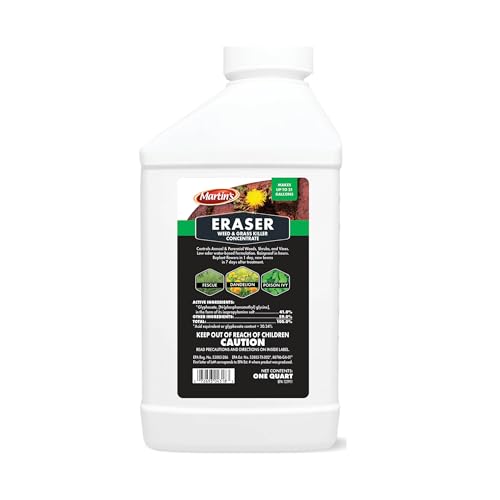
A 41% glyphosate concentrate that kills to the root — and asks for patience you probably do not have.
Start with the strength: this is 41% glyphosate, a systemic herbicide that moves down into the root instead of burning the top. That distinction is the whole reason to buy it. A contact spray browns a leaf and the plant returns; glyphosate at this concentration kills the root system, and owners describe wild brush, vines, grass and weeds all going down for good with no repeat spray. It is labelled for annual weeds, perennial weeds, trees, vines and shrubs, and it carries no residual soil activity, so the ground is clear for replanting later.
Then the disappointment, which is really just timing. Nothing happens for two days, yellowing arrives at four to seven days, and plant death lands between seven and fourteen days. Deep-rooted plants like poison ivy may want a second application. If you came from a pre-mixed spray that browns a dandelion by dinner, this will feel broken for the first 48 hours — it is not, it is working underground. Mix about 100ml (roughly 7 tablespoons) per gallon of sprayer, and a sunny warm morning is the window to aim for. The 32 fluid ounce bottle mixes roughly 3 to 4 gallon sprayer tanks depending on strength — where the Quali-Pro MSM jug next to it in this list holds just 8 fluid ounces, this is a 4x larger pour for jobs that need volume.
The low-odor, water-based formula is a real comfort on a hot afternoon, and it is rainproof in hours, so you are not gambling on a dry forecast. Where it earns its keep is a fence line, a gravel pad, a shed footprint or an overgrown back corner you want reduced to bare soil.
Straight talk on the good
- 41% glyphosate reaches the root, so regrowth is rare
- No residual soil activity — safe to replant that ground later
- Low-odor water-based mix, rainproof within hours
- 32 fluid ounces fills roughly 3 to 4 sprayer tanks
Straight talk on the slow part
- Two days of nothing before any sign of action
- Seven to fourteen days before the plant is truly dead
- Deep-rooted vines may need a second pass
Buy it for: permanent clearance of brush, vines and turf along fences, sheds and gravel where nothing green should survive.
Skip it for: spot-weeding a lawn — it does not choose between the weed and the grass.
5. Ortho GroundClear Weed & Grass Killer Super Concentrate1
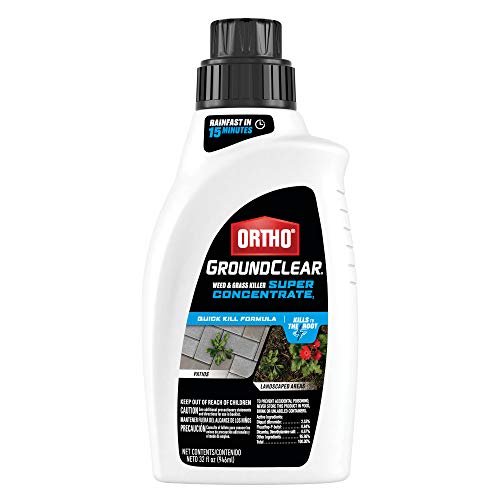
Fifteen minutes to rainproof, and a 32 oz bottle that stretches to 1,120 square feet.
If your spraying window is a lunch break before an afternoon storm, this is the formula that forgives it. Ortho states this concentrate is rainfast in 15 minutes and starts working immediately, so a downpour an hour later does not wash the job away. One 32 fluid ounce bottle treats up to 1,120 square feet, and the label rate calls for mixing with water in a tank sprayer while weeds are actively growing and the air sits above 60°F.
The weed list is the practical one homeowners actually face: clover, dandelion, oxalis, chickweed and crabgrass, all killed to the root. Where it belongs is around perennial landscape plants, trees, shrubs and fences, and on patios, paths, sidewalks, cracks, walkways and driveways. Owner experience splits on strength in a way worth knowing about: at the recommended concentration some find only a little more than half the weeds die and a few creep back within weeks, while a double-strength mix took every plant down. Start at label rate, then step up only if the first pass falls short.
The mixing side is the pleasant surprise. This is a straightforward concentrate that blends easily, and the value is what owners bring up first — several compare it favorably to pricier brands on cost for the same patch of ground. There is a chemical odor at application that fades rather than lingers, which makes a patio session bearable.
Buyer reality check: speed is the selling point — most sprayed weeds show damage inside 48 hours, and the 15-minute rainfast window is the shortest on this list next to the 30-minute Roundup above.
Second look: effectiveness is the debated part of this one, so plan on a follow-up pass at a stronger mix rather than expecting a single spray to finish the job.
Best suited to: driveway, walkway and patio edges where you want weeds down fast and do not mind a second application on the stubborn ones.
Look elsewhere if: you are treating a lawn you want to keep — this kills grass as readily as weeds.
6. Spectracide Weed and Grass Killer Concentrate 32 Oz
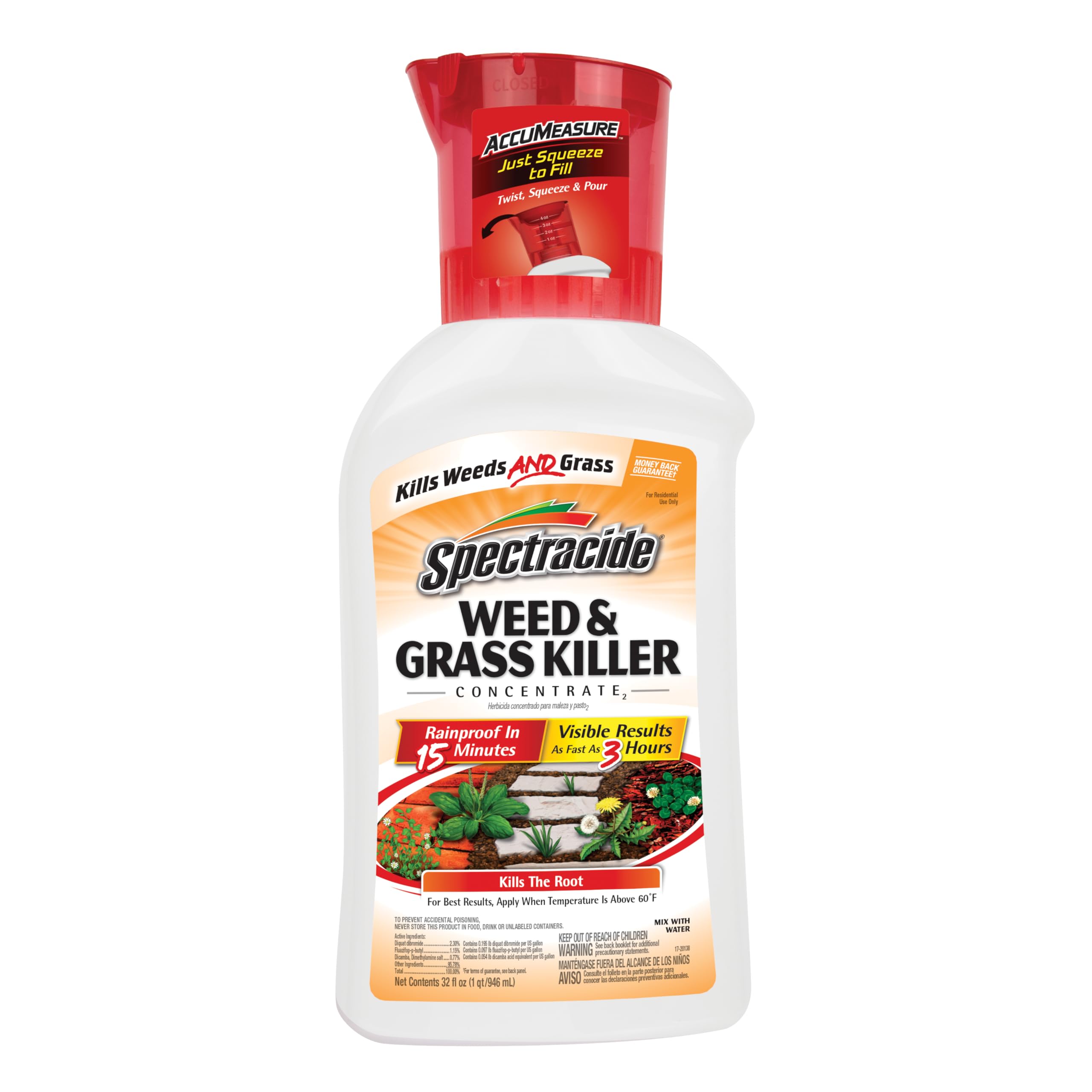
Three hours to visible damage and a self-measuring cap — the impatient gardener’s concentrate.
Speed is the whole argument here. Spectracide promises visible results in as fast as 3 hours, kills down to the root, and the label goes further: replant new flowers, trees and shrubs the same weekend. That short turnaround changes how you use it. You can spray the curb weeds in the morning and see them wilt before lunch, and the 1,350 square feet of coverage from 32 fluid ounces handles most driveway-and-walkway jobs in one mix.
The Accumeasure cap is the feature that gets argued about. It is meant to take the mess out of measuring — twist, squeeze and pour — and while some find it genuinely convenient, others find it more trouble than a measuring cup. What is not in dispute is the knockdown: buyers describe curb weeds dead within a day, and driveway weeds handled at the stronger label mix. Rain 15 minutes after spraying will not wash the effectiveness away, so light weather is not a reason to postpone.
One practical gripe worth knowing before it surprises you: leakage in transit. A few buyers find the bottle has seeped on arrival, so check the seal before you store it on a garage shelf next to anything you care about. The diquat dibromide formula is non-selective, so keep it off the lawn and use it on driveways, walkways, patios, and around fences, trees, flower beds and shrubs.
Why it earns a spot: the 3-hour visible result and 15-minute rainfast window beat the slow systemic options when you need a spot handled before guests arrive.
Worth knowing: the Accumeasure cap divides opinion and the occasional bottle arrives leaking — a small annoyance, not a reason to pass.
The right buyer: someone with a driveway, curb, or patio edge who wants a fast, visible kill and already owns a tank sprayer.
A poor match for: anyone wanting a single no-measure solution — the cap is the part people either love or fight with.
7. Liquid Harvest Mesotrione 8oz

Mesotrione, the ingredient that turns crabgrass white before it dies — with a grass list you must read first.
Mesotrione is the ingredient behind the famous bleaching effect: susceptible weeds turn white, then die. Set expectations on timing, though — it absorbs immediately and starts working on contact, but full death can take 2 to 3 weeks, and owners describe crabgrass whitening inside a week and needing a second coat about two weeks later. The 8 fluid ounce bottle carries enough for repeated treatments because the label rate is small and the active ingredient is potent.
Where it works is defined as much by what it refuses as by what it kills. The label names 46 broadleaf species and grasses including barnyard grass, carpetweed, chickweed, clover, crabgrass and dandelion. It is listed as suitable on Kentucky Bluegrass, centipede grass, buffalo grass, tall fescue, perennial ryegrass, fine fescue and St. Augustine grass (sod only). It is explicitly to be avoided on bentgrass, Poa annua, kikuyugrass, zoysiagrass, seashore paspalum and bermudagrass — unless that bermudagrass is dormant, in which case it can be applied. Run your grass type against that list before you open the bottle.
Water is the trigger. Mesotrione needs activation, and if no rainfall comes within 10 days you have to apply 0.15 inches of water yourself. A surfactant helps, and owners who sprayed early in the year report it still holding through August heat on Florida St. Augustine lawns. Some find the white-weed look alarming; it is the herbicide at work, not a failure. What does divide opinion is value — plenty call it a Tenacity alternative at far lower cost, while others feel the results did not justify the jug.
The strong case: a real one-two punch on crabgrass, both preventing seed germination and killing what is already up, across 46 listed species.
The fine print that matters: that same bleaching action can hit some desirable turf — the label hedges bentgrass, zoysia and bermuda, so a grass-type mistake is expensive.
Pick it if: you run cool-season turf or St. Augustine sod and want crabgrass handled before and after it sprouts.
Pass if: your lawn is zoysiagrass or actively growing bermudagrass — both are on the do-not-apply list.
8. Fertilome Weed Free Zone Broadleaf Weed Killer Concentrate
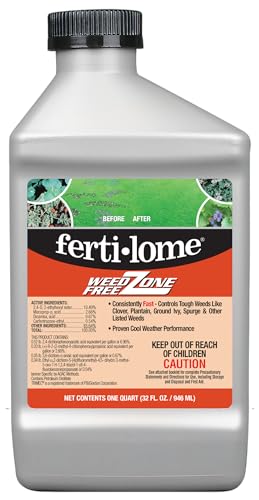
Kills over 80 broadleaf weeds and leaves the lawn standing — creeping Charlie does not survive it.
The trick to this formula is selectivity, and the label spells out exactly how far it reaches: over 80 broadleaf weeds, including clover, spurge, chickweed and thistle, with Kentucky Bluegrass, Bermudagrass, Bahiagrass, Zoysiagrass and more listed as safe. It brings evidence of injury within hours of application, so a morning spray shows the weeds wilting before evening. Spring, summer or fall are all valid windows, and best results come when the broadleaf weeds are young and actively growing.
Creeping Charlie and white clover are where this earns its reputation — both fall to it, and the lawn around them stays green. On St. Augustine, owners mix 2 ounces per gallon with a surfactant and a blue dye so you can see where you sprayed. Surrounding grass may yellow briefly and recover in days. Wild violet is the known holdout; it survives more often than not, so if violet is your target, set expectations accordingly. Stubborn leaves may take two or three treatments.
Value is the argument. One 32 ounce bottle mixes many gallons at the 2 ounces per gallon rate, which spreads the cost across a whole season of spot treating.
The case for buying it
- Over 80 broadleaf weeds on the label, including creeping Charlie and white clover
- Safe on Kentucky Bluegrass, Bermudagrass, Bahiagrass and Zoysiagrass
- Injury visible within hours of spraying
- Mixes at 2 ounces per gallon — a 32 oz bottle lasts a season
What to keep in view
- Wild violet often survives — do not buy it for that weed alone
- Pricier than the big-box brands, and some owners feel it deeply
- Tough leaves need two or three passes
Built for: warm-season lawns drowning in clover, creeping Charlie or chickweed where the grass must come through unharmed.
Not built for: wild violet patches or anyone who wants to treat a lawn and a gravel driveway with the same bottle.
9. The Andersons Barricade Professional-Grade Granular Pre-Emergent Weed Control

A barrier you spread, not spray — 0.48% prodiamine stops crabgrass before it ever breaks soil.
Read the label’s own words before you buy: this product is designed to prevent weeds and will not aid in eliminating existing weeds. That is not a flaw, it is the category. Spread it in early spring or fall, water it in, and the 0.48% prodiamine — a pre-emergent herbicide that blocks seed germination — forms a barrier in the soil. Crabgrass, poa annua, goosegrass and henbit are all named on the label. If your crabgrass is already up, come back to this next season and use a post-emergent now.
The 18 pound bag covers up to 5,800 square feet, which suits a full suburban lawn in one pass. The DG Technology — dispersible granule, meaning the granules are made to dissolve quickly — is what separates this from dusty, lumpy pre-emergents: the small particles break down fast on watering and move the active ingredient into the soil where it needs to be. Small particles also mean more coverage per square inch, so a spreader pass reaches further than the bag weight suggests. Made in the USA.
Owner experience is honest in both directions. Spreadability and the fine particle size draw praise, and applying with a spreader is straightforward. Settings are the part to watch — some report only covering half the advertised area, which almost always traces to a spreader calibration that runs heavy. Weigh out the bag against your square footage and dial the spreader in before you walk the lawn.
Where the money goes: up to 5,800 square feet of crabgrass prevention from one 18 pound bag, with granules engineered to dissolve on contact with water.
Set the spreader right: coverage complaints trace to calibration, not the product — measure your lawn and your rate before the first pass.
Made for: the lawn owner who plans ahead and wants crabgrass stopped in early spring or fall before the seed wakes up.
Wrong tool for: an existing weed problem — it will not touch a plant that is already growing.
10. Alligare Diuron 80 DF Herbicide
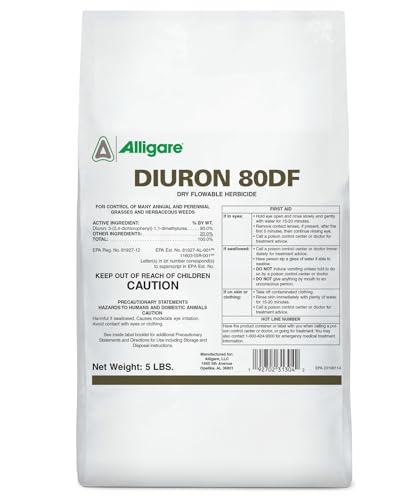
A dry granule for highways, airports and ponds — rain-activated, tank-mix ready, and not for your front lawn.
This is the heavy-equipment end of the list. The label covers over 15 hard-to-kill species including crabgrass, foxtail, ryegrass and pigweed, and the application rate runs 5-10 lb per acre or 3-4 lb per acre depending on the site.
Rain is the switch. Moisture within 2 weeks locks the active ingredient into the soil for persistent control, and warm, humid conditions improve the post-emergent side. That makes weather planning part of the job. It is also tank-mix ready, so land managers can pair it with other herbicides to widen coverage and fight resistance. The 5 pound bag spreads with standard ground equipment.
Buyers in this category use it well beyond pavement, and the pond reports are striking: duckweed, algae and Elodea/Hydrilla cleared, with water going clear within a week and vegetation gone in two. On one high-flow artesian-fed pond, a single spreader pass cleared what repeated treatments had missed. The caution is unanimous and serious — use it sparingly. One-third of a bag cleared a third-acre pond over about a month, but over-application can harm fish. Treat one acre at a time and wait two weeks between passes.
Why land managers buy it: a single rain-activated granule handles both pre- and post-emergent duty across more than 15 listed species, on ground where re-spraying is expensive.
The serious caveat: dose control is everything — too much and the treatment harms fish, so measure to the acre before spreading anything.
For the right operator: property managers, pond owners and large-acreage crews who can measure by the acre and plan around rainfall.
Wrong buyer: a homeowner spot-treating a flower bed — the dose math and the stakes are built for open ground.
11. PBI/GORDON Trimec Lawn Weed Killer, one gallon

One gallon that reaches 32,000 square feet — the big-can answer for a cool-season lawn.
Coverage is the headline on this one. A single gallon of Trimec treats 32,000 to 64,000 square feet of lawn depending on rate, which puts it in a different league from the smaller concentrate bottles here. Trimec is a three-way blend of broadleaf herbicides, and it is labelled for cool-season grasses — think Kentucky bluegrass and tall fescue country rather than a Gulf Coast St. Augustine yard. No assembly, no fuss: pour and mix.
On results, the creeping Charlie and Virginia buttonweed reports are strong — buttonweed showed discoloration at about a week and died by two without a reapplication, and creeping Charlie was dead inside a week after a 16 ounce application at 83°F over roughly 3,000 square feet. Crabgrass and Bahia were greatly reduced while St. Augustine and centipede were left to thrive. Owners spraying twice back to restore a neglected yard found the first treatment usually does the job on a lawn in normal shape.
Two practical notes. First, tough weeds may want a doubled or tripled concentration, or a repeat application — the label rate is a starting point, not a ceiling for severe pressure. Second, the brand you receive can vary: one buyer received a ferti-lome Weed-Out bottle labeled with Trimec rather than the PBI packaging pictured, and it performed fine, since the active chemistry is the same family. If exact branding matters to you, check the bottle on arrival.
What one gallon gets you
- 32,000 to 64,000 square feet from a single gallon
- Trimec blend knocks back crabgrass, Bahia and buttonweed
- Spares St. Augustine and centipede that the weeds were choking
- Simple pour-and-mix, no assembly
Read before you pour
- Labelled for cool-season grasses — not a warm-season lawn formula
- Heavy pressure may need a stronger mix or a second pass
- Bottle branding can differ from the listing photo
Right choice for: a cool-season lawn of serious size where one gallon has to cover tens of thousands of square feet.
Look past it if: you garden in the warm-season South, where its labelling does not match your turf.
Know the Specs
Active ingredient and its mode of action
The active ingredient is the actual chemical doing the killing, and its name tells you how it behaves. Glyphosate is systemic — it travels into the root, so death takes days but regrowth is rare. Diquat dibromide is a contact herbicide that burns the foliage fast and shows damage in hours. Mesotrione bleaches susceptible plants white before they die. Prodiamine does not kill at all; it stops seed from germinating. Match the ingredient to the job, because a contact spray on a deep-rooted vine is a wasted afternoon.
Rainfast time and coverage per container
Rainfast means the point after spraying when rainfall will no longer wash the product off the leaf — here it ranges from 15 minutes on the Ortho concentrate to 30 minutes on the Roundup brush formula, while the glyphosate Eraser is described as rainproof in hours. Coverage tells you the real cost: a 32 fluid ounce bottle can treat 1,120 square feet on one label and 1,500 on another, so the same bottle size is not the same value. Check both numbers before you compare jugs.
Selective versus non-selective formulas
A selective herbicide is built to injure broadleaf weeds while leaving listed lawn grasses unharmed, which is why formulas here name Kentucky Bluegrass, Bermudagrass, Bahiagrass, Zoysiagrass, centipede and St. Augustine as safe. A non-selective formula such as glyphosate or the Roundup brush concentrate kills whatever green it touches. Neither is better in the abstract — one protects a lawn, the other clears a fence line. The mistake is buying non-selective for turf or selective for a gravel pad.
Pre-emergent timing and granule size
A pre-emergent has to be down before the seed sprouts, which in practice means early spring and again in fall for many lawns. Granule size matters because smaller particles dissolve faster on watering and spread the barrier more evenly — the Barricade bag leans on exactly that with its dispersible granule technology. Too large a granule and the barrier is patchy; too heavy a spreader setting and you burn through the bag at half the stated coverage. Weigh the product, measure the lawn, then set the spreader.
Common Questions
Will a broadleaf weed killer damage my St. Augustine lawn?
How long before I see weeds die after spraying a systemic herbicide?
Can I spray a weed killer and then plant grass seed in the same spot?
What does rainfast mean and how long do I have to wait?
Is a pre-emergent any use if the crabgrass is already growing?
How much concentrate do I actually mix per gallon of water?
Why did my weeds turn white instead of brown?
Do I need a surfactant when mixing a concentrate?
Can I use a pond herbicide near fish?
How long can I store an opened concentrate?
The Bottom Line
For most lawns, the grass and weed killer that earns the top spot is the Quali-Pro MSM Turf Herbicide 8oz because 8 fluid ounces at a fraction-of-an-ounce dose clears buttonweed, dollar weed and clover across multiple seasons, and it is gentle on centipede and St. Augustine at label rates.
If your target is poison ivy, kudzu or blackberry along a fence or foundation, the Roundup Poison Ivy Plus Tough Brush Killer2 is the one to reach for — it is rainproof in as fast as 30 minutes and treats 1,500 square feet per bottle. And for stopping next season’s crabgrass before it starts, spread the The Andersons Barricade Granular in early spring or fall and water it in.
The honest nudge: match the ingredient to the job and the grass type to the label, and one jug will do a season’s work. The 8 ounce MSM bottle is the standout value here, and a single 0.226 oz Celsius packet keeps the mixing simple if you would rather not measure at all.
How we choose
We do not accept paid placement. Every pick is matched to a real buyer and a real use-case; we do not hands-on test units.
Sources
Specifications: manufacturer listings and product documentation. Review insights: verified customer reviews, as of October 2026. Pricing: not shown on this page (it changes often); check the current price via the retailer link.
As an Amazon Associate, Aappliancez earns from qualifying purchases. This does not affect which products we feature.