Disclosure: Some links in this post are affiliate links. As an Amazon Associate I earn from qualifying purchases, at no extra cost to you. Learn more
Specs are compiled from manufacturer listings and verified buyer reviews and can change over time — please confirm the key details on the product page before buying.
Bamboo does not die when the top dies. Its underground stems — the rhizomes that spread a grove sideways — keep pushing new shoots up weeks after the leaves turn brown. That is why the herbicide you pick has to move down into the root system, not just burn whatever it touches. On this page you get five concentrates that actually do that job, plus which one suits a small patch against a fence and which one suits a quarter-acre of running bamboo.
This guide is built by comparing the manufacturers’ published specifications and the patterns across verified customer reviews, so you get each pick’s real strengths and trade-offs instead of marketing spin.
Every pick below is a concentrate you dilute yourself, so read the mix rates carefully before you buy. The right glyphosate herbicide for bamboo depends on two things: how deep the roots run and how much ground you must cover.
Top Picks

How To Choose The Best Glyphosate Herbicide for Bamboo
The first thing to get straight: bamboo is not a broadleaf weed, it is a woody grass with a root mass that can sit several inches under the surface and stretch well past the clump you can see. A spray that browns the leaves in two days can still leave the rhizome alive and ready to send up new canes. So you are shopping for two things at once — a formula that travels down into the root, and enough volume to dose every cane in the stand.
Does the formula move down into the root
A systemic herbicide is one that gets absorbed through the leaf and travels through the plant’s own channels down to the root. A contact herbicide only burns what it lands on. For bamboo you want the systemic type, and you want to spray when the plant is actively growing and pushing sap — that is when it carries the chemical downward. Labels that mention translocation into the root system, or that list glyphosate as a percentage of the concentrate, are telling you it is built for that job.
How much area one bottle actually treats
Coverage decides whether you buy one jug or five. A 32 fl. oz. bottle might treat up to 1,120 square feet or up to 4,300 square feet, depending on the mix rate printed on that label. That is a big spread, and it is the single biggest difference between the picks here. Measure your bamboo stand first, then match the coverage figure to it. A small bottle for a large grove means a second order mid-job.
Concentrate strength and the surfactant
A surfactant is an additive that helps the spray cling to and soak into a waxy leaf instead of beading off. Bamboo canes and leaves are slick, so a formula with a built-in surfactant gives the droplet a better chance of staying put long enough to be absorbed. You will see concentrates listed by the percentage of active glyphosate — higher percentages mean more active ingredient per ounce of the bottle, so you use less per gallon of mixed spray.
How long before you can replant
Some formulas leave no residual activity in the soil once they have done their work, so you can replant relatively soon after the ground clears. Others include an ingredient designed to keep suppressing growth for months. If your goal is to clear bamboo and put in a garden bed, that distinction matters more than which bottle looks cheaper per ounce.
Side-by-Side Comparison
| Model | Best For | Active Strength | Stated Coverage | Form | Amazon |
|---|---|---|---|---|---|
| Gly-Star Plus Herbicide 2.5 Gal★ Best Overall | Large stands and multi-season supply | 41% glyphosate with surfactant | Refer to label | Liquid concentrate | Amazon |
| Roundup Poison Ivy Plus Tough Brush Killer2Brush Specialist | Woody brush, vines and cane cut-stump work | Triclopyr 2.50%, Fluazifop-P-Butyl 2.00%, Diquat Dibromide 1.50% | 1,500 square feet | Liquid concentrate | Amazon |
| Ortho GroundClear Super Concentrate1 | Driveways, fences and spot patches | Concentrate (see label) | 1,120 square feet | Liquid concentrate | Amazon |
| Hi-Yield Killzall 365 | Bare-ground reset with regrowth control | Glyphosate + imazapic | 4,300 square feet | Liquid concentrate | Amazon |
| Roundup QuikPro 5-Pack | No-measuring spot treatment | Glyphosate 73.3% plus surfactant | 1.5 oz per gallon of water | Water-soluble powder packets | Amazon |
Detailed Reviews
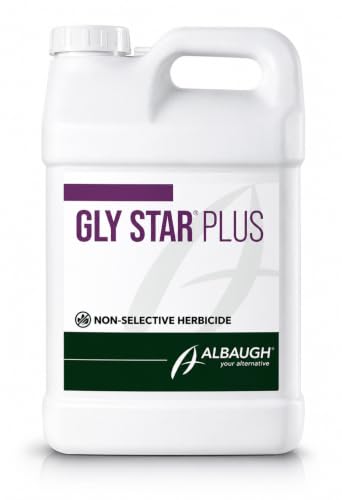
1. Gly-Star Plus Herbicide 2.5 Gallons
Our pick — 4.5+★ from 450+ verified ratings; the strongest balance of quality and price.
A 2.5-gallon jug that ends the mid-job reorder for anyone with a real bamboo stand.
Start with the size, because it is the whole argument. Two and a half gallons is 320 fluid ounces in a single jug, against 32 fluid ounces in a standard concentrate bottle — this one holds ten times the liquid of the Roundup brush concentrate below. If your bamboo runs along a fence line and into a neighbor’s hedge, that difference is the gap between one afternoon of spraying and three separate orders.
The spray clings to slick bamboo foliage instead of rolling off, because the formula is 41% glyphosate with a surfactant (a soap-like ingredient that helps liquid stick) already blended in. It is a non-selective systemic (it kills any plant it touches and travels from the leaf down into the root system). Treat it as a full-reset tool: it will take out the grass and shrubs you sprayed along with the bamboo, so mask or shield anything you want to keep. Expect to wait. The label puts visible effects at 2-4 days on most annual weeds and 7 or more days on perennials. Buyers report the same patience tax, with the words “Just be patient” showing up alongside a mix rate of 2-1/2 oz per gallon of water.
What wins people over is straightforwardly that it kills. A Dallas-area buyer wiped out a lawn of Bermuda, crabgrass and oxalis in two rounds over two weeks after a professional weed-killing service failed, and another cleared half an acre of pasture for a deer plot. The label also states no soil residual activity, which is why it suits a bed you intend to replant rather than a gravel path you want kept bare. Worth knowing before you order: it cannot be shipped to CA, MT, NV, OR, WA or WY, and those are hard geographic blocks, not shipping quirks.
Where the value sits
- 320 fluid ounces in one jug — ten times the volume of a 32 fl. oz. concentrate bottle
- 41% glyphosate with surfactant blended in, so it clings and travels to the root
- Label states no soil residual activity, so replanting is not held back
- Rated 4.5+ stars across 400+ ratings, the highest of any pick here
What to plan around
- A 15-pound jug is a two-hand carry from the truck to the sprayer
- Non-selective — anything green you spray goes too, so shield desirable plants
- Not shippable to CA, MT, NV, OR, WA or WY
Buy this one if: you are clearing a fence line, a hillside or a whole stand and want one jug that lasts the season.
Look elsewhere if: you live in one of the restricted states or you only need to dose a handful of canes.
2. Roundup Poison Ivy Plus Tough Brush Killer2
Built for vines and woody brush, which is closer to bamboo’s problem than a lawn weed formula is.
This one does not rely on glyphosate alone. Its active ingredients are Triclopyr Triethylamine Salt at 2.50%, Fluazifop-P-Butyl at 2.00% and Diquat Dibromide at 1.50% — a brush-oriented blend that lists poison ivy, poison oak, sumac, wild blackberry and kudzu on the label. For bamboo, the cut-stump method is the practical route: sever a mature cane near the ground and spray the exposed top surface. That takes the chemical straight into the root instead of asking it to cross a waxy leaf. One 32 fl. oz. bottle covers 1,500 square feet, which is more ground than the Ortho bottle below manages at 1,120 square feet.
You can spray right before rain, because the label says rainproof in as fast as 30 minutes, with visible results in hours. That matters when you are racing a forecast on a fence line. Replanting is possible 1 to 30 days after application according to the booklet, so it is not a bare-ground-forever product. Owners mention the honest version of this: it kills most leafy plants in a single pass, while the toughest canes want a second pass. “Took two applications to kill Virginia Creeper around garage” is the pattern, and tough brush is the whole reason you are reaching for this bottle rather than a general weed spray.
Where it earns its place: the brush-first chemistry and the 30-minute rainproof window make it the pick for tackling established canes and vines rather than a tidy patch of grass.
The honest catch: results are not guaranteed in one shot on hard woody growth, so budget for a follow-up spray roughly two weeks later and keep pets and skin covered per the label.
Reach for this if: your bamboo is thick, mature and woody and you are willing to cut and treat the canes.
Pass it by if: you want a one-spray-and-done job on a wide, flat area.
3. Ortho GroundClear Weed & Grass Killer Super Concentrate1
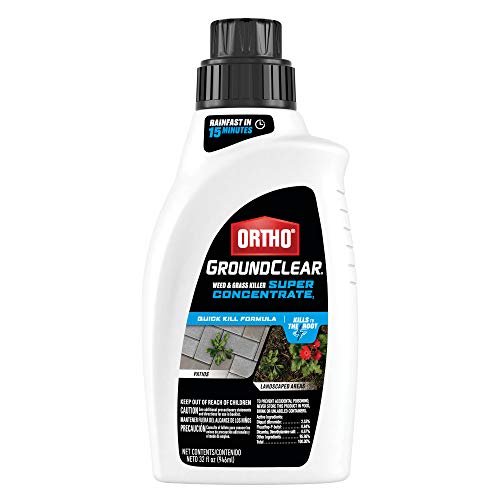
The cheapest way to test whether a root-kill spray is enough for your patch.
Fifteen minutes. That is how fast this becomes rainproof after you spray, which is the tightest window of any pick here and a real advantage if you are working around a sprinkler schedule or an afternoon storm rolling in. It is also a budget-friendly entry point — a 32 fl. oz. bottle treats up to 1,120 square feet, so you get a genuine test run on a small bamboo clump without committing to a multi-gallon jug. The label claims root kill on tough weeds and grasses including clover, dandelion, oxalis, chickweed and crabgrass, and it works when the plant is actively growing and the air is above 60°F.
The mix rate is not a fixed rule, it is a dial. One buyer’s account spells out the pattern clearly: at the recommended concentration it killed a little more than half the weeds and some came back, but at double strength “it killed every plant.” For bamboo that lesson is worth more than any label claim, because the rhizome (the underground root that spreads bamboo) is a bigger target than a dandelion taproot. Start at the label rate, watch for regrowth, and be ready to dose harder on the survivors rather than declaring the whole stand immune.
Where you feel the limit is coverage. Against the Hi-Yield bottle below at 4,300 square feet, this 1,120 square feet is a spot-treatment footprint, not a grove-clearing one — so it fits a side-yard clump or along a short fence, not a quarter-acre invasion. Buyers also flag that the price on this one moves around, so it is worth watching rather than assuming the first listing you see is the fair one.
What the numbers say: 1,120 square feet of coverage, rainproof in 15 minutes and root-kill chemistry make this the low-risk way into bamboo treatment.
Set your expectations: you may need a stronger mix than the label rate to finish off tough canes, and the treated area is small compared with the big-jug and high-coverage picks.
Pick it when: you have one clump, a short run along a fence, or you want to see how the ground reacts before buying in bulk.
Think twice if: your stand sprawls — you would be buying this two or three times over.
4. Hi-Yield (32170) Killzall 365, 32 oz

Four thousand three hundred square feet from a 32 oz bottle, and it keeps the ground bare afterward.
Nobody else on this list stretches a bottle this far. A single 32 oz container treats up to 4,300 square feet, which is nearly four times the 1,120 square feet the Ortho bottle handles from the same 32 fl. oz. volume. That is because the mix instructions are deliberately lean — 6 oz per gallon of water for spot control of brush, vines and weeds. The math on a bamboo stand works in your favour here: fewer ounces of concentrate per gallon means more gallons of spray from one bottle.
The second ingredient is what makes it different. This is glyphosate plus imazapic, and imazapic is there to suppress regrowth, with the label claiming it prevents regrowth for up to 1 year. For bamboo that is the double-hitter you want — kill the existing canes and slow the rhizome’s next push. Treat it as a bare-ground product, not a tidy-up spray: the label says not to use it on lawns, and the point is to clear a zone and keep it clear. Buyers confirm the persistence, with the grass on an empty lot still gone four months after spraying.
The catch is soil-dependent. Imazapic lingers longer in heavy clay and drains away faster in loose sand, and one buyer using it in extremely sandy ground saw it hold only about three or four months. So if your bamboo is in sandy soil, expect the regrowth-suppression half of the promise to run shorter than the label year. Plan your replanting around that residual too — this is not the formula for a bed you want to refill next month.
The case for the bottle
- 4,300 square feet from 32 oz — far and away the widest stated coverage here
- Glyphosate plus imazapic suppresses regrowth for up to 1 year per the label
- 6 oz per gallon mix keeps your spray supply going longer
The part nobody mentions
- Sandy ground shortens the residual window considerably, so regrowth can return in a season
- Extended soil activity means you cannot replant the treated zone straight away
The right call for: clearing a large non-lawn area and wanting the ground to stay bare through the season.
Not the right call for: sandy soil, or a spot where you plan to plant something soon.
5. Roundup QuikPro Weed Killer Herbicide 73.3%, 5 Packets
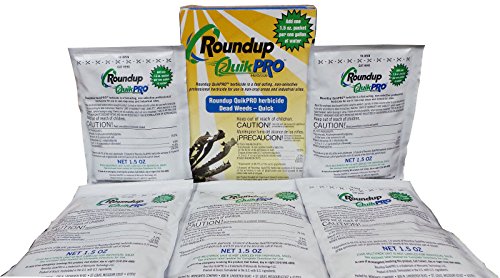
Tear one packet into a gallon of water and you are done measuring — strength without the jug.
The concentration here is the highest on this page at 73.3% glyphosate, delivered as a water-soluble powder rather than a liquid. You add one 1.5 oz packet to one gallon of water and spray; there is no partial-ounce measuring and no half-empty jug sitting in the shed. Five packets, 7.5 ounces total, and each one makes a gallon of spray solution. For spot work on scattered bamboo canes behind a shed or along a property line, that is a cleaner workflow than decanting concentrate into a tank sprayer and estimating by eye.
The packet also does more than one job per dose. It pairs glyphosate, which goes after the root, with diquat, which knocks down foliage, plus a surfactant — so you get a fast top burn and a slower root kill from the same mix. The label puts fast results within 24 hours, and the powder form dissolves quickly with no grit left to clog the nozzle. As owners put it, the all-in-one packet beats buying individual plastic jugs — “works just as it should,” with a straightforward recommendation to buy again.
Two honest notes to size the decision. First, the mixed quantity is a gallon at a time, so if you are treating a wide swath you will be opening packet after packet; the Gly-Star jug up top is the better fit for volume. Second, the review pages show a few voices on both sides of how thoroughly it finishes the job — a small handful report weeds staying green, while the bulk of the feedback is that it kills quickly. Neither changes the fact that this is the tidiest option if measuring concentrate is the step you dread.
Why it wins the no-mess contest: 73.3% glyphosate in a pre-measured 1.5 oz packet per gallon, with diquat for fast burn and a surfactant already inside.
The trade-off to weigh: gallon-at-a-time mixing makes a big grove slow going, and a small minority of buyers found the kill incomplete on their toughest growth.
Worth it for: spot spraying a handful of canes with zero measuring fuss and no half-used jugs.
Skip the packets: when the area is large enough that you would be tearing open five in one session.
Know the Specs
Active Ingredient Percentage
The percentage tells you how much of the bottle is actual weed-killing chemical versus carrier liquid. Higher numbers mean more active glyphosate per ounce, so you dilute it further and get more spray from the same bottle. A 41% liquid concentrate and a 73.3% powder sit at opposite ends of that scale, and a brush formula built on triclopyr lists its actives at much smaller percentages because the chemistry is different, not weaker. Match the percentage to what you are fighting — a concentrate with a built-in surfactant clings better to a slick bamboo leaf.
Stated Coverage in Square Feet
Coverage is the area one bottle will treat at the label’s mix rate, and it is the number that decides how many bottles you need. The spread across these picks is wide — 1,120 square feet at the low end and 4,300 square feet at the high end from the same 32 fl. oz. bottle size — because the mix ratio per gallon differs. Walk your bamboo stand, estimate its length times its width in feet, and pick a bottle whose coverage clears that figure with room for a second application on the survivors.
Rainfast Time
Rainfast means the spray has soaked in enough that rain will not wash it off. Windows range from 15 minutes on one concentrate to 30 minutes on another, and each brand states its own figure. Without a rainfast claim you are guessing, and a washed-off application is money and effort gone. For bamboo, which rewards a slow downward move into the rhizome, a spray that survives the next shower is the difference between one treatment and two.
Systemic Versus Residual Action
A systemic herbicide gets absorbed and travels to the root, while a residual herbicide keeps working in the soil for a stretch after application. Bamboo control usually wants the systemic part, because top-kill alone lets the rhizome reshoot. Some formulas here add extended soil activity to suppress regrowth for up to 1 year, and others state no soil residual so you can replant sooner. Decide which you need — bare ground held clear, or a cleared bed you can plant back into — before you mix anything.
Common Questions
Will glyphosate actually kill bamboo roots or just the canes?
How long after spraying will I see bamboo start to die?
Do I need to cut bamboo canes before treating them?
Can I replant the area after using a bamboo herbicide?
How much area will one bottle cover on a bamboo stand?
How soon can rain wash off the spray?
Is a high-percentage concentrate better than a lower one?
Will these herbicides kill the grass and plants around my bamboo too?
Can I mix a stronger batch than the label recommends for bamboo?
Are these herbicides safe to use near pets and children?
The Bottom Line
For most bamboo battles, the Gly-Star Plus Herbicide 2.5 Gallon is the strongest pick. Its 320 fluid ounces of 41% glyphosate with a surfactant gets the chemical down into the rhizome over a whole season of work rather than one small patch, and it carries the highest rating here at 4.5+ stars across 400+ ratings. If your canes are thick and woody, the Roundup Poison Ivy Plus Tough Brush Killer2 gives you the cut-stump chemistry and a 30-minute rainproof window. For a large bare-ground reset where you want the regrowth held down, the Hi-Yield Killzall 365 stretches its 32 oz bottle to 4,300 square feet. And if measuring concentrate is what stops you from spraying at all, the Roundup QuikPro packets turn it into one torn packet and a gallon of water. Whichever you pick, spray when the bamboo is pushing new growth. That is when it carries the herbicide down instead of just browning the tips.
How we choose
We do not accept paid placement. Every pick is matched to a real buyer and a real use-case; we do not hands-on test units.
Sources
Specifications: manufacturer listings and product documentation. Review insights: verified customer reviews, as of October 2026. Pricing: not shown on this page (it changes often); check the current price via the retailer link.
As an Amazon Associate, Aappliancez earns from qualifying purchases. This does not affect which products we feature.