Disclosure: Some links in this post are affiliate links. As an Amazon Associate I earn from qualifying purchases, at no extra cost to you. Learn more
Specs are compiled from manufacturer listings and verified buyer reviews and can change over time — please confirm the key details on the product page before buying.
If your miniatures come out dull, brittle, or banded with layer lines, the filament is usually the culprit, not your printer. The short answer: a silk PLA wound to a ±0.02mm tolerance gives you a glossy, display-ready surface straight off the plate, with no sanding or polishing. Below are five spools that actually fit that brief for miniatures, props, and tabletop figures, ranked by what they do best.
This guide is built by comparing the manufacturers’ published specifications and the patterns across verified customer reviews, so you get each pick’s real strengths and trade-offs instead of marketing spin.
Silk PLA is the finish-first choice here: it hides layer lines better than matte filament and gives small figures a sheen that reads as painted metal or glazed ceramic. The catch is brittleness, so pick with care — these filament for miniatures options balance shine against strength.
Top Picks

How To Choose The Best Filament for Miniatures
Miniatures fail for three reasons: the filament is too wet, the spool is wound badly, or the color never shows the detail you sculpted. Get those three right and a stock nozzle profile still produces clean 28mm figures and prop pieces.
Diameter tolerance is the detail spec
A tolerance of ±0.02mm means the filament’s width stays within two-hundredths of a millimeter of 1.75mm. That consistency keeps the extruded bead even on a sword blade or a face at 0.08mm layer height. A spool that drifts wider or narrower under-extrudes in spots and leaves ridges you can feel with a fingernail.
Silk finish versus strength
Silk PLA blends give you a glossy, near-metallic surface without polishing, which is why they suit display figures, wands, and trophies. The trade is that silk blends tend to be more brittle than standard PLA, so thin ankles and spears need a little care. Print at a slower speed and keep the part chunky where you can.
Gradient color versus solid color
Tri-color and dual-color spools shift hue as the filament extrudes, so a single-color printer can produce multicolored figures without a single swap. Color bands lengthen with print size, so a large prop shows a bold fade and a 28mm figure a subtle one. Small figures show a subtler blend, which often looks like intentional patina.
Winding, drying, and storage
A neatly wound spool feeds without tangling through a multi-hour print. A vacuum-sealed bag with desiccant keeps moisture out until you open it. Silk PLA absorbs moisture and pops at the nozzle when wet, so dry the spool before a long print in a humid room.
Side-by-Side Comparison
| Model | Best For | Diameter / Tolerance | Spool Size | Signature Look | Amazon |
|---|---|---|---|---|---|
| LANDU Silk Tri-Color PLA★ Best Overall | Display figures | 1.75mm / ±0.02mm | 1kg | Three-color silk sheen | Amazon |
| SUNLU Silk PLA+Most Versatile | All-purpose reliability | 1.75mm / ±0.02mm | 1kg | Chrome-like gloss, black | Amazon |
| SEMDON Dualcolor Red-Black | Winter and prop prints | 1.75mm / ±0.02mm | 1kg | Red-to-black gradient | Amazon |
| Creality Silk PLA Purple | smooth layer lines | 1.75mm / ±0.02mm | 1kg | Pearlescent purple | Amazon |
| SEMDON Dualcolor Blue-Rose Red | Cosplay and art models | 1.75mm / ±0.02mm | 1kg | Blue-to-rose gradient | Amazon |
Detailed Reviews
1. LANDU Silk Tri-Color PLA Filament 1.75mm 1Kg
Our pick — 4.5+★ from 500+ verified ratings; the strongest balance of quality and price.
Three colors in one strand, so a single-nozzle printer paints a figure by itself.
The headline is that triple-color silk design — three shades blended into a single 1.75mm strand, so any one-color FDM printer lays down a multicolored model with zero swaps and zero purge waste. For miniatures that is the whole appeal: a cultist’s robe shifts hue across the back, and you never touch the slicer’s color menu. The spool comes wound to a ±0.02mm diameter tolerance, which is the number that keeps small details from under-extruding.
What wins people over here is print quality, and it holds up on the fine stuff. Owners printing at detail settings report smooth feeding with little stringing on complex models, and the silk sheen lands right on display pieces where matte filament would look flat. Reach for this spool when the figure is going on a shelf, not into a dice bag.
The honest trade-off is toughness. The same silk blend that looks so good tends to be more fragile on thin cross-sections, so weapon hafts and spindly legs want a slightly thicker profile or a slower pass. A few buyers also mention the winding snagging on occasion, worth a glance at the spool before a long overnight print.
What it delivers on figures
- Three shades blended in one strand — multicolor prints on a single-nozzle machine, no swaps
- ±0.02mm tolerance keeps extrusion consistent on 28mm-scale detail
- Silk sheen reads as painted metal or glazed ceramic with no post-processing
- 1kg spool is enough for a whole army of small models
Where it asks for care
- Silk blend is more brittle — thin parts want a chunkier profile
- Occasional tangles mean a quick spool check before long prints
- Triple-color shift is subtler on very small pieces than on big props
Made for: painters and collectors who want display-ready figures straight off the plate with a built-in color shift.
Think twice if: you are printing thin, load-bearing joints where standard PLA toughness matters more than shine.
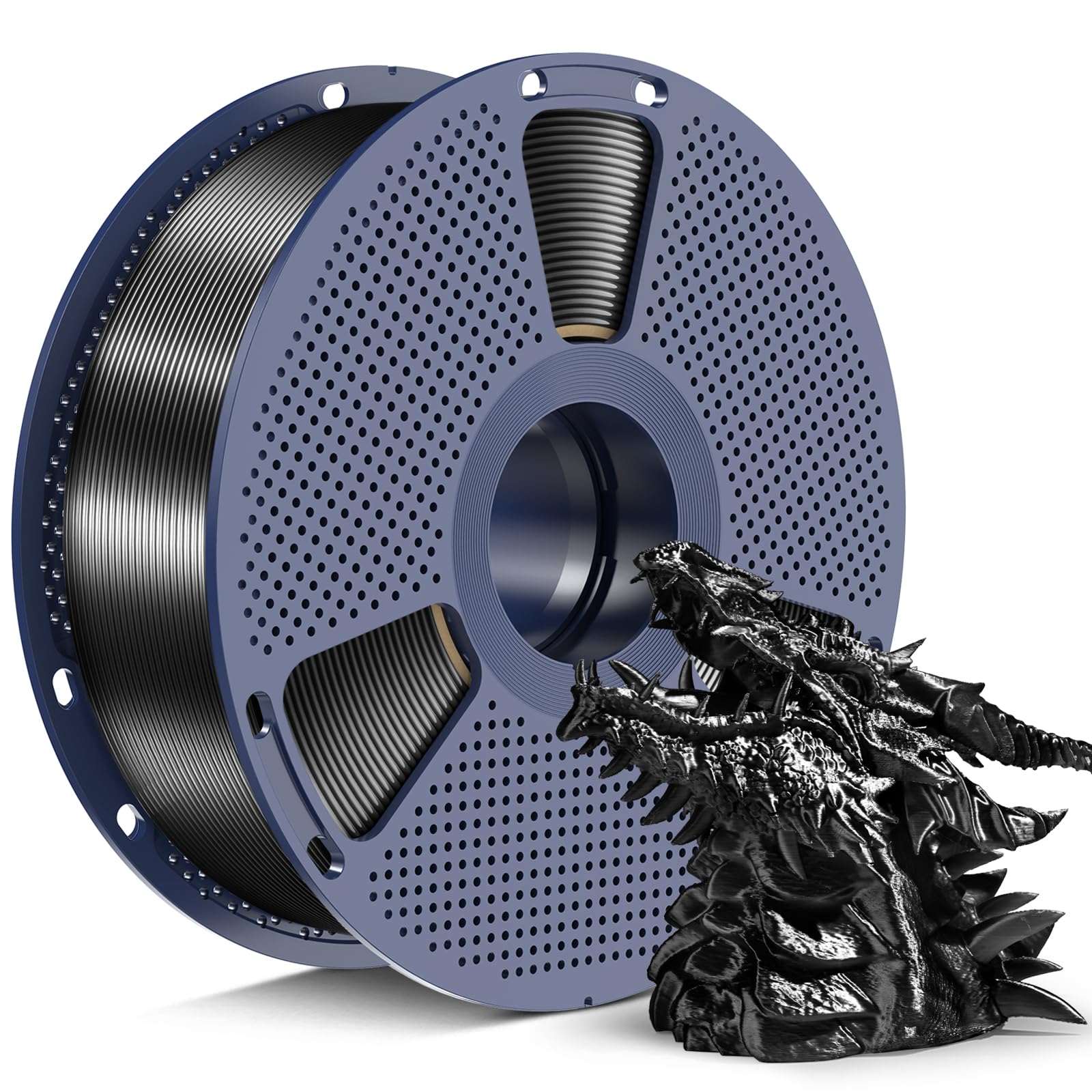
2. SUNLU Silk PLA+ Filament 1.75mm 1kg Black
Black silk that reads like polished obsidian — the workhorse spool you keep loaded.
Black is the smartest base color for miniatures because silver drybrush and edge highlights pop against it. This chrome-like gloss finish goes one better: the surface already carries a satin sheen before you pick up a brush. The spool weighs 2.6 pounds, noticeably meatier than the 2.2-pound SEMDON spools in this list, so you get more material per roll for the long haul. The 1.75mm strand (the standard filament width most printers take) holds a ±0.02mm tolerance (a width wobble of no more than 0.02mm), so the feed stays steady and layers stay even.
Print quality is where this earns its keep. The maker’s stated window is a 205–215°C nozzle and a 60–80°C bed at 30–60mm/s, and they note that dropping speed deepens the silk shine — handy guidance for detail work. High-purity material and low shrinkage mean clean, accurate layers, which matters when a face is only a few millimeters across.
Two things to know before you commit. Moisture is the recurring gripe — some rolls want a session in a dryer before a big print, so budget for that on first open. And the reusable spool is refill-ready, but smaller 250g spools in multicolor packs may need an adapter for a Bambu Lab AMS Lite. The 1kg black roll itself is straightforward.
Base-color logic: a neutral black gloss makes metallics and contrast paints look deliberate rather than muddy, which is exactly why a solid roll beats a gradient for character work.
Prep check: drying before a long print is the difference between glassy surfaces and the occasional pop; keep a desiccant pack in the bag between runs.
Reach for this if: you want one dependable spool for base-coated characters and clean, accurate prototypes.
Look elsewhere if: you want the color shift baked in — solid black is a canvas, not a showpiece on its own.
3. SEMDON Dualcolor PLA Filament 1.75mm Red-Black

One strand, two shades — a cape that fades from crimson to black as it prints.
This is the spool for festive and dramatic pieces: a single filament blends red and black so the color shifts through the print, which is why cape-and-armor characters and holiday ornaments look hand-painted when they are not. It runs on a 1.75mm diameter at ±0.02mm, and the maker lists a 200–230°C window that keeps warping and bed-lift in check on most FDM printers and even 3D pens.
The pre-dried, vacuum-sealed packaging earns real respect on figure work. Because it ships dry with desiccant and a reusable zippered pocket, you can open it and start a detailed miniature without a first-moment clump. ColorLock is the maker’s name for its laser-checked hue consistency, so the red does not wander mid-spool. At 2.2 pounds you get a full 1kg of usable material.
Brittleness is the honest caveat with this one — some batches reportedly break at the feeder or fail to stick on a cold bed, so bed leveling and a slower first layer pay off. It is still a well-rounded spool for art models and cosplay, just handled with a little less brute force than standard PLA.
Gradient in practice: on a prop-sized print the fade is broad and bold; on a 28mm figure the shift reads as a subtle two-tone, so plan the color direction before you slice.
Getting the stick: a good bed clean and a slightly higher first-layer temp keep the red-black roll from peeling at the edges on longer figures.
Suits: cosplay props, holiday décor, and dramatic display figures that benefit from a built-in color fade.
Skip if: your print has tiny contact patches and you want the toughest standard-PLA feel — treat this one as decorative first.
4. Creality Silk PLA 3D Printer Filament 1.75mm Purple
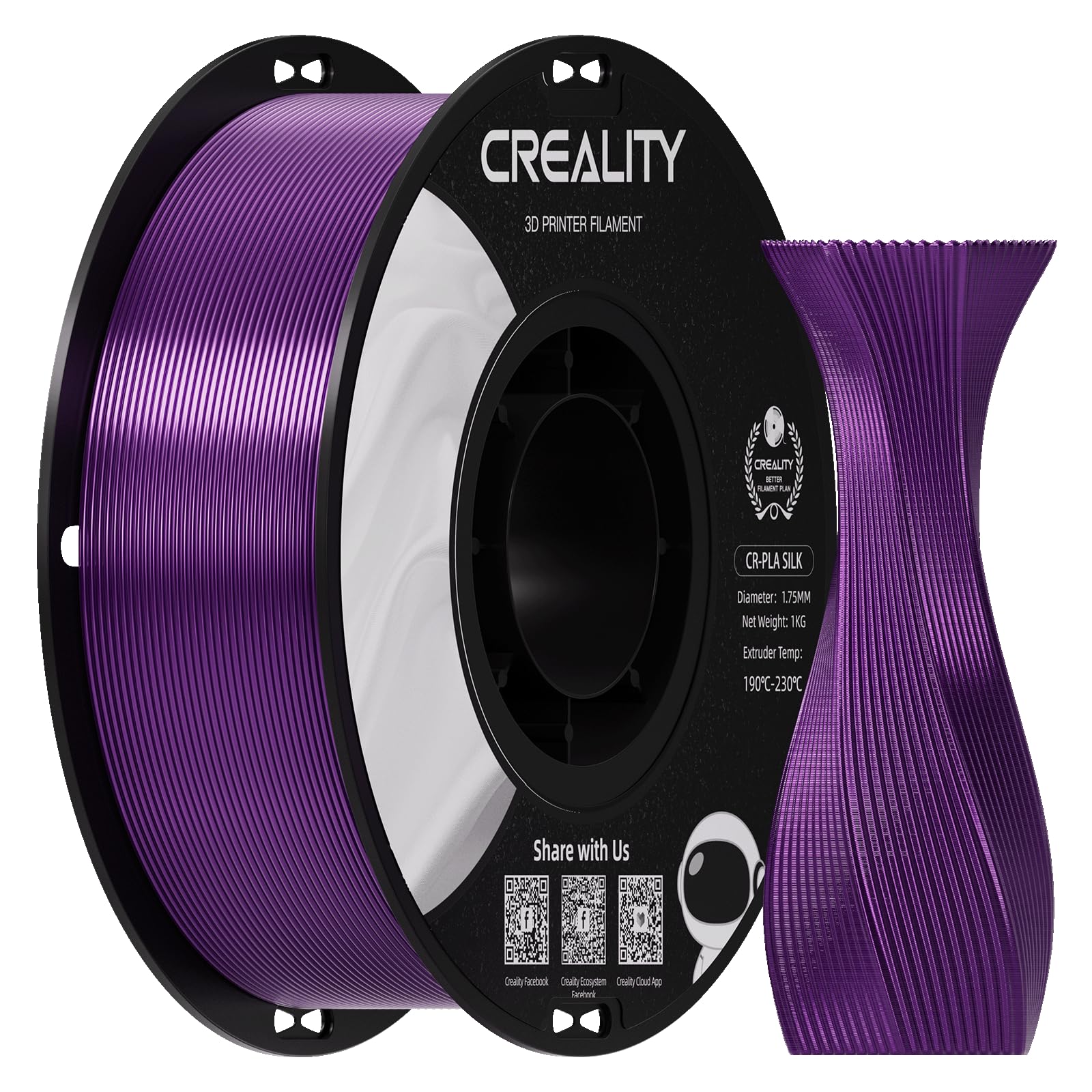
The purple that prints so smooth the layer lines almost disappear.
Layer lines (the faint ridges between printed layers) are the enemy on a miniature — they read as wrinkles on a face or ridges on armor. This pearlescent silk purple fights back hardest: buyers report that articulating animals and vases printed at 50mm/s (millimeters per second, the print speed) on a Bambu Lab X1C come out noticeably smoother than other silk brands at the same settings. That is the reason to choose it over the gradient spools if a clean, smooth finish is your priority.
Compatibility is broad. The maker states it fits 99% of FDM printers and 3D pens, with a 1.75mm diameter and ±0.02mm accuracy, and names MK3, Creality Ender and CR series, plus ELEGOO and Anycubic machines. A vacuformed-style vacuum bag with desiccants and a reusable pouch keeps the roll dry between projects, and it ships with 24/7 support if you want guidance on settings.
For all the shine, two notes temper the picture. Durability gets mixed feedback — silk PLA is not the toughest material for hard-use parts. And one buyer chased frequent tangles while others of the same brand printed cleanly, so spool your patience: watch the first few hours of a long figure.
Why the shine works
- Pearlescent silk glaze hides layer lines better than most silk spools
- ±0.02mm accuracy keeps detail sharp on small parts
- Fits most FDM printers and pens, with named support for Ender, ELEGOO and Anycubic
Trade-offs on record
- Durability feedback is mixed — silk PLA is not a load-bearing material
- Tangles have been reported on some spools, so keep an eye on long runs
- Solid purple is a single-color look, not a gradient
The pick for: makers who want the smoothest possible surface on display figures and will trade a little toughness for it.
Not for you if: you need a spool that behaves like standard PLA under stress or abuse.
5. SEMDON Dualcolor PLA Filament 1.75mm Blue & Rose Red
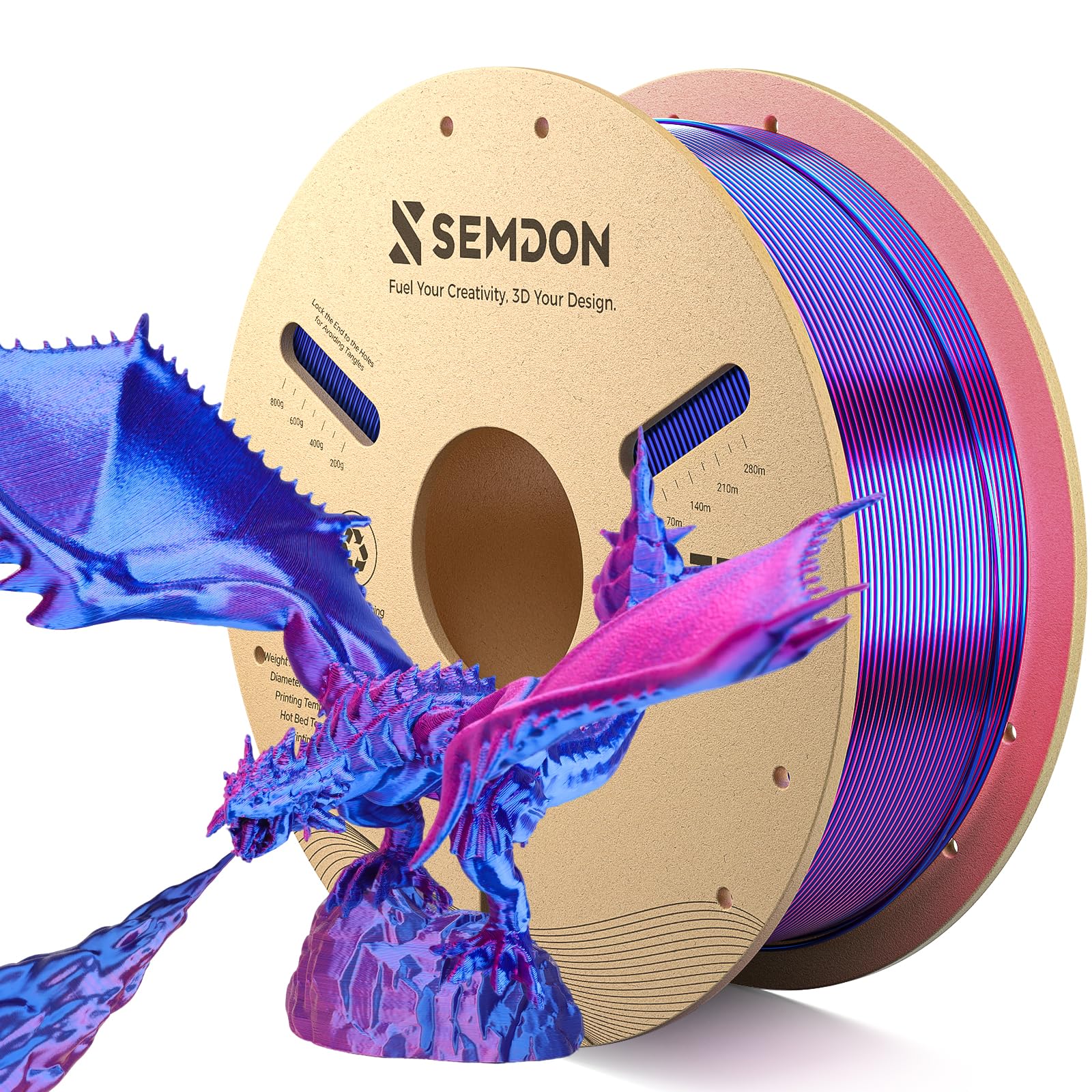
A blue-to-rose fade aimed squarely at cosplay armor and gallery-style art models.
Where the red-black roll leans festive, this one is pure showpiece. It blends blue and rose-red into one 1.75mm filament, and the manufacturer points it at cosplay props, artistic models, and gallery displays rather than tabletop gaming. The stated print-speed window is wide — 50mm/s to 300mm/s — so it can keep up whether you crawl for detail or sprint a big prop.
The specification sheet is honest about consistency: ±0.02mm dimensional accuracy on a 1kg (2.2-pound) spool, a 200–230°C formula tuned to reduce warping, and pre-drying in a humidity-controlled lab before vacuum-sealing with desiccants. That last part matters on a figure with fine fingers — dry filament does not bubble or pop mid-print. There is also a reusable zippered pocket included for storage.
The same brittleness story follows this silk blend. Some owners mention the strand breaking or losing bed adhesion, so a level bed and a gentle first layer are your friends. And because the color lives inside the strand rather than on numbered segments, rotating a small model on the plate changes which shade faces forward — a feature on figures, a quirk you learn to plan around.
Where the fade shines: on a large prop or bust the blue-to-rose transition is broad and dramatic; on a 28mm piece it reads as two-tone shading that looks deliberately painted.
Prep that pays: keep the reusable bag sealed between sessions, and run a first-layer test if the spool has been sitting — dry filament is the difference between crisp edges and spiderwebbing.
Best matched to: prop makers and display modelers who want a bold two-color fade on larger pieces.
Pass on it if: you print tiny, fragile miniatures where a tougher solid PLA is the smarter base.
Know the Specs
Diameter tolerance (±0.02mm)
This is the wobble room in the filament’s width — it stays within two-hundredths of a millimeter of a true 1.75mm. Tighter tolerance means the extruder pushes an even bead on every pass, so the sword edges and facial planes on a small figure come out crisp rather than ragged. A spool that drifts wider or narrower starves the nozzle in spots and leaves ridges.
Silk finish and brittleness
Silk PLA blends carry a glossy, near-metallic sheen straight off the bed, which is why they suit display figures, wands, and trophies. That same blend tends to be more brittle than standard PLA, so thin ankles and spears want a slightly thicker profile or a slower print. Print cool and slow to protect both the shine and the structure.
Tri-color and dual-color gradients
These spools blend two or three shades inside a single strand, so a one-color printer produces multicolored results without swapping filament. The color bands lengthen as the model grows, meaning a prop shows a bold fade and a 28mm figure shows a subtler shift. Plan the orientation on the plate to control which shade faces front.
Nozzle and bed temperatures
Silk PLA generally prints in a warm-but-controlled window — the SUNLU spool lists a 205–215°C nozzle and a 60–80°C bed, with slower speeds deepening the sheen. Too hot and the silk finish dulls; too cool and layer adhesion weakens. Start mid-range and nudge up if edges lift.
Common Questions
Is silk PLA good for printing miniatures?
Will a tri-color filament work on a single-nozzle printer?
How does ±0.02mm tolerance affect small detail?
Why does my silk filament pop and string?
Is standard PLA tougher than silk PLA for miniatures?
Can I use these filaments in a Bambu Lab AMS or AMS Lite?
What nozzle temperature should I start with?
Do gradient colors fade on a tiny figure?
How much filament does a full set of miniatures take?
Should I dry a new spool before printing miniatures?
The Bottom Line
For most makers chasing the best filament for miniatures, the LANDU Silk Tri-Color PLA is the clear winner. Its triple-color strand puts a multicolor figure on the plate from a single-nozzle printer, and the ±0.02mm tolerance (a width wobble of no more than 0.02mm) keeps detail sharp. Want a dependable base color to paint over? Grab the SUNLU Silk PLA+ in black. For cosplay props, reach for the SEMDON Blue & Rose Red Dualcolor, whose blue-to-rose fade does the painting for you. Choose by use: shelf pieces want silk shine, handled pieces want standard PLA toughness.
How we choose
We do not accept paid placement. Every pick is matched to a real buyer and a real use-case; we do not hands-on test units.
Sources
Specifications: manufacturer listings and product documentation. Review insights: verified customer reviews, as of October 2026. Pricing: not shown on this page (it changes often); check the current price via the retailer link.
As an Amazon Associate, Aappliancez earns from qualifying purchases. This does not affect which products we feature.