Disclosure: Some links in this post are affiliate links. As an Amazon Associate I earn from qualifying purchases, at no extra cost to you. Learn more
Specs are compiled from manufacturer listings and verified buyer reviews and can change over time — please confirm the key details on the product page before buying.
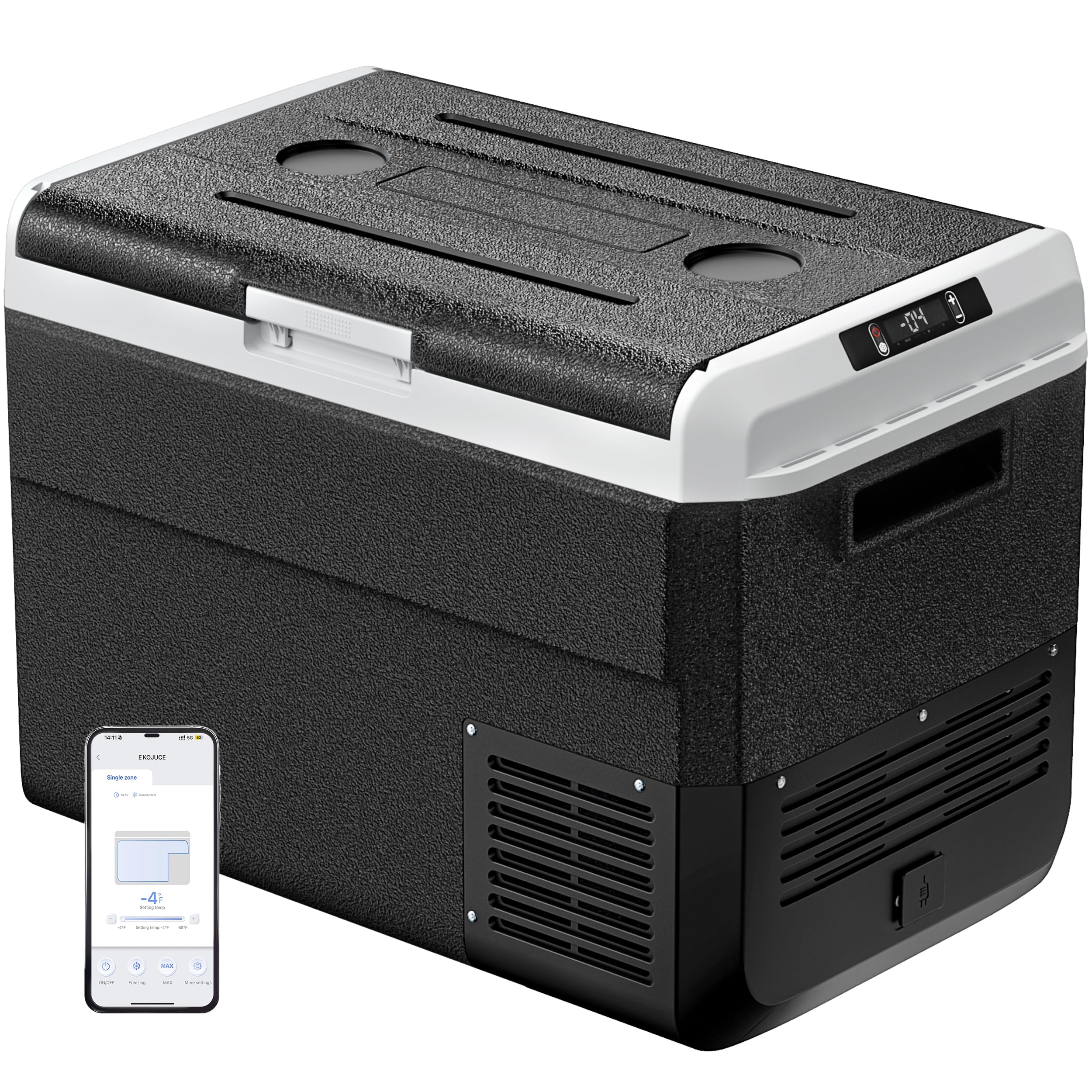
Buying a camping fridge is easier once you know one thing: a compressor cooler is not a cooler at all. It is a small refrigerator that runs on your car’s 12V socket or a portable power station, so you stop buying ice, stop draining melted water, and stop losing food buried in slush. The pick that suits most campers here is the EKOJUCE 53QT — it holds 50 liters, chills down in 15 minutes on MAX and keeps food frozen at 32 decibels. Below you get every pick, the real trade-offs, and the specs that actually decide whether it survives a weekend off-grid.
This guide is built by comparing the manufacturers’ published specifications and the patterns across verified customer reviews, so you get each pick’s real strengths and trade-offs instead of marketing spin.
Some run on plain car power, others want a lithium battery bank behind them. Capacity ranges from a few cans to a full week’s groceries. Here is how each electric coolers for camping pick behaves once the ice runs out.
Top Picks

How To Choose The Best Electric Coolers for Camping
Two kinds of electric cooler get sold as camping fridges, and they behave nothing alike. A compressor fridge (the kind listed here) uses a sealed pump and refrigerant, so it pulls the box down to a real set temperature — often below freezing — no matter how hot the tent is. A thermoelectric cooler uses a cooling plate instead, so it can only drop a certain number of degrees below whatever the air around it already is. On a 95°F afternoon that difference is the whole ballgame.
Compressor or thermoelectric: which one camps better
Every pick on this list except one uses a compressor, and that is the type you want for anything past a single overnight. Compressor fridges hold a set temperature for hours, freeze meat solid, and let you skip ice entirely. Thermoelectric units are lighter and simpler, but they struggle to make ice and they lean on the ambient air. If you only need drinks cold on a short drive, a thermoelectric model can work; if you are feeding a family for a week, go compressor.
Match the quart rating to your trip length
The quart number is the usable box volume, and it decides how much food fits once the compressor housing takes its share. Small boxes in the low-20-quart range suit a couple on a weekend. Anything in the 30-plus-quart range handles a family or a long road trip. Remember that a big cooler also weighs more when loaded, so think about who lifts it out of the truck.
Battery protection is not a luxury
Most of these fridges let you pick a low, medium or high cutoff voltage. That setting tells the fridge when to stop pulling power so your car still starts in the morning. Campers who run off a portable power station instead should look at the daily watt-hour draw. A fridge rated at 28W in ECO mode asks far less of a battery bank than one that drinks power all night.
The unplugged gap nobody mentions
Every one of these boxes needs power to keep cooling. Once you pull the plug, insulation is the only thing holding the cold in, and that is where cheap lids and thin walls show up. Pre-chill the fridge on AC power before you leave, keep the lid shut at camp, and treat the unplugged hours as a short buffer rather than a plan.
Side-by-Side Comparison
| Model | Best For | Capacity | Cooling Method | Temperature Range | Amazon |
|---|---|---|---|---|---|
| EKOJUCE 12V Refrigerator 53QT★ Best Overall | Family base camps | 50 liters | Digital inverter compressor | -4°F to 68°F | Amazon |
| ZENY Car Fridge Cooler & WarmerWarm Food Option | Warm food and short drives | 27 liters | Thermoelectric | 62-68°F below ambient | Amazon |
| Alpicool C9PTBest for Day Trips | Day trips and solo campers | 9.09 liters | Compressor | -4°F to 68°F | Amazon |
| Setpower 21QT | Blackout backup | 20 liters | Compressor | 68°F to -4°F | Amazon |
| Megiu 23 Quart | Front-seat access | 23 quarts | DC inverter compressor | -0.4°F to 59°F | Amazon |
| BougeRV CRPRO 30QT | Long-term truck and RV use | 30 quarts | Inverter compressor | -8°F to 50°F | Amazon |
| BODEGACOOLER 34 Quart | Fridge-and-freezer splits | 32 liters | Compressor | -4°F to 68°F | Amazon |
| Kohree 12V 53 Quart | Two independent zones | 45.4 quarts | Compressor | -4°F to 68°F | Amazon |
| ICECO GO20 | Compact dual-zone travel | 21 quarts | SECOP compressor | 0°F to 50°F | Amazon |
Detailed Reviews
1. EKOJUCE 12V Refrigerator 53QT
Our pick — 4.5+★ from 450+ verified ratings; the strongest balance of quality and price.
The 50-liter box that turns a tent pad into a kitchen counter.
If you are feeding more than two people at camp, capacity decides everything. This EKOJUCE holds 50 liters, against just 9.09 liters in the little Alpicool C9PT further down — a 5.5x gap. That gap is the difference between a week of family groceries and a handful of cans.
The cooling is genuinely quick. On MAX mode it drops to your target in about 15 minutes, and the temperature dial runs from -4°F to 68°F so the same box works as a fridge or a freezer. What wins people over is performance — it is the most-praised trait by a wide margin, with owners describing food and ice staying frozen through consistent temperature control. Some report holding 35°F while the outside air sits at 90°F. A 32-decibel running noise means you can sleep beside it, and the digital inverter compressor keeps the draw steady rather than surging.
You get both a DC cord for the car and an AC cord for the house, plus three levels of battery protection so the fridge cuts out before it flattens your starter battery. The catch is durability, which draws a mixed reception. One recurring point is that the lid feels flimsy and there is nowhere to stow the cords. A few mention the temperature drifting 4-6°F around the set point and the upper shelf running warmer than the lower one. Neither is a dealbreaker: latch the lid firmly and pack frozen items on the lower shelf. As owners put it: “Set -4°F; 20oz water bottles nearly frozen in 1hr.”
Where It Pulls Ahead
- 50 liters of space dwarfs most camping fridges here
- 15-minute cool-down on MAX mode
- 32 decibels — quiet enough to sleep next to
- Three-level battery protection plus AC and DC cords
- -4°F to 68°F covers fridge and freezer duty
What To Keep In Mind
- Lid and cord storage feel flimsy next to the rest of the build
- Temperature can drift a few degrees around your setting
- Upper shelf runs warmer, so pack frozen items low
Reach for this if: you camp with a family or a full week’s groceries and want one box that does fridge and freezer duty.
Look elsewhere if: you want a featherweight day-trip unit — this is a big box, so plan on lifting it loaded.
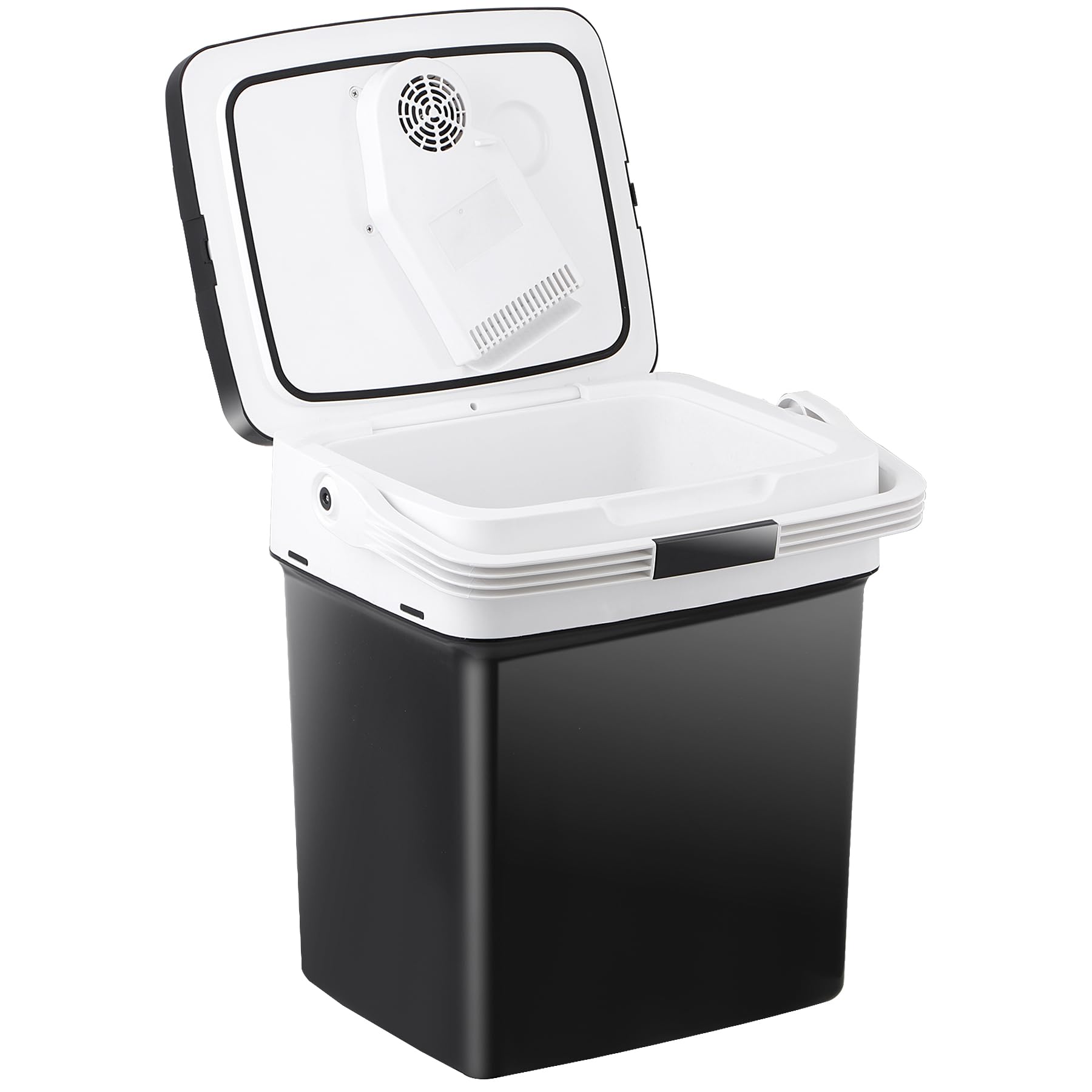
2. ZENY Car Fridge 29L
The only box here that can keep dinner warm instead of cold.
Most camping fridges only cool. This ZENY does both directions, so it can warm food to between 122°F and 149°F or cool to 62-68°F below the outside air. That makes it the pick for tailgates, work lunches and drives where you want hot food at the other end rather than ice-cold drinks. The 27-liter interior handles soda bottles and liter bottles, and it sits small enough to stash almost anywhere in the vehicle.
There is no compressor inside — it uses a thermoelectric plate, which is why it runs near silently and stays light. The trade-off is real, though: it cools to a set number of degrees below ambient rather than to a fixed temperature, so on a hot day it cannot hit freezing. The build uses heavy-duty polyester outside and high-density insulation inside, with a flap-lock handle that keeps the lid sealed over bumpy roads.
The honest catch is consistency. A fair share of feedback lands on cooling that falls short of expectations, and at least one unit failed within two weeks. As owners have put it: “Stoped working after 2 weeks.” Mixed cooling feedback means it suits short warm-food runs, not week-long ice-free camping. It suits short drives and warm-food runs where a few degrees below ambient is enough. It is not the box for a week-long ice-free camp. It also does not make ice, so frozen meat and ice cubes are out.
Best fit: drivers who want hot food kept warm and drinks cooled on a short trip, without paying for a compressor.
Worth weighing: because it counts degrees below the outside air rather than holding a fixed temperature, it struggles to freeze and leans on good insulation instead of raw cooling power.
The niche it owns: warm food and cold drinks in one light box for short runs.
Not the box for: frozen meat or week-long off-grid camping.
3. Alpicool C9PT Portable Car Freezer Cooler, 10 Quart
A 14.8-lb freezer that hides in the back footwell.
This is the smallest real compressor fridge on the list by a wide margin. It holds 9.09 liters — 8 bottles of 18oz water or 12 cans of 12oz cola — and weighs 14.8 lbs, so it lifts out of the truck with one hand. Compare that to the EKOJUCE at the top and the gap is 5.5x in capacity. If your trip is an afternoon with perishables to keep safe, you want small and light, not big and roomy.
It still runs a proper compressor, so the -4°F to 68°F range is a real target rather than a relative offset. You get MAX for fast chilling and ECO for saving energy, plus three battery protection levels (Low, Medium, High) so the fridge will not drain your car battery. Annual energy use runs to 130 kilowatt hours, and the foam insulation keeps cooling going while you carry it to the picnic table.
The reason to pause is cooling consistency. Reviews rave about reliability and performance, with a unit that works off a 100W solar panel (a panel rated at 100 watts of solar input) and a portable battery. But the cooling itself lands mixed — some units run cold, a few do not cool at all. Test the cooling on day one, while the returns window is still open. Buy it for day trips and hunting runs where 9 liters is enough. Test the cooling on day one, while you still have a returns window.
The appeal: a true compressor freezer at a size that slips behind the seat and a 14.8-lb carry weight.
Small, portable, ready: as owners put it: “Very quiet. If if holds up it will be a great refrigerator/ freezer. There even a place for a battery.”
Pick it for: solo campers, hunters and day trips where 9.09 liters of food is the whole plan.
Think bigger if: you are packing for a family — this box fits a handful of drinks, not a week of meals.
4. Setpower 12V Refrigerator 21QT

The one that keeps food cold for 50 hours with the power cut.
Power failures are the reason this box stands out. It ships with an exclusive ice pack that keeps food cool for up to 50 hours, and the same pack doubles as a divider so your vegetables do not share air with the drinks. For a camper on a site with a shaky hookup, or a trucker who parks overnight, that buffer is the difference between salvaged food and a lost grocery run.
The compressor side is efficient: 28W in ECO mode and 40W in MAX, which works out to less than 1kWh a day thanks to the smart cycle. Cooling runs 15 minutes from 77°F down to 32°F, then 45 minutes to -4°F, so you are not waiting around for a cold drink. The 20-liter box covers a 2-3 day road trip for a couple, and you can run it from the panel or a phone app.
Where it stumbles is long-term durability, which draws more negative attention than anything else, and the lid. The hollow lid has no foam inside, which makes it the biggest point of temperature loss, and it does not lock down firmly. One camper found it too heavy fully loaded. The included 3-year compressor support eases the durability worry — use the lid gently and pre-chill before a trip. In brutal Florida heat one buyer reports hitting 40°F in under 30 minutes at 95°F outside.
Why It Earns a Spot
- 50-hour keep-cool ice pack handles blackouts
- 28W in ECO mode for light battery draw
- 15 minutes from 77°F to 32°F
- 3-year compressor warranty
The Weak Points
- Hollow, uninsulated lid leaks the most cold
- Lid does not lock down firmly
- Heavy once you load 20 liters of food
Strongest at: campsites with unreliable power and weekend trips where a blackout would cost you the food.
Know going in: the lid is the weak link, so plan to treat it carefully and keep the box out of direct sun.
5. Megiu Car Refrigerator 23 Quart, Portable 12V Freezer
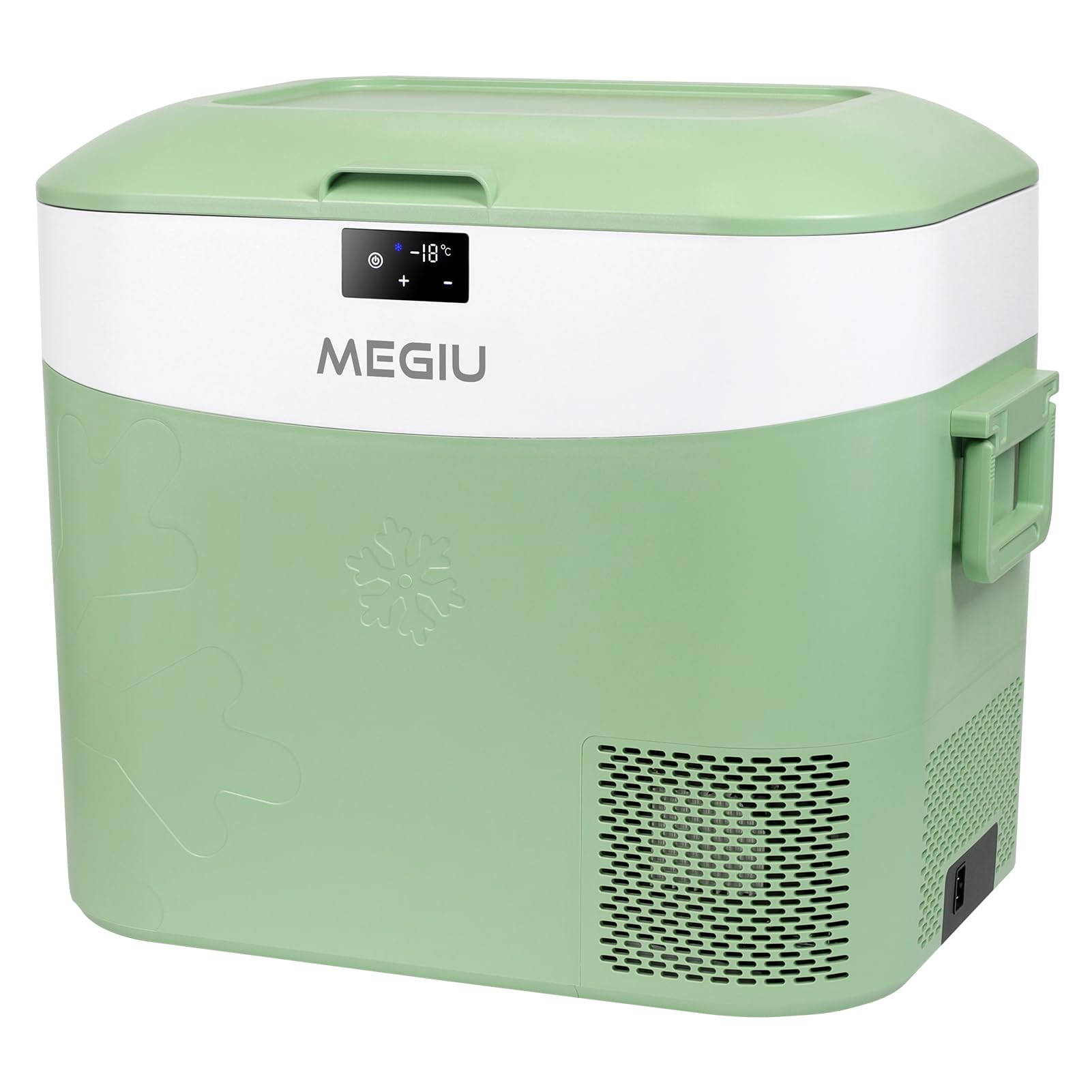
Narrow enough to ride shotgun, cold enough to freeze a can.
At 18.3 inches wide, this Megiu fits on a seat and fastens with the seat belt, so the fridge rides up front where you can reach it. Seat-belted up front, it puts a cold drink within reach without pulling over. The 23-quart box weighs 18.5 lbs, and the ABS shell is built to take a knock against the case while the truck rolls over rough ground.
Cooling is quick: 32°F in 15 minutes and -0.4°F inside 40 minutes, with a temperature dial from -0.4°F to 59°F so it works as either fridge or freezer. Running noise stays under 40 decibels. The HIPS inner tank holds ice cream and meat as easily as drinks, and the removable basket doubles as a food tray. Average power sits at 45W, under 1kWh a day.
The trade-off is insulation. This box sheds cold fast once unplugged, so it wants a live power source through the trip rather than hours of running on its own. The plastic also carries an off-gassing smell when new — air it out before the first camp. One disabled camper describes the daily payoff: “Having an ice cold drink, and the makings for a sandwich right next to me. It’s like staying at the Ritz.”
Who it clicks with: van travelers and drivers who want the fridge within arm’s reach on the seat.
Pack the power: it warms quickly when off, so bring the power bank or keep the 12V socket live through the drive.
Great for: van life and road trips where the fridge sits in the passenger footwell all day.
Look elsewhere if: you plan to unplug for hours — the thin insulation will not hold the cold.
6. BougeRV 12V Refrigerator CRPRO 30QT

Built to live in a truck bed for years, not a weekend.
The CRPRO’s case is made for rough roads. Four tie-down points let you rope it to a seat or truck bed so it does not slide, and the shock-proof design keeps the compressor running at up to a 30-degree tilt off-road. The temperature floor of -8°F is the lowest on this list, and the interior LED light means you are not fumbling in the dark at a night stop.
Power is frugal for a box this capable: 60W in MAX mode and 45W in ECO. The inverter compressor runs quietly and the whole thing is built to be walked past ten thousand times without a fuss. It also comes with a storage box that can hold a power station and its cords, so the wiring stays with the fridge instead of the floor of the truck.
What limits it is a little temperature slop. The set point can swing a few degrees either side — set 34°F and it may read 28 to 33°F — and the readout is not always dead-on with an independent thermometer. That swing is fine for drinks and sandwich meat, but too loose for a precise freeze. Two years of tech support covers the compressor side, which is a real comfort for something bolted into a work truck.
Why Truckers Keep Buying It
- -8°F floor freezes properly in summer heat
- Runs at a 30-degree tilt and ropes down via four tie-downs
- 45W in ECO mode for modest battery draw
- Storage box keeps the cords and power station together
Where It Needs a Nudge
- Actual temperature can stray a few degrees either side of the setting
- Display reading is not always precise
- Battery swapping and the tight cigarette plug take some fiddling
Built for: full-time truckers, RVers and long-haul campers who leave the fridge in place for months.
Less ideal if: you need pinpoint freeze accuracy for ice cream or delicate items.
7. BODEGACOOLER 12 Volt Car Refrigerator, 34 Quart Dual Zone
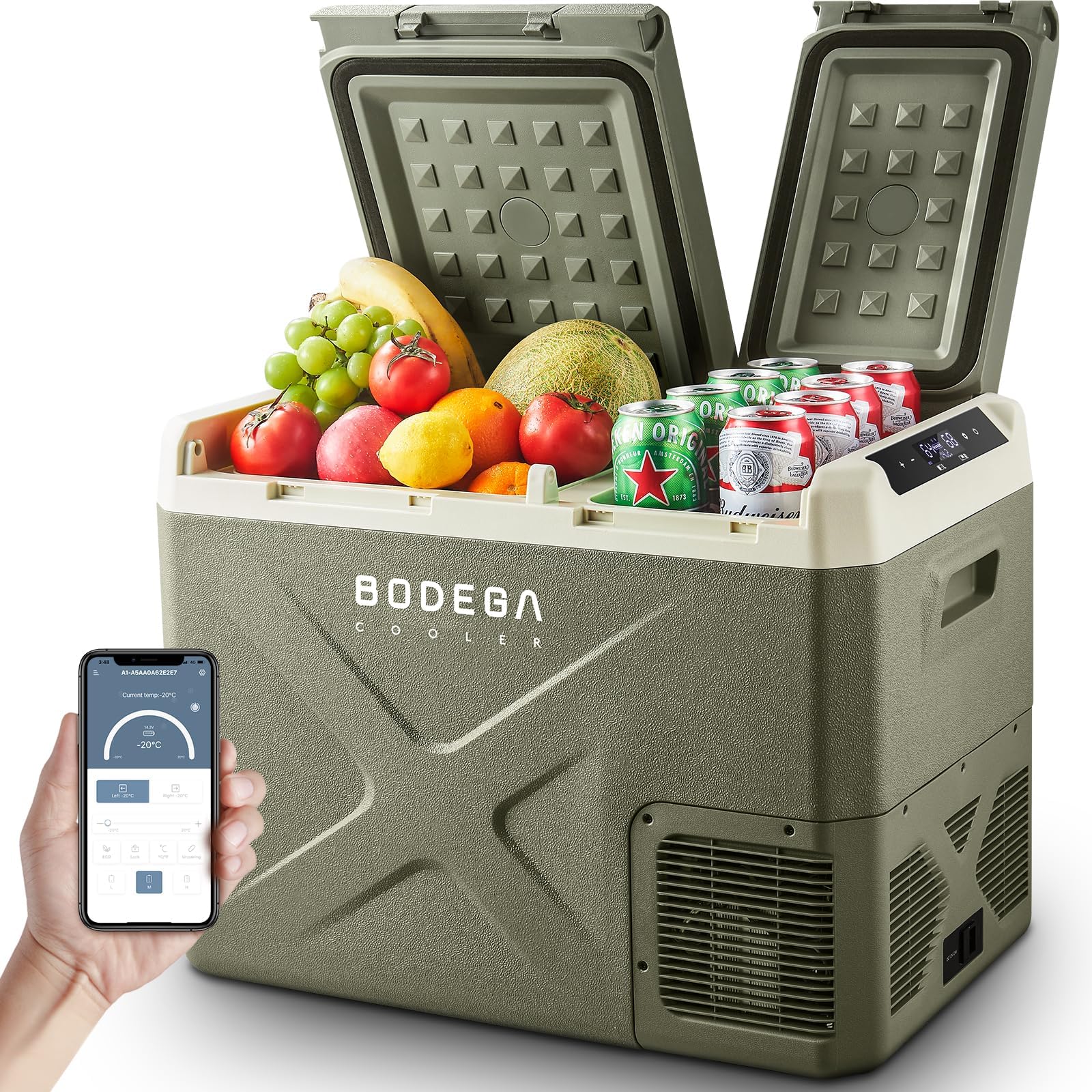
Two independent zones you can split between frozen and fresh.
This BODEGA splits its 32 liters into a 23.8-liter large zone and an 8.3-liter small zone, each with its own temperature dial from 68°F down to -4°F. That means the small side can stay a freezer for ice cream and meat while the large side is a fridge for drinks and produce. You can switch either compartment to the other job whenever you want. It holds up to 32 cans of cola and 28 bottles of water, and the phone app lets you check the temperature without opening the lid.
Cooling is quick — 15 minutes from 68°F to 32°F. The full run uses less than 1kWh a day even on MAX, with an ECO mode to trim it further and H/M/L battery protection to keep your car from going flat. It also runs stably at a 30-degree incline, so a climb does not disturb it. The two-way detachable lid flips direction, and there is a drain hole for cleanup plus cup slots that stop spills.
The caveat: this is a box that wants constant power, not a passive cooler. Pre-chilled to near 0°F, the interior climbs to the 70s°F after a few hours unplugged, so treat it as a plugin appliance. One camper’s 14-night trip sums up what it is and is not for — no buying ice and no melt mess, but a nightly plug-in is part of the routine. Five years of compressor coverage backs the hardware side.
What stands out: a genuine two-zone setup with independent controls and app access, so frozen and fresh travel side by side.
The honest limit: once the plug comes out, the cold leaves fast — the insulation will not cover a night off-grid.
Matches you if: you want frozen meat and fresh produce in the same box on a plugged-in camping setup.
Rule it out if: you plan to leave it in the car unplugged between stops.
8. Kohree 12V Car Refrigerator, 53 Quart (50L)

Two zones, two doors, and enough room for a family week.
This Kohree splits into a 35-liter large zone (37 quarts) and a 15-liter small zone (16 quarts), each with its own temperature dial from -4°F to 68°F. The zones do not share air, so the seafood smell never reaches your snacks. On top of that you get non-slip wheels and a handle with two adjustable lengths, so you can wheel a loaded box across a campsite instead of carrying it.
Unlike the single-door fridges here, this one has two detachable doors you can reposition to suit your rig — a real convenience when you are reaching past a seat. Strain the terrain and it holds up: it keeps running at a 40-degree incline, and three levels of battery protection (Low, Medium, High) guard your battery. Power draw is low enough that the maker compares it to a car navigator, and there is a USB port for your phone plus an LED light for night rummaging.
Where it can bite is the hardware over time. The recurring gripes center on the lid handle and hinge — one long-haul trucker had the handle snap at three months, and hinges break in a small number of units. It is a big, heavier box too, and the plastic housing wants careful handling. The upside is performance and temperature retention, both heavily praised, and one camper kept water frozen flawlessly over a 3-day trip at 11°F.
what separates it
- 37-quart and 16-quart zones with independent temperature control
- Two detachable doors you can flip for access
- Non-slip wheels and a two-length handle
- Runs at a 40-degree incline; USB port and LED light
Where It Asks For Care
- Lid handle and hinges are the weak points over time
- Big and heavy once loaded
- Plastic housing needs gentle handling
Made for: families and group camping trips that need two independent temperature zones and a lot of food.
Be gentle with: the door hardware — keep the load light when lifting by the handle.
9. ICECO GO20 Dual Zone 12V Refrigerator, 21 Quart
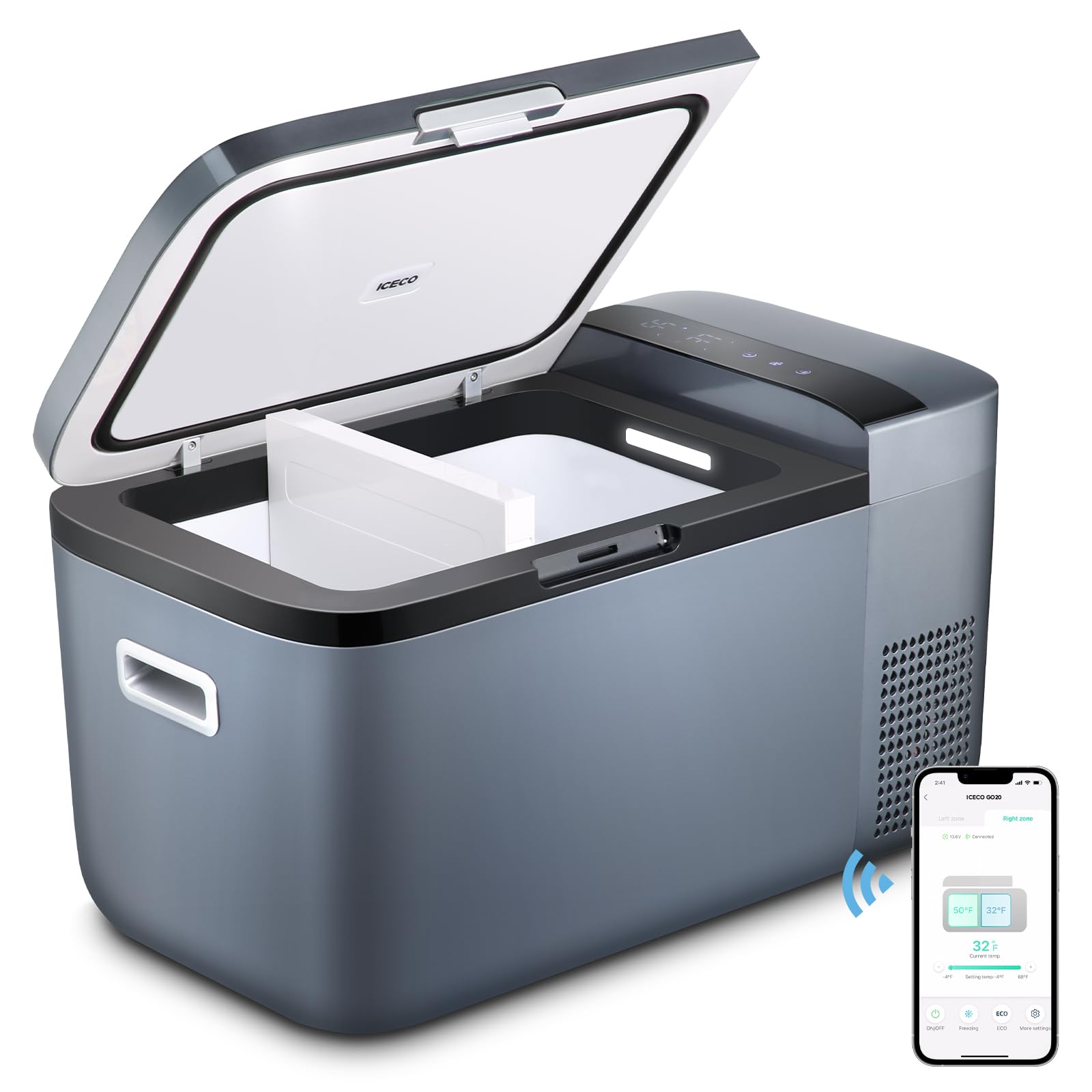
A 21-quart two-zone fridge that downsizes to a third of an ice chest.
The GO20 packs a SECOP compressor into 21 quarts, with a 0°F to 50°F range and a fast-cooling mode that gets you to temperature in about 45 minutes. It runs as one big box or two separate zones, split by a removable partition, each with an independent digital controller. Once you pull the divider it behaves as a single large fridge. No ice needed, and the box shrinks to roughly a third of a traditional cooler’s footprint.
The compressor is efficient — draws somewhere in the 30-40W range — and the anti-bump design keeps it running at up to a 40-degree tilt. It switches between home AC at 110/240V and car 12V/24V, includes an insulation jacket and a 2.5-meter cigarette cord, and has an app to change temps without moving it. Five years of compressor coverage, plus a design award or two on the wall, round it out.
The real catch is the temperature display, which tends to read a little warmer than the actual inside — expect a gap you will have to adjust around. The cigarette plug can pop loose on rough roads, and the glossy shell scratches unless you keep it bagged. The compressor is also slightly louder than the bigger Dometic it can replace, though still quiet enough to sleep nearby. The hardware is the strong point: quality and functionality are what people praise most, and a 2-year road-trip owner reports no issues.
Standout build: a SECOP compressor, dual zones, and an insulation jacket in a 21-quart package that shrinks your cooler footprint.
Mind the plug: the cigarette adapter works loose on bumpy roads, so pack spare tape or run it off a fused extension.
Right size for: two people who want dual zones in a compact package and can run it from a car socket or power station.
Not for: anyone wanting a big family fridge — 21 quarts covers a weekend for two.
Know the Specs
Quart Capacity
This is the usable interior volume, and it is the number that decides whether the fridge suits a weekend for two or a week for a family. A 21-quart box like the ICECO GO20 holds a weekend’s food for two, while a 50-liter EKOJUCE or Kohree swallows a family’s groceries. Always size up rather than down if you pack water bottles and ice packs.
Cooling Method
A compressor fridge (found on nearly every pick here) pulls the box to a fixed temperature and can freeze. A thermoelectric cooler instead counts degrees below ambient, so on a hot day it cannot reach freezing. That is why the ZENY cooler/warmer suits short drives and warm food while the compressor fridges handle frozen meat.
Power Draw
The wattage figure tells you how hard the fridge leans on your battery. A unit at 28W in ECO mode asks far less of a power station overnight than one that runs higher. Multiply by the hours you plan to run it off-grid to estimate the load on your battery bank, and always check the manufacturer’s own numbers.
Battery Protection Levels
These let you set a cutoff voltage so the fridge stops pulling before your car battery goes flat. Most units offer low, medium and high settings. Choose a higher cutoff on an older battery and a lower one on a fresh battery or a dedicated power station.
Noise Level
Measured in decibels, this is what decides whether you sleep next to the fridge or move it out of the tent. Around 32 dB is quiet enough to snooze beside. Some models sit at 45 dB, still quiet but noticeable in a small camper at night.
Insulation and Lid Quality
Once the plug comes out, insulation is the only thing keeping food cold. A hollow lid or thin wall loses cold fast, while a solid, foam-lined lid holds the temperature through a lunch stop. Check the lid for foam before you buy if you plan to leave the fridge unplugged at camp.
Common Questions
Can a 12V camping fridge run off a car battery overnight without killing it?
How many quarts do I need for a family camping trip?
What is the difference between a compressor fridge and a thermoelectric cooler?
Will these fridges work on both car and home power?
How long will food stay cold if the power goes out?
Are dual-zone fridges worth it over a single-zone box?
How fast do these electric coolers cool down?
Can I use these camping fridges as freezers too?
How much power does a 12V camping fridge use over a day?
Do these fridges hold their temperature on rough roads or steep climbs?
The Bottom Line
For most camping setups, the electric coolers for camping winner is the EKOJUCE 53QT. It holds 50 liters, cools down in 15 minutes and runs at 32 decibels (about as quiet as a soft conversation), so a family base camp stays stocked without ice. If you want two independent zones for frozen and fresh food, reach for the BODEGACOOLER dual zone. And if reliable long-haul cooling in a truck bed is the goal, reach for the BougeRV CRPRO 30QT, with its -8°F floor (cold enough to keep food frozen) and four tie-down points. Whichever you pick, check the lid and insulation before your first trip — that is where cheap boxes give the cold away. Each pick above holds a set temperature on 12V power, so it keeps food cold long after ice would have melted.
How we choose
We do not accept paid placement. Every pick is matched to a real buyer and a real use-case; we do not hands-on test units.
Sources
Specifications: manufacturer listings and product documentation. Review insights: verified customer reviews, as of October 2026. Pricing: not shown on this page (it changes often); check the current price via the retailer link.
As an Amazon Associate, Aappliancez earns from qualifying purchases. This does not affect which products we feature.