Disclosure: Some links in this post are affiliate links. As an Amazon Associate I earn from qualifying purchases, at no extra cost to you. Learn more
Specs are compiled from manufacturer listings and verified buyer reviews and can change over time — please confirm the key details on the product page before buying.
You cannot see what you are doing in your own ear, so it is easy to poke too far or miss the wax entirely. A camera otoscope (a tiny camera on a stick that shows your ear canal on a screen) turns that blind guess into a live picture, so you aim instead of stab. The picks below split into two families: all-in-one units with their own built-in screen, and Wi-Fi models that stream to the phone in your pocket. Which one fits you depends on if you want zero setup or a bigger, sharper view.
This guide is built by comparing the manufacturers’ published specifications and the patterns across verified customer reviews, so you get each pick’s real strengths and trade-offs instead of marketing spin.
You will see how lens diameter decides comfort, how megapixels and magnification change what you can actually spot, and where app-based tools stumble. That covers the ear wax camera choices worth your money today.
Top Picks

How To Choose The Best Ear Wax Camera
Most first-time buyers fixate on the megapixel number on the box. That is the wrong place to start. The spec that decides whether a camera otoscope works is the diameter of the lens tip, because a canal is a tight, curved tube and anything too wide will not go in far enough to show you the wax.
Start with the tip diameter, not the resolution
The ScopeAround MS450 uses a 3.9mm lens (a very slim camera head that fits into the ear), while the Bebird H30 narrows to a 3.1mm flexible tip. That 0.8mm difference decides comfort: a thinner tip slips past the bend in the canal with less pressure, so a flexible silicone-tube design suits kids and anyone with a sensitive ear. Once the tip fits, resolution becomes the second question.
Decide if you want a screen or your phone
Self-contained otoscopes like the ScopeAround and the Aertnelz show the image on their own built-in display, so there is no app, no Wi-Fi, and no pairing step. Phone-based models like the Bebird H30, the E33R, and the Zupora stream over 2.4GHz Wi-Fi (a short-range wireless link to your phone) to an app, which gives you a larger screen and saves clips to your photo roll. If you want to see it and be done in thirty seconds, buy the screen. If you want to share a picture with a doctor, the app model wins.
Side-by-Side Comparison
| Model | Best For | Lens Diameter | Viewing Method | Camera | Amazon |
|---|---|---|---|---|---|
| ScopeAround MS450★ Best Overall | Hands-free family checks | 3.9mm | 4.5″ IPS screen, no app | HD with 6 LED lights | Amazon |
| Bebird Home 30SThinnest Tip | Thin flexible tips | 3.1mm | Wi-Fi app to phone | 10MP, 3X magnification | Amazon |
| Anyear E33R Flexible Kit | Full ear, nose and throat kit | Flexible silicone tube | 2.4GHz Wi-Fi app | 10MP with 6 LED lights | Amazon |
| Zupora 1440P Otoscope | Sharpest picture on a budget | 3.5mm | Wi-Fi app via Itimo | 1440P with anti-fog lens | Amazon |
| AnyScope Digital Otoscope | Plug-in phone scope | 0.15 inch (3.8mm) | Wired to phone | HD with 6 LED lights | Amazon |
| Lebbtl W60-N Irrigation System | Flushing plus viewing | Wide-angle endoscope | Wi-Fi app at 30 FPS | 1080P with 6 LED lights | Amazon |
| Aertnelz Digital Otoscope | Multi-purpose home exams | Two interchangeable tips | 1.38″ IPS screen, no app | 1080P with 4 LED lights | Amazon |
Detailed Reviews
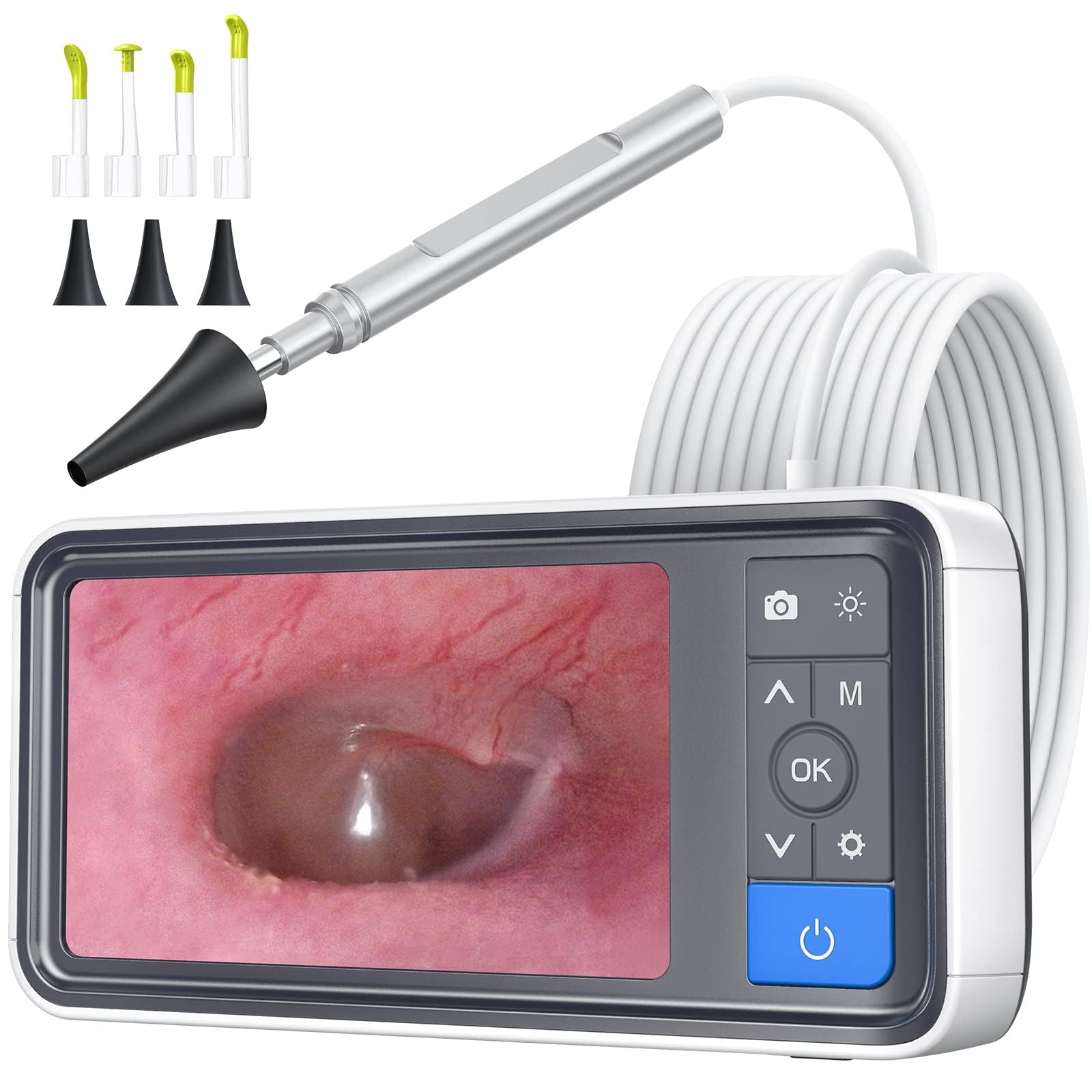
1. ScopeAround Otoscope with 4.5″ IPS Screen
Our pick — 4.0+★ from 950+ verified ratings; the strongest balance of quality and price.
The one you can hand to a nervous parent with zero setup steps
Press one button and the picture appears — no app, no Wi-Fi, no pairing. That instant-on 4.5-inch IPS screen (a flat color panel you read live, like a small tablet) is why this ear wax camera takes the top spot. The 3.9mm lens is wider than the Bebird H30’s 3.1mm tip, so it will not glide quite as deep into the tightest canal, but it still reaches far enough to show wax, irritation, or a blockage clearly. Six adjustable LED lights (small bulbs around the lens that light the tunnel) keep the view from turning into a dark blur.
The gyroscope (a motion sensor that keeps the picture upright) is the quiet hero. Rotate the scope and the image stays level instead of flipping upside down mid-clean. Soft silicone ear tips and a protective collar around the shaft lower the odds of a scratch. The kit ships with a 32GB card (storage for photos and video), a stand that frees both hands, four ear spoons, three specula, and a pack of Q-tips.
Buyers rave most about the clarity of that little screen — one owner used it to locate a missing hearing aid dome pressed against the eardrum after a clinic had already missed it. The recurring gripe is camera orientation: a few find the angle takes a moment to learn, and the lens fogs if you breathe on it, so keep an alcohol wipe nearby. The screen is small enough that farsighted users will hold it close.
What lands immediately
- No app, no Wi-Fi, no pairing — the 4.5-inch screen is live the second it powers on
- The built-in gyroscope steadies the image so rotating the scope does not flip your view
- Ships with a 32GB card, ear spoons, specula, Q-tips, and a stand for hands-free positioning
- Rechargeable battery covers multiple inspections on a single charge
Where it asks a little patience
- The 3.9mm tip is wider than the Bebird’s 3.1mm, so the very narrowest canals need a slower, gentler entry
- A short learning curve — first-timers take a pass or two before the angle feels natural
- The lens fogs if you are too close, and wiping it mid-session gets fiddly
Reach for this if: you want a self-contained scope for the whole household — adults, kids, and pets — with no phone involved.
Look elsewhere if: you need the thinnest possible flexible tip for an unusually narrow canal or a very small child’s ear.
2. Bebird Home 30S Ear Wax Removal, Smart Ear Camera
A 3.1mm flexible tip built for canals that fight back
A 3.1mm flexible tip is 0.8mm slimmer than the ScopeAround’s 3.9mm lens, and that trim is what lets this model slip past the natural curve of a stubborn canal with less pressure — so it earns its spot on fit alone. Add a 10-megapixel lens (the sensor that captures the picture) and 9-axis motion sensitivity (the sensor suite that keeps the image steady), and you get a 3X-magnified view of the canal wall without the distortion of a cheaper fixed lens.
If you have ever put in ear drops and hoped for the best, the reusable visual ear dropper is the sleeper feature: you watch the drop land on the exact spot instead of flooding the whole passage. Mini ear tweezers then reach wax that a soft scoop just pushes around. The kit ships with 23 replacement tips — a traditional metal spoon, four soft silicone scoops, two threaded silicone spoons, four mushroom scoops, six sponge scoops, and six sticky heads — so you are not hunting for consumables after a few weeks.
Reviewers call it the household favorite because the wax actually comes out — effectiveness is the most-discussed quality in its reviews. But be honest about two soft spots. Buyers report the battery lasts about two cleanings between charges, so plan on a cable nearby. Durability is the recurring complaint, with a handful of units giving up after light use. The app is the other trade-off — some find it slow to load, others call it glitchy.
The wax-removal angle: the 3.1mm flexible tip reaches wax the wider all-in-one lenses cannot, and 23 interchangeable scoops and tweezers clear buildup faster.
The honest catch: this is a phone-tethered tool, and the phone is the weakest link — a slow app and a short battery mean a full session needs a charge and some patience.
Best matched to: anyone with a narrow or awkwardly shaped canal, and households that want every scoop and tweezer shape in one box.
Think twice if: you would rather not rely on an app mid-clean, or you want a battery that survives a whole week of sessions.
3. Flexible Ear Wax Removal Tool Camera
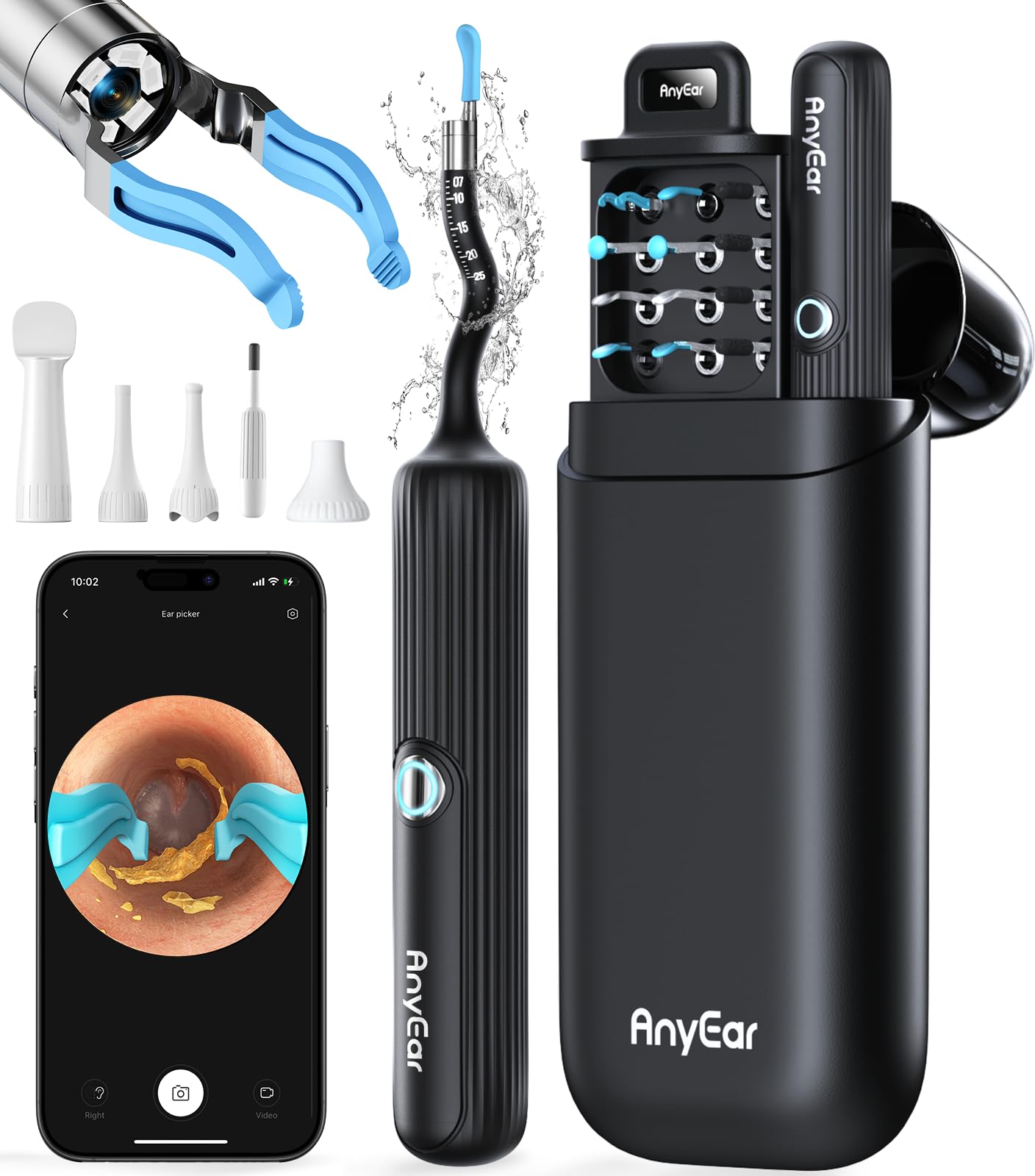
Four tools in one case — ears, nose, throat, and a depth guard for kids
An 80-minute battery run per charge is the longest here, and it is why this kit wins the family-market slot. On the Bebird H30 you get about two cleanings between charges; on this one you do not have to rush. The flexible silicone tube lens bends to the shape of the canal instead of fighting it. The 10MP otoscope and six LED lights feed the real-time picture, and an optional depth limiter (a stop on the tip that blocks over-insertion) tells you when to stop before you get there.
The kit includes four types of soft silicone scoop tips across 12 replacement heads, one pair of painless tweezers, and three visual inspection tools for ears, nose, and throat — enough shapes that you are not settling for the one tip that came in the box. It is IP67 waterproof (a rating that means it survives a rinse under the tap), so cleaning the lens is a rinse-and-brush job instead of a careful wipe. It connects to iOS and Android over 2.4GHz Wi-Fi with no internet needed.
The catch is the lens. Wax and moisture cling to it during use and blur the view — the maker calls this normal and says rinsing and brushing restores it, but a few owners find it comes back blurry after a handful of sessions and stops being useful. Unpack over a table, too: three probes have arrived loose in a box on opening.
Why the toolkit earns its spot: 12 scoop heads, tweezers, and nose and throat tools in a compact case replace a pile of single-purpose picks — and the depth limiter makes it the safest of the flexible-tip options for children and nervous beginners.
Built for: families who want ears, nose, and throat coverage in one kit, plus anyone who wants a depth guard for cautious cleaning.
Worth knowing: the lens needs regular rinsing, and a small number of units lose their clarity after consistent use — clean it religiously and it holds up.
4. Ear Wax Removal, Ear Camera with 1440P HD

The highest resolution on the list, and the tip that refuses to break
A 1440P camera outruns every 1080P unit on this list on pure pixel count, so it takes the sharpest-image slot. The anti-fog, anti-dust coating keeps the lens clear — that means the detail holds up even in a warm, humid canal. The 3.5mm diameter lens is thinner than the ScopeAround’s 3.9mm, which eases entry into a tighter canal without shrinking the image. It is IP67 waterproof (a rating that means it survives a quick rinse), so an alcohol wipe between users is safe.
The build detail you would not guess from the photos: the silicone ear spoon is molded into the main body instead of being a separate press-on piece. A buckle holds the silicone tip to the metal shaft, and the silicone surface is treated to add friction, so it grips wax instead of skating over it. If you have ever fumbled a loose tip inside a canal, that one-piece design is the fix. Inside sits a 250mAh battery (the small cell that powers the light and camera), and the app — Itimo — installs on iOS and Android.
Buyers reward the clarity: people describe seeing everything clearly, and one owner notes that the 1440P sensor is what set it apart. The catch is connectivity — pairing the built-in Wi-Fi to the app is the one step a few find fiddly, so give it a minute on the first run. There is no depth guard here, so this one suits steady adult hands rather than wriggling kids.
What makes it the sharp-eyed pick
- 1440P resolution tops the 1080P models here, so the smallest flecks read clean on screen
- The silicone ear spoon is molded to the body and buckle-locked, so it stays on the shaft
- 3.5mm lens is thinner than the ScopeAround’s 3.9mm for easier entry in a tight canal
- IP67 waterproof, with anti-fog and anti-dust coating on the lens
- Kit bundles 9 ear-accessory pieces, an ear-wax set, a storage bottle, and a velvet pouch
The honest notes
- Wi-Fi pairing to the app is the step a few find fussy, so budget a few minutes the first time
- No depth limiter, so it suits steady adult hands more than children
- It is a phone-app tool, so you must have your phone charged and ready
The match: resolution junkies and anyone who wants to see the tiniest detail — plus a tip that stays put when the job gets messy.
The limit: no depth guard means this one is for grown-ups who can hold a steady line.
5. Digital Otoscope Compatible with iPhone & Android
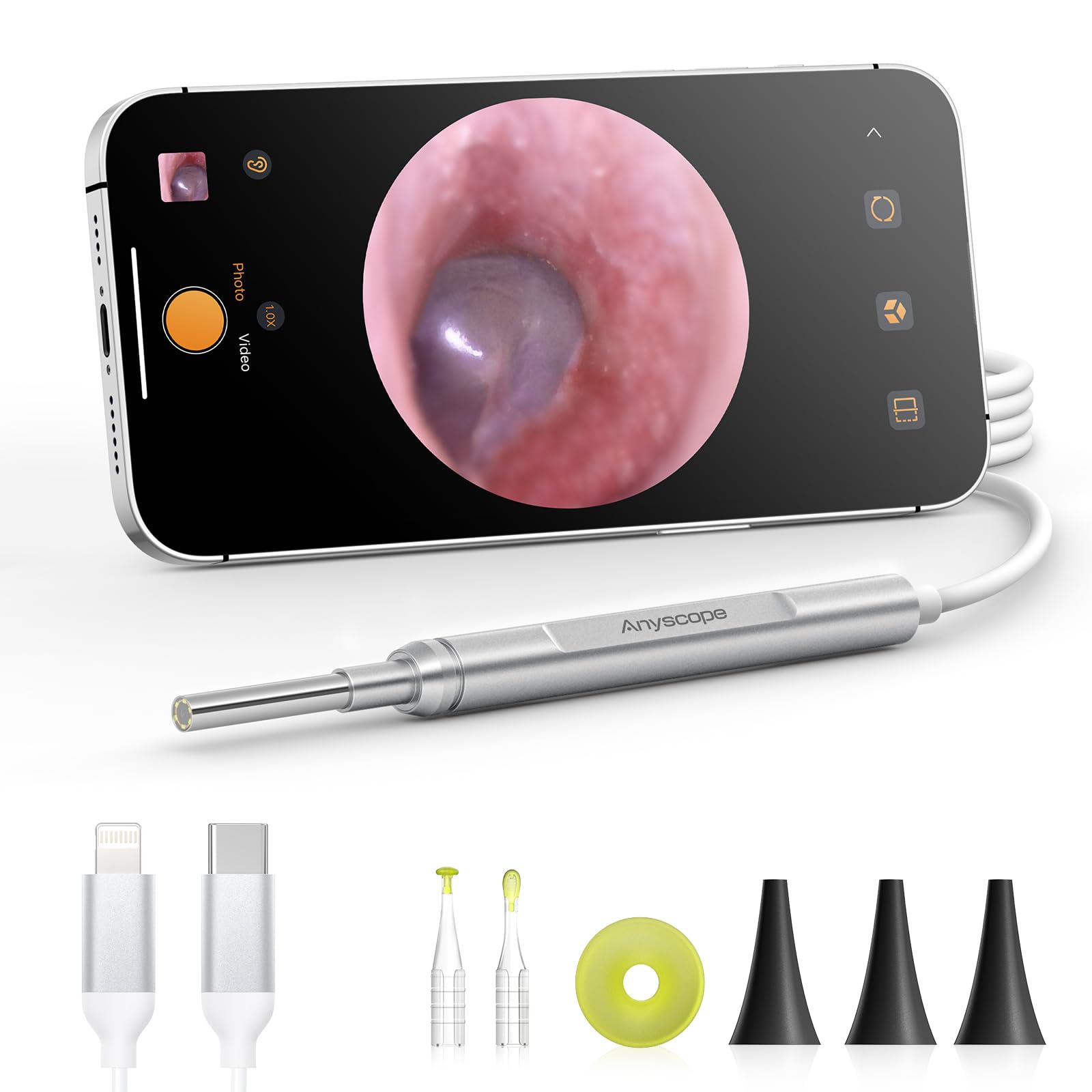
No Wi-Fi, no pairing, no battery — it just plugs into the phone
There is no battery to drain here, and no Wi-Fi to pair: this is the only pick in the guide that plugs straight into your phone over a cable, so your phone is the screen and the power source at once. That kills the two headaches that trip up the wireless models — pairing lag and a dead battery mid-session. Check two things first, though. Your Android phone needs OTG and UVC support (the two-part ability to talk to an external camera through the port), and iPhones need iOS 9.0 or newer. It does not work with a PC.
The 0.15-inch (3.8mm) ultra-fine lens is about as slim as the ScopeAround’s, so it reaches the canal and eardrum without a fight. Six LED lights do the lighting, and the app adds full-screen and split-screen modes — the split view is the clever bit, letting you set the live picture beside a saved photo from last week to see whether things improved. A speculum and adjustable protection cover sit on the tip as a safety stop.
The manual’s recurring warning is worth repeating because it matters: tighten the silicone spoon and speculum firmly before each use, since a loose fitting is the main way this tool scratches instead of cleans. Beyond that, buyers find it effective and quick to set up, with detail sharp enough to identify the structures inside the ear. Just confirm your phone has OTG support before you buy.
The wired advantage: a direct connection sidesteps the pairing lag and battery limits that slow the wireless picks — no charge to remember, no signal to lose.
Verify first: this only works on Android 8.0+ with OTG/UVC or an iPhone on iOS 9.0+, and not on a PC — check before ordering.
Made for: iPhone and OTG-capable Android owners who want zero wireless fuss and a lens fine enough for the eardrum.
skip it if: your Android phone lacks OTG support — a phone without it will not see the camera at all.
6. Ear Irrigation Flushing System with 1080P Otoscope
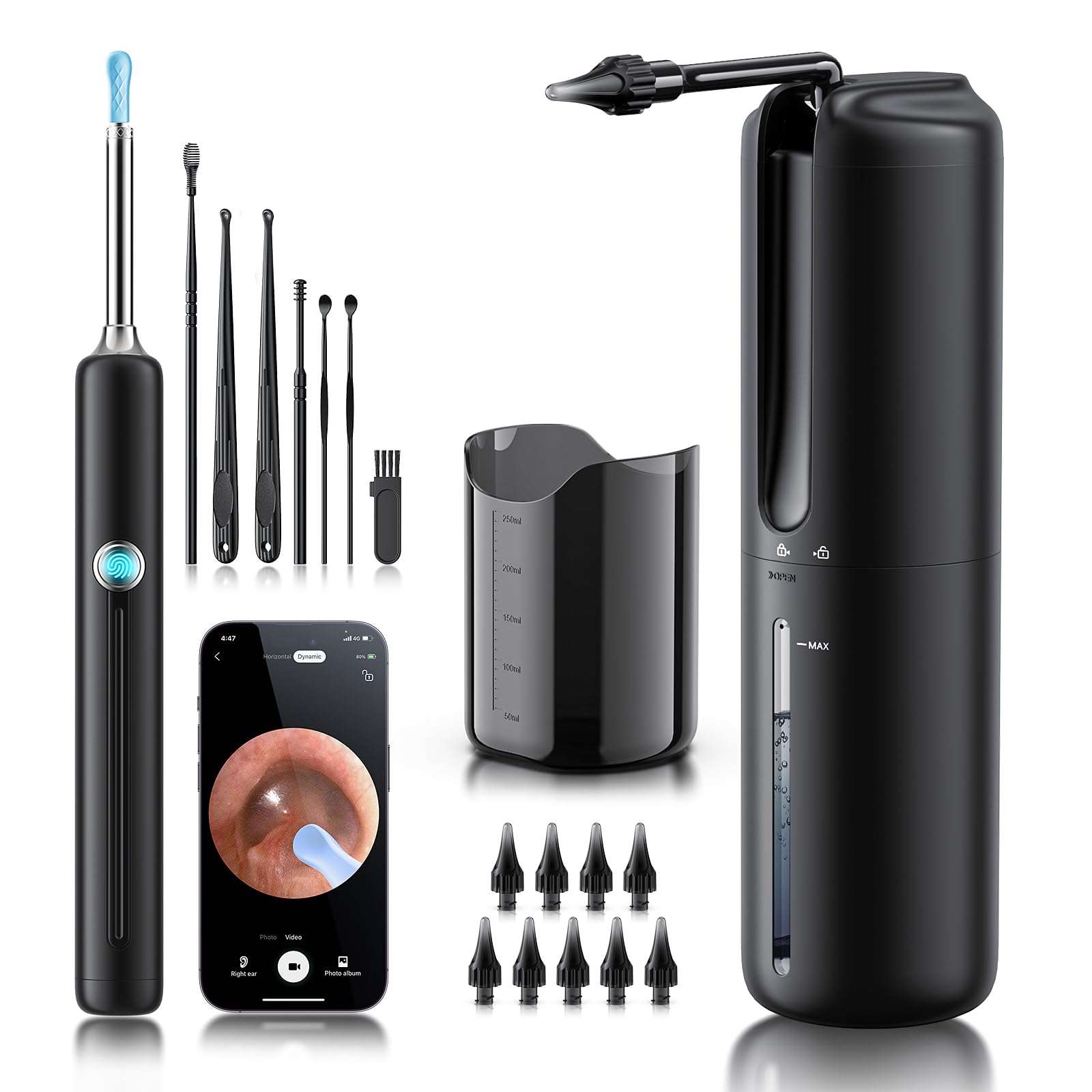
When a camera alone will not do it, this one flushes and films at once
Four cleaning modes — Normal, Gentle, Pulse, and Strong — make this the only pick that removes wax with a controlled water stream instead of a scoop, and that is the answer for wax too tightly packed for a spoon. Run a soft, steady stream for a sensitive ear or a firmer pulse for a stubborn plug, and switch with the toggle button. The camera is a 1080P unit with six LED lights and a wide-angle endoscope lens, so you watch the canal while the water does the work.
An internal battery (a lithium-ion cell is included) powers the stream, and the housing is made for use near water — IPX5 means it survives splashes and rinsing, so a sink or shower session is fine. A 6-axis gyroscope keeps the image level so the live video does not roll sideways when you tilt the nozzle. The Wi-Fi link to iOS or Android runs at 30 FPS (frames per second — the frame rate that keeps the live view smooth, not choppy). Everything arrives in one black box: the wash system, an ear basin, ten earplugs across two hole sizes, an otoscope with light, a storage bottle, six silicone earplug covers, a 7-piece traditional scoop kit, and two Type-C cables.
Buyers praise the four pressure modes for clearing packed wax thoroughly, and report ears feeling noticeably lighter afterward. The honest note: the little plastic drainage basin is more decorative than useful, so owners who clear a serious blockage recommend doing it over a sink. The two packages ship together in a single box, so do not be surprised if you only see one.
The case for flushing: the four pressure modes and IPX5 housing make this the only pick that actually washes out packed wax rather than nudging it — a controlled stream you watch on a 1080P feed.
Choose this for: challenging, packed wax that spoons and tweezers cannot shift, and anyone who wants a hands-off, water-based clean.
Plan around: position yourself over a sink — the included drainage cup is small, and a real flush makes real mess.
7. Digital Otoscope with Light, 1.38-Inch Screen
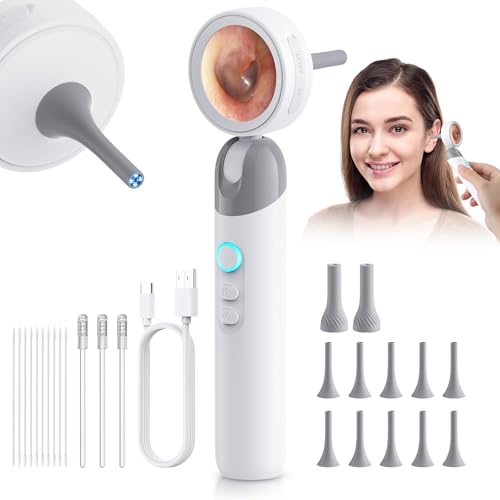
A pocket otoscope that checks ears, nose, skin, and even the pet’s ears
Swap the tip and this stops being an ear tool at all. A 1.38-inch IPS LCD screen sits on the handle — smaller than the ScopeAround’s 4.5-inch panel, but it keeps the whole thing self-contained with no phone and no app. The 1080P camera and four built-in LED lights give real-time images of the ear canal, nasal cavity, oral cavity, and skin. The pointy tip is for standard ear exams, while a wider bell-shaped tip installs reversed to steady the device against the skin for close-ups that are not about ears — the use case is photographing a spot to show your doctor.
A one-button layout means a total beginner can pick it up without reading anything, and 3x magnification with multiple brightness levels lets you dial the view in. A USB-C port supports fast data transfer and PC viewing, so you can push the picture to a larger screen. It carries FCC, CE, ROHS, and UKCA marks (certifications that show it passed the listed safety and compliance checks) and includes ten ear and nasal tips, two skin tips, three adhesive ear sticks, and ten cotton swabs.
The one parameter to respect is focus distance: hold the tip 1.4 to 2 cm (0.55 to 0.8 inches) from what you are viewing, and closer or farther than that the image blurs. That is a normal quirk of the fixed lens rather than a fault, and a half-centimeter adjustment fixes it. The other limit: the package does not include a TF card, so buy one separately if you want to record video and move files to a computer.
Where it shines
- Self-contained 1.38-inch IPS screen with no app — ready the moment you press the button
- Swap the tip and it becomes a skin, nose, and dental scope, not just an ear tool
- USB-C supports PC viewing for a bigger look at any photo
- 1080P camera with 3x magnification and adjustable LED brightness
- Small enough to keep in a drawer between checks
Keep in mind
- The image blurs outside the 1.4-2 cm working distance, so hand position has to be steady
- No TF card included — add one for video and computer transfer
- The 1.38-inch screen is small, so larger, sharper detail is easier on the ScopeAround’s 4.5-inch display
Suits: households that want one no-fuss scope for ears plus occasional nose, skin, and pet checks.
Remember: hold it 1.4-2 cm from the target or the picture softens, and grab a TF card if you plan to record.
Know the Specs
Lens diameter
The diameter of the camera tip (the round lens head at the end of the shaft) decides two things: how comfortably it enters the canal and how deep it can reach. A 3.1mm flexible tip like the Bebird H30 bends through the canal’s natural curve with less resistance, so entry feels easier. A wider lens, like the 3.9mm on the ScopeAround or the 3.5mm on the Zupora, sometimes sees more of the canal wall at once but needs a gentler approach. For a child or anyone with a narrow, sensitive ear, the thinner flexible tip is almost always the easier start.
Resolution and magnification
Resolution is the pixel count — the finer detail the camera captures. A 1440P sensor sees more than a 1080P one, and a 10-megapixel lens sits in the same league. Magnification (how much the view is enlarged) is a separate lever: on the Bebird the 3X zoom makes wax look bigger and closer than it is, so move slowly and stay gentle. A higher number here is not automatically better — a clear, well-lit 1080P image beats a blurry high-resolution one.
Common Questions
Do I need an app to use an ear wax camera?
Will an ear wax camera fit a child’s ear canal?
Is a flushing system better than a scoop-and-camera tool?
What is a safe working distance for a clear image?
How do I keep the lens from blurring during use?
Will a Wi-Fi ear camera work without internet?
Does the plug-in otoscope work with every phone?
Can I use one ear camera for the whole family?
What does 3X magnification actually change?
How long does the battery last between charges?
The Bottom Line
The strongest all-round ear wax camera is the ScopeAround MS450 — 4.0+ stars across 900+ ratings, and the only pick with a live, gyroscope-steady 4.5-inch screen and no phone, app, or pairing. If your canal is narrow or you want every scoop shape in the box, take the Bebird Home 30S and its 3.1mm flexible tip instead. For the sharpest detail, the Zupora 1440P outruns every 1080P model here on pixel count. And when wax is packed too tight for any scoop, the Lebbtl W60-N flushes it with a watched water stream.
How we choose
We do not accept paid placement. Every pick is matched to a real buyer and a real use-case; we do not hands-on test units.
Sources
Specifications: manufacturer listings and product documentation. Review insights: verified customer reviews, as of October 2026. Pricing: not shown on this page (it changes often); check the current price via the retailer link.
As an Amazon Associate, Aappliancez earns from qualifying purchases. This does not affect which products we feature.