Disclosure: Some links in this post are affiliate links. As an Amazon Associate I earn from qualifying purchases, at no extra cost to you. Learn more
Specs are compiled from manufacturer listings and verified buyer reviews and can change over time — please confirm the key details on the product page before buying.
Your camera came with a strap in the box, and that freebie is the reason your neck aches by hour three. A proper strap moves the load, locks the camera to your body, and lets you bring the camera up to your eye without fumbling. The picks below cover that whole range: wrist straps, leather neck straps, dual-camera harnesses, and sling systems for heavy glass.
This guide is built by comparing the manufacturers’ published specifications and the patterns across verified customer reviews, so you get each pick’s real strengths and trade-offs instead of marketing spin.
Two numbers decide almost everything here: the weight rating (how much gear the strap holds) and the connector type (how it clips to your camera). Read those first. Below are the strongest options on the shelf, sorted by what each one does best, so you can match a strap to the body and lens you actually carry — a practical shortlist of the dslr camera straps that earn their place.
Top Picks


How To Choose The Best DSLR Camera Straps
The wrong strap announces itself slowly. First your shoulder starts to complain, then the camera keeps sliding off your hip, then a connector starts to feel loose. Picking correctly depends on three things: what you carry, how long you carry it, and how often you move the camera between your body and a tripod.
Start with your actual load, not the strap’s looks
Add up your camera body and your heaviest lens — that number is the one that matters. A strap rated to 5kg (11lb) is fine for a mirrorless body with a prime lens. Put a full-frame DSLR with a 70-200mm zoom on it and you are asking a light-duty strap to do heavy work. Buy headroom above your real load, because the rating is a ceiling, not a target.
Neck, shoulder, or both shoulders
A neck strap hangs the weight on your cervical spine and is best for light rigs and short sessions. A crossbody or shoulder sling moves that weight to your torso and keeps the camera at hip level, ready to swing up. A dual harness splits two bodies across both shoulders, which is what wedding and event shooters need when both cameras stay out all day. Pick the carry style for your longest shooting day, not your shortest.
Connectors decide your workflow
Quick-release systems let you detach the camera in a second for a tripod, a gimbal, or a bag. The trade-off is one more mechanical part to check. Anchor-style cord connectors and Arca-Swiss plates have both earned a following because they keep the camera secured while still releasing fast. Whichever you pick, read the load rating on the connector itself, not just the strap.
Padding and material weight
Neoprene padding compresses and spreads pressure across a wider band, which is why heavy-camera shooters gravitate toward it. Leather grips well and ages into a look many photographers want, but it can feel stiff at first and needs wiping down if it gets wet. Thin webbing straps stay out of the way and pack small, at the cost of cushioning. No single material wins — match padding and grip to your body and your bag.
Side-by-Side Comparison
| Model | Best For | Carry Style | Stated Load Rating | Connector Type | Amazon |
|---|---|---|---|---|---|
| Peak Design Cuff★ Best Overall | Light rigs and travel | Wrist | Over 200 lbs (90 kg) | Anchor Link | Amazon |
| SmallRig Universal LeatherClassic Leather | Classic leather neck carry | Neck or shoulder | 10 kg (22 lb) | Quick-release buttons | Amazon |
| C Coiro Leather CrossbodyEvent Workhorse | Weddings and long events | Crossbody | — | Dual mount | Amazon |
| PGYTECH Camera Neck Strap Air | Mirrorless daily carry | Neck or crossbody | 90 kg | Ball quick connector | Amazon |
| FIEIL Camera Strap | Heavy body on a budget | Neck or crossbody | — | Locking quick buckle | Amazon |
| FALCAM F38 Quick Release Kit | Tripod-to-strap swaps | Shoulder or belt | 44 lbs (20 kg) base lug | Arca-Swiss flip clamp | Amazon |
| OP/TECH USA Super Pro Strap B | Medium-format bodies | Neck or shoulder | 15 lbs | Pro-Loop metal connectors | Amazon |
| Padwa Lifestyle Leather Harness | Single-camera shoulder work | Shoulder harness | 45 lbs (20 kg) | Quick release, metal buckle | Amazon |
| Peak Design Slide Lite | One strap, every carry mode | Sling, neck, or shoulder | — | Anchor Link | Amazon |
| BLACKRAPID RS-4 Retro Classic | Long lenses carried at hip | Shoulder sling | — | CR3 swivel and FR5 | Amazon |
| ztowoto Double Camera Harness | Two cameras at once | Dual shoulder harness | 5 kg | Quick release plates | Amazon |
Detailed Reviews
1. Peak Design Cuff Camera Wrist Strap
Our pick — 4.5+★ from 13,500+ verified ratings; the strongest balance of quality and price.
Cord that holds 90kg on your wrist and folds into a bracelet between shots.
Here is the number that decides it: the Anchor Link cords on this wrist strap are rated to hold over 200lbs (90kg). That is the weight of a grown adult hanging off a cord thinner than a shoelace on your wrist. For a compact body or a mirrorless camera with a prime lens, that margin means you stop thinking about the strap entirely — you just let the camera hang and trust the hardware.
The other half of the deal is the Anchor Link system itself. Each anchor is a two-layer anti-abrasion thermoplastic cord, and it carries a yellow warning layer that shows through when the cord is worn and due for replacement. Swap the cuff for a neck strap, a sling, or a tripod plate in a couple of seconds. Buyers report that after moving from a factory neck strap: “Purchased for my heavy DSLR. This was my first Peak Design purchase, won’t be the last. This is fantastic in design and build quality. Glad to say goodbye to that old neck strap.”
The build wins people over first — this is a crowd favorite at 4.5+ stars across 13,000+ ratings — and the seatbelt-nylon webbing with aluminum hardware is the reason. It tightens on your wrist when the camera pulls, so a dropped camera catches instead of falling. One honest catch: the magnetic clasp that keeps it folded as a bracelet is weak and can flop open, and the wrist fit runs snug on larger hands and wrists.
What earns the top spot
- Rated to hold over 200lbs (90kg) on a cord you barely feel
- Anchor Link lets you jump to a neck strap or tripod in seconds
- Wear-indicator cords turn yellow when they need replacing
- Folds into a bracelet so the camera fits a small bag
Where it asks for care
- The bracelet magnet is weak and pops open in a pocket
- Wrist loop is too tight for some larger wrists
- Not the right tool for a full-frame body with a long zoom
Reach for this if: you shoot mirrorless or compact and want your hands free without a neck strap sawing at you.
Look elsewhere if: your rig is a full-frame DSLR with a heavy telephoto — a wrist strap cannot carry that all afternoon.
2. SmallRig Universal Leather Camera Neck Shoulder Strap
Full grain leather with a genuine 10kg ceiling, and it looks like it belongs on a vintage body.
SmallRig prints the working limit right on the spec sheet: 10kg (22lb) max load, with the length adjusting from 100 to 110cm (39 to 43in). Put that next to the ztowoto double harness in this list, which is rated to 5kg, and the gap is 2.0x. That matters if you shoot a full-frame body with a fast zoom — you have real headroom instead of a strap working at its edge.
The leather is the selling point that shows up again and again in owner feedback. It grips your shoulder instead of sliding, so the camera stays put when you bend down for a low shot. The quick-release buttons are compatible with Peak Design Anchor Links, which means you can move this leather strap onto the same anchors your other Peak Design gear uses. One owner summed up the feel: “I like it. Nice and stylish. Real leather. My brother says it’s too stiff. But it’s real leather so who cares about his opinion. Maybe a little short if you want shoot at the hip.”
That stiffness is real on delivery, and so is the length. If you like to shoot from the hip with the camera hanging low, the 110cm ceiling does not get you there — plan on wearing it at chest height. The neck section is also thin, so a full-frame body with glass starts to press on you over a long day. Smaller bodies and lightweight mirrorless rigs sit comfortably.
What the leather delivers: genuine grip on the shoulder, a clean vintage look, and quick-release buttons that play nicely with Peak Design anchors.
The honest trade-off: stiff at first, capped at 110cm, and thin enough that heavy bodies make themselves felt by the end of a long shoot.
the balance: retro-styled bodies and mirrorless kits worn high on the chest.
Not the one for: hip-height sling shooters or full-frame bodies with big glass.
3. C Coiro Leather Camera Strap Crossbody for DSLR
A padded leather crossbody that keeps the camera at your hip and off your neck.
The design question this strap answers is simple: where should the weight go when you shoot for eight hours? Not your neck. The padded crossbody layout carries the camera across your torso, resting near your hand, so it comes up to eye level fast. Wedding and event photographers are the obvious match — the camera stays on your shoulder instead of swinging at your sternum while you crouch and move.
Comfort is the headline here, and it is the thing that gets repeated most in feedback. The padding keeps the weight off your neck, back, and shoulders, and it does not transfer dye onto light clothing. Leather ages into a look people like: it holds up across hot and cold months and still reads as fairly new after a couple of years of steady use.
The catch is in the small hardware. The leather arrives stiff and dry on some units, shedding fibers until you condition it, and the screw-in rings and clasp need a periodic check because they can loosen with use. Treat that as a maintenance habit rather than a defect — tighten the rings, condition the leather, and it behaves.
Why event shooters lean on it: padded crossbody carry, two attachment points for stability, and leather that survives a full season of shooting.
What needs upkeep: dry leather on arrival wants conditioning, and the screw-in rings and clasp deserve a check every few weeks.
Built for: wedding, portrait, and travel shooters who want the camera at hip height and their neck out of the equation.
Think twice if: you want zero maintenance — this leather and its small hardware need occasional attention.
4. PGYTECH Camera Neck Strap Air

Tear-resistant Dyneema fiber rated to 90kg in a strap that weighs almost nothing.
PGYTECH builds this strap around Dyneema fiber — a tear-resistant material the maker claims is 15 times stronger than steel at equal weight — and rates the whole strap to 90kg. In practice that means a mirrorless body with a zoom lens is nowhere near the limit. The strap also has a wear warning built in — a yellow layer shows through when it is time to replace it, so you are never guessing about the cord’s condition.
The quick connector is the second win. The ball head buckles in from any angle, so you can attach the camera without looking, and the dual-sided knots adjust the length freely for crossbody or neck carry. Owners with heavy setups notice the comfort: a large lens hangs without the strap digging into the shoulder or neck. What wins people over is the quality of the materials — the leather-like surface with braided rope has real color depth and stays breathable against skin on a hot day.
Two limits to know. The stiff leather-look section does not fold down small, so it packs awkwardly into a tight camera bag or sling. And the strap is designed around mirrorless models — the maker names Canon G7 X, Sony ZV-E10, Sony A6400, and Nikon Coolpix bodies — so a heavier DSLR is not what it was built for.
If you carry a mirrorless body: this is the light, strong, adjustable strap that disappears on your shoulder.
Keep looking if: you need a strap that compresses into a tiny bag, or you shoot a full-size DSLR with long glass.
5. FIEIL Camera Strap with Quick Release Plate
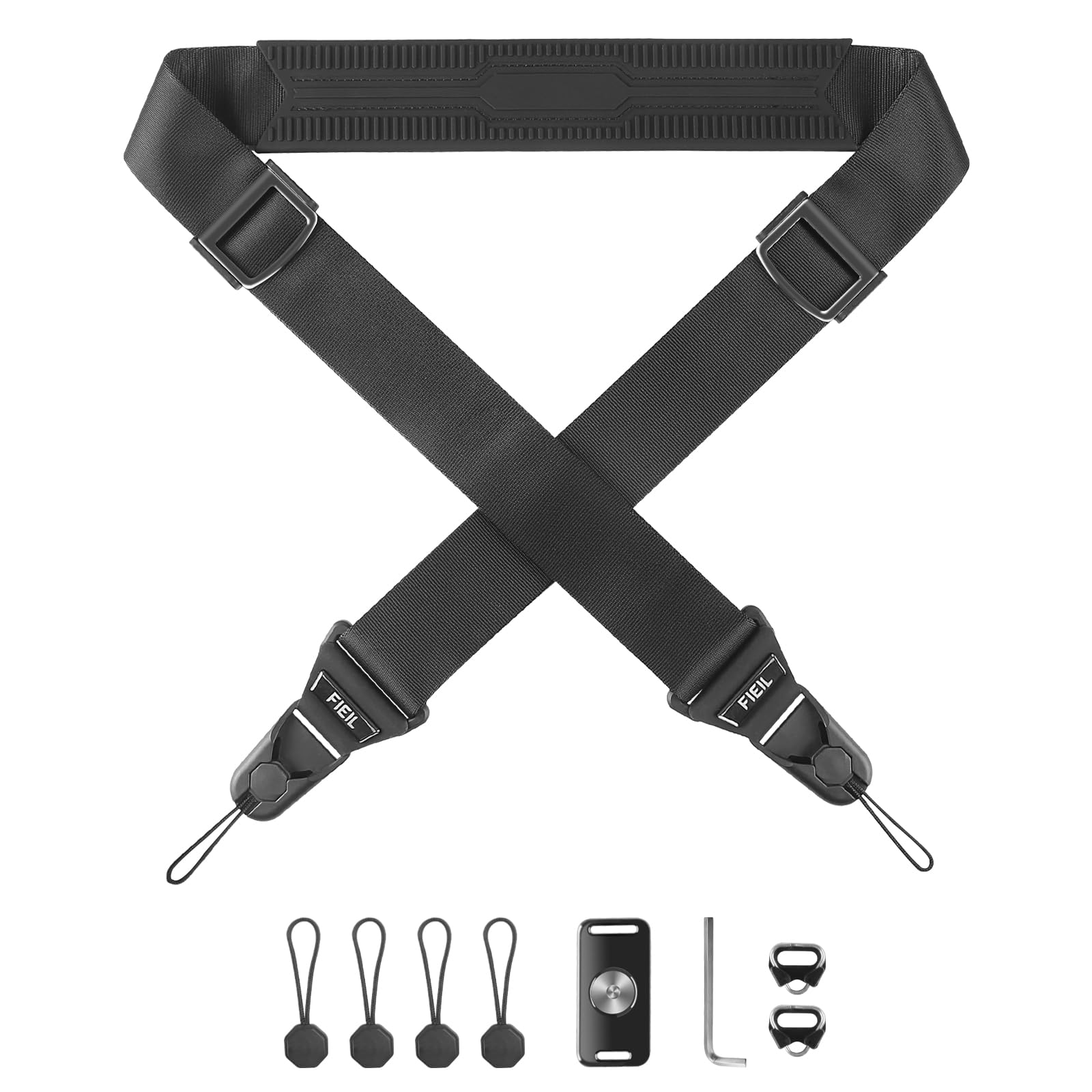
Double-layer nylon and a locking buckle that holds a full-frame body all day for entry-level money.
The safety mechanism is what separates this strap from cheap lookalikes. The quick buckle stays locked inside the connector until you press it, so the camera will not release no matter which angle the force comes from. That is the failure point on budget straps, and FIEIL solves it with a press-and-push lock you can work one-handed. The length adjusts from 41 to 63 inches, which covers neck, crossbody, and over-the-shoulder carry for most body types.
The shoulder pad is silicone, and the grippy surface keeps the strap from creeping off your shoulder when you lean down. Double-layer nylon with Hypalon rubber reinforcement at both ends handles the tension. Owners put it on heavy rigs and it holds: a Sony A7IV with a cage and telephoto is the kind of load people report using it with, and it works for a full day of shooting without complaint.
The one thing to think about is width. At 1.65in wide it is a substantial strap, and on a small DX-format body or a light mirrorless kit it can feel like more strap than camera. The silicone pad is also sewn in place, so it grabs hair if you wear it against skin. Neither is a dealbreaker — just a fit question.
What you get for the money: a locking buckle, 41 to 63 inches of adjustment, silicone grip, and nylon reinforced for heavy bodies.
The fit question: a wide 1.65in strap and a fixed silicone pad suit heavy rigs better than small, light bodies.
Pick it when: you want heavy-camera security and quick release without paying premium-brand money.
Pass it by when: you shoot a small mirrorless body and want a slim, unobtrusive strap.
6. FALCAM F38 Camera Strap Quick Release Kit

A 60g aluminum plate that lets the camera click free of the strap and onto a tripod in one second.
Most quick-release systems are one-directional. The FALCAM F38 plate slides into the flip-up clamp from all four sides — front, back, left, or right — so you are never hunting for the right alignment. The base lug holds up to 44lbs (20kg), and the plate carries an integrated rubber pad plus stainless steel and graphite nylon washers to stop the screw working loose on the move. That load rating is more than double what the ztowoto dual harness is rated for.
The whole point of this kit is the workflow. The base plate stays on the camera body and remains tripod-compatible. The quick-release portion stays on your strap and accepts the FALCAM clamp, so you can go from shoulder carry to tripod to bag without unthreading anything. The base attaches to a backpack strap, belt, or shoulder strap with a nylon cord and no tools at all. Photographers who swap between a short prime on a neck strap and a long lens hanging at the hip get the most from it.
The honest catch is the locking mechanism. The release takes some getting used to if you are clicking in and out constantly, and the clamp can jam if you are rough with it. It is a small, mechanical part — treat it with a little care and it works smoothly. Everything else is 6061 aluminum alloy at 60g (2.1oz), which adds no meaningful bulk to your setup.
The workflow win: four-way plate insertion, a 44lb (20kg) base rating, and tool-free mounting to a belt or backpack strap.
The thing to handle carefully: the release clamp wants a deliberate press — rush it and it can jam.
Best suited to: photographers who bounce between tripod, shoulder, and bag all day and want the camera to click free in a second.
Probably overkill if: your camera stays on your shoulder from start to finish.
7. OP/TECH USA Super Pro Strap B
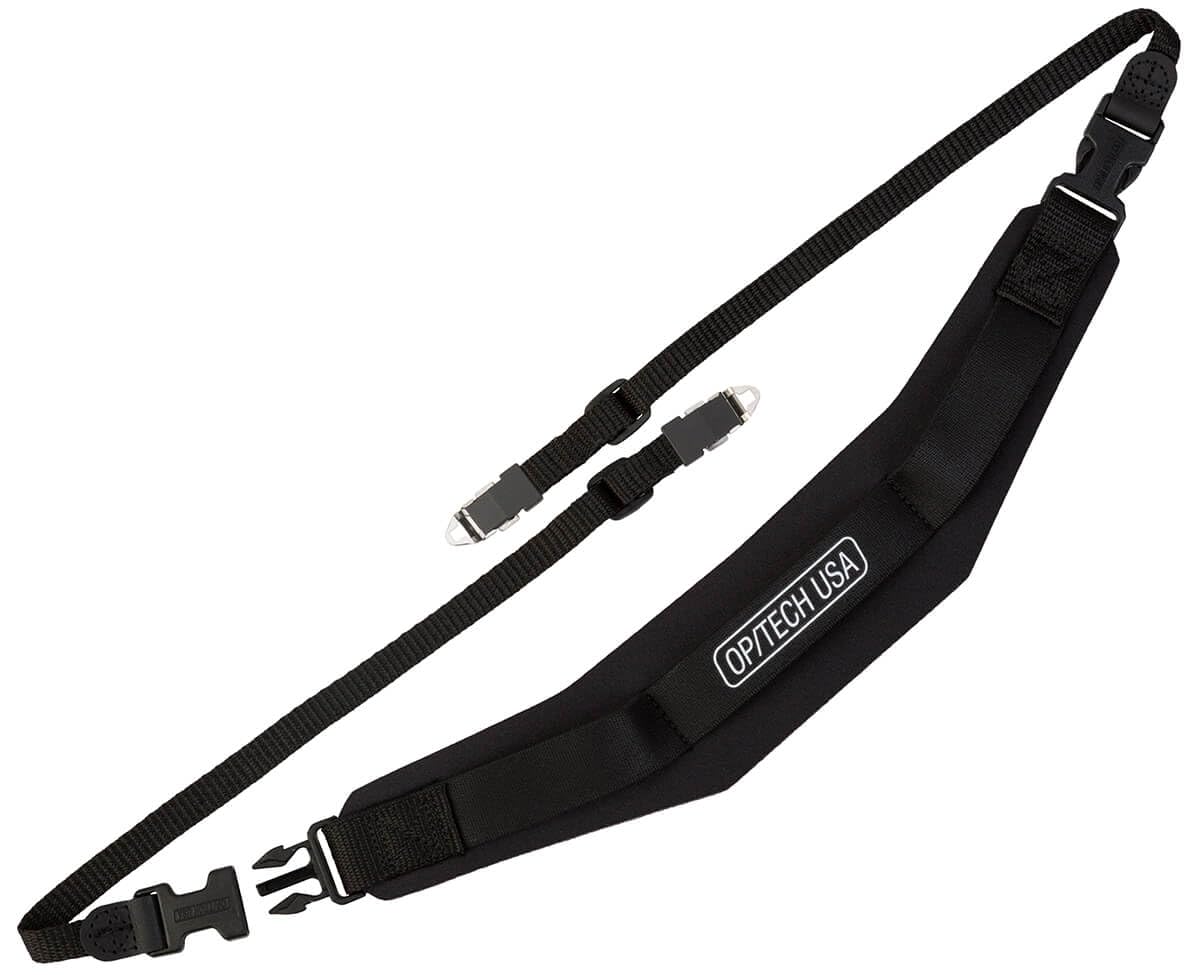
Built for post-lug bodies like Hasselblad and Mamiya, with soft neoprene that carries 15 lbs of medium-format gear.
Medium-format cameras have their own strap attachment — post-style lugs — and most modern quick-release straps simply do not fit them. The Super Pro Strap B uses Pro-Loop metal connectors designed for those posts, fitting Hasselblad, Mamiya, and Bronica bodies as well as other medium-format models. It supports up to 15 lbs, which covers a medium-format body with a large lens and prism attached.
The thick neoprene neck pad cushions a medium-format body, and the patented Non-Slip Grip keeps the strap from creeping off your shoulder. Owners of heavy bodies notice the difference: padding eases the weight of an RB67 or a Mamiya 645 enough to shoot handheld instead of tripod-only. The strap adjusts from 36 to 45 inches, and it integrates with OP/TECH’s Connection System so you can swap between cameras quickly. It is made in the USA and backed by a lifetime warranty against defects in materials and workmanship.
The one part that trips people up is attaching it. The spring-tensioned metal clip needs a deliberate wiggle to slip over the post, and the instructions are thin — the maker’s own video explains it better than the paper in the box. Once the clips are locked in, they hold firm. A plastic locking piece wedges under the rear tabs to keep everything seated.
Why medium-format shooters buy it
- Pro-Loop connectors fit post-style lugs on Hasselblad, Mamiya, and Bronica bodies
- Up to 15 lbs of support with thick, soft neoprene padding
- Removable foam pad swaps between cameras via heavy-duty clips
- Made in the USA, lifetime warranty
The learning curve
- Attaching the spring clip takes patience the first time
- Printed instructions are weak — look up the maker’s video
- Only fits bodies with post-style lugs
Made for: film and medium-format shooters with post lugs who need real weight support and genuine padding.
Wrong fit for: modern DSLR and mirrorless bodies that use standard slot lugs.
8. Padwa Lifestyle Tan Single Camera Harness Strap

Full grain tan leather in a single-camera harness that carries up to 45 lbs.
A harness changes how a camera feels on your body. Instead of one strap pulling on one shoulder, the Padwa sits across your back with a 2-inch wide padded shoulder section that spreads the load. The leather is 100% full grain cowhide, 1-inch wide, multi-layer stitched around the perimeter, and rated to carry a full-frame camera up to 45 lbs (20kg). For studio, wedding, and wildlife days where one body stays out the whole time, that is the right architecture.
The leather is what sells it. It has a glossy tan finish, and the section against your skin is suede, so the strap grips instead of sliding when you bend for a low angle. The leather smell and the color are the details that come up when people describe it — it looks like a considered piece of gear rather than a factory accessory. It is adjustable to fit photographers of any height, and the manufacturer notes it can serve as a gift for shooters.
Two things to know before you commit. Some shorter photographers find the harness runs large, and there is no smaller size listed — check the adjustment range against your height. The O-rings that hold the straps are the part to watch; a few have had one fail, so inspect them when you set it up. The leather is pure cowhide, so wipe it dry after rain or heavy sweat to avoid discoloration.
The full grain argument: 45 lbs of capacity in real cowhide, a 2-inch padded shoulder, and suede against skin to stop the slide.
Care it asks for: shorter shooters may find it oversized, the O-rings deserve a check, and the hide needs drying after rain.
Right match for: single-camera pros who want leather looks and shoulder-spread weight on long wedding or studio days.
Consider your height first if: you are on the shorter side — the fit runs large.
9. Peak Design Slide Lite Camera Strap

One strap that flips between sling, neck, and shoulder thanks to a two-sided webbing surface.
The trick with the Slide Lite is the webbing itself. One side glides smooth so the camera slides up to your eye in sling mode. Flip the strap over and the grippy silicone side holds it on your shoulder for neck carry. Add the one-hand quick-pull aluminum adjusters and the length changes on the fly without breaking stride. The 32mm seatbelt webbing carries without bulk, and the Anchor Link system lets you pull the strap off entirely for tripod work.
Construction is where this one earns its price. It is a crowd favorite at 4.5+ stars across 7,000+ ratings, and owners describe the hardware as tank-like. Those anchors are rated at 200 lbs with built-in wear indicators. A base plate with a screw mount lets you run it as a sling from the tripod socket, and two connection points give stability even with heavy gear. Owners mention the upgrade is immediate: “This is o much better than the default strap that shipped with my Sony RX-10M5! Comfortable, easily adjustable and easy to disconnect the strap from the camera. You may be able to get cheaper but you can’t get better, IMHO.”
The honest caveat is size. At 1.25 inches wide it is a substantial strap, and on a small mirrorless body it can feel like more than you need — the thinner Peak Design Leash is the better match there. The base plate screw can also back off slightly on a leather half-case, so check it now and then. Neither issue touches the core design, which is why it remains the versatile default for DSLR and mirrorless shooters.
Why it earns its price
- Two-sided webbing: glide side for sling, grip side for neck carry
- Quick-pull aluminum adjusters change length one-handed
- Anchors rated 200 lbs with wear indicators
- Base plate lets you run it as a tripod-socket sling
Where it needs a check
- 1.25-inch width is a lot of strap for a small mirrorless body
- The base plate screw can loosen slightly on a leather half-case
One strap, three carry modes: buy it if you want sling, neck, and shoulder from a single piece of webbing.
Try the thinner sibling if: you shoot a compact mirrorless body and want less strap on your shoulder.
10. BLACKRAPID RS-4 Retro Classic Camera Sling Strap

The original sling design, with the camera hanging at your hip and a swivel that follows your hand.
This strap hangs the camera upside down at hip level on a carabiner, so it travels at your side and swings up to your eye in one motion. That is why it exists, and why photographers carrying a 200-600mm zoom keep coming back to it. The pad is a thin, straight, low-profile foam piece with a nylon honeycomb overlay, worn over the shoulder on either side, and the CR3 swivel keeps the camera rotating freely instead of tangling. There is a small zip pocket in the pad for memory cards.
For long-lens days it is hard to argue with. The weight sits on the shoulder instead of the neck, and the front adjustment lets you shorten the sling when you climb or hike. Owners with neck arthritis report relief after switching from a factory strap, and the sling stays comfortable through four to six hours of continuous carry. The rubberized pad does not shift, the screw mount has not backed out over long use, and the included safety tether gives you a backup connection.
The RS-4 is not without personality. Without the under-arm strap, the pad can shift when you lean far forward — a small strip of grip tape fixes it. The metal carabiner can knock against the camera body if you are not paying attention, and it is worth adding a third-party tether for extra security. At 150g it is light, but it is not the strap for someone who wants a camera tight against their chest.
Go for it if: you shoot with a long zoom and want the camera at your hip, ready to swing up without neck strain.
skip it if: you prefer the camera snug on your chest or are bothered by a metal carabiner near the body.
11. ztowoto Double Shoulder Camera Strap Harness

Two cameras, both shoulders, and a back pad that takes the swing out of the second body.
Carrying two DSLRs is a specific problem: one body always ends up swinging. This harness solves it with a force pad at the back waist, which spreads the pull across your back and reduces how far the front cameras swing when you bend or climb. The strap is neoprene with a sandwich net layer — the neoprene compresses to take the bounce, and the net keeps air moving against your back. It holds up to 5kg total, with two quick-release plates, two standard 1/4 screws, and two safety tethers in the box.
You get two straps in one: the harness splits into two single shoulder straps for days when you only carry one camera. It also adjusts widely enough to fit a range of body types. One owner reported it fitted a plus-size frame with a large chest without issue. Another carried a Nikon Z7ii with a 24-120mm on one side and a Z8 with a 180-600mm on the other, all day, with the back and shoulder strain gone. The safety tethers add a second connection per camera — the thing you want on a dual rig.
The honest limit is the 5kg rating. That is the lowest in this roundup, and it is below the 10kg the SmallRig leather strap is rated to. If your two bodies both wear heavy glass, you are near the ceiling and the plastic connectors are the part that will tell you first. Keep your loads moderate and use the safety tethers.
What two-camera shooters get: a back pad to tame the swing, neoprene padding, and two safety tethers in the box.
The number to respect: 5kg total — fine for two moderate rigs, tight if both bodies wear long glass.
Made for: event and birding shooters running two bodies who want both cameras reachable and the weight spread across their back.
Double-check your load if: both cameras wear heavy zooms — the 5kg rating is the tightest here.
Know the Specs
Load Rating in kg and lbs
The load rating is the most important number on any strap. It tells you how much camera and lens weight the connectors and webbing are built to carry — look for both the kg and lbs figures, since makers quote them differently. Buy a strap rated well above your heaviest body-and-lens combo. A strap working at its ceiling wears faster and gives you no margin if you add a battery grip or a flash.
Quick-Release Connectors
Quick release lets you detach the camera from the strap in a second for tripod, gimbal, or bag work. The common types are cord anchors with wear indicators (Peak Design Anchor Link), press-and-push buckles, and Arca-Swiss plates that click into a clamp. Each adds a small mechanical part to check, so read the connector’s own rating and inspect it periodically.
Neck Strap vs Sling vs Harness
A neck strap hangs the load on your neck and suits light rigs. A crossbody strap or shoulder sling moves the weight to your torso and keeps the camera at hip level for fast access. A dual harness splits two bodies across both shoulders. Choose the carry style that matches your longest shooting day, not your shortest walk.
Materials: Leather, Neoprene, Dyneema
Full grain leather grips well and ages into a look, but can be stiff at first and needs drying after rain. Neoprene compresses to spread pressure, which is why heavy-camera shooters favor it. Dyneema fiber is a tear-resistant synthetic rated for very high loads, and some straps build in a yellow wear layer that shows through when replacement is due.
Common Questions
Will a quick-release strap fit my DSLR’s strap lugs?
What load rating do I need for a DSLR with a heavy zoom?
Is a wrist strap better than a neck strap for a DSLR?
Can I use the same quick-release anchors on more than one camera?
Does a leather camera strap stretch or crack over time?
How do I stop a sling strap from bouncing against my body?
What is the difference between an Arca-Swiss plate and a cord anchor?
Will a padded neoprene strap fit a small mirrorless body without feeling huge?
Can I carry two DSLR cameras without neck pain?
Do the anchors wear out, and how will I know?
What does a medium-format strap need that a DSLR strap does not?
The Bottom Line
For most photographers, the dslr camera straps winner is the Peak Design Cuff because a 90kg-rated Anchor Link cord gives you hands-free carry without hanging weight on your neck. It is the crowd favorite too, at 4.5+ stars across 13,000+ ratings. Do check that rating math against your own kit — a wrist strap suits mirrorless and compact bodies, not a full-frame DSLR with a long telephoto.
If your camera lives on your shoulder rather than your wrist, the Peak Design Slide Lite gives you sling, neck, and shoulder carry from one strap with 200 lb anchors. For long-lens shooters who want the camera at hip height, the BLACKRAPID RS-4 is the sling that started the pattern. And if you shoot two bodies at events, the ztowoto Double Harness spreads both cameras across your back for a fraction of the price of premium rigs.
How we choose
We do not accept paid placement. Every pick is matched to a real buyer and a real use-case; we do not hands-on test units.
Sources
Specifications: manufacturer listings and product documentation. Review insights: verified customer reviews, as of October 2026. Pricing: not shown on this page (it changes often); check the current price via the retailer link.
As an Amazon Associate, Aappliancez earns from qualifying purchases. This does not affect which products we feature.