Disclosure: Some links in this post are affiliate links. As an Amazon Associate I earn from qualifying purchases, at no extra cost to you. Learn more
Specs are compiled from manufacturer listings and verified buyer reviews and can change over time — please confirm the key details on the product page before buying.
If your knives are tearing tomatoes instead of slicing them, the quickest fix is a diamond stone — and the one that suits most kitchens is the SHARPAL 127N, a pocket-sized two-grit tool that sharpens dry and slips into a drawer. Diamond wins here because its abrasive is hard enough to cut modern super steels like D2 and M390 that ordinary whetstones only polish.
This guide is built by comparing the manufacturers’ published specifications and the patterns across verified customer reviews, so you get each pick’s real strengths and trade-offs instead of marketing spin.
Shopping this shelf is easier once you know two things: a diamond stone never needs flattening, and grit numbers decide whether you repair or refine. The picks below cover every budget and blade, so you buy only the stone your knives actually need.
Top Picks

How To Choose The Best Diamond Sharpening Stone
Every diamond stone on this list does the same basic job — grinding steel against hard diamond particles so the edge comes back. What separates them is the grit pairing, the working size, and what ships in the box. Get those three right and one stone covers your knives for years.
Match the grits to the blades you actually own
Grit is a number that tells you how coarse the abrasive is — lower numbers cut faster and leave a rougher edge, higher numbers polish. A stone with a 325 side and a 600 or 1200 side covers both repair and refinement in one tool. If your knives are only lightly used, a fine/extra-fine plate can be all you ever touch.
Buy enough surface for your longest blade
A stone noticeably shorter than your chef’s knife forces you to sharpen in sections, which is where edges go wavy. An 8-inch working surface suits most kitchen knives in one smooth stroke. Pocket-sized files trade that surface away for portability — a fair swap if the stone lives in a backpack rather than on a counter.
Weigh what comes in the box
The included extras decide how fast a beginner improves. An angle guide holds the blade at a repeatable tilt so a beginner’s edge matches a veteran’s. A stable base or non-slip pad keeps the stone from walking across the counter mid-stroke. A leather strop, where included, strips the tiny burr off a finished edge.
Side-by-Side Comparison
| Model | Best For | Grit Pair | Working Size | Included Extras | Amazon |
|---|---|---|---|---|---|
| SHARPAL 127N★ Best Overall | Pockets, packs and toolboxes | 325 / 1200 | 8.43″ x 1.38″ | Leather sheath that doubles as a strop | Amazon |
| DMT DuoSharp (Fine/Coarse)Bench Standard | Bench work on chisels and knives | 325 / 600 | 8″ plate on a base | Standard base | Amazon |
| Goodjob 3-Sided 400/1000/8000 | One-kit kitchen sharpening | 400 / 1000 / 8000 | 10.35″ x 4.15″ | Angle guide and non-slip base | Amazon |
| SHARPAL 168H | Freehand work on wide blades | 325 / 1000 | 8″ x 3″ | 4-angle guide and non-slip pad | Amazon |
| Schaaf Tools V3-OT0P-325 | Chisels, plane irons and gouges | 325 / 1200 | 8″ x 2.75″ | Chisel jig, 3-angle guide, spray bottle | Amazon |
| Schaaf Tools (older kit) | Value woodworking setup | 325 / 1200 | 8″ x 2.75″ | Base, angle guide, spray bottle | Amazon |
| DMT DuoSharp Plus (Extra Fine/Fine) | Polishing and touch-ups | 600 / 1200 | 8″ plate on a base | Standard base | Amazon |
Detailed Reviews
1. SHARPAL 127N Dual-Grit Diamond Sharpening Stone File
Our pick — over 4.5★ from 800+ verified ratings; the strongest balance of quality and price.
A two-sided diamond file that sharpens dry on a stump, a knee, or a countertop.
The 127N is the one to grab if your sharpening happens away from a bench. It pairs a coarse 325 grit (a 45 micron abrasive — the scratchy side that rebuilds a dull or chipped edge) with an extra-fine 1200 grit (a 12 micron surface that hones the edge smooth). Two surfaces, one tool, and no oil or water soaking before you start.
What makes this the easiest of the group to live with is the shape. At 8.43″L x 1.38″W x 0.51″H and just 160 g, it rides in a pocket or a pack. That is a fraction of the bulk of the DMT DuoSharp at 516 g, which is a bench tool you leave at home. The ergonomic grip and full-tang stainless handle let you brace the stone on whatever is handy and keep your angle steady without a clamp.
The genuine cowhide sheath is not just packaging — flip it over and it works as a leather strop that polishes the burr off a finished edge. Buyers report: “Corse side will certainly shape up your blade and fine side really hones the edge nicely.” Owners also put pocket knives that were “way past due” back into rotation, and campers like the heavy side for an axe and the lighter side for a finer edge. The recurring note is simply that it does not replace a full bench setup for long sharpening sessions.
What earns its place in a kit
- 325 and 1200 grits in one 160 g tool — repair and polish without a second stone
- Sharpens dry, so no oil, no water, and no mess on a campsite or a kitchen counter
- Leather sheath doubles as a strop to strip the burr off a finished edge
- Full-tang stainless body with an ergonomic grip stays steady braced on a stump or counter
Where it asks you to compromise
- The narrow 1.38″ working width means long chef’s knives get sharpened in sections
- It is a field tool first — a dedicated bench setup suits long sessions better
Made for: hunters, campers, gardeners and anyone who keeps a pocket knife on them and wants a stone that travels.
Think twice if: your sharpening station is a fixed bench and you want a wide 8-inch plate bolted in place.
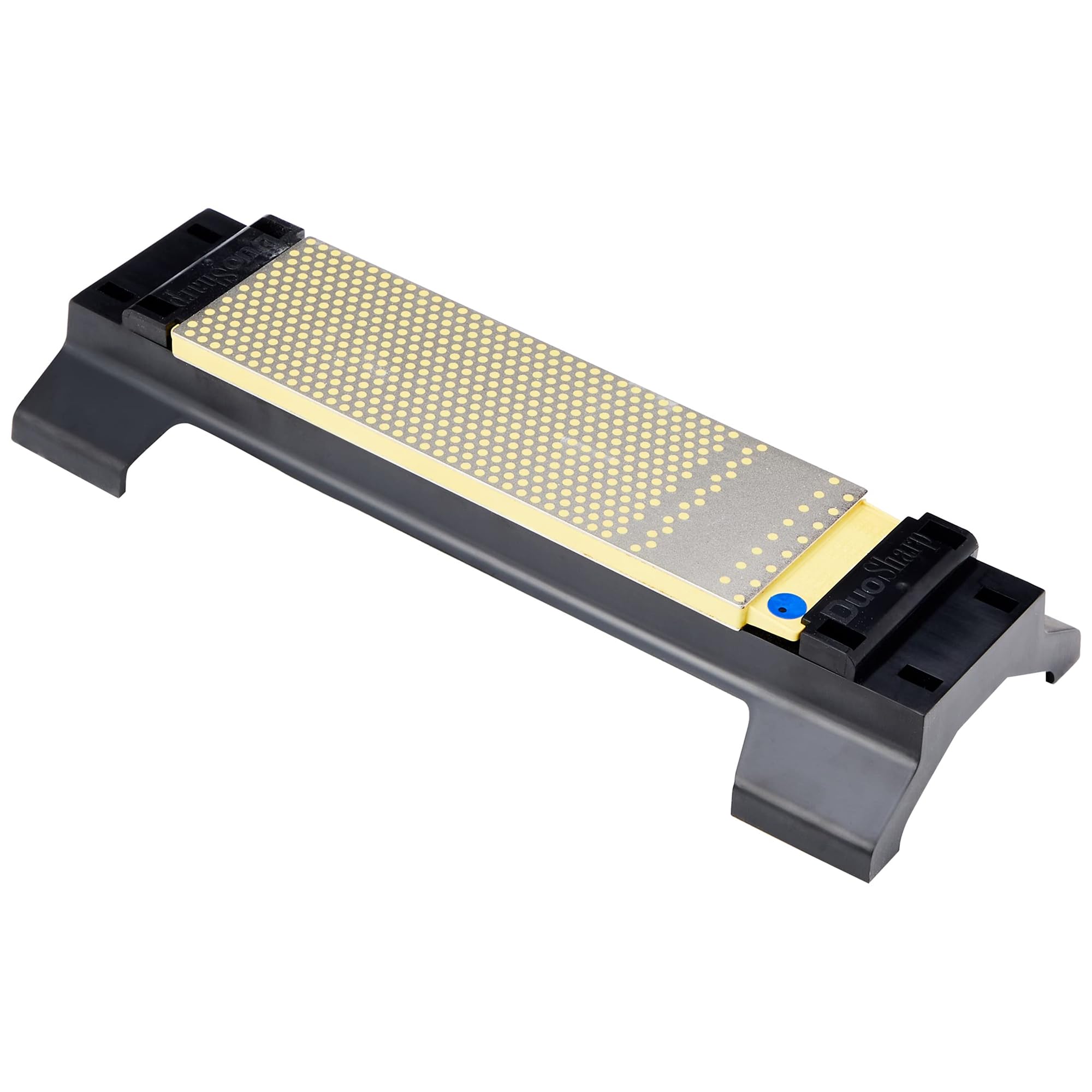
2. DMT DuoSharp Double-Sided Diamond Whetstone
An American-made 8-inch bench plate that brings a neglected kitchen knife back to a razor edge in minutes.
DMT’s 8-inch plate gives you a coarse 325 mesh side (45 micron) to pull a damaged edge back into shape and a fine 600 mesh side (25 micron) to finish it. The continuous diamond zone even handles small pointed tools other stones struggle to reach. Splash water on it or sharpen dry — either way there is no oil to clean up afterward.
The signature feature is DMT’s polka-dot surface pattern — a grid of tiny wells that trap metal debris so fresh diamond keeps meeting the blade. Those wells keep metal debris off the cutting surface, so the diamond keeps biting instead of clogging. It is a genuinely different working feel from the solid, full-surface plates elsewhere in this list.
What owners keep returning to is the raw result: bringing knives back to factory sharpness and hitting a razor edge quickly, with the supplied directions making the first session easy. One buyer put it plainly: “I use this on everything from K390 to D2 steel & get excellent results across the board.” The honest trade-off, and the one gripe that recurs, is durability of the interrupted surface — a few owners note the diamond wears toward a smoother, less aggressive feel after heavy use, and that the wells are fussier to clean than a flat plate.
The performance story: users report sharpening pocket, chef and camping knives to a razor edge in around five minutes, and using light pressure to preserve the blade steel rather than grinding it away.
Pick this if: you want a proven bench stone for hard modern steels and do not mind learning the polka-dot surface’s quirks.
Look past it if: you would rather have a single continuous diamond face that wipes clean and gives you nothing to think about.
3. Diamond Sharpening Stone, 3-Sided Grit 400/1000/8000
Three grits stacked into one block, with the sharpening angle built right into the base.
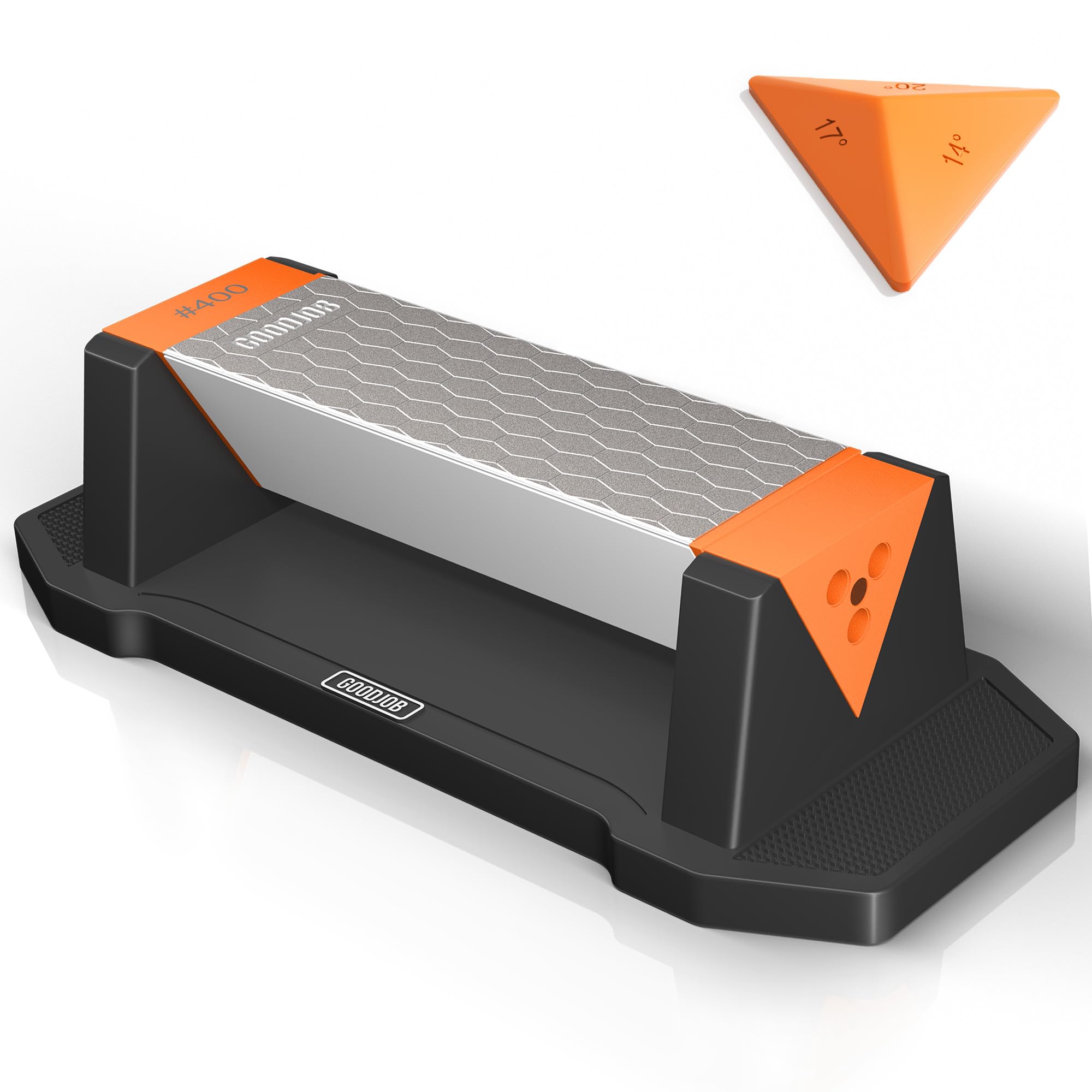
Where a dual-sided stone gives you two options, this one stacks three surfaces: a 400 grit diamond for repairing chipped or dull blades, a 1000 grit diamond for daily honing, and — the unusual part — an 8000 grit ceramic side for mirror-level polishing. That 8000 grit ceramic side leaves an edge that glides through a ripe tomato’s skin instead of crushing it.
The built-in angle guide locks 14, 17 and 20 degrees, which is what makes this the gentle intro for a beginner who has never held a stone before. A wide non-slip plastic base keeps it stable, and the whole thing only needs water or a drop of honing oil before you start. Cleanup is a rinse and a wipe, then it stores flat in a drawer.
What wins people over is how hard the diamond bites: it works faster than the traditional whetstones many buyers upgraded from, and it handles all steel hardnesses, from everyday kitchen knives to carving tools. The one honest catch is the base — most owners find it stays put, but the stability of that base is the most-noted mixed point in the reviews, so plant a hand on the block if you are pressing hard. The angle guide is similarly a nice starter aid rather than a precision tool.
Best beginner’s move: this gives a new sharpener three grits and a working angle guide in one purchase, so there is nothing else to assemble before the first knife.
Reach for it if: you are starting from zero and want the trio of repair, hone and polish grits with a guided angle.
Not the one if: you sharpen a lot of long blades and need a plate wider than this compact block.
4. SHARPAL 168H Large 8″ x 3″ Dual-Grit Diamond Sharpening Stone
Extra bench width plus a verified-flat surface make this the freehand sharpener’s pick.
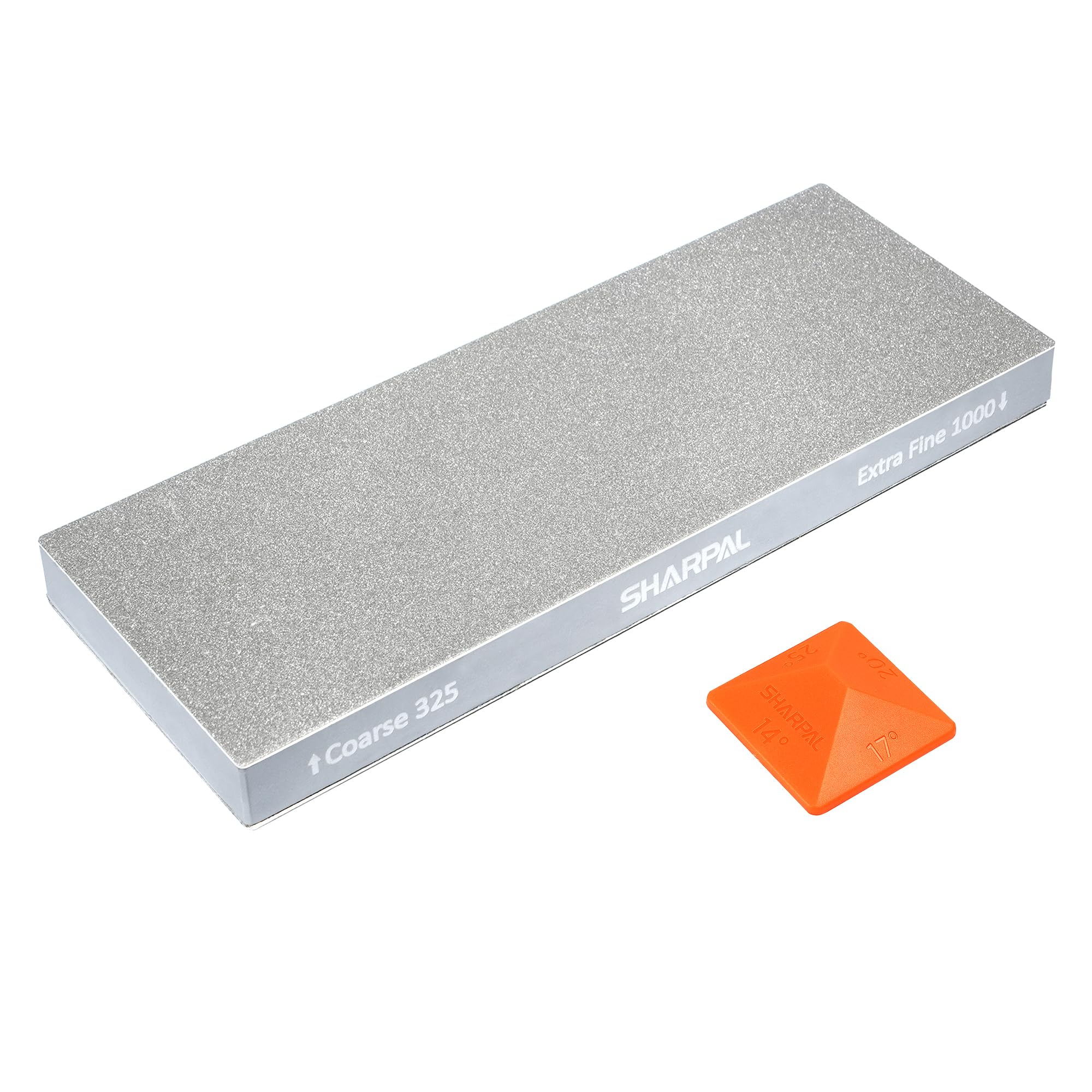
This is the SHARPAL line’s big sibling. It runs a coarse 325 grit (45 micron) to reset a dull edge and an extra-fine 1000 grit (15 micron) to hone it, on a full 8″ x 3″ face. That wider, long plate lets a chef’s knife sit and sweep in one pass rather than being worked in short overlapping strokes.
The MirrorFlat technology is the spec that matters most here. The surface is precision-ground flat to ±0.002 inch (0.05 mm), so the abrasive bites the blade evenly and you are not fighting a surface that’s cupped. SHARPAL anchors the diamond with a Three-Times Electroplating Process — that is the layer that holds the grit in place — so the plate keeps cutting under pressure. It ships with a 4-angle guide (14, 17, 20 and 25 degrees) and a non-slip pad.
Then there is the raw speed. Users report restoring a bad angle in about two minutes and hitting razor edges fast, which tracks with their description of it as a maintenance tool for working knives. The honest catch — and it is the one mixed point in the reviews — is cleaning. Diamond particles embed swarf, and while a wipe-down keeps the surface working, a deep clean takes more effort than the field-friendly file up top.
Workhorse verdict: pair this with a leather strop to finish an edge, and you have a maintenance station that handles everything from touch-ups to full reprofiling.
Suits you if: you sharpen on a counter or bench, want the flat-ground precision, and value speed over portability.
Skip if: your sharpening has to happen far from a work surface, where the compact 127N above is the smarter travel shape.
5. Schaaf Tools Diamond Sharpening Stone, 325/1200
A near-complete sharpening station for woodworkers and chefs who want everything in one box.
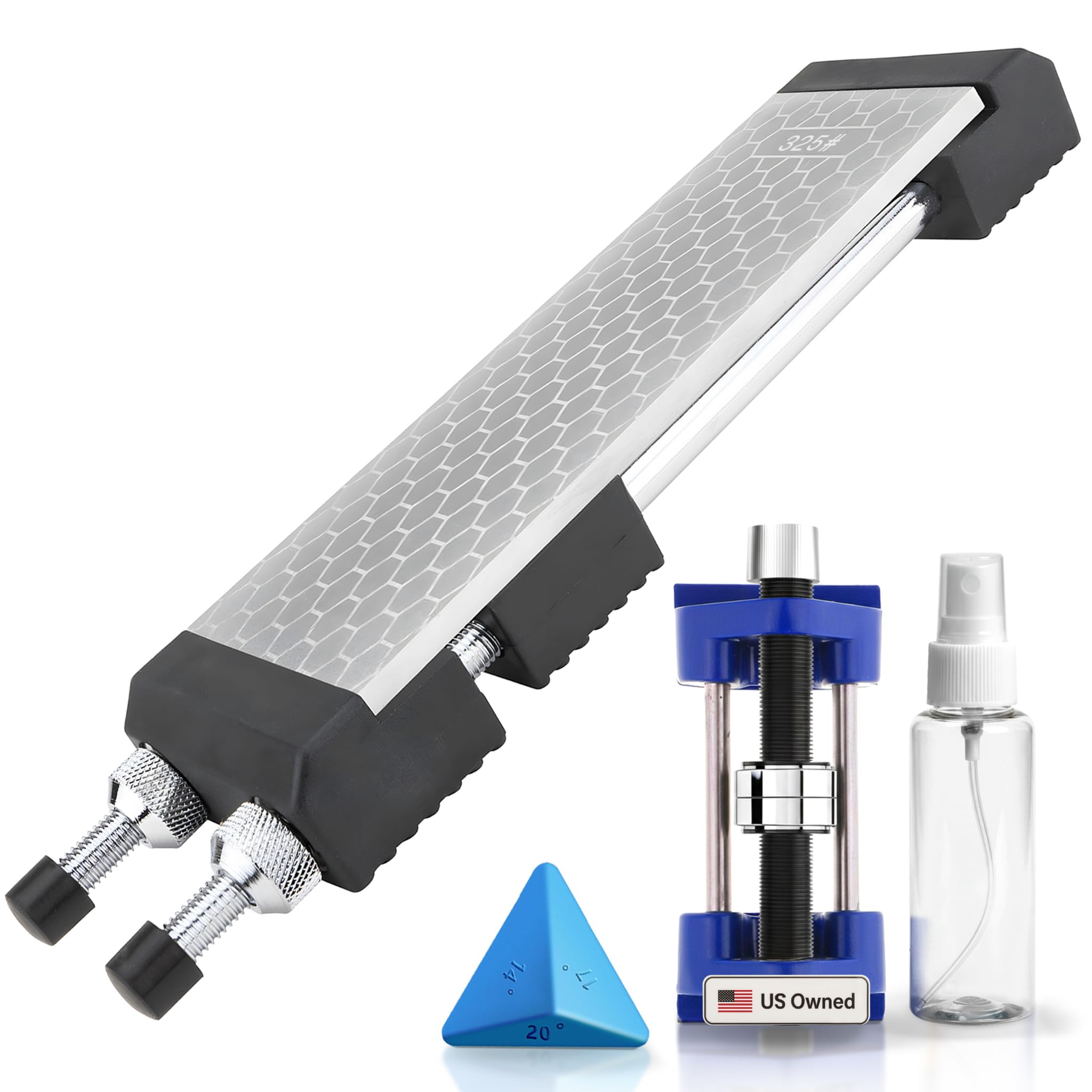
Start with the plate: an 8″ x 2.75″ dual-grit diamond surface running 325 coarse for fast edge restoration and 1200 extra fine for finishing. The diamonds are electroplated onto solid steel with a honeycomb surface that resists clogging, so the flat face stays flat through regular workshop and kitchen use.
What separates this kit from the pack is the accessories. You get an adjustable base with non-slip rubber feet, a 3-sided angle guide set to 14, 17 and 20 degrees, a chisel sharpening jig for chisels from 1/8″ to 1-7/8″ and plane irons from 1-3/8″ to 3-1/8″, plus a spray bottle for light wet work. That jig is the piece a hand-tool woodworker will actually use — it holds a chisel dead square so the edge comes up even.
Owners say the thing everyone raves about is raw quality and speed: it removes material efficiently and restores chipped ceramic knives and bench plane blades to paper-slicing edges. The recurring gripe is flatness — the 1200 side occasionally arrives with a slight hollow, which is why a few buyers pair it with a strop rather than trusting it for a final polish. That is a small reality check on an otherwise capable kit.
Why woodworkers rate it
- Ships as a system — plate, adjustable base, angle guide, chisel/plane jig and spray bottle all included
- 325 and 1200 grits handle both damage repair and fine finishing on one surface
- Honeycomb surface resists clogging and keeps the diamond plate flat
- Non-slip rubber feet and an adjustable holder keep it steady during heavy work
The honest catches
- A couple of owners find the 1200 side slightly hollow and finish on a strop instead
- At 2.1 pounds it stays put on a bench but is not a field tool
Right for: woodworkers and serious cooks who want a single box that sharpens chisels, plane irons, gouges and knives.
Consider the DMT DuoSharp instead if: you only ever sharpen kitchen blades and do not want the chisel jig extras.
6. Schaaf Tools Diamond Sharpening Stone, 325/1200 (V3-OT0P-325)
The same Schaaf plate and holder most buyers are already happy with, in the earlier kit.
You are looking at an 8″ x 2.75″ dual-grit plate — 325 coarse to restore an edge and 1200 extra fine to finish it — mounted on an adjustable base with non-slip feet. Diamond is electroplated onto solid steel with the same honeycomb anti-clog surface, and it runs dry or with a light water spritz instead of a long soak.
The reason this keeps earning praise is how fast the fine side works once the plate settles in. Owners describe the 1000-grade side cutting quickly and leaving an edge a strop can refine to razor-level, and they call out the holder for making freehand sharpening genuinely manageable. If you compare it directly to the cheaper clone it was frequently measured against, the Schaaf wins on the holder — better knurled hardware that feels more secure — though the two plates themselves are described as near identical.
The fair caveat shows up around grit accuracy. One detailed buyer found the fine side felt coarser than its 1200 label suggests, and another noted a persistent scratch pattern that a strop smooths out. Neither ruins the kit for real work, but if you want a polished edge straight off the stone, budget for a couple of passes on leather afterward.
Who this serves: anyone restoring chisels, plane irons or kitchen knives who wants a flat diamond plate and a solid holder without paying for the full jig kit.
Strong buy if: your priority is a grab-and-go diamond plate with a holder that stays put for freehand work.
Step up if: you specifically need the chisel jig, in which case the full Schaaf kit a spot above is the better fit.
7. DMT DuoSharp Plus Bench Stone (Extra Fine/Fine, WM8EF-WB)

The two finest grits DMT makes, on one wide bench plate for finishing and polishing.
Unlike the coarse/fine DuoSharp, this Plus plate is a touch-up and finishing tool. It pairs a fine 600 mesh side (25 micron) to start honing an edge with an extra-fine 1200 mesh side (9 micron) to refine and polish it. No coarse side means no heavy metal removal — the payoff is a finer, keener bevel than a single grit can deliver.
The surface is DMT’s micronized monocrystalline diamond, the same polka-dot interrupted pattern that traps debris so the diamond keeps cutting clean. Because the two faces sit on a large flat plate, you have room to keep a long chef’s knife moving in one continuous stroke — the size owners describe as perfect for big kitchen blades.
This is the stone for someone who already has freehand technique and just wants to maintain sharp steel: a chef’s knife restored in a few dozen strokes and an edge back to tomato-slicing sharpness without breaking out the whole progression. The honest note is that a no-coarse setup cannot fix a chipped edge or reprofile a badly worn blade — that needs a coarser stone first, so this is a finisher, not a rescue tool.
Final-edge perspective: treat it as the last two steps in a system and it delivers a polished, consistent edge on practically any steel; expect long sessions of grinding out damage and you will want a coarser plate alongside it.
Best for: experienced freehand sharpeners maintaining already-sharp knives and tools who want a fine/extra-fine finishing plate.
Not the first buy if: you still have chips and dull edges to remove — start with a coarse/fine stone like the DuoSharp, then refine here.
Know the Specs
Grit Numbers And What They Do
A grit number tells you how coarse the sharpening surface is — lower numbers cut faster and leave a rougher edge, higher numbers smooth and polish. A 325 grit side, for example, is a 45 micron abrasive that quickly rebuilds a dull or chipped edge. A 1200 grit side is a 12 to 9 micron surface that hones a finished edge to razor sharpness. Most kits pair one low number with one high number so you can repair and refine on the same tool.
Micron, Mesh And Why Both Appear
Micron and mesh are two ways of describing the same abrasive size, which is why a single stone often lists both — a “325 mesh / 45 micron” side, for instance. Micron measures the physical particle size in thousandths of a millimeter; mesh counts how many particles fit through a screen. You do not need to convert between them. Just treat the micron figure as the more precise ranking when comparing two diamond plates side by side.
Common Questions
Do I need oil or water with a diamond sharpening stone?
What grit do I need for a dull or chipped kitchen knife?
Will a diamond stone work on hard super steels like D2 or M390?
Does a diamond stone need to be flattened like a water stone?
Is a 1200 grit side really 1200 grit?
What is the difference between monocrystalline and polycrystalline diamond?
Can I use these stones on ceramic knives and scissors?
How do I keep a diamond plate cutting like new?
Should I pair a diamond stone with a leather strop?
Is a wider stone better for a chef’s knife?
The Bottom Line
For most people, the best diamond sharpening stone is the SHARPAL 127N, because two grits, a strop sheath, and dry sharpening cover nearly every blade you own in a tool that fits a pocket. If you sharpen at a fixed bench and want verified-flat precision, reach for the SHARPAL 168H. And if you sharpen woodworking tools, the Schaaf Tools kit is the one to grab.
How we choose
We do not accept paid placement. Every pick is matched to a real buyer and a real use-case; we do not hands-on test units.
Sources
Specifications: manufacturer listings and product documentation. Review insights: verified customer reviews, as of October 2026. Pricing: not shown on this page (it changes often); check the current price via the retailer link.
As an Amazon Associate, Aappliancez earns from qualifying purchases. This does not affect which products we feature.