Disclosure: Some links in this post are affiliate links. As an Amazon Associate I earn from qualifying purchases, at no extra cost to you. Learn more
Specs are compiled from manufacturer listings and verified buyer reviews and can change over time — please confirm the key details on the product page before buying.
Buying a jet pump depends on one question you can answer before you spend anything: how deep is your water, and how many sprinkler heads do you need to feed? A pump rated for a 25-foot well cannot pull from a 90-foot one, no matter how big its motor is. Match the pump to your well depth first, then worry about horsepower and flow. The nine picks below are sorted so you can find your depth in seconds.
This guide is built by comparing the manufacturers’ published specifications and the patterns across verified customer reviews, so you get each pick’s real strengths and trade-offs instead of marketing spin.
A cast iron jet pump, properly primed, will move water out of a shallow well for years. Budget-tier models do the job for garden irrigation, mid-range units add dual-voltage flexibility and bigger pressure tanks, and premium picks push suction depth and flow rate much further. This breakdown covers what actually matters so you can choose a deep well jet pump without guessing.
Top Picks

How To Choose The Best Deep Well Jet Pump
Two numbers eliminate most of the wrong pumps for you: the depth of your water and the flow rate you need. Get those two wrong and no amount of horsepower rescues the setup. Everything else — voltage, tank size, pipe threads — is a detail you tune around those two figures.
Match suction depth to your actual water level
A shallow well jet pump pulls water up from a well up to roughly 25 feet deep. Push past that and the pump simply loses its grip, which is why a convertible jet pump with an ejector kit exists — it handles the deeper 26-to-50-foot range by sending part of the assembly down the well. Units like the Hallmark MA0419X-12A go much further, reaching a maximum lifting height of 420 feet because they are submersible and sit down in the water rather than sucking from above. Measure your static water level and your pump setting depth before you buy anything.
Size the flow rate to your sprinkler zones, not your ego
Flow rate is measured in GPM, meaning gallons per minute. If you run a lawn irrigation system, add up how many heads fire at once in a single zone and how much water each one needs, then buy above that total. A pump rated at 13 GPM at 30 PSI can comfortably feed a modest set of garden heads, while a 69.99 GPM unit handles large-volume work. Bigger flow with a small well can also pull your water level down faster than it recovers, so size to your well’s recharge rate.
Understand the pressure switch before you blame the pump
The pressure switch is the small box that turns the motor on at a low pressure point and off at a high one. A 20/40 setting means the pump kicks in at 20 PSI and stops at 40 PSI, while a 30/50 setting gives you a stronger shower and better hose reach. This is the single easiest thing to adjust, and it is the reason two owners with the same pump can report completely different water pressure at the tap.
Side-by-Side Comparison
| Model | Best For | Horsepower | Max Lifting Height | Flow Rate | Amazon |
|---|---|---|---|---|---|
| Aquastrong 115V Shallow Well Garden Pump★ Best Overall | Garden irrigation and home water supply | 1.6 hp | 164 feet | 22 gpm | Amazon |
| WAYNE SWS100 1 HP Cast Iron Shallow Well Jet PumpTop Performer | Shallow wells up to 25 ft | 1 hp | 25 feet | 510 gph (50 psi) | Amazon |
| Acquaer Shallow Well Jet PumpBest Value | Compact shallow well replacement | 1 hp | 180 feet | — | Amazon |
| BOMGIE 1HP Shallow/Deep Well Jet Pump with Ejector Kit | Deeper wells up to 50 ft | 1 hp | 164 feet | 23.3 gpm | Amazon |
| Hallmark Industries MA0419X-12A | Very deep wells, submersible | 2 hp | 420 feet | 35 gpm | Amazon |
| Red Lion RL-SWJ75 | Small homes and cottages | 0.75 hp | 25 feet | 13 gpm | Amazon |
| WAYNE CWS50-1/2 HP Convertible Jet Well Pump | Deeper wells 25–90 ft | 0.5 hp | 80 feet | 6.8 gpm | Amazon |
| AQUASTRONG 1.5 HP Shallow Well Jet/Centrifugal Pump | High-volume lawn sprinkler systems | 1.5 hp | 108 feet | 69.99 gpm | Amazon |
| Red Lion RL-SPRK150 Sprinkler/Irrigation Pump | Large multi-zone irrigation | 1.5 hp | 25 feet | 71 gpm | Amazon |
Detailed Reviews
1. Aquastrong 115V Shallow Well Garden Pump
Our pick — over 4★ from 250+ verified ratings; the strongest balance of quality and price.
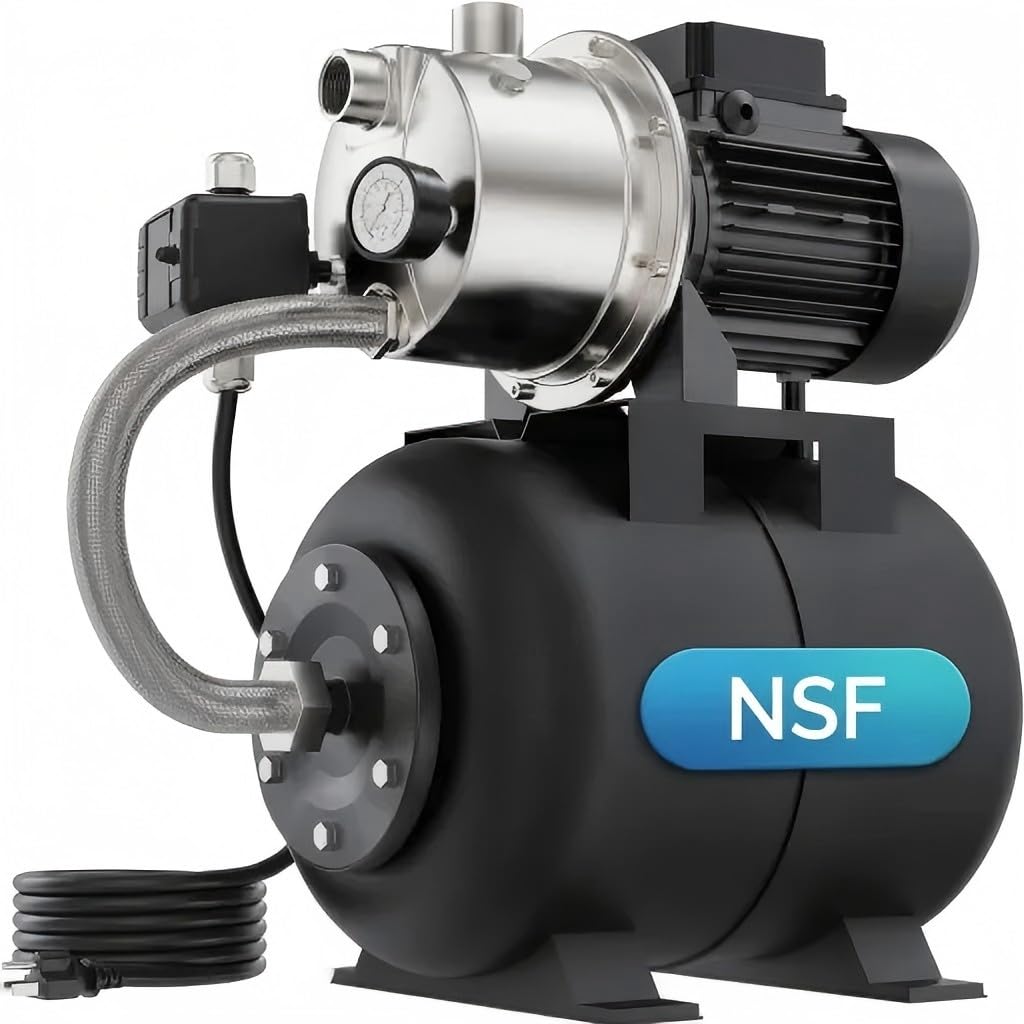
A 1.6 hp stainless-steel workhorse that arrives pre-assembled with its own pressure tank.
If your well sits shallow but your water demand is steady — a cabin, a farmhouse, two showers running at once — this is the pump to beat. It draws a strong suction up to 26ft and pushes a maximum flow of 1340 GPH with a maximum head of 164ft, and it ships with a compact 5-gallon pressure tank already bolted on. That tank is the reason your tap doesn’t stutter every time the motor cycles. The 1.6 hp rating is the highest horsepower of any shallow well pick here — the Acquaer runs 1 hp, which is 60% less on the spec sheet, and that matters when you’re feeding a whole house rather than a single garden zone.
The build is the other half of the story. A stainless steel casing resists corrosion far better than plain cast iron in damp basements and pump houses, and the whole system carries NSF certification, meaning the materials meet the quality and safety requirements for drinking water applications. That’s a real difference if the pump feeds household taps, not just sprinklers. It runs on 115V, so a standard household circuit works, and the 6.5′ UL power cord means you’re not immediately rewiring anything.
What wins people over is how quickly it gets water moving — buyers report filling a 5000-gallon rain tank and running 60ft from a well without losing pressure. As owners put it: “This is a great pump, had 1 small issue and customer service was great!! We use this on a cistern in colorado daly to supply water to 2 rvs.” That’s a homeowner running a full supply line off a cistern, and it held.
The case for this one
- 1.6 hp motor with a maximum lifting height of 164 feet and a maximum flow of 1340 GPH
- Stainless steel casing with NSF certification for drinking water applications
- 5-gallon pressure tank and pressure gauge included, pre-assembled at the factory
- Automatic overload stop shuts the motor down if it overheats from water shortage
The honest catch
- It runs 115V only, so it cannot be switched to 230V for a longer, cooler wire run
- Several long-term owners had units fail between the eleven-month and two-year marks and relied on warranty replacement
- Priming before startup and winter draining are both on you
Buy it if: you need a ready-to-plumb stainless pump with a pressure tank for a cabin, farmhouse, or two-shower household.
Think twice if: your well is deeper than a shallow well can reach, or you specifically want dual-voltage wiring.
2. WAYNE SWS100 Shallow Well Jet Pump
A cast iron classic that trades reach for quiet, steady pressure on shallow wells.
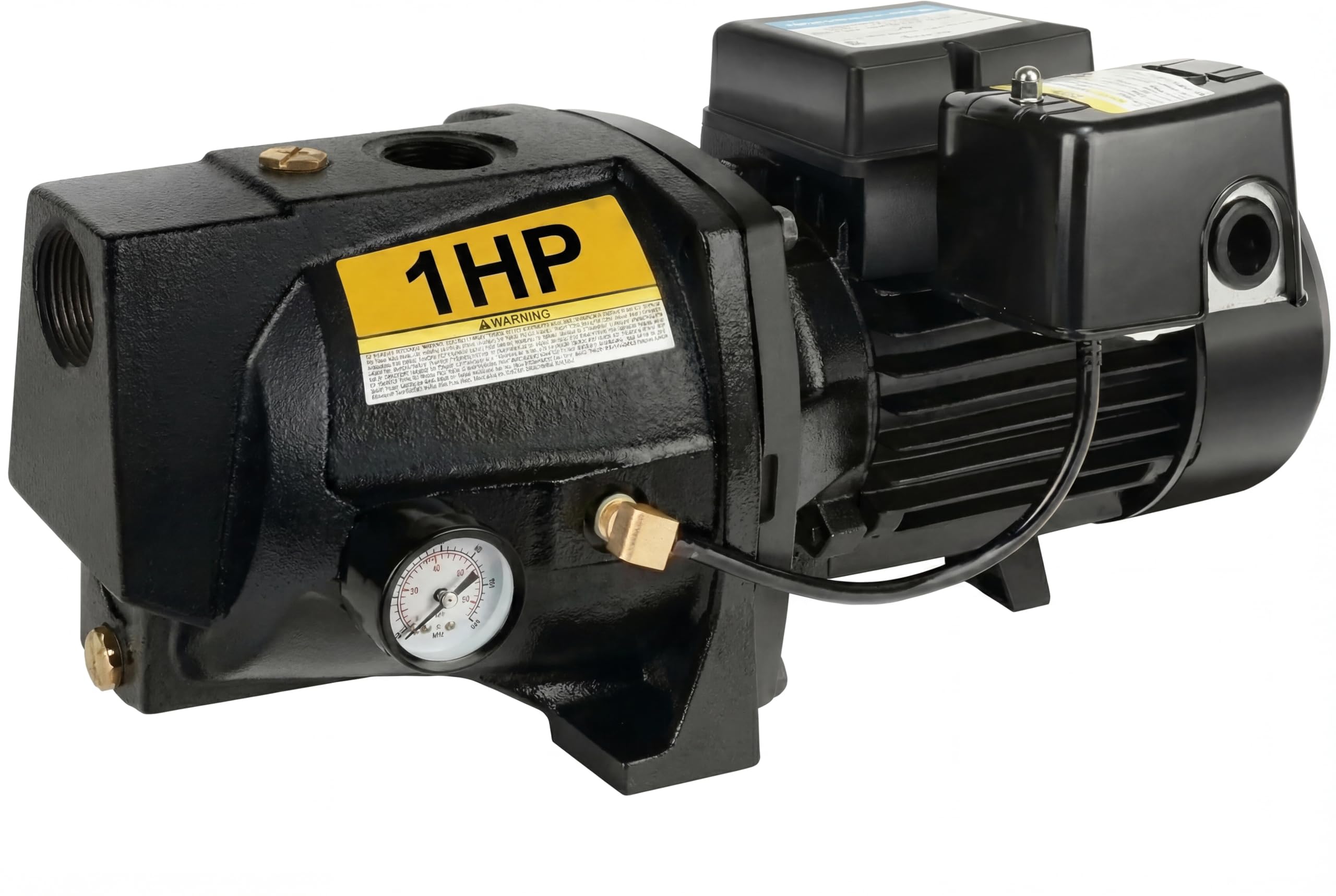
This is the pump for a 20-to-25-foot well feeding a house, garden, or pool heater, and its defining number is the pressure switch setting: 30-50 PSI straight from the factory, meaning the motor kicks on at 30 PSI and stops at 50. That’s a noticeably stronger shower than the 20/40 pumps in this group. Flow tops out at 510 gallons per hour at 50 PSI, and the cast iron volute includes a dedicated priming port so you can pour water in without fighting the pipework.
Reliability is what carries this pick. The pump runs fine for years on a properly plumbed setup — one long-term owner reported it working reliably for 3+ years with a spindown filter on a 69′ deep well, and noted it ran roughly 90% quieter on 230V. It handles a 240V supply, though the included instructions cover both. Just be aware of its reach limit: at a maximum lifting height of 25 feet it is the shallowest pick in the article, and the Acquaer reaches 180 feet — a 7.2x gap that means this pump is simply the wrong tool for anything deeper than a genuine shallow well.
The recurring gripe is durability past the first few years. Long-term owners mention motor bearings eventually failing and impeller troubles on older units, so treat this as a pump you buy knowing you may replace it down the line. An occasional unit also arrives with a factory assembly issue, though Wayne’s support and Amazon’s return process cover that.
Why it earns its place
- Pre-set 30-50 PSI pressure switch delivers stronger tap pressure than 20/40 rivals
- Cast iron volute with a dedicated priming port for easier first fill
- 3/4 in. NPT discharge with 1-1/4 in. suction, assembled in the US with foreign and domestic parts
- 3-year parts warranty backs a pump that many owners run for three years and beyond
What to weigh first
- A maximum lifting height of 25 feet rules out anything deeper than a true shallow well
- Bearing and impeller wear shows up on some units after a few seasons
- It is heavier than the compact alternatives at 41.3 pounds, so plan where it lives before it arrives
the balance: a genuine 25-foot-or-less well where you want quiet operation and a strong 30/50 pressure band.
Look elsewhere if: your water sits deeper, or you want a lighter pump you can lift onto a shelf solo.
3. Acquaer Shallow Well Jet Pump
Compact cast iron, dual voltage, and the widest reach in the shallow-well class.
At a maximum lifting height of 180 feet, this Acquaer out-reaches every other shallow well jet pump in this guide, including the WAYNE SWS100’s 25 feet — a 7.2x difference that turns a “too deep” problem into a non-issue. It’s also a fraction of the footprint: 16″L x 8″W x 8″H versus the WAYNE’s 23″L x 12″W x 11″H, so it tucks into a tight pump closet without a fight. The quality numbers back the spec sheet too, with build quality the thing owners bring up most.
It runs on either 115V or 230V and ships set for 230V, which means fewer amps drawn over a long run — the smart choice if your pump house sits far from the breaker panel. Overheat protection cuts the motor when the water inside runs dry, sparing you a burnout when the well runs low. Primeability is a genuine strength here: filling a 40-gallon pressure tank is comfortably within its range, and one owner reported pumping 250 gallons in about half an hour.
The trade-off you’ll notice is pressure. The factory 20/40 PSI setting reads as a modest dribble to anyone used to a 30/50 switch, and several owners bumped the cutoff upward to 50 PSI to feel the difference. The no-leak fittings are also a weak point on some units — the threaded bosses can be finicky, so thread tape and patience matter. As one owner put it about the pressure: “Nowhere did it say the max psi. As I have learned, it’s a dribbling 40 psi which is at the VERY bottom for residential.”
The value math: a dual-voltage, 180-foot-reach 1 hp pump with an automatic 20/40 pressure switch and overheat shutoff, for less than the mid-range competition.
Set your expectations: you’re getting useful pressure for irrigation, not the punchy tap feel of a 30/50 setup. If you need more, adjust the switch.
Reach for this if: you have a shallow well that still needs real reach, you want dual-voltage flexibility, and value is the priority.
skip it if: you need heavy household pressure straight from the start and won’t touch the pressure switch.
4. BOMGIE Shallow/Deep Well Jet Pump

One pump that swaps between shallow and deep setups with a bundled ejector kit.
The idea here is flexibility. Because it arrives with a venturi and ejector kit in the box, this pump covers single-pipe wells from 0-25 feet and two-pipe wells from 26-50 feet — a range no single shallow-well pump in this article touches. Maximum flow is 23.3 gpm with a 164-foot head, and a 3/4 HP electric motor drives the suction. If you’re on the fence about your well depth or might move the pump to a deeper hole later, that adaptability is the whole reason to pick it.
The wiring is dual voltage, running 115V or 230V and shipping set for 230V. Two things trip up first-time installers, and both have straightforward fixes. The 120/220 selector switch sits tucked inside the junction box, so if you plan to plug into a household receptacle you’ll need to flip it to 120 first — and it’s loose-wired and mounted upside down from the factory. Some units also arrive with a 110V plug cord even though the motor is set for 220V, which means cutting and fitting the correct plug yourself.
Reliability is the aspect buyers raise most, and it genuinely splits — this is a pump with a loyal camp and a frustrated one. Customers note running irrigation systems for 9 zones across 0.8 acre with seven-plus months of trouble-free service, and long-term performance going strong at two years. Others have hit dead-on-arrival whine or a motor that stalled within a month, in which case BOMGIE has issued full refunds.
Where it shines: the bundled ejector kit and 0-50 foot coverage make this the only convertibly flexible pump in the lineup, and it handles both shallow and deep wells without a second purchase.
What you’re signing up for: a genuine installation job. Verify the voltage switch, source the right plug, and prime carefully — the manual and the pump’s actual switch location don’t always match.
Best for: buyers who need one pump to cover both a shallow well and a 50-foot-deep one, and who are comfortable doing the wiring setup themselves.
Consider another option if: you want a plug-and-run install with no switch-flipping or plug-swapping.
5. Hallmark Industries MA0419X-12A Deep Well Submersible Pump
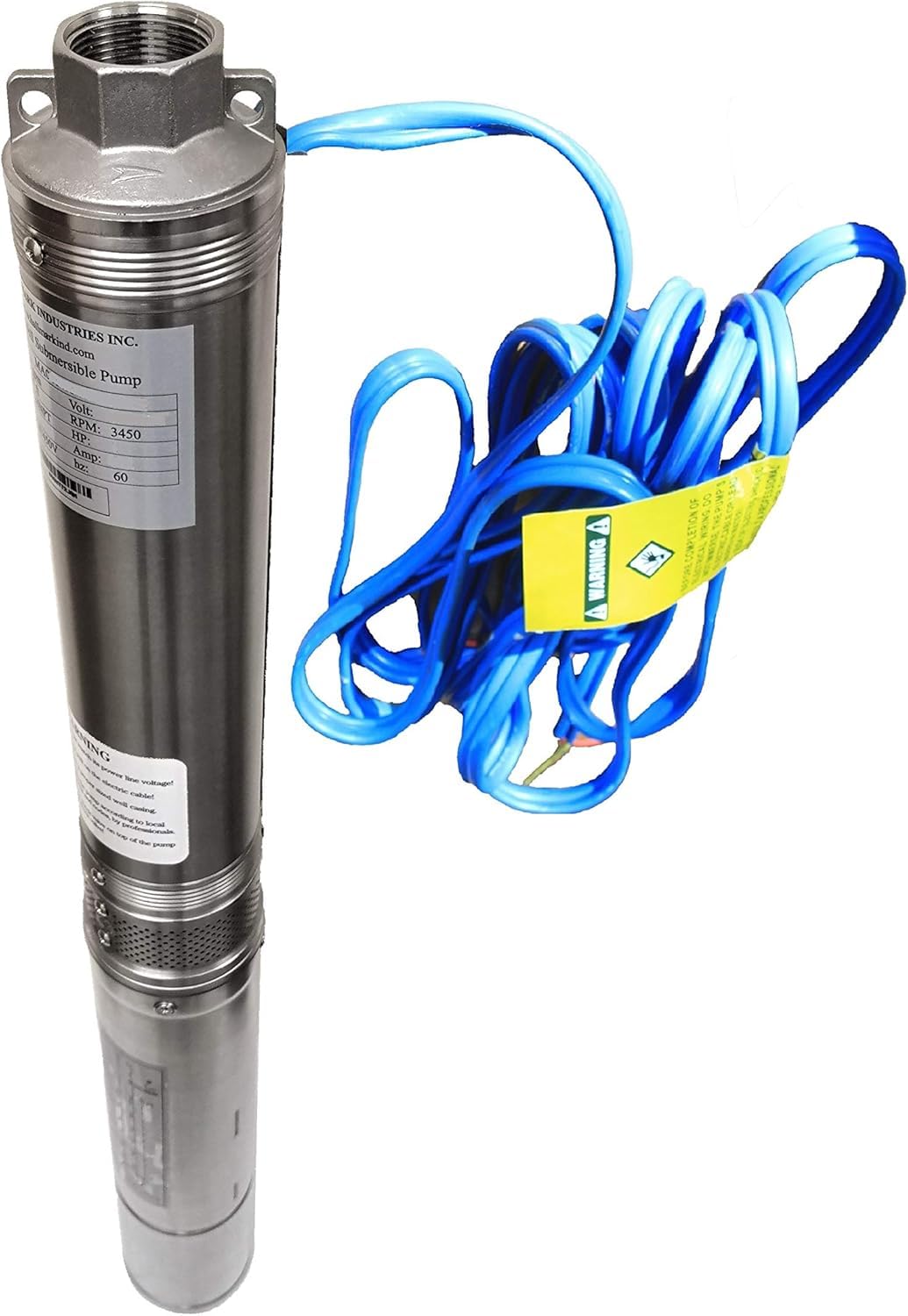
A 420-foot submersible that drops into the well instead of sucking from above.
When a shallow jet pump runs out of reach, this is the pump that ends the conversation. At a maximum lifting height of 420 feet it goes down into the water rather than pulling from above, which is a completely different engineering approach — and it’s why a 2 HP submersible can serve a well that no jet pump here can touch. It pumps 35 gpm through a stainless steel body just 3.8 inches wide, so it slides down a narrow casing with room to spare. Flow is fast enough that reviewers point out it fills tanks quickly, and the build quality draws consistent praise from people who install pumps for a living.
Its field experience is the strongest argument for it. Shoppers say running this pump 400 feet down in a 455-foot well and getting great results once the plumbing is right, and one industry veteran who has installed a dozen of them reports no issues out of any. The trick is water hammer: dropping a 2 HP submersible into a long column of water creates a slam on startup, and owners who fixed that by adding spring-loaded check valves at intermediate points report the setup running smoothly for years.
Plan on two maintenance realities. The capacitor is a known weak link — some units fail soon after install because the capacitor sits loose in the housing and its wire chafes on startup, so replacing or securing it before the pump goes down the well saves a pull later. And lifespan varies: some units last seven years, others quit around eighteen months. The 2 HP, 35 GPM output is well above anything shallow-well in this group, but the failure stories make this a pump to install carefully rather than cheaply.
Why deep-well owners commit: a 420-foot maximum lifting height, 35 GPM flow, and a slim 3.8-inch stainless body — specs no jet pump here can match. Buyers report running it 400 feet down in a 455-foot well with excellent results.
Known quirks: the loose factory capacitor deserves a check before install, and water hammer on startup is real in deep wells — budget for spring-loaded check valves.
Your pick if: you own a genuinely deep well that needs a submersible drop-in pump with serious reach and flow, and you’ll install it thoughtfully.
Not for you if: your water sits shallow enough for a jet pump, or you want a pump you can service at surface level without pulling it.
6. Red Lion RL-SWJ75 Shallow Well Jet Pump

A light, self-priming 3/4 HP pump built for cottages and small households.
Weighing in at 22.5 pounds, this is the easiest pump in the group to hang or lift into place single-handed, and for a cottage or an average-sized home it has everything you need. The 3/4 HP motor draws up to 13 GPM, and the included 30/50 pressure switch gives you a stronger-feeling supply than a factory 20/40 setup from the start. It’s self-priming after the initial fill, which takes one chore off a spring startup.
The dual-voltage design is worth the small bit of extra setup. It ships set for 230 Volts and switches easily to 115 Volts, though the voltage you choose must match your incoming power source — the wrong pairing is a common DIY mistake. Suction and discharge use standard 1-1/4-inch and 1-inch female NPT threads, so off-the-shelf fittings work. Buyers who run it on the 220 side with a foot valve to 27′ report it running for two years without missing a beat.
The honest caveat is flow. At 13 GPM this is a modest-volume pump, best suited to flowers, ponds, and a small household supply rather than a multi-zone sprinkler system. And a handful of owners have had units that shut off after a few minutes of running, so if you see that pattern, check for a wiring or priming issue before assuming the pump is dead.
What makes it easy: self-priming after the first fill, a 30/50 pressure switch, standard 1-1/4-inch and 1-inch NPT fittings, and a 22.5-pound weight that one person can manage.
Where it stops: 13 GPM won’t feed a big irrigation system, and the 25-foot depth limit is firmly shallow-well territory.
Made for you if: you’re pumping for a small home, cottage, pond, or garden with standard pipework and want a light, straightforward install.
Pass on it if: you need heavy flow for multiple sprinkler zones or your water sits deeper than 25 feet.
7. WAYNE CWS50 Convertible Jet Well Pump

A convertible pump that reaches 80 feet deep on just a 1/2 HP motor.
Here’s the trick worth understanding: because a convertible jet pump uses a two-pipe setup with a jet assembly down in the well, it can lift from 25 to 90 feet deep while running only a 1/2 HP motor. This WAYNE reaches a maximum lifting height of 80 feet, which no single-pipe shallow pump here can approach. The 1″ NPT discharge, 1-1/4″ NPT suction, and 1″ drive connections are all standard, and the cast iron volute includes a dedicated priming port. Flow is a modest 6.8 gpm, so this is a low-volume, deep-reach machine.
The voltage flexibility helps too. The dual-voltage square flange motor covers 115V and 230V with the factory default at 115V, and the pressure switch is pre-set at 30-50 PSI for automatic operation. Owners who convert to 220V often do it for a longer run to a distant well. One notable quirk: the jet assembly is required but sold separately, so factor that into your parts list before installation day.
Longevity is the mixed piece. Owners mention a first CWS50 lasting many years on a 98-foot-deep well before a second one went in, so the design holds up. But the pump’s quality draws split opinions, and one unit arrived not fully bolted, which is a factory flaw rather than a design failure. It comes with a 3-year warranty, which softens that risk.
Reach without the power draw: 80 feet of lift from a 1/2 HP motor is the convertible advantage — a two-pipe jet assembly does the work a bigger motor can’t do from surface level.
Don’t forget the jet assembly: it’s required and sold separately, so your install isn’t complete from the start. Flow at 6.8 gpm also means this is not a sprinkler-zone pump.
Suits you when: your well runs deeper than a shallow pump can manage, but you still want the simplicity of a surface-mounted unit.
Look past it if: you need high flow for irrigation, or you want everything included in the box with no separate parts to buy.
8. AQUASTRONG Shallow Well Jet/Centrifugal Pump

A large-volume sprinkler pump with an oversized 2-inch intake that moves serious water.
When your sprinkler system is the point, look at the flow numbers first. This AQUASTRONG pushes a 69.99 GPM maximum flow through a 2″ NPT suction and a 1-1/2″ NPT discharge with a 108-foot max head, which is the kind of volume a big lawn or multi-zone setup demands. It’s built as a centrifugal pump with a reinforced impeller and diffuser for high-efficiency volume, wrapped in a durable cast iron volute, and it runs dual voltage (115V/230V) with the factory setting at 230V for a cooler run. Quality is the spec sheet’s strongest note — it’s the first thing owners bring up, followed closely by value, quiet operation, and pumping pressure.
The field record is unusually strong for a pump this size. Professional installers use them in volume: a well driller who bought 30 over a year reports being happy with the quality across the batch and finding the units quieter and stronger than competing brands. Two things owners flag as non-issues are worth hearing: most prime complaints trace back to air leaks at the fittings, not the pump, and the missing cord is simply a matter of supplying your own. Set your plumbing tight and this thing stays primed.
The one thing to watch is the housing. While most customers note years of reliable performance, some units have developed cracks in the cast iron housing, which is why durability is the mixed note in an otherwise praised pump. A two-year warranty comes standard, with an upgrade option available. Treat it as a high-volume irrigation workhorse rather than a light-duty household booster.
Where it delivers
- 69.99 GPM maximum flow with a 108-foot maximum head through 2″ suction and 1-1/2″ discharge
- Reinforced impeller and diffuser for efficient high-volume flow
- Dual voltage 115V/230V with a high-efficiency round flange motor
- Built-in automatic thermal overload protection guards the motor against overheating
Before you buy
- It ships without a cord, so plan to supply and wire your own
- Air leaks at the fittings will cause lost prime — the plumbing has to be sealed properly
- Some units have developed cracks in the cast iron housing over time
The pick for: a large lawn or irrigation system where high flow is the whole job and you’ll plumb the connections carefully.
Think about something else if: you want a cord-in-the-box household booster or you don’t want to chase down air leaks in the intake line.
9. Red Lion RL-SPRK150 Sprinkler/Irrigation Pump

A dedicated irrigation pump that primes once and then feeds up to 14 sprinkler heads.
This is the pump you buy when your lawn is the job and you want the head count spelled out. The RL-SPRK150 moves 71 GPM at 10 PSI and 44 GPM at 30 PSI — enough to drive up to 14 sprinkler heads with 1/2-inch fittings, or 7 heads with 3/4-inch fittings, in a single zone. It handles water sources down to 25 feet deep and runs 1.5 HP on dual voltage, factory-set at 230 Volts with a simple switch to 115. Suction and discharge use big 2-inch and 1.5-inch female NPT threads. It primes once and, per the manual, needs no additional priming after that initial fill.
Performance is what owners praise first, and the numbers behind it hold up. One owner replaced this exact model after 26 years of service and found the newer unit much quieter. Another has run it for several summers pulling from a lake to water a lawn, trees, and plants with no trouble at all. Build quality gets similar respect — a durable cast iron housing with a glass-filled thermoplastic impeller that handles both well water and lake water.
Two honest notes for anyone considering it. The priming port can be stubborn on new units; owners who couldn’t prime through it backfilled the pump with city water through a temporary hose bib and had it self-prime perfectly, then kept the bib in place for future restarts. And repair history is genuinely mixed — some units fail after a few seasons and need a rebuild, while plenty others simply run for years. It carries a 2-year manufacturer warranty.
The head-count math: 44 GPM at 30 PSI covers up to 14 sprinkler heads with 1/2-inch fittings per zone, or 7 with 3/4-inch — a straightforward way to size your zones before buying.
Plan for the prime: if the priming port won’t take water, backfill through a temporary hose bib and leave it connected. Reviewers point out the pump self-primes reliably after that first fill.
Choose this if: you’re building or replacing a multi-head lawn irrigation system and want a pump with the zone capacity clearly stated and a proven track record with lake or well water.
Look elsewhere if: you’re feeding household taps rather than a sprinkler system, or you want a pump that primes purely through its own port without a workaround.
Know the Specs
Horsepower and maximum lifting height
Horsepower tells you how hard the motor can work, but the number that decides whether a pump reaches your water is maximum lifting height. A shallow well jet pump sits at surface level and sucks water up, and that above-ground method tops out around 25 feet no matter how big the motor is. This is why the WAYNE SWS100 and the Red Lion RL-SWJ75 both stop at 25 feet even with real horsepower behind them. Pumps that lift from much deeper do it differently: the Hallmark MA0419X-12A is submersible and sits down in the water, reaching 420 feet, while convertible pumps like the WAYNE CWS50 use a two-pipe jet assembly to reach 80 feet. Match the lifting height to your actual water depth first.
Dual voltage and pressure switch settings
Dual voltage means the motor can run on 115 volts (a standard household circuit) or 230 volts, and most of these pumps ship factory-set to 230V. Running 230V draws fewer amps for the same work, which matters when your pump sits far from the panel and you want less voltage drop over a long wire run. You must match the pump’s setting to your supply — a mismatch can trip the overload or underperform. The pressure switch is the other setting you’ll actually touch: a 20/40 pump turns on at 20 PSI and stops at 40, while a 30/50 pump gives noticeably stronger tap pressure. Raising the cutoff on a 20/40 unit, as several owners do, is the quickest way to feel the difference without buying a new pump.
Common Questions
Will a shallow well jet pump work if my well is deeper than 25 feet?
Should I run my pump on 115V or 230V?
Why does my new pump keep losing its prime?
What PSI should I set my pressure switch to?
Can I use a jet pump to feed a sprinkler system?
How deep can the Hallmark MA0419X-12A actually reach?
Do I needto prime the pump myself, or is it self-priming?
What do the NPT thread sizes mean on these pumps?
Which pump is best for a lake or rain cistern instead of a well?
How long should a jet pump last before I need to replace it?
Will these pumps handle a 2-inch discharge plumbing setup?
The Bottom Line
The best deep well jet pump for most buyers is the Aquastrong 115V Shallow Well Garden Pump, because it combines a 1.6 hp motor, a 164-foot maximum lifting height, a stainless steel NSF-certified casing, and an included 5-gallon pressure tank in one pre-assembled unit. If you need more depth and want a submersible, reach for the Hallmark Industries MA0419X-12A with its 420-foot reach and 35 gpm flow. And if your lawn is the priority, the Red Lion RL-SPRK150 feeds up to 14 sprinkler heads per zone. Whatever you choose, confirm your well depth and flow needs first — that one step saves more frustration than any feature. Buyers reward careful matching, and the picks that hold up are the ones you sized correctly from the start.
How we choose
We do not accept paid placement. Every pick is matched to a real buyer and a real use-case; we do not hands-on test units.
Sources
Specifications: manufacturer listings and product documentation. Review insights: verified customer reviews, as of October 2026. Pricing: not shown on this page (it changes often); check the current price via the retailer link.
As an Amazon Associate, Aappliancez earns from qualifying purchases. This does not affect which products we feature.