Disclosure: Some links in this post are affiliate links. As an Amazon Associate I earn from qualifying purchases, at no extra cost to you. Learn more
Specs are compiled from manufacturer listings and verified buyer reviews and can change over time — please confirm the key details on the product page before buying.
If your desk turns into a hot zone every afternoon, the short answer is this: buy a real compressor unit with a hose if you have a window, and buy an evaporative cooler only if you want cold air on your face and nowhere else. Those are two completely different machines, and most of the frustration in this category comes from buying the wrong one. This guide separates them clearly so you spend once.
This guide is built by comparing the manufacturers’ published specifications and the patterns across verified customer reviews, so you get each pick’s real strengths and trade-offs instead of marketing spin.
A desktop cooler is a personal spot-cooling device, not a room air conditioner. The picks below split into two honest groups: units that genuinely drop the temperature and units that move air over ice. Each pick earns its spot by doing one job well — match that job to your room. Read the short list below, then check the specs section before you commit to any desktop portable air conditioner.
Top Picks


How To Choose The Best Desktop Portable Air Conditioner
The one decision that matters: cool a room or cool yourself. Tank size, timer, night light, and remote are comfort extras layered on top of that answer.
Decide first: compressor or evaporative
A compressor unit (the kind with a hose that goes out a window) actually removes heat from the air and pushes it outdoors. That is why an 8,000 BTU machine can chill a small room while a personal cooler cannot.
An evaporative cooler blows air across water or ice. It feels cold on your skin at close range, and it adds humidity rather than pulling it out. In dry heat it does more; in a muggy room it does less.
Match the BTU to the square footage you actually occupy
Cooling power is quoted in BTU. A unit rated for a small room will not cool an open-plan space, and no amount of positioning fixes that. Measure the room you want cool, not the whole floor plan, and pick a machine rated for at least that.
Check the hose and window kit before you buy
A compressor portable AC is only as good as its exhaust path. Look at the window plate design and the hose length, because that is where setups go wrong. If your windows are unusual, this is the spec to read twice.
Read the noise figure, not the noise adjective
Every listing calls itself quiet. The decibel number is the honest one, and it matters most in a bedroom. A unit in the fifties is background rumble you notice; a unit around 30 dB is close to a whisper.
Side-by-Side Comparison
| Model | Best For | Cooling Power | Noise | Form | Amazon |
|---|---|---|---|---|---|
| Uhome 8,000 BTU Portable AC★ Best Overall | Cooling a real small room | 8,000 BTU | <55 dB | Compressor, window hose | Amazon |
| Midea 8,500 BTU Portable ACSmartest Control | Smart control in a small room | 8,500 BTU ASHRAE | — | Compressor, window hose | Amazon |
| FLOWBREEZE Gale 200Y Evaporative Cooler | Rooms with no window at all | Evaporative, 3 speeds | 39 dB | Tower, freestanding | Amazon |
| PUUXUMIC Desktop AC Fan | Desk-side spot cooling | Evaporative, 3 speeds | 45 dB | Desktop, 2 lb | Amazon |
| CUXPOXTU 4-in-1 Air Cooler | Small rooms and car use | Evaporative, 3 speeds | 55 dB | Desktop, USB powered | Amazon |
| Humuge Mini Portable AC | Budget personal misting | Evaporative, 3 speeds | 30 dB | Mini desktop, USB-C | Amazon |
Detailed Reviews
1. Uhome Portable Air Conditioner, 8000 BTU Compact AC Unit
The one machine here that genuinely chills a bedroom instead of just your face.
Here is the number that separates this pick from everything else on the page: 8,000 BTU. That is real cooling power, the kind that removes heat from a room and pushes it out the window through the included hose. The maker rates it for a small room up to 350 sq ft and lists a 200 square foot floor area, so a bedroom or a studio apartment is squarely in range.
On the desk-cooler side of the aisle, the Uhome is not in the same conversation as the tiny USB units below — it is a freestanding compressor appliance on built-in rolling wheels. The trade-off is that it needs a window for the exhaust hose, and that is where the honest friction sits. The window sealing plate is the weakest part of the package: it has no lips to hold the duct, sits low, and can need tape or a custom cut to seal properly. If you rent and cannot modify anything, plan for that. The other recurring note is volume — this is not a whisper machine. The spec says under 55 dB, and owners who sleep next to it describe it as loud but steady, the kind of white noise you adapt to.
What wins people over is durability in real heat. Buyers report it cooling a bedroom and holding a living room through 100°F summers for two years, while a bigger 12,000 BTU unit failed within a year. Controls are straightforward: an LED display, a remote, and a 24-hour timer that holds anywhere from 60°F to 86°F in one-degree steps. Maintenance is genuinely easy — the washable filter lifts out and rinses under a faucet, and the bucket-less self-evaporating design means you are not emptying a pan every day.
Where it pulls ahead
- 8,000 BTU actually lowers room temperature — the only true AC in this group
- Dehumidifier mode pulls up to 40 pints of moisture a day
- Self-evaporating design means no daily bucket duty
- Washable filter lifts out and rinses clean under the tap
What to plan around
- Needs a window and hose — the sealing plate often needs tape or trimming
- Runs loud; the very quiet sleep you imagined is not happening
- Eco auto-shutoff at your set temperature cannot be disabled
Buy it if: you have a window and want a bedroom or small living area actually cooled, not just fanned.
Look elsewhere if: you cannot cut, tape, or modify a window plate, or you need silence at night.
2. Midea 8,500 BTU ASHRAE Portable Air Conditioner
Same room-cooling job as the Uhome, but you can start it from the driveway.
If you want to walk in to a cold bedroom rather than wait twenty minutes for one, this is the pick. Midea’s 8,500 BTU ASHRAE rating (5,000 BTU under the stricter SACC measure) covers up to 150 sq ft, and the SmartHome app lets you switch modes and set schedules from anywhere. It also pairs with Alexa and Google Assistant if voice is how you like to run things. The 24-hour timer spans 62°F to 90°F across cooling, dehumidifying, and fan-only modes.
The Midea beats the Uhome on cooling capacity at 8,500 BTU (British thermal units, a measure of cooling power) versus 8,000, and it wins clearly on app control. It falls short on setup simplicity where the window hardware is concerned — the included window brackets fit openings from 26.5 to 48 inches, which covers most standard windows, but owners describe the plastic adapter as flimsy and note the heavy hose can tug the panel. It ships with a 5ft hose, and installation needs no extra tools.
Cooling performance splits honestly. In a 130 sq ft room at 95°F, owners mention it holding 70°F, with noticeable cooling in 15 to 30 minutes — not instant, and it struggles in larger rooms or direct sun. Noise is the trade-off: this is a louder portable rather than a quiet one, tolerable on low and more present on high. Two practical notes worth knowing: there is a small black drain cap on the back that must be opened to drain, so keep a container ready, and cleaning the reusable filter roughly once a week keeps performance steady. Airflow is listed at 330 cubic feet per minute per watt, and annual energy consumption at 615 kilowatt hours per year.
Who it is really for: anyone who wants app scheduling and voice control on a genuine compressor AC. The smarts are the whole point here.
The catch: 150 sq ft is the ceiling, and if your room is open to a hallway or bakes in afternoon sun, this will not keep up.
Worth reaching for when: you want to schedule cooling remotely and your room is genuinely small.
Not for you if: you expect it to handle a larger or sun-blasted space — the 150 sq ft rating is firm.
3. FLOWBREEZE Gale 200Y Small Evaporative Air Cooler
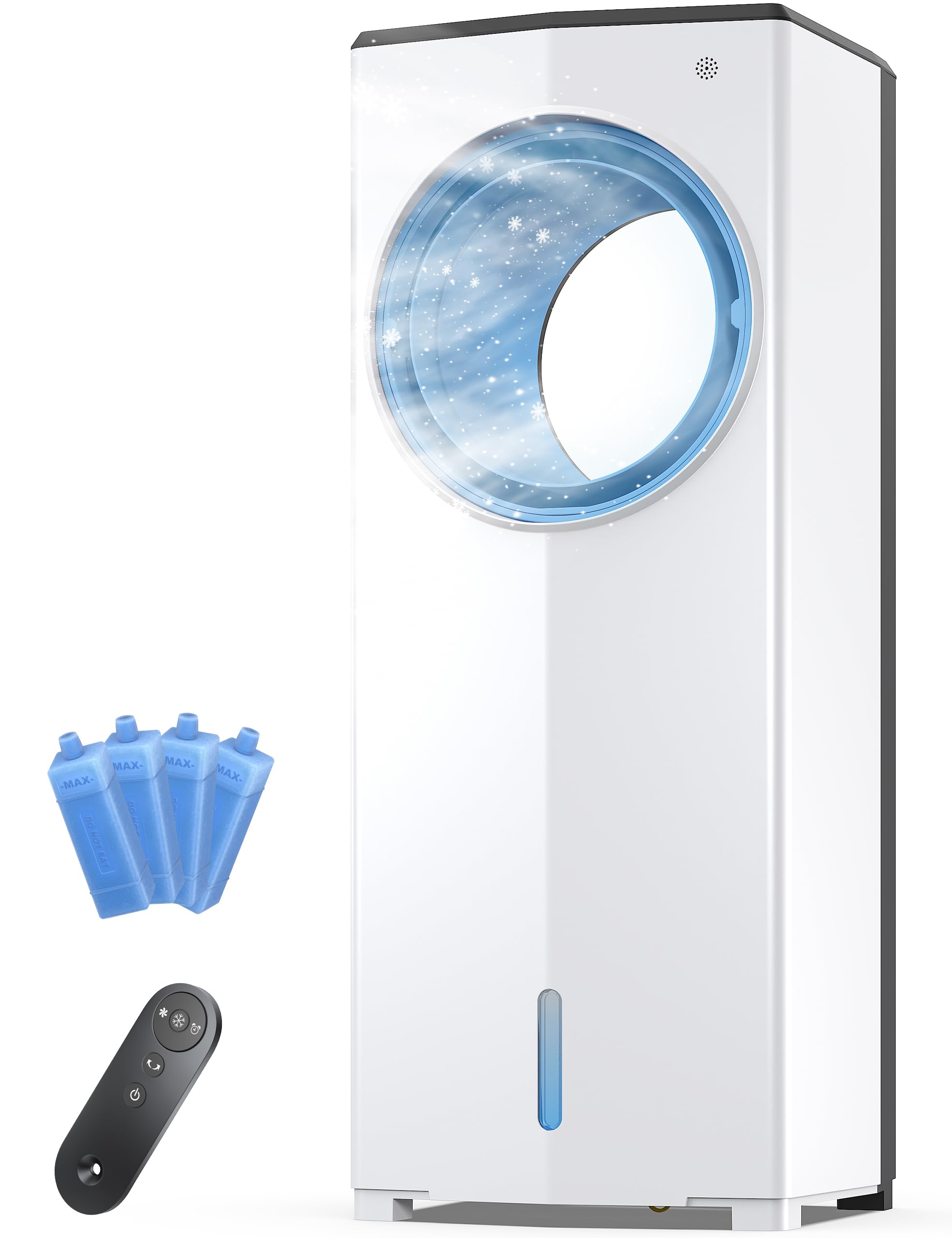
A freestanding tower for the dorm or office window that will never open.
The pitch here is narrow and useful: no exhaust, no hose, no window. It runs at 39 dB, which is quiet enough to keep beside a bed.
Set expectations carefully, because this is where buyers get burned in this category. An evaporative cooler adds moisture to moving air; it does not remove heat like the compressor units above. One owner ran it through a July Florida power outage on ice and a portable battery pack, holding a small area near 73°F for hours on roughly 30% of the battery — and even that owner doubted it could cool a genuinely hot room. Another honest note: a strong plastic smell from the start, strong enough that one buyer aired it outside and still returned it. Most units air out; that one did not.
What you get is a compact tower that will hold a small pocket of air at a pleasant temperature if you sit near it and feed it ice. The tank is on the small side, so refills come often. Night light, timer, and remote cover the convenience basics, and the freestanding form means it tucks into a corner without a rigged window plate.
The real use case: a no-window room where a compressor unit is simply not an option, and you want cool air at arm’s reach.
Set your expectations: this is spot relief with ice, not room refrigeration. Sit close and keep the ice packs frozen.
Right pick if: your room has no usable window and you want something quiet and freestanding for close-range relief.
Think twice if: you want the room’s air temperature to drop — that is a job for a compressor unit.
4. PUUXUMIC Desktop AC Fan, 1500ml Tank, Remote and Timer
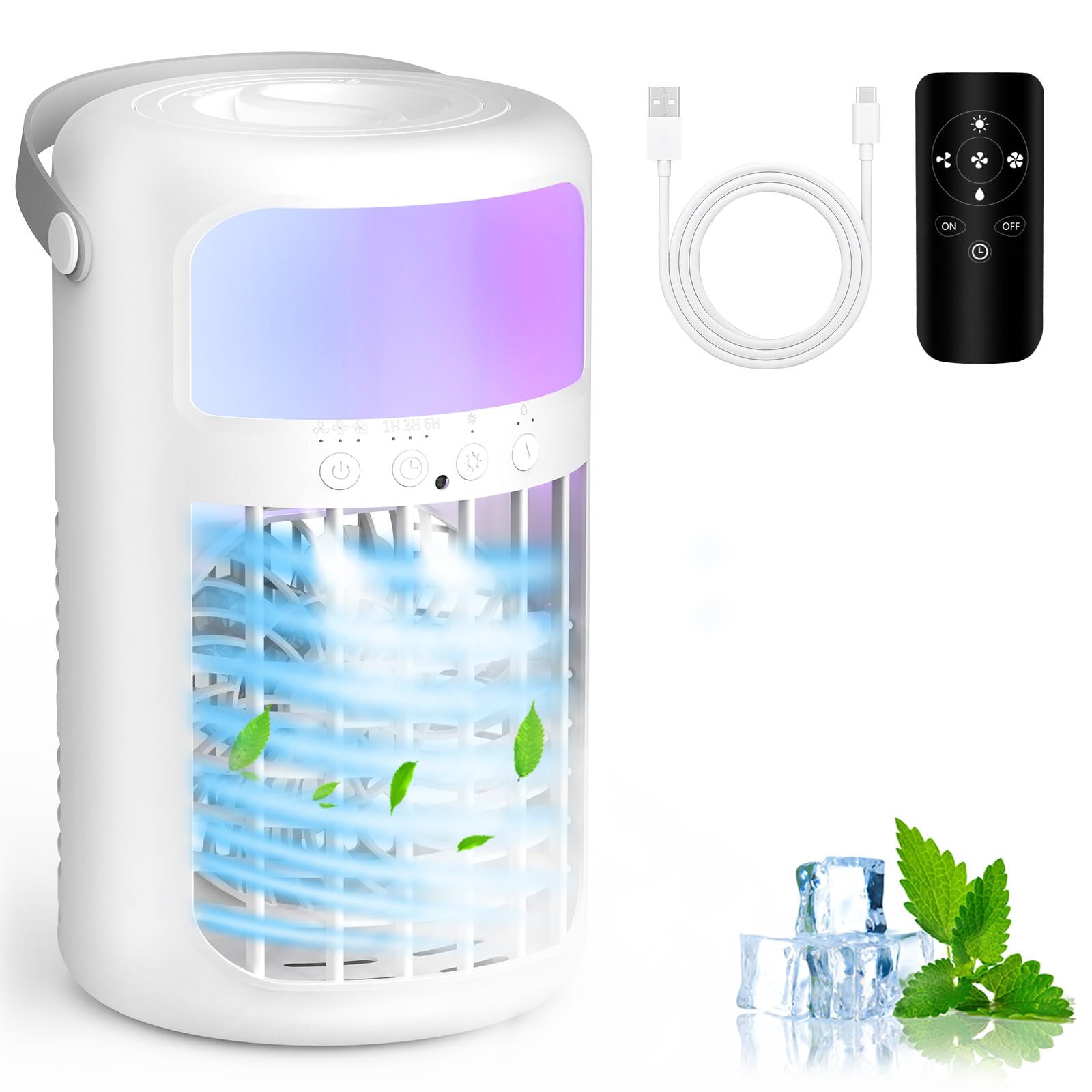
Two pounds of USB cooling you can carry room to room by the handle.
This is the one most people actually want when they say “desktop” — a 2-pound unit with a handle that runs off USB from a power bank, laptop, or car charger. The 1500ml tank feeds two mist modes, and the louvers swing through 90 degrees so you can aim the cool air at your face instead of the ceiling. Three fan speeds, a 1/3/6-hour timer, and a seven-color night light round it out, all controllable from the remote. Noise is listed at 45 dB.
How it stacks against the Midea above tells you everything: the Midea moves 8,500 BTU of real cooling and this one moves air and moisture. Owners treat it as exactly what it is — a personal cooler that makes a hot desk bearable. It is light enough to carry from bedroom to office, easy to refill and clean, and effective at close range with cold water and ice in the tank.
The honest weak spot is mist leakage. Water can seep through the mist vents when the unit is off, so you want to empty or tip it carefully rather than leaving it full on a desk. The louvers are manual rather than oscillating, and the tank drains noticeably within the first twenty minutes of misting. One more thing to know: it is USB-C powered and the adapter is not included, so you need your own wall plug or power bank.
Why the desk crowd likes it
- 2 lb with a built-in handle — genuinely one-handed portable
- 1500ml tank with two mist modes and 8 hours of runtime
- 90° adjustable louvers plus a remote and 1/3/6-hour timer
Friction points to expect
- Water can leak through the mist vents when the unit is off
- USB-C only — no wall adapter in the box
- Louvers are hand-adjusted, not motorized
Suits you if: you work at a fixed spot and want cold, moist airflow aimed right at you.
Skip the idea if: you were hoping it would cool the whole room — it will not, and the listing says so plainly.
5. CUXPOXTU 4-in-1 Air Cooler, 1600ML Tank, Remote
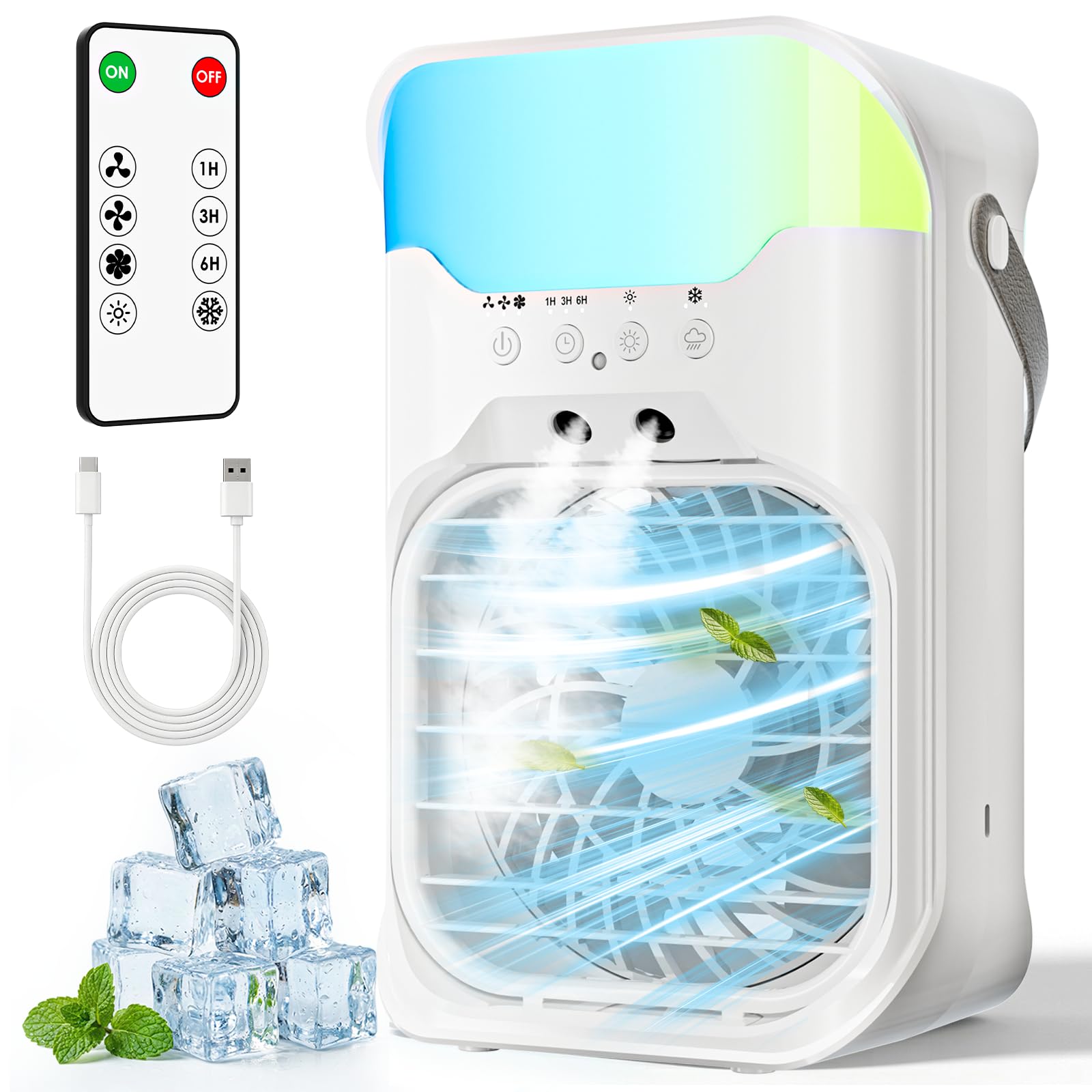
A 1600ml tank, two mist nozzles, and a handle for carrying it between rooms.
The capacity number is the reason to look here: a 1600ml tank that the maker says runs 6 to 10 hours on one fill, with two mist outlets for a wider stream of cool air. It runs on just 7 watts, which is low enough that leaving it on all day barely registers. Ten gradient RGB colors and a remote that works up to 10 meters away mean you can change settings without getting up. The fan blades lift off magnetically for cleaning, and there is a handle on top for carrying.
Against the PUUXUMIC above, the CUXPOXTU offers a slightly larger tank and a lower 7-watt draw, but it is the louder of the two at 55 dB. Treat the cooling claims carefully. Owners describe it, fairly, as a light cooling fan and a misting fan rather than an air conditioner — it feels best directly underneath, and the mist travels a short distance. The company’s own listing notes it cools only the area around you, not the whole room. It also runs on USB rather than an internal battery, so “portable” means carrying it to another outlet, not to the beach.
Set-up is simple and the auto-switch to fan mode when water runs low is a thoughtful safety touch. One recurring mechanical gripe: the on-unit buttons can be fiddly, with the remote becoming the reliable way to power it on. Use the remote and you are fine.
Where it fits: a small room, a bedside, or a car when you want a bigger tank and a low power draw.
Be realistic: it is a misting fan, not a compressor AC. Sit in front of it and it feels good; expect it to cool a room and you will be disappointed.
Best matched to: buyers who want the biggest tank in this group and long USB runtime for close-range relief.
Not the one for: anyone who needs a real temperature drop across a room — that takes BTU, and this unit has none to give.
6. Humuge Mini Air Conditioner, 3-Speed Cool Mist

The quietest thing on this list, at a whisper-level 30 dB.
Thirty decibels is the number to notice here. That is roughly a whisper, and it makes this the calmest pick in the group — a fair choice if you want something at your bedside that will not keep you up. It runs off a 5V/2A Type-C port, so a laptop, power bank, or car charger all work, and it combines a fan, a humidifier, and a seven-color LED night light. There are three wind speeds and a timer you can set to 2 hours, 4 hours, or off.
The comparison worth drawing is against the Midea: 30 dB versus a compressor unit that buyers routinely call loud. That gap is the whole reason this category exists. What you give up is cooling power — the maker’s own note says this cools only the area around you, not a room, and the mist output is the point of contention. Some units mist beautifully, with ice water turning the airflow noticeably cold. Others arrive with the mist function not working at all, and the adjustable speed sometimes sticks.
The fit is clear once you accept what it is: a personal desk and bedside cooler with a night light, not a room air conditioner. Owners who bought it for a nightstand or a work-from-home desk tend to get what they expected. Buyers who wanted it to drop a room’s temperature end up returning it — and in this category, that is almost always a mismatch, not a defect.
The honest trade: near-silent operation and true USB-C portability, in exchange for spot cooling only.
Check on arrival: run the mist function the day it arrives, while you can still return it. That is the one part that varies.
Pick it for: a bedside or desk spot cooler where quiet matters more than raw cooling.
Pass if: you need the mist function to be a guaranteed feature from day one — test it immediately.
Know the Specs
BTU (Cooling Power)
BTU stands for British thermal unit — think of it as the amount of heat a machine can pull out of a room per hour. The higher the number, the bigger the space it can handle. A unit rated around 8,000 BTU is built for a small room, while anything marketed as a personal cooler typically lists no BTU figure at all because it is not removing heat. If the listing does not quote BTU, assume it moves air rather than cools it.
Decibels (Noise)
A decibel is a measure of how loud something is, and it works on a scale where every small increase is noticeable. A unit around 30 dB is whisper-quiet, fit for a bedside. A unit in the forties or fifties is a steady, audible hum — background noise you can sleep through but will not forget about. Compressor units with a hose generally run louder than small misting fans, and that is a physical trade, not a design flaw.
Evaporative vs. Compressor
A compressor unit uses refrigerant to remove heat and sends it out a window hose. An evaporative cooler blows air across water and ice. The second kind adds moisture to the air rather than taking it out, so it feels best in dry heat and much weaker in a humid room. Before you buy, decide which physics you actually need — it matters more than any timer or light.
Water Tank Capacity
Tank size is quoted in milliliters or fluid ounces and sets how long the mist runs before a refill. A 1500ml tank running up to 8 hours means roughly a workday or a night’s sleep. Smaller tanks mean more trips to the faucet. Bigger tanks are heavier and need a steady surface, so balance capacity against where the unit will sit.
Common Questions
Can a desktop portable air conditioner cool a whole room?
Do evaporative coolers work in humid weather?
Does a desktop air conditioner need a window?
How loud is a portable air conditioner at night?
How often do I need to empty the water tank?
Can I run a portable air cooler off a power bank?
Why does my misting cooler stop misting after a while?
Is a 1500ml tank bigger than a 1600ml one?
Do I need to clean the filter on a compressor portable AC?
Can a desktop cooler run on ice alone without water?
The Bottom Line
For most buyers, the desktop portable air conditioner winner is the Uhome 8,000 BTU model because it is the only pick here that actually removes heat from a room instead of just moving air over it. If you want app and voice control on the same job, the Midea 8,500 BTU is the smarter twin, with a larger rating and remote scheduling. And if your window never opens, the FLOWBREEZE tower is the honest no-window answer — just feed it ice and sit close, because that is the job it was built for.
How we choose
We do not accept paid placement. Every pick is matched to a real buyer and a real use-case; we do not hands-on test units.
Sources
Specifications: manufacturer listings and product documentation. Review insights: verified customer reviews, as of October 2026. Pricing: not shown on this page (it changes often); check the current price via the retailer link.
As an Amazon Associate, Aappliancez earns from qualifying purchases. This does not affect which products we feature.