Disclosure: Some links in this post are affiliate links. As an Amazon Associate I earn from qualifying purchases, at no extra cost to you. Learn more
Specs are compiled from manufacturer listings and verified buyer reviews and can change over time — please confirm the key details on the product page before buying.
You want the boat to sit still over a brush pile while you rig a bait — without paying flagship money for it. That is exactly why this corner of the market exists. Spot lock (GPS anchoring that holds your boat over one point without a physical anchor) used to be a premium-only feature. The picks below get you close to that experience on a tighter budget. Some genuinely lock; others only cruise. Knowing which is which before you buy is the difference between a great day and a frustrating one.
This guide is built by comparing the manufacturers’ published specifications and the patterns across verified customer reviews, so you get each pick’s real strengths and trade-offs instead of marketing spin.
A few of these motors lock onto a GPS point and hold it, while others are honest cruise-control units that keep speed but not direction. The trick is matching thrust and shaft length to your hull before you chase features. Here is what separates a true cheap spot lock trolling motor from one that only looks like a bargain.
Top Picks
How To Choose A Cheap Spot Lock Trolling Motor
The first decision is not brand or price — it is whether the motor actually holds position. Spot lock uses GPS to keep your bow pinned over one coordinate. Cruise control only maintains a speed setting, so wind and current still push you sideways. If holding over structure matters to you, buy GPS anchoring and accept fewer other extras. If you mostly slow-troll along a bank, cruise control is enough.
Match thrust to your hull, not to the brochure
Thrust is measured in pounds and it has to move the whole loaded boat. A 12-volt, 55-lb motor is generally aimed at hulls up to roughly 18 feet, which is why the Haswing Cayman units list that ceiling. Step up to 80 lbs and you are usually running 24 volts, which means two batteries and a heavier bow. Buy more thrust than you think you need if you fish with a full livewell and two friends.
Shaft length is a measurement, not a guess
The shaft has to reach from your bow deck down into the water with the propeller fully submerged in chop. Too short and the prop cavitates (sucks air) every time a wake rolls under you. The motors here run from 36 inches up to 60 inches, so measure from your deck to the waterline and add a margin. A 45-inch shaft on a high-bow bass boat will not cut it.
Voltage, batteries and the real cost of 24 volts
A 12-volt motor runs off one battery. An 80-lb, 24-volt motor needs two in series, and a 36-volt setup needs three. That changes your wiring, your charger and your bow weight. Lithium packs such as the LiTime units are much lighter than lead-acid for the same stated capacity, which is why so many anglers pair a new motor with a lithium bank.
Side-by-Side Comparison
| Model | Best For | Thrust | Shaft | Spot Lock | Amazon |
|---|---|---|---|---|---|
| Lowrance Ghost★ Best Overall | Quiet GPS anchoring | 97/120 lbs | 47 in | Yes (Anchor mode) | Amazon |
| Minn Kota Ulterra (i-Pilot Link)Top Performer | One-touch stow and deploy | 80 lbs | 60 in | Yes (Spot-Lock) | Amazon |
| Minn Kota UltrexBest for Bass Boats | Cable-steer feel with GPS | 80 lbs | 52 in | Yes (Spot-Lock) | Amazon |
| AQUOS Haswing Cayman B (remote) | Wireless control on a budget | 55 lbs | 54 in | No (cruise control) | Amazon |
| Minn Kota Edge | Simple cable-steer value | 45 lbs | 36 in | No | Amazon |
| Haswing Cayman (foot control) | Fresh and salt water | 55 lbs | 48 in | No (cruise control) | Amazon |
| LiTime 12V 100Ah LiFePO4 (2-pack) | Light battery bank | — | — | — | Amazon |
| Haswing Cayman B 55 (remote and foot) | Hands-free boat control | 55 lbs | 48 in | No (cruise control) | Amazon |
| Minn Kota Fortrex 80 | Heavy-cover bass fishing | 80 lbs | 52 in | No | Amazon |
| Minn Kota Riptide Terrova | Saltwater spot lock | 80 lbs | 60 in | Yes (Spot-Lock) | Amazon |
| Minn Kota Ulterra CHIRP | Auto deploy with sonar | 80 lbs | 45 in | Yes (Spot-Lock) | Amazon |
Detailed Reviews
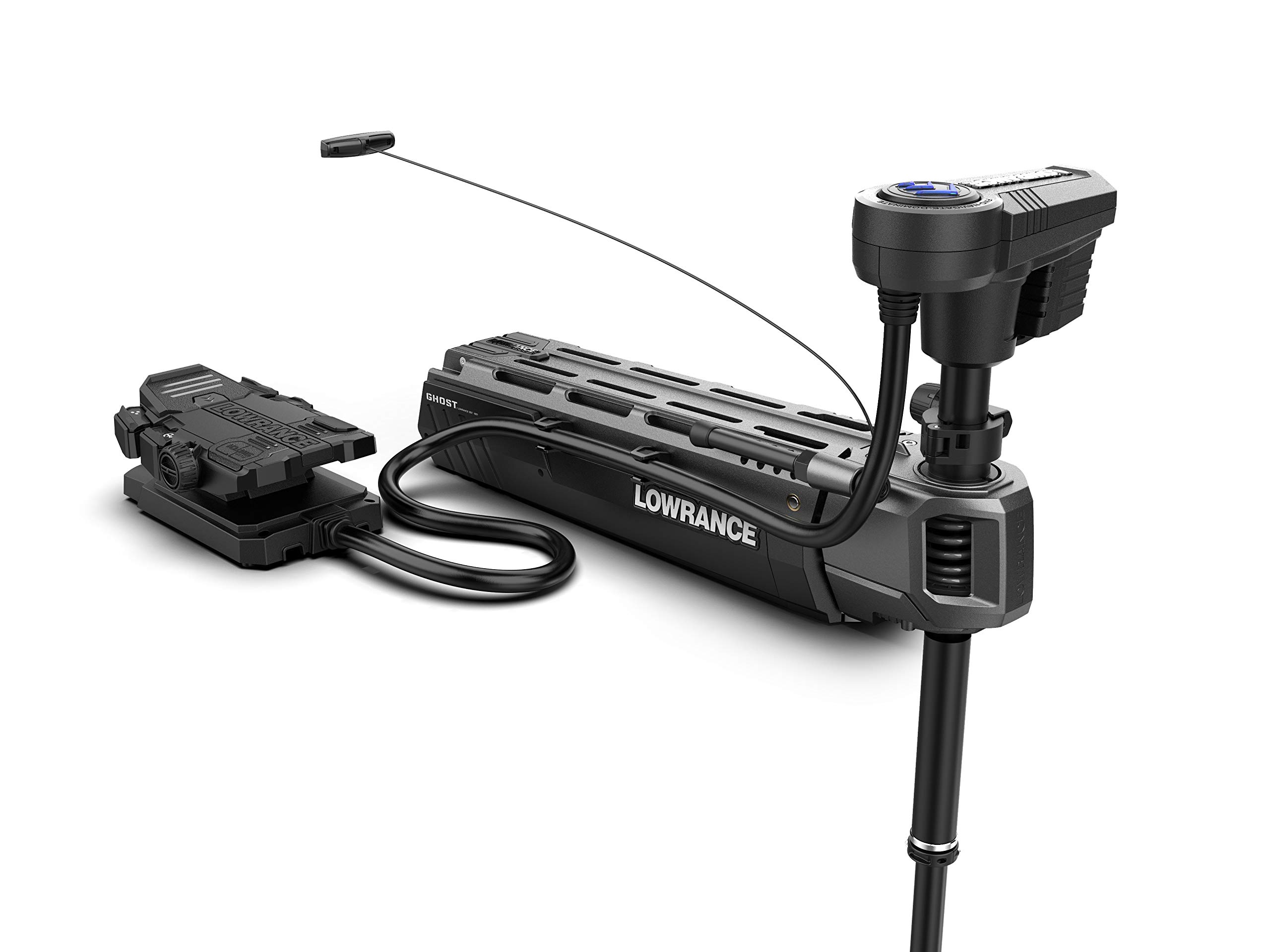
1. Lowrance Ghost Freshwater Bow Mount
A brushless bow mount that fishes silent, locks onto a spot, and paints your sonar screen without interference.
The Ghost is the pick to beat because the motor itself is brushless — meaning it spins without the carbon brushes that wear out and crackle on ordinary motors. That buys you two things you notice on the water: it runs very quietly, and it throws off no electromagnetic interference, so your fish finder display stays clean. The included HDI nosecone transducer gives you Lowrance CHIRP sonar and DownScan Imaging right from the start, tucked into the nose of the motor instead of dangling on your transom.
Where the Ghost separates from the Haswing Cayman B below is raw push and anchoring. The Ghost is rated 97/120 lbs of thrust against the Cayman B’s 55 lbs, and it has a genuine anchor mode built into the configurable foot pedal alongside heading mode and battery level. You can program the shortcut keys to drop a waypoint. Anglers fishing deeper structure find it replaces a shallow-water anchor rig entirely, and the anchor holds even in wind and chop before full calibration.
It is the only motor here that pairs brushless-quiet running with anchor mode and built-in CHIRP/DownScan sonar. The honest catch is setup patience. The anchor function wants manual calibration or it will drift. Value is the most agreed-upon weak spot in this motor’s feedback — plenty of buyers feel the outlay is steep, even while calling the result money well spent. Install itself is friendly: the mounting holes line up with major brand patterns. As buyers report, “Did not have to buy anything for installation and was able to install within 3 hours by myself.” It holds 4.0+ stars across 60+ ratings.
What earns it the crown
- Brushless motor runs whisper-quiet and emits zero electromagnetic interference, so your sonar stays clean
- HDI nosecone transducer delivers CHIRP sonar and DownScan Imaging without extra purchase
- 97/120 lbs of thrust out-pushes every other motor on this list
- Anchor mode holds in wind and chop, with a 3-year manufacturer warranty behind it
Where it asks for patience
- Anchor mode needs manual calibration or the boat drifts off the point
- Highest outlay among the mid-range crowd, and value is the most debated point in owner feedback
Reach for this if: you want a quiet brushless motor that anchors and feeds your Lowrance sonar in one package.
Pass if: you will not take the time to calibrate the anchor function — a non-GPS cruise motor will frustrate you less.
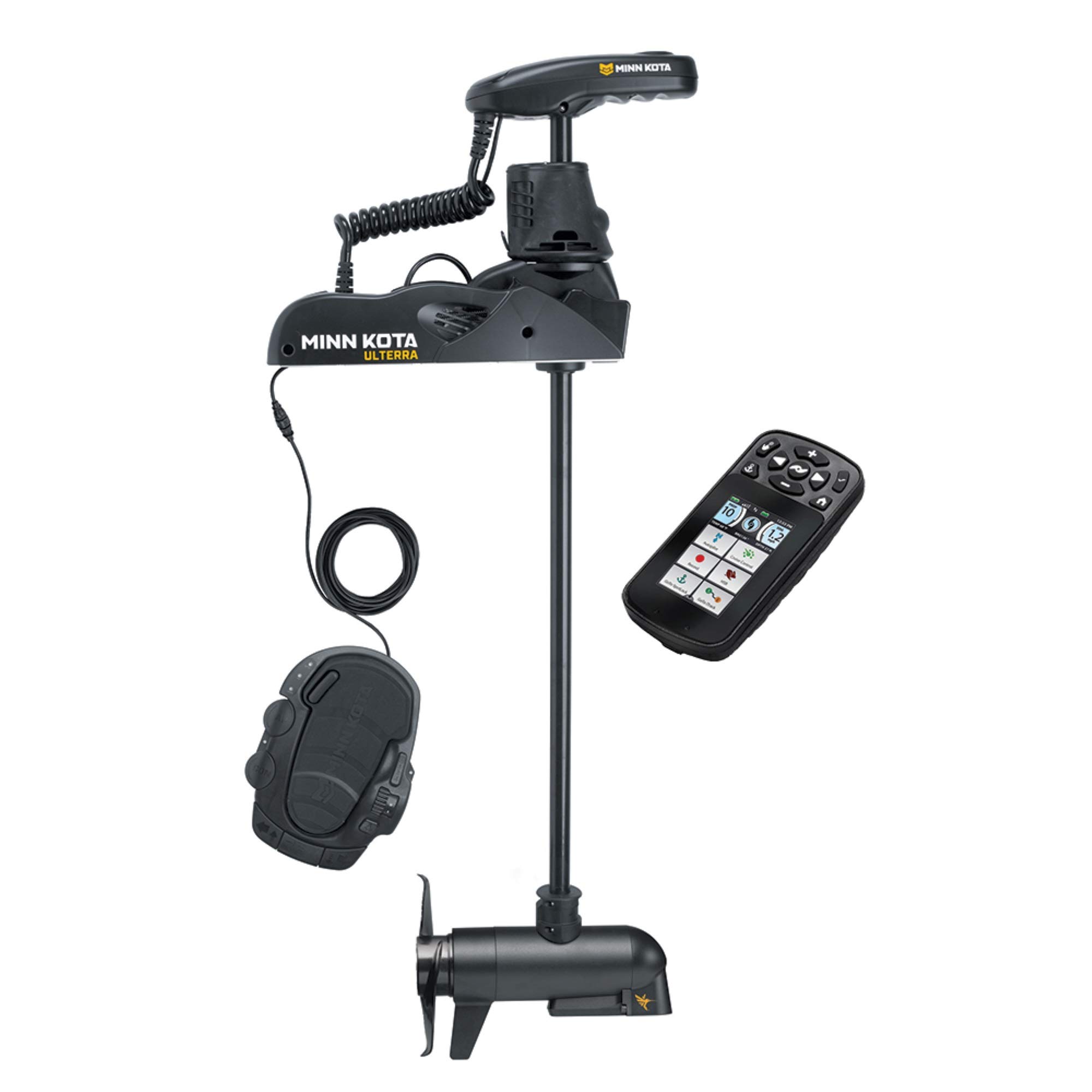
2. Minn Kota Ulterra with MEGA Down Imaging & i-Pilot Link
The only motor here that stows and deploys itself at the touch of a button, no hauling the head by hand.
If getting up off the seat to raise and lower the motor is the part of fishing that wears you down, this is the answer. Press a button and the Ulterra lowers itself into the water or lifts back onto the deck. Trim up or down from the same control. The i-Pilot Link GPS system then does the holding — Spot-Lock pins you over a coordinate while the color touch-screen remote lets you record paths and follow depth contours. On a tiller boat, auto deploy saves a walk to the bow every time you move; as one owner put it, “Hit a few buttons and the motor is down and spot locked.”
This 60-inch shaft version runs 80 lbs of thrust on 24 volts, and it carries a built-in transducer with Hummingbird MEGA Down Imaging rated to show structure and individual fish down to 125 feet below the boat. At 125 feet, that covers the bottom on most inland lakes. Compare it to the Minn Kota Ulterra CHIRP further down the list, which gives you sonar inside the shaft but no down or side imaging without adding a transducer.
The trade-off is expense and wiring. Networking cables to tie everything into your Hummingbird finder are costly, and you are buying into the i-Pilot Link ecosystem. Weigh it against the Fortrex 80, which is a heavier motor at 86 pounds and makes you lift and stow by hand but skips the electronics. The Ulterra’s 69 pounds of motor is easier on the bow, and the auto deploy means you spend less time wrestling it back onto the deck.
Where the money goes: one-touch stow and deploy, a 60-inch shaft, 80 lbs of thrust on 24 volts, Spot-Lock driven by i-Pilot Link, and a transducer embedded in the lower unit.
The honest limit: every cable and adapter you need to fully network it into your fish finder adds up. If you move slowly around the deck, the auto deploy (a motor that lifts and lowers itself) still earns the extra wiring cost.
Best for the angler who: wants the motor to do the lifting and anchoring so they can stay seated and fish.
Look elsewhere if: you already own a simple fish finder and have no plans to network it — you would be paying for electronics you never use.
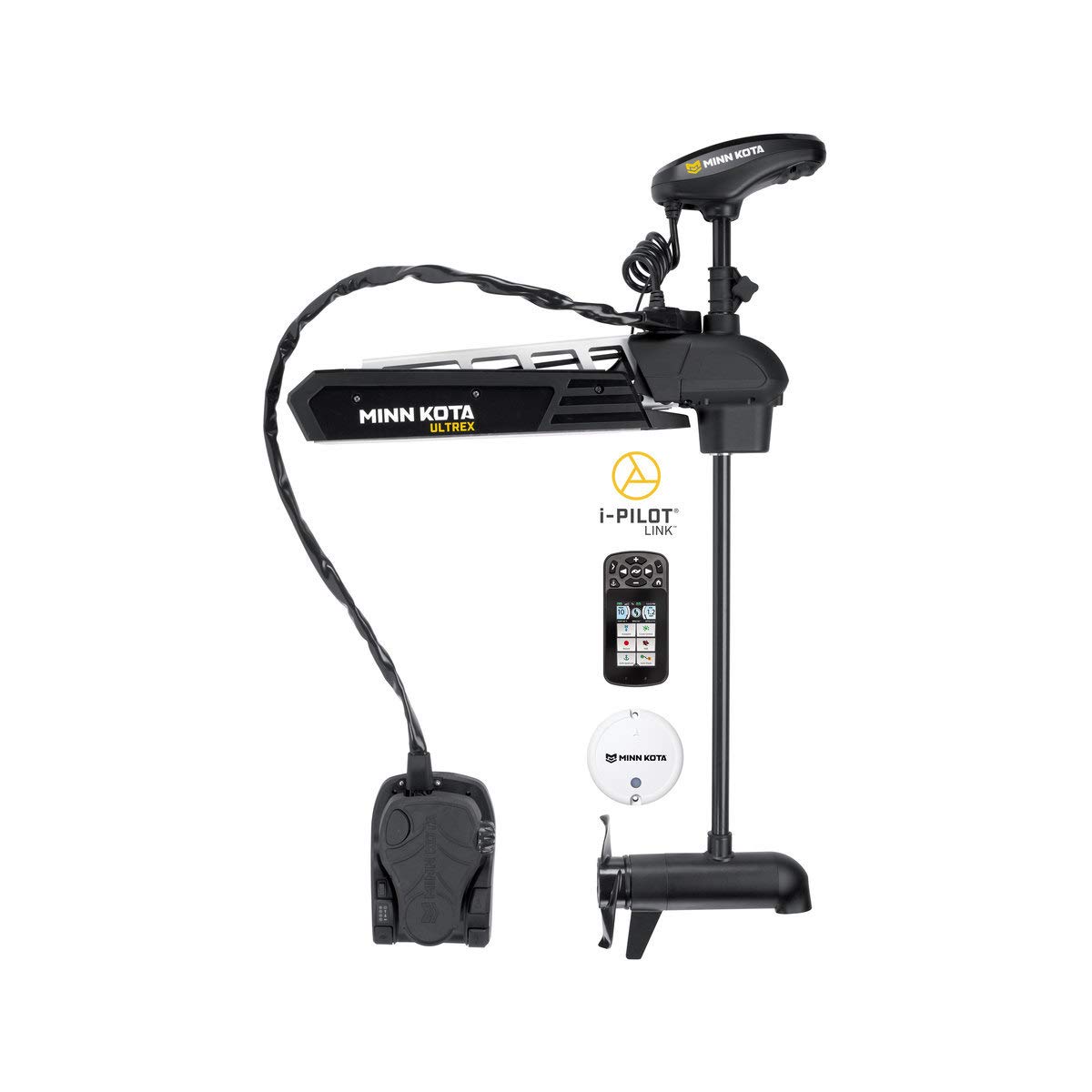
3. Minn Kota Ultrex Cable & Electric-Steer Bow Mount
Cable-steer responsiveness with GPS Spot-Lock built in, wrapped in a foot pedal that steers under power.
Bass anglers who like the feel of a cable-steer pedal but want the motor to anchor itself get both here. This Ultrex runs a 52-inch shaft with 80 lbs of thrust on 24 volts, and the heel-toe foot pedal has Power Steering for instant response. There is a dedicated button on that pedal to fire off Spot-Lock, so you can pin the boat without taking your hand off anything. AutoPilot holds your heading and corrects for wind, waves and current on its own.
The Universal Sonar 2 runs your transducer and wiring down through the shaft itself, with shielded connectors that keep everything protected. That is the same idea the Ulterra uses for a cleaner bow deck. The Ultrex weighs 86 pounds, which is heavier than the 69-pound Ulterra above — so once it is mounted, you will not want to move it between boats often. Against the Haswing Cayman B’s 55 lbs, this 80-lb Ultrex adds a chunky jump in push for a bigger bass rig.
The complaint worth hearing: setup and the i-Pilot Link instructions are the steep part. Written instructions leave some buyers struggling to get the system working, and the learning curve is real before the payoff. “Never in my mind did I think this thing would make fishing this much more enjoyable,” as one angler put it after learning the system. For most buyers, the Spot-Lock button on the foot pedal is the reason for the spend.
What wins people over: the Power Steering foot pedal with a Spot-Lock button on it, plus 3-year manufacturer warranty coverage on a 24-volt 80-lb motor.
Fit note: if you want plug-and-play electronics, budget time for the i-Pilot Link learning curve and lean on support before you give up.
Reach for this if: you fish bass water from the bow and want cable-steer feel with genuine anchoring.
Think twice if: you change boats often — at 86 pounds this is a mount-once motor.
4. AQUOS Haswing Cayman B 12V 55lbs 54in with Wireless Remote
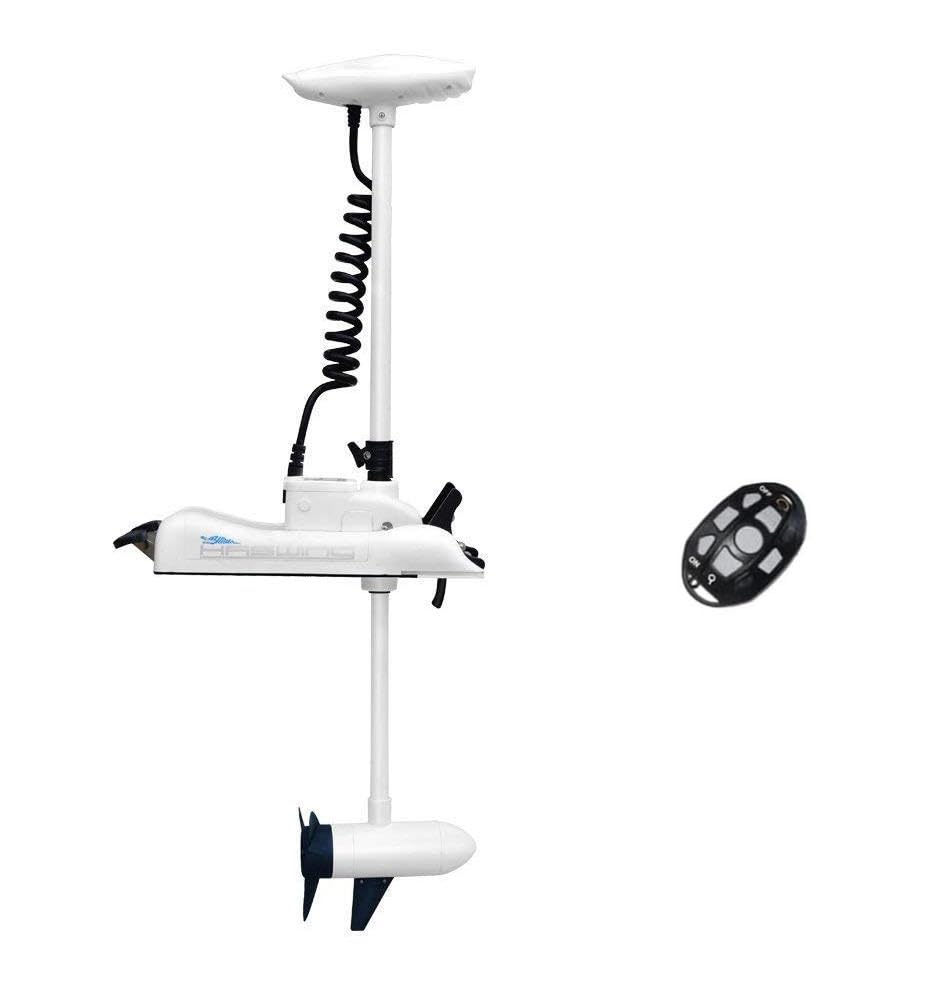
A wireless-remote bow mount that punches well above its price on a pontoon, with cruise control doing the speed work.
You still get remote control at this price. This Cayman B carries a 2.4G wireless remote (a cordless hand control) that reaches up to 164 feet, so you can steer from the shore while you get the boat settled. It runs a 54-inch aluminum alloy shaft with 55 lbs of thrust on 12 volts and is rated for boats up to 2750 lbs. One buyer runs it on a pontoon, where the 164-foot remote range lets you steer from the deck.
The one thing you must know before buying: this is cruise control, not spot lock. Press the speed up or down button on the remote and it holds your speed, but you still have to correct the heading manually when wind or current pushes the nose around. If you expect the motor to pin you over a brush pile, this is not that motor. The variable speed dial keeps power draw lower, so a battery lasts longer at any setting.
Steering is sharp to the point of being twitchy on a 17-foot fiberglass hull, which reads as ~2.5 mph at max — acceptable but not fast. It is built for both fresh and salt water, using a sacrificial anode to protect the metal parts, and it ships with a two-year warranty on the motor itself. The depth collar locks the shaft where you set it, and the ergonomic lifting handle makes carrying it easy.
Standout spec: a 164-foot wireless remote range and 55 lbs on 12 volts at an entry-level tier.
Size the caveat: touchy steering and no GPS anchoring make it a slow-troll motor, not a hold-your-spot motor.
Suits you if: you run a pontoon or an 18-foot hull and want wireless control without paying for GPS.
Skip if: staying pinned over one spot is the whole reason you are shopping.
5. Minn Kota Edge 45 lb. Thrust, 36 In. Shaft

No screens, no GPS, no fuss — a 45-lb cable-steer foot motor for small boats and simple trolling.
Sometimes you want a motor that just pushes the boat while you fish, and the Edge is the honest version of that. It carries a 36-inch shaft and 45 lbs of thrust on five speed settings, with a heel-toe cable-steer pedal that has momentary and constant on/off. A Power Prop built for thick vegetation chews through heavy cover, and the Latch & Door bracket holds the motor securely while stowed. The directional indicator on the head tells you where you are pointed at a glance.
This is where the price-to-feature split earns attention. The motors above you that anchor need GPS and 24-volt wiring; the Edge at 18 pounds is simple and light enough to mount on a small boat and take off at the end of the day. There is no spot lock and no remote — you steer with your foot the old way. For a 12-to-14 foot aluminum boat, that is often all you need.
Two gripes recur in owner feedback, both small. The wiring harness to the battery runs only around 3 feet, which is short on some hulls and needs an extension. Noise is mixed — some find it very quiet, others say it runs a bit louder than they expected. Both are worth knowing but neither stops this motor from doing its job on a small rig.
The case for keeping it simple
- Weighs just 18 pounds, so mounting and removal are easy
- 5 speed settings and a responsive heel-toe pedal with momentary and constant on/off
- Power Prop built for 3-1/4″ motor diameters to push through heavy vegetation
- Ships with mounting hardware, prop, and hold-down strap
Small things you will notice
- Battery wiring is only about 3 feet and may need an extension
- No GPS or spot lock — you hold position yourself
- Noise level draws split opinions
Ideal match: a small aluminum boat, a tight budget, and a fisherman who steers by foot.
Not your motor if: you want the boat to hold a spot without your hands on anything.
6. Haswing Cayman 12V 55lbs 48 inch with Foot Control

A quiet 12-volt cruiser with quick-release convenience and a USB-rechargeable remote, built for freshwater and salt.
This Cayman is the 48-inch version, running 55 lbs of thrust on 12 volts with a variable speed dial that lets you dial in precise control. The variable speed keeps power draw low so your battery stretches further at any setting, and the 2.4G remote reaches up to 164 feet. The quick-release bracket means you can pull the motor off between trips without fighting bolts, and a lifting handle makes carrying it to the truck easy.
Compare it to the Minn Kota Edge, which has no remote and stops at 45 lbs thrust. This Cayman’s 55 lbs gives a little more punch for a loaded 17-foot boat, and the remote lets you steer from the console. Where the Edge is a stripped-down cable-steer, the Cayman adds the wireless layer and the corrosion protection — a sacrificial anode guards the metal parts in salt water, and a two-year warranty covers the motor.
The mounting is the part to measure carefully. On some bass boats under 18 feet the mount overhangs the bow by about 5 inches, which complicates install and means reaching into the hull for nuts. Instructions are thin, and one unit arrived without a plastic spacer inside the motor. Support is slow to respond. As one owner summed it up after a full day on the water, the battery barely half-drained after several hours of trolling at various speeds.
Why it holds up: 55 lbs on 12 volts, a variable speed dial for lower draw, quick-release hardware, and corrosion protection for salt duty.
Measure first: the mount can overhang a short bow, and setup instructions need a confident installer.
Pick this when: you want a light remote-controlled motor you can pull off the boat after each trip.
Be ready for: a little installation problem-solving on a sub-18-foot hull.
7. LiTime 12V 100Ah LiFePO4 Trolling Motor Battery (2-Pack)

Two lithium packs that weigh 22.2 pounds each and are built to feed a 12-to-36-volt trolling motor.
Every motor above needs a battery, and this pair of 100Ah LiFePO4 packs is the light way to do it. Each weighs 22.16 pounds in Group 31 size — 64% lighter than a comparable lead-acid 12V 100Ah, which directly lightens your bow and changes how the boat handles. A built-in battery management system guards against overcharge, overheat and short circuits, and it also stops charging below 32°F and discharging below -4°F to protect the cells from cold. A built-in TVS shields 12-to-36-volt motors from voltage spikes.
Runtime is where the math justifies the spend. LiTime puts the lifespan at 10 years on 4000+ cycles at 100% depth of discharge, against AGM packs that last about 3 years on 200-500 cycles. Battery quality is the single thing that wins these buyers over most. One customer ran a 12-volt refrigerator for five days, and another reported a two-hour full charge. On a 12 or 24-volt motor that runs all day, that reserve is what keeps you fishing past the last cast.
There is a catch list worth reading. These are energy-storage batteries, not starting batteries — LiTime does not intend them for engine cranking, golf carts or jacks. A few arrived asleep and needed a force-mode wake-up with no instructions in the box. Multiple-package shipping means the two may not land on the same day. The rest is solid, and the price-to-capacity case is strong.
Why anglers pair these with a motor
- 22.16 pounds each — 64% lighter than a lead-acid 12V 100Ah
- 2000-cycle-plus margin at 10 years on 4000+ cycles versus 3 years for AGM
- Low-temperature cutoffs stop charging below 32°F and discharging below -4°F
- Expands to 4P4S (51.2V 400Ah, 20.48kWh) as your power needs grow
The fine print to know
- Not a starting battery — storage use only per the manufacturer
- Some arrive in shipping-sleep mode and need a manual wake-up
- Two-packs may arrive as separate shipments on different days
Go here if: you are setting up a 12, 24 or 36-volt motor and want to shed bow weight and cycle life together.
Keep looking if: you need to crank an outboard — this pack is not rated for that.
8. Haswing Cayman B 55lb 48in Bow Mount with Remote & Foot
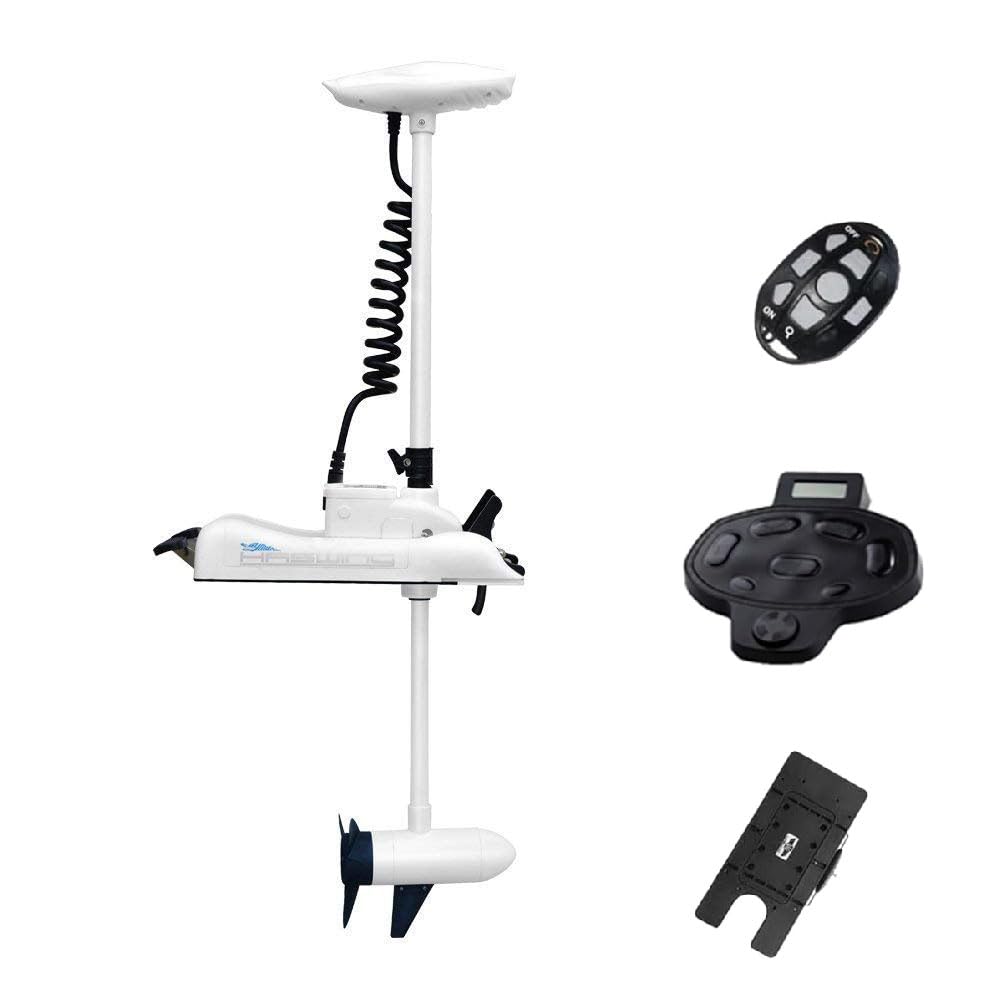
Remote in one hand and a wireless foot pad under the other — two ways to steer while you fish.
Two controls are the draw on this Cayman B. You get the palm-sized remote that reaches up to 164 feet and a wireless foot control you can operate in the boat — so one angler can steer with a foot while both hands stay on a rod. The 48-inch aluminum shaft and 55 lbs of thrust on 12 volts are aimed at boats up to 2750 lbs and about 18 feet. The quick-release bracket pulls the motor off in seconds.
Reliability is the trait that earns the most confidence in this motor’s feedback, and it shows up on real water. One test on a 16-foot, 1740-lb hull with five people and gear aboard found 55 lbs of thrust plenty, with the remote responsive and no connection loss, and the battery indicator unchanged after two hours of use. A heavier 20-foot flats boat has been pushed by it too. Pushing a 20-foot flats boat with 55 lbs on 12 volts is near the top of this motor’s range.
The honest weaknesses are the controls and, on rare units, the pairing. The foot pedal is slow to respond and needs a firm press, and the hand remote has no on/off indicator light. Cruise control, not spot lock, means you still correct heading by hand. On a much rarer note, one new-in-box motor would not pair with a remote at all — if that happens, test pairing immediately rather than waiting months to install.
The strongest trait: reliability across bay and flats conditions, with 55 lbs of torque doing more work than its size suggests.
Second thought: the foot control is sluggish to respond, so fine steering takes a deliberate press.
Built for: the angler who wants two independent controls and quick on-off mounting.
Not the one if: you need GPS anchoring — this is a cruise and steer motor.
9. Minn Kota Fortrex 80 Bowmount with Universal Sonar
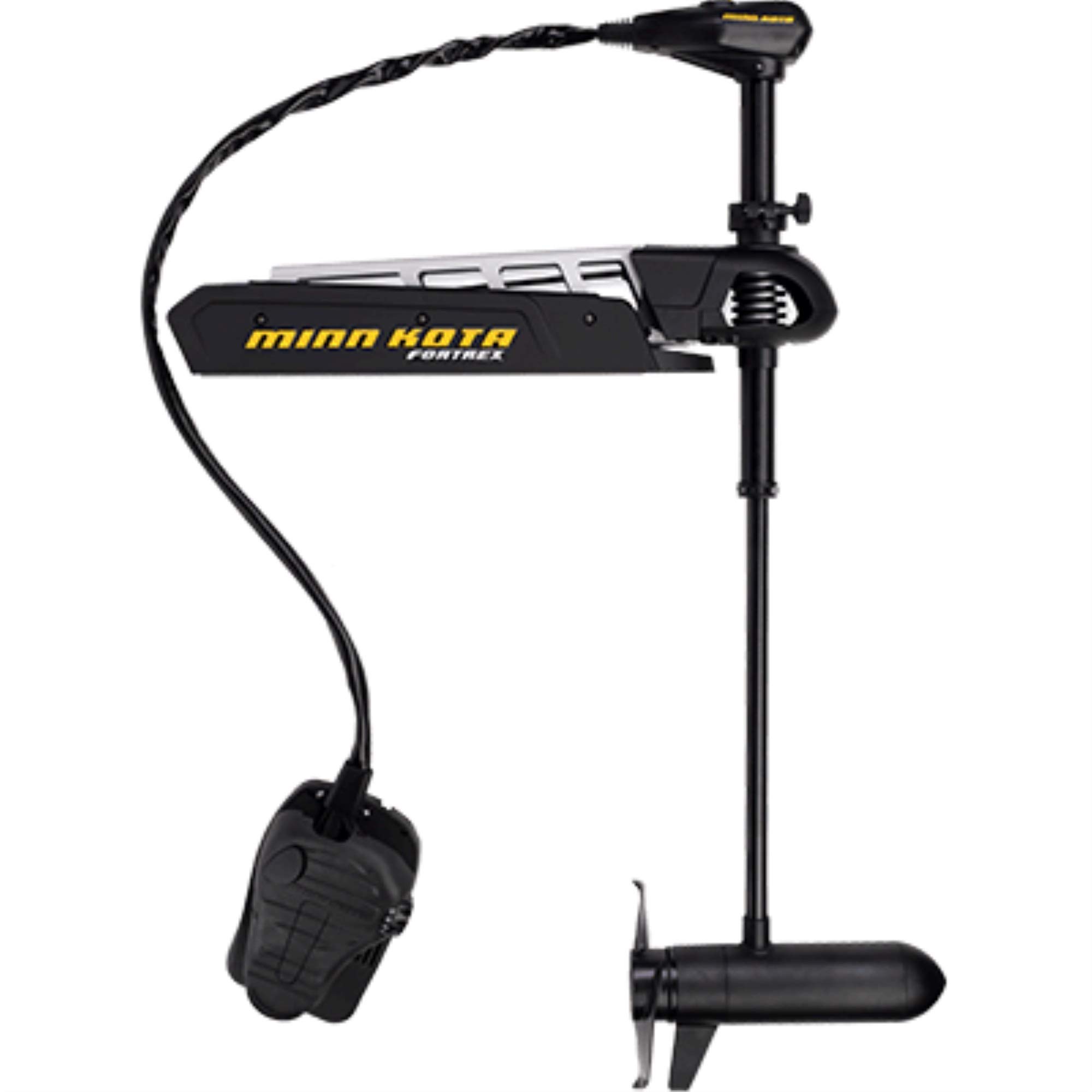
An 80-lb brute with a lift-assist mount that halves the weight of stowing it and a bowguard that resets after impact.
If you fish standing timber and rock, the Fortrex earns its place on impact protection alone. The Bowguard 360 bracket breaks away when you hit something from any angle and resets itself, so you do not stop fishing to fix it. The Lift-Assist Mount cuts the felt weight of stow and deploy in half — worth knowing on a motor this size. A 52-inch shaft carries 80 lbs of thrust on 24 volts, and the one-piece mono-arm is built from extruded, anodized aluminum to keep vibration and noise down.
Two specs make the difference in a long day. The Digital Maximizer extends run time up to 5 times longer on one charge by sipping power instead of dumping it, and the illuminated directional indicator lets you see your heading in low light. Universal Sonar 2 conceals the transducer wiring inside the shaft. On an 18-foot bass boat this 80-lb motor has pushed through big waves at 2.9 mph — that is the kind of reserve you want when the wind picks up.
What you give up is anchoring. There is no GPS and no Spot-Lock, so this is a hands-on cable-steer motor. It is also heavier than the Ulterra above, which matters if you move it between boats. Noise and a slightly off-center sonar head are the small knocks — the sonar can shoot to one side if the head is not factory-straight.
The draw: impact-tolerant Bowguard 360, a Lift-Assist mount, 80 lbs of thrust, and up to 5x longer run time on a charge from Digital Maximizer.
Read this: no GPS anchoring and no remote — an old-school cable-steer motor for anglers who want power in heavy cover.
For you if: you fish rock and timber and want a motor that survives the occasional strike.
Look past it if: Spot-Lock is your reason for shopping — the Fortrex has none.
10. Minn Kota Riptide Terrova 80 lb. 60 In. with GPS Spot-Lock

A saltwater-rated Terrova that pins you over a spot and lets you jog that spot five feet in any direction.
Saltwater changes the equation: corrosive spray eats ordinary lower units, so the Riptide coats its housings in grit-blasted aluminum and powder coat to fight oxidation and rust. This one runs a long 60-inch shaft with 80 lbs of thrust and a precision GPS system with Spot-Lock and Jog. Jog lets you shift your locked position 5 feet in any direction, so you can work a flat or edge without re-anchoring your spot every time. Drift, follow and dodge modes round it out.
The one-touch deploy and stow lever uses fall-away ramps to slide the motor into the water, and the LCD wireless remote has a non-slip grip with four programmable One-Boat Network buttons. That 60-inch shaft is the longest in the lineup, which matters on a high freeboard bay boat. Compare it to the 47-inch Lowrance Ghost: the Riptide is a much longer reach for a deeper-riding hull, though the Ghost pushes more thrust with 97/120 lbs against the Riptide’s 80.
Motor quality is what sells this one, and it holds its position like a physical anchor. At this tier, the warranty runs three years with registration, and the Digital Maximizer (a power-saving circuit) extends run time up to 5x longer on a charge. The rare complaint is an early failure where the prop stopped turning. With proper installation and registration, it is among the most secure anchoring motors in saltwater.
Standout spec: Spot-Lock with Jog that shifts the locked point 5 feet in any direction, on a genuine 60-inch shaft.
The caveat: a rare unit has failed early on the water, so register the warranty the day it arrives.
Built for: saltwater anglers who anchor over structure and want the boat to hold while they cast.
Weigh against: a shorter-shaft motor if your bow sits low — the 60-inch shaft is a long reach.
11. Minn Kota Ulterra 80 lb. 45 In. with Dual Spectrum CHIRP
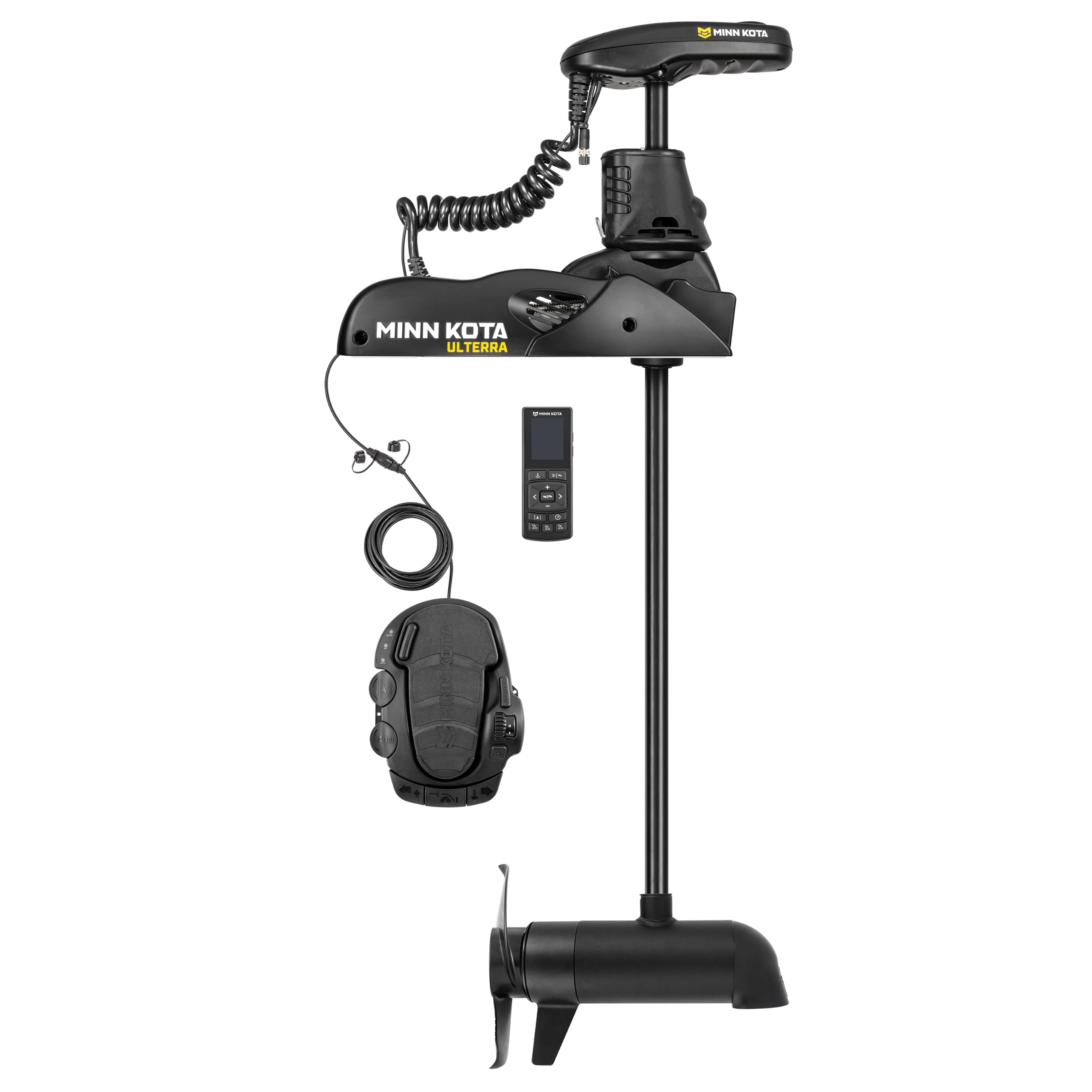
Ships with the sonar already built into the shaft and stows itself at a button press — a compact-shaft premium pick.
This is the 45-inch-shaft Ulterra, so it is aimed at a lower-bow boat than the 60-inch version above. The sonar is built into the shaft: Dual Spectrum CHIRP shows fish, structure and bottom contour with more detail than traditional sonar, with every transducer component hidden inside the shaft so nothing dangles. Auto stow and deploy with power trim adjusts the motor up or down from the remote, foot pedal, One-Boat Network App or a compatible Humminbird finder.
GPS with Spot-Lock and Jog does the holding, shifting your locked point 5 feet in any direction, and Digital Maximizer extends run time up to 5x longer on a charge. The wireless remote has four programmable One-Boat Network buttons. Where the Lowrance Ghost above gives you CHIRP plus DownScan in the nosecone, this Ulterra’s built-in sonar is CHIRP only — no down or side imaging until you add a transducer, as buyers have found. That is the single mismatch to plan around.
The auto-deploy is the sanity-saver, especially on a boat with a back-trolling layout. As owners mention: “the push of a button keeps you in place” while you change a bait, untangle a line or deal with anything else — no fighting the motor back onto the deck. Warranty runs three years with registration. Two rare failures turned up early on new units, so test the prop and deploy cycle on day one rather than after a season.
Why it earns a spot: built-in Dual Spectrum CHIRP sonar in the shaft, one-touch auto stow and deploy, and Spot-Lock with Jog.
Second thought: the sonar is CHIRP only — no down or side imaging without a separate transducer.
Good match if: you have a lower-bow boat and want auto deploy and built-in sonar in one unit.
Check before you buy: if you need down or side imaging (sonar that shows what is below or beside the boat) — if so, budget for an added transducer.
Know the Specs
Thrust in pounds
Thrust is the push the motor gives at full power, rated in pounds. A 55-lb, 12-volt motor is generally aimed at hulls up to around 18 feet, while an 80-lb motor usually needs 24 volts and moves a heavier bass boat. Match thrust to the loaded weight of your boat, not just its length, and buy extra if you fish with a full livewell and friends aboard.
Shaft length
The shaft is the tube that drops the motor head into the water. It has to be long enough that the propeller stays submerged in chop, so measure from your bow deck to the waterline and add margin. A 36-inch shaft suits a low small boat; a 60-inch shaft suits a high-freeboard bay boat. Too short a shaft cavitates every time a wake rolls under the hull.
Spot lock vs cruise control
Spot lock is GPS anchoring that holds your boat over one coordinate without a physical anchor, and it can include jog to move that point a few feet. Cruise controlmaintains a set speed but leaves heading correction to you — turn the motor and the boat drifts with wind or current. If holding over structure matters, buy GPS anchoring. If you mostly slow-troll a bank, cruise control is enough.
Voltage and batteries
Battery count follows voltage: a 12-volt motor runs off one battery, 24 volts means two in series and 36 volts means three. That changes your wiring, charger and bow weight. Lithium packs such as the LiTime units weigh far less than lead-acid for the same stated 100Ah capacity (amp-hours, a measure of charge stored). They also hold a flat discharge curve — so you check resting voltage, not voltage under load, to gauge remaining charge.
Common Questions
Do I need GPS for a trolling motor to hold position without an anchor?
What is the difference between spot lock and cruise control?
Will a 55 lb thrust motor push my boat?
How do I measure shaft length for my boat?
Can I run a 24 volt trolling motor with one battery?
Is it safe to use a lithium battery with my trolling motor?
Can I add down imaging to a motor that only has CHIRP sonar?
Do trolling motors work in salt water if the listing does not say so?
How long will a trolling motor run on a single charge?
Does auto stow and deploy really save time on the water?
The Bottom Line
For most anglers shopping for a cheap spot lock trolling motor, the Lowrance Ghost is the one to beat. It runs brushless-quiet, gives 97/120 lbs of thrust, and packs genuine anchor mode and built-in sonar into one package, backed by a 3-year warranty. If you want the motor to lift itself and pin you down, the Minn Kota Ulterra with i-Pilot Link is the easy choice. And for a saltwater bay boat, the Minn Kota Riptide Terrova gives you Spot-Lock with jog and a corrosion-protected lower unit. Buy for the water you actually fish, and the anchor feature you actually want.
How we choose
We do not accept paid placement. Every pick is matched to a real buyer and a real use-case; we do not hands-on test units.
Sources
Specifications: manufacturer listings and product documentation. Review insights: verified customer reviews, as of October 2026. Pricing: not shown on this page (it changes often); check the current price via the retailer link.
As an Amazon Associate, Aappliancez earns from qualifying purchases. This does not affect which products we feature.