Disclosure: Some links in this post are affiliate links. As an Amazon Associate I earn from qualifying purchases, at no extra cost to you. Learn more
Specs are compiled from manufacturer listings and verified buyer reviews and can change over time — please confirm the key details on the product page before buying.
White spots and streaks on your paint come from minerals in your tap water, and a deionized water system removes them at the source instead of chasing the marks later. These units strip the minerals out of your rinse water, so you can walk away and let the car air dry. The short answer: the On The Go Spotless wins on run time per refill, the iSpring WGB22BD is the pick if you want a 1,200-gallon filter on a rolling cart, and the Filterelated CWS-713 is the cheapest way to a 0 PPM rinse.
This guide is built by comparing the manufacturers’ published specifications and the patterns across verified customer reviews, so you get each pick’s real strengths and trade-offs instead of marketing spin.
You are about to see how each system handles real water, what the flow-rate and resin rules actually mean, and where the honest limits sit. Below are nine deionized water systems ranked by resin capacity, flow rate and real-world spot-free results.
Top Picks


How To Choose The Best Deionized Water System for Car Washing
Two numbers decide which unit you buy, and neither is printed big on the box: your tap water’s mineral count (measured in ppm, or parts per million) and how much water you need per rinse. Match both to a unit’s resin volume and gallon rating and you avoid buying capacity you will never use.
Start with your water’s mineral count
Water hardness and TDS (total dissolved solids, a measure of how many minerals are floating in your water) decide how fast your resin gets used up. Feed it clean water and the cartridge runs for months. Feed it heavy mineral water and the same cartridge gives up in a handful of rinses. That is why the included TDS meter matters: test your tap water first, then test the output, and you know exactly when the resin is spent.
Resin capacity and gallon ratings are the same conversation
Every gallon figure on these listings assumes a certain starting water quality. A system rated around 630 gallons at 200 ppm is working from the same math as one rated 300 gallons — different resin volume, different tank size, so different run time. Match the capacity to how often you wash and how many vehicles are in the driveway.
Pressure and flow control protect your resin
Push water through too fast and it skips past the resin without fully contacting it, which shows up as a TDS reading above zero. Many of these kits ship with a bypass valve for exactly this reason — wash with tap water, then flip to filtered water for the final rinse only. Washing on tap and switching to filtered water only for the final rinse can double the gallons you get from one resin load.
Portability versus capacity
Two tanks weigh more but give you more gallons between cartridge changes. A single compact tank is easy to carry but needs refilling sooner. If you wash in the same driveway every weekend, a 27- or 43-pound unit on a cart costs you nothing in convenience. If you haul the kit to an RV or a boat, the handle and cart design matter more than the tank volume.
Side-by-Side Comparison
| Model | Best For | Rated Capacity | Max Flow | Item Weight | Amazon |
|---|---|---|---|---|---|
| On The Go Spotless Portable Dual Bed Deionizer★ Best Overall | Overall balance of capacity and transport | 630 gallons | 2 GPM | 18 lbs per tank | Amazon |
| Filterelated Spotless Water System CWS-713Budget Entry | First-time buyers on a tight budget | — | — | 14.82 pounds | Amazon |
| H&G lifestyles Portable Water Softener 5A Food-GradeRV Companion | RV owners who also want softer wash water | 2,600 gallons (max reference) | — | 13.62 pounds | Amazon |
| H&G lifestyles Water Deionizer WDR01 | Compact single-tank driveway rinses | 500 gallons | — | 12.52 pounds | Amazon |
| Filterelated 10L Mixed Bed System Tank 04 | Bigger resin load with a bypass valve | 560 gallons at 200 ppm | — | 27 pounds | Amazon |
| AKM Pre-Filled DI System akmjs-BP | Reusable tank that ships ready to run | — | — | 24.3 pounds | Amazon |
| Waterdrop CWE Spotless Water System | Wall-mount or floor placement with bypass | 8 spotless washes at 200 ppm | 300 psi max pressure | — | Amazon |
| iSpring WGB22BD | High-volume washes on a rolling cart | 1,200 gallons | — | 43.2 pounds | Amazon |
| CR Spotless DIC-20 | Heavy-use detailing and solar panels | 300 gallons | 2.5 gpm | 42.6 pounds | Amazon |
Detailed Reviews
1. On The Go Spotless Portable Dual Bed Deionizer
Our pick — 4.5+★ from 100+ verified ratings; the strongest balance of quality and price.
Two small tanks that out-run the big single housings and still fit in a corner.
The dual-bed design is the whole story here. This unit carries.50 CUFT of resin compared to the.33 CUFT inside two 20″ x 4.5″ big blue housings — more media in a stack that measures just 8″ x 20″ on the ground. Each tank weighs 18 lbs and measures 22″ x 6.75″, so you carry two light pieces instead of one awkward barrel. For a home detailer with a pressure washer and a tight garage, that footprint is the real selling point.
Run time is the number that wins people over. On The Go rates it at roughly 630 gallons before a recharge is needed at 200 ppm — and that is 210 more gallons than two 20-inch deionizing resin cartridges deliver. Max flow rate is 2 GPM, which is fast enough to rinse a full-size truck without standing there all afternoon. The kit ships with a 4 ft. hose, polypropylene cam lever quick-connects between the tanks, a cap and plug for travel, and a handheld digital TDS meter so you can verify the output yourself.
The catch is flow discipline. Push a full-blast spigot through this and the reading climbs — buyers report that cutting the pressure to about a quarter brings the output back down to 1 PPM. A few owners also notice a smell from the treated water that fades quickly, most often when the source water carries heavy particulates. That is a quirk of the resin, not a defect, and it does not affect the finish. The value side gets mixed feelings because resin refills cost real money, so use the bypass habit and reserve filtered water for the final rinse.
Where it earns its keep
- .50 CUFT of resin beats the.33 CUFT in two 20″ big blue housings
- 630 gallons at 200 ppm before a recharge — 210 more than two 20-inch cartridges
- 2 GPM max flow and an 8″ x 20″ footprint
- Ships with hose, cam levers, travel cap and a digital TDS meter
What to plan around
- Needs reduced spigot pressure — full blast raises the output reading
- Treated water can carry a brief odor when source water is dirty
- Resin refills are the long-term cost, so lean on the bypass
Go with this if: you wash at home with a pressure washer and want the longest run between recharges without a rolling cart.
Hold off if: your spigot has no way to dial back pressure — that control is what keeps the output at 1 PPM.
2. Filterelated Spotless Water System CWS-713
The starter kit that gets minerals out of your rinse without asking for much space.
At 14.82 pounds, this is the lightest kit on the list — 1.2 pounds lighter than the H&G lifestyles softener at 13.62 pounds. FRP is fiberglass-reinforced plastic, the same tough material used in commercial filter housings, and it is what lets the tank shrug off driveway drops. The full kit adds 3/4″ NPT fittings, two quick-connect sets, a bypass valve, a strap handle and a TDS pen.
What wins people over is how little ceremony there is. Hook it to a garden hose, flush the tank for about a minute, and you are rinsing. The 150-ppm scenario is the one that sells it: tap water going in at 150 PPM comes out at 0 PPM, and a dark green Benz air-dried in the sun with no spots or streaks. Buyers running a 36ft Class A motorhome report the same clean result using the pressure-washer bypass switch for the final rinse.
Honest limits live in the water quality. If your tap runs around 500 PPM, the 5L of resin gives you roughly two truck washes before it needs a change — a much larger tank is the smarter buy in that situation. The recurring gripe is the connections; a few units arrive seeping, and a wrap of plumber’s tape plus a careful tighten settles most of them. The lid also takes some fiddling to reseat after a refill. None of that changes the result on the paint, but budget a little patience for setup.
The real-world read: a light, portable kit that turns 150 PPM tap water into a 0 PPM final rinse — exactly what a driveway detailer needs and nothing more.
Know before you buy: at 500 PPM source water the 5L resin load is short-lived, so hard-water homes should step up in tank size.
Reach for this if: your water sits in the moderate range and you want the lowest-cost way to stop chasing streaks with a towel.
Look elsewhere if: your tap tests very hard — the resin will not stretch far enough to feel like a bargain.
3. H&G lifestyles Portable Water Softener for RV 5A Food-Grade
A softener built for the RV bay that doubles as a mobile wash-water helper.
Be clear on what this is: a softener swaps calcium and magnesium for sodium rather than stripping everything out. So it softens the water you wash with — and the water you drink — but it will not bring TDS to zero. H&G states plainly that it does not lower TDS and will not remove iron. If your goal is a rinse that dries without mineral residue, a true deionizer is the right tool. If your goal is water that feels softer on the rig and the wash, this does the job.
Buyers praise the build most. It uses NSF certified food-grade resin (NSF is an independent safety-certification body) tested by a third party to NSF 42/60 standards, and the media is a 10% crosslink cation resin — a step up from the usual 8% crosslink, which means better chlorine resistance and a longer working life on municipal water. The exchange capacity beats the standard 12,000-grain offerings, and H&G rates the tank at a 2,600-gallon maximum reference under specific water conditions. Treat that gallon figure as a ceiling, not a promise; harder water needs more frequent regeneration. It arrives pre-filled with salt, so first use needs no setup.
Hardness numbers tell the tale. One user tested 350 before and zero after, with no leaks and no pressure drop. The 3/4″ brass fittings and hose make installation quick, and transport caps keep things tidy on the road. The threaded interface is tapered, so some thread stays exposed after the adapter seats — H&G warns against over-tightening, and loosening slightly is the fix when a fitting seeps. The carry handle sits a touch loose on some units. Empty it weighs 12.5 lb; charged with water it climbs to 16 lb, so lifting it in and out of a bay is a two-hand job.
What sold people
- 10% crosslink food-grade resin resists chlorine better than 8% media
- Beats standard 12,000-grain softeners on exchange capacity
- 2,600-gallon maximum reference, pre-filled with salt and ready to go
- 3/4″ brass fittings, transport caps and a carry handle
The honest caveats
- Does not reduce TDS and does not remove iron — it is a softener, not a deionizer
- Tapered threads need a light touch; over-tightening risks cracking
- 16 lb when charged with water makes it a deliberate lift
Pick this one if: you want softer water in the RV and around the wash bay, and you understand it trades minerals rather than removing them.
Pass on it if: your only goal is a spot-free final rinse — you want a deionizer for that job.
4. H&G lifestyles Water Deionizer WDR01

A 12.52-pound deionizer that promises zero TDS and a rinse-and-walk-away finish.
This one does the opposite job of its softener sibling above — it strips minerals out entirely instead of trading them. H&G rates it to generate up to 500 gallons of deionized water, and the whole unit weighs 12.52 pounds, easy to lift onto a shelf or carry to the driveway. The design keeps the controls simple, so there is no learning curve beyond connecting a hose and switching it on.
Where it shines is the rinse. Rinse the car with this water and let it air dry — no towel, no squeegee, no chasing droplets down the door panels. The included high-quality outlet connector hose is the kind of small detail that saves a hardware run. Functionality is what carries this unit in owner experience, with quality close behind; people plug it in, watch the number drop, and get on with their day.
Here is the thing nobody tells you up front: if your first reading does not hit zero, it is usually not the resin. H&G’s own note says to fill the deionizer completely and let it stand for five minutes so the water fully contacts the mixed bed resin. Then dial back the pressure — high pressure pushes water through without proper contact and the reading lands above zero. Do those two things and it behaves. Durability is the fair question mark; owners leaning on it for frequent washes want to be gentle with the fittings.
The small print that saves you a return: fill it, let it stand five minutes, and lower the pressure. Skipping either step gives a false TDS reading that looks like a broken unit.
The right fit: drivers washing one or two cars who want zero-TDS rinses from a compact, light kit.
The mismatch: high-volume users who rinse a fleet every weekend — 500 gallons goes quickly at that pace.
5. Filterelated 10L Mixed Bed System Tank 04

Double the resin of the starter kit, plus a bypass valve that stretches every gram of it.
Where the smaller Filterelated kit runs 5L of resin, this tank carries 10L — two vacuum-sealed 5L bags of LANLANLANG mixed bed resin, backed by NSF/REACH/SGS/WQA certifications. More media means more ionic impurities pulled out before the cartridge tires. Filterelated rates it at roughly 560 gallons of spot-free water under average water quality of 200 ppm TDS. At 27 pounds it is a sit-and-stay unit rather than a carry-around one, so plan a permanent spot near your spigot.
The bypass valve is the smart part. Flip it and you are washing with ordinary tap water; flip back and you are rinsing with deionized water. That one switch keeps the expensive stuff for the final pass and keeps the resin alive far longer. The kit also ships with a TDS pen so you can see the output yourself, and the resin is refillable with the same LANLANG replacement pack used across the brand’s kits.
The same pressure rule applies, and it catches people out. If the TDS does not hit zero, fill the deionizer completely and let it sit five minutes, then lower the water pressure — high pressure skips the resin contact and the reading floats above zero. Connection seepage is the other recurring theme; tighten the fittings carefully, use tape where needed, and most weeping stops. Given the resin volume and the bypass, this kit rewards a patient setup with a long, quiet service life.
Why the extra resin matters: 10L of media at 200 ppm gets you about 560 gallons of spot-free water, and the bypass switch means you spend that water only on the final rinse.
The trade-off to accept: at 27 pounds it stays put, so this is a fixed-station kit rather than a portable one.
Choose it when: you want a larger resin reserve and a bypass valve without moving up to a big two-tank cart.
Choose differently when: you need to haul the system to an RV or boat — 27 pounds and no cart make that a chore.
6. AKM Pre-Filled DI System akmjs-BP
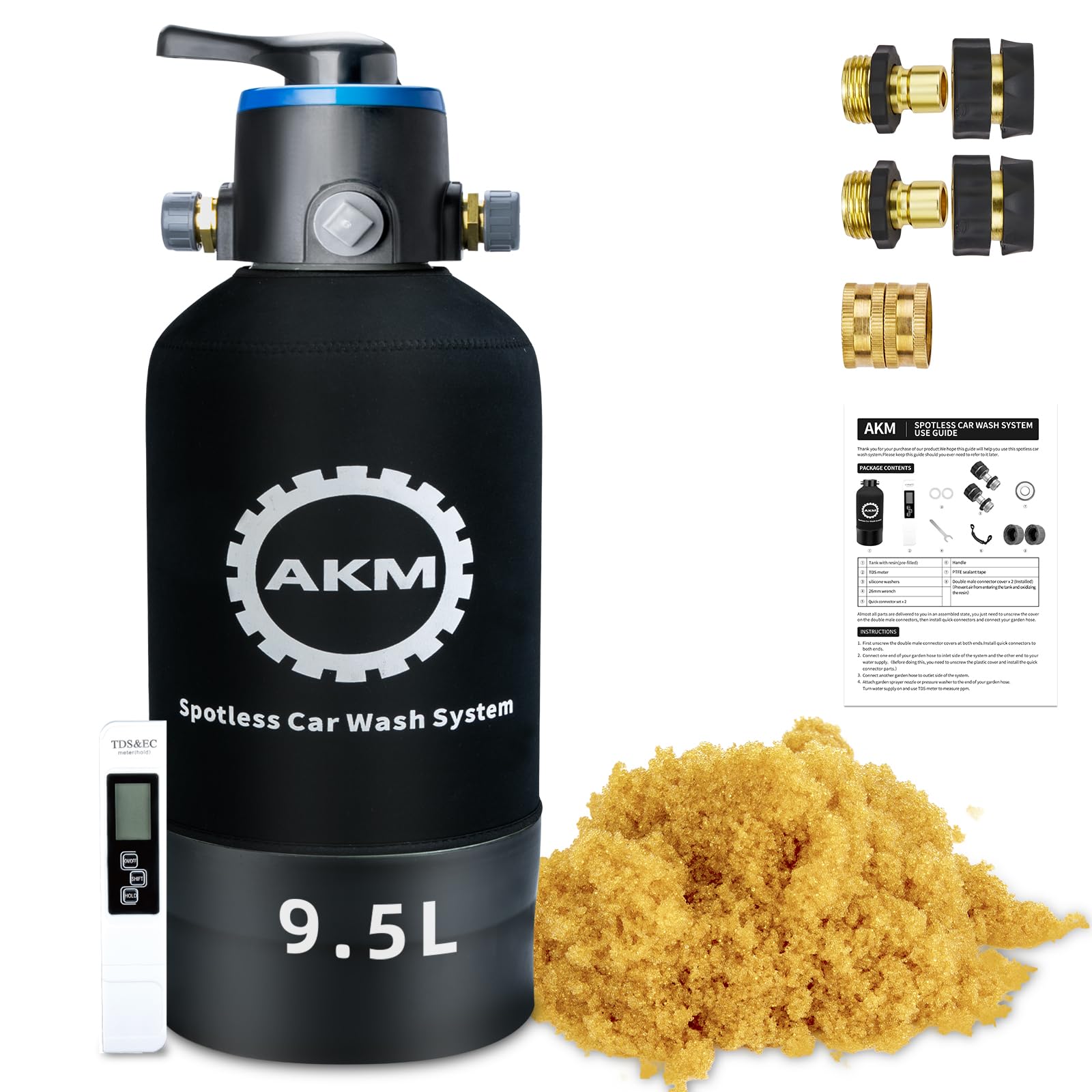
A fiberglass tank that arrives loaded and ready, then refills instead of getting tossed.
The tank is the durable piece here. AKM uses a 9″ x 20″ FRP tank with a polyester cover and pre-fills it with 9.5 liters of mixed bed resin — enough to fill to 10 liters once water goes in. Unlike a throwaway plastic filter housing, this shell is built for the long haul; when the resin is spent you pour it out, refill with AKM’s 10L mixed DI resin and reconnect. The 24.3-pound package includes two 3/4″ garden hose quick-connectors, one 3/4″ double female connector, PTFE sealing tape, a black handle and a TDS meter pen.
The bypass handle is the feature to learn first. Shift it one way for tap water, the other for filtered — wash the car on tap, then switch to filtration for the final rinse. That habit preserves pure water and extends the resin’s lifespan, which is exactly where the operating cost lives. People also report the connector courtesy: the included female-to-female piece saves a trip to the hardware store on install day.
Two things to hold in mind. Water resistance lands where you would expect — one reading in the reviews measured all the way down to 0.005 ppm, which is why the finish comes out clean. Leakage is the split opinion: plenty of users run dry setups, while some find a weeping joint that needs a fresh O-ring or a careful seal. Resin longevity and output are the honest long-run questions, and in very hard water the refills add up. Factor that into what you consider a good deal, and buy the replacement resin knowing the tank itself will outlast several fills.
Standout details
- 9″ x 20″ FRP tank with a polyester cover, pre-filled with 9.5L of resin
- Refillable with AKM 10L mixed DI resin — no disposable housing
- Bypass handle plus two garden hose quick-connectors and a TDS pen
- The double female connector spares a hardware run
Budget for these
- Joint seepage shows up on some units and needs an O-ring or tape
- Resin refill cost adds up in hard-water areas
- 24.3 pounds is a two-hand move from shelf to spigot
Worth owning if: you want a tank you keep and refill rather than replace, and you value a bypass handle from the start.
Think twice if: you wash with very hard water — the resin will need frequent, paid refills.
7. Waterdrop CWE Spotless Water System
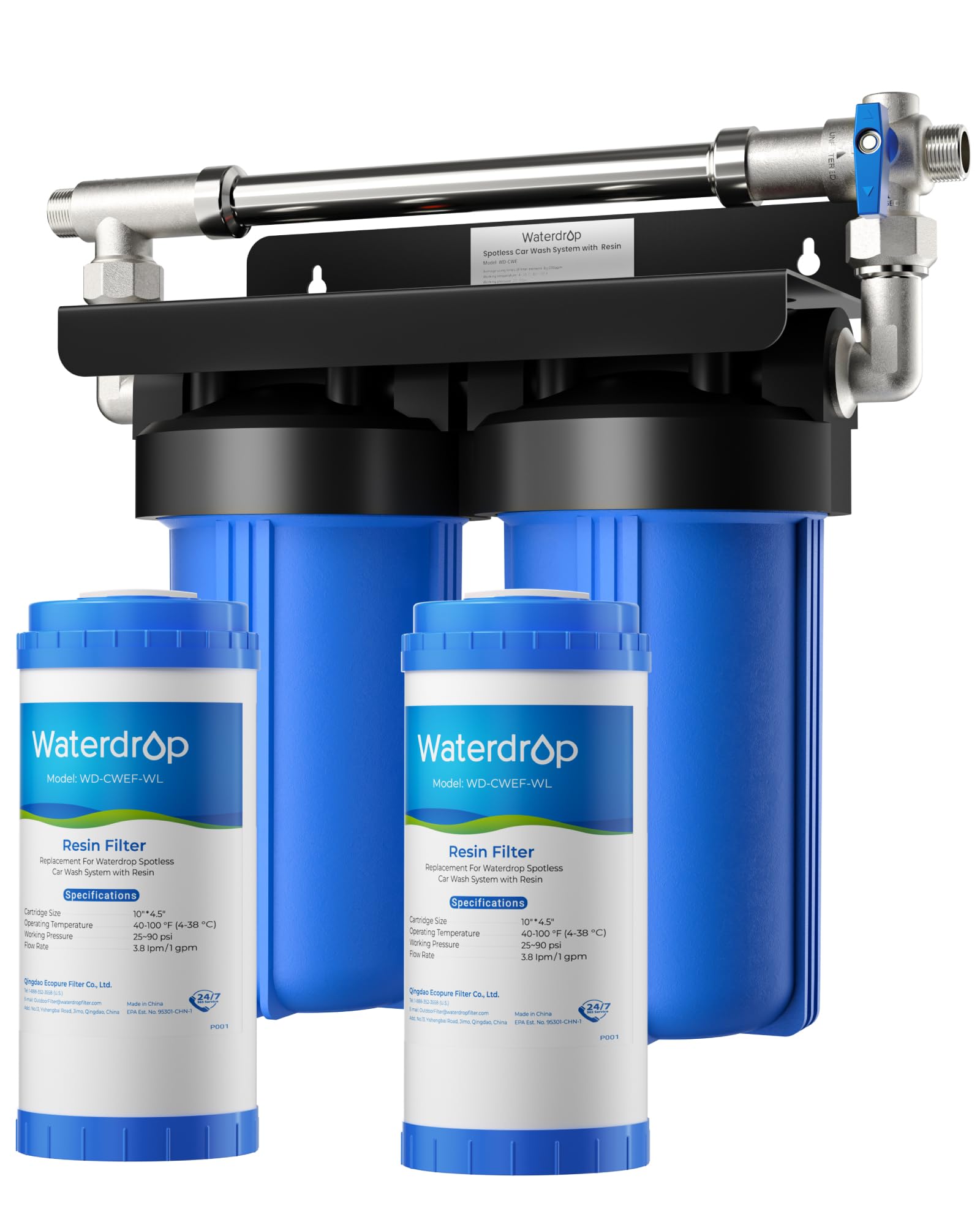
The branded, wall-mountable option with a bypass switch and a service team behind it.
Waterdrop’s system carries pre-mixed premium resin that reduces mineral and calcium-magnesium ion particles in the water — a rinse that also cuts down on scratches and wear during the wash. It is rated for 8 spotless cleans based on a 200 ppm feed, and the maker is upfront that actual lifespan varies with your water condition. The unit uses 3/4″ MNPT threads on both inlet and outlet, so match your house piping before you buy. Filtration performance is the clear strength: it stands up to lab pressure testing and is rated to a maximum pressure of 300 psi.
Placement is flexible. Hang it on a board or set it on the ground — freestanding install works either way. The bypass switch lets you flip between tap water and purified water so most of the wash does not chew through resin. Waterdrop advises using spotless mode only for the final rinse, roughly 8-10 minutes, and making sure the bypass is rotated to the correct position so you do not shorten the unit’s service life. Replacements are handled through a WD-CWEF-WL filter, and the maker points to a second filter saving over 70% of the cost on later use.
Set expectations on the output. Waterdrop is honest that the system reduces water spots without dropping TDS to zero — so do not judge it by a 0.000 reading. Feed it water above roughly 350 TDS and the filters deplete fast; a pre-filter can help if your supply is heavy. Leakage is the split vote: plenty of units run dry, while a few arrive weeping at the seal, and the maker’s replacement route closes those cases. Overall, the filtration and build earn the price for a buyer who wants a name behind the warranty.
The one number to respect: 300 psi max pressure is a hard ceiling — exceed it and you are buying seals, not a rinse.
The quiet catch: it reduces spots rather than zeroing TDS, and very hard feed water shortens filter life noticeably.
Fits you best if: you want a wall-hung or freestanding unit with a bypass, and you value a responsive service channel over the cheapest resin.
Less suited if: you expect a literal 0.000 TDS reading — this model is engineered to reduce spots, not to zero out the meter.
8. iSpring WGB22BD

A 1,200-gallon filter on wheels that makes spot-free rinsing a one-step routine.
The capacity is what changes your habits here. The 20″ high-capacity filter yields up to 1,200 gallons — the maker’s own estimate works out to about 240 car rinses, and the cartridge lasts up to 12 months. That is the highest rated gallon figure on this list — roughly 240 car rinses — so a single 20″ filter covers a year of weekly washing. What makes it work is 100% DI water: minerals cannot crystallize if the water dries mid-wash, so the sandpaper effect that causes micro-scratches and swirl marks is taken out of play. Ceramic coatings, wraps and waxed surfaces all dry spot-free, and pure water keeps soap at full strength with zero residue.
The no-bypass design is deliberate — iSpring built it for quick washes, so you are not flipping valves, just hooking up and rinsing. Setup is tool-free with standard 3/4″ GHT quick connectors, and the heavy-duty metal rolling cart makes moving the 43.2-pound unit around a driveway easy. Pressure-release buttons make filter changes simple when the time comes. iSpring provides a 1-year manufacturer warranty on online registration plus free technical support from a U.S.-based team.
Honest notes: 43.2 pounds is a lot to lift onto a cart, and the unit is designed to live on it. Filter life is the open question — a good number of users see filters stretch across several years, but opinions on lifespan do spread. At this rated capacity the math works in your favor for regular use, but if you wash once a month you will not get near the ceiling before the calendar catches up. Effectiveness and spot-free results are the two things that keep people happy, and they are the reason to look here first.
The selling points
- Up to 1,200 gallons and about 240 car rinses from one 20″ filter
- 100% DI water blocks mineral crystallization and the micro-scratch risk
- Tool-free 3/4″ GHT quick connectors and a heavy-duty metal rolling cart
- 1-year warranty with U.S.-based technical support
Weigh these in
- Filter life opinions vary — not every owner gets the full estimate
- 43.2 pounds means you roll it, not carry it
- No bypass, so all your wash water runs through the filter
Buy this for: regular washes on multiple vehicles where the big gallon rating and quiet routine are worth the cart.
Skip the upgrade if: you wash once a month — a smaller tank keeps you from paying for capacity you will not use.
9. CR Spotless DIC-20

The two-housing workhorse that pros recognized before homeowners could buy one.
CR Spotless is the name that started this category — the first to bring deionized rinse water to homeowners in a compact, portable format. The DIC-20 is its two-housing setup: two 20-inch de-ionization housings with replaceable or refillable cartridges that slide into watertight tubes. It mounts on a powder-coated, rust-resistant rolling cart so you can wheel it into position and store it out of the way. A 2.5 gpm maximum flow rate is the highest on this list, and the unit produces roughly 300 gallons of mineral-free water based on your input quality.
What you get in the box is complete: two 20-inch deionizing resin cartridges, a stainless steel input line, filter wrench, spray nozzle and a battery-operated water purity indicator. The stainless inlet line stands out over plastic and rubber hose on the other kits. The 15″ x 15″ x 25″ footprint and 42.6 pounds mean you are moving it on its cart rather than carrying it — the wheeled stand is the whole reason it stays usable in a busy garage.
The trade-offs are honest ones. The 300-gallon rating is lower than the iSpring’s 1,200-gallon ceiling, so if you plan to rinse every weekend across several vehicles, capacity is the line to weigh. Value for money draws mixed feelings because the two-cartridge refills are the recurring cost — though the cart, the stainless steel plumbing and the full accessory kit are why the brand built its reputation. Durability complaints do surface, so treat the housings with care. This is the pick for someone who wants the original design and a complete, cart-mounted system on day one.
The case for it: a full, cart-mounted system with two refillable 20-inch housings, stainless steel inlet plumbing and the category’s first name on the label.
The case against it: 300 gallons is modest next to the iSpring’s 1,200, and printed durability concerns mean you should treat the housings gently.
Reach for this because: you want the two-housing original with a complete accessory kit and a rolling cart, and the 300-gallon run per refill matches your routine.
Look at the iSpring instead if: you need the longest possible run between refills — its 1,200-gallon ceiling simply goes further.
Know the Specs
TDS (Total Dissolved Solids)
This is the mineral count in your water, measured in parts per million (ppm). The higher the incoming number, the faster your resin gets used up. A system that takes 150 ppm down to 0 ppm leaves nothing behind to dry into spots. That is why so many kits ship with a TDS meter — you test the source and the output, and you know when to refill.
Resin and Mixed Bed Media
Resin beads are the working part of the system; mixed bed means both cation and anion beads sit together to pull out the full mix of minerals. More resin volume, measured in liters or cubic feet, means more gallons between refills. Ignore fancy labels and look at the actual volume — a.50 CUFT load will outlast a.33 CUFT load every time.
Bypass Valve
A bypass valve lets you skip the resin for the wash phase and run it only during the final rinse. Running the wash phase on tap water and the final rinse on resin is the single biggest lever on how long a cartridge lasts. If a system has no bypass, count that into your ongoing refill cost. If it does, use it every wash.
Flow Rate and Pressure
Flow is measured in gallons per minute (gpm), and pressure in psi. Push water through too fast and it does not fully contact the resin, so the output reads above zero. Reduce the pressure and the reading drops. Some systems put a hard ceiling on pressure — 300 psi on the Waterdrop — so know your hose and pressure washer output before you connect anything.
Common Questions
Will a deionized water system really let me skip drying my car?
Why does my system show a TDS reading above zero?
Does a water softener work for spot-free car washing?
How many gallons will I get before I need to replace the resin?
Should I use filtered water for the whole wash or just the rinse?
Can I refill the resin myself instead of buying a whole new housing?
How do I know when the resin needs replacing?
Will this work with a pressure washer?
Can I use one of these for solar panels or windows too?
Does the water smell after it comes out of the deionizer?
The Bottom Line
If you wash at home and want the longest run per refill without a rolling cart, the On The Go Spotless Portable Dual Bed Deionizer is the one — 630 gallons at 200 ppm (parts per million of minerals),.50 CUFT of resin and a 2 GPM max flow (gallons per minute). If you want the highest capacity and don’t mind a cart, the iSpring WGB22BD gives you 1,200 gallons and a 20″ filter that lasts up to a year. And if the budget is your first consideration, the Filterelated CWS-713 gets you a 0 PPM rinse from 150 PPM tap water for a lot less money.
How we choose
We do not accept paid placement. Every pick is matched to a real buyer and a real use-case; we do not hands-on test units.
Sources
Specifications: manufacturer listings and product documentation. Review insights: verified customer reviews, as of October 2026. Pricing: not shown on this page (it changes often); check the current price via the retailer link.
As an Amazon Associate, Aappliancez earns from qualifying purchases. This does not affect which products we feature.