Disclosure: Some links in this post are affiliate links. As an Amazon Associate I earn from qualifying purchases, at no extra cost to you. Learn more
Specs are compiled from manufacturer listings and verified buyer reviews and can change over time — please confirm the key details on the product page before buying.
If you want a copper finish that reads as real metal rather than orange plastic, the deciding factor is not the color name on the can — it is how the coating behaves after it dries. Some copper sprays are ordinary pigment. Others are reactive systems that actually oxidize into the mottled green-brown patina real aged copper wears. This guide covers both kinds, plus the prep and topcoat steps that make the difference hold up.
This guide is built by comparing the manufacturers’ published specifications and the patterns across verified customer reviews, so you get each pick’s real strengths and trade-offs instead of marketing spin.
You will see which formulas dry fastest, which cover the most surface, and where a small bottle runs out mid-project and forces a second order. Read to the end and you will know exactly which copper finish matches your project, which brings the strongest value among all the copper spray paint options reviewed here.
Top Picks


How To Choose The Best Copper Spray Paint
Copper is the one metal finish that looks wrong when it looks factory-new. Real copper darkens, then blooms into green. So the first question is not which can costs least. It is if you want a flat copper color that stays put, or a finish that keeps changing after you walk away.
Decide between pigment and patina
A standard copper aerosol lays down metallic pigment and stops there. A reactive aging solution is different: it is a clear liquid you apply over a copper or bronze base coat, and it speeds up the oxidation that turns that metal green. If your project is a costume piece or a picture frame you want bright, go pigment. If it is a garden planter, a statue, or anything meant to look a century old, you want the reactive route.
Read the two time numbers, not one
Cans list a dry time and often a full cure time, and they are far apart. Dry time is when you can touch the piece without smearing it. Full cure is when the coating has hardened enough to handle weather and abrasion. Plan your project around the cure number, not the dry number.
Match the can to the surface area
Coverage is listed in square feet per can, and it drops fast once you add a second or third coat. Thin coats always beat one heavy pass, because a heavy pass drips, and drips mean sanding back and starting over. Buy one can more than your square-footage math suggests if the piece has legs, edges, or texture that swallows paint.
Prep decides the result
On rusted metal, the surface has to be sound before anything goes on. Loose flakes need to come off, and grease needs to go, or the coating lifts within a season. On plastics you generally want a light scuff so the paint has something to bite.
Side-by-Side Comparison
| Model | Best For | Form | Dry Time | Coverage | Amazon |
|---|---|---|---|---|---|
| Modern Masters Metal Effects Rust Activator★ Best Overall | Fast, convincing rust on decorative metal | Liquid in a can | 0.5 hours | 100 sq ft | Amazon |
| Modern Masters Metal Effects Blue Patina Aging SolutionBest for Blue Patina | Blue-green patina over bronze reactive paint | Liquid, 16 fl oz | — | 100 sq ft | Amazon |
| Jacquard Airbrush Color Metallic Copper | Airbrush work and fine detail copper | Liquid, 4 fl oz bottle | 24 hours | Full | Amazon |
| JENOLITE Directorust Metallic Finish Aerosol, Copper | Painting straight over rusted metal | Aerosol, 13.5 oz | 16 hours | — | Amazon |
| pt Modern Masters PA901 Green Metal Effects Aging Solution | Green verdigris on copper-toned bases | Liquid, 16 fl oz | — | 100 sq ft | Amazon |
Detailed Reviews
1. Modern Masters Metal Effects Rust Activator
Our pick — 4.5+★ from 400+ verified ratings; the strongest balance of quality and price.
Rust on demand, dry in half an hour, no waiting around for a season.
The number that sells this one is 0.5 hours — the dry time. That is half an hour from spray to touchable, and against the Jacquard airbrush bottle’s 24-hour dry time it is the difference between a weekend project and a week of waiting. Full cure lands at 40 minutes, so you can move on to sealing while the piece is still on the bench.
What it does is trigger oxidation on metal and on iron or bronze coatings, pushing a bright surface toward that orange-brown rusted look. It spreads across 100 sq ft per can, which is generous for planters, pedestals, and small garden sculpture. The finish type is metallic, and it stays an indoor-rated product by the maker’s own listing, so plan a topcoat if the piece lives outside.
The honest caveat is cost. Value for money is the one area where sentiment splits, and the finish is genuinely nice enough that people pay it anyway. As the review pages put it, “Kindof expensive but worth the finish.” The other thing to know is that temperature and humidity change how fast the oxidation moves. So two pieces sprayed on the same afternoon can end up different shades. That unpredictability is the nature of reactive metal finishing, not a defect.
What earns it first place
- Half-hour dry time and a 40-minute full cure keep a project moving.
- 100 sq ft of coverage per can handles several decorative pieces.
- Owners routinely get a look that reads as genuinely old metal.
- Simple to apply with no mixing step.
Where it asks more of you
- Listed as indoor use, so outdoor pieces need a clear topcoat.
- Humidity and temperature shift the final shade.
- Cost draws more mixed feelings than the results do.
Worth grabbing if: you want a rusted, aged look on planters, agave sculptures, or steampunk builds and you want it done in an afternoon.
Plan around this: it is not a standalone copper color — pair it with a metal-effects oxidizing base coat for the truest result.
2. Modern Masters Metal Effects Blue Patina Aging Solution
A translucent blue liquid that flips bronze into weathered green-blue in minutes.
Grab a 16 fluid ounce can of this and you can treat 100 sq ft of surface — the same footprint as the Green Patina solution, and four times the volume of the Jacquard 4 fl oz bottle. That matters because reactive solution gets used up fast across big pieces, so a smaller bottle runs out mid-project.
It is a low-VOC, nonflammable translucent blue liquid, and it arrives with a brush and a sponge included so you can start the moment it lands. You apply it over a reactive bronze or copper base, and it accelerates the oxidation that produces the blue-green patina real weathered bronze carries. Effectiveness is the thing that wins people over here — it is far and away the quality most associated with this solution, and the color it produces is the close second.
The catch is consistency. Finish results split: some pieces come out exactly as pictured, and others refuse to go as green as expected. Texture also draws some grumbles, which usually traces back to how wet the base coat was when the solution went on. Seal it afterward — the maker lists it as not waterproof on its own.
The real strength: a 16 fl oz bottle that treats 100 sq ft means you are not rationing drops on a large planter or a run of small ornaments.
The variable: how green it goes depends heavily on the base coat and the conditions, so test on a scrap piece first.
Reach for this if: you are working over bronze reactive paint and want the cool blue-green verdigris rather than the warmer green.
Look elsewhere if: you want a guaranteed identical shade on every piece — reactive chemistry does not promise that.
3. Jacquard Airbrush Color Metallic Copper

Artist-grade copper that flows through a fine nozzle and mixes like a dream.
This is the one for anyone spraying through a gun rather than a can. It is an artist-grade fluid acrylic airbrush paint in a 4 fl oz bottle, and the metallic copper color is designed to be diluted, layered, and blended rather than simply blasted on.
Plan your schedule around two numbers: 24 hours to dry and 7 days to full cure. That is slow, and it is the price of a formula thin enough for fine detail. Do not compare it to the JENOLITE aerosol’s fast touch-dry — they are built for opposite jobs. The maker rates coverage as full and calls it vibrant and durable on multiple surfaces, though it is listed for indoor use.
Quality is what owners keep coming back to, with color close behind and value right there too — plenty of painters treat it as the affordable stand-in for pricier brands. The friction point is thickness. The paint clumps and clogs for some users, and opacity divides opinion, so thin it properly and strain it before it goes near a fine needle.
Where it shines: a 4 fl oz bottle of metallic copper that mixes cleanly into other colors and sprays through fine detail work.
What to plan for: clumping and clogging show up if you skip thinning — treat it like the artist paint it is, not a rattle can.
Pick this one when: your copper work is on a model, a prop, or an airbrushed panel where control matters more than speed.
Not your bottle if: you need a one-step opaque coat on a rusty gate by lunchtime.
4. JENOLITE Directorust Metallic Finish Aerosol, Copper
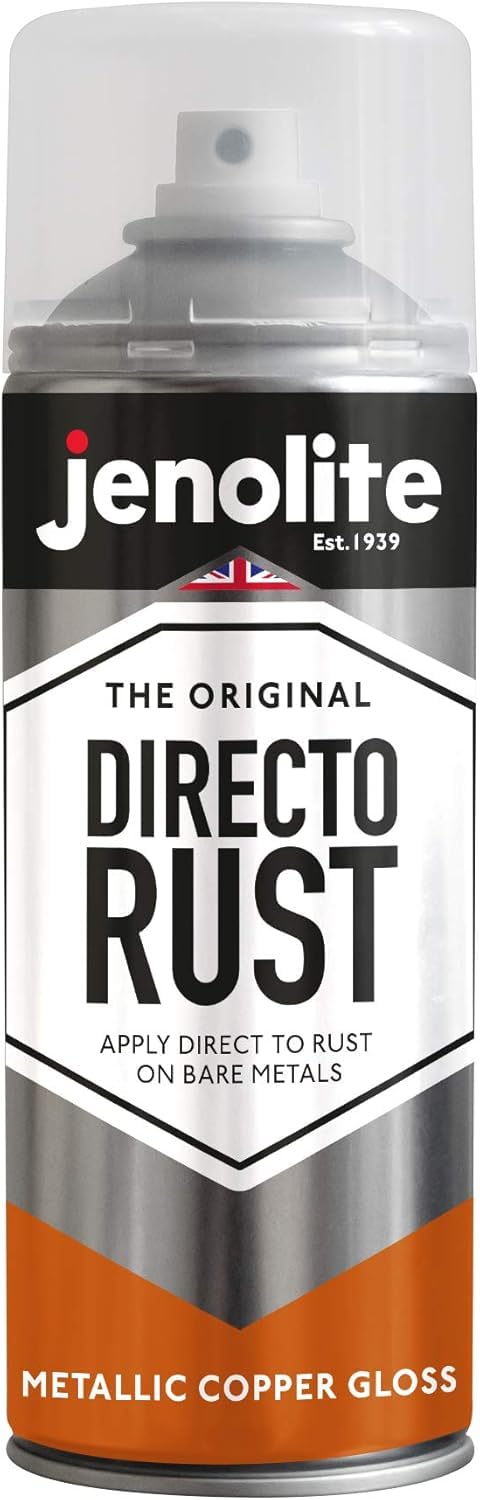
One 13.5 oz can that primes, coats, and fights rust in a single pass.
If the metal in front of you is already rusty and you are not in the mood for a three-product process, this is the can that skips the primer. It goes straight onto wood, various metals, plastic, ceramic, and rusted surfaces, and acts as primer, undercoat, and topcoat together. The finish is a gloss metallic copper with weather and UV resistance built in.
One can finishes a small run of parts, because the maker lists a 13.5 oz fill and a 16-hour dry time. Roughly 2-3 coats is the balance for a full copper look. The spray lays down smooth and even with no clogging at the nozzle when it is behaving. The gloss metallic copper is the whole point of choosing this over a matte. It catches light like a factory finish.
The one recurring complaint is real but manageable: the nozzle starts to drip once the can runs low, and drips mean redoing parts. Keep the can upright, spray in short passes, and clean the tip between coats. On the positive side, the 15-minute working dry surprised people doing last-minute costume work, and it holds up nicely on 3D prints too.
Why it earns a spot
- No separate primer step saves a whole stage of the job.
- Weather and UV resistance built into a single gloss aerosol.
- Sticks to wood, metal, plastic, and ceramic alike.
- Smooth, even spray with no nozzle clogging when used upright.
The trade-off you accept
- Nozzle drips as the can empties, and drips require repainting sections.
- One 13.5 oz can only covers a modest area.
- Gloss finish shows surface imperfections more than matte would.
Best suited to: rusted garden furniture, metal railings, or a quick costume build where you want copper from a single can.
Watch for this: keep a rag handy for nozzle drips near the end of the can, or you will be sanding back small runs.
5. pt Modern Masters PA901 Green Metal Effects Aging Solution

The green verdigris endgame for copper planters and weathered bronze statuary.
This is the warm-green counterpart to the Blue Patina solution, and it works the same way: a translucent reactive liquid that speeds up oxidation on a copper or bronze base. You get a full 16 fluid ounce can, a 100 sq ft coverage figure, and an applicator included. Apply it while the base paint is still tacky rather than fully dry, because that is when the reaction bites hardest.
Speed is the impressive part. Oxidation starts showing in roughly twenty minutes and progresses over hours — quick enough to see whether the shade is heading the right way before you commit the whole piece. Effectiveness is the quality most praised in this formula, with the color it produces running a close second.
Two honest limits. First, the solution is water-thin, so it runs and streaks if you flood it; a dry brush gives far more control. Second, it dilutes as you work, which means the last third of a large project may behave differently from the first. Sealing afterward is optional but smart if the piece faces rain.
what separates it: you see oxidation in about twenty minutes, so you can course-correct on a scrap before treating the real piece.
Work around this: the thin consistency rewards a dry brush and patience — flooding it leaves streaks you cannot undo.
Go this route if: you want authentic green verdigris on resin or real copper and you are willing to work in thin layers.
Think twice if: you need a uniform factory-perfect coat — this product is designed to look irregular.
Know the Specs
Dry time versus full cure
Dry time tells you when the film is safe to touch without smearing. Full cure tells you when it has hardened enough to resist scuffs and weather. The gap can be wide — half an hour to dry against forty minutes to cure on one product, or a full day to dry against a week to cure on a fine-detail airbrush paint. Schedule handling and topcoating around cure, not dry.
Coverage in square feet
Coverage is the area one container treats at the recommended thickness. Thin coats always beat one heavy coat, so real-world coverage on textured or awkward shapes runs leaner than the label. If a can lists 100 sq ft, plan for it to stretch across a couple of medium pieces rather than a large one.
Form: aerosol, liquid, or reactive solution
Aerosols are fastest and most forgiving for large flat areas. Bottled fluid acrylic suits airbrushes and fine detail. Reactive solutions are not paint at all — they are chemistry that changes the color of a base coat. Match the form to the job before you buy: aerosol for large flat areas, bottled fluid acrylic for airbrush detail, reactive solution over a base coat for patina.
Waterproof rating and topcoat
A can marked not waterproof is not a problem — it just means you need a clear sealer on outdoor work. Gloss topcoats deepen the metallic look; matte topcoats mute it. Either way, seal after the coating has fully cured, not while it is still tacky.
Common Questions
Can I spray copper paint straight onto rusted metal?
What is the difference between copper spray paint and a patina aging solution?
How long before I can handle a copper-painted piece?
Do I need a clear coat over copper spray paint outdoors?
Will copper spray paint work on plastic and 3D prints?
How much surface does one can of copper finish cover?
Why does my patina look uneven or streaky?
Can I use an aging solution without the matching base paint?
Is copper spray paint safe to use indoors?
Will the copper finish fade or keep changing over time?
The Bottom Line
You get a copper finish that looks genuinely aged rather than freshly painted with the Modern Masters Metal Effects Rust Activator. It dries in half an hour, covers 100 sq ft, and earns steady praise from the people building with it. If blue-green verdigris is the target, reach for the Blue Patina Aging Solution. It brings four times the volume of the little airbrush bottle and the same 100 sq ft coverage. And for rusted metal you just want coated in one pass, the JENOLITE Directorust Aerosol skips the primer entirely. That gets you a gloss copper finish without a separate stage. Whichever you choose, the prep and the topcoat will decide how long it lasts.
How we choose
We do not accept paid placement. Every pick is matched to a real buyer and a real use-case; we do not hands-on test units.
Sources
Specifications: manufacturer listings and product documentation. Review insights: verified customer reviews, as of October 2026. Pricing: not shown on this page (it changes often); check the current price via the retailer link.
As an Amazon Associate, Aappliancez earns from qualifying purchases. This does not affect which products we feature.