Disclosure: Some links in this post are affiliate links. As an Amazon Associate I earn from qualifying purchases, at no extra cost to you. Learn more
Specs are compiled from manufacturer listings and verified buyer reviews and can change over time — please confirm the key details on the product page before buying.
If a lens has ever slid off-centre on a windy run, or a grain of grit has landed under a contact mid-serve, you already know the real question: what keeps your eyes stable and comfortable while you play? This guide covers the cleaners, solutions, inserters and protective eyewear that athletes actually pair with their contacts — from gas-permeable care to glasses that sit over soft lenses.
This guide is built by comparing the manufacturers’ published specifications and the patterns across verified customer reviews, so you get each pick’s real strengths and trade-offs instead of marketing spin.
You’ll learn which cleaners cut protein buildup, which solutions suit rigid lenses, and how protective glasses change things on court. This is the working shortlist of contacts for sports if you would rather buy once and get back to playing.
Top Picks


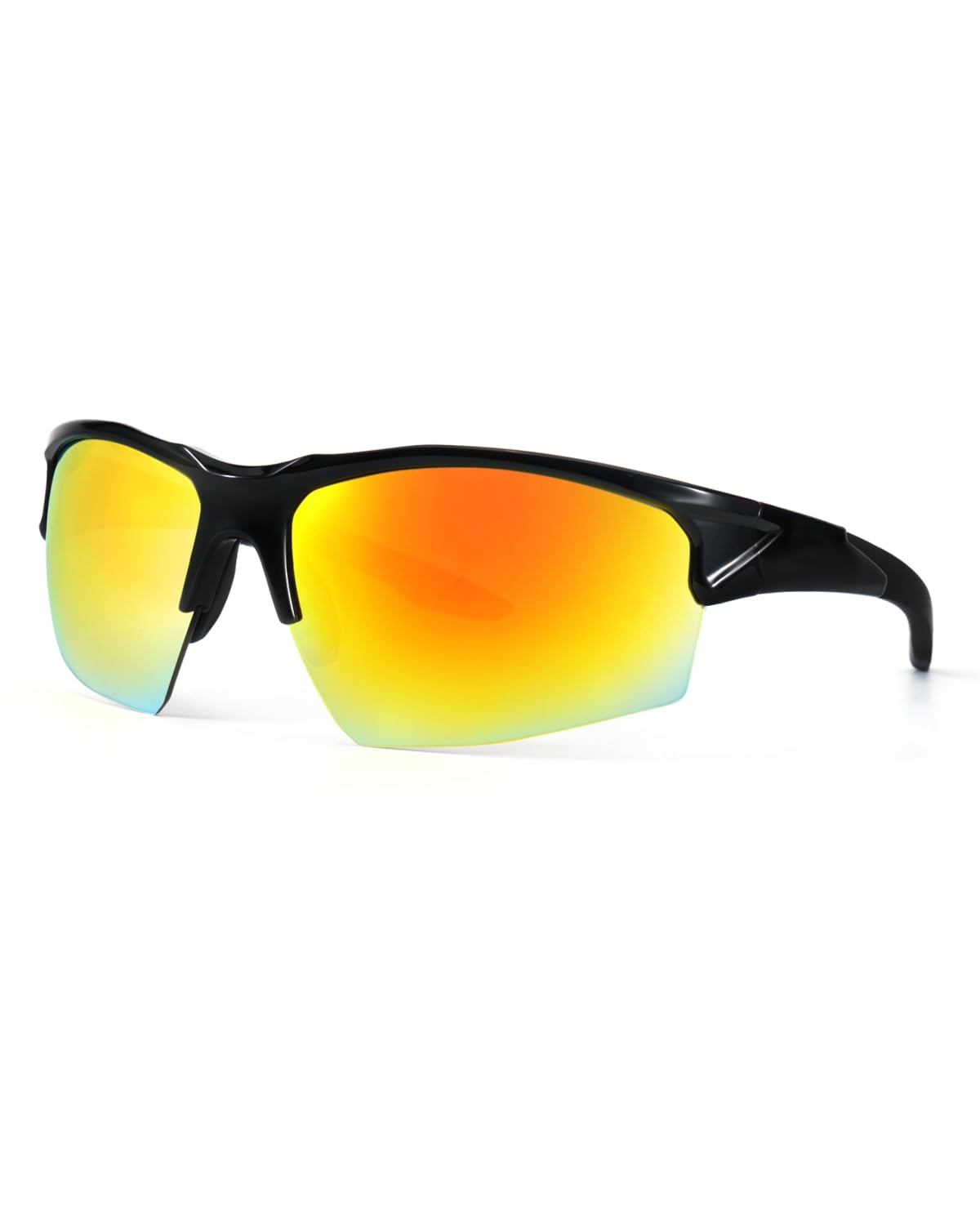
How To Choose The Best Contacts for Sports
Sport puts a contact lens through things an office day never does — wind straight at the eye, sweat running under the lid, dust kicked up from a pitch, a ball arriving faster than you planned. The right kit for contacts around sport is less about one wonder product and more about matching three things: what lens you wear, how you clean it, and what protects it while you move.
Match the solution to the lens type first
Rigid gas-permeable lenses — the hard ones — need a solution built for them, and a soft-lens bottle will not do the same job. A multi-purpose RGP solution that cleans, conditions and disinfects in one soak saves you juggling bottles, especially when you are packing a kit bag at 6am. And whatever cleaner you buy, check it is not hydrogen-peroxide based before it touches a capsule-style cleaner.
Protein removal is the number that matters
Protein from your tears builds up on any lens and makes it feel gritty by late afternoon. A cleaner rated at 94.7% protein removal is doing measurable work on soft-lens comfort. If you want to get more wear out of two-week lenses or you are stretching a discontinued stock, this is the spec to read carefully — and to discuss with your eye doctor, not to self-prescribe.
Glasses are part of the kit, not instead of it
On a windy pitch or a dusty trail, sport glasses shield the lens and the eye from grit, and cut glare so you can track a ball. Plain tinted shades cut brightness; non-polarized tint keeps a golf green readable and a ball in the air visible. Wraparound coverage blocks wind from the sides without squeezing your head.
Fit and face shape quietly decide everything
A pair that slips at the nose is worse than no pair, because you will spend the match pushing it up. Look at the frame width and nose pads: a wider head needs a wider lens, and rubber pads hold better under sweat than bare plastic. If you wear contacts, glasses without an eyeglass insert inside are the simpler choice.
Side-by-Side Comparison
| Model | Best For | Lens Type Served | Key Claim | Format | Amazon |
|---|---|---|---|---|---|
| Menicon Unique pH Multi-Purpose Solution★ Best Overall | All-in-one RGP daily care | RGP / gas permeable | Clean, condition and disinfect in one soak | 4 fl oz, 3 pack | Amazon |
| Applied Vision Sports Vision Training Strobe GlassesTraining Tool | Reaction and hand-eye training | Vision training aid | Micro Crystal Lens strobe technology | Hard case, charger, cloth | Amazon |
| Meeloog Sports SunglassesCleanest Tint Read | Golf and tennis sun cover | Sport sun protection | Non-polarized tint for green and ball reading | Twin-lens sport frame | Amazon |
| ATTCL Cycling Hiking Sunglasses | Cycling and high-speed wind | Sport sun protection | UV400, impact and scratch resistant | Wraparound TR90 frame | Amazon |
| suoso Polarized Sports Sunglasses | Water sports and outdoor days | Sport sun protection | Up to 99% UV400 protection | Wraparound TR90 frame | Amazon |
| ReO2 Gen6 Cleaner Capsule | Deep cleaning soft lenses | Soft and coloured lenses | 94.7% protein removal | Replacement capsule | Amazon |
| Polarized Cycling Glasses PC Lens | Road and trail cycling | Sport sun protection | 100% UVA/UVB, interchangeable lenses | Wraparound with spare lens | Amazon |
| Running Sunglasses for Women Men | Pickleball and racket safety | Sport eye protection | One-piece shatterproof lens | Goggle-style full frame | Amazon |
| Rechargeable LED Scleral & RGP Inserter Kit | Scleral and RGP insertion | Scleral / RGP / prosthetic | Hands-free LED alignment stand | Stand, 2 tubes, 6 sticks | Amazon |
| Menicon LacriPure Saline | Portable sterile rinsing | Scleral and hard lenses | Preservative-free 0.9% NaCl | 5ml vials, 98 count | Amazon |
| Astral Brewer 3.0 Shoes | Wet, rocky, water-adjacent days | Footwear companion | Water-friendly build with grip | Lace-up shoe | Amazon |
Detailed Reviews
1. Menicon Unique pH 3 Pack
Our pick — 4.5+★ from 4,000+ verified ratings; the strongest balance of quality and price.
One bottle that cleans, conditions and disinfects your rigid lenses in a single overnight soak.
If you wear rigid gas-permeable lenses — the hard, oxygen-passing kind — this is the pick the crowd has already made. It sits at 4.5+ out of 5 stars across 4,000+ owners, and what wins people over is simply that it does the whole job in one step. Three separate products become one: you drop the lens in the soaking case at night, and by morning it is cleaned, conditioned and disinfected.
The pH part is doing real work, not marketing. The solution is blended close to your eye’s natural tear pH, so an RGP lens that dried out overnight wets more readily on reinsertion. It also carries hydroxypropyl guar, a conditioning polymer that coats the RGP lens surface. For an athlete, that means an RGP lens that goes in without a scratchy first blink before a match and stays comfortable through a full session.
Real-world evidence from owners spans several lens types. Parents running ortho-k for a child say the brand keeps working night after night. Scleral wearers describe insertion with no burning or stinging. A small amount covers each lens, so the three bottles stretch further than the size suggests. It comes in a Blow-Fill-Seal bottle, which is a sealed-at-fill process that makes each one leak-resistant and travel-ready, and the pack includes a free lens case.
What earned it the top spot
- Cleans, conditions and disinfects in one soak — no separate daily cleaner to pack
- Can be diluted with a daily protein remover for simultaneous enzymatic cleaning
- Formulated toward your eye’s natural tear pH for easier, wetter insertion
- Leak-proof, sealed bottles that survive a kit bag on the road
- Gentle enough to protect the lens surface while it disinfects
Where it asks you to plan ahead
- The three-bottle pack is an upfront commitment rather than a single trial bottle
- Rigid-lens care only — this is not a soft-lens multi-purpose solution
The honest catch: value is the one thing owners push back on, and a recurring gripe is the cost per bottle compared with generic saline. Treat the three-pack as your season’s supply, not a test purchase.
Made for: anyone on rigid or scleral lenses who wants one bottle to do three jobs before a training session.
Think twice if: you wear soft lenses, because this is formulated for the harder lens type.
2. Applied Vision Sports Vision Training Strobe Glasses
Glasses that flicker a lens opaque to force your eyes to read the play faster.
For the athlete who suspects their hands are slower than their eyes, this is a training aid rather than eyewear. The Micro Crystal Lens technology isn’t about tint or UV — it flashes the lens between transparent and opaque, so your eye gets less information and has to process what is left more efficiently. The maker pitches it as weight training for the eyes. Pair it with a reflex ball for baseball, softball, basketball or soccer and the drills carry a reaction-time goal.
Where it earns its place is in specific, believable small results. A baseball player who could not catch a fly ball behind him and struggled charging the ball describes an immediate change: a hit caught easily in the next game, and charging the ball no longer an issue. A pickleball player says the ball appears to slow down in flight and spin becomes readable. Volleyball reaction timing improved too. Those are narrow outcomes, but for a sport where half a second is the whole game, narrow is the point.
The catch is the software and the fit. The app is the weak link — connection trouble, thin onboarding, no progress tracking, and requests for a battery indicator that have gone unanswered across a year. The adjustable elastic headband can feel awkward over a pair of eyeglasses, which is why switching to contacts while you train is the smoother route. It also arrives uncharged, and the 4 x 4 inch package is small enough to live in a kit bag, helped by the hard case.
What it does well: the strobe modes let you close one eye or flash both at different speeds, and the charge holds long enough to be a daily drill tool. For a right-handed, left-eye-dominant rifle shooter it has been used to train eye dominance — a niche but telling use.
Worth it for: players who will commit to visual drills a few times a week, and who wear contacts rather than glasses during sport.
Reservations if: you want an app that tracks progress for you — the glasses still work, the companion app does not yet carry its weight.
3. Meeloog Sports Sunglasses
A lightweight tint that does not flatten the green on a golf course.
Here is the pair for the golfer who has tried polarized lenses and stopped. Non-polarized tint keeps the contrast you need to read a green and to follow a ball in flight, and that is what this frame delivers. On court it reads equally well — a tennis player reports clear vision with no fogging and a frame that stayed in place once they began to sweat. On a golf course it keeps the wind out of your eyes, which matters more than most people realise when they are over a putt.
Weight is a genuine selling point. Owners repeatedly describe it as lightweight and easy to forget you are wearing. One golfer rates it above considerably more expensive sunglasses for blocking Arizona sun. That is a small frame beating a big name, and for the price bracket this sits in, it is fair value.
Two things to keep in mind, and both are honest fit notes rather than reasons to walk away. The frame is not for small children of patience — lenses want care, and one pair lost a lens with no impact involved. The other recurring theme is a smell on arrival; the maker’s own buyers describe being on the hunt for something just like it, only without the odour. Ordering through a retailer with a return window solves that if it turns up, and the second batch is usually milder than the first.
The reasons it gets picked
- Non-polarized tint preserves green-reading and ball visibility
- Light enough to stay put through a sweat-soaked round
- Clear, wide lens for both golf and tennis
Points to weigh before buying
- Odour on arrival reported on some units
- Not built for rough handling — keep it in a case
The fit: golfers and tennis players who want a cheap, clear, light sun pair and will look after them.
Better elsewhere if: you need a hard-wearing pair for a pocket-and-throw kit bag.
4. ATTCL Cycling Sunglasses

A wrap-around frame built to stop wind, dust and insects reaching the eye at speed.
For a cyclist with contacts, this is the barrier layer. The UV400 coating is rated to block UVA and UVB rays, which is the first job of any outdoor pair. The second is the curve: a wider lens and a full-frame wraparound cut wind and keep grit out, and the curve also reduces air resistance at high speed. Impact resistance and a scratch-resistant coating round it out for a lens that lives in a bag.
Comfort is where the price bracket surprises. At 25g the frame is light enough to forget, and the non-slip nose pads and rubber ear pads hold without pressure. An adjustable nose pad lets you seat it properly, which also helps stop misting. It ships with a hard case, a microfiber pouch, a cleaning cloth and a polarization test card — a kit that makes it a reasonable gift for a cycling father or partner.
Here is where honesty matters. From all appearances these are not polarized, and the manufacturer supplies a test card so you can check for yourself. For a sunny ride the mirrored coating still cuts light sufficiently. The frame is large, which suits bigger heads; if your head is on the narrow side, look carefully at the fit. Runners who tried it found headphones sat comfortably underneath and the lens held steady without rattling. One thing it does not do is wrap so tightly that no light reaches the nose — a sliver of clearance remains, well short of annoying.
The value read: you are buying coverage, low weight and a full accessory set in a mid-priced frame, not premium optics. Treat the polarization card as your honesty check and the mirrored pair will serve.
Pick this if: you ride, hike or run and want broad wind protection at a light weight.
Look on if: a visible polarized lens is a hard requirement for you.
5. suoso Polarized Sunglasses

A polarized pair you can dunk in white water and still see the line through.
For water sports, polarized lenses are the difference between seeing the surface and seeing through it. These carry high-definition polarized lenses with up to 99% UV400 protection, blocking UVA and UVB while cutting glare. The TR90 frame is the flex-and-toughness material that survives knocks, and a wraparound shape with adjustable nose pads offers 180° wind and debris coverage.
The placement that proved it was a week of white-water rafting down the Grand Canyon. Even with walls of water crashing over, the frame stayed on. That is not a claim every sunglasses brand on this list could make, and for a paddler or kayaker it is the whole game.
Fit is the split point. Runners report a secure hold over weeks of road work. Some users found it looser than hoped for softball, slipping off when they moved fast. If your head is on the smaller side, expect to use the nose pads to dial it in, and check the tint against the picture — colours can vary from the product image.
Reach for it when: you spend days on or near water and want glare cut hard.
Reconsider when: you need a snug hold for a contact sport on dry land.
6. ReO2 Gen6 Contact Lens Cleaner Capsule Replacement

A replacement capsule that turns a daily soak into a measured protein strip-down.
Soft-lens wearers get a very different tool here: a capsule that works with the ReO2 cleaner to lift the protein film your tears leave behind. Two numbers make the case — a 94.7% protein removal rate and a 94% oxygen transmissibility restore rate. In plain terms, the capsule restores a soft lens’s breathability, which is what keeps a long day of play from ending in a gritty, tired feeling.
The math of extending lens life is the real draw. Owners who use two-week contacts report wear stretching well past a month, which buys some breathing room if you have a discontinued lens you rely on. That is their observed habit, not advice your eye doctor would give, so check with yours before you change a replacement schedule. The capsule also self-cleans, using an electrophoresis-powered field to stop buildup on its own surfaces, so no scrubbing is needed.
Two practicalities. It works with normal saline or most multi-purpose solutions, but you must keep hydrogen peroxide out of it. And the small screen on the unit is the most common small complaint — readable, but not generous. As a daily-use habit it feels well built and simple, and the maker sells replacement capsules separately.
Why soft-lens wearers buy it
- 94.7% protein removal and 94% oxygen transmissibility restore
- Self-cleaning capsule with no manual scrubbing
- Works with normal saline or most multi-purpose solutions
What to know before ordering
- Replacement capsule only — needs the ReO2 cleaner to run
- Small on-device screen
Built for you if: you already run a ReO2 cleaner and want to keep the daily deep clean going.
Not the one if: you have never bought the cleaner itself — this is the capsule, not the whole device.
7. Polarized Cycling Glasses PC Lens UV Protection

One frame, two tints, and a wind seal that holds over twenty miles an hour.
Road cyclists will recognise the value of swappable lenses. The box arrives with a spare yellow lens alongside the primary tint, which lets you move from a bright ride to a low-light one without a second pair. The polycarbonate lens is rated 100% UVA/UVB and polarized, so glare from wet tarmac or a car bonnet is dealt with, and the wraparound shape keeps wind from creeping in at the temples.
That wind control is the standout. At over 20 miles per hour, riders report no wind getting in around the glasses. It comes with a zip-up box, a thick bag and a cloth, and the lens-removal tool is included, though the instructions are thin, so expect a little trial and error on your first swap. Vents help stop fogging when you are working hard.
The one genuine fit warning: it runs large. Riders with a wider head describe it as sturdy and comfortable. If you have a smaller head, the lens height can feel heavy and can interfere with a sun visor or ball cap. For night work, the red lens cuts some oncoming headlight glare but is not a dedicated low-light solution.
Put it this way: on a mid-priced cycling frame, the spare lens and the wind seal are what you are paying for. The large fit is the trade you make for that coverage.
Choose it if: you cycle in changing light and want one frame to cover both.
Pass if: you have a small head and wear a cap on the bike.
8. Running Sunglasses

The pair that took a pickleball to the face and protected the eye behind it.
When your sport involves a hard ball travelling fast near your head, glasses stop being sunglasses and become safety gear. This full-frame goggle style is built around that idea. The one-piece shatterproof lens in crystal purple TR90 spans the whole eye area, and the wraparound shape blocks wind, glare and debris from the sides. A player took a pickleball to the eye area and came away intact. Another describes a face-first fall onto concrete that left only deep scratches on the lens and no breakage.
Court performance matches the protection story. Pickleball players report the glasses brighten the court during play. Racket-sport players returning after an eye injury have made them a permanent part of the bag — clear, non-dark and fog-free. An adjustable two-position nose pad and wraparound fit hold through sweat, and the lenses do not slip.
There is a look to these that splits opinion. They are large on the face and one owner calls them pretty silly looking, recommending them as construction safety glass. And the tint is not dark enough to serve as a daily light-sensitivity pair. If you want them for sun reading rather than eye protection, look elsewhere in this list.
Ideal for: pickleball and racket players whose main worry is an eye injury, not a tan line.
A miss if: you need a dark lens for bright, glarey afternoons — this is a protection lens first.
9. Rechargeable LED Scleral & RGP Contact Lens Inserter Kit
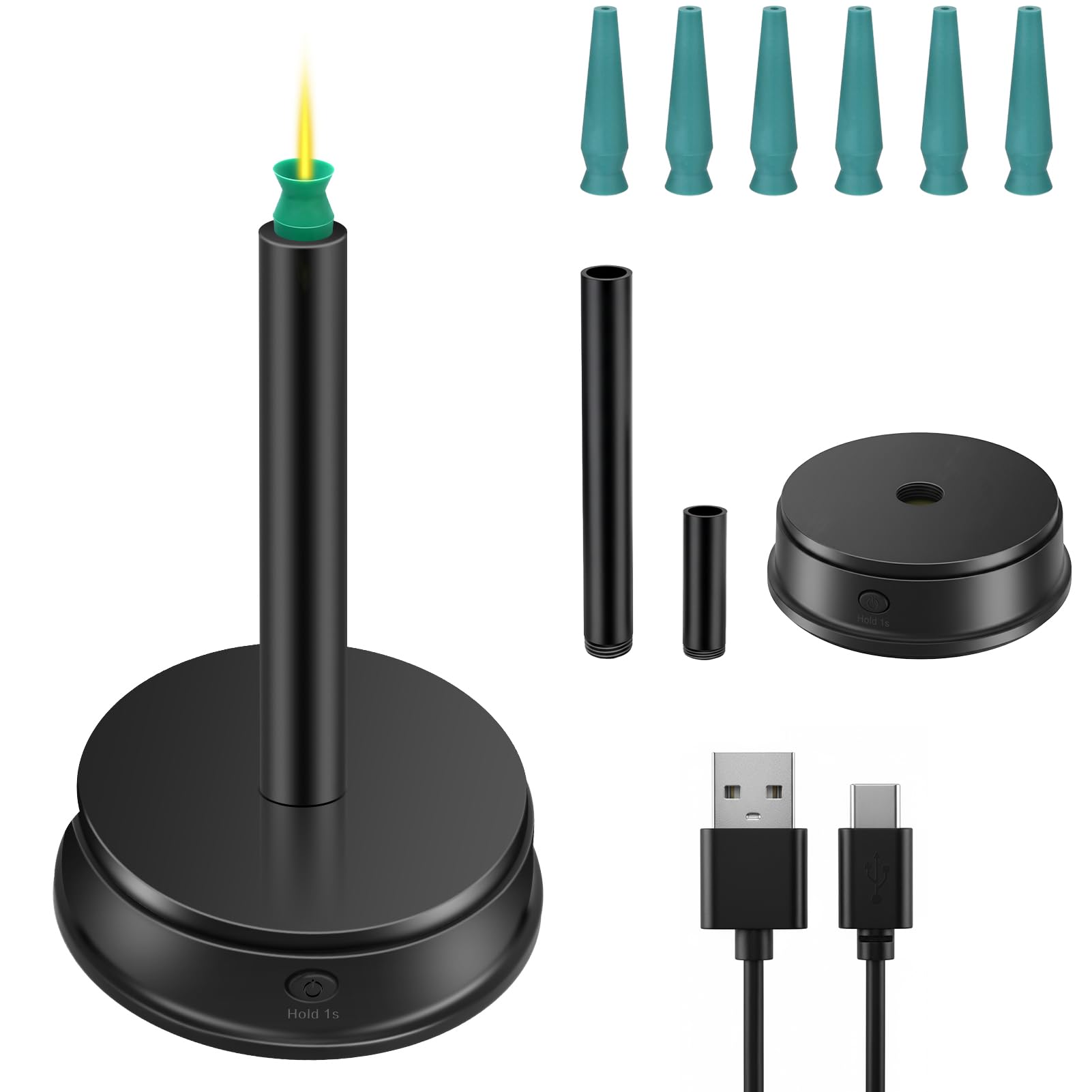
A lit stand that holds the lens so both your hands stay free for the eyelid.
Scleral lenses are the hard, large ones that sit over the whole front of the eye, and putting one in one-handed is a skill that takes time to learn. This kit removes the hard part. A built-in LED stand holds the lens and lights it so you can line it up by looking at the glow rather than your reflection in a dark mirror. Both hands are then free to fold back the upper lid and hold the lower lid open.
The support it gives is the reason keratoconus patients and beginners take to it. One wearer describes the frustration of fighting a contact vanishing, and being able to take the lens out after 8 to 12 hours more easily. Another notes the light does the guiding. It comes with two interchangeable polycarbonate tubes — 5.32 inch and 1.58 inch — so different hand sizes and grip preferences can be accommodated, plus six BPA-free vented applicator sticks that reduce suction and fogging.
Recharging keeps it simple: an integrated lithium battery charged by USB cable, with no disposable batteries, and the charge lasts long enough for daily sessions. The build is the honest weak point. Some units have stopped powering at the button after a few months, so the reliability is a real risk rather than a theoretical one. Appearance is praised and the stand is praised for looking good on a bathroom counter, but expect to treat it as a replaceable tool rather than a lifetime item.
Why it earns the place: 100+ owners averaging 4.0+ out of 5 put appearance and functionality first — it does the job and does not look like lab equipment. The durability caveat is the gap between most and all.
The person this helps: new scleral or RGP wearers, older hands, and anyone with one eye or limited dexterity.
The caveat: a small share of units have failed at the power button — the tool is worth having, but buy it knowing you may need support.
10. Menicon LacriPure Saline Contact Lens Solution 5ml 98 vials
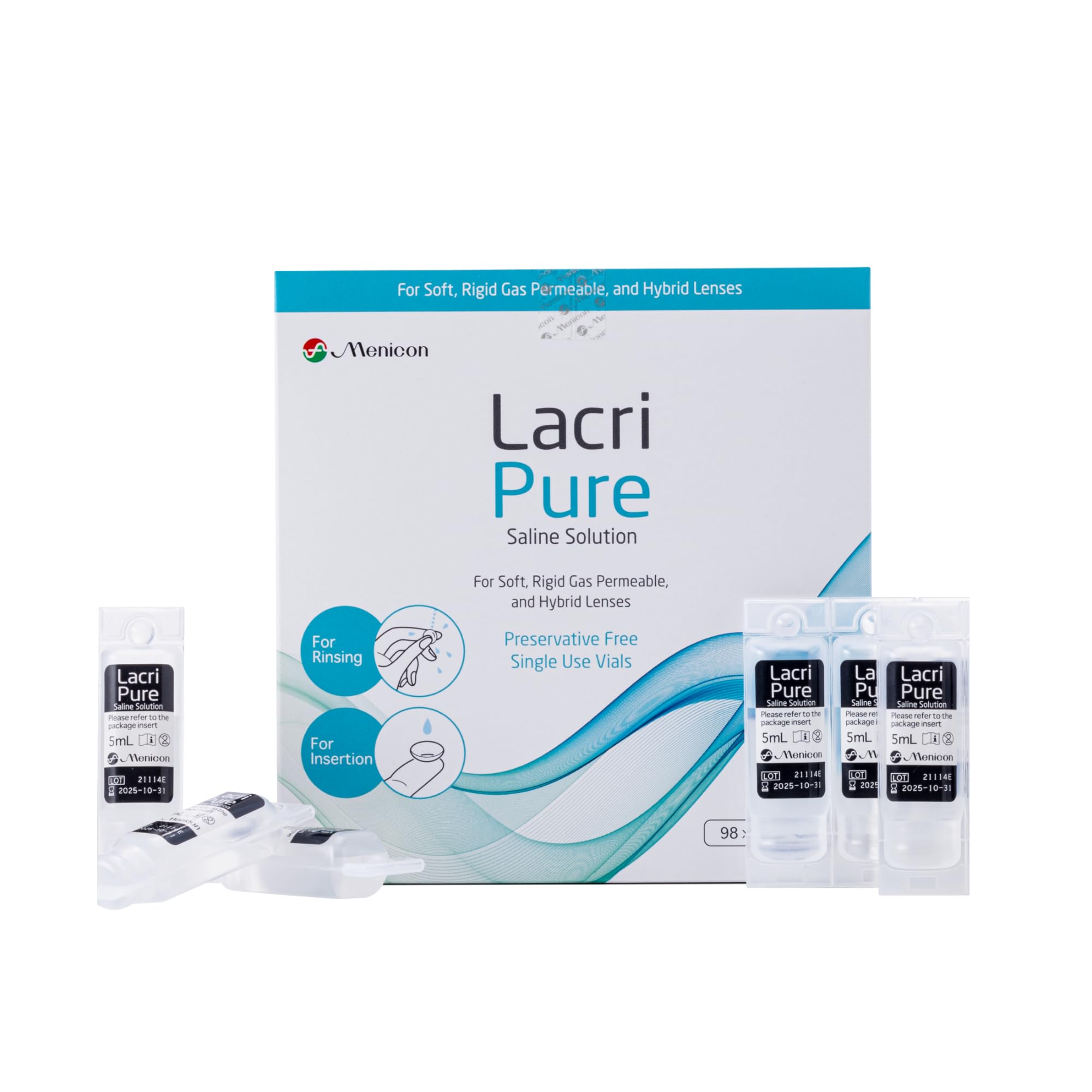
Single-use saline vials for filling a scleral bowl before you touch the eye.
Filling a scleral lens with saline before insertion is the step that decides whether it feels comfortable all session. These vials solve it with a clean, preservative-free 0.9% NaCl solution — the same concentration as your nasal and eye surface fluid, so there is no sting and no irritation. The formulary is deliberately simple, and that is the point.
The format is built for travel. Each 5ml vial is big enough for a lens fill, and the individual seal means you carry one in a wallet or pocket without it becoming heavy or leaking. For a scleral wearer on a court or in a changing room, that convenience is a real comfort win. It also serves as a gentle rinse for a lens that has picked up dust between plays. Buyers cite the eye doctor recommendation behind it as their main reassurance.
The trade-off is cost and size. The individual packaging means plastic waste, and the price per vial sits higher than a bottle. If you mainly care about price per millilitre, this is not that purchase. If you need sterile, single-use packs that fit in a gym bag, the convenience is what you are buying.
The case for it
- Preservative-free, stings no more than water
- Wallet-sized for pocket portability
- 98 single-use vials covering roughly three months of use
The case against
- Plastic waste from single use
- Higher cost per vial than a bottle
Great for: scleral or hard-lens wearers who need sterile, portable saline for filling.
Skip if: you want the cheapest saline for a big bathroom supply.
11. Astral Brewer 3.0 Shoes

The shoe that stops you sliding on a river bottom while you carry your kayak.
You may wonder what footwear is doing in a lens guide. It is here because the outdoor session around your contacts — kayak, boat launch, river bank — is where feet get wet and people slip. The Brewer 3.0 answers that. Its grip has done real work: when a kayak overturned in fast current on a rocky river bottom, the sole kept a paddler upright. Water-friendly construction and quick drying mean the shoe is ready again next morning.
Comfort is where most of the love is. Riders and hikers with wide forefeet describe an uncrowded toe box and enough padding for 5 to 6 mile rainforest trails with no chafing. A size 12 wearer took it through a 10-day Costa Rica trip and found it the only shoe needed, drying overnight after waterfall hikes and beach swims. Looks are city-appropriate, so it moves from trailhead to town.
Sizing needs attention. Multiple users say it runs slightly big — a size 10 wearer settled on a 9.5 for a perfect fit, and the EU chart is the most reliable guide. Value is the sore point; the price is premium and a small number of owners feel it is high for the construction. Treat the fit check as the priority before committing.
The quick read: this is a specialist water shoe for wet, irregular ground, not a daily trainer. Buy it for the boat launch and the river trail, and size down if you are between sizes.
Best for: paddlers, anglers and wet-trail hikers who need real grip on slick rock.
Not for: anyone wanting a budget everyday shoe — this one asks premium money for a narrow job.
Know the Specs
The labels on a contact-lens product or a sport-glasses box can be read in a few seconds once you know what they are telling you. Here are the terms that come up most when you are buying for sport.
RGP (Rigid Gas Permeable)
These are the hard contact lenses that let oxygen pass through to the eye. They are made of a rigid plastic rather than the soft gel of a soft lens, and they need a different solution to clean and store them. If you see a solution marked RGP or “for gas permeable lenses”, match it to that lens type only — it is not the same formula you would use for a soft lens.
Protein removal rate
Tears leave a protein film on any contact lens, and the film is what makes a lens feel dry or scratchy as the day goes on. A cleaner that states a protein removal rate — for example, 94.7% — is telling you how much of that deposit it lifts. A higher protein removal figure means a cleaner soft lens and a fresher feel during a long session.
UV400
UV400 is a lens-coating claim: the lens is designed to block light up to 400 nanometres, which covers the UVA and UVB range. In practical terms it is the difference between sunglasses that shield your eyes and ones that simply darken the view. On a bright pitch or a reflective water surface, that protection matters as much as how dark the tint is.
Polarized versus non-polarized
Polarized lenses filter reflected glare, which is why they are prized on water and wet roads. Non-polarized lenses simply darken the whole view. Golfers and ball players sometimes prefer non-polarized tint because it keeps a green or a moving ball readable in the way polarization can flatten. Neither is better in the abstract — the choice depends on the surface you play on.
Preservative-free saline
A preservative-free saline is a simple salt-water solution at 0.9% concentration with nothing added to keep it stable over time. It comes in single-use vials rather than a bottle, which is why it is often the choice for filling a lens bowl or rinsing before insertion. There is no sting from a preservative, and no bottle that has been open for weeks.
Oxygen transmissibility
Oxygen transmissibility describes how readily oxygen passes through a lens to your eye. A cleaner that claims to restore a percentage of that value is telling you how much of the lens’s original breathability it brings back after cleaning. Better oxygen transmissibility means a soft lens you can wear longer without the gritty, tired feeling late in the day.
Common Questions
Can I wear contacts while playing sport like tennis or pickleball?
Do I need a different cleaning solution for rigid gas-permeable lenses?
How long does a multi-purpose solution last once opened?
Are polarized sunglasses better for sport than non-polarized?
Will sport sunglasses fit over contact lenses comfortably?
How do I insert a scleral lens without a mirror?
Does filling a scleral lens with saline before insertion really help?
Can a lens cleaner extend how long I wear my two-week contacts?
What should I do if a grain of sand gets under my contact during play?
Is it worth buying vision training glasses for a young athlete?
The Bottom Line
If you wear rigid or scleral lenses (hard lenses that cover more of the eye), the Menicon Unique pH Multi-Purpose Solution gives you the most day-to-day benefit. It cleans, conditions and disinfects in one soak, so you skip extra steps. The travel-sized bottle stays leak-proof in your kit bag. If protein buildup on soft lenses is your main worry, the ReO2 Gen6 capsule adds a measured 94.7% protein removal to your daily routine. And when you need to protect the eye on court rather than clean the lens, the one-piece shatterproof sport frame is the pair to keep in the bag. It took a pickleball hit and held, which is the kind of proof a spec sheet cannot give you.
Start with the lens care you actually need, then add the protective glasses that suit your surface. For golf, choose a non-polarized tint (a tint that does not cut glare, so you can read the green). For cycling, choose a wind-sealing wrap. If you are still learning to place a scleral lens, add a light-guided stand. That covers the whole kit, and every pick here has earned its place through published specs and the experience of a lot of owners.
How we choose
We do not accept paid placement. Every pick is matched to a real buyer and a real use-case; we do not hands-on test units.
Sources
Specifications: manufacturer listings and product documentation. Review insights: verified customer reviews, as of October 2026. Pricing: not shown on this page (it changes often); check the current price via the retailer link.
As an Amazon Associate, Aappliancez earns from qualifying purchases. This does not affect which products we feature.