Disclosure: Some links in this post are affiliate links. As an Amazon Associate I earn from qualifying purchases, at no extra cost to you. Learn more
Specs are compiled from manufacturer listings and verified buyer reviews and can change over time — please confirm the key details on the product page before buying.
If your legs ache by mid-afternoon, the fix is not a tighter pair — it is the right pressure rating and a size that matches your actual measurements. Compression pantyhose work by squeezing hardest at the ankle and easing off as they climb toward your waist, which helps blood travel back up instead of pooling in your calves. Get the millimetres-of-mercury number wrong and you get either a pair that does nothing or a pair you dread pulling on. This guide sorts the real options by pressure level, fabric, and how they behave over a full shift.
This guide is built by comparing the manufacturers’ published specifications and the patterns across verified customer reviews, so you get each pick’s real strengths and trade-offs instead of marketing spin.
Below you will find the five pairs worth your attention, ranked by how they actually wear rather than by what the box promises. Every pick here states its pressure rating in mmHg, so you can match it to your day instead of guessing at the shelf — the honest shortlist of compression panty hose that covers long shifts, travel days, and recovery weeks.
Top Picks


How To Choose The Best Compression Panty Hose
Buying compression hosiery is a two-number decision, not a style decision. You need a pressure rating that matches how long you stand or sit, and a size taken from your ankle and calf rather than your dress size. Everything else — toe style, waistband, fabric blend — is comfort tuning on top of those two.
Start With The mmHg Rating
The mmHg figure is millimetres of mercury, the same unit a blood-pressure cuff uses, and it tells you how hard the fabric squeezes at the ankle. A 15-20 mmHg pair is mild everyday pressure — the kind you wear on a desk day or a short flight to keep your legs from feeling heavy. A 20-30 mmHg pair is firmer and is what most people mean when they talk about graduated support for full shifts on their feet. Firmer is not automatically better. A 20-30 pair you cannot get on, or that you peel off by lunchtime, helps nobody.
Size By Measurement, Not By Dress Size
Compression sizing runs on its own chart, and the number that matters is your ankle and calf circumference, with height deciding length. Dress size is a poor guide here — the fit notes on these pairs show people who wear a clothing size 6 landing in a large. Measure first thing in the morning before any swelling sets in, and if you land between two sizes, the larger one is usually the safer wear.
Footless Or Closed Toe
A footless design ends at the ankle, so your toes and feet stay free and you can wear any shoe or go barefoot at home. A closed-toe pair covers the whole foot and keeps the fabric from bunching at the heel, but it limits you to shoes with room in the toe box. If you spend your day in trainers or open sandals, footless wins. If you want full leg coverage under a dress, closed toe looks more like ordinary hosiery.
Plan On A Rotation
Compression fabric relaxes with wear, and it relaxes faster if you machine-wash it hot or tumble-dry it. Hand-washing and air-drying keeps the squeeze consistent, and owning two pairs to alternate gives each one a day to recover its shape. Expect a pair worn hard and often to need replacing within the better part of a year — that is normal life for stretch fabric, not a defect.
Side-by-Side Comparison
| Model | Best For | Compression | Toe Style | Fabric | Amazon |
|---|---|---|---|---|---|
| Compression Pantyhose Stockings for Women Men★ Best Overall | Long standing shifts | 20-30 mmHg | Closed toe | — | Amazon |
| Medical Graduated Compression TightsBest Fabric | Full-leg medical support | 20-30 mmHg | Footless | 75% Nylon, 25% Spandex | Amazon |
| 20-30mmHg Compression Pantyhose for Women | Travel and swelling days | 20-30 mmHg | Footless | — | Amazon |
| AMZAM 20-30 mmHg Compression Pantyhose | Firm support under dresses | 20-30 mmHg | Closed toe | — | Amazon |
| 15-20mmHg Compression Pantyhose, 2 Pairs | Mild everyday pressure | 15-20 mmHg | — | — | Amazon |
Detailed Reviews
1. Compression Pantyhose Stockings for Women Men, 20-30 mmHg
Our pick — 4.0+★ from 1,000+ verified ratings; the strongest balance of quality and price.
A 20-30 mmHg closed-toe pair that holds firm pressure through a 12-hour shift without pinching.
What makes this one the pick is the balance it strikes at 20-30 mmHg — that is firm graduated pressure, the level most people want for a full day on their feet. It squeezes hardest at the ankle and eases as it rises, so your calves get steady help rather than a uniform clamp. Buyers who put it on for long hospital shifts report it holds up where cheaper pairs give out, and it reads like normal black tights rather than medical hosiery.
Where it wins people over is the squeeze itself: the compression is what buyers praise most about this pair, and it earns that on the sheer fact that it is genuinely tight enough to do the job. It is easy to roll on, stays put once it is up, and the finish is opaque enough to wear to work without a second thought. If you want a pair that does the medical job and still looks like hosiery, this is the one.
The catch is fit, and it is worth planning around. The sizing chart is the recurring complaint — people who chose by their body measurements ended up with a pair that felt loose, and the honest move is to size down if you sit on the border. The crotch also runs short on some bodies, so tall wearers may find themselves tugging it back up. Neither issue is a dealbreaker; both are the kind of thing that turns a good pair into a perfect one when you get the size right.
What earns the top spot
- 20-30 mmHg graduated pressure — firm enough for real support through a long shift
- Rolls on easily and stays in place once it is up
- Opaque black finish passes as ordinary hosiery under work clothes
- Unisex sizing opens it to men who need leg support too
Where it asks you to be careful
- The size chart runs loose — size down if you are between sizes
- Crotch length runs short, which means adjusting for taller wearers
- A handful of buyers found it easier to pull on than expected firm pressure should be
Reach for this if: you stand or sit for most of a 12-hour day and want pressure firm enough to notice by evening.
Measure twice first: the fit is the one thing that divides people, so take your ankle and calf numbers before you order.
2. Medical Graduated Compression Tights
A footless 20-30 mmHg tight in 75% nylon and 25% spandex, with no toe seam to dig in.
The standout here is the blend: 75% nylon and 25% spandex, which is a fabric-forward recipe for a compression tight. That mix is what lets the pair feel soft against the skin while still doing its 20-30 mmHg job, and it gives the fabric enough spring to snap back after a wash. The footless cut ends at the ankle, so there is no toe seam to dig in and no constriction around the foot — you can wear whatever shoe the day calls for.
What the wearers keep coming back to is the compression itself, which is the thing they praise most, with the fabric quality running a close second. The high waistband sits steady without rolling, the flat seams lie smooth, and the whole thing disappears under a skirt or trousers. It is the pick for anyone who wants 20-30 mmHg support but hates a closed toe pressing on their feet all day.
There are two things to know before you commit. It runs long, and smaller wearers have found it reaching past where it should — so check the height guidance carefully. And the fabric does not take machine washing well; it pills and snags over time, so hand-wash and air-dry if you want it to keep its bite. Treat it gently and it will outlast a cheaper pair.
Best for the fabric-sensitive: the 75% nylon and 25% spandex blend is the reason this one feels closer to soft leggings than to medical hose, and the footless cut means your toes stay free all day.
The trade-off to accept: it wants hand-washing and careful handling, and it runs long on shorter frames.
Pick this if: you want firm graduated pressure and a fabric that feels good against your skin, with feet free for shoes.
Look elsewhere if: you want to toss your tights in the machine without a second thought.
3. 20-30mmHg Compression Pantyhose

A footless 20-30 mmHg pair with a high waist that stays put through a full travel day.
If your reason for buying is a flight or a full day standing on concrete, this footless 20-30 mmHg pair is built for exactly that. The high waist and the extra room through the seat keep it from pulling down when you bend or sit, and the graduated pressure does its work from ankle up. It is also a genuine daily-wear pair — the fabric is soft and stretchy, and it disappears under clothing rather than announcing itself.
What buyers notice first is the compression, which is the thing they praise most about this pair, with build quality right behind it. It delivers firm support without the over-tight feeling that makes you want to strip it off by noon. Buyers report it holding up through long travel days and staying put on the leg, which is the real test of a pair you plan to wear all day.
The fit is the one place this pair splits opinion. Most find it true to the chart and steady in place, but curvy legs can find it less forgiving than a straighter frame does. There is also a warning in the material list worth heeding: a small number of buyers had a skin reaction, so if you know you are sensitive to latex, rubber, or neoprene, this is not the pair for you. Everyone else gets a capable travel companion that does not need to be wrestled back up all day.
Why travellers like it: the footless 20-30 mmHg design pairs with any shoe, and the high waist keeps the garment where you put it through a full travel day.
The honest caveat: the fit runs less generous on curvy legs, and anyone with a latex, rubber, or neoprene sensitivity should skip it.
Made for: the flight, the desk-to-dinner day, the long stretch on your feet where you want support and a smooth line.
Skip if: you have a known sensitivity to latex, rubber, or neoprene — the material is not for every skin.
4. AMZAM 20-30 mmHg Compression Pantyhose

A closed-toe 20-30 mmHg pair in opaque run-resistant fabric that passes as ordinary hosiery.
The defining feature here is the closed-toe design paired with an opaque run-resistant fabric. That combination means full coverage from waist to toe — no bare ankle showing under a skirt, no bunching at the heel, and a finish dark enough to hide blemishes. The four-way stretch weave is built to hold its shape through repeated washing, and the non-binding waistband is meant to sit flat rather than roll. It is the pair to reach for when you want 20-30 mmHg support that looks like a regular opaque tight.
The graduated pressure runs firm at the ankle and eases toward the waist, which is the correct way to build it, and that structure is the reason the pair can feel supportive without pinching at the top. What buyers respond to is the quality of the fabric — the weave is the thing that gets praised most on this pair — and the closed toe genuinely solves the shoe problem for anyone whose workday involves dress shoes. The 20-30 mmHg rating lands it in firm-support territory, so it is built for all-day wear under a dress or suit.
The trade-off to know about is the waist. Some wearers find it does not stay up as reliably as the leg portion does, and a few note the compression is stronger at the foot and leg than through the stomach — so this is not the pair to buy if you want tummy support. If your priority is firm leg compression and a clean line, it delivers; if you need a waist that grips hard, check the sizing carefully and consider a different cut.
Why it stands out
- Closed-toe opaque fabric gives full coverage that looks like normal hosiery
- Four-way stretch weave holds shape through repeat washing
- Graduated 20-30 mmHg pressure runs firmest at the ankle
- Run-resistant finish hides blemishes and pairs with dresses or trousers
What to keep in mind
- The waist can slip on some bodies; not the strongest choice for stomach support
- A smaller review base means less consensus than the top picks
- Firm compression means a snug fight to get on at first
Go for it if: you want a closed-toe, fully opaque pair that supports the leg firmly and looks like a dress tight.
Think twice if: a waistband that stays put through a full day is non-negotiable for you.
5. 15-20mmHg Compression Pantyhose 2 Pairs
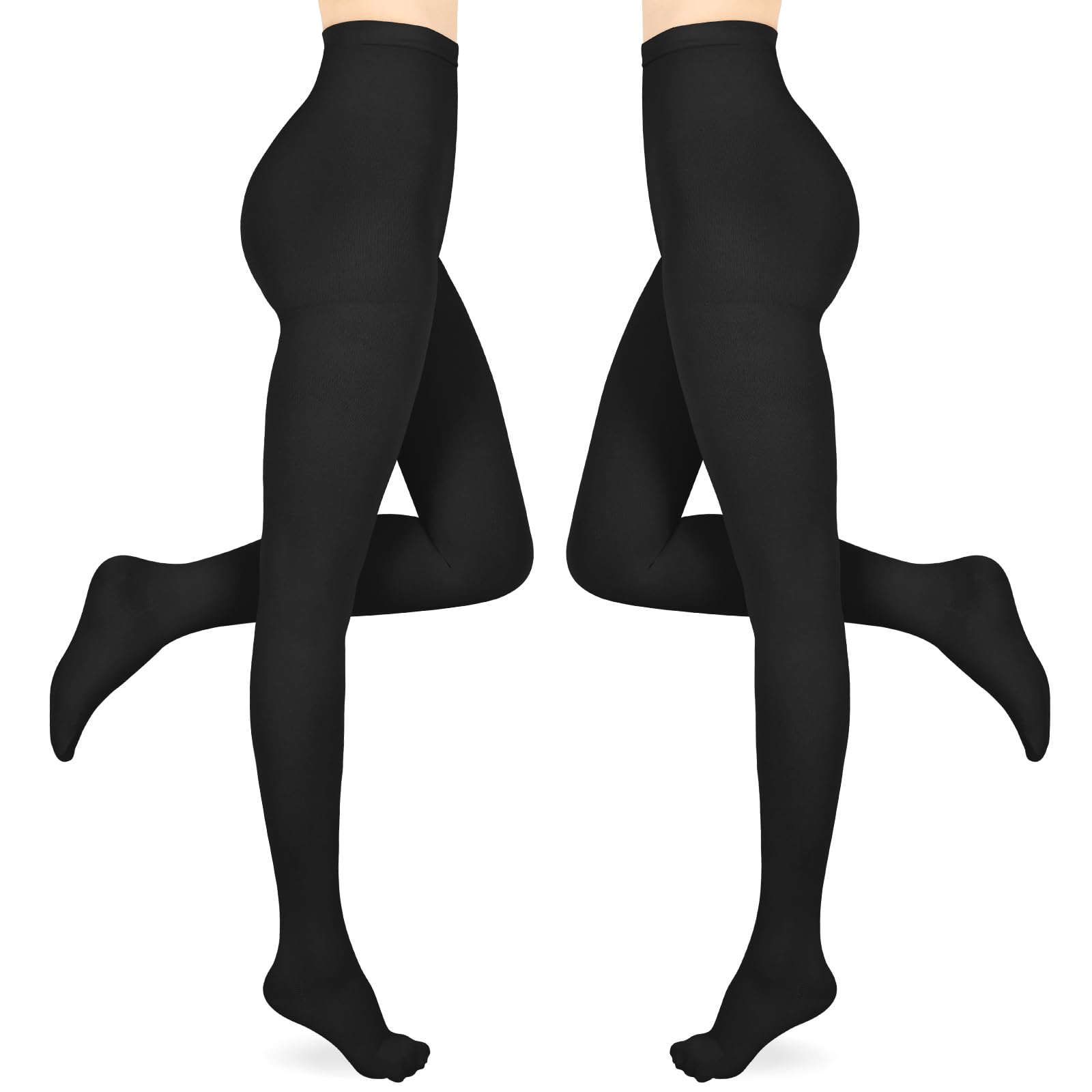
A 15-20 mmHg two-pair pack that lets you rotate one pair while the other rests.
This is the gentlest option on the list at 15-20 mmHg, which puts it in the mild-pressure bracket — the level you wear on a desk day or a short trip to keep legs from feeling heavy, not the level you buy for firm all-day support. The two-pair pack is the quiet draw here: you get a rotation from the start, which is exactly how compression fabric is meant to be worn. Each pair gets a rest day to recover its stretch instead of being pulled on again while it is still relaxed.
What buyers like most is the support-to-comfort balance — firm enough to feel it, soft enough to wear under trousers without a second thought. The fabric is described as strong and durable, the waist sits high, and the sizing runs true for most. It is the pair to buy if you are new to compression and want to test 15-20 mmHg before committing to a firmer rating.
The honest limits are length and fit. This pair runs long, and a 5’5″ wearer found it about 5 or 6 inches too long, so shorter frames should check the height guidance first. Getting it on is also a fight for some, and a few find it rides down while walking. Those are the trade-offs of a mild-pressure pair — the compression is gentle, so it depends more on the fit staying put. Get the size right and it is a comfortable everyday option; get it wrong and you will be tugging at it.
The smart buy for beginners: 15-20 mmHg is mild everyday pressure, and the two-pair pack lets you rotate so each pair keeps its stretch.
Watch the length: this pair runs long, and shorter wearers have found it several inches past their ankle, so check the size chart against your height.
Start here if: you want gentle everyday pressure and two pairs so one can rest while you wear the other.
Not for you if: you need firm 20-30 mmHg support for long shifts on your feet.
Know the Specs
What mmHg Actually Measures
The mmHg figure on the box is millimetres of mercury, the same unit a blood-pressure cuff uses. It tells you how much pressure the fabric puts on your ankle, which is the point where graduated hosiery squeezes hardest. A 15-20 mmHg pair is mild everyday pressure for desk days and short trips. A 20-30 mmHg pair is firm and is what most people want for long shifts on their feet or for travel days when swelling builds. The number is a rating, not a guarantee — how tight the pair feels on you also depends on getting the size right.
How Graduated Compression Works
Graduated compression means the fabric is tightest at the ankle and eases as it climbs toward the waist. That direction is what helps blood travel back up the leg instead of pooling in the calf. It is also why a proper pair feels firm at the foot and softer near the hip — that is the design working, not a manufacturing flaw. A pair that feels uniformly tight all the way up is not graduated, and it will not do the same job.
Footless vs Closed Toe
A footless pair ends at the ankle, leaving your toes free and letting you wear any shoe or go barefoot. A closed-toe pair covers the whole foot, keeps the fabric from bunching at the heel, and gives you a full-hosiery look under a dress. The closed toe also limits you to shoes with room in the toe box. Neither is better — it depends on your workday and your wardrobe.
Fabric Blend and Care
The blend tells you how the pair will feel and how long it will last. A nylon-and-spandex recipe like 75% nylon and 25% spandex gives the fabric its spring and its softness, and it is what lets the pair snap back after a wash. Compression fabric relaxes with heat and with constant wear, so hand-washing and air-drying keep the squeeze consistent. Owning two pairs to alternate gives each one time to recover its shape, which stretches how long it holds its rating.
Common Questions
How do I pick the right size in compression panty hose?
What is the difference between 15-20 mmHg and 20-30 mmHg?
Can I wear compression panty hose all day?
Will footless compression tights stay up on my leg?
How long does a pair of compression panty hose last?
Can I put compression panty hose in the washing machine?
Are opaque compression tights noticeable under clothing?
What if I have a latex or rubber sensitivity?
Should I buy one pair or a two-pair pack?
Why does my compression panty hose ride down when I walk?
The Bottom Line
For most people, the compression panty hose winner is the Compression Pantyhose Stockings for Women Men, because it pairs firm 20-30 mmHg graduated pressure with a finish opaque enough to wear to work and a price that makes a second pair easy to justify. If you want a softer, footless feel against your skin, the Medical Graduated Compression Tights brings a 75% nylon and 25% spandex blend and a high waist that stays put. And for a travel day or a dressier look, the 20-30mmHg Compression Pantyhose for Women and the closed-toe AMZAM 20-30 mmHg Compression Pantyhose each solve a different fit problem.
The one move that matters more than any single pick: measure your ankle and calf before you order, and size down rather than up when you sit on the border. A firm pair that fits beats a premium pair that slips. Start with the top pick if you want all-day support, and step down to the mild 15-20 mmHg two-pair pack if you are testing whether daily compression helps at all.
How we choose
We do not accept paid placement. Every pick is matched to a real buyer and a real use-case; we do not hands-on test units.
Sources
Specifications: manufacturer listings and product documentation. Review insights: verified customer reviews, as of October 2026. Pricing: not shown on this page (it changes often); check the current price via the retailer link.
As an Amazon Associate, Aappliancez earns from qualifying purchases. This does not affect which products we feature.