Disclosure: Some links in this post are affiliate links. As an Amazon Associate I earn from qualifying purchases, at no extra cost to you. Learn more
Specs are compiled from manufacturer listings and verified buyer reviews and can change over time — please confirm the key details on the product page before buying.
If you are tired of raking leaves, grass clippings and pine needles by hand, the short answer is this: a tow-behind sweeper that hooks to your lawn tractor clears a big yard in a few passes, and a walk-behind unit handles tight commercial floors and warehouses. The pick that fits most buyers is the Agri-Fab 44-inch tow-behind, because it pairs a 28 cu ft hopper with a dump-from-seat handle and the deepest owner track record here — the crowd favorite at 4.0+ stars across 3,000+ owner reviews.
This guide is built by comparing the manufacturers’ published specifications and the patterns across verified customer reviews, so you get each pick’s real strengths and trade-offs instead of marketing spin.
Most buyers get burned by the same mistake: they buy on sweep width alone and ignore hopper size and how the bag empties. This guide sorts both, starting with the lawn sweepers worth your time on a commercial lawn sweeper.
Top Picks
How To Choose The Best Commercial Lawn Sweeper
Before you look at a single model, decide three things: how big the area is, what you are actually sweeping up, and how the hopper empties. Those three answers eliminate most of the list for you. A half-acre of dry leaves is a very different job from a 60-foot shop floor covered in wet sand.
Match the sweep width to your turns, not your ego
A wide sweep cuts the number of passes. A 50-inch deck like the VEVOR covers a lot of ground per lap, while a 16-inch brush like the SWIPESMITH turf sweeper is built for tight artificial-turf areas rather than open lawn. The catch is width versus maneuverability. Wide machines are awkward around trees and flower beds, and a 54-inch model makes corners and storage trickier. If your yard is broken up by beds and paths, a 42 or 44-inch unit usually finishes faster than a monster deck that has to be backed out of every turn.
Hopper capacity decides how often you stop
Hopper capacity — the bag or box that catches what the brushes lift — is measured in cubic feet (cu ft) on tow-behind sweepers and gallons on walk-behind and vacuum units. The Agri-Fab 44 carries 28 cu ft and the Brinly combo carries 30 cu ft, while the VEVOR carries 26 ft³. Bigger means fewer trips to the pile. But a filled hopper gets heavy, and mulch packs tight, so an oversized bag is not automatically easier to live with.
Dry debris and wet debris are two different jobs
Sweepers with spinning brushes lift dry leaves, pine needles and clippings beautifully. Wet leaves and matted thatch are harder — many sweepers smear them rather than lift them. If your cleanup happens after rain, a vacuum-style unit with a high-suction engine is the safer bet. The Agri-Fab Mow-N-Vac pulls with a 208cc engine and up to 80 MPH suction, and the Billy Goat pairs a five-blade impeller with a 40-gallon bag.
Brush ratio and brush adjustment
The brush-to-wheel ratio tells you how many times the brushes spin for each turn of the wheels. Higher equals faster tip speed and more lift. The Agri-Fab 44 runs a 5.6 to 1 ratio and the Brinly 42 runs 5 to 1. Adjustable brush height matters just as much — it lets you sweep pavement one day and lift leaves off tall turf the next without scalping either.
Side-by-Side Comparison
| Model | Best For | Sweep Width | Hopper Capacity | Power Source | Amazon |
|---|---|---|---|---|---|
| SWIPESMITH 16″ Artificial Grass Sweeper★ Best Overall | Artificial turf | 16 inches | 12 gal | 15 Amp corded | Amazon |
| Agri-Fab 44 In Tow-Behind SweeperAlso Great | Best overall balance | 44 inches | 28 cu ft | Towed | Amazon |
| VEVOR 50″ Tow Behind Lawn SweeperWidest Sweep | Wide open lawn | 50 inches | 26 ft³ | Towed | Amazon |
| Tomahawk 30″ Battery Push Sweeper | Shop and warehouse floors | 30 inches | 1 gal dust system | Battery | Amazon |
| Agri-Fab Hard Top Mow-N-Vac | Wet leaves and heavy debris | Fits decks up to 54 in | 32 cu ft | 208cc gas engine | Amazon |
| Brinly 42″ Tow-Behind Sweeper | Mixed yards with trees | 42 inches | 20 cu. ft. | Towed | Amazon |
| Brinly 54″ Combo Sweeper | Sweeping and dethatching | 54 inches | 30 cu. ft. | Towed | Amazon |
| Kärcher KM 70/20 C 2SB | Warehouse floors | 36 inches | 11 gal | Manual push | Amazon |
| Billy Goat KV601 Lawn Vacuum | Large-property leaf vacuuming | — | 40 gal | 190 cc gas | Amazon |
Detailed Reviews
1. SWIPESMITH 16″ Artificial Grass Sweeper
A corded power brush for artificial turf that leaves the fake grass looking newly laid.
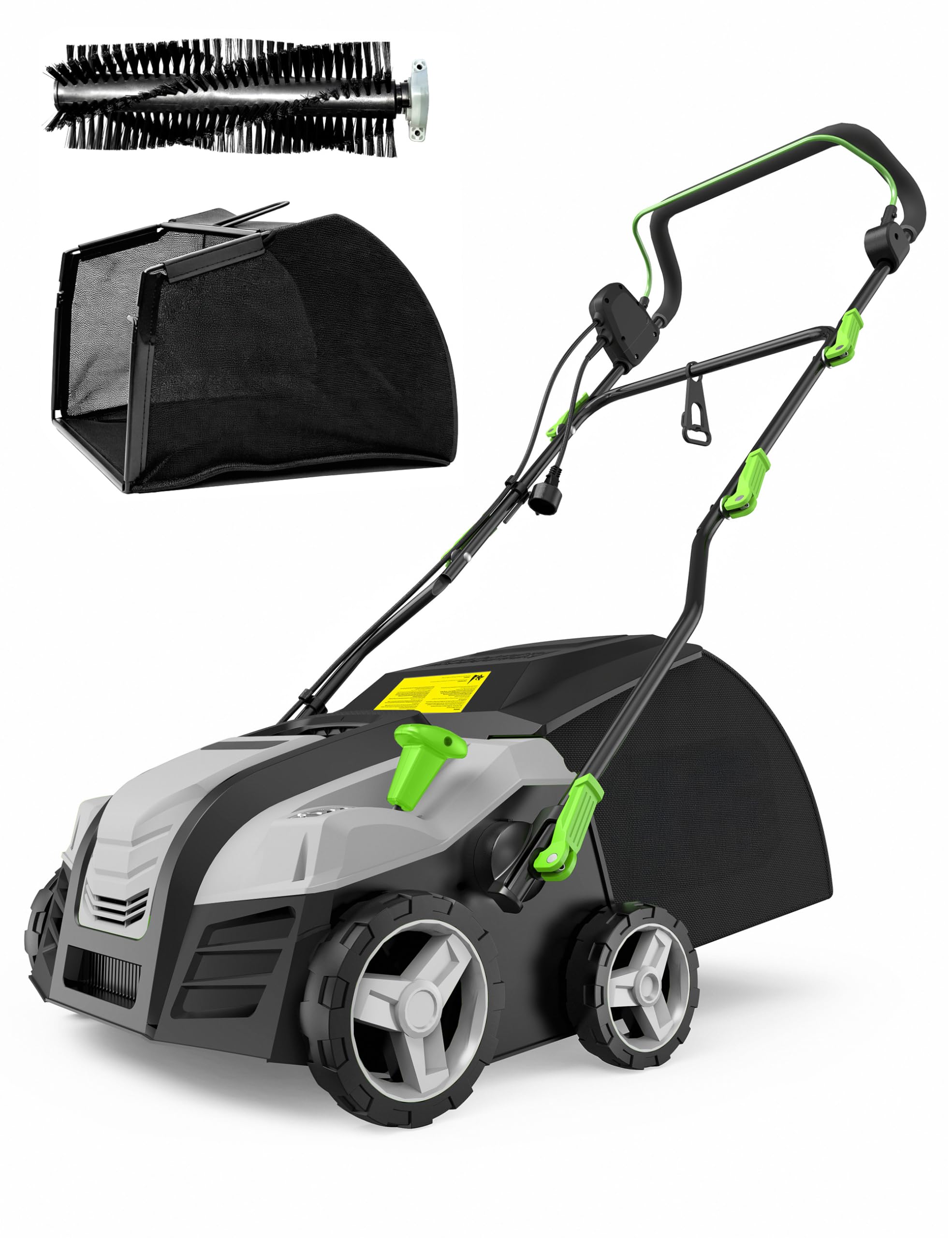
This is a different job from the lawn sweepers above. A 15 amp motor spins a 16-inch brush to lift dirt, hair and leaves off artificial turf, and a 12-gallon removable collection bag catches it as you go. That bag is the tell for the category — it dwarfs the 1-gallon dust system on the Tomahawk push sweeper, because turf cleanup is about hauling debris out, not dust control.
What wins people over is the result on the turf. Owners mention the turf looks freshly mowed after a pass, and the 16-inch brush lifts small rocks, redwood leaves and stuck debris. It is light, self-propelled in motion, and has a 5-position height lever from -0.47 to 0.24 inches for a range of turf heights, plus a 3-position rod for different operators. It rolls on its own so you are not pushing dead weight.
Two things to plan for. It is corded, so a big yard needs a long extension cord. And there is a technique: the brush works best pulled backward to pick up leaves — as buyers put it, you “must pull backward to pick up leaves.” It is also turf-only, with no dethatching function. If your fake grass is the job, it is the specialist tool for it.
Turf results: the 15 amp brush and 12-gallon bag put real pickup in a light, self-propelled frame built just for artificial grass.
The catch: corded power and a backward-pull technique mean it is a turf-only tool, not an all-purpose yard sweeper.
Made for: artificial-turf owners tired of hand-brushing pet hair, leaves and grit out of the fake grass.
Not the tool for: real lawns or long reaches where a cord won’t stretch.
2. Agri-Fab 44 In Tow-Behind Lawn Sweeper
The balanced tow-behind that hooks to any tractor and empties without you ever leaving the seat.
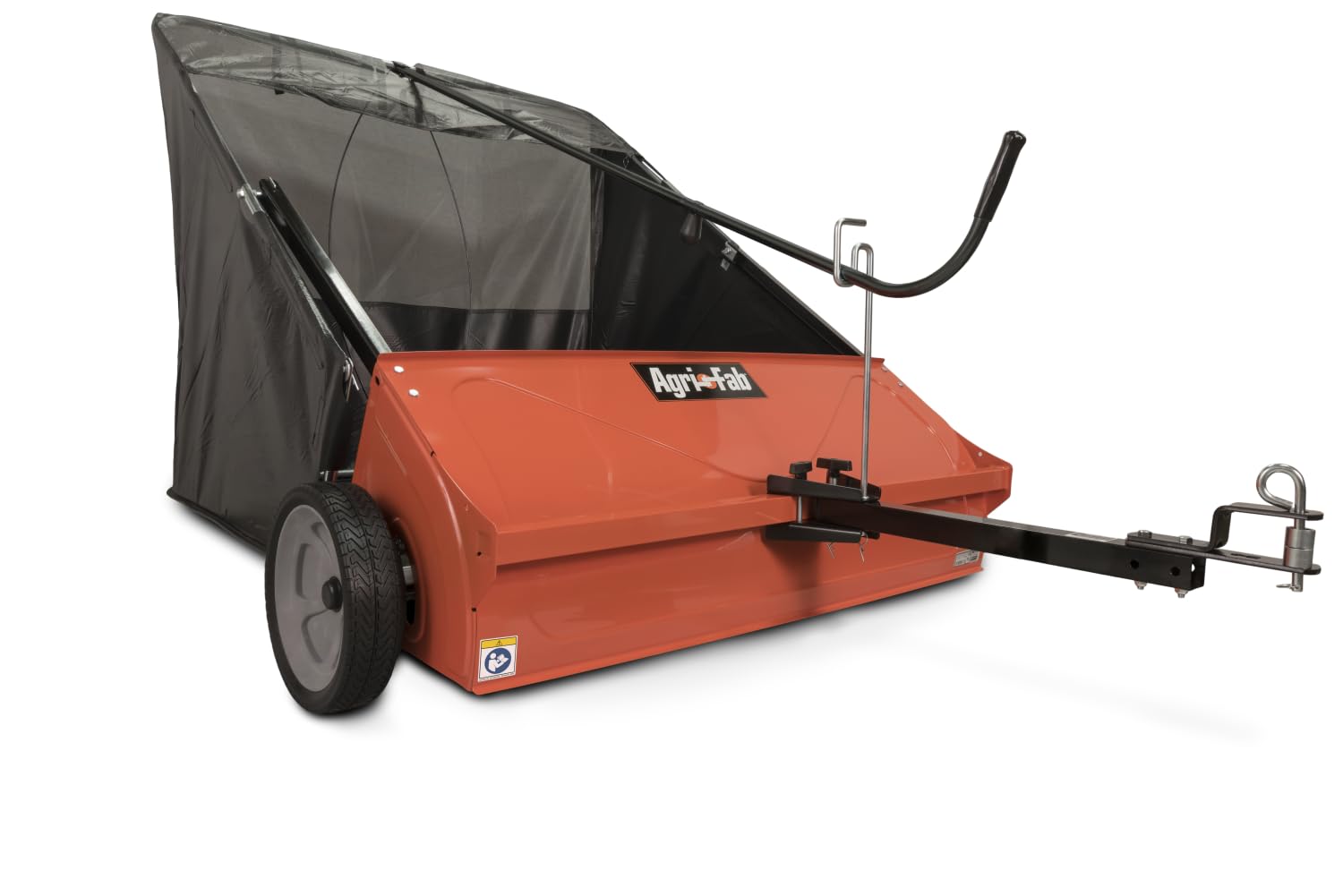
The number that drives this pick is 44 inches of sweep width paired with a 28 cu ft flow-through hopper bag. That bag fills from back to front, which means you get the full width of collection until it is genuinely full, not a heap at the front opening. For a yard with a season of leaves, it is the difference between a few loads and a dozen.
What wins people over is how little fiddling it takes. The brush-to-wheel ratio is a published 5.6 to 1 — higher than the Brinly 42’s 5 to 1, so the brushes spin faster per turn of the wheels and lift debris with more force. The dump-from-seat handle is the part owners keep coming back to: pull it, the hopper tips, and you are sweeping again. Adjustable brush height covers leaves, pine needles and grass clippings, and it tows on 12 in x 3 in tires with bronze brush shaft bushings.
The honest trade-off: this is a machine you assemble, and assembly is the recurring gripe — plan for a slow afternoon with the manual, and expect the odd unit to arrive with a bent part or a missing cotter pin from the factory or the shipper. A soft-bottom bag shows fabric stress after heavy loads, so avoid stuffing it to the brim. It is also a dry-debris tool at heart; wet leaves clump and need a slower pass or a vacuum instead.
Where it pulls ahead
- 28 cu ft flow-through hopper fills back to front for fewer dumps
- 5.6 to 1 brush-to-wheel ratio lifts debris with real force
- Seat-mounted dump handle means no climbing off the tractor
- Hooks to a standard rear hitch with adjustable positioning
What to expect on delivery day
- Assembly is a project, and factory hardware can arrive imperfect
- Bag fabric scuffs at the corners under heavy loads
- Light dry leaves can blow over the top of the bag
Reach for this if: you tow behind a tractor, deal mostly in dry leaves and clippings, and want to empty without dismounting.
Think twice if: your cleanup is wet-leaf work after rain — a suction vacuum like the Mow-N-Vac below handles that better.
3. VEVOR Tow Behind Lawn Sweeper 50″
Fifty inches of spinning brush for wide, flat ground and a hopper that swallows a lot of debris.
Picture a long, open lawn with nowhere to turn. That is where this sweeper earns its keep. Fifty inches of sweep width is the widest tow-behind here short of the Brinly combo, and it is roughly three times the cutting path of the 16-inch SWIPESMITH turf brush. On a big rectangular yard, that saves a real number of laps.
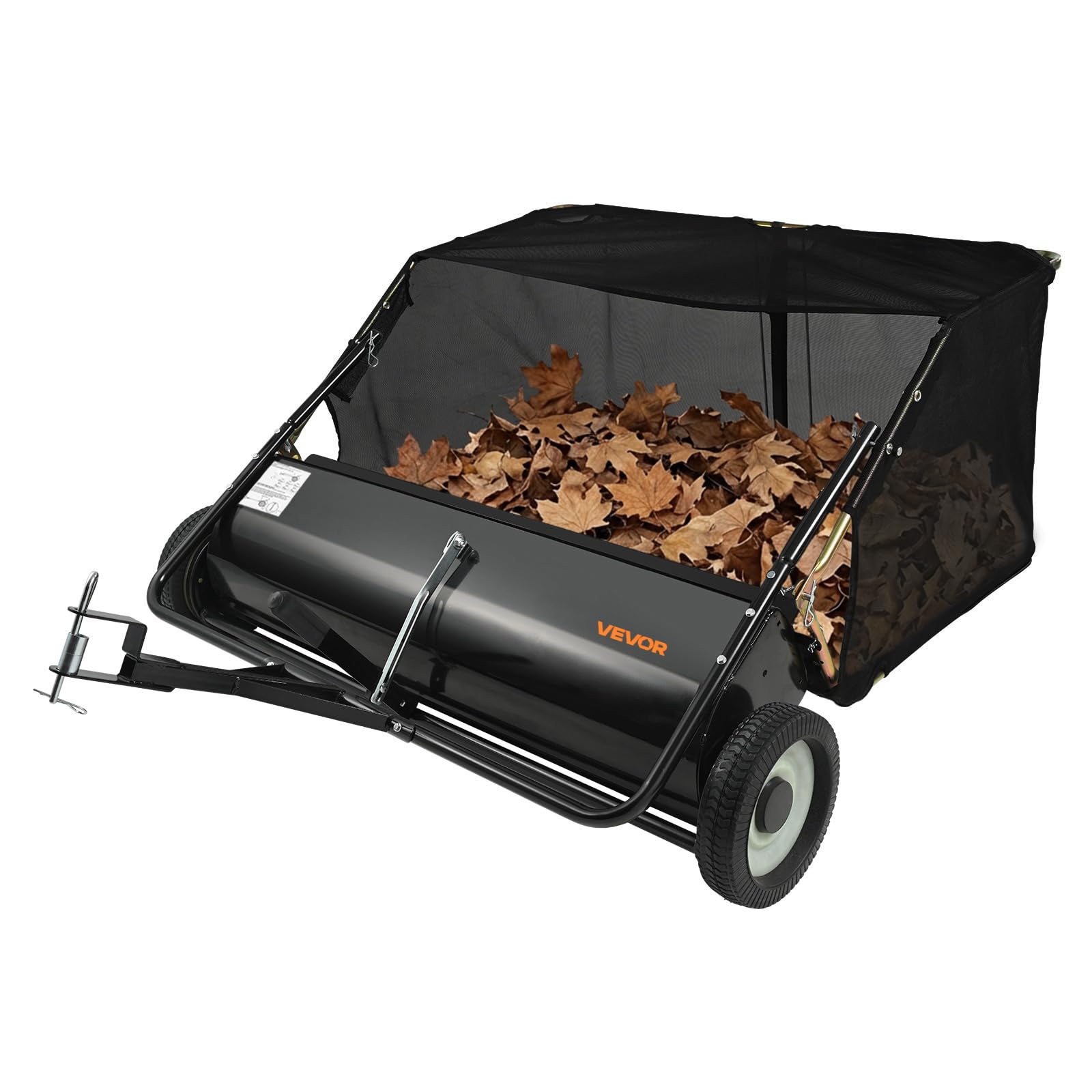
The 26 ft³ non-woven hopper bag holds grass, leaves and clippings so you dump less often, and the spinning brushes lift leaves, twigs and dry debris as you tow. Brush height is adjustable by hand for sidewalks, driveways and turf, and the whole thing folds near-vertical for shed storage. It is heavy, though — 72.8 pounds — so plan for a second set of hands when you move it, and give the bag a rope to keep it from dragging.
Here is the part you need to weigh honestly. Durability is the concern buyers raise most, and it is fair to call it the weakest spot — a few units have had a brush come loose or a tow bar fail, and the pin-assembled frame can bend under strain. The instructions are thin and the bag wants a hitch adjustment. If you want a wide deck at an entry-level position and can treat the machine with care, it does the wide-lawn job; if you want the sturdier version at similar width, look at the Brinly 54 below.
The wide-lawn math: 50 inches of brush versus 16 inches on the turf sweeper is a lot more ground covered per pass, which is exactly what a large, flat yard needs.
The honest caveat: build quality is where this one is thinnest — the frame bends and brushes need checking, so it suits a careful owner rather than a heavy commercial fleet.
Go here if: you have wide open turf and want the biggest sweep for the money.
Look elsewhere if: your yard is tight, angled, or you expect daily heavy use.
4. Tomahawk 30″ Battery Powered Push Sweeper

A battery push sweeper built for concrete, not turf, and it keeps the dust down while it works.
The feature that matters on a shop floor is the built-in 1-gallon dust suppression system. Sweeping a dusty warehouse with a broom throws a cloud in the air; this unit wets the bristle path and keeps it down. The head has a triple brush layout with a 30-inch path, and it tunes to concrete, tile and asphalt with adjustable brush depth.
This is genuinely a floor-cleaning machine, and the buyers who use it that way love it. As one shop owner summed it up, cleaning two 50’x100’ shops takes “a fraction of the time” compared with pushing a broom. It handles bolts, welding slag and wire, stays charged for long stretches, and rolls on rugged 12-inch wheels that clear curbs and corners. It is also 53 pounds — for a battery push unit that is manageable, and it folds for low-profile storage.
The catch is the edges. A few buyers report the front bristles can throw debris sideways instead of into the bin, so the middle of the floor gets cleaner than the perimeter. The bin holds a lot but is not the easiest to clip on and off. If you need corner-to-corner pickup in a tight shop, that is a real limitation; for open floor, it is a fast, low-dust trade-up from a broom.
Dust is the headline: the 1-gallon suppression system turns a choking broom job into a controlled sweep, and that is the reason to pay for this over a manual broom.
The honest limit: the front bristles can fling debris past the bin, so it suits big open floors better than cluttered rooms.
Best fit: warehouse, barn and hangar owners who sweep concrete all day and want less dust and less time at it.
skip it if: your space is packed with obstacles that need edge-and-corner pickup.
5. Agri-Fab Hard Top Mow-N-Vac

A tow-behind vacuum with a real gas engine, built to suck up the leaves a sweeper only pushes.
Where a brush sweeper lifts, this machine inhales. A 208cc LCT engine delivers up to 80 MPH of suction into a 26-bushel, 32 cu ft collection system — the largest hopper in this lineup short of the Billy Goat’s 40 gallons. It vacuums and mulches grass and leaves down to a fine size, which means the bag holds more before you stop. It fits mower decks up to 54 inches wide, and there is a zero-turn mower hose option.
Assembly is the bright spot. The hard-top vented design cuts dust while you work, the easy-lift handle simplifies hitching, and it tows on 15 in x 6 in turf tread tires. Buyers who run it are impressed with how hard the 208cc engine pulls — as one put it, “THIS THING REALLY SUCKS.” Expect a learning curve: it is top-heavy, so watch obstacles and make wide turns, and the hose usually needs trimming to about 3 feet so it does not drag.
The trade-off is quality control. A small number of units show up with pulled rivets, mismatched parts or dents, and the machine leaks at bolt gaps when that happens; that is a delivery and factory-fit issue, not a design you fight every weekend. Don’t fill the bag to full capacity either — mulch packs tight and is hard to empty. For wet leaves and big-volume cleanup, the suction power is worth the fuss.
Why owners keep it
- 208cc engine and up to 80 MPH suction pull leaves a sweeper leaves behind
- 32 cu ft collection holds a big load before emptying
- Hard-top vented design keeps dust down during operation
- Fits mower decks up to 54 inches with hose compatibility for zero-turns
What to watch for
- Top-heavy — wide turns and careful obstacles are a must
- Factory fit and shipping damage show up on some units
- Hose often needs cutting to length to avoid ground drag
Worth it when: your cleanup is heavy, wet, or includes pine cones and matted debris a brush can’t lift.
Not for you if: you want a light, easy-push tool — this is a towed, engine-driven machine.
6. Brinly 42″ Tow-Behind Lawn Sweeper
Six brushes and a 5 to 1 gear ratio that keep lifting debris even while you turn the tractor.
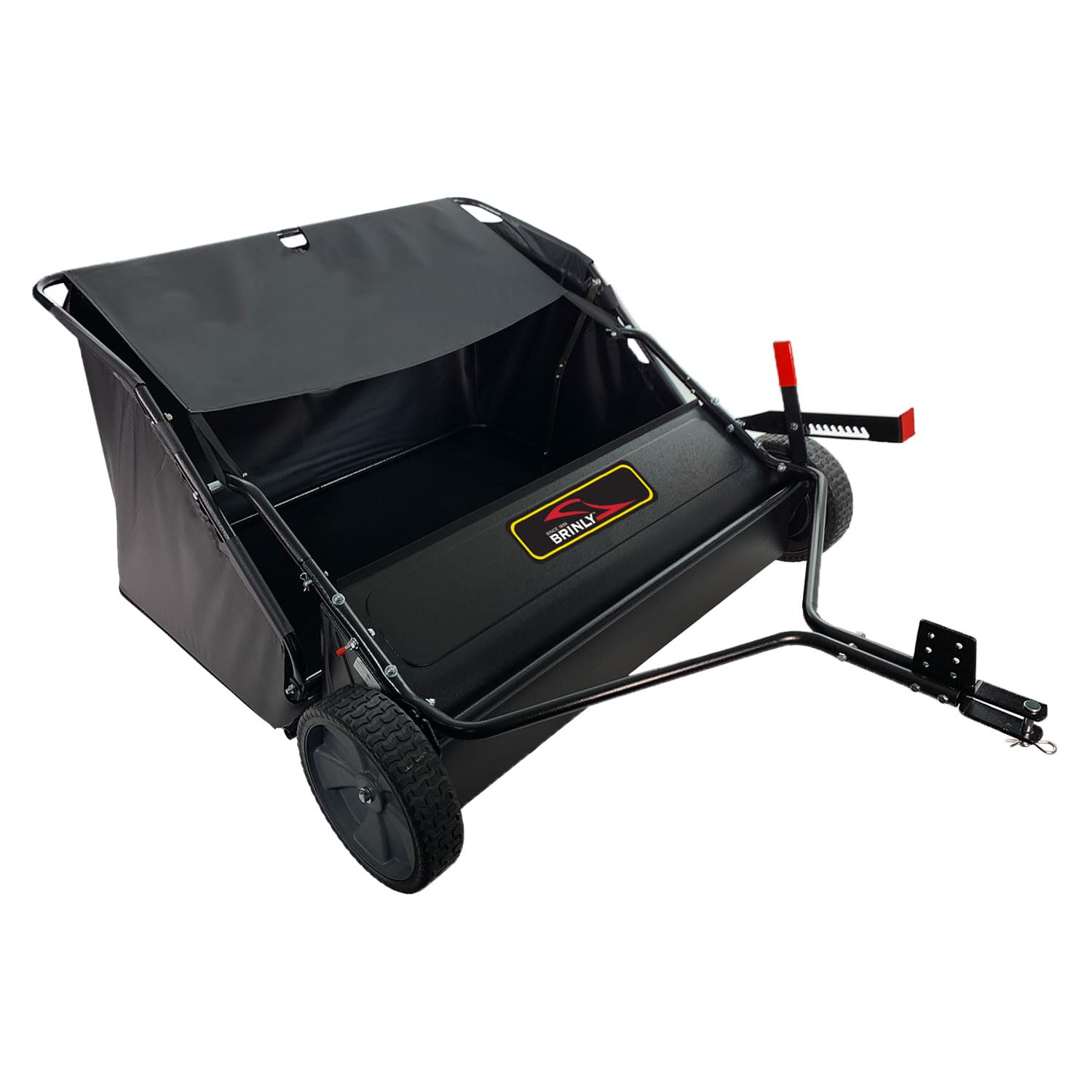
The engineering detail here is that the brushes keep sweeping through a turn. Six high-velocity brushes run off a 5:1 gear ratio — slightly below the Agri-Fab 44’s 5.6 to 1, but the design keeps pickup continuous rather than pausing mid-curve. A 20 cu. ft. hamper and 42-inch width handle leaves, clippings, sticks, twigs and pine needles, with a removable mesh windscreen to keep the load from blowing back out.
What earns it a place is build quality. The sturdy steel construction and hammered finish draw the most praise, and the Twist-Lock height adjustment keeps the brush setting locked even over uneven ground. It fits a standard tractor hitch, empties with a pull cord and T-handle, and folds upright for compact storage. The footprint is a hair wider than the 42-inch brush because of the wheels, so measure your shed door before you commit.
Assembly is the mixed note — some find it easy, others find it challenging, and a few call the printed instructions terrible. This is a dry-debris sweeper, so wet leaves and heavy thatch need a slower pass. It is a fair step up in feel from the VEVOR at the same tow-behind job, and worth the look if sturdy steel matters more to you than the widest possible deck.
Built to last: the steel frame and six-brush drive are the parts buyers single out, and the height setting holds on rough ground.
Worth knowing: the wheels push the real width past 42 inches, so a snug shed entry is a tight squeeze.
Pick this one for: a yard with trees where you want sturdy steel and continuous brush pickup around curves.
Second-guess it if: you need maximum hopper size for a big leaf fall — the 28 cu ft Agri-Fab above holds more.
7. Brinly 54″ Tow-Behind Combo Sweeper with Dethatcher

The widest sweep here, plus a dethatcher that pulls old thatch up while the brushes collect it.
Two machines in one is the draw here. A 54-inch sweep pairs with two rows of 16 independently flexing, rust-resistant steel tines, so it dethatches and sweeps in the same pass — a job that normally takes a separate machine. An oversized 30 cu. ft. easy-dump hamper takes the load, and the 10-position side-mounted control sets brush depth precisely.
Where the combo shines is effectiveness — customers note the 54-inch sweep clears dry and wet leaves on a one-acre yard in one go, and many call it the equal of a John Deere sweeper for less money. Six high-velocity brushes run a 5:1 brush-to-ground ratio, the magnetic Quick-Connect hitch pin stays put without cotter pins, and the whole unit folds vertically for storage. It hooks to any tractor or ZTR with a standard rear hitch.
Assembly is the recurring gripe — plan about two hours, and the instructions are not much help. A few owners note the bag material is thin at the seams and the pull rope runs a touch short. It is heavy when the hamper is full. For a wide yard where dethatching matters, the all-in-one build earns the rough edges.
The combo advantage
- 54-inch width with two rows of 16 flexing tines dethatches and sweeps together
- 30 cu. ft. hamper cuts the number of empty trips
- 10-position height control dials in brush depth
- Magnetic hitch pin and vertical folding for easy storage
The rough edges
- Assembly takes about two hours and the instructions are thin
- Bag seams and the pull rope draw complaints
- Heavy when the hamper fills up
For the dethatcher buyer: a wide yard with thick thatch where one pass for both jobs saves real time.
Only if you can build it: the assembly effort is the real barrier, so budget the afternoon before season starts.
8. Kärcher KM 70/20 C 2SB Push Sweeper
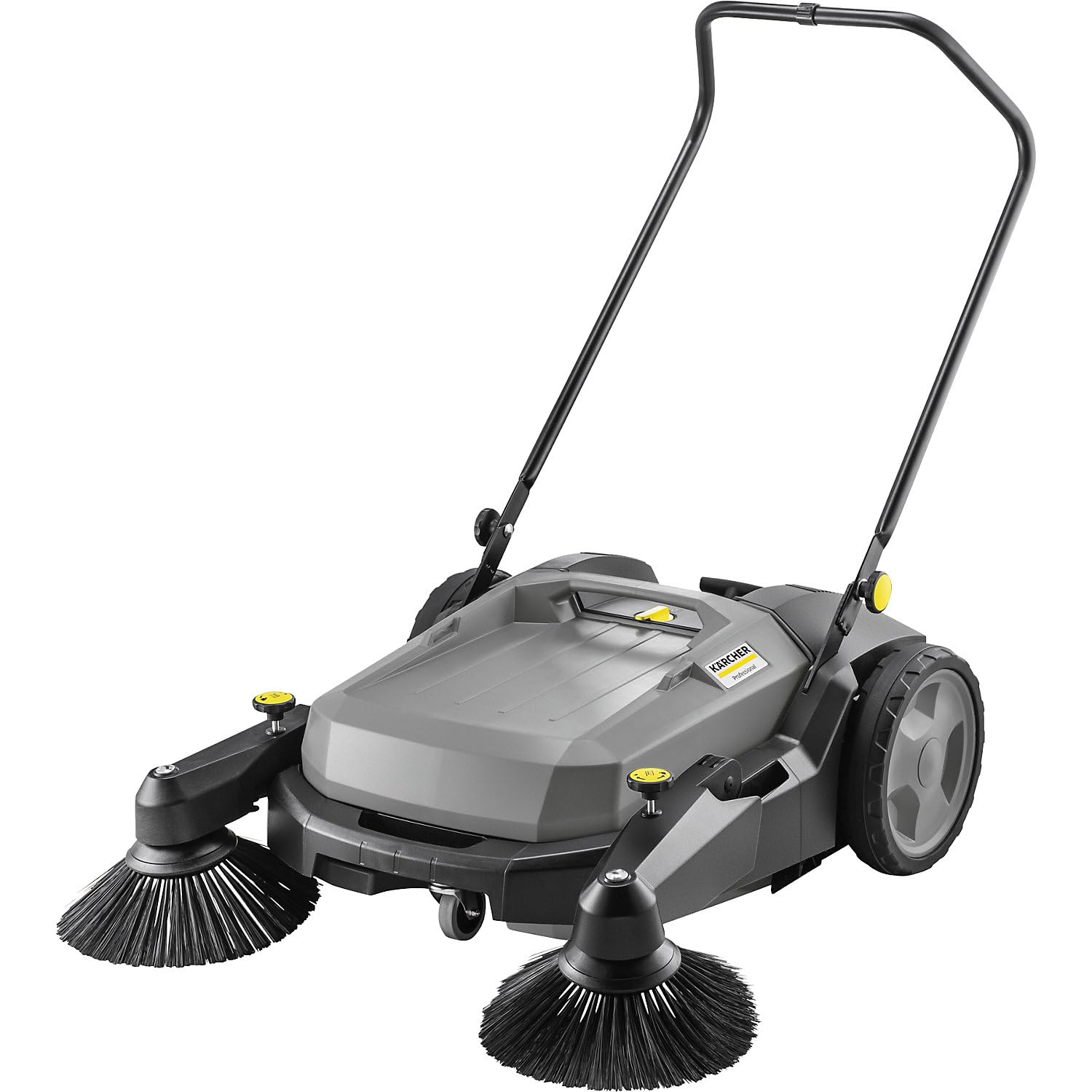
A manual push sweeper with two side brushes that reaches right into corners on hard floors.
A cleaning path of 36 inches with two side brushes is what makes this the corner-to-corner tool in the lineup. The side brushes sweep right up to walls and edges, the main roller brush is adjusted in six steps for different floors, and both wheels drive it for consistent power. A prominent dust filter cleans the exhaust air so dust does not fly up while you work — and it costs you no gas or battery to run.
On hard floors it covers ground. It is rated to sweep areas up to 20,000 square feet, and the 11-gallon debris hopper holds the load between dumps. It folds for storage. In a shop that sees wet sand tracked in by a tractor, the side brushes do a genuinely good job on the main floor.
The dust filter is the difference between this and a plain push broom. But the side brooms can throw a lot of dust if you run them indoors, so some buyers drop the side brushes for interior work. A rare unit arrives not matching its listing. For a commercial warehouse or workshop floor, this is a serious manual sweeper.
Edge cleaning first: two side brushes and a 36-inch path push right into corners, and the dust filter keeps the exhaust clean.
The catch: run the side brooms indoors and they can kick up dust — switch them off for interior sweeps.
Right choice for: warehouse, workshop and shop floors that need edge-to-edge sweeping without fuel or charging.
Pass on it if: you are sweeping outdoor turf rather than hard indoor floors.
9. Billy Goat KV601 Lawn Vacuum

A self-propelled leaf vacuum with a huge bag and a five-blade impeller that shreds as it sucks.
The capacity here is the story: a 40-gallon turf bag, the biggest in the lineup, fed by a five-blade serrated impeller that boost suction and chops debris down as it goes. A 190cc Briggs engine powers it, and variable height adjustment lets you work hard surfaces or turf. The bag loads from the bottom on a hard mesh base with an integral dust cover, and marine-style clasps replace zippers so dumping is quick.
Reviewers point out the 40-gallon bag swallows a large amount of leaves at once, and the five-blade impeller picks up pine cones and straw well. On level ground and pavement it does exactly what it promises. The catch is weight: as the bag fills, 112 pounds gets heavier and harder to push uphill, so empty it regularly. Narrow wheels struggle on sandy soil, and it is loud. There is a working learning curve to the pull-start on some units, though Billy Goat’s support has stepped in for shipping issues.
Performance is the part that divides a few people — some run it happily for a long stretch, others find it shuts down sooner than expected. Treat it as a big, heavy, high-capacity machine for large open properties and it delivers; ask it to be nimble on tight, uneven ground and it fights you.
Volume is the win: 40 gallons and a five-blade serrated impeller mean very few stops between dumps on a big leaf drop.
The heavy truth: 112 pounds plus a filling bag is a lot to push, so level ground suits it best.
Made for: large properties with a heavy leaf fall where bag capacity and suction beat maneuverability.
Wrong pick if: your ground is sloped, sandy, or you need a light machine to steer one-handed.
Know the Specs
Sweep width and brush-to-wheel ratio
Sweep width is how wide a path the brushes cover in one pass, measured in inches. Wider means fewer laps. The brush-to-wheel ratio is how many times the brushes turn for each turn of the wheels — higher equals faster tip speed and more lift force. A 5.6 to 1 ratio (Agri-Fab 44) spins faster than a 5 to 1 (Brinly 42), so it lifts debris with more force per wheel turn.
Hopper capacity in cu ft and gallons
Tow-behind sweepers measure their catcher in cubic feet — the Agri-Fab 44 holds 28 cu ft, the Brinly combo 30 cu ft. Walk-behind and vacuum units measure in gallons, like the Billy Goat’s 40-gallon bag and the Kärcher’s 11-gallon hopper. Bigger holds more per load, but a full bag gets heavy and mulch packs tight, so more capacity is not automatically easier to empty.
Power source: towed, battery, gas, or corded
Towed units ride behind a tractor and use wheel-driven brushes — no engine to maintain. Gas engines, like the 208cc on the Mow-N-Vac or the 190cc on the Billy Goat, drive suction for vacuuming. A corded 15 amp motor (SWIPESMITH) runs a brush for turf. A battery push sweeper (Tomahawk) runs triple brushes for hard floors. Match the power source to whether you are sweeping turf, hard floor, or towing behind a tractor.
Brush height adjustment and dethatching
Adjustable brush height lets you lift leaves off tall turf one day and clean pavement the next. The Brinly 42 uses a Twist-Lock setting that holds over rough ground; the Brinly 54 offers 10 locking positions. Some models add a dethatcher — steel tines that pull up thatch before the brushes collect it. If thatch is your problem, a combo sweeper-dethatcher like the Brinly 54 saves a separate machine.
Common Questions
Will a tow-behind lawn sweeper fit my riding mower?
Can a lawn sweeper pick up wet leaves?
What is the difference between a lawn sweeper and a lawn vacuum?
How full should I fill the hopper bag before emptying?
Do these lawn sweepers work on slopes and uneven ground?
Is a push sweeper or a broom better for a warehouse floor?
How do I keep the brushes and chain on a sweeper working?
Will a lawn sweeper dethatch my lawn too?
How do sweeper size and hopper size affect a big yard?
Does a battery push sweeper need gas or a cord?
The Bottom Line
For most buyers, the winner here is the Agri-Fab 44 In Tow-Behind Sweeper because its 28 cu ft flow-through hopper and 5.6 to 1 brush ratio handle a real leaf season with fewer stops and less fiddling. If your yard is wet, heavy, or full of pine cones, the Agri-Fab Mow-N-Vac and its 208cc engine suck up what brushes can’t lift. And for a warehouse or shop floor, the Tomahawk 30″ Push Sweeper replaces a broom with less dust and less time. If you want the widest single machine, the Brinly 54″ Combo sweeps and dethatches in one pass.
How we choose
We do not accept paid placement. Every pick is matched to a real buyer and a real use-case; we do not hands-on test units.
Sources
Specifications: manufacturer listings and product documentation. Review insights: verified customer reviews, as of October 2026. Pricing: not shown on this page (it changes often); check the current price via the retailer link.
As an Amazon Associate, Aappliancez earns from qualifying purchases. This does not affect which products we feature.